

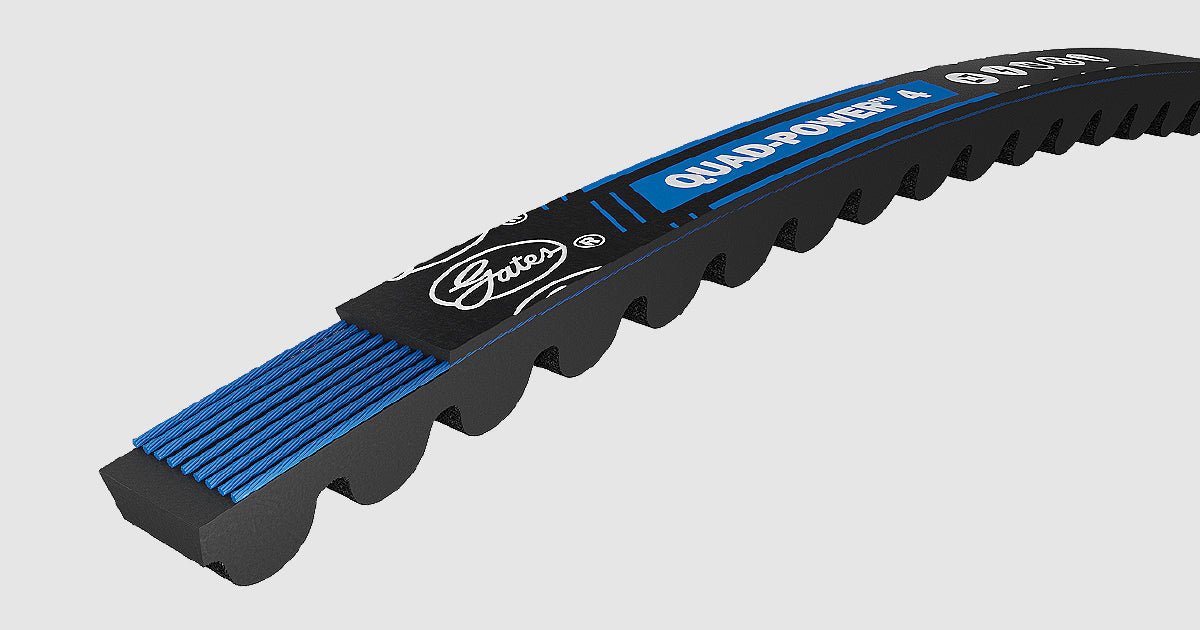
What is a drive belt?
A drive belt transfers rotational power between two pulleys, replacing a chain or direct coupling. The most common industrial type is the V-belt — a trapezoidal rubber-and-fabric belt that wedges into matching pulley grooves under load, multiplying friction without slip. Drive belts run pumps, compressors, fans, conveyors, ride-on mowers, and most plant machinery. Modern variants include cogged V-belts, banded (joined) V-belts for shock loads, timing belts for synchronous drives, and poly-V (multi-rib) belts for car engines.
When your equipment runs smoothly, your operations do too. One component quietly doing the heavy lifting behind the scenes? The V-belt. Whether you’re a mechanic, plant manager, or weekend warrior, understanding how V-belts work — and choosing the right one — can save you costly downtime.
What Is a V-Belt?
A V belt is a mechanical power transmission belt with a trapezoidal (V-shaped) cross-section. It's designed to fit snugly into pulley grooves, creating high friction and efficient torque transfer from a motor to the driven component.
Key Features:
-
Trapezoidal shape for better grip and reduced slippage
-
Commonly made of rubber, with reinforced cords
-
Used across industries: HVAC, mining, manufacturing, agriculture, and more
Why V-Belts Outperform Flat Belts
When comparing V-belts and flat belts, the advantages are clear:
- More Stability – The wedging effect reduces lateral movement.
- Better Alignment – The V-shape naturally centers the belt.
- Less Slippage – More grip equals more reliable torque transfer.
- Energy Efficient – Less energy loss due to slippage.
For power transmission that needs to stay steady under pressure, V-belts offer a dependable upgrade.
How Long Do V-Belts Last?
A well-maintained V-belt can last thousands of hours — but only if you take care of it. Here’s what impacts lifespan:
- Proper Tensioning – Too tight = stress. Too loose = slippage.
- Accurate Alignment – Misalignment causes uneven wear.
- Regular Inspection – Spot cracks or frays before they fail.
Tip: Schedule regular belt checks in your preventive maintenance routine to avoid costly surprises.
Where Are V-Belts Commonly Used?
V-belts are the unsung heroes of:
- Industrial Equipment (conveyors, compressors)
- Agricultural Machinery (tractors, harvesters)
- Automotive Systems (fans, alternators)
- Home Appliances (washing machines, HVAC units)
If it spins and it needs power, chances are there’s a V-belt in the mix.
What Are the Disadvantages?
No product is perfect — and V-belts do have some limitations:
- Can Wear Quickly if misaligned or over tensioned.
- Not Ideal for High-Speed or High-Torque applications.
- May Require More Frequent Maintenance than synchronous belts.
Still, when used in the right setting, they offer excellent value and performance.
V-Belts vs. Timing Belts
Here’s the quick comparison:
Feature |
V-Belt |
Timing Belt |
|
Power Transfer |
Friction-based |
Tooth-based (synchronous) |
|
Slippage |
Possible (if worn) |
No slip |
|
Application |
General-purpose |
High precision (e.g., camshafts) |
Timing belts are precise — but V-belts are versatile and cost-effective.
V-Belt vs. Serpentine Belt
A serpentine belt is actually a multi-ribbed version of a V-belt, commonly found in modern vehicles. It drives multiple accessories (alternator, water pump, A/C) using just one long belt. It’s more space-efficient, but also requires more tension control.
Looking for V-belts near you? We’ve got you covered!
Whether you need a quick replacement or want to upgrade, local stock of quality V-belts is ready to keep your machines running smooth.
At AIMS Industrial, we offer a wide range of V-belts in all major profiles — plus expert advice and fast delivery right to your door.
Just tell us what you need, and we’ll help you find the perfect fit!
Not all V-belts are built the same. Get the lowdown on types, materials, and what makes each one tick.
Up Next: Understanding the Types and Construction of V-Belts: A Modern Guide
Cross-reference our V-Belt Measurement guide for classical (A, B, C, D), narrow (SPA, SPB, SPC, SPZ) and FRAS sections.
More Common Questions
What is a drive belt used for?
A drive belt transmits power from one rotating shaft to another by friction between the belt and pulleys. They are used in automotive engines to drive alternators, water pumps and air conditioning compressors; in industrial machinery to drive fans, pumps and conveyors; and in agricultural equipment to drive cutters, augers and PTO components. Drive belts allow flexibility in shaft positioning, absorb shock loads, and slip safely if the driven load jams.
How long does a drive belt last?
Drive belt life depends heavily on application, tension, alignment and operating conditions. Automotive serpentine belts often last 60,000 to 100,000 kilometres with regular inspection. Industrial V-belts can last anywhere from a few months to several years depending on duty cycle, belt quality, and how well the drive is tensioned and aligned. Inspect belts regularly for cracks, glazing, fraying and missing chunks — any of these mean replacement.
What's the difference between a V-belt and a drive belt?
Drive belt is the general term for any belt that transmits power between shafts. A V-belt is a specific type of drive belt with a trapezoidal cross-section that wedges into matching grooved pulleys. Other drive belt types include flat belts, timing belts (toothed for synchronous drive), and ribbed serpentine belts (multiple parallel ribs). V-belts dominate industrial drives because they grip well, transmit high power and are inexpensive to replace.
How do I know what drive belt I need?
Identify the belt by reading the part number printed on the belt itself — for example A48, SPB1800, or 5L420 — and order the same number. If the markings are worn off, measure the outside circumference with a tape measure, the top width, and the depth. Drive belts use standard cross-section codes (A, B, C, SPA, SPB, SPC) that match the pulley grooves — using the wrong section will damage the belt and the pulleys.


