

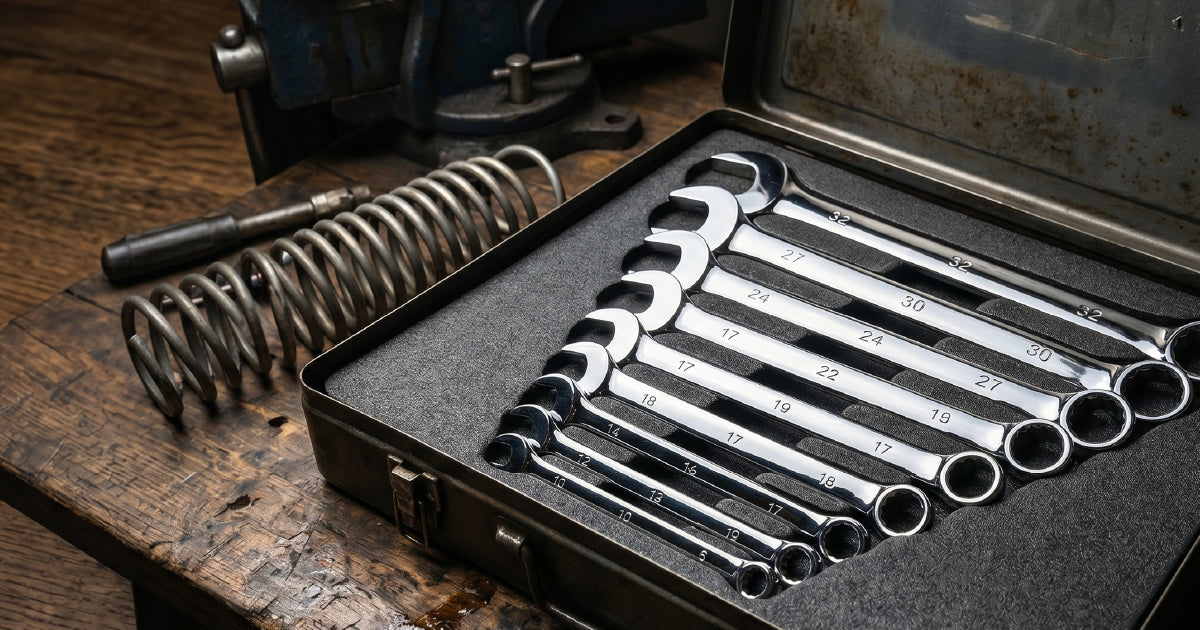
What Is a Spanner?
A spanner is a hand tool used to turn nuts, bolts and other threaded fasteners. In Australian and British English the tool is called a "spanner". In American English the same tool is called a "wrench". A spanner size refers to the across-flats (AF) measurement of the fastener head, which is the same dimension the spanner jaw must match.
How Spanner Sizes Work
Spanner size is measured across the flats (AF) of the fastener head — the distance between two parallel faces of the hex. A 19mm spanner fits any fastener that measures 19mm across the flats, regardless of whether the fastener thread is metric or imperial. Bolt thread diameter (M8, M12 etc.) and spanner size are different measurements. An M8 bolt has a 13mm hex head — so you need a 13mm spanner, not an 8mm one.
Metric Spanner Size Chart
| Bolt Size | Spanner Size (AF) | Common Application |
|---|---|---|
| M6 | 10mm | Most common — engines, brackets, interior panels |
| M8 | 13mm | General engineering, structural fasteners |
| M10 | 17mm | General engineering, machinery |
| M12 | 19mm | Automotive, structural, machinery |
| M14 | 22mm | Suspension components, driveline |
| M16 | 24mm | Heavy structural fasteners |
| M20 | 30mm | Large structural and machinery fasteners |
| M24 | 36mm | Large bolts, plant and structural |
Imperial (AF) Spanner Size Chart
Imperial spanners are sized in fractions of an inch and are common on American-manufactured vehicles and equipment, agricultural machinery, and older plant. The best metric-to-imperial match is 19mm and 3/4" (19.05mm), where the difference is only 0.05mm.
BSP Fitting Spanner Sizes
BSP (British Standard Pipe) sizes are nominal pipe bore sizes — not the actual across-flats measurement of the fitting. A 1/2" BSP fitting requires a 26mm spanner, not a 1/2" (12.7mm) one. The most common BSP size — 1/2" BSP — requires a 26mm spanner.
Open-End, Ring and Combination Spanners
Open-end spanners engage two flats and are faster to use. Ring spanners (12-point) engage all six flats and are preferred for high-torque work. Combination spanners give you both in one tool. Flare nut spanners (crow's foot) have a slotted ring allowing them to pass over brake or fuel lines. Ratchet spanners work in tight spaces where a full swing arc isn't possible.
Frequently Asked Questions
The most common spanner size in metric is 10mm, fitting M6 bolt heads. An M8 bolt has a 13mm hex head — need a 13mm spanner. AF (across flats) means the jaw opening is measured across the parallel faces of the hex fastener. In some cases metric and imperial spanners are interchangeable where sizes are very close — 19mm and 3/4" differ by only 0.05mm.
People Also Ask — Spanner Size Chart: Metric & Imperial Wrench Sizes
Q: What spanner size fits an M10 bolt?
An M10 coarse bolt (1.5 mm pitch) uses a 17 mm spanner across the flats. M10 fine (1.25 mm pitch) also uses 17 mm. This is one of the most common sizes in Australian trade and maintenance work — a 17 mm open-end or combination spanner is considered a toolbox essential.
Q: How do I convert spanner sizes from metric to imperial?
Divide the metric jaw size in mm by 25.4 to get inches. A 13 mm spanner equals approximately 1/2" (actually 12.7 mm, so there's a slight mismatch — never substitute if the fit is loose). Common near-equivalents: 11 mm ≈ 7/16", 13 mm ≈ 1/2", 17 mm ≈ 11/16", 19 mm ≈ 3/4".
Q: What size spanner is needed for BSP fittings?
BSP (British Standard Pipe) fitting sizes are not the same as their thread diameter — a 1/2" BSP fitting uses a 27 mm spanner across the hex, while a 3/4" BSP uses 32 mm. Always check the fitting's hex size, not its pipe thread designation, to choose the right spanner.
Q: What is the difference between an open-end and combination spanner?
An open-end spanner engages two faces of the fastener and suits confined spaces where a ring won't fit. A combination spanner has an open end on one side and a ring (box) end on the other — the ring end gives better grip and is less likely to round off a fastener, making it the better choice when access allows.


