

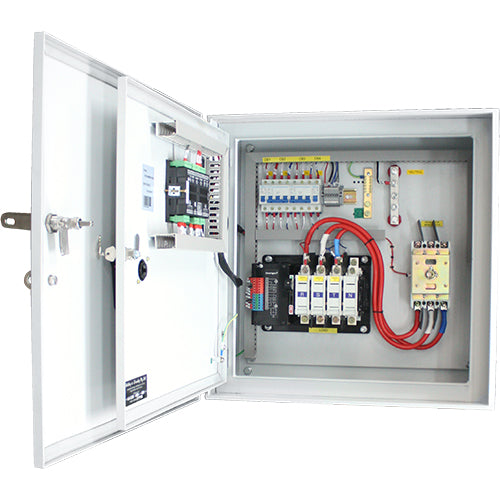
Quick answer: No generator should ever be connected to your switchboard without a licensed electrician fitting a changeover switch first. The only real decision left is manual (cheaper, needs someone present within minutes) or automatic (costs more, switches over unattended in seconds) — and that comes down to what you're backing up, not personal preference.
In 30 seconds
- A changeover switch isolates your switchboard from the grid before your generator connects — skip it and you risk backfeeding the street network.
- Manual switches cost roughly $600–$1,500 installed, but someone needs to be there to flip it every time.
- Automatic transfer switches (ATS) cost roughly $1,500–$4,000+ installed, but switch over in 10–30 seconds, unattended.
- It must be a licensed electrician — connection to your switchboard falls under AS/NZS 3000 and AS/NZS 3010, with no DIY path in Australia.
- Use the tool below to get a straight recommendation for your setup in under a minute.
Can I just plug my generator into the house?
No — not without a licensed electrician fitting a changeover switch first. Plugging a generator directly into a switchboard or wall outlet can backfeed electricity into the street network, which can seriously injure or kill a linesworker working on what they believe is a dead line, and it bypasses the safety devices built into your home's wiring. This is why a changeover switch isn't optional paperwork — it's the one piece of the setup that actually keeps other people safe, not just you.
How backfeeding actually works (and why the "suicide cord" shortcut is genuinely dangerous)
Every generator setup needs a way to stop your home's wiring from being connected to both your generator and the street supply at the same time. Without that, power from your generator can flow backwards through your switchboard, out through the street transformer, and into the network — at a voltage the network isn't expecting from that direction.
We're going to address something directly rather than dance around it, because it's a genuinely common question: yes, people build a double-male ("suicide cord") lead to backfeed a house from a generator through a dryer or oven outlet. It's cheap, it's fast, and in rural areas it's sometimes treated as normal practice. It's also how linesworkers get killed. A transformer can step your generator's output back up to line voltage on the other side, energising a section of network that crews assume is isolated. It also removes your home's own circuit protection from the equation. This isn't a compliance technicality — it's the actual safety case for why changeover switches exist.
The safe alternative, if you genuinely can't get a switch fitted yet: run extension leads from the generator directly to individual appliances (fridge, freezer, a few lights). That never touches your switchboard, so it doesn't create a backfeed path. It's a stopgap, not a long-term answer, but it's the only DIY option that doesn't put someone else at risk.
Manual changeover switch or automatic transfer switch (ATS)? The real decision
Both do the same core job — isolating your switchboard from the street supply before connecting the generator. The difference is what happens during the outage itself.
| Manual changeover switch | Automatic transfer switch (ATS) | |
|---|---|---|
| Transfer time | 2–10+ minutes — someone has to be there to flip it | 10–30 seconds, unattended |
| Needs a person present | Yes, every time | No |
| Typical installed cost (AU) | ~$600–$1,500 | ~$1,500–$4,000+ |
| Best suited to | Occasional home backup, staffed sites, budget-conscious setups | Medical equipment, refrigeration/cold chain, data/IT, life-safety systems, unattended sites |
The honest way to think about it: a manual switch is fine if a few minutes without power is a genuine inconvenience. An ATS earns its extra cost when a few minutes without power is a real problem — spoiled stock, a medical device, a server room, anything where "someone will get to it soon" isn't good enough.
Which changeover switch do you need?
Answer three quick questions and we'll tell you what to look for.
1. Is any of what you're backing up critical? (medical equipment, refrigeration/cold chain, data or IT systems, life-safety systems)
2. Will someone reliably be on-site to operate a switch during an outage?
3. Is your supply single-phase or three-phase?
Have this quoted properly by a licensed electrician — installation must comply with AS/NZS 3000 and AS/NZS 3010 either way.
Get a quote for this switch →Do you legally need an electrician for this?
Yes — this isn't a grey area. Both Energy Safe Victoria and the Queensland Electrical Safety Office are explicit: any permanent connection between a generator and your switchboard must be installed by a licensed electrician, and must comply with AS/NZS 3000 (the wiring rules) and AS/NZS 3010 (generating sets). The switch has to break all live conductors, including neutral, and the connection needs to respect your home's multiple-earth-neutral (MEN) setup. None of this is something to DIY, and no Australian jurisdiction offers a homeowner carve-out for it.
Single-phase or three-phase — which switch do you need?
This follows your supply, not your generator. Most homes run single-phase (230/240V) and need a 1-pole or 2-pole changeover switch. Workshops and commercial sites with three-phase machinery need a 3-pole or 4-pole unit, with the 4-pole version switching the neutral as well — relevant for MEN compliance. If you're not sure which supply you have, that's a five-minute question for your electrician, not something to guess at.
What actually happens when you get one installed
It's worth knowing the process before you call anyone, so you're not caught out by a quote or a timeframe. An electrician will typically start with a site visit to look at your existing switchboard — how much room there is, the condition of the existing wiring, your supply's amperage, and whether the board itself needs upgrading before a switch can go in (older boards sometimes do, which changes the quote materially). From there, the quote reflects the switch type (manual or ATS), your phase, and how much switchboard work is involved — this is exactly why a "typical cost" range is a planning figure, not something to hold a tradesperson to sight-unseen.
The installation itself is generally a same-day job for a straightforward single-phase manual switch on a board that doesn't need upgrading. Three-phase installs, ATS units with their own control logic, or any job that turns up a switchboard upgrade along the way can run longer — timeframes genuinely vary site to site, so treat any figure here as indicative rather than a quote. Before the electrician signs off, they should test the switch under load and show you how to operate it (for a manual switch) or walk you through what the ATS does automatically (for an ATS) — don't accept a job as finished until you've actually seen it work.
Maintenance and testing — it's not "install and forget"
Changeover switches are mechanically simple, but simple isn't the same as maintenance-free. The practical approach most electricians and generator servicers recommend: test the switch under load whenever your generator itself gets serviced, rather than treating it as a separate job — it's a natural point to confirm the whole system still works together, not just the generator on its own. A visual check for anything obviously wrong is worth doing yourself between services: signs of heat discolouration or corrosion around the switch terminals, a handle that's become stiff or doesn't sit firmly in position, or anything that looks physically damaged are all reasons to get an electrician to look at it before you actually need it in an outage.
An ATS has more going on than a manual switch — it has its own control electronics deciding when to transfer — so it's worth confirming with whoever installs it what their recommended check-in interval is for your specific unit, rather than assuming "no moving parts to worry about" applies the same way it might to a manual switch.
What about solar or battery systems?
If your property already has solar panels or a home battery, adding a generator changeover switch isn't a separate, unrelated job — it's a system your electrician needs to look at as a whole, not bolt a switch onto in isolation. Solar inverters have their own safety requirements around not feeding power back into a "dead" grid (the same underlying backfeed problem a changeover switch solves for a generator, but with its own separate compliance requirements for the inverter itself), and a generator, a battery system and solar all trying to interact with your switchboard is a genuinely different design problem than a generator on its own. If this is your situation, say so upfront when you're getting quotes — it changes what the electrician needs to assess and spec for, not just the changeover switch itself.
What to check before you call an electrician
A quote over the phone will always be rougher than one from a site visit, but you can get a more accurate starting figure by having a few things ready. Find your main switch or circuit breaker rating on your existing switchboard — commonly 63A or 100A for a home, higher for commercial sites — since that tells an electrician roughly what your supply can handle before they've even seen the site. Have a rough idea of the distance between your switchboard and where the generator will actually sit, since a longer cable run between the two adds cost. And know your phase (checked above) and whether anything critical is on the list, since that's the manual-vs-ATS decision made before a single quote gets written. If you haven't settled on a generator yet, sort that first — our generator sizing guide covers working out the right capacity and phase before you're ready for this step.
What does it actually cost?
As a realistic starting point: a manual changeover switch installed typically runs around $600–$1,500, and an ATS installed typically runs $1,500–$4,000 or more. What actually moves the number within those ranges: your amperage and phase (three-phase costs more than single-phase), how far the switch needs to sit from your existing switchboard, and — the big variable — whether your switchboard needs upgrading before the switch can go in at all. Treat these as planning figures, not a quote — your actual cost depends on your specific setup, and the only way to know for certain is a site visit.
Frequently asked questions
Can I just plug my generator into a power point?
No. This can backfeed the street network and put linesworkers at risk, and it bypasses your home's circuit protection. Use extension leads to individual appliances only, and get a changeover switch fitted for anything touching your switchboard.
Is it illegal to backfeed a generator into my house?
Backfeeding without a proper changeover switch breaches AS/NZS 3000 and is treated as unsafe, unlicensed electrical work by every state electrical safety regulator — it's not just discouraged, it's the exact scenario the wiring rules exist to prevent.
How much does a changeover switch cost installed?
Roughly $600–$1,500 for a manual switch and $1,500–$4,000+ for an ATS, depending on your amperage, phase and how much switchboard work is involved — get a specific quote for your site.
Do I need three-phase or single-phase?
Whatever your existing supply is — most homes are single-phase, workshops and larger commercial sites are often three-phase.
Can I install a changeover switch myself?
No. Any connection to your switchboard must be done by a licensed electrician under AS/NZS 3000 — there's no DIY exception in Australia.
Does a changeover switch need maintenance?
It's mechanically simple but not maintenance-free. Get it tested under load whenever your generator is serviced, and keep an eye out for heat discolouration, corrosion, or a stiff handle between services.
Can I have a changeover switch and solar power?
Yes, but it's a combined design question, not two separate jobs. If you have solar or a home battery, tell your electrician upfront so they assess the whole system together — solar inverters have their own separate backfeed-safety requirements that interact with a generator setup.
Can I use a contactor instead of a proper ATS?
Not recommended without a qualified electrician specifically engineering it that way. A purpose-built ATS includes safety interlocking and control logic that a bare contactor doesn't provide on its own — talk to your electrician rather than assuming a cheaper component swap is equivalent.
General cost and timeframe figures in this guide are indicative planning ranges based on typical Australian market conditions as at August 2026, not quotes — always confirm against a site-specific assessment from a licensed electrician. Regulatory references (AS/NZS 3000, AS/NZS 3010, Energy Safe Victoria, Queensland Electrical Safety Office) reflect publicly available guidance current at time of writing.