

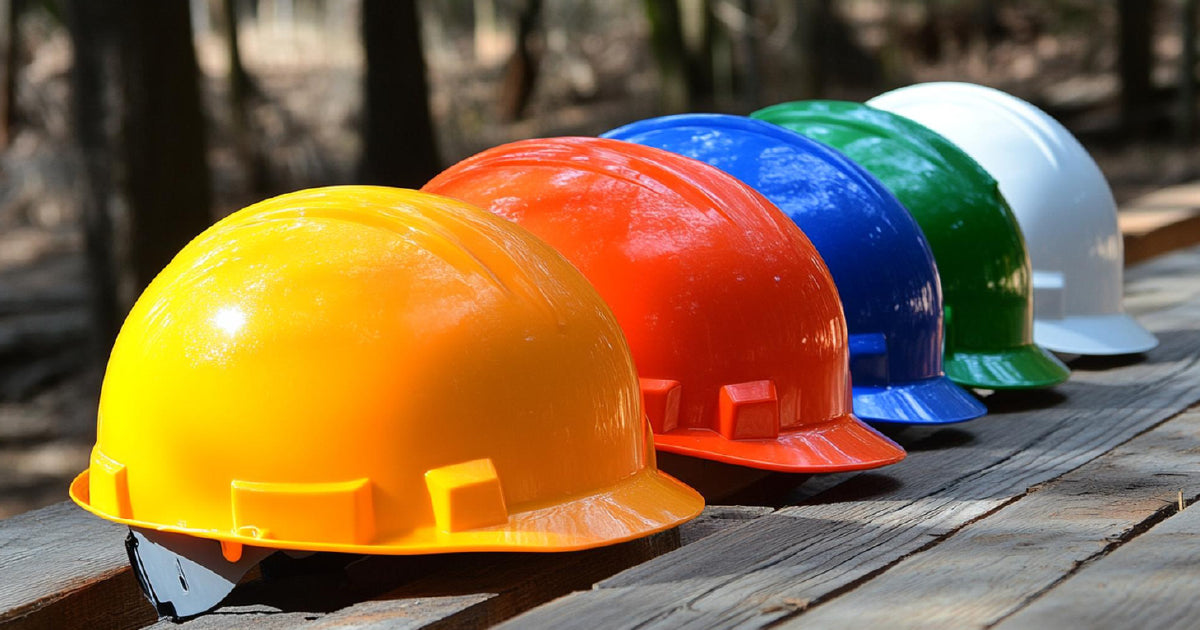
Hard hat colour on an Australian worksite tells you who someone is and what role they hold. The standard the helmet is certified to — and the class marked inside the shell — tells you whether it offers any electrical protection at all. This guide covers both: the colour conventions used across Australian construction, mining and industrial sites, and the current AS/NZS 1801:2024 standard that governs helmet types, electrical classes, and replacement intervals.
Quick answer — hard hat colours & standards (AU)
Construction site colour code (AU): White = manager/supervisor/engineer · Blue = electrician/technical · Yellow = general labourer · Green = first aid officer · Red = fire/emergency · Orange = road crew/traffic · Brown = welder/heat trades · Pink = visitor/new starter (varies by site)
Standard: AS/NZS 1801:2024 — current since September 2024, replacing the 1997 version. Four helmet types (1–4); the only recognised AS/NZS electrical class is Class E.
⚠️ Replacement rule: Replace a hard hat 3 years from the date of first issue (check the sticker inside the shell), or sooner after any impact. Unissued stock has a hard 5-year cap from the manufacture date.
This guide covers the complete picture for Australian workplaces: colour conventions, the AS/NZS 1801:2024 standard and its electrical classes, helmet types and brim styles, how to choose by industry, when to replace a helmet, and how to care for one.
Hard Hat Colour Quick Reference
| Colour | Typical role on site |
|---|---|
 |
Site manager, supervisor, foreman, engineer |
 |
Technical operator, electrician, carpenter |
 |
General labourer, earthmoving operator |
 |
Safety officer, first-aider, new starter |
 |
Emergency response, fire warden |
 |
Road worker, traffic controller, signaller |
 |
Welder, heat-resistant work |
 |
Often used to mark visitor / loaned-out hats |
Replacement: the general rule of thumb is 3 years from the date the helmet was first issued (see the Expiry section below for the full picture, including the separate rule for unissued stock). The manufacture ("born-on") date is moulded into the underside of the brim or inside the shell — replace any hat where the date is illegible, the shell is cracked, the harness webbing is damaged, or after any heavy impact.
Hard hat colour meanings in Australia
Australia does not have a single national colour code standard for hard hats. What you find on Australian sites is a set of well-established conventions — widely followed but set by the principal contractor or site safety plan rather than by AS/NZS regulation. This matters because the same colour can mean different things on different sites. Always check site-specific induction documentation.
The table below reflects the most common conventions across Australian construction, mining, and industrial worksites.
| Colour | Typical wearer | Notes |
|---|---|---|
 White White |
Site managers, engineers, supervisors, architects | Most common colour for site leadership across Australia. White denotes seniority and authority on the majority of Australian construction sites. |
 Yellow Yellow |
General labourers, plant operators, earthmoving operators | The most common colour on site overall. Workers involved in general construction, excavation, and earthmoving typically wear yellow. |
 Orange Orange |
New workers, traffic controllers, visitors (site-dependent) | Orange is used by many sites to identify workers in induction periods or probationary phases. Also widely used for traffic controllers and road workers. |
 Blue Blue |
Carpenters, electricians, technical tradespeople | Blue is commonly assigned to qualified tradespeople. Electricians on some sites use blue; others use orange. Confirm at induction. |
 Green Green |
Safety officers, environmental officers, first aiders | Green for safety is the most consistent convention across Australian sites. On some sites, green is also used for apprentices or trainees. |
 Red Red |
Firefighters, fire wardens | Less common in general construction. Predominantly used in emergency services, mining, and industrial settings with dedicated fire response teams. |
 Brown / Black Brown / Black |
Welders, heat workers | Darker colours reflect the practical reality of weld spatter and heat exposure. Black hard hats absorb more UV — check expiry stamps more frequently in outdoor settings. |
 Pink Pink |
Visitors, subcontractors (site-dependent) | Some sites issue pink to visitors for easy identification. Not universal — orange is more common for this purpose. |
 Grey Grey |
Subcontractors (site-dependent) | Used on some large infrastructure projects to distinguish direct-hire workers from subcontractors. Site-specific practice only. |
Important: These are conventions, not regulations. The principal contractor defines the colour scheme for each project. When working on multiple sites, do not assume a colour means the same thing. Check the site safety plan at induction.
AS/NZS 1801:2024 — the Australian standard explained
The current Australian and New Zealand standard for industrial safety helmets is AS/NZS 1801:2024, in effect since September 2024. It replaces AS/NZS 1801:1997, which had been in place for 27 years and is still referenced in a lot of the guidance material you'll find online. The companion standard, AS/NZS 1800:1998, covers selection, care and use of helmets and has not been updated — it remains the reference for maintenance, storage and replacement guidance.
Helmets already in service and certified under the 1997 version remain compliant until their normal replacement date — there's no obligation to replace them early. The 2024 requirements apply to newly manufactured helmets. When buying new, check for the AS/NZS 1801:2024 mark on the shell.
What changed in the 2024 update
- A new Type 4 helmet was introduced, with multi-directional (front, side and back, not just top) impact protection and a foam energy-absorbing liner — not yet commercially available in Australia as of late 2025.
- Type 1 helmets can now use a soft foam impact liner as an alternative to the traditional harness suspension, and can be made from a wider range of shell materials including polyethylene (PE), not just ABS and polycarbonate.
- Type 3 (bushfire/wildland firefighting) helmets are now tested under the international standard AS/NZS ISO 16073.5 rather than directly against AS/NZS 1801.
- The mandatory stiffness (side-impact) test is now optional, at the manufacturer's discretion — which broadens the viable shell material options.
Electrical protection: Class E
AS/NZS 1801 defines one electrical protection class: Class E, tested to withstand 20,000 V AC. A Class E helmet must be non-vented — any ventilation holes in the shell defeat the electrical protection entirely. Look for the letter "E" marked inside the shell. A helmet with no class marking carries no rated electrical protection, regardless of how new or otherwise compliant it is.
A note on US classifications (ANSI/ISEA Z89.1)
You will often see hard hats described using US terminology: ANSI "Type 1" and "Type 2" — which describe top-only versus top-and-lateral impact protection and have no relationship to the AS/NZS type numbering above — and ANSI Class G (2,200 V), Class E (20,000 V) and Class C (no protection). These are US ANSI/ISEA Z89.1 classifications and are not part of AS/NZS 1801. The only AS/NZS 1801 electrical class is Class E. If you see "Class G" or "Class C" applied to an AS/NZS 1801 helmet, treat it as a labelling error — it's describing the US system, not the Australian one.
Hard hat types, brim styles & choosing by industry
Beyond colour, three things determine whether a helmet is right for a job: its AS/NZS 1801 type, its brim style, and whether it's vented or non-vented.
The four AS/NZS 1801:2024 types
| Type | Name | Shell Material | Primary Application |
|---|---|---|---|
| Type 1 | Standard industrial safety helmet | ABS, PE, or polycarbonate | General construction, manufacturing, warehousing, mining, civil |
| Type 2 | High-temperature safety helmet | Polycarbonate (PC) | Foundries, smelters, steelworks, environments with sustained elevated heat |
| Type 3 | Bushfire / wildland firefighting helmet | Flame-retardant materials | Fire brigades, rural fire service, hazmat operations with fire exposure |
| Type 4 | Enhanced multi-directional protective helmet | Shell + internal foam energy liner | High-risk environments requiring front, side, and back impact protection (not yet commercially available in AU) |
For the vast majority of Australian construction, industrial and trade workers, Type 1 is correct. Type 2 is for sustained high-heat environments such as foundries and smelters. Type 3 is for bushfire and wildland firefighting. Type 4 is not yet commercially available in Australia.
Brim style and ventilation
| Type | Description | Best suited for |
|---|---|---|
| Cap-style (short brim) | Brim only at the front. Lighter and more compact. Compatible with face shields and earmuffs designed for cap-style helmets. | General construction, confined spaces, where head clearance is limited. The most common type on Australian worksites. |
| Full-brim (wide brim) | Continuous brim around the full circumference. Provides superior sun, rain, and spatter protection. Sometimes called a "cowboy" style on Australian worksites. | Outdoor work, roofing, high-UV environments, welding support. Increasingly common in Australian construction for sun protection compliance. |
| Vented | Ventilation slots in the shell improve airflow and reduce heat build-up inside the hat. | Outdoor work in warm climates. Vented helmets cannot be Class E — ventilation slots defeat the electrical protection. Never use a vented helmet for electrical work, and be aware vents also let in liquids and airborne dust more readily than a solid shell. |
| Non-vented | Solid, continuous shell with no ventilation slots. | Electrical work, chemical splash environments, dusty environments. Required for Class E rating. |
| Bump cap | A lightweight cap with a rigid insert. Not a safety helmet — does not meet AS/NZS 1801. Provides protection against bumping into fixed objects only. | Low-hazard environments only — food processing, light assembly. Never use as a substitute for an industrial safety helmet on a regulated worksite. |
Suspension systems
The suspension (harness) inside the shell transfers impact energy away from the skull and determines fit, comfort and ease of adjustment. Under AS/NZS 1801:2024, Type 1 helmets can use either a traditional harness suspension or a soft foam impact liner — for Australian worksites, harness-based suspension remains the standard, in one of three forms:
- Ratchet: the most popular choice in Australia. A dial or wheel at the back allows one-handed size adjustment without removing the helmet — useful when helmets are removed and replaced often through the day. Costs more but delivers noticeably better all-day comfort.
- Pin-lock (key-lock): a series of pin holes in an adjustment band. Size adjustment requires removing the helmet. Less flexible than ratchet but more durable, with fewer moving parts — standard on budget-level helmets and perfectly adequate for a worker with a consistent hat size.
- Slide-lock: a sliding mechanism rather than a ratchet wheel. Faster to adjust than pin-lock without the full cost of ratchet — found on mid-range helmets.
Most helmets also include an absorbent sweatband as part of the suspension — replace it when saturated or damaged, since a soaked harness can compromise fit. The suspension is a separate component from the shell and has its own service life (see the Expiry section below).
How to choose the right hard hat for your industry
Use this selection matrix to match the correct helmet specification to your work environment. When in doubt, choose the higher specification — the cost difference between a general Type 1 and a Class E non-vented helmet is negligible compared to the consequence of incorrect PPE selection. Always verify your site's SWMS (Safe Work Method Statement) and JSA (Job Safety Analysis) — site-specific requirements can be more stringent than the general guidance below. Many mining and petrochemical sites require Class E non-vented helmets for all personnel, regardless of individual task risk.
| Industry / Application | Type | Class | Vented? | Brim |
|---|---|---|---|---|
| General construction (outdoor) | Type 1 | Not required | Yes | Full or short brim |
| Electrical work / near live conductors | Type 1 | Class E required | No | Short brim or cap |
| Mining (surface) | Type 1 | Check site SWMS | Yes (if no electrical hazard) | Full brim |
| Mining (underground) | Type 1 | Often Class E (check site rules) | No | Cap style |
| Manufacturing / factory floor | Type 1 | Per site SWMS | Depends on dust / chemical risk | Short brim or cap |
| Foundry / steelworks / high-temp | Type 2 | Per site requirements | No (typically) | Short brim |
| Bushfire / wildfire fighting | Type 3 | N/A | No | Extended brim + neck flap |
| Civil / road construction (outdoor) | Type 1 | Not required (typically) | Yes | Full brim |
For a colour convention alongside the correct type and class, see the colour meanings table above.
Hard hat expiry: when to replace
Hard hats have a defined service life. The principle is straightforward: both age and damage independently require replacement, and neither condition excuses the other. There is no approved method for testing shell integrity in the field without specialist equipment — the practical rule is: when in doubt, replace it.
The three-year rule
The general guideline under AS/NZS 1800:1998 is a maximum of three years in service from the date of issue — when the helmet was first put into use — not from the manufacture date. The issue date is recorded on a sticker inside the helmet or on the headband. The manufacture date is stamped or moulded into the shell itself, typically as a quarter/year code or a calendar wheel on the inner brim showing year (outer ring) and month (inner ring or arrow).
Even a visually undamaged helmet will have experienced UV degradation, sweat absorption, temperature cycling, and cumulative minor impacts over three years. This degradation isn't always visible, but it's real and progressive.
Shell age vs issue date: the warehouse stock problem
A new helmet received from a supplier may have been manufactured 12–24 months earlier and sat in a warehouse before it reaches site. The three-year service clock starts from issue, not manufacture. However, if the manufacture date stamp shows the shell is already more than five years old, do not issue it at all — shell material degrades during storage, particularly if stored in a hot or sunlit environment such as a site shed or vehicle.
Replace immediately if any of the following apply
- After any impact, fall, or crush — even minor, and even with no visible damage to the shell
- Visible cracks, dents, or deformation in the shell or brim
- The shell has become chalky, brittle, or noticeably discoloured from UV
- Suspension straps or webbing are frayed, cracked, hardened, torn, or deformed
- The adjustment mechanism (ratchet, pin-lock) is damaged or no longer holds securely
- There is chemical contamination — solvents, acids, fuels, or aggressive cleaning agents on the shell
- The shell has been painted with solvent-based paint
- Hat has been stored in a vehicle where temperatures regularly exceed 50°C
Ready to upgrade your site's head protection? View our full range of hard hats and safety helmets — stocked with AS/NZS 1801 compliant options in a full range of colours, types and Class E ratings.
How to wear a hard hat correctly
A hard hat worn incorrectly provides significantly less protection than rated. The following points cover the most common fitting errors:
- Front-facing only: hard hats must be worn with the brim forward unless the manufacturer specifically certifies reverse wear — and even then, typically at a reduced protection rating. Most hard hats lose significant impact protection when worn backwards without that certification.
- Suspension adjustment: set the suspension so the shell sits level and stable on the head without tilting forward or back. There should be approximately 25–35 mm clearance between the top of the head and the inner surface of the shell — this clearance is the energy-absorption zone.
- Chin strap: use a chin strap in environments where the helmet could be dislodged — working at heights, windy conditions, operating vibrating equipment. The strap should be snug but not restrictive.
- Hat under hard hat: never wear a fabric hat, beanie, or baseball cap under a hard hat in a way that reduces suspension clearance or shifts the shell above its designed wear position.
- Accessories: only use accessories (earmuffs, face shields, sun brims) approved for your specific helmet model. Unapproved accessories can compromise the shell or shift the fit position.
Care, storage, stickers & accessories
Hard hats are simple to maintain but easy to damage through incorrect cleaning, storage, or modification. AS/NZS 1800:1998 is the applicable reference.
Cleaning
Clean with warm water and mild soap or detergent only. Rinse thoroughly. Never use solvents, petroleum-based cleaners, acetone, paint thinner, or abrasive pads — these attack ABS and polycarbonate shells and can cause micro-cracking that compromises impact performance with no visible sign of damage. A visually clean helmet that's been wiped with a solvent rag may have a structurally degraded shell.
Storage
Store in a clean, dry location away from direct sunlight, UV sources, and heat. Never leave a hard hat on the dashboard of a vehicle — a car interior in Australian summer can exceed 70–80°C, which significantly accelerates shell and suspension degradation. Store helmets flat or in a proper rack. Do not hang a helmet by its chin strap or suspension — this creates stress and fatigue at the attachment points over time.
What invalidates a helmet
The following actions invalidate a helmet's compliance or substantially compromise its protection under AS/NZS 1800:1998:
- Drilling holes in the shell (unless factory-drilled for specific certified accessories)
- Applying solvent-based paint directly to the shell surface
- Applying stickers with aggressive solvent-based adhesives (see sticker guidance below)
- Storing under heavy objects that deform the shell
- Wearing a beanie, hood, or hat under the helmet — this alters the critical clearance between shell and skull and reduces the suspension's ability to absorb impact energy properly
- Carrying pens, tools, or objects wedged between the shell and suspension — explicitly noted as a safety risk in AS/NZS 1800:1998
Stickers: what is and isn't allowed
Stickers on hard hats are a topic of ongoing debate on Australian sites. The practical answer is: permitted, with conditions. AS/NZS 1800:1998 does not outright prohibit stickers but requires that the helmet shell not be compromised:
- Standard pressure-sensitive vinyl stickers are generally acceptable when applied to the outer shell surface only
- Do not apply stickers over cracks, damage, or certification/manufacture markings
- Some sticker adhesives contain trace solvents that can attack ABS over time — if the shell surface around a sticker becomes cloudy, tacky, or etched, remove it and inspect the shell
- Solvent-based spray paint on the shell must never be used — it structurally degrades ABS and this degradation may not be visible
- For Class E helmets in strictly controlled electrical environments, check your site policy — stickers may compromise the dielectric testing basis of the shell surface
- When in doubt, check the manufacturer's own sticker guidance — most Australian hard hat manufacturers publish this
Accessories: compatibility matters
Accessories must be specifically designed and certified for your helmet model. Generic or non-compatible accessories can alter the helmet's geometry or attachment points in ways that affect its certified performance.
Earmuffs: slot-mount earmuffs (30 mm slot standard) attach to brim slots. Full brim and short brim helmets have different slot positions — earmuffs designed for one style may not fit the other. Verify compatibility before purchasing.
Face shields and visors: attach to brim slots or helmet-specific bracket systems. Must meet AS/NZS 1337 for eye and face protection. Ensure the visor bracket does not require drilling into the shell.
Neck flaps and sun capes: clip to the helmet brim and do not structurally affect the helmet. Highly recommended for outdoor Australian worksites where sun exposure to the back of the neck is a risk.
Helmet lights: battery-powered lights that clip to brim slots or use adhesive mounts. For adhesive-mount lights, refer to the sticker guidance above regarding adhesive compatibility with the shell material.
Chin straps: essential for work at height, on scaffolding, or in high-wind conditions. Verify the attachment method is compatible with your specific helmet model.
Stay protected & compliant on site.
Shop AS/NZS 1801-compliant hard hats for every role
Vented and non-vented, full brim and short brim — AIMS Industrial stocks hard hats in all site colours across Type 1, Type 2 and Class E ratings, ready to ship Australia-wide.
Frequently asked questions
What do hard hat colours mean in Australia?
Hard hat colours in Australia follow site-specific conventions rather than a national regulated standard. The most common pattern is: white for managers and engineers, yellow for general labourers, orange for new workers or traffic controllers, blue for tradespeople, and green for safety officers. Colours are set by the principal contractor for each project — always confirm the scheme at site induction.
Does Australia have a hard hat colour code standard?
No national regulatory standard mandates specific hard hat colours in Australia. The colour conventions you see on Australian sites are industry practice, not law. The regulated requirement is that the helmet meets AS/NZS 1801 — the colour is a site management tool, not a compliance requirement.
What is AS/NZS 1801 and what changed in the 2024 update?
AS/NZS 1801 is the Australian and New Zealand standard for industrial safety helmets. The current version, AS/NZS 1801:2024, replaced the 1997 version in September 2024. Key changes: a new Type 4 helmet was introduced; Type 1 helmets can now use soft foam liners as well as traditional harness suspension, and a wider range of shell materials; the mandatory stiffness test is now optional; and Type 3 (bushfire) helmets are now tested under the international standard AS/NZS ISO 16073.5. Helmets certified under the 1997 standard remain valid until their normal replacement date.
What is the difference between a Type 1 and Type 2 hard hat?
Under AS/NZS 1801, Type 1 is the standard industrial safety helmet — made from ABS, polyethylene or polycarbonate — used for general construction, manufacturing and warehousing. Type 2 is a high-temperature safety helmet made specifically from polycarbonate, for foundries, smelters, steelworks and similar environments with sustained elevated heat. This is a different system to US ANSI/ISEA Z89.1, where "Type 1" and "Type 2" instead describe top-only versus top-and-lateral impact protection — that US definition does not apply on Australian sites.
What hard hat class do electricians need in Australia?
Electricians and anyone working near live electrical conductors need a Class E hard hat, tested to 20,000 volts AC and marked with an "E" inside the shell. Class E helmets must be non-vented — any vents in the shell defeat the dielectric protection. Class G and Class C, sometimes seen on supply catalogues, are US ANSI/ISEA classifications and are not part of AS/NZS 1801.
Can you wear a vented hard hat for electrical work?
No. A vented hard hat cannot achieve Class E electrical certification — the ventilation slots break the dielectric barrier, so the helmet provides no protection against electrical current. If there's any possibility of exposure to live conductors, a non-vented Class E helmet is mandatory, even if the vented helmet is fully certified to AS/NZS 1801 for impact protection.
How long does a hard hat last in Australia?
The general guideline under AS/NZS 1800:1998 is a maximum service life of three years from the date of first issue, not manufacture. A helmet must also be replaced immediately after any significant impact, if the shell shows cracking or chalking, if the suspension is damaged, or if the shell is more than five years old from manufacture — even if it has never been issued.
How do I find the date stamp on my hard hat?
Look inside the shell. Most Australian-market helmets include a moulded calendar wheel showing year (outer ring) and month (inner ring or arrow) — the arrow or punch-out indicates the manufacture date. Some helmets use a printed adhesive label instead; check it hasn't been removed or obscured. The issue date (when the helmet was first put into use, and the date that starts the three-year clock) is usually recorded separately on a sticker inside the shell or on the headband.
Can you put stickers on a hard hat?
Generally yes, with conditions. AS/NZS 1800:1998 doesn't ban stickers, but the shell must not be compromised. Use pressure-sensitive vinyl stickers only, applied to the outer shell surface. Don't apply stickers over damage, cracks, or certification/manufacture markings. Avoid stickers with solvent-based adhesives, which can attack ABS and polycarbonate shells. Solvent-based spray paint must never be applied to a shell. On Class E helmets, check your site policy — stickers may affect dielectric integrity in strict electrical environments.
What is the difference between a hard hat and a bump cap?
A hard hat (safety helmet) is certified to AS/NZS 1801 for protection against falling objects and impacts. A bump cap is a low-profile head covering designed only to protect against bumping into fixed objects — not falling objects. Bump caps are not AS/NZS 1801 certified and must never substitute for a hard hat where falling-object risk exists.
What is the "cowboy" hard hat — is it AS/NZS compliant?
"Cowboy" is the informal Australian site term for a full-brim hard hat — a 360-degree brim extending around the entire helmet, similar in silhouette to a wide-brimmed hat. Reputable full-brim hard hats from major PPE brands comply with AS/NZS 1801 in the same way cap-style helmets do. Full-brim style provides superior sun and rain protection, making it well-suited to Australian outdoor work. Check the standard marking inside the shell before purchasing.
What is the difference between ABS and HDPE hard hat shells?
ABS (acrylonitrile butadiene styrene) is stiffer and more heat-resistant, and is standard for Type 1 industrial helmets. HDPE/PE (high-density polyethylene) is more flexible and cheaper, and is now an accepted shell material for Type 1 under the 2024 update. Both meet AS/NZS 1801 impact requirements when correctly certified — the choice comes down to heat exposure and cost.
Can I mount ear muffs or a face shield to a hard hat?
Yes, provided the accessory is designed for your specific helmet. Slot-mount ear muffs (30 mm slot standard) and face shields clip into the brim slots on most industrial hard hats — full brim and short brim helmets have different slot positions, so confirm compatibility before purchase. Some hats use proprietary slot systems that only accept the manufacturer's own accessories.
What happens if a hard hat falls off a scaffold?
Treat it as an impact event and retire it immediately, even if there's no visible damage — the shell's energy-absorbing capacity may have been partially used. The same principle applies to a hard hat that's been dropped, run over, or subjected to any other significant force. Replace it; don't continue using it.
How much do hard hats weigh?
Standard Australian hard hats typically weigh 350–450 g depending on shell material and features. Full-brim ("cowboy") styles are heavier, at 400–500 g. Weight matters for all-day wear — a heavier hat causes neck fatigue over an 8-hour shift, so trial before buying if you'll be wearing it continuously.
People Also Ask — Hard Hats in Australia
Q: What is the difference between a Type 1 and Type 2 hard hat?
Under the Australian AS/NZS 1801:2024 standard, Type 1 is the standard industrial safety helmet — made from ABS, polyethylene or polycarbonate — used for general construction, manufacturing and warehousing. Type 2 is a high-temperature safety helmet made specifically from polycarbonate, for foundries, smelters, steelworks and similar environments with sustained elevated heat. This differs from the US ANSI/ISEA Z89.1 system, where "Type 1" and "Type 2" instead describe top-only versus top-and-lateral impact protection — that US definition doesn't apply on Australian sites.
Q: What do hard hat classes mean?
Under AS/NZS 1801, the only Australian electrical class is Class E — tested to withstand 20,000 volts AC, identified by an "E" marking inside the shell, and requiring a non-vented shell. Helmets without an E marking carry no rated electrical protection. Class G and Class C are US ANSI/ISEA Z89.1 classifications, not part of the Australian standard — if you see them referenced, that's the US system, not AS/NZS 1801.
Q: How often should a hard hat be replaced?
Under AS/NZS 1800:1998, the general guideline is a maximum of three years in service from the date of issue — not the manufacture date — recorded on a sticker inside the helmet. If a helmet's manufacture date shows it's already more than five years old, it shouldn't be issued at all, even if it's never been worn. UV radiation, chemical exposure and heat degrade the shell over time even without visible damage. Any helmet that has taken a significant impact should be replaced immediately, regardless of age or appearance.
Q: What do hard hat colours mean on Australian worksites?
Colour conventions vary by site, but a common Australian pattern is: white for supervisors and managers; yellow for general workers and labourers; orange for traffic controllers or new starters; green for safety officers; blue for tradespeople; red for fire wardens. Always check your site's specific colour code — there is no single mandatory national scheme.
Q: How do you adjust a hard hat for correct fit?
Adjust the ratchet, pin-lock or slide-lock suspension so the shell sits level, with roughly 25–35 mm clearance between the top of the head and the inner shell, and doesn't wobble or tip forward. The fit should be firm but comfortable. A hard hat that shifts during normal movement isn't providing its intended level of protection. Chin straps are required in elevated work environments and wherever the hat could be dislodged.
Q: Can you put stickers on a hard hat?
Generally yes, with conditions. AS/NZS 1800:1998 doesn't ban stickers, but the shell must not be compromised — use pressure-sensitive vinyl stickers only, and never apply them over cracks, damage, or certification and manufacture markings. Some adhesives contain solvents that can attack ABS and polycarbonate shells over time; if the surface around a sticker turns cloudy, tacky or etched, remove it and inspect the shell. Solvent-based paint should never be applied to a shell.