

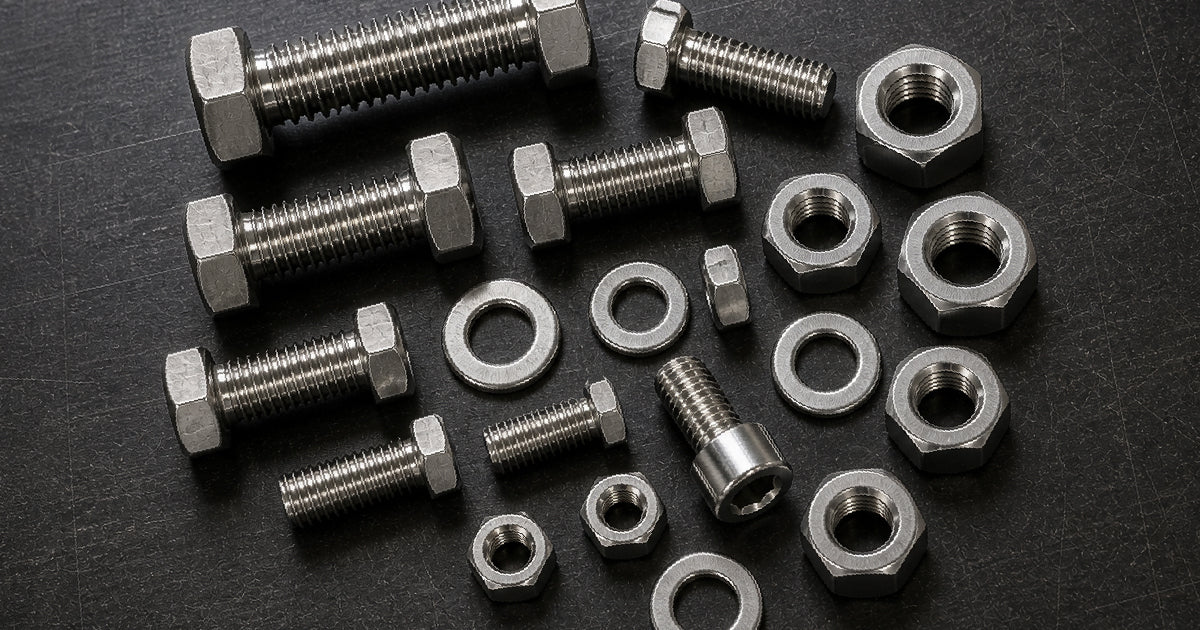
Stainless Fastener Grades — A2 vs A4 at a glance
Stainless fasteners are graded by steel type (A1 to A5 per ISO 3506-1) and property class (-50 to -110). A2 = 304 stainless (general indoor/outdoor and food-grade). A4 = 316 stainless (marine-grade — contains 2-3% molybdenum for chloride resistance). The suffix number x 100 = minimum tensile strength in MPa (so A4-80 = 316 stainless at 800 MPa minimum tensile).
What Is Stainless Steel?
Stainless steel is a low-carbon alloy with at least 10.5% chromium. The chromium reacts with oxygen in the air to form a thin, self-repairing chromium oxide layer — this gives stainless steel its corrosion resistance. Using stainless steel does not guarantee that minor surface rust will not appear. "Tea staining" (brownish surface discolouration) is common in harsh environments but does not mean the fastener is failing.
304 vs 316 Stainless Steel
Grade 304 (A2): 18% chromium, 8% nickel — the standard "18/8" austenitic stainless. Used in kitchens, food processing, general industrial. Grade 316 (A4): 16-18% chromium, 10-14% nickel, 2-3% molybdenum. The molybdenum significantly improves resistance to pitting corrosion in chloride environments. A4 costs roughly 20-30% more than A2. PREN: 304 ~18-20, 316 ~24-27.
Thread Galling: The Silent Killer of Stainless Fasteners
Thread galling (cold welding) occurs when stainless threads seize and fuse together during tightening. Prevention: always apply anti-seize compound (copper-based or PTFE-based) to threads before installation. Tighten slowly with a torque wrench rather than a power driver. Reduce target torque by 15-25% when anti-seize is applied. Ensure threads are aligned before applying load.
Galvanic Compatibility
Stainless steel is highly noble — it sits near the top of the galvanic series. Contact with mild steel: HIGH risk — accelerates rusting in mild steel. Contact with galvanised steel: HIGH risk — zinc corrodes rapidly. Contact with aluminium: MEDIUM-HIGH risk — aluminium corrodes at bolt hole in wet or coastal conditions. Isolate with nylon washers and sleeves in marine environments.
Application Selection Guide
General indoor: A2-70. Food processing (mild): A2-70. Outdoor inland: A2-70. Coastal (within ~5 km of sea): A4-70 minimum. Marine/direct seawater: A4-80. Swimming pools: A4-80 minimum. Chemical plant: A4-70 or A4-80 depending on chemical type.
When NOT to Use Stainless Steel Fasteners
High-strength structural joints where 10.9 or 12.9 is required and corrosion is not a factor. Hot chloride environments above ~60°C (SCC risk). Contact with hydrochloric acid. Aluminium structures in wet/coastal environments without proper isolation.
Frequently Asked Questions
What does A2-70 mean on a stainless bolt? A2 = 304 stainless steel. 70 = property class, indicating 700 MPa minimum tensile strength. A2-70 is the standard stainless bolt specification stocked by most suppliers. What is thread galling and how do I prevent it? Thread galling (cold welding) occurs when stainless-to-stainless threads seize during tightening. Prevention: always apply anti-seize compound. Are stainless steel fasteners stronger than Grade 8.8? No — A2-70 is 700 MPa; Grade 8.8 is 800 MPa. A4-80 matches Grade 8.8 at 800 MPa but falls well short of 10.9 (1,040 MPa).
People Also Ask — Stainless Steel Fastener Grades Explained: A2, A4, -70 & -80
Q: What is the difference between A2 and A4 stainless steel fasteners?
A2 (304 stainless) is the standard food-grade and general-purpose stainless — excellent corrosion resistance in most environments. A4 (316 stainless) adds molybdenum, which significantly improves resistance to chlorides, salt water, and chemical exposure. For marine, coastal, swimming pool, or chlorinated environments, A4 is the correct choice. A2 is appropriate for indoor, food processing, and non-marine outdoor applications.
Q: Why do stainless steel fasteners gall and how do I prevent it?
Galling (cold welding) occurs when stainless threads seize under load due to the breakdown of the passive oxide layer and metal-to-metal adhesion. It is most common with A2/A4 stainless bolts and nuts under high clamping loads. Prevent it by applying an anti-seize compound (copper-based, nickel-based, or PTFE paste) to threads before assembly. Tighten slowly and avoid pneumatic impact tools on stainless fastenings.
Q: Is A2-70 stainless as strong as an 8.8 bolt?
No — A2-70 has a minimum tensile strength of 700 MPa and yield of 450 MPa, compared to 8.8's 800 MPa tensile and 640 MPa yield. For the same diameter bolt, an 8.8 steel bolt can handle approximately 40% more load before yielding. If structural load is the primary concern, use high-tensile steel with appropriate corrosion protection (HDG, zinc plate, or Delta Protekt coating) rather than stainless.
Q: Can I use stainless steel fasteners with aluminium?
Use caution — stainless and aluminium are significantly apart on the galvanic series, making them prone to galvanic corrosion when in contact in a wet or conductive environment. In dry indoor applications the risk is low. Outdoors or in marine environments, isolate with neoprene washers or use aluminium-compatible fasteners (aluminium bolts, titanium, or anodised aluminium). Apply an isolating compound to thread contacts in critical applications.

