

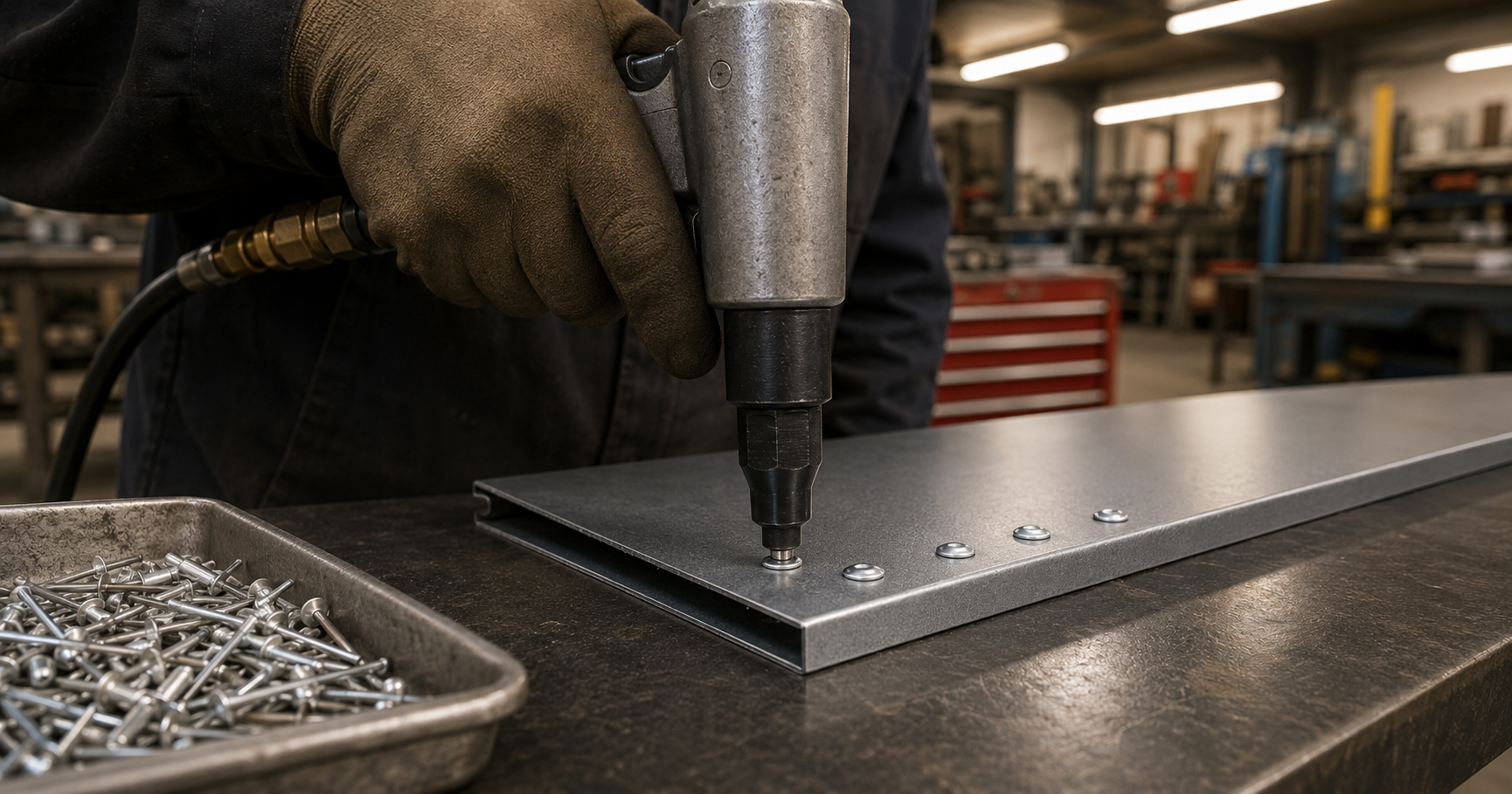
What is a rivet?
A rivet is a permanent mechanical fastener that joins two or more sheets of material by deforming a soft metal pin to clamp the joint. Once set, a rivet cannot be undone without drilling it out. Common types include solid rivets, blind (pop) rivets, structural rivets, and threaded rivnuts — each suited to a different combination of access, load, and material thickness.
What is the difference between a rivet and a rivnut?
A standard rivet creates a permanent joint between sheets. A rivnut (also called a blind rivet nut) installs the same way but leaves a threaded socket behind, so bolts can be screwed in and out repeatedly — useful where you need a removable fixing on thin or single-sided sheet.
Types of Rivets — Quick Reference
The main rivet types used in Australian industry, each suited to different access, load and material conditions.
| Rivet Type | Best For | Access Required |
|---|---|---|
| Blind (Pop) Rivet | Sheet metal, signage, panels — most common | One side only |
| Solid Rivet | Structural, aircraft, heavy-load joints | Both sides |
| Structural / Multi-Grip | High-strength load-bearing fastening | One side only |
| Tubular / Semi-Tubular | Leather, brake linings, friction materials | Both sides |
| Drive Rivet | Quick installation in pre-drilled holes | Both sides |
| Self-Piercing | Automotive sheet joining without pre-drilling | Specialty tool |
| Rivet Nut (Rivnut) | Adding threaded fastening to sheet metal | One side only |
What Is a Rivet? (And Why Use One Instead of a Bolt or Weld)
A rivet is a permanent mechanical fastener consisting of a smooth cylindrical shaft (the shank) with a pre-formed head on one end. The rivet is inserted through a pre-drilled hole, then the tail end is deformed to create a second head — clamping the materials together with no thread, no nut, and no heat required.
The question most people ask is: why use a rivet instead of a bolt or a weld? The answer depends on the application:
- Rivets vs bolts: Rivets are permanent and vibration-resistant — a rivet cannot self-loosen under vibration the way a threaded fastener can. They are also faster to install at volume and require no clearance for a nut on the back side.
- Rivets vs welds: Rivets require no heat, no shielding gas, no post-weld treatment, and no welding qualification. They can join dissimilar metals and heat-sensitive materials that cannot be welded. They are also inspectable — a correctly set rivet head is visually verifiable in a way that a weld bead often isn't.
- When to weld or bolt instead: Where shear or tensile loads exceed rivet ratings, where a watertight continuous seal is required along a full seam, or where the joint must be disassembled, bolts or welding may be the better choice.
Rivets have been the fastener of choice in aircraft, ships, vehicles, and structures for over a century. Modern blind rivets (pop rivets) make the technology accessible to any tradesperson with a hand tool — but understanding the types, materials, and sizing is what separates a correct installation from a failed joint.
Types of Rivets
There are seven principal rivet types used in Australian trade and industrial work. The right choice depends on access, load, material, and application.
1. Blind Rivets (Pop Rivets) — Most Common in Australia

Blind rivets — universally known in Australia as pop rivets — are the dominant rivet type in trade and light industrial work. The term "blind" refers to the fact that installation requires access to one side of the workpiece only: no access to the back is needed.
The rivet consists of a hollow aluminium or steel body with a steel mandrel (pull pin) running through the centre. A rivet gun grips the mandrel and pulls it back through the body. This draws the tail of the body against the blind face of the material, expanding it to form a second head. When the set clamping force is reached, the mandrel snaps off flush with the face of the rivet body — leaving the joint complete.
Where they're used: Sheet metal fabrication, HVAC ductwork, guttering, roofing and cladding, trailer bodies, signage, cabinetry, automotive panels, and general assembly wherever one-sided access is the constraint.
Standard diameters (metric): 2.4mm, 3.2mm, 4.0mm, 4.8mm, 6.4mm
Standard blind rivets provide clamping force between materials — they are not designed to carry sustained tensile loads (forces pulling the joint apart). The hollow body and mandrel stub do not contribute full cross-sectional strength. For structural or load-bearing joints, use structural rivets (see below), bolts, or solid rivets. This is the single most common rivet specification mistake on Australian job sites.
Available at AIMS: Pop Rivets →
2. Solid Rivets — Maximum Strength

Solid rivets are a single piece of solid metal — no mandrel, no hollow body. They are the oldest rivet type and still the strongest. Installation requires access to both sides of the joint: the rivet tail is deformed by a hammer or pneumatic rivet set, while a bucking bar (dolly) is held against the opposite end to resist the force and form the shop head.
A correctly set solid rivet fills the hole completely and transfers shear loads across the full solid cross-section of the shank. This makes solid rivets the choice for aircraft structures, structural steelwork, bridges, boiler plate, and any application where maximum fatigue resistance and joint strength are required.
Where they're used: Aircraft skins and frames, bridge construction, heavy structural steel, marine vessels, boiler and pressure vessel fabrication.
Limitations: Two-sided access is mandatory. Skilled installation is required — inconsistent shop heads reduce joint integrity. Impractical for maintenance and repair where one side is enclosed.
Common materials: Aluminium alloy 2117 (aircraft, most common), 2024 aluminium, mild steel, stainless steel, copper, brass.
3. Semi-Tubular Rivets — Reduced Setting Force

Semi-tubular rivets resemble solid rivets in appearance but have a partial hole drilled into the tail end — typically to a depth of approximately 112% of the rivet's diameter. This hollow tail section reduces the force needed to set the rivet by approximately 75% compared to a solid rivet.
When set, the thin tail section rolls outward to form the shop head. Because less metal needs to deform, semi-tubular rivets can be set by machine press or hand press rather than requiring a pneumatic hammer. This makes them the standard choice for high-volume factory assembly operations.
Where they're used: Brake shoes and clutch facings, leather goods, bookbinding hardware, hinges, conveyor rollers, and small mechanical assemblies. Many everyday manufactured products — door hinges, briefcase clasps, industrial hardware — use semi-tubular rivets.
Limitations: Not as strong as solid rivets under tensile loading. Generally set by machine rather than portable tools. Not a field-installation product.
4. Drive Rivets — No Rivet Gun Required

Drive rivets have a short mandrel protruding from the head rather than through the body. A single hammer blow drives the mandrel into the hollow rivet body, expanding the tail to create the joint — no rivet gun, no air supply, no power tool required.
Where they're used: Nameplates, decorative panels, and assemblies where a rivet gun is unavailable or impractical. Useful for occasional field fastening without power tools.
Limitations: Low joint strength. Limited to light-duty, non-structural applications. Installation consistency depends on hammer technique — less reliable than gun-set rivets.
5. Split Rivets (Bifurcated Rivets) — Fabric and Leather

Split rivets — also called bifurcated rivets — have a tubular shank that is split into two prongs at the tail end. The prongs pierce soft materials directly (no pre-drilled hole required) and are then bent outward through the back of the material to secure the joint.
Where they're used: Leather goods (belts, bags, saddlery), canvas, heavy fabric, upholstery, and packaging. They are the standard fastener for attaching components to soft materials in the leathercraft and textile trades.
Limitations: Soft materials only. Cannot be used in metal or any application requiring structural integrity.
6. Structural Rivets (High-Strength Locking Rivets)

Structural rivets are engineered blind rivets designed for applications where standard pop rivets are insufficient. The key difference is in how the mandrel is handled: rather than snapping off and leaving a hollow body, the mandrel is mechanically locked inside the rivet body after setting. This creates a fully filled shank with a locked steel core — significantly increasing tensile and shear strength while retaining the single-sided installation advantage of a blind rivet.
Well-known structural rivet systems include the Gesipa® BULB-TITE® (which forms a large-diameter blind head that spreads load across the panel) and the Huck Magna-Lok® and Huck BOM systems. Shear ratings of 8–15 kN depending on diameter make these comparable to Grade 4.6 bolts at equivalent sizes.
Where they're used: Heavy vehicle and trailer bodies, agricultural equipment frames, modular building systems, structural steel fabrication where one-sided access is required, and any application that would normally specify a bolt but cannot accommodate a nut on the back side.
If the joint carries a load that you would ordinarily specify a bolt for — frame members, mounting brackets, tow points, floor plates — use structural rivets, not standard blind rivets. The cost difference is small. The strength difference is significant.
7. Rivet Nuts (Nutserts / Rivnuts) — Threaded Inserts
 Rivet nuts — also called nutserts or rivnuts — are threaded inserts that are set into a pre-drilled hole like a blind rivet, but leave a usable female thread in the material. This allows you to install and remove a bolt or screw repeatedly into sheet material that is too thin to tap directly.
A rivet nut tool draws a mandrel back through the threaded insert, causing the body to collapse and expand behind the sheet — exactly as a standard blind rivet works. The result is a permanently anchored nut in the sheet, flush or countersunk on the face.
Where they're used: Automotive panels and trim, electronics enclosures, aluminium extrusions, thin-wall tubing, and anywhere a removable fastener is needed in sheet material that cannot accept a conventional nut.
→ Full installation guide: How to Install Nut Rivets in Six Easy Steps →
Rivet Materials: Matching Metal to Application
The material a rivet is made from is as important as its type and size. The wrong material choice leads to galvanic corrosion, premature joint failure, or staining — all of which are expensive to rectify in the field.
Aluminium
The most common material for pop rivets in general trade use. Lightweight, non-magnetic, reasonable corrosion resistance in sheltered environments, and easy to set. The 5056 aluminium alloy is the most widely stocked for trade rivets — good strength and better corrosion resistance than 5052 or pure aluminium.
Use with: Aluminium, fibreglass, plastic, timber, and other aluminium assemblies.
Avoid with: Steel in wet or outdoor environments (galvanic corrosion will degrade the aluminium rivet over time).
Steel (Zinc Plated)
Stronger than aluminium — typically 50–70% higher shear strength at equivalent diameter. Zinc plating gives moderate corrosion protection for indoor and sheltered applications. Not suitable for coastal, marine, or prolonged outdoor exposure.
Use with: Steel substrates in dry or indoor environments.
Avoid with: Aluminium substrates (galvanic pair), and do not specify for permanent outdoor exposure without additional protection.
Stainless Steel (304 and 316)
Excellent corrosion resistance, significantly stronger than aluminium. The 304 grade handles general outdoor exposure and chemical environments. The 316 grade contains molybdenum for enhanced resistance to chloride attack — the grade to specify for coastal areas, marine environments, and applications where the rivet will be exposed to salt water or salt air.
Stainless steel and aluminium form an aggressive galvanic couple. Using stainless rivets in aluminium sheet will corrode the aluminium, not the stainless. For aluminium in marine or coastal applications, use monel rivets. For aluminium in general outdoor applications, use 5056 aluminium rivets or isolate the joint.
Use with: Steel and stainless steel substrates, outdoor and coastal environments.
Avoid with: Aluminium substrates.
Monel (Nickel-Copper Alloy)
Monel is the correct material for riveting aluminium in marine environments. It is galvanically compatible with aluminium — the electrochemical potential difference is small enough that corrosion is negligible. Monel rivets are the standard choice for aluminium boat hulls, aluminium marine structures, and coastal aluminium fabrication.
Use with: Aluminium in marine and coastal applications.
Note: Higher cost than aluminium or steel — specify where galvanic compatibility with aluminium is the priority.
Copper
Used in electrical applications (copper conductors, busbar assemblies), leathercraft, and decorative work. Corrosion resistant and non-magnetic. Not for structural applications.
Material Selection Table
| Rivet Material | Compatible With | Avoid With | Best Application |
|---|---|---|---|
| Aluminium (5056) | Aluminium, fibreglass, plastic | Steel (outdoors), stainless | Roofing (dry), HVAC, general sheet metal |
| Steel — zinc plated | Steel (indoors/sheltered) | Aluminium, prolonged outdoor | Indoor fabrication, heavy steel assembly |
| Stainless 304 | Steel, stainless steel | Aluminium | General outdoor, light industrial |
| Stainless 316 | Steel, stainless steel | Aluminium | Coastal, marine, chemical environments |
| Monel | Aluminium (marine/coastal) | — | Aluminium boat hulls, marine structures |
| Copper | Copper, brass, leather | Steel (galvanic) | Electrical, leathercraft, decorative |
Rivet Sizes Explained: How to Read the Code
Specifying the wrong rivet size is the second most common installation mistake after material mismatch. There are two dimensions to get right: diameter and grip range.
Understanding Diameter
Rivet diameter is the outside diameter of the rivet body — the dimension that matches your drilled hole (less 0.1mm clearance). In Australian metric stock, the five standard pop rivet diameters are:
- 2.4mm — light duty, nameplates, thin sheet
- 3.2mm — general trade workhorse, HVAC, guttering, panels
- 4.0mm — medium duty, trailer sheeting, cabinetry
- 4.8mm — heavy sheet, structural panels, heavy vehicle bodies
- 6.4mm — heavy duty structural, requires pneumatic gun
Legacy imperial sizes (3/32", 1/8", 5/32", 3/16") still appear in aviation maintenance and some older imported equipment. The 1/8" (3.175mm) size is equivalent to the 3.2mm metric — they are often interchangeable in non-precision applications.
Understanding Grip Range
Grip range is the total thickness of materials the rivet is designed to join — all sheets stacked together. A rivet with a grip range of 1.5–4.5mm will correctly set any stack from 1.5mm to 4.5mm total thickness.
If your stack is outside the grip range:
- Too thin for the rivet: The body over-expands and sets loosely — the joint will be weak and the rivet may pull through.
- Too thick for the rivet: The mandrel snaps before the body has expanded enough — the rivet sets without clamping the materials properly.
Measure your total material stack before ordering. If you're on the boundary between grip ranges, order the shorter range — it will clamp more tightly.
Sizing Formulas
Diameter rule: Rivet diameter ≥ 3× the thickness of the thickest single sheet being joined.
Example: Joining two sheets of 1.5mm aluminium → thickest sheet 1.5mm × 3 = 4.5mm minimum diameter → specify 4.8mm rivets.
Drill size rule: Drill hole diameter = rivet diameter + 0.1mm (metric) or rivet diameter + 1/64" (imperial).
The hole should allow the rivet to slide in without force but leave no visible gap. A sloppy hole reduces joint strength significantly — the rivet body has room to shift laterally under shear load.
Rivet Size Reference Table
| Diameter (metric) | Imperial Equiv. | Typical Grip Range | Drill Size | Typical Applications |
|---|---|---|---|---|
| 2.4mm | 3/32" | 0.5–3.0mm | 2.5mm | Nameplates, thin gauge sheet, electronics |
| 3.2mm | 1/8" | 1.5–4.5mm | 3.3mm | HVAC ductwork, guttering, signage, general sheet metal |
| 4.0mm | 5/32" | 2.0–6.0mm | 4.1mm | Trailer sheeting, cabinetry, medium fabrication |
| 4.8mm | 3/16" | 2.0–8.0mm | 4.9mm | Heavy sheet, structural panels, vehicle bodies |
| 6.4mm | 1/4" | 4.0–12.0mm | 6.5mm | Heavy-duty structural, thick stacks |
How to Choose the Right Rivet: Application Decision Guide
The right rivet for the job is determined by four factors: access (one-sided or two), load type (structural or non-structural), material compatibility, and environment (indoor, outdoor, coastal). The table below covers the most common Australian trade applications.
| Application | Recommended Type | Recommended Material | Notes |
|---|---|---|---|
| HVAC ductwork (indoor) | Blind (pop) | Aluminium or zinc steel | 3.2mm standard. Aluminium for al duct, steel for steel duct |
| Guttering and downpipes | Blind (pop) | Aluminium or stainless 304 | Match to gutter material; Colorbond rivets for coloured gutters |
| Colorbond roofing and cladding | Blind (pop), sealed end | Colorbond aluminium | Colour-match to panel. Use sealed rivets where waterproofing matters |
| Steel trailer body | Structural blind | Zinc steel or stainless | Standard pop rivets insufficient for frame loads |
| Aluminium boat hull | Blind or solid | Monel | Galvanic compatibility with aluminium is critical |
| Heavy vehicle body (steel) | Structural blind | Steel or stainless | Gesipa® BULB-TITE® or equivalent; check shear rating |
| Automotive panel repair | Blind (pop) | Aluminium | Non-structural body panels only; 3.2mm most common |
| Signage (al to steel) | Blind (pop) | Aluminium + isolation washer | Washer prevents direct metal contact and galvanic reaction |
| Leather and canvas goods | Split (bifurcated) | Copper or brass | No pre-drilling needed in soft materials |
| Aircraft skin | Solid | 2117 or 2024 Al alloy | Specialist installation — bucking bar and pneumatic rivet gun required |
| Thin sheet — removable bolt | Rivet nut (nutsert) | Steel or stainless | Creates reusable female thread. See nut rivet guide |
| Outdoor coastal (any) | Blind (pop) sealed | 316 stainless | Within 1km of salt water: 316 stainless is the minimum spec |
Pop Rivets vs Solid Rivets: Which Do You Need?
This is the most common question in rivet selection — and the answer is usually straightforward once you understand the functional difference between the two types.
The core distinction
A pop rivet works by expanding a hollow body against the blind face of the material. The clamping force it generates holds the sheets together — but the joint's strength is limited by the wall thickness of the hollow body and the area of the expanded flange. The mandrel stub that remains inside adds minimal structural contribution.
A solid rivet, correctly set, fills the drilled hole completely with solid metal. Shear loads are transferred across the full cross-section of the solid shank. The shop head formed on the tail distributes load across a larger bearing area. Under both shear and fatigue loading, a solid rivet significantly outperforms a blind rivet of equivalent diameter.
Use blind (pop) rivets when:
- You only have access to one side of the joint
- The joint is non-structural — panels, cladding, ductwork, guttering, trim
- Speed and volume of installation matter
- The application does not carry sustained tensile or dynamic loads
- Total material stack is within standard grip ranges (up to ~12mm with large sizes)
Use solid rivets when:
- Maximum shear and tensile strength is required
- The application is structural or safety-critical (aircraft, bridges, lifting structures)
- You have two-sided access to the joint
- The joint will experience repeated dynamic loading (fatigue conditions)
- The material stack exceeds what blind rivets can handle
If you need bolt-comparable strength but only have one-sided access, structural locking rivets (Gesipa® BULB-TITE®, Huck Magna-Lok®) bridge the gap. They install blind but lock the mandrel inside the body — approaching solid rivet strength without the two-sided access requirement. Specify these for trailer frames, heavy vehicle bodies, and structural panels.
Rivet Guns and Setting Tools
The right rivet gun matters — especially when setting stainless or structural rivets, which require significantly more force than aluminium pop rivets.
Hand Rivet Gun (Manual)
A squeeze-handle hand gun is adequate for occasional use with 2.4mm and 3.2mm aluminium rivets. They are inexpensive, portable, and require no power source. However, repetitive use — particularly with larger diameters or stainless material — creates significant hand fatigue and inconsistent set quality. If you're setting more than 20 rivets at a time, move to a pneumatic or battery gun.
Pneumatic Rivet Gun
The trade standard for any volume work. A pneumatic pop rivet gun connects to a workshop compressed air supply (typically 6–7 bar / 90 PSI) and sets rivets with a single trigger pull — consistently, rapidly, and with minimal operator fatigue. Pneumatic guns are rated by maximum rivet diameter and material: ensure your gun is rated for the rivet diameter and material you're using. Stainless rivets require a gun rated for stainless — a gun rated for aluminium only will not develop sufficient pull force to set 4.8mm or 6.4mm stainless correctly.
Battery-Powered Rivet Gun
A good middle ground for site work where an air compressor is unavailable. Battery rivet guns handle aluminium and zinc steel rivets up to 4.8mm without difficulty, and some models rate for 4.0mm stainless. Cycle time is longer than pneumatic but dramatically faster than a hand gun. The freedom from an air line makes them practical on elevated access platforms and remote site work.
→ Browse rivet guns and setting tools: AIMS Rivets & Rivet Guns →
Common Mistakes With Rivets
Most rivet installation failures are predictable and preventable. These are the six mistakes that cause the most callbacks and joint failures in Australian trade work.
1. Galvanic Corrosion From Mismatched Materials
Installing aluminium rivets into steel in an outdoor or wet environment — or stainless rivets into aluminium — creates a galvanic couple that corrodes one of the metals. The result is a weakened joint and staining that appears months or years after installation, by which time the rework cost has multiplied. Match rivet material to substrate material and environment. When in doubt: stainless-to-steel is safe; aluminium-to-aluminium is safe; mixing requires care.
2. Using Standard Pop Rivets on Structural Joints
Pop rivets are not structural fasteners. If the joint would ordinarily be specified with a bolt, a pop rivet is not the correct substitution — specify structural locking rivets or solid rivets. This mistake is most common in trailer repair and agricultural equipment maintenance, where the visual similarity between a standard blind rivet and a structural blind rivet leads to an incorrect specification.
3. Wrong Drill Size
Oversized holes allow the rivet body to shift laterally under load, reducing shear strength. Undersized holes prevent the rivet body from seating and can cause the mandrel to snap prematurely. Add 0.1mm to the rivet diameter for metric drills (3.2mm rivet → 3.3mm drill). In imperial: add 1/64" (1/8" rivet → 9/64" drill). Check your drill size before you start — not after 50 rivets are already set.
4. Setting Rivets Over a Gap
Rivets provide clamping force — they do not close gaps between materials. If there is daylight between the sheets when the rivet is inserted, the rivet will set with that gap built in: the expanded body clamps the two faces it contacts, but the joint has no preload across the gap. Always clamp materials tightly together before riveting. Use a C-clamp or vice-grip at each rivet location if the sheets spring away from each other.
5. Wrong Grip Range
A rivet whose grip range is too short for the material stack will have the mandrel snap before sufficient expansion has occurred — the rivet feels like it set, but the body hasn't clamped properly. A rivet whose grip range is too long will over-expand and set loosely. Measure your total stack. Order to the correct grip range — don't assume that whatever's in the cabinet will do.
6. Using an Underpowered Gun for Stainless or Large Diameter Rivets
Setting 4.8mm or 6.4mm stainless rivets requires significantly more mandrel pull force than 3.2mm aluminium. A standard hand gun or an entry-level pneumatic gun rated for aluminium only will not develop enough force to snap the mandrel correctly — the rivet will appear set but will be under-expanded and weak. Check your rivet gun's rated capacity against the rivet specification before starting the job.
Australian Considerations
Colorbond Rivets
COLORBOND® steel is the dominant cladding material in Australian residential and light commercial construction — roofing, guttering, fascia, wall cladding, and fencing. Where rivet heads are visible on Colorbond panels, a standard mill-finish or grey aluminium dome head is conspicuous and looks unfinished.
Colorbond-matched aluminium dome rivets are available pre-finished in the full COLORBOND® colour palette — 28 colours including Monument, Surfmist, Woodland Grey, Ironstone, Manor Red, and others. Specifying the correct colour rivet is standard practice for roofing and cladding trades, and is the mark of a quality installation. AIMS stocks Colorbond rivets in the most common colours.
→ Browse Colorbond Rivets at AIMS →
Coastal and Marine Environments
The Australian coastal classification for corrosion resistance (consistent with AS/NZS 3566) defines a coastal zone as within approximately 1km of breaking surf or tidal water. Within this zone:
- Minimum rivet spec: 304 stainless steel for steel substrates
- Preferred spec: 316 stainless steel — the molybdenum content resists chloride attack
- Aluminium substrates: Monel rivets — galvanically safe with aluminium and highly corrosion resistant
- Standard zinc-plated steel and aluminium rivets are not appropriate for coastal exposure — they will corrode within 2–5 years in a salt air environment
The cost premium for 316 stainless rivets over aluminium is modest. The cost of rework in a coastal installation that corrodes prematurely is not.
Metric vs Imperial Sizing in Australia
Modern Australian industrial supply is metric. When ordering from AIMS or any current Australian supplier, specify diameter in millimetres (2.4mm, 3.2mm, 4.0mm, 4.8mm, 6.4mm) and grip range in millimetres. Legacy imperial sizes (3/32", 1/8", 5/32", 3/16") still appear on aircraft maintenance worksheets, some American-manufactured equipment, and older specification documents. The imperial and metric diameters are close but not always identical — 1/8" = 3.175mm vs 3.2mm metric. For non-precision applications, these are interchangeable; for aircraft or close-tolerance work, verify the exact size required.
AS/NZS Standards
There is no single AS/NZS standard governing rivet selection across all applications. However, the following are relevant:
- AS/NZS 3566 (Corrosion-resistant fasteners): Applies to self-drilling screws and fasteners used in cladding, roofing, and building applications. Class 3 (hot-dip galvanised or stainless) required for external applications; Class 4 (316 stainless or equivalent) for coastal and marine. These classifications are a useful corrosion resistance framework even when selecting rivets for cladding applications not explicitly covered by the standard.
- AS 1418 (Cranes and lifting equipment): Covers fasteners used in lifting structures — solid rivets used in structural lifting components must meet the grade requirements of the relevant standard.
Set it. Forget it. Never loosen.
Shop pop rivets, blind rivets & structural rivets at AIMS Industrial
From aluminium and steel open-end pop rivets to stainless sealed rivets and heavy-duty structural blind rivets — AIMS Industrial stocks rivets across all grip ranges, head styles, and materials for sheet metal, fabrication, and structural applications, ready to ship Australia-wide.
Frequently Asked Questions
- What is the difference between a pop rivet and a blind rivet?
- Pop rivet and blind rivet refer to the same fastener. 'Blind rivet' is the technical term — 'blind' because the fastener can be installed from one side only, with no access to the back. 'Pop rivet' is the name that stuck in Australian trade use, derived from the POP® brand name that dominated the Australian market for decades. Both terms are correct; you'll see them used interchangeably in supplier catalogues and on job sites.
- How do I choose the right rivet size?
- Select rivet diameter first: it should be at least 3× the thickness of the thickest material being joined. Then select grip range: the rivet's grip range must bracket your total material stack (e.g. if your two sheets total 4mm, choose a rivet with a grip range such as 3.0–5.5mm). Drill the hole at rivet diameter plus 0.1mm (metric) — for a 3.2mm rivet, use a 3.3mm drill. Too large a hole causes the rivet to spin or pull through; too small and the body won't seat correctly.
- Can you use aluminium rivets on steel?
- In dry, indoor environments — yes. In wet, outdoor, or coastal environments — no. Aluminium and steel form a galvanic couple: when moisture bridges the joint, an electrochemical reaction corrodes the aluminium rivet. For steel in outdoor or wet environments, use zinc-plated steel rivets (matched steel-to-steel) or 304/316 stainless steel rivets. If you must rivet aluminium to steel outdoors, use 5056-series aluminium rivets with an isolation washer to minimise metal contact, or use monel rivets.
- What is the strongest type of rivet?
- Solid rivets, when correctly installed, are the strongest rivet type. A properly set solid rivet fills the hole completely and transfers shear loads across the full cross-section of the shank. In structural blind rivet applications, high-strength locking rivets (such as the Gesipa® BULB-TITE® or Huck Magna-Lok®) are the strongest single-side option — with shear ratings of 8–15 kN depending on diameter, comparable to a Grade 4.6 bolt at the same diameter.
- Can you install rivets without a rivet gun?
- Standard blind (pop) rivets require a rivet gun — either a hand-squeeze gun, pneumatic, or battery-powered. You cannot set them with a hammer. However, drive rivets are designed for hammer installation — a single blow on the protruding mandrel expands the body. Solid rivets are set with a bucking bar and hammer or pneumatic rivet hammer, requiring access to both sides. Split rivets can be peened with a punch and hammer on soft materials.
- What is the rivet grip range?
- Grip range is the total thickness of materials the rivet is designed to join — the combined stack of all sheets being fastened. For example, a rivet with a grip range of 1.5–4.5mm can join material stacks from 1.5mm to 4.5mm total thickness. Choosing a rivet with a grip range too short for your stack means the mandrel snaps before the body has expanded enough; too long means the body over-expands and sets loosely. Always measure your total stack before ordering.
- What size drill bit do I use for a rivet?
- Drill the hole at rivet diameter plus approximately 0.1mm in metric sizing. Common combinations: 2.4mm rivet → 2.5mm drill; 3.2mm rivet → 3.3mm drill; 4.0mm rivet → 4.1mm drill; 4.8mm rivet → 4.9mm drill; 6.4mm rivet → 6.5mm drill. In imperial: add 1/64" to the rivet diameter — so a 1/8" (3.2mm) rivet uses a 9/64" drill. The fit should be snug. A sloppy hole allows the rivet body to shift under load and reduces joint strength significantly.
- Are pop rivets waterproof?
- Standard open-end pop rivets are not waterproof — the hollow mandrel hole in the centre allows water ingress. Closed-end (sealed) blind rivets have a sealed body with no through-hole and are waterproof when correctly installed. Use sealed rivets for applications exposed to water, weather, or where contamination of the joint is unacceptable — fuel tanks, roof cladding penetrations, or marine assemblies. Sealed stainless rivets are available for coastal and marine use.
- What are structural rivets?
- Structural rivets — also called high-strength blind rivets or locking rivets — are engineered for load-bearing applications where standard pop rivets are insufficient. Unlike standard blind rivets where the mandrel snaps off, structural rivets lock the mandrel inside the body (examples: Gesipa® BULB-TITE®, Huck Magna-Lok®). This creates a filled body with a locked pin that contributes to tensile and shear strength. They are used in heavy vehicle bodies, trailers, agricultural machinery, and structural steel assemblies where blind installation is required but bolt-equivalent strength is needed.
- Should I use solid rivets or blind rivets?
- Use blind (pop) rivets when you only have access to one side of the joint, for non-structural applications, and for sheet-to-sheet joining up to about 8mm stack. Use solid rivets when maximum joint strength is required, the application is structural or safety-critical (aircraft, bridges), you have access to both sides, and fatigue resistance under repeated loading matters. For most trade and maintenance work — ductwork, guttering, panels, bodywork — blind rivets are the correct and practical choice.
- What is a Colorbond rivet?
- A Colorbond rivet is an aluminium dome-head blind rivet pre-finished in one of the standard COLORBOND® steel colours (Monument, Surfmist, Woodland Grey, and others). They are used where rivet heads will be visible on Colorbond roofing, guttering, fascia, or fencing, allowing the fastener to blend with the panel colour. Colorbond rivets are an Australian-specific product — 28 colours are available to match the full COLORBOND® palette. Standard dome-head aluminium rivets in grey or mill finish are visible and aesthetically inconsistent on coloured cladding.
- What is the difference between a rivet and a rivet nut?
- A rivet permanently joins two materials — once set, the joint is fixed and the rivet cannot be removed without drilling it out. A rivet nut (also called a nutsert or rivnut) is a threaded insert that is set into a single sheet like a rivet, but leaves a usable female thread in the material. This allows a bolt or screw to be installed and removed repeatedly. Use rivets for permanent joints; use rivet nuts where you need a removable fastener in thin sheet material that cannot be tapped directly.
Browse the AIMS Welding range for Bossweld, Gemini, Tecmen and more.
What is a rivet used for?
Rivets join two or more sheets of material with a permanent mechanical fastener. They are common in sheet metal, signage, aluminium fabrication, automotive panels, ductwork and electrical enclosures. Rivets work well where you can only access one side of the joint, where vibration would loosen a threaded fastener, or where speed of assembly matters more than the ability to dismantle later.
How do you remove a rivet?
The standard method is to drill out the rivet head with a drill bit slightly smaller than the rivet shank. Mark the centre with a punch first to stop the bit walking, drill through the head, then push the remaining shank through with a punch. For pop rivets, drilling to the head's depth typically separates the head and lets the body slide out.
What's the difference between a rivet and a rivnut?
A standard rivet creates a permanent join between sheet materials and cannot accept a threaded fastener. A rivnut — also called a nut rivet or rivet nut — is a hollow threaded insert installed in a single sheet from one side, providing a threaded hole where one didn't exist. Rivnuts are used to add threaded mounting points to thin sheet metal where welding a nut isn't practical.
What size drill bit for a rivet?
Match the drill bit to the rivet shank diameter — a 3.2mm rivet needs a 3.3mm hole, a 4.0mm rivet needs a 4.1mm hole, a 4.8mm rivet needs a 4.9mm hole. A snug fit gives the strongest joint. Oversize holes let the rivet body collapse rather than expand against the material, weakening the joint and risking rotation.