

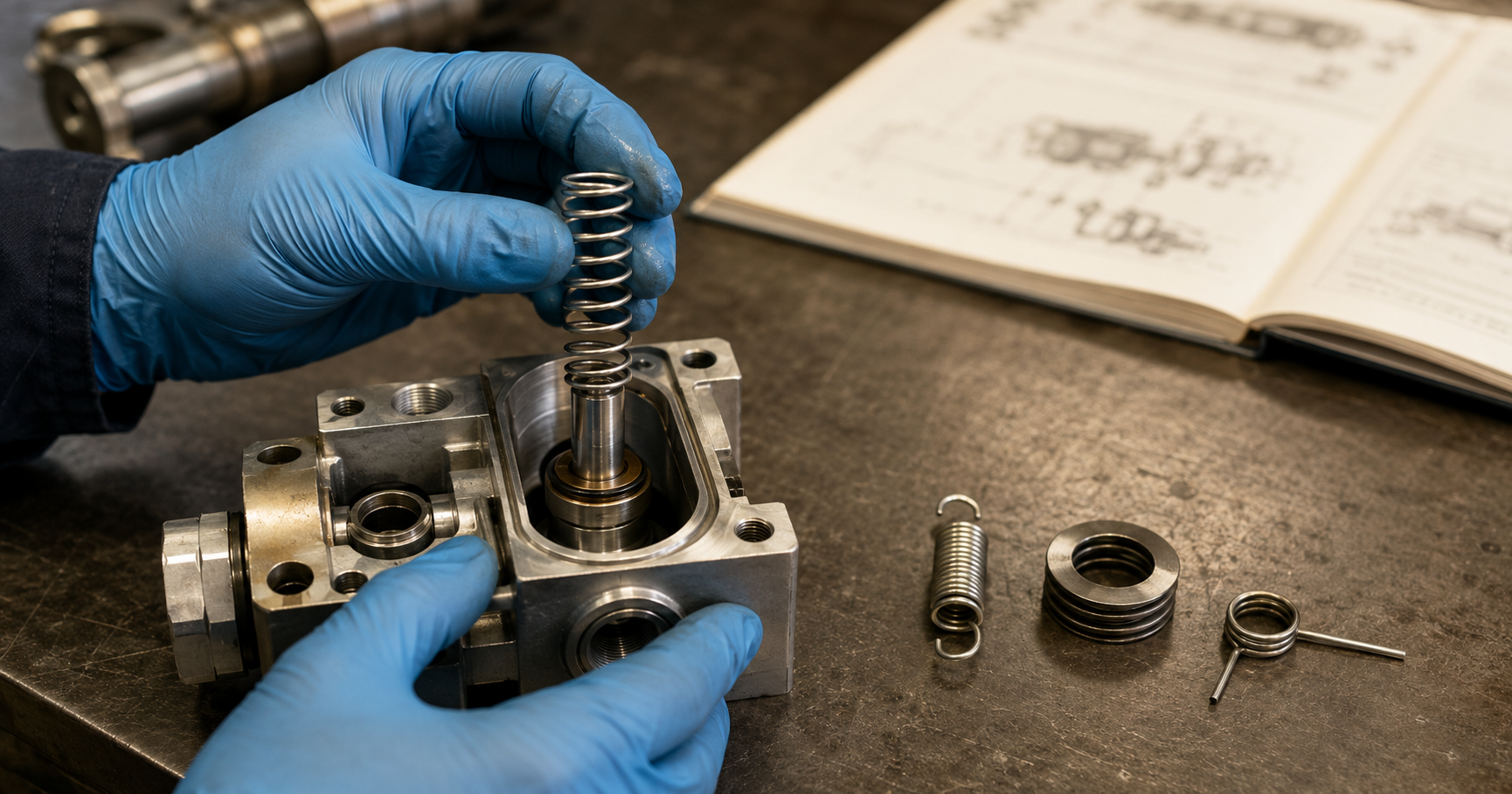
Springs are some of the most ubiquitous mechanical components in industry — and some of the most misunderstood. The same word "spring" gets attached to a 5mm music-wire compression spring inside a pen, a 200kg leaf spring under a truck, and a gas strut on a workshop bonnet. They all store and release energy, but they do it in very different ways.
This guide is the full hub. We cover every major spring type used in Australian industry — what each one does, how it works, the dimensions you need to measure for replacement or custom orders, materials, and how to choose. Where we have a deep-dive guide on a specific type (like our Compression Spring Guide), we link to it. Where AIMS doesn't routinely stock a type, we cover it for education and point you in the right direction.
If you're trying to source a spring you can't find locally — bring us the dimensions or a sample. We work with a network of Australian and overseas spring manufacturers and can quote anything from a stock match to a fully custom wound spring.
What is a spring?
A spring is a mechanical device that stores energy through elastic deformation. When you compress, stretch, or twist a spring within its elastic limit, it stores potential energy in the deformed metal. Release the load, and the spring returns to its original shape, releasing that energy back as motion or force.
The relationship between force and deflection is described by Hooke's law: F = kx, where F is the force applied, x is the deflection, and k is the spring rate (the stiffness of the spring). For most industrial springs operating within their design range, this relationship is linear — double the load gives you double the deflection.
Springs appear in almost every machine and assembly: valves, clutches, brakes, vehicle suspension, hinges, latches, locks, dies, presses, vibration isolation, retractable mechanisms, instruments, scales, switches, garage doors, mousetraps, ballpoint pens, hair clips. Industrial maintenance and engineering teams encounter springs constantly — usually when one fails and needs replacing.
The four core spring families
Engineering and procurement standards (ISO 26909, AGMA, and most spring manufacturer catalogues) classify springs by how they deform under load. There are four core families:

| Family | Deformation | Force direction | Common applications |
|---|---|---|---|
| Compression | Shortens under load | Pushes back | Valve springs, clutch springs, mattresses, ballpoint pens |
| Extension (tension) | Stretches under load | Pulls back | Trampolines, garage door counterbalance, screen doors |
| Torsion | Twists under load | Returns to angular position | Garage door overheads, hinges, clothes pegs, mousetraps |
| Constant force | Unrolls from a pre-stressed coil | Pulls with near-constant force | Tape measures, retractable cords, counterbalances |
You'll see the question "what are the 4 types of springs?" come up often. The answer above is the engineering classification. A different framing — "the 4 types of suspension springs" — refers to vehicle suspension specifically: coil, leaf, torsion bar and air. Both framings are valid; just match the answer to the question.
Beyond these four families, there are specialty types — disc springs (Belleville washers), wave springs, leaf springs, gas springs, and clock/spiral springs. Each has its own niche where the four core types don't fit. We cover all of them below.
Compression springs
Compression springs are the most common spring type in industrial use. They're open-coiled helical springs designed to resist a pushing force — they shorten under load and push back with force proportional to the deflection.
The classic shape is a uniform-diameter helix wound from round wire. Variations include conical (tapered), barrel-shaped (hourglass inverted), and hourglass — each tuned for specific load-deflection behaviour. End types matter: closed and ground ends sit flat and self-centre; closed unground ends are cheaper but less stable; open ends are used in light-duty applications where the spring sits in a guide.
Common applications include valve springs, clutch and brake mechanisms, mattress springs, retractable pen mechanisms, die springs in tooling, anti-vibration mounts, automotive suspension (coil-over), and just about any push-back assembly.
For a complete deep-dive on compression springs — sizes, end types, materials, the Wahl correction factor, surge frequency, kit selection, and how to measure for replacement — see our dedicated Compression Spring Guide.
AIMS stocks compression springs in plain finish, zinc-plated and stainless 304/316, with metric and imperial kits from suppliers including Champion (Champion CA1802 stainless 12-size kit, CA102 plain 72-piece kit, SSCCS stainless range) and GJ Works (90-piece imperial assortment kit covering compression and extension). For the full range visit our Springs collection, or contact us if you need a specific size or material we don't show online.
Extension (tension) springs
Extension springs — also called tension springs — are closed-coil helical springs designed to resist a pulling force. They stretch under load and pull back. The coils sit tight against each other in the unloaded state, and a typical extension spring has hooks or loops at each end for attaching the load.
The "tension" terminology trap: "Tension spring" and "torsion spring" sound similar but they're completely different. Tension = extension spring (pulls back when stretched, force in a straight line). Torsion = twists around an axis (rotational force). If you're sourcing a replacement and the original supplier called it a "tension spring", they almost certainly meant an extension spring.
Initial tension (preload) is the force built into the spring during manufacturing — the load required just to start opening the coils. Below the initial tension, the spring doesn't extend at all. Above it, the spring follows Hooke's law normally. A typical extension spring has 5–25% of its maximum load as initial tension.
Hook types matter as much as the spring body. Common hook configurations include:

- Machine half loop / half hook — the most common, formed from the last coil bent up
- Full loop over centre — the standard "garage door" style hook
- Side loop — hook offset from the spring axis
- Extended loop — for longer reach
- German hook / swivel hook — separate fitting for high-cycle applications
- Threaded plug — for screw-in attachment
The hook is almost always the failure point on an extension spring. Forum-validated mechanic insight: extension springs in cyclic-load applications (garage doors, machinery) typically fail at the hook bend before the body coils show any fatigue. If you're specifying for high-cycle use, choose a swivel hook or specify a stress-relieved hook.
Common applications: garage door counterbalance (extension type — runs along the track), trampoline springs, screen door closers, weighing scales, retractable assemblies, light vehicle and trailer parts, agricultural machinery.
AIMS stocks Champion stainless extension springs (Champion C101-30 and the broader stainless extension range), plus the GJ Works 90-piece imperial assortment kit (mixed compression and extension). Other sizes and hook configurations we source on request.
Torsion springs

Torsion springs twist around their axis rather than compressing or extending. The legs of the spring (one or both) are loaded with rotational force, and the spring stores energy by winding tighter. When the load is removed, it returns to its free angle.
Wind-direction warning: Torsion springs must be loaded in the direction the coils are wound — the direction that winds the spring tighter. Loading a torsion spring against its wind direction tries to unwind the body, dramatically reduces fatigue life, and is a common cause of premature failure. Right-hand wound springs are loaded clockwise (when viewed from the open end); left-hand wound the opposite. Never substitute a left-hand for a right-hand spring without confirming the load direction.
Torsion springs come in single-leg and double-leg configurations. Leg shapes vary widely — straight, formed, hooked, eyed, pinned. Spring rate is expressed as torque per degree (or per radian) of deflection, not force per millimetre.
The key dimensions for torsion springs include wire diameter, OD, ID, total coils, leg length on each side, leg position relative to body (the "free angle" — the angle between legs in the unloaded state), and crucially the wind direction. We cover measurement detail in the dedicated dimensions section below.
Torsion springs aren't the same as torsion bars. A torsion bar is a single straight rod twisted about its long axis (used in some vehicle suspensions and stabiliser bars). A torsion spring is a coiled spring that stores rotational energy. Both store energy via twisting, but the geometry is completely different.
Common applications: garage door overhead counterbalance (torsion type — sits perpendicular above the door), hinges, clothespegs, mousetraps, animal traps, clipboard clamps, lever returns on machinery, ratchet assemblies, return springs in valves and switches.
AIMS doesn't stock torsion springs as a routine line — they're nearly always size-and-leg-specific to the application. If you need a torsion spring, send us your dimensions or a sample and we'll source it through our supplier network.
Specialty helical types
Beyond the standard cylindrical helicals, several specialty helical springs handle specific engineering problems.

Conical (tapered) springs
The coil diameter changes along the length — narrow at one end, wide at the other. The benefit is a variable spring rate (gets stiffer as it compresses, because the small-diameter end goes solid first), and a very low solid height because the coils nest inside each other. Used where compactness matters — battery contacts, pen springs, light fittings, push-button mechanisms.

Wave springs
Coiled flat strip with waves stamped into it — sits in the same axial space as a thin washer but provides spring force. Wave springs deliver compression spring behaviour in 30–50% less axial space than a comparable round-wire compression spring. Common in bearings, seal assemblies, transmissions, and any tight-tolerance assembly.

Die springs
Rectangular-wire compression springs designed for heavy industrial use — pressing, forming, stamping dies, injection-mould ejectors. Colour-coded by load class (light, medium, heavy, extra-heavy) under ISO 10243. The rectangular wire allows higher force in a given OD/ID envelope than round-wire equivalents and resists buckling under heavy loads. Almost always supplied with a precise OD/ID/hole tolerance to fit standard die plates.

Drawbar springs
A compression spring fitted with a drawbar that pulls through the centre. Look like extension springs but use compression-spring body in tension. Have a built-in maximum extension — when the bar reaches the end of the spring, it stops. Used where a fail-safe extension limit is needed (gates, latches, tractor implements).
Disc springs (Belleville washers)

Disc springs — also called Belleville washers, conical disc washers, or cup washers — are conical disc-shaped springs that look like a flat washer with a slight cone. They flatten under load and provide very high spring force in a small axial space. They're some of the highest-force-per-volume springs available.
The big advantage of disc springs is that you can stack them to tune the force-deflection behaviour:
- Parallel stack (bowl-to-bowl, all facing the same way) — force adds, deflection stays the same. Two parallel discs = double the force at the same compression.
- Series stack (alternating, bowl-to-bowl, bowl-to-bowl) — deflection adds, force stays the same. Two series discs = double the deflection at the same force.
- Mixed stacks — combine parallel and series sections to get specific force-deflection curves.
Common applications include: bolted joint preload (under nuts to maintain clamp load through thermal cycling), hydraulic and pneumatic seal preload, pressure relief valves, electrical contact pressure, vibration absorbers, and industrial machinery where high force and small movement are needed.
Disc springs are standardised under DIN 2093 (manufacturing) and DIN 6796 (heavy-duty conical spring washers). Materials are typically heat-treated carbon steel (51CrV4 / SAE 6150) or stainless steel for corrosive environments. AIMS stocks Belleville-style spring washers as part of the washer range — for specialty disc-spring stacks or non-standard sizes, contact us.
Leaf springs

Leaf springs are flat strips of spring steel stacked and clamped together, typically curved in the unloaded state. Under load, the leaves flatten and store energy through bending rather than torsion. They're the oldest mechanical spring design — used on horse-drawn carriages and still found on heavy vehicles today.
The main types are:
- Semi-elliptical (multi-leaf) — the classic "stack of leaves" shape. Most common on trucks, trailers, and heavy 4WDs.
- Parabolic — fewer, thicker leaves with a parabolic taper. Lighter, gives a smoother ride, less inter-leaf friction. Common on modern trucks.
- Mono-leaf — single tapered leaf. Used in light commercial and some passenger vehicles.
- Quarter-elliptical and three-quarter-elliptical — historical designs, now mostly heritage applications.
Leaf springs are primarily a vehicle suspension component — heavy commercial vehicles, trailers, agricultural and earth-moving equipment, light commercial utes. They handle the simultaneous duties of carrying load, locating the axle, and damping motion (via inter-leaf friction).
AIMS doesn't supply leaf springs — they're a specialty category usually handled by suspension specialists, spring works (e.g. Pedders, Lovells), or vehicle parts wholesalers. We've covered the basics here for completeness; for specific leaf-spring sourcing speak to a vehicle suspension supplier.
Gas springs and gas struts
A gas spring (also called a gas strut, gas shock, or pneumatic spring) is a sealed cylinder containing pressurised nitrogen and oil, with a piston rod that extends and retracts. Pushing on the rod compresses the gas and stores energy; releasing the load lets the gas expand and push the rod back out. Unlike mechanical springs, gas springs deliver a near-constant force through most of their stroke — and built-in damping from the oil flow.
Common applications: vehicle bonnet and tailgate lift-assist, machinery covers and access panels, office chair height adjustment, hospital bed mechanisms, agricultural equipment hatches, industrial enclosures, RV/caravan compartments. Anywhere you need a heavy panel to stay up by itself without a mechanical latch.
The key spec for a gas strut is force in newtons (N). Typical AU sizes range from 50N (small cabinet doors) to 1500N+ (heavy machinery covers). Two standard configurations exist — compression-type (force pushes the rod out, the most common) and tension/traction-type (force pulls the rod in). Most lift-assist applications use compression-type.
Replacement tip: Gas struts wear out — usually after 5–10 years they leak gas and lose force. Always replace as a matched pair on dual-strut applications. To order a replacement you need extended length, stroke (the difference between extended and compressed length), force in N, and the end fittings (eyelet, ball stud, blade, clevis, threaded). We cover dimension measurement in detail below.
AIMS doesn't stock gas struts as a routine product line. Specialist suppliers (Camloc, Stabilus, Bansbach) cover this category locally — or for industrial applications we can source on request.
Constant force, clock and spiral springs
This family covers springs made from flat strip wound into a tight spiral. They look similar but function differently — and the names get used interchangeably in catalogues, which causes confusion.
Constant force springs
Pre-stressed flat steel strip, tightly wound around a small drum. As the strip is pulled off the drum, it delivers a near-constant pulling force regardless of how much has been unrolled — different from a normal extension spring where force increases with extension. Used in retractable cords, tape measures, window counterbalances, fall-arrest reels, and constant-tension applications.
Constant torque springs
The torque equivalent — a flat strip wound between two drums, delivering constant rotational force as it transfers from one drum to the other. Used in motor mechanisms, retractable mechanisms, and timer escapements.
Clock springs (mainspring)
A flat strip wound into a coil and contained in a barrel — when wound up by an external force, it stores energy that releases as the strip unwinds. The traditional power source for mechanical clocks, watches, and music boxes. The strip stores energy in bending, not in extension.
Spiral torsion springs (hair springs)
A flat strip wound in a flat spiral — provides a return torque around its centre. Used in instrument movements (gauges, meters), watch balance wheels, retractable mechanisms.
Most of these are highly specialised — for industrial applications, AIMS doesn't routinely stock this family but can source through our supplier network.
Key dimensions: how to measure a spring for replacement or custom order
This is the section to bookmark if you've got a broken spring on the bench and need a replacement, or want a custom spring quoted. Here's exactly what to measure for each spring type — and what to send AIMS if you'd like us to quote.
Compression spring dimensions
| Dimension | How to measure | Notes |
|---|---|---|
| Free length (L₀) | Total length of unloaded spring, end to end | Use vernier or steel rule; spring must be relaxed |
| Wire diameter (d) | Diameter of the wire itself | Use vernier callipers or a micrometer; measure at the body, not at ends |
| Outside diameter (OD) | Across the outside of the coils | Vernier across the widest point |
| Inside diameter (ID) | Across the inside of the coils | OD minus 2× wire diameter, or measured directly |
| Mean diameter (D) | (OD + ID) ÷ 2 | The diameter the wire centre traces |
| Total coils (Nₜ) | Count every coil including ends | Includes inactive end coils |
| Active coils (Nₐ) | Total minus end coils that don't deflect | Typically Nₜ minus 2 for closed ends |
| End type | Closed and ground / closed unground / open ground / open unground | Look at how the last coil terminates |
| Pitch | Distance between the centres of adjacent coils (free) | L₀ ÷ Nₐ approximately |
| Solid length | Length when fully compressed coil-to-coil | Nₜ × wire dia for closed-and-ground |
| Spring rate (k) | Force per unit deflection (N/mm) | Optional but useful — measure by applying known load and recording deflection |
Extension spring dimensions
| Dimension | How to measure | Notes |
|---|---|---|
| Body length | Length of the coiled body only (excluding hooks) | From where the body starts to where it ends |
| Overall free length | Total length end-to-end including hooks | Hook geometry adds significantly to this |
| Wire diameter (d) | Diameter of the wire | Measure at the body, vernier or micrometer |
| OD / ID | Outside and inside coil diameter | Body section, not at hooks |
| Hook type | Machine half loop, full loop over centre, side loop, German, swivel, threaded plug | Both ends — they may differ |
| Hook gap (inside hook) | Inside dimension of the hook opening | Critical for fitment to the load |
| Hook orientation | Hooks aligned, 90° offset, 180° offset | Affects how the spring sits in the assembly |
| Initial tension | Load required to start opening the coils | Hard to measure without a test rig — note if known |
| Spring rate (k) | Force per unit extension above initial tension | Optional |
Torsion spring dimensions
| Dimension | How to measure | Notes |
|---|---|---|
| Wire diameter (d) | Diameter of the wire | Vernier at the body |
| OD / ID | Body coil diameter | Not the legs |
| Body length | Length of the coiled section | Excluding legs |
| Number of coils | Count active coils | Affects rate |
| Leg length each side | Distance from body to leg tip | Both legs — they may differ |
| Leg shape / form | Straight, bent, hooked, formed, eyed | Both legs — record any bends or hooks |
| Free angle (leg position) | Angle between the legs in the unloaded state | Measured looking down the spring axis |
| Wind direction (LH or RH) | Look down the spring with the open end facing you | Critical — see warning above. RH = coils spiral clockwise away from you. LH = anticlockwise. |
| Torque rate | Torque per degree of deflection | Optional but useful |
Disc spring (Belleville) dimensions
| Dimension | How to measure |
|---|---|
| Outside diameter (D) | Across the rim |
| Inside diameter (d) | Across the centre hole |
| Thickness (t) | Material thickness, usually printed in DIN 2093 catalogue |
| Free height (H) | Total height of the cone in unloaded state |
| DIN reference | Note any DIN 2093 series A/B/C marking — gives full spec from catalogue |
Gas strut dimensions
| Dimension | How to measure |
|---|---|
| Extended length | End-to-end (centre of mounting eye to centre of mounting eye) when fully extended |
| Compressed length | End-to-end when fully compressed |
| Stroke | Extended length minus compressed length |
| Force (N) | Stamped on the body of most struts |
| Rod diameter | Diameter of the polished rod |
| Tube diameter | Diameter of the outer cylinder |
| End fittings | Eyelet (with bore size), ball stud (with stud size), blade, clevis, threaded |
What to send AIMS for a custom spring quote
- The measurements above for the relevant spring type (mm preferred)
- Application — what the spring does, what it loads, what it returns
- Operating environment — temperature range, wet/dry, chemical exposure, food contact
- Cycles per day or expected service life
- Material preference if any (e.g. 304 stainless for marine, music wire for cost)
- Finish requirement — plain, zinc-plated, passivated, painted, powder-coated
- Quantity — sample, prototype run, ongoing production
- A photograph of the original (or the broken pieces) is often more useful than a sketch
Send this to AIMS Industrial via our contact page or call us on (02) 9773 0122 and we'll work out what you need.
Spring rate, load and Hooke's law
Spring rate is the single most important spec on most springs. It tells you how stiff the spring is — how much force it takes to deflect it by one unit.
The formula is F = kx (Hooke's law):
- F = force applied (N or kgf)
- k = spring rate (N/mm or kgf/mm)
- x = deflection from free length (mm)
So a 5 N/mm compression spring needs 5 N of force to compress it 1 mm. To compress it 10 mm takes 50 N. Linear, predictable. This holds within the spring's elastic range — push past the elastic limit and the spring takes a permanent set (a shorter free length than original).
Spring rate units in AU industry are typically N/mm. You'll also see kgf/mm (kilogram-force per mm — common on auto spring catalogues), lb/in (American), and N/m for instrument springs. Conversion: 1 kgf/mm ≈ 9.81 N/mm; 1 lb/in ≈ 0.175 N/mm.
How to measure spring rate without a test rig: Place the spring on a scale, push down with a flat plate, record the load and the deflection from free length. Repeat at two or three load points. Spring rate = change in load ÷ change in deflection. Avoid the very start (initial seating) and the very end (approaching solid).
Linear vs progressive: Most cylindrical compression and extension springs are linear (constant rate). Conical, barrel, and progressive-pitch springs deliver a variable rate — softer at low loads, stiffer at high loads — which is useful in vehicle suspension and seat springs. Progressive springs are tuned to provide comfort at low load and capacity at high load.
Materials and finishes
Spring material choice depends on operating temperature, corrosion environment, fatigue cycles, magnetic requirements, and cost.
| Material | Typical use | Notes |
|---|---|---|
| Music wire (ASTM A228) | General compression, extension, torsion to 120°C | High-carbon steel, very high tensile strength, low cost. The default for most light-to-medium springs. Not corrosion-resistant. |
| Oil-tempered (ASTM A229) | Larger industrial springs, automotive | Heat-treated carbon steel. Good for thicker wire than music wire. Not corrosion-resistant. |
| Hard-drawn (ASTM A227) | Low-cost light-duty springs | Cold-drawn carbon steel. Lower fatigue strength than music wire — used where cost dominates. |
| Chrome silicon (ASTM A401) | Heavy industrial, valve springs, high-stress applications to 220°C | Excellent fatigue and shock resistance. Common in engine valve springs and high-cycle industrial. |
| Chrome vanadium (ASTM A232) | High-cycle, shock-load applications to 220°C | Similar to chrome silicon. Used in vehicle and machinery service. |
| 302 / 304 stainless | Mild corrosion environments to 230°C | General-purpose stainless. Lower tensile than carbon steels — needs larger wire dia for equivalent strength. Slightly magnetic after cold-working. |
| 316 stainless | Marine, food-grade, chemical environments to 290°C | Better corrosion resistance than 304, especially in chloride environments. AIMS Champion compression and extension springs use 316/A4. |
| 17-7 PH stainless | High-strength stainless to 340°C | Precipitation-hardening stainless. Higher strength than 302/304 stainless. |
| Inconel X-750 | High-temperature service to 540°C | Nickel alloy. Used in turbines, exhaust, high-temp valves. |
| Phosphor bronze / beryllium copper | Electrical contact springs, non-magnetic applications | Conductive, non-magnetic. Lower strength than steel — used where electrical or magnetic properties drive selection. |
Finishes for carbon-steel springs include:
- Plain (mill finish) — no coating; for indoor dry use only, will rust quickly otherwise
- Oil-dipped / black oxide — minimal corrosion protection, good for indoor industrial
- Zinc-plated (electroplating) — moderate corrosion resistance, suitable for most workshop and indoor use
- Hot-dip galvanised — heavy zinc layer, outdoor use, but coating thickness can affect spring rate on small wire diameters
- Powder coat — durable colour finish, good corrosion barrier; thickness affects fitment in tight assemblies
- Passivation — for stainless springs, removes free iron from the surface to maximise corrosion resistance
How to choose, source or quote a custom spring
A simple decision tree for picking the right spring:
- What does the spring need to do? Push back (compression), pull back (extension), return to angle (torsion), lift assist (gas), preload bolt (Belleville), counterbalance constant load (constant force).
- How much force, at what deflection? The spring rate × deflection at maximum load. Get this right and most other choices follow.
- What's the operating environment? Wet, salty, hot, cold, chemical, food contact — drives material selection.
- How many cycles? A spring that operates once a week will tolerate higher stress than one that cycles 1,000 times a day. Cycles drive material choice and stress-relief specification.
- What space do you have? Determines OD/ID limits, free length, solid height (compression) or maximum extension (extension). Specialty types (conical, wave) come in here.
- Standard or custom? If you can find a stock match, use it. If not, custom is faster and easier than most people expect.
Standard kits and assortments work well for replacing common compression and extension springs in maintenance situations. Champion CA1802 (compression, stainless, 12 sizes), Champion CA102 (compression, plain, 72 pieces), and the GJ Works 90-piece imperial kit cover most workshop replacement needs.
For specific known sizes, individual springs in the AIMS range are available in metric and imperial, plain and stainless. Browse our Springs collection for what's stocked.
For springs we don't show online — torsion springs, gas struts, oversize compression, custom rates, specialty alloys, very high-cycle applications — get in touch. We work with a network of Australian and overseas spring manufacturers and can quote anything from a stock match to a fully custom wound spring. Send us your dimensions or call (02) 9773 0122.
Springs at AIMS Industrial
AIMS stocks a complete range of compression and extension springs for industrial maintenance and engineering, including:
- Champion compression springs — stainless 316/A4, plain finish, individual and assortment kits (CA1802, CA102, SSCCS range)
- Champion extension springs — stainless 316/A4 individual sizes (Champion C101 series)
- GJ Works imperial assortment kit — 90-piece compression and extension mix, the workshop go-to
- Champion compression spring assortment refills — replacement packs for the kits
- Macnaught grease pump replacement springs — OEM replacements for K-series grease pumps
Stock it. Replace it. Custom quote it.
Shop compression & extension springs — Champion & GJ Works stocked
AIMS stocks Champion stainless and plain finish compression and extension springs, GJ Works assortment kits, and Belleville-style spring washers — with fast Australia-wide dispatch. Need torsion springs, gas struts, or custom wound springs? Contact our team for a quote.
Spring Material & Wire Reference Chart
Selecting the right spring wire material is the second most important decision after specifying the spring rate. The table below covers the primary wire standards encountered in Australian industry — tensile strength values are approximate ranges across common wire gauges; finer wire achieves higher tensile strength than heavier gauges in the same material. All standard citations in this table are [VERIFY:] and should be confirmed against current editions before use in a formal specification.
| Material | Standard [VERIFY:] | Tensile Strength MPa (approx.) | Max Service Temp (°C) | Best For | Avoid In |
|---|---|---|---|---|---|
| Music wire (piano wire) | ASTM A228 | 1,900–2,700 | 120 | High-stress compression and extension springs, fatigue applications, precision instruments | Corrosive environments, temperatures above 120°C |
| Hard-drawn carbon steel | ASTM A227 | 1,400–1,900 | 120 | General-purpose compression springs, cost-sensitive static-load applications | Saltwater, high-fatigue cycling, impact loads |
| Oil-tempered carbon steel | ASTM A229 | 1,400–1,900 | 150 | Heavier compression springs (wire >5 mm), automotive and industrial static loads | High-fatigue cycling (lower than A228 in this regard), corrosive environments |
| Chrome-vanadium alloy | ASTM A231 | 1,500–1,800 | 220 | Shock and impact loads, high-cycle fatigue, valve springs, elevated temperature service | Highly corrosive environments, cryogenic applications |
| Chrome-silicon alloy | ASTM A401 | 1,700–2,000 | 245 | High-temperature springs (>150°C), maximum fatigue life, engine valve and heavy-duty industrial springs | Cryogenic service, cost-sensitive low-cycle applications |
| Stainless steel 302 / 304 | ASTM A313 (Type 302/304) | 1,100–1,900 | 230 | Corrosion-resistant springs, food and pharmaceutical processing, mild marine and general industry | Hot chloride environments (stress corrosion cracking), temperatures above 230°C long-term |
| Stainless steel 316 | ASTM A313 (Type 316) | 1,100–1,700 | 290 | Marine, seawater, chloride-rich environments, food and pharmaceutical requiring higher corrosion resistance than 304 | Hot chloride stress corrosion cracking above 60°C, highest-fatigue applications |
| 17-7 PH stainless | ASTM A313 (Type 631) [VERIFY: current type designation] | 1,400–1,800 | 340 | High-strength stainless service, elevated temperature stainless applications, aerospace and defence components | Cost-sensitive applications (significant premium); specialist quoting required |
| Inconel X-750 | ASTM B637 | 1,100–1,300 | 650 | Very high temperature service (>300°C), corrosive and hot environments, turbine and exhaust springs | Cost-sensitive applications (major cost premium over steel) |
| Beryllium copper | ASTM B197 | 1,100–1,300 | 200 | Electrical contact springs, non-magnetic applications, high electrical conductivity requirements | Cost-sensitive applications; machining dust hazard (requires controls); specialist quoting required |
Verification note: Tensile strength values are indicative ranges across common wire diameters (approximately 0.5–10 mm). Finer wire achieves higher tensile strength. Actual values for a specific diameter must be confirmed against the current edition of the relevant ASTM standard or supplier material test certificate before use in a specification. Service temperature limits are continuous service values; peak or short-duration exposure limits differ and should be confirmed with the spring manufacturer.
Compression Spring Rate Formula Reference
The theoretical spring rate for a close-coiled helical compression spring is calculated from the standard shear modulus formula. This gives the design starting point — manufactured springs should always be verified against a load-deflection test, as real-world variation in wire diameter, coil diameter and end conditions affects the result.
Formula: k = Gd&sup4; / (8D³N)
| Variable | Description | Unit | Notes |
|---|---|---|---|
| k | Spring rate (stiffness) | N/mm | Force required to deflect the spring by 1 mm |
| G | Shear modulus (modulus of rigidity) | MPa (N/mm²) | Material-dependent — see table below [VERIFY:] |
| d | Wire diameter | mm | Measure at the spring body using vernier callipers or micrometer |
| D | Mean coil diameter | mm | Mean = (OD + ID) ÷ 2 = OD − d |
| N | Number of active coils | — | Total coils minus inactive end coils (typically 2 for closed-and-ground ends) |
Shear Modulus (G) — Common Spring Materials [VERIFY:]
| Material | G (approx. MPa) |
|---|---|
| Carbon steel (music wire, hard-drawn, oil-tempered) | ~80,000 |
| Alloy steel (chrome-vanadium, chrome-silicon) | ~79,000–80,000 |
| Stainless steel 302 / 304 / 316 | ~69,000–73,000 |
| 17-7 PH stainless | ~71,000 [VERIFY:] |
| Inconel X-750 | ~76,000 [VERIFY:] |
| Beryllium copper | ~48,000 [VERIFY:] |
Worked Example
A carbon steel compression spring:
- Wire diameter (d) = 2 mm
- Mean coil diameter (D) = 20 mm
- Active coils (N) = 10
- Material: carbon steel, G = 80,000 MPa
k = Gd&sup4; / (8D³N)
k = (80,000 × 2&sup4;) / (8 × 20³ × 10)
k = (80,000 × 16) / (8 × 8,000 × 10)
k = 1,280,000 / 640,000
k = 2.0 N/mm
This spring needs 2.0 N of force to compress 1 mm. To compress 10 mm requires 20 N. To compress 25 mm requires 50 N.
Extension and torsion spring formulas: Extension springs use the same shear modulus formula as compression springs for rate calculation. Torsion springs use a different formula based on the flexural (Young's) modulus. For complex calculations, custom spring design, or applications where an exact spring rate is critical, contact the AIMS team — we work with spring manufacturers who can provide full engineering support including FEA on critical applications.
Spring Wire Standards Reference
Spring wire procurement and specification in Australia involves a mix of Australian/New Zealand, ISO and ASTM references depending on supplier origin and end-use requirements. The table below covers the primary standards encountered on supply documentation. All edition years are [VERIFY:] — confirm current editions via Standards Australia and ISO before citing in a formal specification.
| Standard [VERIFY: edition year] | Scope | When You’ll See It |
|---|---|---|
| AS 1443 [VERIFY:] | Cold-drawn carbon steel wire for springs [VERIFY: confirm this covers spring wire specifically vs general drawn wire — scope distinction matters] | Australian national standard for carbon spring wire; may appear on locally sourced or Australian-manufactured spring certification |
| AS 1444 [VERIFY:] | Wrought alloy steels — standard, hardenability (H) and hardenability-controlled (HH) series [VERIFY: check whether this covers spring-specific alloy wire or applies more broadly to bar/rod material] | Relevant when specifying alloy steel spring wire grades (chrome-vanadium, chrome-silicon) in Australian procurement |
| ISO 8458-1 [VERIFY:] | Steel wire for mechanical springs — Part 1: General requirements | International framework standard; often cross-referenced alongside ASTM A228/A229/A231 on multi-standard certifications |
| ISO 8458-2 [VERIFY:] | Steel wire for mechanical springs — Part 2: Patented and cold-drawn unalloyed steel wire | ISO equivalent of ASTM A228 (music wire) and A227 (hard-drawn); common on European-origin wire and imported springs |
| ISO 8458-3 [VERIFY:] | Steel wire for mechanical springs — Part 3: Stainless steel wire | ISO equivalent of ASTM A313 for stainless spring wire; appears on 304 and 316 stainless spring certifications from European and Asian manufacturers |
| ISO 4960 [VERIFY:] | Cold-rolled narrow steel strip — technical delivery conditions | Covers flat spring strip (used in flat springs, clock springs, constant force springs) rather than round wire |
| EN 10270-1 / -2 / -3 [VERIFY:] | Steel wire for mechanical springs — Part 1 (patented cold-drawn), Part 2 (oil-hardened and tempered), Part 3 (stainless steel wire) | European standard; very common on European-origin springs and increasingly specified in AU engineering documents. EN 10270-3 = stainless spring wire. |
Wrong-family alert: AS 1442 is the standard for hot-rolled carbon steel bars (raw bar material, not spring wire — don’t cite it in a spring wire specification). AS 1666 covers wire rope for lifting and rigging, not spring wire. Neither should appear on spring wire purchase specifications or material certifications. If you see these numbers cited on a spring datasheet, it’s likely a wrong-family error.
Related Engineering Reference Resources
Spring material selection sits alongside broader material, dimensional and tool selection decisions. These AIMS reference pages cover the adjacent engineering data:
- Workpiece Material Cross-Reference Chart — ISO VDI 3323 material groups mapped to international equivalents including AS/NZS, SAE, DIN, BS, JIS and GOST standards
- Steel Grades Comparison Chart — 1020, 4140, 4340, D2, H13 and stainless grades side by side with properties and typical applications
- Material Density Chart — steel, aluminium, brass, copper, titanium and more in kg/m³ for weight and deflection calculations
- Hardness Testing Guide — Rockwell, Brinell and Vickers hardness scales, conversions, and what hardness means for spring wire
- Cutting Tool Materials Guide — HSS, cobalt, carbide and PM-HSS tool material properties (cross-relevant for understanding alloy steel grades)
- Metric to Imperial Conversion Chart — wire gauges (SWG, AWG), drill sizes and dimensional conversions
- Browse springs at AIMS Industrial — Champion and GJ Works stocked springs; custom sourcing available for torsion, gas struts and non-standard sizes
Frequently Asked Questions
What is the difference between a compression and an extension spring?
A compression spring shortens when force is applied to its ends — it stores energy by being squeezed and pushes back. An extension spring stretches when force is applied — it stores energy by being pulled apart and pulls back. Compression springs have open coils with space between them; extension springs have tightly wound coils with hooks at each end. They're not interchangeable: a compression spring used in tension will be destroyed at the ends; an extension spring used in compression will buckle and lose its initial tension.
What is the difference between a tension spring and a torsion spring?
A "tension spring" is the same thing as an extension spring — it pulls in a straight line when stretched. A torsion spring twists around its axis and stores rotational energy. The names sound similar but the geometry, application and replacement parts are completely different. If a parts list calls for a "tension spring", it almost always means an extension spring — but check the application: if the load is rotational (a hinge return, a clothes peg) it's a torsion spring.
What are the four main types of springs?
The four core families used in engineering classification are compression, extension, torsion and constant force. Beyond these, common specialty types include disc (Belleville), wave, leaf, gas, and clock/spiral springs. If the question is about vehicle suspension rather than springs in general, the four types are coil, leaf, torsion bar and air.
Are coil springs and helical springs the same thing?
"Helical" describes the geometry — wire wound in a helix shape. "Coil" is the everyday word for the same thing. Compression, extension and torsion springs are all helical (and all "coil") springs — they share the same basic geometry but load differently. The energy storage mechanism in all helical springs is actually torsional — the wire twists about its own axis as the spring deflects.
What is spring rate and how do I calculate it?
Spring rate (k) is the force needed to deflect the spring by one unit of length, expressed as N/mm in metric. Hooke's law says F = kx, where F is force and x is deflection. To measure the rate of an existing spring, apply a known load (with a scale or weight), measure the deflection, and divide. Repeat at a couple of load points to confirm linearity. Calculated values from spring formulas are also possible if you know the wire diameter, mean diameter, active coils and shear modulus of the material.
Why does a torsion spring have a wind direction?
A torsion spring stores energy by being twisted further in the direction it's already wound — this winds the body tighter, packing energy into the metal. Loading it the other way unwinds the body, which fatigues the material much faster and dramatically shortens the spring's life. Right-hand wound springs are loaded clockwise (when looking at the open end); left-hand wound springs anticlockwise. Always check the wind direction before substituting.
What is the most common type of spring failure?
The failure mode depends on the spring type. Extension springs typically fail at the hook bend — the hook is a stress concentration point. Compression springs often fail by taking a permanent set (becoming shorter than original) when overloaded, or by surge fatigue at high cycle rates. Torsion springs fail by fracture at the leg-to-body transition, often when loaded in the wrong direction. Most spring failures happen long before the body coils show any visible damage.
Are Belleville washers and disc springs the same thing?
Yes — Belleville washer, disc spring, conical disc washer and cup washer all describe the same family of springs: a slightly conical disc that flattens under load. They deliver high force in a small axial space and can be stacked (parallel for more force, series for more deflection) to tune the load-deflection curve. DIN 2093 covers the standard sizes for industrial disc springs.
Can I use a compression spring as an extension spring?
No. Compression springs have open coils designed to handle being squeezed; they have no hooks or attachment points for tension load. Pulling on the ends of a compression spring will distort the end coils and the spring will lose its initial geometry. If you need to convert direction of load, use a drawbar spring (a compression spring with an internal pull rod that converts the compression to a pulling action with a built-in maximum extension).
What's the difference between a gas spring and a coil spring?
A gas spring uses pressurised nitrogen and oil in a sealed cylinder with a piston rod — it provides near-constant force through most of its stroke and includes built-in damping from the oil. A coil (helical) spring uses elastic deformation of metal wire — force varies linearly with deflection. Gas springs are used where you want constant lift force (bonnets, tailgates, machinery covers); coil springs where you want a force that scales with deflection.
What material is best for a corrosion-resistant spring?
For most corrosive environments, 316 stainless steel (sometimes called A4) is the standard choice — better chloride resistance than 304/A2. For severely corrosive or saltwater applications, consider 17-7 PH stainless or specialty nickel alloys. For high-temperature corrosion, Inconel X-750. Note that stainless springs have lower tensile strength than carbon steel, so the spring may need to be physically larger (thicker wire or more coils) to match the load capacity of a carbon-steel equivalent.
What measurements do I need to send AIMS for a custom spring quote?
For a compression or extension spring: free length, wire diameter, OD, ID, end type (or hook type for extension), and ideally the spring rate or the load you need at a given deflection. For a torsion spring: wire diameter, OD, body length, leg length on each side, free angle between legs, and crucially the wind direction (LH or RH). Plus your application (what loads the spring), operating environment (temperature, wet/dry, chemical), expected cycles, material preference, finish, and quantity. A photograph of the broken or original spring is usually more useful than a sketch.
How do I measure a spring for replacement?
For a compression spring: free length end to end, OD across the outside, wire diameter at the body, count the total coils, note the end type (closed and ground / closed unground / open). For an extension spring: body length only (excluding hooks), OD, wire diameter, count the body coils, and record the hook type and gap. For a torsion spring: body length, OD, wire diameter, count the coils, measure each leg length, the free angle between legs, and note LH or RH wind. Use vernier callipers or a micrometer for wire diameter — a steel rule isn't precise enough.
What is a constant force spring used for?
Constant force springs deliver a near-constant pulling force regardless of how much they've been extended — different from a normal extension spring where force scales with extension. Common uses include retractable cords (vacuum cleaner, hair dryer, fall-arrest reels), tape measures, window counterbalances, motor brushes (maintaining contact pressure as the brush wears), and machine guards that retract automatically.
What is the difference between a torsion spring and a torsion bar?
Both store energy by twisting, but the geometry is completely different. A torsion bar is a single straight rod twisted about its long axis — used in some vehicle suspensions and as anti-roll bars. A torsion spring is a coiled spring with two legs that twists around its coil axis when the legs are loaded rotationally. They're not interchangeable as components, even though both rely on the torsional stiffness of metal.
Need the right torque value? Our Metric Bolt Torque Chart covers every common grade and size.
What is the difference between ASTM A227 and ASTM A229 spring wire?
Both are carbon steel spring wire, but they differ in manufacture and performance. ASTM A227 (hard-drawn) is cold-drawn carbon steel — economical and adequate for general static-load springs. ASTM A229 (oil-tempered) is heat-treated after drawing, which improves fatigue resistance and raises the continuous service temperature limit to around 150°C (vs 120°C for A227). For springs that cycle repeatedly under load — valve springs, latch mechanisms, anything that moves thousands of times — A229 is the better choice. For static springs where cost is the driver, A227 is sufficient. [VERIFY: current ASTM revision]
Why is music wire (ASTM A228) the default spring material?
Music wire achieves the highest tensile strength of any standard carbon steel spring wire — typically 1,900–2,700 MPa depending on wire diameter — because it’s drawn from very high-purity, high-carbon steel through a series of precision dies. This allows a spring made from music wire to store more energy per unit volume than an equivalent spring in hard-drawn or oil-tempered wire. It’s also consistent from batch to batch. Trade-offs: it’s not suited to corrosive environments or temperatures above ~120°C, and it costs more than A227. Most light-to-medium industrial compression and extension springs are music wire unless corrosion or temperature drive a different choice. [VERIFY: current ASTM A228 revision]
Why do stainless steel springs have lower load capacity than carbon steel springs of the same size?
Stainless steel spring wire (ASTM A313) has a lower shear modulus (G ≈ 69,000–73,000 MPa) and lower achievable tensile strength than carbon steel (G ≈ 80,000 MPa). The lower shear modulus means a stainless spring of identical dimensions has a lower spring rate than its carbon steel equivalent. The lower tensile strength means the maximum allowable stress — and therefore the maximum load capacity — is also reduced. To match the performance of a carbon steel spring, a stainless spring typically needs a larger wire diameter, a smaller mean coil diameter, or more active coils, all of which increase physical size and material cost. This is the main reason stainless springs are larger and more expensive than carbon steel equivalents for the same duty.
What is the spring rate formula and how do I use it?
The standard formula for a helical compression spring is k = Gd&sup4; / (8D³N), where k is the spring rate in N/mm, G is the shear modulus of the wire material (approximately 80,000 MPa for carbon steel, 70,000 MPa for stainless), d is the wire diameter in mm, D is the mean coil diameter in mm, and N is the number of active coils. Example: a carbon steel spring with d = 2 mm, D = 20 mm, N = 10 gives k = (80,000 × 16) / (8 × 8,000 × 10) = 2.0 N/mm. This is the theoretical value — always verify the manufactured spring with a load-deflection test for critical applications. [VERIFY: G values against current engineering references]
What does “active coils” mean in spring calculations?
Active coils are the coils that deflect under load and contribute to the spring rate. In a compression spring with closed-and-ground ends, the end coils are pressed flat against adjacent coils and don’t deflect — they’re "dead" or inactive coils. A spring with 12 total coils and closed-and-ground ends typically has around 10 active coils (12 total minus 2 inactive end coils). The spring rate formula uses active coils, not total coils. Using total coils in the formula gives an incorrect (artificially stiffer) result. When counting for replacement: count all the coils visible in the body, then subtract the end coils based on the end type.
What spring material is best for food processing or pharmaceutical applications in Australia?
316 stainless steel (ASTM A313 Type 316) is the standard choice for food and pharmaceutical spring applications. The molybdenum content in 316 gives better chloride resistance than 304 — important where chlorine-based cleaning agents (sodium hypochlorite) or sodium hydroxide (caustic soda) are used in washdown. For applications requiring formal certification, request material test certificates (MTCs) confirming ASTM A313 compliance. Passivated or electropolished surfaces improve both cleanability and corrosion resistance over as-drawn wire. In Australia, food-contact spring materials should also be confirmed against FSANZ requirements for the specific end-use. [VERIFY: current FSANZ requirements for your application]
Can I order custom springs through AIMS?
Yes. AIMS works with a network of Australian and overseas spring manufacturers and can source custom springs from a technical specification. For a compression or extension spring, provide: free length, wire diameter, OD, end type (or hook type), material, finish, and either the required spring rate or the load at a working height. For torsion springs: wire diameter, OD, body length, leg lengths on each side, free angle, wind direction (LH or RH), and application description. A photograph of the original or the broken pieces is often the most useful starting point. Contact the AIMS team via the contact page or call (02) 9773 0122.
What Australian standard covers spring wire?
AS 1443 covers cold-drawn carbon steel wire for springs in Australia [VERIFY: current scope and edition — confirm it applies specifically to spring wire rather than general drawn carbon wire]. For alloy steel spring wire, AS 1444 covers wrought alloy steel grades relevant to chrome-vanadium and chrome-silicon spring applications [VERIFY: edition and scope]. Internationally, ISO 8458-1, -2 and -3 cover steel wire for mechanical springs and are widely referenced on supply certifications in Australia regardless of wire origin. European spring wire is typically certified to EN 10270-1/-2/-3. In practice, most quality spring wire documentation cites ASTM designations (A228, A227, A229, A231, A313 etc.) alongside ISO equivalents. Note: AS 1442 (hot-rolled carbon steel bars) and AS 1666 (wire rope) are not spring wire standards — don’t conflate them.
People Also Ask — Types of Springs
Q: What are the main types of industrial springs?
The four main types are compression springs (resist being shortened), extension springs (resist being stretched), torsion springs (store rotational energy), and flat springs (leaf and disc springs for axial loads). Each type suits different load directions and applications. Compression springs are the most common, found in valves, mechanisms, and return assemblies.
Q: What is a compression spring used for?
Compression springs resist being compressed and push back to their free length when the load is removed. Common applications include valve return mechanisms, tooling fixtures, clutch assemblies, and suspension systems. Selecting the right spring requires specifying free length, loaded length, load at that height, coil diameter, and wire diameter.
Q: What is spring rate, and why does it matter?
Spring rate (or spring stiffness) is the force required to compress or extend a spring by one unit of length, measured in N/mm. A high spring rate means a stiff spring that deflects little under load; a low rate means a compliant spring. Spring rate determines how the spring behaves in service and must match the application's force and travel requirements.
Q: What materials are industrial springs made from?
Most springs are made from carbon spring steel or alloy steel (chromium-silicon or chromium-vanadium) for standard industrial use. Stainless steel 304 or 316 is used where corrosion resistance is needed — marine, food processing, and chemical environments. Inconel and titanium are used for very high temperature or aggressive chemical exposure.
Q: How do you select the right spring for an application?
Define the force required at the working height, the free length, the available envelope (outer and inner diameter), the number of cycles expected, and the operating environment. Spring suppliers use these parameters to select wire gauge, coil diameter, and number of turns. For critical applications, provide a full specification rather than using a nearest-size catalogue spring.
Need o-rings and o-ring kits? Browse the AIMS range at o-rings and o-ring kits.

