

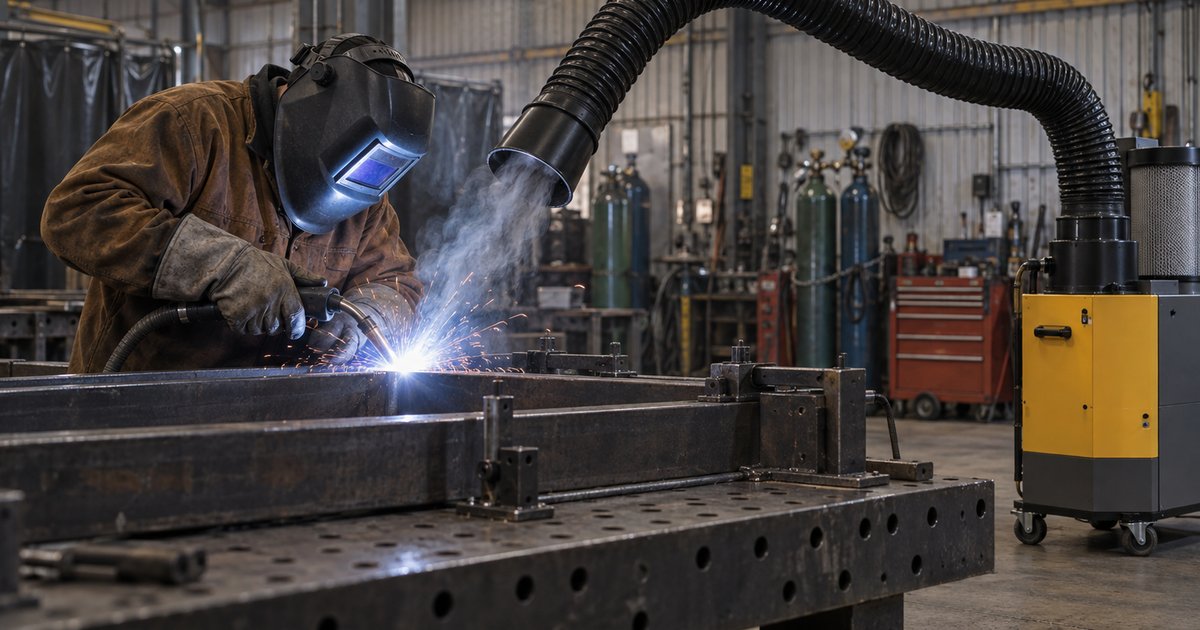
Workshop ventilation and fume extraction is now the single most-changed area of Australian workplace safety. In 2017 the International Agency for Research on Cancer (IARC) reclassified welding fume from Group 2B (possibly carcinogenic) to Group 1 (definite human carcinogen), based on sufficient evidence linking welding fume to lung cancer. In response, Safe Work Australia reduced the Workplace Exposure Standard for welding fume from 5 mg/m³ to 1 mg/m³ inhalable fraction — a 5× more stringent limit. Recent assessment research found most Australian welding workplaces that met the old 5 mg/m³ limit now operate above the new 1 mg/m³ threshold. The implication is direct: control measures that were previously adequate are likely insufficient under current law, and most workshops need immediate reassessment.
This guide is for Australian workshops, fabrication shops, welding bays, automotive workshops, mechanical workshops, electronics workshops, laser cutting facilities, and any industrial site where welding, soldering, cutting, grinding, or chemical work produces airborne contaminants. It covers the source-capture engineering control hierarchy under AS/NZS 1668.2:2024 and AS/NZS 1715:2009, decoded for practical workshop application — fume extractor selection, capture arm sizing, CFM math, filter technology, AS WES compliance, and the welding fume carcinogen reality. AIMS stocks a range of Bossweld workshop fume extraction equipment and sources broader industrial ventilation and fume control through our supplier network. This article completes the three-article workshop air quality cluster alongside our Industrial Cooling Guide and Industrial Heating Guide.
Why workshop fume extraction matters — IARC Group 1, the new 1 mg/m³ WES, and worker cancer risk
The 2017 IARC reclassification of welding fume to Group 1 was based on epidemiological evidence that welders have measurably higher lung cancer rates than the general population, with sufficient evidence to establish causation. The Cancer Council Australia has issued formal position statements aligned with the IARC finding. Practical translation: welding fume is now in the same regulatory category as asbestos, tobacco smoke, and diesel engine exhaust — all confirmed human carcinogens.
The Australian regulatory response: the WES for total welding fume dropped from 5 mg/m³ to 1 mg/m³ (inhalable fraction). For hexavalent chromium — produced when stainless steel is welded — the WES is 0.01 mg/m³, one hundred times more stringent than total fume. Cr(VI) is itself an IARC Group 1 carcinogen with documented lung cancer and other health effects.
The second major welding fume health concern is manganese, present in most MIG and MMA filler wires. Chronic manganese exposure causes manganism — a progressive neurological condition with symptoms resembling Parkinson's disease (tremors, muscle rigidity, cognitive impairment). Unlike lung cancer which presents decades after exposure, manganism progression can be measurable within years of chronic exposure to elevated fume.
The honest reality from Australian occupational hygiene assessment: workshops that ran adequate fume control under the old 5 mg/m³ WES are typically operating non-compliant under the new 1 mg/m³ WES. Welders who weren't experiencing visible fume exposure issues under the old rules are likely accumulating dose toward lung cancer risk under the new rules. This is not theoretical regulatory tightening — it's a measurable workplace exposure gap that needs engineering controls.
Recent regulatory changes — what changed in 2024 and 2025
Australian welding fume regulation has tightened significantly in the past 18 months. Three regulatory changes affect every Australian welding workshop, fabrication shop, automotive workshop, and any site where welding is performed:
| Date | Change | Workshop impact |
|---|---|---|
| 18 January 2024 | Workplace Exposure Standard for welding fume (not otherwise classified) reduced from 5 mg/m³ to 1 mg/m³ inhalable fraction (8-hour TWA) | Most workshops that met the old standard now operate above the new limit. Control measure reassessment required. |
| 17 November 2025 | Workplace Exposure Standard for aluminium welding fume reduced from 5 mg/m³ to 1 mg/m³ inhalable fraction | Aluminium welding workshops (boilermakers, marine, aerospace, food and beverage stainless / aluminium fabrication) now subject to the same tighter limit as other welding fume |
| Ongoing (WHS Regulation Schedule 14) | Health monitoring required for workers with significant welding fume exposure — spirometry, chest X-ray, blood/urine tests for metals, physical examination | Employer obligation to provide and pay for periodic health monitoring of exposed workers |
The 2024 and 2025 WES changes were national — Safe Work Australia endorsed the lower limits and each state's regulator (SafeWork SA, SafeWork NSW, WorkSafe Victoria, WorkSafe Queensland, WorkSafe Tasmania, WorkSafe WA, WorkSafe NT, ACT WorkSafe) implemented on the same effective date. There is no state where the welding fume WES is more relaxed than 1 mg/m³.
Individual component WES requirement: the obligation is not only to meet the 1 mg/m³ total welding fume limit. PCBUs (persons conducting a business or undertaking) must determine the composition of welding fumes at their workplace and ensure that no worker is exposed above the WES for each individual component — hexavalent chromium (0.01 mg/m³), manganese, nickel, iron oxide, copper, zinc oxide, and others depending on the welding consumables and base materials used. The total WES of 1 mg/m³ is a ceiling; individual component limits can be reached well before the total is approached, particularly for stainless welding where Cr(VI) drives the control requirement.
Practical interpretation: if your workshop welds stainless steel, the Cr(VI) limit of 0.01 mg/m³ is almost always the binding constraint — total welding fume may be well under 1 mg/m³ but Cr(VI) at the welder's breathing zone can be over 0.01 mg/m³ without aggressive source capture. The Australian occupational hygiene community has formally flagged that historical control measures designed for the old 5 mg/m³ total WES generally do not achieve the current Cr(VI) component standard.
Welder health monitoring — Schedule 14 WHS Regulations
Schedule 14 of the model Work Health and Safety Regulations identifies hazardous chemicals and processes for which health monitoring is required. Welding fume exposure exceeds the threshold for health monitoring under several Schedule 14 entries — particularly manganese, hexavalent chromium, nickel, and the broader category of respiratory sensitisers.
The Code of Practice recommends the following health monitoring components for workers with significant welding fume exposure (typically defined as more than 2-4 hours per day of welding, regularly):
- Pre-employment baseline — symptom/exposure history questionnaire, spirometry (lung function testing), chest X-ray (baseline), blood and urine testing for metals (particularly manganese, chromium, nickel), physical examination of respiratory and skin health
- Periodic monitoring — annual or biennial spirometry, symptom questionnaire, blood/urine metals testing (depending on welding consumables used and workplace fume monitoring results)
- Exit monitoring — when the worker leaves welding work, a final health monitoring assessment
- Record keeping — health monitoring results must be retained for 30 years after employment ends
The employer (PCBU) is responsible for arranging and paying for health monitoring, and must provide results to the worker. Workers cannot be required to pay for their own health monitoring under WHS legislation. The 30-year record retention requirement reflects the long latency of welding fume-related cancers — chest X-ray and exposure history records may be needed decades after employment ends.
For workshop operators: health monitoring is not optional when significant welding fume exposure is present. The cost is typically several hundred dollars per worker per year and is regarded as a normal cost of running a welding workshop. Workshops that haven't formalised health monitoring should engage an occupational health provider (such as Sonic HealthPlus, Resile, or local occupational physicians) and establish a baseline program.
The engineering control hierarchy — source capture, general ventilation, then respirator
AS/NZS 1715:2009 (Selection, use and maintenance of respiratory protective equipment) and the broader WHS framework establish a hierarchy of controls for airborne contaminants. The hierarchy is not optional — relying on a lower level of control when a higher level is achievable is a WHS Regulation breach.
| Level | Control type | What it does | Example |
|---|---|---|---|
| 1 (highest) | Elimination | Remove the hazard entirely | Switch from MIG to cold mechanical joining where possible |
| 2 | Substitution | Replace with less hazardous | Lower-fume filler wires; lower-fume processes (e.g., TIG vs MIG for stainless) |
| 3 | Engineering — source capture | Capture contaminant at the source before it enters worker breathing zone | Fume extraction arm at the weld, on-torch extraction, downdraft table |
| 4 | Engineering — general ventilation | Dilute and remove airborne contaminant from the workshop | Workshop mechanical ventilation per AS/NZS 1668.2:2024 |
| 5 | Administrative controls | Procedures, training, work rotation | Reduce welding duration per worker per shift; rotate hot work assignments |
| 6 (lowest) | Personal protective equipment | Respirator on the worker | P3 respirator, PAPR, supplied-air respirator per AS/NZS 1715 |
The honest reading: source capture (Level 3) is what most Australian workshops should be implementing right now. General ventilation alone (Level 4) cannot achieve 1 mg/m³ compliance in most welding scenarios — there's no realistic air volume that dilutes welding fume to that limit at the welder's breathing zone without source capture removing it first. Skipping to Level 6 (respirator only) is acceptable only when Levels 1-4 are not reasonably practicable, and it places the entire compliance burden on a single point of failure (the respirator seal). See our Respirator & Dust Mask Guide for the PPE side of the hierarchy.
Source capture configurations — capture arm, on-torch, downdraft, crossdraft
Source capture means removing contaminant before it disperses into the workshop. The closer the capture point is to the fume source, the smaller the airflow required and the more effective the control. Four main source capture configurations cover most Australian workshop applications:
| Configuration | How it works | Best for | Typical CFM |
|---|---|---|---|
| Articulated capture arm | Flexible articulating arm with hood positioned 150-300mm from weld; operator repositions as work moves | General workshop welding, fitter-welder, fabrication shop variable work | 200-600 CFM depending on arm diameter (3-6 inch) |
| On-torch extraction (MIG) | Fume extraction nozzle built into the MIG torch handle, captures fume at the arc | Continuous MIG welding, factory production welding, high-duty-cycle operations | 40-80 CFM per torch (compact, highly efficient) |
| Downdraft table | Perforated work table with extraction below; fume is pulled downward through the work surface | Bench welding, small-component fabrication, grinding, plasma cutting on a table | 800-2,000 CFM depending on table size |
| Crossdraft (back-draft) | Vertical filter wall behind the work area pulls air across the work zone | Larger fabrication, multiple-welder setups, fixed work positions against a wall | 4,000-15,000+ CFM depending on wall size |
The capture-distance rule from welding fume engineering: capture velocity at the source must be at least 0.5 m/s to overcome thermal plume buoyancy from welding. At 150 mm capture distance, that requires roughly 200-300 CFM through a 3-inch (75mm) arm hood. Doubling the capture distance to 300 mm quadruples the required CFM. The single most important practical insight: move the arm hood close to the weld, every time. Welders who place the arm "near" the work (450-600 mm away) and rely on the extraction to do its job are not getting effective fume control.
AIMS workshop fume extraction range — Bossweld BT Weld
AIMS stocks a workshop-tier fume extraction range from Bossweld, covering torch-mounted through to 3-phase 3kW workshop-scale units. The Bossweld BT Weld range is the AIMS go-to workshop solution for most Australian fabrication shops, automotive workshops, and welding bays.
| Product | Type | Power | Workshop scenario |
|---|---|---|---|
| Bossweld BT Weld EXT-1 Torch Fume Extraction Unit 240V (681010) | Torch-mounted extraction unit, hand-portable | 240V single-phase 10A | Single welder, mobile, small workshop, MIG production |
| Bossweld BT Weld EX-10 Workshop Fume Extraction Unit 240V 0.75kW (681020) | Floor-standing single-arm workshop unit | 240V single-phase 0.75kW | Single-welder bay, light-medium duty, standard workshop wall socket |
| Bossweld BT Weld EX-30 Workshop Fume Extraction Unit 415V 3kW (681040) | Floor-standing twin-arm or single-arm heavy-duty workshop unit | 415V 3-phase 3kW | Heavy-duty multi-bay workshop, fabrication shop, production welding |
| Bossweld BT Weld Fume Extraction MIG Torch | MIG torch with integrated extraction nozzle | Connects to BT Weld extractor unit | On-torch capture for continuous MIG production welding |
The Bossweld range covers the workshop and small-to-medium fabrication shop scenarios. For larger or specialty applications — multi-station crossdraft walls, large downdraft tables, plasma cutting integrated extraction, laser fume extraction, central plant fume extraction with ducted multiple capture points — AIMS sources through specialist suppliers (Plymovent, Lincoln Electric, ESAB, KEMPER, Donaldson Torit). Contact us with workshop layout, welder count, processes used, and electrical supply, and our team will quote and assist with selection.
Sizing fume extraction — CFM math and capture arm selection
Fume extraction sizing is driven by capture velocity, hood-to-source distance, and the number of simultaneous welding stations. The basic equation: capture velocity at the source × hood area = required CFM. For welding fume the target capture velocity is 0.5 m/s minimum at the source, 1.0 m/s preferred for stainless or high-fume processes.
| Application | Arm diameter | Required CFM | Capture distance | AIMS product fit |
|---|---|---|---|---|
| Small MIG/MMA workshop, occasional welding | 3 inch (75mm) | ~200 CFM | 150mm from weld | Bossweld BT Weld EXT-1 or EX-10 |
| Standard workshop welding bay, daily use | 4 inch (100mm) | ~350 CFM | 150-200mm from weld | Bossweld BT Weld EX-10 |
| Heavy-duty fabrication, multi-station | 5 inch (125mm) | ~500 CFM per arm | 200-300mm from weld | Bossweld BT Weld EX-30 + multiple stations sourced |
| Production MIG with on-torch capture | On-torch nozzle | ~40-80 CFM per torch | At the arc | Bossweld BT Weld Fume Extraction MIG Torch + EX-10/30 unit |
| Bench welding/grinding downdraft table | Table extraction | 800-2,000 CFM | Through work surface | Specialist source — KEMPER, Plymovent downdraft tables |
| Multi-station crossdraft wall | Wall extraction | 4,000-15,000+ CFM | Across work zone | Specialist source + install — Plymovent, Lincoln Electric |
For workshops running multiple welders simultaneously, total extraction CFM is the sum of each station — five stations at 350 CFM each requires 1,750 CFM total system capacity. Central plant configurations with multiple capture points and a single fan/filter unit are more energy-efficient but require duct engineering. AIMS sources central plant systems through specialist suppliers.
Filter technology — HEPA, activated carbon, self-cleaning vs disposable
The fume extractor moves fume away from the welder; the filter determines what happens to the fume next. Three filter categories cover most workshop applications:
- Mechanical filters (HEPA, cartridge) — capture particulate fume. HEPA H13 captures 99.95% of particles >0.3µm; HEPA H14 captures 99.995%. Welding fume particles are typically 0.01-1µm — HEPA is required for adequate removal. Pre-filters protect the main HEPA filter from large particles, extending HEPA lifespan
- Activated carbon filters — capture gases and odours, particularly ozone (produced by TIG and aluminium welding), nitrogen oxides, and organic vapours. Activated carbon doesn't capture particulate — it works in series with HEPA
- Self-cleaning cartridge systems — periodic reverse-pulse cleaning blows accumulated dust off cartridge filters into a collection bin. Extends filter life dramatically vs disposable. Required for high-duty production welding where disposable filters would clog in days
Disposable HEPA cartridges are economic for light-duty workshop use; self-cleaning systems are economic for heavy-duty production welding. The break-even is roughly 4-6 hours per day of continuous welding — below that, disposable cartridges win on capital cost; above that, self-cleaning wins on operating cost.
One forum-validated reality from fabrication shop operators: HEPA filter replacement is a real ongoing cost. A workshop running 8 hours per day of MIG welding through a small fume extractor will need disposable HEPA cartridge replacement every 3-6 months. Workshops that don't budget for filter replacement end up running clogged filters with reduced extraction — defeating the purpose of the equipment.
General workshop ventilation under AS/NZS 1668.2:2024
While source capture handles the fume hazard, general workshop ventilation handles oxygen replenishment, heat removal, and dilution of low-level airborne contaminants. AS/NZS 1668.2:2024 (The Use of Ventilation and Airconditioning in Buildings, Part 2: Mechanical Ventilation) is the Australian standard governing workshop mechanical ventilation.
The 2024 update replaced non-quantified performance requirements with precise prescriptive minimum airflow rates. Key requirements for workshop application:
- Workplace fresh air baseline: 10 L/s per person
- Workplace temperature above 27°C: 15 L/s per person
- Welding, fabrication, hot work areas: significantly higher rates required, typically 20+ air changes per hour for active hot work
- Painting/spraying: dedicated extraction with negative-pressure containment
- Specific industrial processes have their own ACH requirements per the standard
The interaction with source capture matters. Extracted air must be replaced. If a workshop extracts 1,750 CFM through fume extractors but doesn't have matching makeup air supply, the workshop goes negative pressure — pulling air in through roller doors, gaps in the building envelope, and any other opening. This causes drafts (affecting welding shielding gas), reduces fume extractor effectiveness (the extractor can't pull more air than is entering the workshop), and creates building envelope issues over time.
The rule: extraction CFM = makeup air CFM. Heated or cooled workshops particularly need engineered makeup air; otherwise the heating/cooling is wasted because the extraction is constantly venting it outside.
Welding-specific fume control — by process
| Process | Fume composition | Primary hazard | Extraction approach |
|---|---|---|---|
| MIG/MAG (GMAW) | High fume rate; manganese, iron oxide; shielding gas displacement | Manganism (chronic), lung cancer (chronic), oxygen depletion (acute) | On-torch extraction ideal, capture arm acceptable; significant CFM required |
| Stick (MMA/SMAW) | Highest fume rate of common processes; flux + filler metals; manganese; potassium | Manganism, lung cancer; high particulate burden | Capture arm at 150mm; high CFM required; HEPA mandatory |
| TIG (GTAW) | Lower fume rate; ozone (from UV interaction with air); some metal fume | Ozone respiratory damage; chronic carcinogen exposure lower than MIG | Capture arm + activated carbon filter for ozone; lower CFM than MIG |
| Stainless welding (any process) | Hexavalent chromium Cr(VI) — Group 1 carcinogen at 0.01 mg/m³ WES; nickel oxide | Lung cancer (Cr(VI)); asthma (nickel); 100× more stringent WES | Aggressive source capture mandatory; HEPA + activated carbon; respirator backup |
| Aluminium welding (MIG/TIG) | Aluminium oxide; ozone (especially TIG); fluoride flux fume | Lung effects; ozone; potential fluoride exposure | Capture arm + activated carbon; cleaning materials substitution where possible |
| Galvanised steel welding | Zinc oxide fume — metal fume fever risk | Acute "zinc shakes" (24-48hr flu-like response); chronic respiratory effects | Source capture mandatory; respirator backup; remove zinc coating where possible |
| Cast iron welding | Iron oxide; carbon monoxide; nitrogen oxides | CO acute, respiratory irritation | Source capture + good general ventilation |
The stainless steel welding case is the most-cited example of the post-2017 control reassessment requirement. Hexavalent chromium is itself a Group 1 carcinogen at the very low 0.01 mg/m³ WES. Workshop operators running stainless fabrication under the old WES framework with general ventilation are likely in significant breach under the current standard, and worker cancer risk is measurable. The control: aggressive source capture (capture arm within 100mm of the weld), HEPA + activated carbon filtration, and respirator backup at minimum P2 and ideally PAPR.
Plasma cutting, grinding, and adjacent fume/dust sources
Workshop fume hazards aren't only welding. Plasma cutting, grinding, abrasive blasting, and certain chemical processes also produce airborne contaminants requiring engineering control:
- Plasma cutting — heavy metals from base material (often the same hazards as welding the same metal), plus higher-temperature ozone production. Downdraft tables are the standard plasma fume control. See our Plasma Cutter Guide
- Grinding/abrasive cutting — metallic dust (the same metal as the workpiece, plus abrasive material), particulate respiratory hazard. Dust extraction (different equipment class than fume extraction but related principle)
- Abrasive blasting — silica dust if blasting concrete/stone; metal dust if blasting metal; abrasive media particulate. Engineered containment + dedicated dust extraction
- Brake dust and friction material work — historic asbestos concern (limited now); current concern is generic respirable dust. See our Brake Cleaner Guide
- Solvent cleaning, painting, adhesive application — VOC vapour, isocyanates (2-pack), other chemical hazards. Different control approach — dedicated paint booth or extracted bench
- Solder fume (electronics workshop) — rosin/colophony from solder flux; documented as occupational asthma sensitiser. Specialty low-CFM bench-top extractors
- Laser cutting fume — composition depends on material; can include heavy metals from coated materials, plastics fume, particulate. Dedicated laser fume extractors with HEPA + activated carbon
Confined space welding — when source capture isn't enough
Welding inside vehicles, tanks, ducts, pipes, or other confined spaces is a special-case scenario where source capture alone is rarely adequate. The combination of restricted ventilation, oxygen depletion from welding combustion, shielding gas displacement, and concentrated fume accumulation makes confined space welding one of the highest-hazard welding scenarios.
The required controls for confined space welding under WHS Regulation Part 4.3 (Confined Spaces) and AS 2865 (Confined Spaces):
- Confined space entry permit — formal hazard assessment + entry permit + standby person + retrieval system
- Atmospheric monitoring — oxygen level (19.5-23.5%), flammable gas/vapour, toxic gas, fume concentration
- Source capture — fume extraction arm or on-torch capture pulled into the confined space
- Forced ventilation — engineered air supply to maintain breathable atmosphere
- Supplied-air respirator (not just air-purifying P3) — confined space welding typically requires supplied-air respiratory protection because air-purifying respirators may not handle the concentrated hazard
- Standby personnel — outside the confined space, communications maintained, prepared for retrieval
This is not a workshop fume extractor scenario. Confined space welding requires specialty contractors with appropriate equipment, training, and procedures. If your work involves welding in confined spaces, engage a confined space-certified contractor or invest in appropriate training and equipment per AS 2865.
Hot work permits and welding ventilation — AS 1674.1
Workshop welding usually doesn't require a hot work permit because the welding bay is the designated hot work area. But welding outside the designated bay — site work, maintenance welding on installed equipment, welding in production areas — requires a hot work permit under AS 1674.1:2024 (Safety in welding and allied processes — Fire precautions).
Hot work permits require:
- Fire watch personnel for the duration of work + 30 minutes after (60 minutes minimum AU industry standard)
- Removal or screening of combustible materials within 10 metres
- Fire extinguisher and/or hose immediately available
- Confirmation of inactive sprinklers/fire suppression (or equivalent provisions)
- Ventilation assessment — fume extraction or general ventilation must be planned for the temporary work location
The ventilation assessment is the often-missed element. A welder doing maintenance work in a warehouse production area can't rely on the workshop's welding bay extraction — that's not there. Portable fume extractors (like the AIMS-stocked Bossweld EXT-1) become essential for mobile/site welding work that needs to comply with current WHS controls.
Australian Standards reference for workshop ventilation and fume extraction
| Standard | Scope | Workshop application |
|---|---|---|
| AS/NZS 1668.2:2024 | Mechanical ventilation in buildings | General workshop ventilation, fresh air rates, extraction system design |
| AS/NZS 1715:2009 | Selection, use, maintenance of respiratory protective equipment | Respirator selection when source capture isn't fully adequate |
| AS/NZS 1716:2012 | Respiratory protective devices | Performance standards for respirator certification |
| AS 1674.1:2024 | Welding fire precautions — hot work | Hot work permits, fire watch, ventilation assessment |
| AS 1674.2:2007 | Welding electrical safety | Electrical hazard control for welding (adjacent to fume control) |
| AS 2865:2009 | Confined spaces | Confined space welding controls + atmospheric monitoring |
| AS/NZS 3666 | Air-handling and water systems of buildings | Workshop HVAC system maintenance + microbial control |
| WHS Regulation 49 | Atmospheric contaminants — Workplace Exposure Standards | The legal limit on workshop air contaminant concentration (now 1 mg/m³ for welding fume) |
| WHS Regulation 50 | Monitoring airborne contaminants | Requirement to monitor when there is uncertainty about WES compliance |
| WHS Regulations Schedule 14 | Hazardous chemicals and processes requiring health monitoring | Welding fume exposure triggers health monitoring obligation (spirometry, X-ray, blood/urine metals, physical exam) |
| Safe Work Australia Welding Processes guidance | Practical welding fume control | Updated post-IARC reclassification with revised control guidance |
Brand reality — workshop fume extraction supplier landscape
| Brand / supplier | Specialty | AIMS positioning |
|---|---|---|
| Bossweld BT Weld | AU workshop-tier fume extraction range — torch-mounted, single-arm workshop, twin-arm heavy-duty | Stocked: EXT-1, EX-10, EX-30, MIG Torch Extractor (4 SKUs at AIMS) |
| Plymovent | Netherlands-origin premium industrial fume extraction specialist — capture arms, downdraft tables, central plant systems | Source via specialist supplier for large or specialty installations |
| Lincoln Electric / Miller Electric | US welding equipment majors — also produce premium fume extraction range | Source via welding specialist distributors |
| ESAB | Swedish welding equipment major — Origo fume control range | Source via ESAB distributor network |
| KEMPER | German fume control specialist — premium downdraft tables and crossdraft walls | Source via specialist installer — typically central plant fabrication shop installs |
| Donaldson Torit | US industrial dust + fume collection specialist — large central plant systems | Source via specialist for production fabrication / manufacturing installations |
| Nederman | Swedish industrial filtration and fume extraction — full product range | Source via specialist supplier |
| BOFA | UK-origin solder fume + laser fume specialist | Source for electronics workshop / laser cutting facility |
| Coates Hire / Kennards Hire | AU industrial hire — portable fume extractors, dust extractors for project use | Refer for hire arrangements when purchase isn't right |
Honest scope: AIMS stocks the Bossweld BT Weld workshop fume extraction range for typical Australian fabrication shop and welding bay applications. For larger installations (multi-station fabrication shop, production manufacturing, laser cutting facility, dust collection for grinding production, central plant ducted systems), we source through specialist supplier network and assist with quote consolidation and specification. Contact us with workshop layout, welder count, processes, electrical supply, and budget approach (workshop purchase vs project hire), and our team will quote.
Common mistakes — 12 patterns that compromise workshop fume control
| Mistake | What goes wrong |
|---|---|
| Relying on general workshop ventilation for welding fume | Cannot achieve 1 mg/m³ WES without source capture in most welding scenarios — control measure is non-compliant |
| Capture arm positioned 450mm+ from weld | Capture velocity at the source drops below 0.5 m/s threshold — fume escapes into workshop and breathing zone |
| Skipping source capture on stainless welding | Hex chromium WES 0.01 mg/m³ cannot be met by general ventilation — Group 1 carcinogen exposure to welder |
| HEPA filter not replaced when clogged | Extraction CFM drops below capture velocity threshold — equipment running but not capturing fume effectively |
| Extraction without makeup air | Workshop goes negative pressure — drafts disturb shielding gas + extractor CFM drops below design point |
| Disposable cartridge used in heavy production duty | Cartridge clogs in days — false economy vs self-cleaning system + control failure |
| Activated carbon filter on a pure-particulate fume source | Carbon doesn't capture particulate (welding fume) — wrong filter type, ineffective control |
| Workshop fume extractor used in confined space welding | Confined space requires supplied-air respirator + atmospheric monitoring + standby personnel — workshop extractor inadequate |
| Galvanised steel welded without source capture | Zinc oxide fume → acute "zinc shakes" + chronic respiratory effects — workshop hazard documented |
| Hot work outside designated bay without portable extraction | Hot work permit ventilation assessment requirement breached — fume not controlled at temporary work site |
| Test-and-tag skipped on portable fume extractor | AS/NZS 3760 non-compliance — workplace electrical equipment must be inspected annually |
| Single fume extractor shared across multiple simultaneous welders | Capture CFM divided across multiple stations — none get adequate extraction |
Selection checklist — the 10 questions that get you the right fume extraction solution
- Process used — MIG / TIG / stick / plasma / multiple. Drives the capture configuration and CFM.
- Workpiece material — mild steel / stainless / aluminium / galvanised. Drives filter selection (HEPA + activated carbon for ozone-generating processes, P3 respirator backup for Cr(VI)).
- Welder count — single station / multi-station / production line. Drives total system CFM and central vs distributed configuration.
- Duty cycle — light occasional / standard daily / heavy production. Drives self-cleaning vs disposable filter decision.
- Workshop layout — fixed bay vs mobile fitter work. Drives portable vs floor-standing vs central plant configuration.
- Electrical supply — 10A / 15A / 3-phase 415V. Limits equipment options.
- General ventilation already in place — does the workshop have AS/NZS 1668.2-compliant fresh air supply? If not, fume extraction needs to be paired with makeup air.
- Confined space work — yes/no. If yes, specialty equipment + procedures required, not just workshop fume extractor.
- Hot work outside the bay — site work, maintenance welding. Drives portable fume extractor purchase.
- Budget vs running cost — capital investment in self-cleaning system vs ongoing disposable filter cost. Break-even at ~4-6hr/day continuous welding.
AIMS workshop fume extraction supply — Bossweld range + sourced specialty
Stocked at AIMS:
- Bossweld BT Weld EXT-1 Torch Fume Extraction Unit 240V (681010) — portable, single-welder, mobile workshop or site work
- Bossweld BT Weld EX-10 Workshop Fume Extraction Unit 240V 0.75kW (681020) — single-arm workshop bay, standard wall socket
- Bossweld BT Weld EX-30 Workshop Fume Extraction Unit 415V 3kW (681040) — heavy-duty workshop / fabrication shop, 3-phase supply
- Bossweld BT Weld Fume Extraction MIG Torch — on-torch capture for continuous MIG production welding
All available through our welding equipment range.
Sourced through AIMS supplier network — call for quote:
- Downdraft tables (KEMPER, Plymovent, Lincoln Electric) — bench welding, grinding, plasma cutting fume control
- Crossdraft / back-draft walls — multi-station fabrication shop configurations
- Central plant fume extraction with ducted multiple capture points
- Production-scale dust extraction for grinding / cutting / sanding
- Solder fume extraction (BOFA, ESTA) — electronics workshop specialty
- Laser cutting fume extraction with HEPA + activated carbon — laser cutting facility specialty
- Confined space ventilation equipment + supplied-air respirator systems
- Large industrial axial / exhaust fans for general workshop ventilation
- Air scrubber / air filtration units (HEPA + activated carbon) for paint/chemical workshop environments
Contact us on (02) 9773 0122 with workshop layout (single bay / multi-bay / fabrication shop / production), welder count, processes used (MIG/TIG/stick/plasma), workpiece materials (mild steel / stainless / aluminium / galvanised), electrical supply (10A / 15A / 3-phase 415V), and existing general ventilation. Our team will quote the right fume extraction solution and assist with installation, AS compliance, and ongoing servicing.
This guide completes the three-article workshop air quality cluster alongside our Industrial Cooling Guide (fans, evaporative coolers, HVLS) and Industrial Heating Guide (diesel/gas/electric heaters, radiant heating). For the PPE side of the welding fume hierarchy, see our Respirator & Dust Mask Guide.
Frequently Asked Questions
Is welding fume actually carcinogenic?
Yes. In 2017 the International Agency for Research on Cancer (IARC) reclassified welding fume from Group 2B (possibly carcinogenic) to Group 1 (definite human carcinogen), based on sufficient evidence linking welding fume to lung cancer with limited evidence for kidney cancer. The Cancer Council Australia has issued formal position statements aligned with the IARC finding. Welding fume is now in the same regulatory category as asbestos, tobacco smoke, and diesel engine exhaust.
What's the current AU Workplace Exposure Standard for welding fume?
1 mg/m³ inhalable fraction. This is 5× more stringent than the previous 5 mg/m³ standard. The change was prompted by the IARC reclassification to Group 1 carcinogen. Recent assessment research found that most Australian welding workplaces meeting the old 5 mg/m³ limit now operate above the new 1 mg/m³ threshold — meaning control measures that were previously adequate are likely insufficient under current law.
What's the WES for hexavalent chromium from stainless welding?
0.01 mg/m³ — one hundred times more stringent than total welding fume. Hexavalent chromium (Cr(VI)) is produced when stainless steel is welded, as chromium in the alloy oxidises during the weld. Cr(VI) is itself an IARC Group 1 carcinogen with documented lung cancer effects. Workshops doing stainless steel welding require aggressive source capture, HEPA filtration plus activated carbon, and respiratory protection backup to achieve compliance.
What's the engineering control hierarchy for welding fume?
From highest to lowest: (1) Elimination, (2) Substitution, (3) Engineering controls - source capture, (4) Engineering controls - general ventilation, (5) Administrative controls, (6) PPE. Source capture (Level 3) is what most Australian workshops should be implementing right now. General ventilation alone cannot achieve 1 mg/m³ compliance in most welding scenarios. Skipping to PPE-only is acceptable only when higher levels are not reasonably practicable.
How close does the fume extraction arm need to be to the weld?
150-300 mm from the weld point for effective capture. The capture velocity at the source must be at least 0.5 m/s to overcome thermal plume buoyancy from welding. Doubling the capture distance quadruples the required CFM, so positioning the arm close to the weld is critical. The single most important practical insight: move the arm hood close to the weld every time. Welders who place the arm "near" the work and rely on the extraction to do its job are not getting effective fume control.
What CFM do I need for my workshop fume extraction?
Approximate guidance: 3-inch (75mm) arm needs ~200 CFM for general workshop welding; 4-inch (100mm) arm needs ~350 CFM for daily-use welding bay; 5-inch (125mm) arm needs ~500 CFM per station for heavy fabrication. On-torch extraction integrated into the MIG torch needs only 40-80 CFM per torch — the most efficient configuration. Downdraft tables need 800-2,000 CFM depending on size; crossdraft walls need 4,000-15,000+ CFM. Total system CFM is the sum across all simultaneous stations.
What's manganism and why should welders worry about it?
Manganism is a progressive neurological condition caused by chronic exposure to manganese in welding fume (present in most MIG and MMA filler wires). Symptoms resemble Parkinson's disease — tremors, muscle rigidity, cognitive impairment — and unlike lung cancer which presents decades after exposure, manganism progression can be measurable within years of chronic exposure to elevated fume. Welders running production MIG without adequate source capture face documented manganism risk.
Do I need a HEPA filter and activated carbon?
Depends on the welding process. HEPA filters capture particulate fume — required for all welding processes that generate fume (most of them). Activated carbon captures gases and odours, particularly ozone produced by TIG welding and aluminium welding. For pure-particulate processes like stick welding, HEPA alone is adequate. For TIG, aluminium welding, or processes generating ozone, HEPA + activated carbon in series is the standard. For stainless steel welding generating Cr(VI), aggressive HEPA filtration is mandatory.
What's the difference between source capture and general ventilation?
Source capture removes contaminant at the source before it disperses into the workshop — capture arm at 150mm from the weld, on-torch extraction, or downdraft table. Highly effective; relatively low CFM required. General ventilation dilutes and removes contaminant after it has dispersed — workshop mechanical ventilation per AS/NZS 1668.2. Much higher CFM required for the same effect; rarely adequate alone for welding fume. The control hierarchy under AS/NZS 1715 requires source capture before relying on general ventilation.
Can I use a workshop fume extractor for confined space welding?
No. Confined space welding (inside vehicles, tanks, ducts, pipes) requires specialty controls under WHS Regulation Part 4.3 and AS 2865 — confined space entry permit, atmospheric monitoring, forced ventilation, supplied-air respirator (not just air-purifying P3), and standby personnel outside the space. Workshop fume extractors are not designed for this scenario. Engage a confined space-certified contractor or invest in appropriate equipment and training.
How often do HEPA filters need replacement?
Depends on duty cycle and welding process. Light-duty workshop use (occasional welding, mild steel) — every 6-12 months. Standard daily use (single welder, mixed processes) — every 3-6 months. Heavy production (continuous MIG, stainless) — every 1-3 months for disposable cartridges. Heavy production workshops typically move to self-cleaning cartridge systems where reverse-pulse cleaning extends filter life dramatically. Budget for filter replacement upfront; workshops that don't end up running clogged filters with reduced extraction.
Does extraction need to be balanced with makeup air?
Yes. Extracted air must be replaced. If a workshop extracts 1,750 CFM through fume extractors but doesn't have matching makeup air supply, the workshop goes negative pressure — pulling air in through roller doors and building gaps. This causes drafts (disturbing welding shielding gas), reduces fume extractor effectiveness, and creates building envelope issues over time. The rule: extraction CFM = makeup air CFM. Heated or cooled workshops particularly need engineered makeup air.
What about hot work outside the designated welding bay?
Hot work outside the designated bay (site work, maintenance welding on installed equipment) requires a hot work permit under AS 1674.1:2024. The permit includes a ventilation assessment — fume extraction or general ventilation must be planned for the temporary work location. A welder doing maintenance work in a warehouse production area can't rely on the workshop welding bay extraction. Portable fume extractors (like the Bossweld EXT-1) become essential for mobile welding work needing current WHS compliance.
What about solder fume in electronics workshops?
Solder fume from rosin/colophony flux is a documented occupational asthma sensitiser — not the same hazard class as welding fume but a real workplace health concern. Electronics workshops need bench-top solder fume extraction with HEPA + activated carbon filter, typically much lower CFM than welding extraction (50-150 CFM range). Specialty suppliers like BOFA and ESTA produce dedicated solder fume extractors. AIMS sources solder fume extraction on request.
Does AIMS stock fume extraction equipment?
Yes. AIMS stocks the Bossweld BT Weld workshop fume extraction range — torch-mounted EXT-1 portable unit, workshop EX-10 single-arm 240V unit, heavy-duty EX-30 3-phase 415V unit, and integrated MIG Fume Extraction Torch. For larger installations (downdraft tables, crossdraft walls, central plant systems, specialty laser/solder fume), AIMS sources through the specialist supplier network. Contact us on (02) 9773 0122 with workshop application details and we'll quote and assist with selection.
What changed with aluminium welding fume in November 2025?
On 17 November 2025 the Workplace Exposure Standard for aluminium welding fume was reduced from 5 mg/m³ to 1 mg/m³ inhalable fraction (8-hour TWA), bringing aluminium welding fume into alignment with the general welding fume WES that was changed in January 2024. The change affects boilermakers, marine fabricators, aerospace welding, food and beverage industry stainless and aluminium fabrication, and any workshop where aluminium welding is performed. Aluminium welding produces aluminium oxide particulate and ozone (especially with TIG); the tighter limit means most aluminium welding workshops require source capture with HEPA + activated carbon filtration to comply.
Do welders need to be in a health monitoring program?
Yes, under Schedule 14 of the model WHS Regulations, workers with significant welding fume exposure (typically more than 2-4 hours per day of welding regularly) require employer-provided health monitoring. Components include pre-employment baseline (symptom questionnaire, spirometry, chest X-ray, blood/urine metals testing, physical exam), periodic annual or biennial monitoring, and exit monitoring when the worker leaves welding work. Records must be retained for 30 years after employment ends. The employer (PCBU) is responsible for arranging and paying for health monitoring. Workshops that haven't formalised this should engage an occupational health provider to establish a baseline program.
For 240V single-phase and 415V three-phase motors, see the AIMS Electric Motors range.