

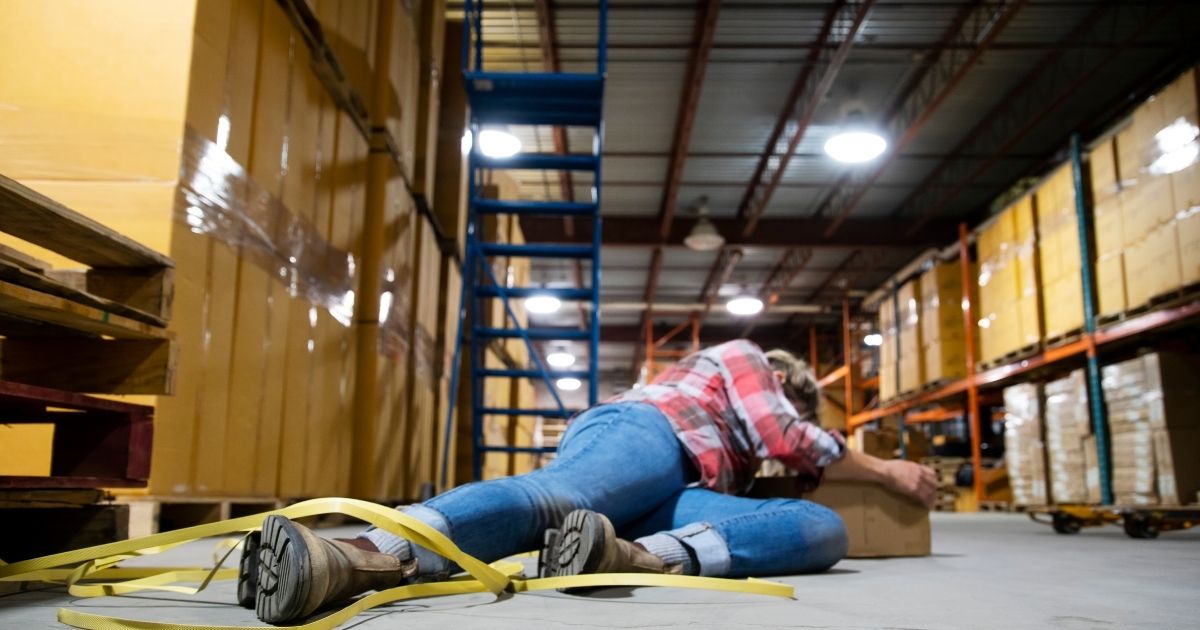
Slips, trips and falls (STF) are one of the largest sources of serious workplace injury claims in Australia. According to Safe Work Australia data, falls, trips and slips of a person sit consistently in the top three injury mechanisms across all industries, behind only body stressing. Recovery isn't quick either — the median time off work for a serious STF claim runs to weeks, not days.
This guide takes you through STF prevention the way the WHS Act expects you to manage it: identify the hazard, apply the hierarchy of controls, and treat PPE as the last line — not the first. We cover the WHS Act duty of care, hazard types, engineering and administrative controls, AS/NZS slip-resistance standards, footwear, industry-specific scenarios, spill response and incident investigation.
Quick Reference — STF Prevention Hierarchy
The WHS Act hierarchy of controls. Work top-down. PPE is the last resort, not the first.
| Level | Control type | Example for STF | When to use |
|---|---|---|---|
| 1 | Eliminate | Remove the hazard — redesign the workflow so workers don't cross wet zones | Always consider first |
| 2 | Substitute | Replace polished tile with slip-resistant flooring rated to AS 4586 | When elimination isn't practical |
| 3 | Engineering | Anti-slip treads, drainage, handrails, edge protection, lighting upgrades | Built into the workplace |
| 4 | Administrative | Spill response procedure, housekeeping schedule, signage (AS 1319), training | Backed by engineering, not in place of it |
| 5 | PPE | Slip-resistant footwear (AS/NZS 2210.3 SR rating), hi-vis (AS/NZS 4602) | Last line — never the only control |
The Scale of the Problem
STF aren't minor. Safe Work Australia consistently reports falls, trips and slips of a person as one of the top three mechanisms of serious workplace injury, behind body stressing and ahead of being hit by moving objects. Falls from a height are far less frequent than falls on the same level, but they account for a disproportionate share of workplace fatalities — particularly in construction.
The cost goes well beyond the injured worker. A serious STF claim drags workers' comp premiums up, pulls supervisors into incident investigation and ICAM workshops, triggers SafeWork inspector attention if it's a notifiable incident, and damages crew morale. PCBUs that treat STF as a "bit of bad luck" usually have a second one within twelve months.
For broader workplace injury statistics and trend context, see our Australia WHS Statistics overview.
The WHS Act Duty of Care
The model Work Health and Safety Act 2011 — adopted in NSW, Vic, Qld, SA, Tas, ACT and NT (WA has its own equivalent) — sets out three core duties relevant to STF prevention.
Section 19 — PCBU primary duty
A Person Conducting a Business or Undertaking (PCBU) must ensure, so far as is reasonably practicable, the health and safety of workers and other persons. For STF specifically, this means providing and maintaining a work environment without risks to health and safety, including safe access and egress.
Section 27 — Officer due diligence
Officers (directors, senior managers) must exercise due diligence to ensure the PCBU complies. Practically, that means knowing what STF hazards exist, having current control measures in place, and being able to demonstrate active oversight — not just signing off on a paper system.
Section 28 — Worker duties
Workers must take reasonable care for their own health and safety, take reasonable care not to adversely affect others, comply with reasonable instructions, and cooperate with policies. Reporting near-misses is part of this duty.
The "reasonably practicable" test isn't a free pass to do nothing. SafeWork inspectors will assess: likelihood of the hazard, degree of harm, what the PCBU knew or should have known, available control measures, and cost. Cost is the weakest of those factors — you can't argue your way out of a $200 anti-slip mat after a $50,000 claim.
Identifying STF Hazards — Walk the Site
The first step is a structured hazard hunt. Walk the workplace at the times STF are most likely: early morning (condensation), shift changeover (rushing), wet weather, end-of-shift cleaning. Look at the floor, look up at the lighting, look at what workers carry.
Hazard register and walk-through audit
- Floors: wet patches, oil spills, dust accumulation on smooth flooring, polished surfaces, uneven joints between flooring sections, lifting tiles, worn vinyl, ice/condensation in cool rooms.
- Walkways: cords and cables across pedestrian paths, hoses, pallet jacks left in walkways, stock overflow from shelving.
- Stairs: worn or missing nosings, broken treads, inadequate handrails, poor lighting, lack of contrast on tread edges.
- Transitions: changes in floor level without warning markings, ramp gradients steeper than AS 1428.1 allows, missing landings.
- Outdoor: moss build-up, sloping concrete with no broom finish, loose gravel, drainage failures.
- Loading docks and ramps: edge marking, contrast, gradient, handrails.
Near-miss reporting culture
STF near-misses are the cheapest data you'll ever get. A worker who slips but catches themselves on a handrail just told you the floor is slippery. Make near-miss reporting fast (phone-based form, not a 4-page PDF), blame-free, and visible (post the count, not the names). Most workplaces with mature reporting see real STF claims drop within 12 months.

Slip Hazards — Causes and Controls
A slip occurs when the friction between footwear and floor drops below what's needed to keep the foot from sliding. Five common causes:
| Cause | Where you see it | Control |
|---|---|---|
| Wet contamination | Food prep, wet industry, weather ingress, cleaning | Drainage, slip-resistant flooring (AS 4586), mopping protocol with signage, anti-slip mats |
| Oil/grease | Workshops, kitchens, manufacturing | Drip trays, absorbent products, anti-slip surface treatment, immediate clean-up |
| Dust on smooth floors | Carpenters, dry-cutting, polished concrete | Regular sweep, dust extraction at source, surface texture |
| Polished/smooth surface | Showrooms, foyers, polished concrete, vinyl | Specify slip-resistant flooring at fit-out; retrofit anti-slip coating or tape |
| Ice/condensation | Cool rooms, freezer entries, early morning concrete | Entrance mats, anti-slip treads, scheduled inspection, slip-resistant boots |
The retrofit fix for slippery flooring is anti-slip treatment — coatings, treads, mats or tape. AIMS stocks a range of anti-slip safety solutions rated for industrial environments. For deeper guidance on product selection, see our Anti-Slip Product FAQ and the Anti-Slip Solutions Guide.
Trip Hazards — Causes and Controls
A trip occurs when the foot catches an unexpected obstacle. Trips often produce worse injuries than slips because the body pitches forward with no recovery time. Common causes:
- Trailing cables and cords: The biggest single trip hazard in offices and workshops. Fix by relocating power outlets near the point of use, using cable covers across walkways, or running cables overhead.
- Uneven floor surfaces: Raised tile edges, lifting vinyl, gaps between sections of flooring. Repair, replace or mark with high-contrast tape.
- Low obstacles: Pallet jacks, ladders left flat, boxes in walkways, drawers left open below eye line. Housekeeping discipline.
- Transitions between floor levels: Single steps without warning are particularly dangerous. AS 1428.1 requires contrast strips at step edges in accessible environments — a good standard to apply everywhere.
- Loose mats: An anti-slip mat that itself slides or curls is a trip hazard. Use mats with non-slip backing and replace when worn.
Housekeeping isn't soft. A "5S" or equivalent housekeeping system — set in place, set in order, shine, standardise, sustain — is one of the most cost-effective STF controls available. It also reduces fire, ergonomic and manual handling risk at the same time.
Falls on the Same Level
Falls on the same level are usually the result of a slip or trip followed by a loss of balance. Prevention is the same as for slips and trips, plus:
- Adequate lighting (see AS/NZS 1680 series) so workers see hazards in time to react.
- Handrails on stairs and along raised walkways.
- Contrast marking on step edges, ramp transitions and changes in level.
- Slip-resistant footwear so the slip doesn't progress to a fall.
Falls From Height — Separate Code, Higher Stakes
Falls from height kill workers. Safe Work Australia consistently reports falls from a height as one of the top causes of workplace fatalities, particularly in construction and agriculture. The Safe Work Australia Code of Practice — Managing the Risk of Falls at Workplaces applies whenever a worker could fall from one level to another. Working at heights above 2 metres triggers additional controls under most jurisdictions; some industries (construction in particular) treat any fall risk as significant.
Fall-from-height controls follow the same hierarchy:
- Eliminate — design out the need to work at height (e.g., maintenance from ground level, prefabrication on the ground).
- Passive fall protection — guardrails, edge protection, scaffolding compliant with AS/NZS 1576, mobile work platforms.
- Work positioning systems — travel-restraint preventing the worker from reaching the fall edge.
- Fall arrest systems — harnesses compliant with AS/NZS 1891 catching the worker after a fall. Anchor points, lanyards, deceleration devices.
- Ladders — ladders are the lowest control in the hierarchy and should only be used for short-duration, low-risk work. AS/NZS 1892 covers ladder safety. AS 1892.1:2018 covers portable ladder design, manufacture and safety requirements.
AIMS stocks height safety equipment including harnesses, anchor points and ladder safety accessories. For ladder-specific guidance see Why Ladder Rung Covers Are Essential. For fall arrest harness selection, see our Safety Harness Guide.
Engineering Controls
Anti-slip flooring and coatings
The Australian standards for slip resistance:
| Standard | Scope |
|---|---|
| AS 4586 | Slip resistance classification of new pedestrian surface materials. P-rating (P0–P5) for ramp tests; new surfaces are specified to this standard. |
| AS 4663 | Slip resistance measurement of existing pedestrian surfaces. Used for assessing surfaces already in service. |
| AS/NZS 3661 | Slip resistance properties of pedestrian surfaces — parts 1 (requirements) and 2 (guide to reduction of slip hazards). |
| HB 198:2014 | Guide to the specification and testing of slip resistance of pedestrian surfaces. Practical handbook for designers, specifiers and risk assessors. |
| AS 1428.1 | Design for access and mobility — sets slip resistance requirements for ramps, stairs and accessible paths. |
AS 4586-2013 (Amdt 1:2017), AS 4663-2013, AS 1428.1:2021, HB 198. (Note: AS/NZS 3661 has been superseded by the AS 4586 series.)
For new fit-outs, specify flooring to AS 4586 with a P-rating appropriate to the contamination expected. Kitchens and wet industry typically need P4 or P5. For existing surfaces that have become slippery, options include anti-slip coatings, abrasive treads, anti-slip tape and grit-impregnated mats — all available through our anti-slip safety solutions range.
Stair safety and handrails
AS 1657 covers fixed platforms, walkways, stairways and ladders. Key requirements: handrails on stairs of three or more risers, consistent riser/going dimensions, non-slip nosings, and adequate lighting. Retrofit options include anti-slip stair tread covers, fluorescent edge marking and additional handrails. AS 1657:2018 covers fixed platforms, walkways, stairways and ladders.
Drainage
In wet industries — food processing, hospitality kitchens, wash bays — adequate floor drainage is the first engineering control. Floors should slope to grated drains (typically 1:80 to 1:100). Drains must be regularly cleaned to prevent blockage and overflow.
Lighting
AS/NZS 1680 series covers interior workplace lighting. Pedestrian walkways and stairs need illuminance high enough to see hazards in time to react, free of glare and deep shadow. Emergency lighting (AS/NZS 2293) ensures egress is safe even during a power outage. AIMS' lighting range includes industrial lighting suitable for workshop and warehouse applications. AS/NZS 1680 series (industrial task 1680.2.4:2017). AS/NZS 2293.1:2018+A1:2021 — Emergency lighting and exit signs for buildings.
Edge protection and guardrails
Anywhere a fall of more than around 300 mm is possible — loading docks, mezzanines, pit edges, raised work platforms — passive edge protection should be considered. Permanent guardrails are preferred over temporary barriers.
Administrative Controls
Engineering does most of the work. Administrative controls reinforce it.
Signage — AS 1319
AS 1319 covers safety signs for the occupational environment. STF-relevant signs include "Caution — Wet Floor", "Caution — Slippery Surface", "Warning — Trip Hazard" and floor marking tape for walkway delineation. Signs must be visible at the point of hazard, not in a corridor leading to it. AIMS stocks compliant safety signs in a wide range of categories. AS 1319-1994 (R2018) — Safety signs for the occupational environment.
Spill response procedure
Every workplace where spills are possible needs a documented spill response procedure. We cover this in detail below in the dedicated section.
Housekeeping standards
Written housekeeping standards, allocated to a person on each shift, with audit and consequence. "Keep walkways clear" is a wish — "Walkways inspected at 10:00, 14:00 and end-of-shift; deficiencies logged in the daily checklist; supervisor signs at end-of-shift" is a control.
Scheduling and workflow
Rushing causes slips and trips. If a workflow has workers running between zones to meet a deadline, that's a design problem, not a worker problem. Stagger cleaning so wet floors and pedestrian traffic don't overlap. Schedule deliveries so pallet jacks aren't crossing busy walkways.
Training
STF-specific training covers: hazard identification, near-miss reporting, spill response, correct use of PPE (particularly footwear), and manual handling (because workers carrying loads can't see the floor). Refresh annually and on incident.
PPE — Slip-Resistant Footwear
Footwear is the last line of STF defence. AS/NZS 2210.3 covers occupational, protective and occupational-purpose footwear, including the Slip Resistance (SR) rating system. The relevant SR ratings:
| Rating | Test surface | Suitable for |
|---|---|---|
| SRA | Ceramic tile with diluted sodium lauryl sulphate solution | General-purpose wet floors (food service, hospitality) |
| SRB | Steel surface with glycerine | Heavily contaminated industrial floors (oil, grease) |
| SRC | Both SRA and SRB tests passed | Combined wet and oily environments — manufacturing, food processing |
AS/NZS 2210.3:2019 (Slip Resistance ratings SRA/SRB/SRC retained from prior edition).
Sole compound matters: nitrile rubber outsoles tend to perform better in oil contamination than standard rubber; PU dual-density outsoles are common in food-service boots. Whatever the spec, footwear has a finite life — soles wear smooth, and a worn slip-resistant sole is no better than a smooth one. Replace before the tread pattern is gone.
For full footwear selection guidance see our Safety Footwear FAQ and Safety Boots Guide. AIMS stocks safety footwear from major brands.
Industry-Specific Prevention
Food processing and hospitality kitchens
- Wet and oily floors are constant — specify P4/P5 flooring to AS 4586 at fit-out.
- Drainage is critical — slope to grated drains, daily clean.
- SRC-rated boots — combined water and oil contamination.
- Anti-fatigue mats with slip-resistant backing in prep areas.
- Spill response measured in seconds, not minutes — workers know who has the mop and where signage is kept.
Manufacturing and workshops
- Oil and coolant spills around machining centres — drip trays, absorbent floor matting at known leak points.
- Swarf and offcut debris — sweep at shift changeover, dust extraction at source.
- Cable management for power tools and welding leads — overhead reel systems where feasible.
- For welding workshop STF + broader safety, see our Welding Safety FAQ.
Construction
- Site surfaces change daily — mud, debris, formwork, reinforcement bar stubs all create hazards.
- Edge protection on slabs, mezzanines and excavations — required by SafeWork inspectors on every site visit.
- Hi-vis for traffic interaction — AS/NZS 4602 (see our Hi-Vis Vest Guide).
- Hard hats — AS/NZS 1801 (see Hard Hat Guide Australia) — because a worker who slips on a slab without head protection is in trouble.
- Site induction including STF awareness for every visitor.
Retail and hospitality (customer-facing)
- Customer slips trigger public liability claims as well as worker safety claims.
- Entrance matting to capture rain water — measured runner zones, not a single small mat.
- Wet floor signs deployed at the moment of mopping, not 10 minutes after.
- Spill response training for all front-of-house staff.
Aged care and healthcare
- Resident falls overlap with worker safety — wet floors from cleaning, spills from spilled drinks, electrical leads from mobility equipment.
- Lighting becomes more important — older eyes need higher illuminance to see hazards.
- Slip-resistant footwear for clinical and care staff.
- Contrast on stair nosings and threshold transitions.
Cleaning services
- Cleaners are the highest-risk single role for STF — they create the wet floor and then walk on it.
- Mandatory wet floor signage every time a wet mop touches the floor.
- SRC-rated boots.
- Two-cleaner protocol for after-hours sites — no working alone in case of fall.
Spill Response Protocol
A documented spill response procedure with practiced execution is one of the highest-leverage administrative controls available. The five-step protocol:
- Contain — stop the spill spreading. If it's running toward a walkway or drain, block it with absorbent or barriers first.
- Signage — deploy wet floor signs or barriers at the limit of the affected area. Signs go down before clean-up starts, not after.
- Notify — for anything beyond a small water spill (oil, chemical, food product), notify the supervisor. Chemical spills may require a SDS check and specific absorbent material.
- Clean — appropriate absorbent for the spill type (water absorbent for water, oil-specific absorbent for hydrocarbons, chemical neutraliser for some chemicals). Dispose per the SDS.
- Document — log the incident even if no one slipped. Spill events feed into the near-miss data that drives engineering controls.
Spill response kits should be stationed at the most likely spill points — machining centres, kitchen prep areas, dispensing benches. First aid supplies should be co-located so workers can self-treat minor falls without leaving the work area.
Incident Response and Investigation
If an STF happens
- Care for the injured person. First aid, ambulance if needed. Do not move the worker if a spinal or head injury is suspected.
- Secure the area. Preserve the scene if possible — photograph the floor, the contamination, the lighting, the footwear, the surrounding hazards before clean-up.
- Notify. Internal: supervisor, WHS officer, safety committee. External: SafeWork if the injury meets the notifiable incident threshold (serious injury, illness or dangerous incident — refer to your jurisdiction's definitions).
- Witness statements. Collect within 24 hours while memory is fresh.
- Root cause analysis. ICAM, 5-Whys or equivalent. Don't stop at "worker wasn't paying attention" — that's a symptom, not a cause. Why was the floor wet? Why wasn't there signage? Why wasn't the spill cleaned?
- Corrective action. Engineering controls preferred over administrative. Track to closure.
- Share the lesson. Toolbox talk, safety alert, induction update.
Compliance Standards Reference
The key Australian standards and codes relevant to STF prevention:
- WHS Act 2011 (model) — primary duty of care, officer due diligence, worker duties. Adopted in NSW, Vic, Qld, SA, Tas, ACT, NT. WA has the WHS Act 2020.
- Safe Work Australia Code of Practice — Managing the Risk of Falls at Workplaces — primary reference for falls-from-height risk management.
- AS 4586 — Slip resistance classification of new pedestrian surface materials.
- AS 4663 — Slip resistance measurement of existing pedestrian surfaces.
- AS/NZS 3661 Parts 1 and 2 — Slip resistance properties of pedestrian surfaces.
- HB 198:2014 — Guide to specification and testing of slip resistance.
- AS 1428.1 — Design for access and mobility (slip resistance on ramps, stairs, accessible paths).
- AS 1657 — Fixed platforms, walkways, stairways and ladders.
- AS/NZS 1576 — Scaffolding.
- AS/NZS 1891 — Industrial fall-arrest systems and devices.
- AS/NZS 1892 — Portable ladders.
- AS/NZS 2210.3 — Occupational protective footwear, including SR slip-resistance ratings.
- AS/NZS 4602 — High visibility safety garments.
- AS/NZS 1801 — Occupational protective helmets.
- AS 1319 — Safety signs for the occupational environment.
- AS/NZS 1680 series — Interior workplace lighting.
- AS/NZS 2293 — Emergency lighting and exit signs.
AIMS' Note on Workplace STF Prevention
STF prevention isn't a one-off project — it's an ongoing programme. Practical advice for PCBUs and safety officers:
- Annual hazard audit minimum. Quarterly if the workplace involves wet processing, chemical handling or significant pedestrian traffic. Walk the site at different times of day.
- Allocate clear ownership. Someone owns spill response. Someone owns the housekeeping audit. Someone owns near-miss follow-up. "Everyone" owns means "no-one" owns.
- Engage a WHS specialist for high-risk environments. Construction, mining, food processing, healthcare — the cost of a specialist audit is small compared to a single claim. SafeWork inspectors are also a free resource for advice (not just enforcement).
- Don't skip footwear policy. Specifying SR-rated footwear in worker dress codes (and providing it where required) is one of the cheapest single controls available.
- Listen to your near-miss data. If three workers slipped on the same patch in a month and none of them were hurt, your engineering control is missing — find it before someone gets hurt.
AIMS supports STF prevention with a comprehensive safety range covering anti-slip safety solutions, safety signs and labels, safety footwear, height safety equipment, workwear, personal protective equipment, industrial lighting and first aid supplies. Ring our Sydney team for advice on selecting the right combination for your site — we'd rather help you spec the right anti-slip mat than process the claim that follows the wrong one.
Frequently Asked Questions
What are the three top causes of workplace injury in Australia?
Safe Work Australia consistently reports the top three injury mechanisms as body stressing (manual handling, repetitive movement), falls/trips/slips of a person, and being hit by moving objects. STF sit at number two.
Does the WHS Act require me to eliminate every STF hazard?
The duty is to ensure safety "so far as is reasonably practicable" — which means weighing likelihood, severity, knowledge and cost. You don't need to eliminate every conceivable hazard, but you do need to apply the hierarchy of controls (eliminate, substitute, engineer, administrate, PPE) and be able to demonstrate active management. Cost alone isn't a defence.
What slip resistance rating do I need for a commercial kitchen?
For wet and oily commercial kitchens, specify flooring rated to AS 4586 with a P-rating of P4 or P5 (the highest two ratings). Workers should wear SRC-rated footwear under AS/NZS 2210.3, which combines slip resistance on water (SRA) and oil/grease (SRB).
How often should I inspect the workplace for STF hazards?
At minimum, a formal documented audit annually. Quarterly is appropriate for wet/oily/high-traffic environments. Daily visual checks should be part of pre-start, particularly in food service and manufacturing where conditions change shift-to-shift. Near-miss reports should be reviewed weekly.
Are anti-slip mats enough on their own?
No. Mats are useful in known wet zones (entrances, sink areas, machinery drip points) but they're a localised control. If the floor itself is slippery across a broader area, you need flooring upgrade, anti-slip coating, drainage improvement or a combination. Mats also need to stay flat — a curling mat is itself a trip hazard.
What footwear does the law require?
The WHS Act doesn't mandate specific footwear by SR rating — but it does require the PCBU to provide PPE appropriate to the risk where higher controls aren't sufficient. In practice, for any workplace with wet, oily or dusty floors, that means specifying SR-rated footwear (SRA, SRB or SRC depending on contaminants) compliant with AS/NZS 2210.3.
What's the difference between a slip and a trip?
A slip is loss of friction between the foot and the floor — the foot slides. A trip is the foot catching an unexpected obstacle and not clearing it. Both can result in a fall on the same level. Slips tend to drop the worker backwards; trips pitch them forwards. Trips often produce worse upper-body injuries because there's no time to brace.
Does a wet floor sign protect me from a claim?
Not by itself. The sign is one control in a hierarchy. If the wet floor was avoidable (engineering control wasn't in place — no drainage, no spill response, no slip-resistant flooring), a sign alone won't satisfy the "reasonably practicable" test. Signage is a layered defence, not a substitute for fixing the hazard.
How do I report a slip-trip-fall near-miss?
Your workplace should have a near-miss reporting system — typically a paper form, online form or app. Report immediately, even if no-one was hurt. Include date, time, location, what happened, contributing factors and any photo evidence. Near-miss data is the cheapest leading indicator you'll find.
When is an STF injury notifiable to SafeWork?
The threshold varies by jurisdiction but generally a notifiable incident includes a death, a serious injury requiring immediate hospital treatment (e.g., fracture, head injury, amputation, loss of consciousness) or a dangerous incident with potential for serious harm. Check your state SafeWork authority's notifiable incident criteria. Notify by phone immediately and follow up in writing.
Are anti-slip coatings worth the cost?
For workplaces with persistent slip hazards on existing flooring, yes — particularly where flooring replacement isn't practical. A typical anti-slip coating treats the floor surface to raise the slip resistance without major disruption. Costs are usually a fraction of a single STF claim. Test on a small area first to confirm appearance, durability and slip-resistance lift before treating the whole floor.
What about falls from low heights — under 2 metres?
Don't dismiss them. Many serious injuries occur from falls of less than 2 metres — a fall from a ladder onto a concrete floor at 1.5 metres can produce serious head injuries even with a hard hat. Apply the same hierarchy of controls. Working from steps and step-ladders should still be planned, brief, and limited to short-duration tasks.
Are anti-fatigue mats the same as anti-slip mats?
Not always. Anti-fatigue mats are designed primarily for ergonomic relief on hard floors (standing workstations, kitchens, assembly benches) — many but not all have slip-resistant backing. Anti-slip mats are designed primarily for grip in wet zones. If the role requires both, specify a mat that meets both requirements.
Who's responsible for STF prevention — the PCBU, the worker, or both?
Both, with the PCBU carrying the primary duty. Section 19 of the WHS Act puts the responsibility on the PCBU to provide a safe workplace. Section 28 requires workers to take reasonable care and comply with reasonable instructions. The PCBU sets the system; workers operate within it. Officers (directors, senior managers) must exercise due diligence under section 27.
How do I build a business case for STF prevention investment?
Pull your workers' comp claims data for the last 24 months. Add direct costs (claim payments, premium impact) to indirect costs (supervisor time, investigation hours, replacement labour, productivity loss). Compare to the cost of the engineering controls that would have prevented those claims. For most workplaces, the maths is strongly in favour of prevention — see our companion article on the business case for anti-slip investment.
People Also Ask — Slip, Trip and Fall Prevention
Q: What is the WHS Act hierarchy of controls for managing STF hazards?
The WHS Act hierarchy works from most to least preferred: eliminate the hazard, substitute a safer alternative, isolate the hazard, apply engineering controls (guardrails, drainage, non-slip surfaces), administrative controls (procedures, signs, training), then PPE as the last line — not the first response.
Q: What are the most common slip hazards in Australian workplaces?
Wet or contaminated floors (oil, water, food residue), inadequate drainage in wet work areas, smooth flooring not suited to the traffic or conditions, worn or inappropriate footwear, and poor transition lighting between indoor and outdoor areas.
Q: What is the practical difference between a slip hazard and a trip hazard?
A slip hazard is a surface condition that causes loss of traction — wet, oily, or polished floors. A trip hazard is an obstruction or level change that catches the foot — raised thresholds, uncontrolled cables, uneven pavement, or objects left in walkways.
Q: What engineering controls are most effective for reducing fall risks?
Fixed guardrails and barriers along elevated edges, non-slip surface treatment on stairs and ramps, level-change warnings, adequate drainage to eliminate standing water, and proper lighting in transition areas. Engineering controls take priority over signs and PPE.
Q: When is anti-slip tape or surface coating the appropriate control?
Anti-slip solutions are appropriate where the surface cannot be replaced and wet or contaminated conditions are unavoidable — stair nosings, ramp surfaces, loading docks, and wet process areas. They function as an engineering control and should be maintained and inspected regularly.
