

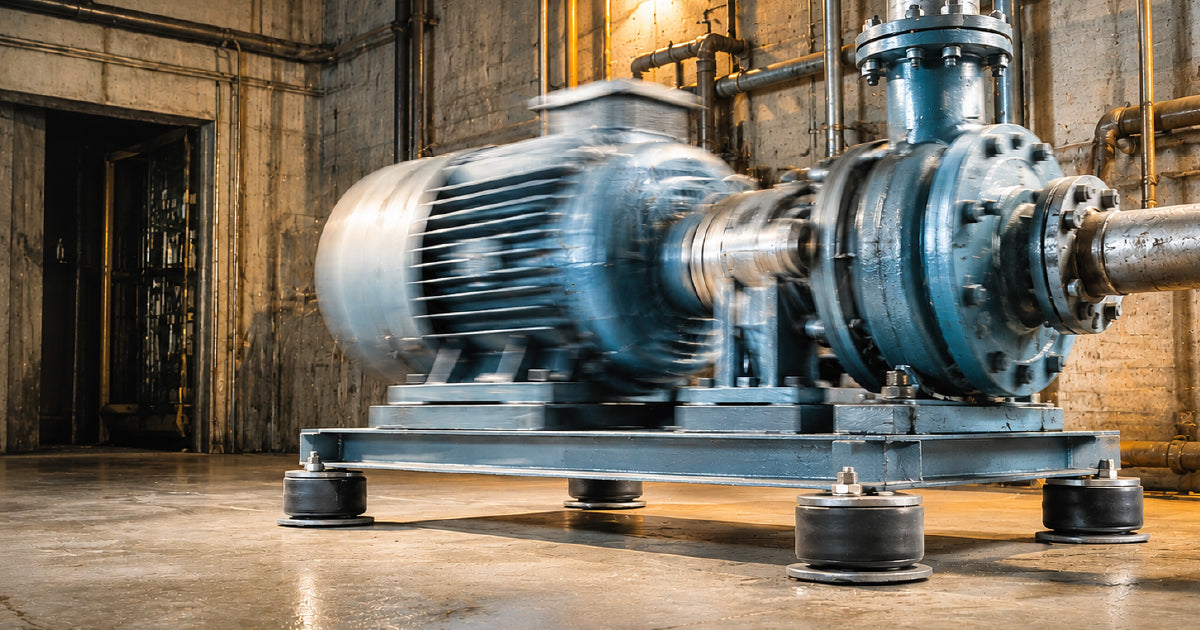
What Is an Anti-Vibration Mount and How Does It Work?
An anti-vibration mount is a resilient element — typically a rubber-to-metal bonded component — installed between a vibrating machine and its supporting structure. The rubber acts as a spring: it deflects under load, stores energy, and releases it out of phase with the original vibration. (For applications where rubber is not suitable — high temperatures, oil exposure, or very heavy loads — coil-spring isolators are the alternative; see our Types of Springs Guide for an overview of spring families.) The result is that most of the vibrational energy is absorbed by the mount rather than transmitted to the floor, frame, or adjacent structure.
The key variable is stiffness. A softer mount deflects more under load, gives a lower natural frequency, and provides better high-frequency isolation. A stiffer mount deflects less, gives a higher natural frequency, and provides less isolation but more stability. Selecting the correct stiffness for the load and operating frequency is the entire science of mount selection.
Anti-vibration mounts serve three purposes simultaneously:
- Vibration isolation: preventing machine-generated vibration from reaching the structure
- Noise reduction: blocking structure-borne noise transmission paths
- Shock absorption: protecting equipment from external shock loads and floor-transmitted impact
Vibration Isolation vs Vibration Damping — Getting the Terms Right
These terms are used interchangeably but they describe different mechanisms. Getting them confused leads to the wrong product choice.
| Term | What It Means | How It Works |
|---|---|---|
| Vibration isolation | Preventing vibration from travelling from source to structure | Tuned resilient element (spring or rubber mount) creates a low natural frequency — vibration above that frequency is not transmitted |
| Vibration damping | Dissipating vibration energy within the vibrating component itself | Viscoelastic or constrained-layer material converts vibrational energy to heat |
Anti-vibration mounts primarily provide isolation. They work by ensuring the natural frequency of the mounted system is well below the disturbing frequency of the machine. Damping is a secondary effect from rubber's hysteresis properties. If someone recommends "damping pads" under your compressor, they mean isolation mounts — the terminology is loose in the field.
Types of Anti-Vibration Mounts
The mount type determines load direction capability, stiffness ratio (axial vs radial), installation method, and environmental suitability.
| Type | Description | Best For | Load Direction |
|---|---|---|---|
| Cylindrical / Bobbin | Rubber bonded between two metal threaded studs (male-male or male-female). The most common type. | Electric motors, fans, small pumps, HVAC equipment | Compression + shear — multi-directional |
| Sandwich / Pad | Rubber bonded between two flat metal plates with through-bolt holes. Equipment sits on top, bolted through. | Generators, large compressors, heavy machinery, base plates | Primarily compression — vertical loads |
| Conical | Tapered rubber element in a metal housing. Better lateral stability than cylindrical due to the cone geometry. | Pumps, compressors, marine applications, rolling equipment | Compression + lateral shear — good stability |
| Bell / Bushings | Rubber bonded inside a cylindrical metal housing with a central threaded boss. Installed through a clearance hole. | Fan blade isolation, pipe hangers, mounting brackets | Multi-directional — radial and axial |
| Levelling Mounts | Anti-vibration pad combined with an adjustable levelling screw. Provides isolation and precise height adjustment. | Machine tools, CNC equipment, laboratory instruments, precision equipment | Compression — vertical loads with levelling |
| Wire Rope Isolators | Stainless steel wire rope loops through aluminium retaining bars. Very high shock tolerance, no rubber degradation. | Military/aerospace, mobile equipment, harsh chemical environments | Multi-directional — high shock and vibration |
Rubber Compound Selection
The rubber compound determines temperature range, chemical resistance, and long-term performance. Most catalogue mounts use natural rubber as the default — it has the best dynamic properties for vibration isolation. But not every application is suitable for natural rubber.
| Compound | Temperature Range | Oil/Fuel Resistance | Weather/UV | Best Applications |
|---|---|---|---|---|
| Natural Rubber (NR) | −40°C to +70°C | Poor — degrades in oils | Poor — UV hardens it | Indoor machinery, electric motors, fans, general industrial — the default choice |
| Neoprene (CR) | −40°C to +100°C | Moderate — oil resistant | Good — weather resistant | Outdoor equipment, oily environments, marine, HVAC rooftop units |
| Nitrile (NBR) | −30°C to +120°C | Excellent — fuel and oil | Poor | Fuel pumps, hydraulic units, diesel engines, compressors near oil mist |
| EPDM | −50°C to +150°C | Poor | Excellent — ozone, UV | Outdoor applications with no oil exposure — water treatment, outdoor plant |
| Silicone | −60°C to +200°C | Moderate | Excellent | High-temperature applications — ovens, furnaces, engine bays. Higher cost. |
When in doubt for an indoor, non-oily application: natural rubber. For outdoor or oily environments: neoprene. For fuel or hydraulic fluid exposure: nitrile.
How to Select and Size an Anti-Vibration Mount — 5 Steps
Most mount selection failures come from skipping steps 1 and 2. Buying "medium duty" mounts without calculating the load is the single most common mistake.
Step 1 — Calculate load per mount
Total equipment weight (kg) ÷ number of mounts = load per mount (kg). Use this to select a mount rated within its optimal load range — typically 60–80% of its maximum rated load. Never exceed the rated maximum.
Example: 120 kg compressor on 4 mounts = 30 kg per mount. Select a mount rated for 40–50 kg maximum load.
Step 2 — Determine operating frequency
Convert the machine's operating speed to frequency in Hz: Frequency (Hz) = RPM ÷ 60
A 1,450 RPM motor = 24.2 Hz. A 960 RPM motor = 16 Hz. A 1,500 RPM motor = 25 Hz.
For reciprocating machines (pistons, compressors), use the stroke frequency — which for a single-cylinder 4-stroke at 1,450 RPM is 1,450 ÷ 2 = 725 cycles/min = 12 Hz.
Step 3 — Set your isolation target
For most industrial applications, aim for 80% isolation efficiency (only 20% of vibration force transmitted). For sensitive applications like precision measurement equipment or sound recording, target 90%+.
80% isolation requires the system natural frequency to be approximately one-third of the operating frequency. For a 25 Hz motor: target natural frequency ≤ 8 Hz.
Step 4 — Select static deflection
Natural frequency is determined by static deflection — the amount the mount compresses under the equipment weight. The relationship: lower deflection = higher natural frequency = less isolation.
| Static Deflection (mm) | Natural Frequency (approx.) | Minimum RPM for 80% isolation |
|---|---|---|
| 1 mm | ~16 Hz | ~2,900 RPM |
| 3 mm | ~9 Hz | ~1,700 RPM |
| 6 mm | ~6.5 Hz | ~1,200 RPM |
| 10 mm | ~5 Hz | ~900 RPM |
| 15 mm | ~4 Hz | ~750 RPM |
| 25 mm | ~3 Hz | ~550 RPM |
Choose a mount whose static deflection (at your calculated load per mount) gives a natural frequency well below the operating frequency.
Step 5 — Check the mount type suits the load direction
If the machine has significant horizontal forces (e.g., reciprocating compressor, unbalanced fan), confirm the mount handles shear loads, not just compression. Sandwich mounts are weak in shear. Cylindrical, conical, and bell mounts handle multi-directional loads.
Application Guide
| Equipment | Typical RPM | Recommended Mount Type | Rubber Compound | Notes |
|---|---|---|---|---|
| Electric motor (small–medium) | 960–3,000 RPM | Cylindrical/bobbin | Natural rubber | Size for motor weight only — not driven load if coupled via flexible coupling |
| Air compressor (reciprocating) | 700–1,450 RPM | Sandwich or conical | Neoprene or nitrile | High shock loads from piston action — use mounts rated for dynamic loading. Use flexible hose at outlet. |
| Rotary screw compressor | 1,450–3,000 RPM | Cylindrical or levelling | Natural rubber or neoprene | Smoother vibration signature than reciprocating — easier to isolate |
| Centrifugal pump | 1,450–3,000 RPM | Conical or cylindrical | Neoprene or nitrile | Ensure inlet/outlet pipework is flexible — rigid pipe connections defeat the isolation |
| Fan / blower | 960–3,000 RPM | Cylindrical or bell | Natural rubber | Check for blade pass frequency in addition to shaft RPM for multi-blade fans |
| Diesel generator | 1,000–1,500 RPM | Sandwich mounts — heavy duty | Neoprene or nitrile | High mass, high torque reaction. Size for full generator set weight. Use 4-point or 6-point mounting. |
| HVAC unit / air handler | 700–1,450 RPM | Levelling mounts or spring isolators | Neoprene (outdoor) | Rooftop units need weather-resistant compound. Acoustic performance often the primary driver. |
| CNC machine / precision equipment | Varies | Levelling mounts | Natural rubber | Primary goal is incoming floor vibration isolation, not outgoing. Choose stiffness for precision, not deflection. |
3-Point vs 4-Point Mounting
The number of mounts affects stability and load distribution.
3-point mounting is statically determinate — all three mounts are always in contact with the floor and equally loaded regardless of minor floor irregularities. This is the preferred approach for compressors and pumps where load equalisation matters. The disadvantage is lower lateral stability compared to 4-point.
4-point mounting provides better lateral stability and is required for elongated equipment with significant overhang (large motors, long pump sets, generators). The risk with 4-point is that on an uneven floor, one mount may carry little or no load — leading to uneven isolation performance and potential mount overload on the diagonal pair. Always use levelling feet or shimming to equalise loads in a 4-point arrangement.
Rule of thumb: For square or near-square equipment footprints, 4-point. For compact machines where the centre of gravity is roughly centred, 3-point. For generators and large sets, 6-point or more.
Installation — What Goes Wrong and How to Avoid It
Torque limits
Anti-vibration mounts have a maximum torque for the mounting studs. Over-torquing compresses the rubber excessively, increases stiffness, raises the natural frequency, and degrades isolation performance — potentially to the point where the mount provides no useful isolation. Tighten to the manufacturer's specified torque. If no specification is given, finger-tight plus one quarter turn is a conservative guide for M8–M12 studs.
Clearance
The equipment must be free to move in all directions within the mount's deflection range. Check that pipes, conduit, and structural members do not contact the machine chassis after mounting — any rigid contact point creates a short-circuit vibration path that bypasses the mounts entirely.
Flexible connections — the step most installers miss
If all service connections to the machine (pipework, conduit, ducting) are rigid, the anti-vibration mounts are largely useless — vibration will travel through those connections to the structure regardless of mount quality. All services to isolated equipment must include flexible sections: flexible hose for pipework, flexible conduit for electrical, flexible duct for air connections. This is the single most common reason correctly-specified mounts fail to reduce vibration.
Mount orientation
Cylindrical and conical mounts perform best when loaded in compression. Avoid loading them in pure tension (hanging loads) unless the mount is specifically rated for tensile loading. Sandwich mounts should not be used for lateral or shear loads without a retaining bolt through the plate.
Common Mistakes
| Mistake | What Happens | Fix |
|---|---|---|
| Selecting mounts by machine size, not calculated load per mount | Mounts either too stiff (no isolation) or overloaded (premature failure) | Calculate weight ÷ number of mounts, then select by load |
| Using the same mount type for all applications | Cylindrical mounts on a large generator, sandwich mounts on a multi-directional pump — wrong type for the load direction | Match mount type to load direction and equipment dynamics |
| Over-torquing the mount studs | Rubber compressed solid — mount behaves as a rigid spacer, zero isolation | Torque to specification. Check rubber is not bottomed out at installation load. |
| Rigid pipework or conduit connections | Vibration bypasses mounts entirely through rigid connections | Install flexible hose/conduit sections on all services |
| Ignoring the mount's load range | Under-loaded mounts are too soft and allow excessive movement. Over-loaded mounts bottom out. | Load each mount to 60–80% of its rated maximum |
| Using natural rubber in oil-contaminated environments | Rubber swells and softens — mount loses stiffness and fails | Use neoprene or nitrile in oily environments |
| Bolting machine to concrete without mounts, then wondering why neighbours complain | All vibration is transmitted directly to the slab and building structure | Anti-vibration mounts are not optional in shared buildings or noise-sensitive sites |
Silence the shake. Protect the machine.
Shop anti-vibration mounts from Mackay & Finer Power Transmissions
Cylindrical, flange, and levelling mounts in 40, 55 and 65 Shore hardness — AIMS Industrial stocks rubber isolators and vibration damping components for motors, fans, compressors, and plant equipment, ready to ship Australia-wide.
Frequently Asked Questions
What is the difference between an anti-vibration mount and an anti-vibration pad?
An anti-vibration pad is typically a flat sheet of rubber, cork-rubber composite, or elastomer material that the equipment sits on — no bonding to the equipment, no threaded studs, not positively fixed. Anti-vibration mounts are engineered components bonded between metal interfaces, with threaded connections that positively attach to both the machine and the mounting surface. Mounts provide predictable, calculable performance. Pads are a lower-cost option for light applications where precise isolation is not required.
How do I know if my anti-vibration mounts are working?
Check static deflection: the mount should compress 3–10 mm under the equipment weight (visible deflection). If there is no visible deflection, the mount is too stiff for the load. Also check that the equipment rocks slightly when pushed gently — if it feels completely rigid, the mounts are either bottomed out or the equipment has a rigid connection somewhere bypassing them.
Should I bolt my compressor or pump to the floor or use anti-vibration mounts?
For most workshop and industrial installations, anti-vibration mounts are the better choice. Bolting to a concrete slab transmits all vibration to the structure, causing noise, structural fatigue over time, and potential issues with adjacent equipment. Anti-vibration mounts allow the machine to move slightly, absorbing the energy. The exception is very large machinery (multi-tonne) where a purpose-built inertia base with mounts is the correct approach.
What does "AV mount" mean?
AV mount is simply shorthand for anti-vibration mount. The terms are interchangeable. You may also see the abbreviations NM (noise/vibration mount), VIM (vibration isolation mount), or the tradenames of specific manufacturers. All refer to the same class of product.
What is static deflection and why does it matter?
Static deflection is the amount a mount compresses under the static weight of the equipment. It matters because it determines the natural frequency of the mounted system: more deflection = lower natural frequency = better low-frequency isolation. A mount that deflects 6 mm under load gives a natural frequency of approximately 6.5 Hz, which will provide good isolation for machines running above 1,200 RPM. A mount that only deflects 1 mm under load gives ~16 Hz natural frequency — useful only for high-speed equipment above 2,900 RPM.
How many anti-vibration mounts do I need?
Minimum three (for a 3-point stable support). Most equipment uses 4 mounts at the four corners. Large or elongated equipment may use 6 or more. The key constraint is load per mount — divide total weight by number of mounts and ensure each mount is sized to carry that load within its rated range. More mounts reduce individual mount load and can allow the use of softer (lower natural frequency) mounts.
Can I use rubber matting or cork sheets instead of proper mounts?
For very light applications (small laboratory equipment, domestic appliances), rubber or cork matting provides basic isolation. For industrial machinery — motors, compressors, pumps — properly engineered mounts are required. Matting has unpredictable stiffness, ages and hardens quickly, provides no lateral restraint, and cannot be reliably sized to a specific natural frequency. The cost difference between matting and proper mounts is small; the performance difference is large.
How long do anti-vibration mounts last?
In a clean indoor environment with correct loading, 10–20 years is typical for natural rubber mounts. Accelerated deterioration occurs from: oil contamination (causes swelling and softening), UV exposure (surface hardening and cracking), ozone (cracking on unloaded surfaces), temperature extremes, and cyclic overloading. Inspect mounts annually — look for rubber cracking, delamination from metal inserts, and excessive permanent set (a mount that no longer springs back has lost most of its isolation performance).
What is the difference between isolation and damping for mounts?
Isolation prevents vibration from travelling from source to structure by using a tuned resilient element. Damping dissipates vibration energy within the structure or component itself. Anti-vibration mounts primarily provide isolation — the rubber acts as a spring with a tuned natural frequency. The rubber also provides some damping through hysteresis, but this is secondary. Products marketed as "damping pads" are usually isolation mounts — the terminology is used loosely in the industry.
Can anti-vibration mounts also level my equipment?
Standard cylindrical and sandwich mounts have no height adjustment. Levelling mounts — which combine anti-vibration rubber with an adjustable threaded stud — provide both isolation and levelling in one fitting. They are the standard choice for machine tools, CNC equipment, and any precision equipment requiring both vibration control and accurate levelling. Standard mounts can be shimmed for levelling but this adds complexity.
What happens if the machine RPM changes — do I need different mounts?
If operating speed changes significantly (e.g., a VFD-driven motor running at variable speeds), the isolation performance will vary across the speed range. At some speeds, the forcing frequency may coincide with the natural frequency — this is resonance, which amplifies rather than reduces vibration. Variable-speed machinery requires careful mount selection to avoid resonance at common operating speeds. If the machine regularly passes through a resonant speed, damping (higher loss factor rubber) becomes more important than isolation efficiency.
My mounts are installed correctly but the machine is still vibrating. What's wrong?
The most common cause is rigid service connections — pipework, conduit, or ducting that bypasses the mounts and provides a direct vibration path to the structure. Check every connection to the machine: all must be flexible. Other causes: mounts too stiff for the operating frequency (natural frequency too close to or above the disturbing frequency), mounts overloaded and bottomed out, or the machine has a structural fault (bearing wear, imbalance, misalignment) generating abnormally high vibration that exceeds mount capacity.
Do anti-vibration mounts require maintenance?
Minimal maintenance is required. Annual visual inspection covers: rubber condition (cracking, oil contamination, permanent set), stud torque (vibration can loosen fixings over time), and rubber-to-metal bond integrity (delamination). Replace any mount showing cracked or delaminated rubber — it will have significantly degraded performance. In high-temperature or chemical environments, inspect more frequently.
What is the difference between a 3-point and 4-point mount arrangement?
Three-point mounting is statically determinate — all three mounts always share the load equally regardless of minor floor unevenness, making it ideal for compressors and pumps where load equalisation is critical. Four-point mounting provides better lateral stability and suits elongated equipment, but requires careful levelling to ensure all four mounts share the load. On an uneven floor, one mount in a 4-point arrangement may carry minimal load while its diagonal partner is overloaded — use adjustable levelling mounts to correct this.
Can I mix mount types or stiffnesses on the same machine?
Avoid mixing mount stiffnesses on the same machine unless specifically designed for an asymmetric load distribution. Mixing soft and stiff mounts causes the machine to tilt and rock on the softer mounts rather than isolating. The single exception is centre-of-gravity adjustment — if a machine has significantly unequal weight distribution across mounting points, different load ratings at different corners can equalise deflection. This requires calculation, not guesswork.
For belt-drive RPM calculation and pulley sizing, see our Pulley Speed Ratio guide.
People Also Ask — Anti-Vibration Mounts
Q: What is an anti-vibration mount and what does it do?
An anti-vibration mount is a resilient component — usually rubber bonded to metal fixings — placed between a machine and its base to absorb and isolate vibration and shock. By introducing a flexible element with controlled stiffness, the mount stops vibration from the machine transmitting into the floor and surrounding structure, which reduces noise, protects nearby equipment and prolongs the life of the machine itself. Pumps, motors, compressors, fans and engines are common candidates. The mount works by tuning the system's natural frequency well below the machine's operating frequency, so the vibration is dissipated in the rubber rather than passed on.
Q: How do I select the right anti-vibration mount?
Selection is driven by the load on each mount, the machine's operating speed and the type of disturbance. First work out the weight supported per mount, ideally accounting for uneven weight distribution, so each mount carries a load within its rated range. Then consider the running speed — effective isolation needs the mount soft enough that the system's natural frequency sits well below the disturbing frequency. Finally consider the environment and the direction of the forces. Under-loading a mount is as bad as over-loading it, because a mount only isolates properly near its design deflection. If you give us the machine weight, mounting points and running speed, we can help size them.
Q: What materials are anti-vibration mounts made from?
The resilient element is most often natural or synthetic rubber bonded to steel plates, studs or threaded inserts. Natural rubber gives excellent damping and is a good all-rounder; synthetic rubbers such as neoprene are chosen where oil, heat or weather resistance matters. For very heavy or precise isolation, spring-based and combined spring-and-rubber mounts are used, and for lighter or specialised jobs there are cork, polyurethane and elastomer options. The material affects load capacity, damping, and resistance to oil, ozone and temperature, so the choice depends as much on the operating environment as on the load.
Q: Where should anti-vibration mounts be installed?
Mounts go between the machine's feet or base frame and the supporting structure, positioned so the load is shared as evenly as practical across all mounts. Even sharing matters because each mount only isolates correctly when loaded near its design deflection, so a machine with an offset centre of gravity may need different mounts at different feet. The supporting surface should be rigid and level, and fixings should locate the machine without clamping the rubber solid. For tall or top-heavy machines, mount placement also has to keep the unit stable. Correct positioning and even loading are what turn a good mount into effective isolation.
Q: Do anti-vibration mounts reduce noise as well as vibration?
Yes — much of the noise around machinery is structure-borne, meaning vibration travels through the floor and framework and is then radiated as sound by those surfaces. By isolating the machine from the structure, anti-vibration mounts cut that transmission path, so they reduce both the felt vibration and a good deal of the audible noise. They do not silence airborne noise coming straight off the machine, which needs enclosures or acoustic treatment, but for the rumble and drumming carried through a building, properly selected mounts make a clear difference. The better the isolation match to the machine's running speed, the greater the noise reduction.
Q: Can anti-vibration mount rubber be damaged by oil or fuel spills?
Yes — oil contamination causes the rubber in an anti-vibration mount to swell and soften, degrading its isolation performance. This is one of the main accelerated-deterioration risks alongside UV exposure, ozone cracking, temperature extremes and cyclic overloading, which is why synthetic rubbers such as neoprene are chosen specifically where oil resistance matters.
Q: Should stud torque be checked as part of routine anti-vibration mount maintenance?
Yes — annual visual inspection of anti-vibration mounts should cover stud torque, since vibration can loosen fixings over time, alongside checking rubber condition for cracking or permanent set and confirming the rubber-to-metal bond hasn't delaminated.
Q: Why is it important not to clamp the mounting rubber solid during installation?
Fixings should locate the machine without clamping the rubber solid, because a mount only isolates correctly when it can compress and flex near its design deflection. Clamping the rubber solid removes that working deflection and defeats the purpose of fitting a resilient mount in the first place.
Q: Can spring mounts be combined with rubber mounts on the same machine?
Yes — for very heavy or precise isolation needs, combined spring-and-rubber mounts are used alongside pure spring-based or pure rubber options. The choice depends on the load, the operating environment and how demanding the required isolation performance is.
Vibration doesn't only work mounts loose — it works fasteners loose too. Where a joint can't be isolated with an anti-vibration mount, a Loctite threadlocker on the fastener itself is the other half of the fix; see our Loctite Threadlocker Guide for grade selection.