

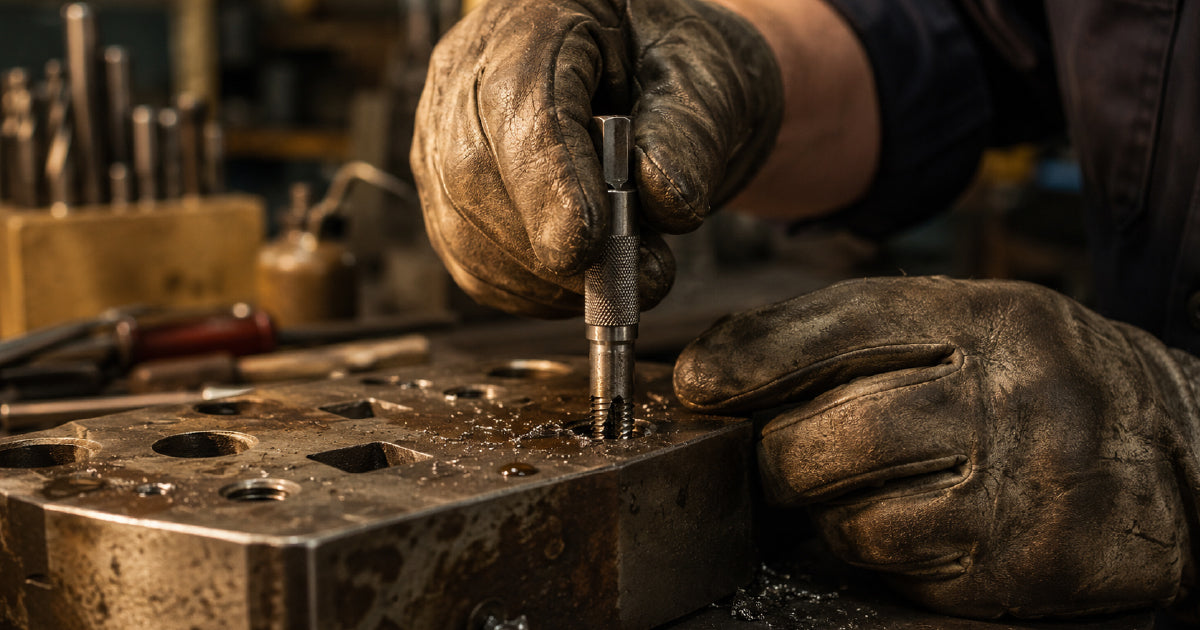
Stop — Read This Before You Touch the Workpiece
A broken tap feels like a crisis. The instinct is to grab the nearest drill bit and go. That instinct destroys more parts than the broken tap ever would.
HSS taps are harder than HSS drill bits. Driving a standard twist drill into a broken tap will snap the drill and press the tap fragments deeper and tighter into the hole. Once you've done that, your options narrow significantly.
The first rule of broken tap removal: do nothing until you have assessed the situation and chosen the right method. Two minutes of assessment can save hours of work — or a scrapped part.
If the broken fastener is a stud rather than a tap — different geometry, different tool family — see our Stud Extractor Guide for cam-grip, collet, and spiral hex extractor selection plus the heat-the-parent-not-the-stud removal technique.
Assess Before You Act
Work through these questions before choosing a method:
| Question | Why It Matters |
|---|---|
| How much of the tap is above the surface? | Anything protruding gives you more options (weld-out, extractor). Flush or below-surface limits you to EDM, chemical, or milling. |
| Is the tap in one piece or shattered? | Shattered taps cannot be extracted with a tap extractor — the claws have nothing solid to grip. EDM or chemical dissolution required. |
| What is the workpiece material? | Aluminium opens the chemical dissolution option (the alum trick). Steel, cast iron, and titanium do not. |
| What are the threads worth? | If the hole can be drilled out and re-tapped at the next size up, or fitted with a thread insert, that may be faster and cheaper than a careful extraction. |
| What tap size broke? | Small taps (M3 and below) are extremely difficult to extract mechanically. EDM is almost always the right answer below M4. |
| Is the hole through or blind? | Blind holes trap chips from milling methods. Through holes allow push-through with a punch as a last resort. |
The Six Methods — Overview
| Method | Best For | Not Suitable When | Skill Level |
|---|---|---|---|
| Tap extractor | Clean break above or at surface, tap M6+ | Shattered tap, flush/below-surface, small taps | Basic |
| Left-hand drill bit | Tap protruding slightly, not bottomed out | Shattered tap, very small taps, blind holes at bottom | Basic |
| Weld-out (TIG/MIG) | Tap stub above surface, M6+, steel workpiece | Below-surface taps, aluminium workpiece (warps), non-weld environment | Intermediate |
| Milling/carbide end mill | Tap M6+, access to milling machine or drill press | Very small taps, no carbide tooling, blind holes with no clearance | Intermediate |
| Chemical dissolution (alum) | Tap in aluminium only — any size, any depth | Steel, cast iron, titanium, stainless workpiece (dissolves with the tap) | Basic — just time |
| EDM / spark erosion | Any size, any depth, any workpiece material — the reliable fallback | Non-conductive materials (plastics, composites) | Machine shop or hire |
Method 1 — Tap Extractor
A tap extractor is a tool with three or four hardened prongs that insert into the flutes of the broken tap. When turned counter-clockwise, the prongs grip the tap and back it out. This is the first method most machinists reach for — and the most commonly misused.
When it works
- The tap broke cleanly — not shattered into fragments
- The break is at or above the workpiece surface
- The tap is M6 or larger (prongs need flute clearance)
- The tap is not bottomed against the end of a blind hole
When it fails
- The tap shattered — no solid section for the prongs to grip
- The tap is below the surface — prongs can't reach the flutes
- Small taps (below M4) — flutes are too narrow for the prongs
- The tap has rolled or welded itself into the hole — no rotational play at all
Technique
- Clear chips from the flutes with compressed air before inserting the extractor.
- Insert the prongs into the flutes. Seat them fully — a partial engagement will snap the prongs off.
- Apply gentle counter-clockwise rotation. Do not jerk or force. If it won't move, stop — forcing it will break the extractor prongs into the hole, making the situation far worse.
- If there is any movement, alternate between half-turns back and quarter-turns forward (as you would with a hand tap) to break the friction gradually.
- Apply a drop of penetrating oil to the thread before attempting extraction — allow it to soak for 10–15 minutes.
Important: Tap extractor prongs are hardened but brittle. Broken prongs in a hole containing a broken tap is a genuinely difficult recovery. If the tap shows no rotational movement after gentle pressure, move to another method.
Method 2 — Left-Hand Drill Bit
Left-hand (reverse-helix) drill bits cut counter-clockwise. When drilling into a broken tap that is not fully seized, the friction of the drill can grab the tap and wind it out — before the bit even cuts into the tap body. This is a worthwhile first attempt on M6+ taps with some protrusion. The same left-hand drill technique works on broken bolts — see the Bolt Extractor Guide for matched left-hand drill + extractor kits (Bordo per-size, Sutton M603S20L 10pc combined set).
- Centre-punch the broken tap face as centrally as possible.
- Select a left-hand drill bit smaller than the tap's minor diameter — you want to drill into the tap, not through the threads.
- Drill at low speed with firm, steady pressure. Use cutting fluid.
- The rotation friction often backs the tap out without the drill needing to cut through the full tap body.
If the tap does not back out after the drill bites 2–3 mm, the tap is too seized for this method. Do not continue drilling — you risk deflecting off the harder tap body and damaging the surrounding threads. For drill bit substrate selection on hardened tap bodies (cobalt M35/M42 vs solid carbide), see our Cobalt Drill Bit Guide.
Method 3 — Weld-Out (TIG or MIG)
If the broken tap protrudes by 3 mm or more above the surface, a welder can tack a steel rod, nut, or welding wire to the stub and wind it out with a spanner or pliers. This is highly effective when it can be done — particularly on steel workpieces where surrounding heat distortion is less of a concern.
- Clean the stub surface of oil and debris.
- TIG-weld a short length of steel rod (or tack a nut) to the top of the tap stub. MIG can work but TIG gives more control on small stubs.
- Allow to cool slightly — do not quench.
- Apply counter-clockwise torque to the welded rod/nut. The weld creates a gripping interface that a tap extractor cannot.
- If the tap moves, back it out gradually. If not, the weld bond failed — re-weld and try again.
Caution on aluminium: Welding near aluminium risks warping thin sections and creating heat-affected zones that damage the base material. The chemical dissolution method (below) is usually the better choice for aluminium.
Method 4 — Carbide End Mill / Milling Out
A solid carbide end mill can cut through an HSS tap because carbide is significantly harder. This method requires either a milling machine or a drill press with a quality vice and precise setup. It is not a freehand operation. For end mill type, flute count and coating selection (a 4-flute solid carbide TiAlN end mill is the typical choice for this work), see our End Mill Guide.
- Set the workpiece up precisely on the mill or drill press — the end mill must enter the exact centre of the broken tap. Misalignment by even 0.3 mm on a small tap will cut into the threads.
- Select a carbide end mill slightly smaller than the tap's minor diameter (the core of the tap, inside the threads).
- Mill at conservative speed (carbide end mill in HSS tap — reduce normal speed by 30%).
- Mill in small increments (0.5 mm depth of cut maximum). Use cutting fluid continuously.
- Once you have removed the bulk of the tap body, the thin flute walls will collapse and can be picked out of the threads with a pick or dental probe.
- Clean threads with a bottoming tap run by hand before use.
The risk with this method is damaging the threads if alignment is off. On critical parts, EDM is a better choice.
Method 5 — Chemical Dissolution (The Alum Trick)
This method works exclusively on aluminium workpieces. It is the most underrated broken tap removal technique and deserves to be better known.
Alum — potassium aluminium sulfate, available at most pharmacies or pool supply stores — dissolves HSS steel (the tap material) in warm acidic solution while leaving aluminium unaffected. The chemistry is straightforward: HSS is iron-based and reacts with the sulphate solution; aluminium forms a protective oxide layer that resists the reaction.
Process
- Fill a non-metallic container (plastic or ceramic) with warm water. Add alum at roughly 50–100 g per litre. The solution does not need to be boiling — warm is sufficient, but warm accelerates the reaction.
- Submerge the aluminium workpiece fully. If the workpiece is large or cannot be submerged, pack the area around the broken tap with alum paste (alum + small amount of water).
- Wait. For a small tap (M4–M6) in a crockpot on low heat, expect 2–8 hours. Larger taps or cold-water solutions may take overnight.
- Remove the workpiece and clear the dissolved tap material from the hole. The threads will be intact.
- Run a tap through the hole to clean the threads before use.
Alternative dissolving agent: Sodium bisulfate (found as pool pH reducer, "pH Down") works similarly to alum. Some machinists prefer it as it is more widely available.
What will NOT work: This method does not work on steel, stainless, cast iron, or brass workpieces — the acid will attack the workpiece material as well as the tap. Aluminium only.
Method 6 — EDM (Electrical Discharge Machining / Spark Erosion)
EDM is the professional-grade solution and the correct choice when:
- The tap is small (below M4)
- The tap has shattered into fragments
- The break is flush with or below the workpiece surface
- All other methods have been attempted and failed
- The part is critical and cannot be risked
An EDM tap remover uses controlled electrical discharges to erode the tap material without applying mechanical force. The electrode is positioned over the tap and discharges arc between the electrode and the tap, vaporising small amounts of tap material until only the flute shells remain — which can then be removed by hand with a pick.
Because the process is non-contact, the surrounding threads are not damaged. This is the only method that reliably removes a shattered tap without destroying the hole.
Access options
- Machine shop service: Most engineering workshops offer EDM tap removal as a service. For a one-off critical part, this is the most cost-effective approach.
- Portable EDM units: Compact portable EDM tap removers (EDM-8C style) are available to purchase or hire. They handle taps from M2 upward. Suited to workshops that break taps frequently.
- Tool hire: Portable EDM units are available through industrial tool hire companies in Australia.
Limitation: EDM requires the workpiece material to be electrically conductive. It works on steel, aluminium, cast iron, stainless, and titanium — but not on plastics or composites.
When to Use a Thread Insert Instead
Sometimes the most efficient path is not to remove the tap — it is to accept that the hole is now larger and install a thread repair insert. This is particularly true when:
- The threads around the broken tap are already damaged from previous extraction attempts
- The hole can be drilled out and re-tapped to the next standard size with an insert that restores the original thread
- Speed matters more than original-specification repair
Thread repair systems including Recoil (the Australian-made brand) and Helicoil install a hardened stainless steel coil insert into an oversize drilled and tapped hole. For mapping old Recoil part numbers (2007 or 2013 codes) to current RC kit numbers, see our Recoil thread repair cross-reference. The insert provides a new thread at the original size. For example: an M8 thread damaged by a broken tap can be drilled to M10 tap size, tapped M10, and fitted with an M8 Recoil insert that restores the original M8 thread — often stronger than the parent material. For the full reference covering Recoil wire inserts and Keyserts, Helicoil compatibility, TimeSert solid bushings, step-by-step installation, and the steel vs stainless decision, see our Stripped Thread Repair Guide.
This approach salvages parts that would otherwise be scrapped and is the standard repair method in automotive, aerospace, and maintenance engineering.
Prevention: Why Taps Break
Most broken taps are preventable. Understanding the causes eliminates the majority of breakages.
| Cause | Why It Breaks the Tap | Prevention |
|---|---|---|
| Speed too high | Heat builds at the cutting edge, tap loses temper and softens | Use correct tapping speed (see our Cutting Speeds & Feeds Chart — tapping section) |
| Wrong pilot hole size | Tap has too much material to remove — overloaded cutting edge | Use correct tap drill size for material and thread form — see our Tap Drill Size Chart |
| No cutting fluid | Friction heat, chip welding, tap seizure | Always use cutting fluid suited to the material — see our Cutting Fluids Guide |
| Chips packing in blind hole | Tap hits chip mass at hole bottom and shears | Use a spiral-flute tap for blind holes — see Tap Types Explained |
| Wrong tap type for hole | Spiral point (gun tap) in blind hole packs chips; bottoming tap as starter skates sideways | Match tap type to hole — taper/plug to start, bottoming to finish blind holes, gun tap for through-holes only |
| Forcing through resistance | Tap suddenly harder to turn = chips blocking, side load, or material change. Cranking harder snaps the tap. | Stop. Back off, clear chips, re-lubricate, check alignment, then continue gently. |
| Hole not deep enough | Tap bottoms out, operator keeps turning, tap shears at the root | Drill the hole at least 3 thread pitches deeper than the required tapped depth |
Prevention beats extraction every time.
Stock up on quality taps — before the next one breaks
The best broken tap story is the one that never happens. Get the right taps, extractors, and thread repair kits from AIMS Industrial — trusted by Australian tradespeople and maintenance teams nationwide.
Frequently Asked Questions
What causes taps to break?
The most common causes are: wrong pilot hole size (too small, overloading the tap), no cutting fluid (friction causes chip welding and tap seizure), chips packing in a blind hole (tap hits the chip mass and shears), tapping speed too high (heat damage to the cutting edge), and the tap bottoming out in a hole that wasn't drilled deep enough. Most broken taps are preventable with the correct setup.
Can I drill out a broken tap with a standard HSS drill bit?
No. HSS taps are harder than HSS drill bits — a standard twist drill will not cut through a tap. Attempting to drill with an HSS bit will deflect off the tap, damage the surrounding threads, and typically push tap fragments deeper into the hole. Only solid carbide tooling, EDM, or chemical dissolution can remove tap material reliably.
What is a tap extractor and when does it work?
A tap extractor has hardened prongs that seat in the flutes of a broken tap and apply counter-clockwise torque to back it out. It works when: the tap broke cleanly (not shattered), the break is at or above the surface, the tap is M6 or larger, and the tap has some rotational play. It fails on shattered taps, flush or below-surface breaks, and small taps (below M4). Never force a tap extractor — broken prongs in the hole make the situation significantly worse.
What is the alum trick for removing a broken tap from aluminium?
Alum (potassium aluminium sulfate) dissolved in warm water dissolves HSS steel taps while leaving aluminium unaffected. Submerge the aluminium workpiece in the alum solution (warm water speeds the reaction) and wait 2–8 hours or overnight depending on tap size. The tap dissolves completely, leaving the threads intact. This method only works in aluminium — do not use it on steel, stainless, cast iron, or brass workpieces.
Can I use heat to remove a broken tap?
Heat alone rarely removes a broken tap, but it can help in two ways: heating the aluminium workpiece causes the parent material to expand more than the steel tap (different thermal expansion coefficients), which may loosen the tap's grip enough for a tap extractor to work. Second, some machinists anneal the tap by heating to red heat — this softens the HSS, making it possible to drill through with a cobalt bit. However, annealing risks distorting the workpiece and is not recommended for precision parts.
What is EDM tap removal?
EDM (Electrical Discharge Machining) uses controlled electrical sparks to erode the tap material without applying mechanical force. An electrode is positioned over the tap, and electrical discharges vaporise small amounts of the tap until only the thin flute shells remain — which are then removed by hand. EDM does not damage the surrounding threads. It works on any tap size, any depth, and any workpiece material that is electrically conductive. Machine shops offer it as a service; portable units are also available to purchase or hire.
Can I remove a broken tap that is flush with the surface?
Yes, but your options are limited. A tap extractor needs the tap to be at or above the surface — flush or below-surface breaks require EDM, carbide milling (on M6+), or chemical dissolution (aluminium only). EDM is the most reliable method for flush and below-surface breaks regardless of tap size.
What should I do if the tap has shattered into pieces?
EDM is the only reliable method for a shattered tap. Tap extractors cannot grip broken fragments. Mechanical drilling risks embedding fragments further into the threads. EDM erodes all conductive material from the hole — including multiple fragments — without contact. Take the part to a machine shop that offers EDM tap disintegration if you don't have access to an EDM unit.
What is a thread insert and when is it the right choice?
A thread insert (Recoil, Helicoil) is a hardened stainless steel coil installed in an oversize hole to restore the original thread size. After drilling out the broken tap area and re-tapping to a larger size, the insert provides a new thread at the original specification — often stronger than the parent material. Use this approach when threads are already damaged from extraction attempts, when speed matters more than original-spec repair, or when the damaged hole is in a soft material (aluminium, cast iron) that benefits from a hardened thread.
How do I prevent taps from breaking in the future?
The main preventions: use the correct tap drill size (too small a pilot hole is the number one cause), always use cutting fluid appropriate for the material, back off every 1–2 turns to break chips in blind holes, drill the hole at least 3 thread pitches deeper than required, and use spiral-flute taps for blind holes. For correct tapping speeds by material, see our Cutting Speeds & Feeds Chart.
What is the difference between a spiral-flute tap and a standard tap for blind holes?
A standard (hand) tap pushes chips downward into a blind hole. As chips accumulate, the tap meets increasing resistance until it shears. A spiral-flute tap (gun tap for through holes, spiral-flute for blind holes — see our Tap Types Explained guide) curls chips upward and out of the hole, preventing chip packing. For blind holes in any material tougher than aluminium, spiral-flute taps reduce the risk of breakage significantly.
Can I remove a tap broken in stainless steel without EDM?
It depends on the break. If the tap protrudes and is in one piece, a weld-out or tap extractor may work. Chemical dissolution does not work on stainless. Carbide milling is possible but risks deflecting off the hardened tap body and cutting into the work-hardened stainless threads. EDM is the most reliable choice for stainless — stainless work-hardens rapidly, making mechanical methods less predictable.
What size tap extractor do I need?
Tap extractors are sized by tap range — typically covering a group of metric sizes (e.g. M3–M4, M5–M6, M8–M10, M12–M14). Match the extractor to the tap size that broke. The prongs must fully seat in the flutes — an oversized extractor will not engage, and an undersized extractor will slip. Tap extractor sets covering M3–M16 are stocked by AIMS and cover the majority of workshop applications.
What happens if I break the tap extractor prongs off in the hole?
Tap extractor prongs are hardened steel — harder than a drill bit but not as hard as the original tap. You now have multiple pieces of hardened steel in the hole. EDM becomes the only practical solution, and the job is now more complex. This is why forcing a tap extractor is the worst thing you can do — if the tap shows no movement under gentle pressure, stop and switch methods.
Is there a method that works on all materials and all situations?
EDM is the universal fallback. It works on any tap size (M2 and above), any depth, any break profile (clean, flush, shattered), and any electrically conductive workpiece material. It is the correct choice when other methods have failed or when the part is too critical to risk with mechanical approaches. The only exception is non-conductive workpiece materials (plastics, composites), where mechanical removal or thread insert is required.
How long does the alum dissolution method take?
With warm water (not boiling) and a crockpot on low heat: a small tap (M4–M5) typically dissolves in 2–4 hours; M6–M8 in 4–8 hours; larger taps may need overnight. Cold water solutions take much longer — 24–48 hours or more. Adding heat significantly accelerates the reaction. Check periodically — once the tap is dissolved, remove the part and rinse thoroughly to stop the reaction.
Where can I buy tap extractors and thread repair kits in Australia?
AIMS Industrial stocks tap extractor sets (covering M3 through M16), Recoil and Helicoil-compatible thread repair kits, cobalt and solid carbide drill bits for hardened tap material, and the full Sutton Tools Australian-made tap range so the next tap doesn't break. Order online or contact our team for the right tooling for your job.
People Also Ask — Broken Tap Removal
Q: What is the first step when a tap breaks in a hole?
Stop immediately and do not attempt to reverse or force the tap further. Assess whether the broken tap is flush, recessed or protruding, and whether any section is still accessible by hand. Penetrating oil applied around the tap and left to soak can help loosen the tap before any extraction attempt.
Q: What tools can remove a broken tap?
Common options include tap extractors (finger-type tools that grip the flutes), EDM (electrical discharge machining) which erodes the tap without touching the workpiece, carbide drill-out if the tap material is softer than the surrounding workpiece, and chemical dissolution in aluminium workpieces where nitric acid dissolves steel taps. The best method depends on tap size, workpiece material and how firmly the tap is stuck.
Q: Can I drill out a broken HSS tap?
Drilling out a broken HSS tap is extremely difficult because HSS is hardened. A carbide drill is required, and even then the tap's hard flutes tend to deflect the drill. EDM is generally the preferred method for removing broken HSS taps cleanly, particularly in precision workpieces where damaging the hole wall is not acceptable.
Q: How can I prevent taps from breaking in the first place?
Use the correct tap drill size for the thread and material, apply cutting fluid consistently, clear chips frequently by reversing half a turn during tapping, avoid forcing the tap when resistance increases, and use spiral-flute or spiral-point taps in materials prone to chip packing such as aluminium and stainless steel.