

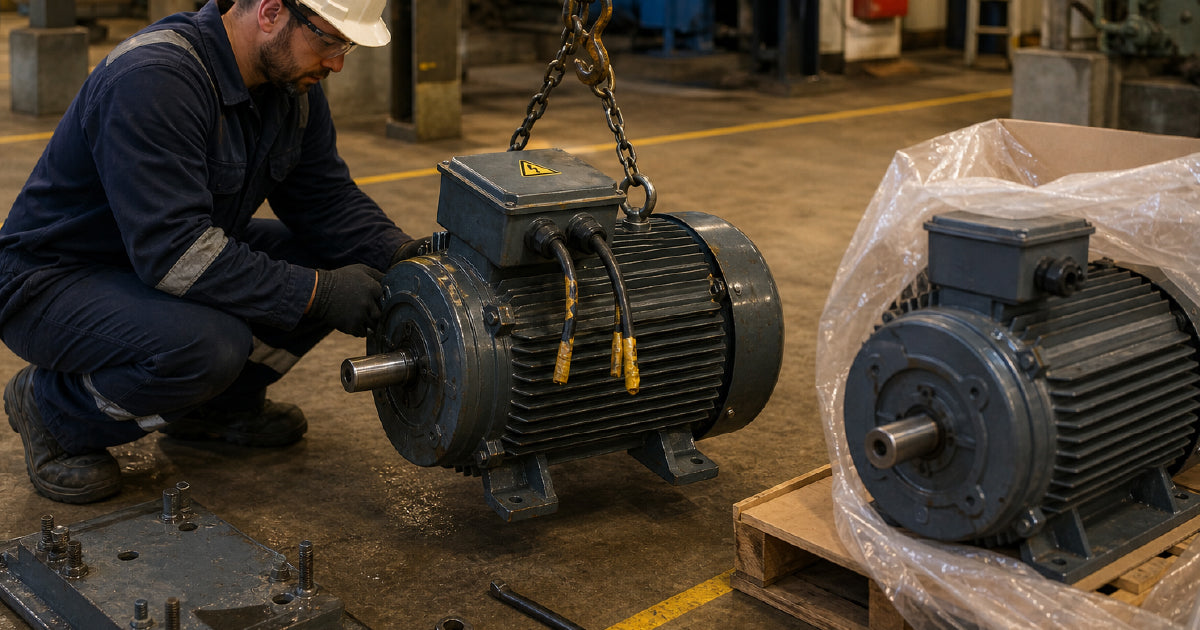
If you're replacing a motor, the fastest approach is to find the identification plate fixed to the frame and match every spec on it. If you're selecting a motor from scratch — for a new application, a pump, a conveyor, a compressor — this guide walks through every decision in sequence, with reference tables you can use on the workshop floor.
AIMS Industrial stocks Techtop electric motors — a range of industrial AC induction motors covering single phase and three phase, aluminium and cast iron, from 0.18 kW to 315 kW.
Electric Motor Selection — Quick Reference
Choose an electric motor by matching voltage + phase + kW (power) + RPM + frame size + IP rating to the driven load. Most AU workshop motors run 240V single-phase or 415V three-phase, with frame sizes per AS/NZS 1359. Common selection criteria below.
| Selection Criterion | Common AU Options | When to Choose |
|---|---|---|
| Voltage / Phase | 240V 1-phase / 415V 3-phase | 1-ph up to ~2.2kW; 3-ph for higher power + efficiency |
| Power (kW) | 0.18kW – 200kW+ | Match driven load + 15–25% safety margin |
| Speed (RPM) | 2880 / 1440 / 960 / 720 | 2-pole = high RPM; 4-pole = workshop standard |
| Frame Size (IEC) | D63 – D355 per AS/NZS 1359 | Matches shaft height + bolt pattern |
| IP Rating | IP55 / IP56 / IP65 | IP55 indoor; IP56+ wash-down + outdoor |
| Mount Style | B3 foot / B5 flange / B14 face | Match drive coupling + base |
| Insulation Class | Class F / H | Class F = workshop standard; H = high temp |
| Efficiency (IE) | IE2 / IE3 / IE4 | IE3 MEPS-compliant minimum for AU 0.73–185kW |
Critical: AU MEPS (Minimum Energy Performance Standards) regulation requires IE3 efficiency for most motors 0.73–185kW since 2026. Match shaft diameter + key to driven coupling (see flexible coupling guide). For belt drives, see v-belt size chart. AIMS stocks electric motors, 240V single-phase, 415V three-phase + accessories.
What Is an Induction Motor?
An induction motor is the standard workhorse of industrial and commercial applications. It is an AC (alternating current) motor where the rotor is driven by electromagnetic induction from the stator windings — there is no electrical connection to the rotor, no brushes, and no commutator. This makes induction motors robust, low-maintenance, and long-lived compared to DC motors or brush-type motors.
Virtually all industrial electric motors sold in Australia for pump, fan, conveyor, compressor, and general machinery applications are induction motors. When someone refers to a "single phase motor" or "three phase motor" in an industrial context, they mean a single phase or three phase AC induction motor.
DC motors are available for applications requiring variable speed control without a VFD — such as some traction, winding, and process control applications — but they are the minority in general industrial use. This guide focuses on AC induction motors.
Single Phase vs Three Phase: Which Do You Need?
The first decision is power supply. In Australia, the standard supply is:
- Single phase: 230–240V, 50Hz. Available at standard GPO outlets. Suitable for motors up to approximately 2.2 kW in most applications.
- Three phase: 415V (line-to-line), 50Hz. Requires a three phase supply. Standard for anything above 2.2 kW, and preferred for continuous-duty applications at any power level.
| Factor | Single Phase | Three Phase |
|---|---|---|
| Supply voltage (AU) | 230–240V | 415V (line-to-line) |
| Typical power range | 0.18 kW – 2.2 kW | 0.18 kW – 315 kW+ |
| Starting torque | Requires starting capacitor or auxiliary winding | Good starting torque inherent in design |
| Efficiency | Lower (needs starting components) | Higher — smoother power delivery across all 3 phases |
| Maintenance | Capacitor requires periodic checking | Lower — no capacitors in standard design |
| Typical applications | Pumps, fans, small compressors, bench grinders, light conveyors | Compressors, large pumps, conveyors, machine tools, HVAC |
If three phase power is available at your site, use a three phase motor wherever possible — they are more efficient, start better, run cooler, and last longer under load. Single phase motors are the right choice where three phase is unavailable or impractical.
Single Phase Motor Types
Single phase induction motors cannot self-start — the stator field alone does not produce starting torque. Different designs solve this with auxiliary windings or capacitors:
| Type | How It Works | Starting Torque | Typical Use |
|---|---|---|---|
| Capacitor Start (CS) | Run capacitor in start winding, disconnected by centrifugal switch once at speed | High | Compressors, pumps, hard-starting loads |
| Capacitor Start / Capacitor Run (CS/CR) | Two capacitors — large start capacitor disconnected at speed, smaller run capacitor remains | High | Best all-round performance; air compressors, conveyors |
| Permanent Split Capacitor (PSC) | Single run capacitor, no switching | Low–Medium | Fans, blowers, light pump loads — smooth, quiet running |
| Shaded Pole | Copper ring on stator creates phase shift for starting | Very low | Small fans, instrument drives — very light loads only |
For most industrial single phase applications, a capacitor start / capacitor run motor is the preferred choice. It delivers the starting torque to get heavy loads moving and the running capacitor improves efficiency and power factor once at speed.
How to Read a Motor Nameplate
Every motor has an identification plate (nameplate) fixed to the frame. Matching this plate is the fastest way to replace a motor like-for-like. Key data fields:
| Nameplate Field | What It Means | Example |
|---|---|---|
| kW / HP | Rated output power at the shaft | 1.5 kW / 2 HP |
| Volts | Supply voltage (and wiring configuration for 3-phase) | 240V or 415V / 415–440V |
| Amps (A) | Full load current at rated voltage | 3.8A |
| Hz | Supply frequency — always 50Hz in Australia | 50Hz |
| RPM | Rated shaft speed at full load (slightly less than synchronous speed) | 1,450 RPM |
| Phase | 1 (single phase) or 3 (three phase) | 3 |
| Frame | IEC frame size — determines shaft height, bolt centres, and shaft diameter | 90L |
| IP | Ingress protection rating | IP55 |
| Ins. Class | Thermal insulation class of windings | F |
| Duty | Duty cycle — S1 = continuous operation | S1 |
| IE Class | Energy efficiency class | IE3 |
| cos φ | Power factor at full load | 0.82 |
Selecting the Right Power Rating (kW)
Power rating is the rated output at the shaft at full load. Size the motor so it operates in the 65%–100% of rated load range under normal conditions. Operating below 40% load wastes energy and reduces power factor; operating above 100% overheats the motor and shortens winding life.
kW to Horsepower Conversion
Older specifications and some imported machinery use horsepower (HP). The conversion is 1 kW = 1.341 HP, or 1 HP = 0.746 kW.
| kW | HP (approx) | Typical Application |
|---|---|---|
| 0.18 | 0.25 | Small fans, light conveyors |
| 0.25 | 0.33 | Small pumps, agitators |
| 0.37 | 0.5 | Small compressors, augers |
| 0.55 | 0.75 | Pumps, fans |
| 0.75 | 1 | Pumps, light machinery |
| 1.1 | 1.5 | Conveyors, compressors |
| 1.5 | 2 | General industrial |
| 2.2 | 3 | Upper limit of practical single phase in most applications |
| 3 | 4 | Three phase preferred above this point |
| 4 | 5.5 | Compressors, pumps |
| 5.5 | 7.5 | Air compressors, conveyors |
| 7.5 | 10 | Industrial machinery |
| 11 | 15 | Large compressors, pumps |
| 15 | 20 | Heavy machinery |
| 18.5 | 25 | Industrial plant |
| 22 | 30 | Industrial plant |
| 30 | 40 | Large industrial |
| 37 | 50 | Large industrial |
| 45 | 60 | Large industrial |
| 55 | 75 | Large industrial |
| 75 | 100 | Heavy plant |
Motor Speed: RPM and Pole Pairs
The synchronous speed of an induction motor depends on the supply frequency and the number of poles. At 50Hz (Australia's supply frequency):
| Number of Poles | Synchronous Speed (50Hz) | Typical Full-Load Speed | Common Applications |
|---|---|---|---|
| 2-pole | 3,000 RPM | ~2,850–2,900 RPM | High-speed pumps, centrifugal fans, grinders |
| 4-pole | 1,500 RPM | ~1,400–1,450 RPM | General machinery — most common industrial choice |
| 6-pole | 1,000 RPM | ~940–960 RPM | Conveyors, mixers, lower-speed applications |
| 8-pole | 750 RPM | ~700–720 RPM | Slow-speed direct-drive applications |
The difference between synchronous speed and actual full-load speed is called slip — typically 3–5% in a standard induction motor. The 4-pole (1,450 RPM) configuration is by far the most common in general industrial use. If you need variable speed, fit a variable frequency drive (VFD) rather than selecting a slower-pole motor — a VFD gives infinitely variable speed control from a single motor.
IP Ratings for Electric Motors
The IP (Ingress Protection) rating tells you how well the motor is sealed against solids and liquids. It is defined by IEC 60034-5. For a complete reference covering every IP code used across motors, enclosures, and industrial equipment in Australia, see our IP Rating Guide. The rating has two digits: the first indicates protection against solids; the second against liquids.
IP Rating Reference Table
| First Digit | Protection Against Solids | Second Digit | Protection Against Liquids |
|---|---|---|---|
| 0 | No protection | 0 | No protection |
| 1 | Objects >50mm (hand contact) | 1 | Vertically dripping water |
| 2 | Objects >12mm (fingers) | 2 | Dripping water up to 15° from vertical |
| 3 | Objects >2.5mm (tools, thick wire) | 3 | Spraying water up to 60° from vertical |
| 4 | Objects >1mm (fine wire) | 4 | Splashing water from any direction |
| 5 | Dust-protected (limited ingress, no harmful deposit) | 5 | Low-pressure water jets from any direction |
| 6 | Dust-tight (completely sealed) | 6 | High-pressure water jets from any direction |
| — | — | 7 | Temporary immersion up to 1 metre |
| — | — | 8 | Continuous immersion under pressure |
IP44 vs IP55 vs IP66: What's the Difference?
| IP Rating | Dust Protection | Water Protection | Typical Use |
|---|---|---|---|
| IP44 | Objects >1mm | Splashing from any direction | Clean indoor environments, non-washdown areas |
| IP55 | Dust-protected | Low-pressure jets from any direction | Standard industrial — most outdoor, dusty, and wet environments |
| IP66 | Dust-tight | High-pressure jets from any direction | Washdown areas, food processing, harsh outdoor, mining, wastewater |
IP55 is the standard for most industrial applications and is the default rating on the majority of Techtop motors. Choose IP66 for washdown areas, food processing, outdoor exposed installations, and environments with regular high-pressure cleaning. If you work with hazardous area motors (Zone 1, Zone 2, Ex-rated), the enclosure and certification requirements are above and beyond standard IP ratings — see our dedicated hazardous areas FAQ.
Motor Enclosure Types
| Enclosure Type | Description | IP Range | Use |
|---|---|---|---|
| TEFC (Totally Enclosed Fan Cooled) | Enclosed housing, external fan on non-drive end draws air over fins | IP55–IP66 | Standard for most industrial applications — protects against dust and moisture |
| ODP (Open Drip-Proof) | Ventilated housing allows air circulation through motor | IP23 | Clean, dry indoor locations only — lower cost, better cooling at low speeds |
| TEAO (Totally Enclosed Air Over) | Enclosed, cooled by externally moving air from the driven machine (eg. fan blade) | IP55 | Direct fan/blower drive where the driven equipment provides cooling airflow |
| TENV (Totally Enclosed Non-Ventilated) | Enclosed, relies on surface radiation — no cooling fan | IP55–IP65 | Low-speed or variable speed applications where the fan cooling is ineffective |
| Explosion-Proof (Ex/EXD) | Heavy-duty sealed enclosure prevents internal sparks from igniting external atmosphere | IP66 | Hazardous areas — flammable gas, vapour, or dust (Zone 1/Zone 2) |
TEFC is the correct default choice for virtually all Australian industrial applications. ODP is rarely specified outside of purpose-built clean room equipment.
Efficiency Ratings: IE Classes and MEPS
Motor efficiency is classified under IEC 60034-30-1 into efficiency classes — IE1 through IE4. Australia's Minimum Energy Performance Standards (MEPS) require that most three phase motors from 0.73 kW to 185 kW sold in Australia meet IE3 (Premium Efficiency) as a minimum. IE2 motors are no longer legally sold as standard catalogue items for general industrial use in Australia.
| IE Class | Description | Status in Australia |
|---|---|---|
| IE1 | Standard Efficiency | Not compliant with current MEPS — do not specify for new installations |
| IE2 | High Efficiency | Not compliant for general use — restricted applications only (VFD-controlled motors) |
| IE3 | Premium Efficiency | Minimum MEPS requirement for most 3-phase motors in Australia |
| IE4 | Super Premium Efficiency | Available — higher upfront cost, lower running cost for high duty-cycle applications |
For high-use motors running 8+ hours per day, efficiency class matters significantly — a single percentage point of efficiency improvement on a 15 kW motor running 5,000 hours per year is worth hundreds of dollars annually in power savings. Specify IE3 as a minimum; consider IE4 for duty-cycle-critical applications.
Single phase motors are not covered under MEPS in the same way — the focus is on three phase. However, single phase motor efficiency still varies between manufacturers and models.
Insulation Class
Insulation class defines the maximum temperature the motor windings can withstand continuously. Heat is the primary cause of insulation degradation — every 10°C above rated temperature approximately halves insulation life.
| Insulation Class | Maximum Winding Temperature | Notes |
|---|---|---|
| Class B | 130°C | Older standard — rarely specified now |
| Class F | 155°C | Current standard for most industrial motors — AIMS Techtop range |
| Class H | 180°C | High-temperature applications — found in some brake motors and high-ambient environments |
Most modern industrial motors are wound to Class F insulation but are designed for Class B temperature rise — meaning the motor runs well within Class F limits under normal load. This provides a thermal margin that directly extends motor life.
IEC Frame Size Guide
The IEC frame number defines the shaft centreline height above the mounting surface (in mm), plus the bolt pattern and shaft dimensions. Two motors with the same frame size and mounting type are dimensionally interchangeable regardless of manufacturer.
| IEC Frame | Shaft Height (mm) | Typical Power Range (4-pole) |
|---|---|---|
| 56 | 56 | 0.06–0.12 kW |
| 63 | 63 | 0.12–0.18 kW |
| 71 | 71 | 0.25–0.37 kW |
| 80 | 80 | 0.37–0.75 kW |
| 90S / 90L | 90 | 0.75–1.5 kW |
| 100L | 100 | 1.5–2.2 kW |
| 112M | 112 | 2.2–4 kW |
| 132S / 132M | 132 | 4–7.5 kW |
| 160M / 160L | 160 | 7.5–15 kW |
| 180M / 180L | 180 | 11–18.5 kW |
| 200L | 200 | 18.5–22 kW |
| 225S / 225M | 225 | 22–37 kW |
| 250M | 250 | 37–45 kW |
| 280S / 280M | 280 | 45–75 kW |
| 315S / 315M / 315L | 315 | 75–200 kW |
Frame suffixes S (short), M (medium), and L (long) indicate the length of the frame body — longer frames accommodate larger stator windings for more power at the same shaft height. When replacing a motor, match the frame number exactly to ensure the replacement bolts directly into the existing mounting.
Mounting Types (IEC)
| IEC Mount Code | Description | Common Name |
|---|---|---|
| IM B3 | Four feet on base, shaft horizontal | Foot mount (standard) |
| IM B5 | Large flange on drive end face, shaft horizontal | Face flange (large) |
| IM B14 | Small flange on drive end face | Face flange (small) |
| IM B35 | Feet on base plus large face flange | Foot + flange (most common for pump sets) |
| IM V1 | Flange mount, shaft pointing downward | Vertical down |
| IM V3 | Flange mount, shaft pointing upward | Vertical up |
Material: Cast Iron vs Aluminium
| Frame Material | Advantages | Disadvantages | Best For |
|---|---|---|---|
| Cast Aluminium | Lighter weight; better thermal conductivity (cools faster); lower cost; corrosion resistant | Less durable under severe mechanical impact; lower structural rigidity at large frame sizes | General industrial, smaller frame sizes (up to ~132M), applications where weight matters |
| Cast Iron | Superior mechanical strength and durability; better suited to heavy vibration and impact; performs better at large frame sizes | Heavier; higher cost; can rust if coating damaged | Mining, heavy industry, large frame sizes (160M+), high-vibration applications |
For most standard industrial applications up to approximately 7.5 kW, aluminium frame motors are the practical choice. Above 15 kW, or in harsh environments with mechanical shock or vibration, cast iron is preferred.
Electric Motor Lifespan and Common Failure Causes
A properly selected and maintained industrial induction motor should last 15–20+ years under normal operating conditions. Studies report average lifespans of 12 years across the installed base — this average is pulled down by premature failures from the causes below.
Common Causes of Motor Failure
| Failure Category | % of All Failures | Common Causes | Prevention |
|---|---|---|---|
| Bearing failure | ~50% | Improper lubrication, contamination, overloading, vibration, incorrect bearing selection | Regular re-lubrication (not over-lubrication), correct alignment, vibration monitoring |
| Winding failure | ~30% | Overheating from overload or blocked ventilation, voltage spikes, moisture ingress, insulation degradation | Correct motor sizing, thermal protection relay, IP rating matched to environment |
| External / mechanical | ~20% | Overloading, shaft misalignment, excessive belt tension, vibration from driven equipment | Correct sizing, alignment checks, proper belt tension, vibration monitoring |
Factors That Reduce Motor Lifespan
- Undersizing: Running a motor above its rated load continuously overheats windings and accelerates bearing wear. The motor may run — but not for long.
- Voltage imbalance (three phase): Even a 1% voltage imbalance between phases causes a disproportionate increase in current in the affected phase — a 3.5% imbalance can cause 25% additional heating. Check supply quality before commissioning.
- Voltage fluctuation: Both over-voltage and under-voltage stress insulation. Under-voltage increases current draw to maintain torque; over-voltage stresses insulation.
- Blocked ventilation: The external cooling fan on a TEFC motor must have clear airflow. Accumulated dust and debris on the cooling fins can raise motor temperature significantly. Clean regularly.
- Incorrect IP rating: A motor with insufficient ingress protection in a dusty or wet environment will fail prematurely. Match the IP rating to the installation environment.
- Infrequent starts on single phase: Capacitors in single phase motors degrade over time — capacitor condition should be checked as part of periodic maintenance.
Motor bearings — typically deep groove ball bearings on the drive end and the non-drive end — wear with use and are the most common motor service item. For motor bearing replacement: dimension series, seal types, C3 clearance for thermal expansion, and brand selection (SKF, NTN, Nachi, NSK), see our Deep Groove Ball Bearing Guide.
Motor Protection: Thermal Overload and VFDs
All industrial motors should be protected by a correctly rated thermal overload relay or motor protection circuit breaker set to the motor's full load current (FLC). This is not optional — an unprotected motor will run to failure on sustained overload.
For variable speed applications, a variable frequency drive (VFD) provides both speed control and built-in motor protection (overload, phase loss, over-temperature). A standard TEFC motor can be used with a VFD at speeds above approximately 25–30Hz; below this, the cooling fan becomes less effective and a separately ventilated or TENV motor should be considered for sustained low-speed operation.
Selecting a Motor: Decision Checklist
- Power supply available: Single phase 240V or three phase 415V?
- Required output power: Calculate load kW requirements — size motor to operate at 65–100% load.
- Required speed: What shaft speed does the application need? Select pole count accordingly, or specify VFD for variable speed.
- Environment: Indoor/outdoor? Dusty? Wet? Washdown? Select IP rating — IP55 minimum for most industrial, IP66 for washdown/harsh.
- Mounting: Foot (B3), flange (B5/B14), or combination (B35)? Match to existing base/coupling dimensions.
- Frame size: Match existing frame if replacing. For new: determine from power and mounting requirements.
- Material: Aluminium (light duty to 7.5kW general) or cast iron (heavy duty, large frame, high vibration)?
- Efficiency class: IE3 minimum for three phase. Consider IE4 for high duty cycle.
- Duty cycle: S1 (continuous) is standard. S2–S9 for intermittent, short-time, or cyclic duty.
- Special requirements: Brake motor? Hazardous area certification (Ex)? Variable speed (VFD-compatible)?
Once the motor is selected, the drive pulley pairing determines the final shaft speed. For the pulley reference — V-belt sheave profiles, taper lock vs pilot bore mounting, speed ratio calculations, alignment with Gates laser tools — see our Pulley Types Guide.
Industrial Electric Motors in Australia: Brands and Suppliers
AIMS Industrial stocks the Techtop electric motor range — a globally established brand manufactured by Shanghai Top Motor Company, one of the world's leading induction motor manufacturers. Techtop Australia, established in 2013, is the exclusive Australian distributor. The range covers single phase and three phase AC induction motors from 0.18 kW to 315 kW in aluminium and cast iron frames, with standard IP55 and IP66 ratings across the series. AIMS Industrial holds stock in Sydney for fast despatch across Australia.
Troubleshooting Common Induction Motor Problems
| Symptom | Likely Cause | Action |
|---|---|---|
| Motor hums but won't start | Single phase: failed start capacitor or centrifugal switch. Three phase: single phasing (one phase missing) | Test capacitor; check all three supply phases at the motor terminals |
| Motor hums loudly under load | Overloaded rotor; loose stator laminations; voltage imbalance (three phase) | Check load against rated kW; check supply voltage balance across phases |
| Motor runs hot | Overload; blocked cooling fins; wrong motor for duty cycle; high ambient temperature | Check load current against FLC on nameplate; clean cooling fins; verify duty rating |
| Motor vibrates excessively | Shaft misalignment; unbalanced driven load; bearing wear; loose mounting bolts | Check alignment; inspect bearings; tighten all mounting hardware |
| Motor trips thermal overload repeatedly | Motor undersized for load; overload relay set too low; high ambient temperature | Verify motor kW against actual load; check overload relay setting against nameplate FLC |
| Motor runs in wrong direction (three phase) | Phase sequence — two supply phases are transposed | Swap any two of the three supply phases at the terminal box |
Frequently Asked Questions
What is an induction motor?
An induction motor is an AC electric motor where the rotor is driven by electromagnetic induction from the rotating stator field — no brushes or commutator required. It is the standard motor type for industrial and commercial applications worldwide. The vast majority of electric motors sold for industrial use in Australia (pumps, fans, compressors, conveyors, machinery) are induction motors.
What is the difference between single phase and three phase motors?
Single phase motors run from a standard 240V GPO supply and are practical up to about 2.2 kW. Three phase motors run from a 415V three phase supply, are available from 0.18 kW to hundreds of kilowatts, and are more efficient, run smoother, and start better than single phase. Use three phase wherever the supply is available and the application is above 2.2 kW.
What is the difference between IP44 and IP55?
IP44 offers protection against solid objects larger than 1mm and against water splashing from any direction. IP55 offers dust-protected (limited ingress, no harmful deposit) and low-pressure water jets from any direction. IP55 is the standard for industrial motors. IP44 is suitable for clean, dry indoor environments only. For outdoor, dusty, or wet industrial applications, specify IP55 as a minimum.
What does TEFC mean for electric motors?
TEFC stands for Totally Enclosed Fan Cooled. The motor housing is fully enclosed (not ventilated), and an external fan mounted on the non-drive end shaft draws air over the cooling fins. TEFC is the standard industrial motor enclosure, typically rated IP55 or IP66. It protects the motor internals from dust, moisture, and debris.
How do I choose the right motor kW rating?
Size the motor so it operates at 65%–100% of its rated load under normal conditions. A motor running below 40% load wastes energy and has a poor power factor. A motor running above its rated load overheats and fails prematurely. Calculate the actual load requirement first, then select the nearest standard motor size that puts the operating point in the 65–100% range.
What RPM does a 4-pole motor run at in Australia?
On Australia's 50Hz supply, a 4-pole induction motor has a synchronous speed of 1,500 RPM. At full load, the actual speed is typically 1,400–1,450 RPM due to slip (the difference between synchronous and actual speed). The 4-pole configuration is the most common choice for general industrial applications.
What is IE3 efficiency class for motors?
IE3 (Premium Efficiency) is the efficiency class required by Australia's Minimum Energy Performance Standards (MEPS) for most three phase induction motors from 0.73 kW to 185 kW. IE3 motors are measurably more efficient than the previous IE2 standard. IE2 motors are no longer compliant for general industrial sale in Australia. IE4 (Super Premium Efficiency) is available for applications where maximum efficiency is required.
What insulation class do most industrial motors have?
Most modern industrial motors use Class F insulation, which withstands continuous winding temperatures up to 155°C. Standard industrial motors are typically designed for Class B temperature rise (130°C) within Class F insulation, providing a thermal safety margin that extends motor life. Class H (180°C) is used in high-ambient or high-duty applications such as brake motors.
Are induction motors self-starting?
Three phase induction motors are self-starting. The rotating magnetic field produced by the three phase supply creates sufficient torque to accelerate the rotor from standstill without any auxiliary starting mechanism. Single phase induction motors are not self-starting — the single phase stator field produces a pulsating (not rotating) field, which generates no net starting torque. Single phase motors require an auxiliary starting means: a start winding with capacitor (capacitor start), a permanently connected run capacitor (PSC), or a shaded pole arrangement.
Why is my induction motor humming but not starting?
A humming motor that fails to start has one of two common causes. In single phase motors, the start capacitor or centrifugal switch has failed — the motor receives power to the run winding but cannot generate starting torque. In three phase motors, the motor is single-phasing: one of the three supply phases is absent at the motor terminals due to a blown fuse, a faulty contactor contact, or a supply fault. A three phase motor on two phases will hum loudly, draw excessive current on the remaining phases, and will not start under load. Check all three phase voltages at the motor terminal box immediately — single phasing will burn out a three phase motor quickly if it is not disconnected.
Where can I buy induction motors in Australia?
AIMS Industrial stocks Techtop single phase and three phase induction motors in Sydney with fast despatch across Australia. The range covers 0.18 kW to 315 kW in aluminium and cast iron frames, with standard IP55 and IP66 ratings. View the full Techtop motor range or contact AIMS Industrial for assistance selecting the right motor for your application.
How long does an industrial electric motor last?
A properly selected, correctly installed, and maintained industrial induction motor should last 15–20 years under normal conditions. Industry studies report average lifespans of approximately 12 years across the installed base — this average reflects premature failures from undersizing, incorrect IP rating, bearing neglect, and voltage problems rather than a fundamental limit on motor life.
What causes electric motors to fail?
Bearing failure accounts for approximately 50% of all motor failures, typically caused by improper lubrication, contamination, or vibration. Winding failure (around 30%) results from overheating, moisture ingress, or voltage spikes. The remaining 20% involves external factors: overloading, shaft misalignment, excessive belt tension, and mechanical damage. Correct motor sizing and IP rating selection, combined with regular maintenance, address the majority of these causes.
Can I use a standard motor with a VFD?
Yes — a standard TEFC induction motor can be used with a variable frequency drive (VFD) at speeds above approximately 25–30Hz (50–60% of rated speed). Below this, the external cooling fan loses effectiveness and the motor may overheat on sustained loads. For sustained low-speed VFD operation, specify a separately ventilated (TEAO) or TENV motor. Always check the motor manufacturer's VFD compatibility specifications.
What is the difference between a capacitor start and capacitor run motor?
A capacitor start motor uses a capacitor in the start winding to create a phase shift for starting torque; the capacitor is disconnected by a centrifugal switch once the motor reaches speed. A capacitor start / capacitor run (CS/CR) motor uses a large start capacitor for high starting torque plus a smaller run capacitor that stays in circuit during operation, improving running efficiency and power factor. CS/CR is the preferred type for most industrial single phase applications with hard-starting loads.
Ready to replace or upgrade?
Shop our range of industrial electric motors
Single-phase and three-phase induction motors across a range of kW outputs, frame sizes, and IP ratings — stocked for fast Australia-wide dispatch.
People Also Ask — Electric Motors
Q: What is the difference between a single-phase and three-phase electric motor?
Single-phase motors run on standard 230–240V single-phase power available from most domestic and light commercial outlets. They are suitable for smaller loads up to around 3.7kW. Three-phase motors run on 415V three-phase industrial power and are more efficient, simpler in construction, and available in much larger power ratings. Three-phase motors self-start directly; single-phase motors need starting capacitors or other starting mechanisms. For industrial applications, three-phase is standard where power is available.
Q: What does motor IP rating mean?
IP (Ingress Protection) rating classifies the motor's protection against solids and liquids. The two-digit code after 'IP' indicates solid particle protection (first digit, 0–6) and liquid protection (second digit, 0–9). IP55 means the motor is dust-tight and protected against water jets from any direction — a common industrial standard. IP65 provides full dust-tight protection and water jet resistance. Higher IP ratings increase cost and reduce cooling efficiency, so match the IP rating to the actual environment.
Q: What is motor frame size and why does it matter?
Frame size is a standardised dimension code (IEC or NEMA) that defines the mounting dimensions, shaft height and shaft diameter of the motor. Common IEC frame sizes include 63, 71, 80, 90, 100, 112, 132 and 160. When replacing a motor, matching the frame size ensures the replacement will bolt directly to the existing mount and connect to the existing coupling or pulley without modification. Always confirm the frame size before ordering a replacement motor.
Q: What is motor efficiency class and why does it matter for running costs?
IE efficiency classes (IE1 to IE4 under IEC 60034-30) indicate how efficiently a motor converts electrical input to mechanical output. An IE3 (Premium Efficiency) motor running continuously consumes significantly less electricity than an IE1 (Standard Efficiency) motor of the same power rating. The energy savings from upgrading to IE3 in a continuously running application typically pay back the price difference within one to three years. Most Australian states now require IE3 or higher for new motors above certain power thresholds under MEPS regulations.
Q: How do I choose the correct motor for a conveyor or pump application?
Key selection factors are: required power output (kW or hp) based on the load calculation; speed in RPM or use of a gearbox for low-speed applications; mounting configuration (foot, flange or combined); frame size for mechanical fit; IP rating for the environment; and duty cycle (S1 continuous, S2 short-time, etc.). For pumps, always consider starting torque requirements. Consulting the driven equipment manufacturer's specification sheet is the most reliable starting point for correct motor selection.
What is a star-delta starter?
Star-delta (also written Y-Δ) is a reduced-voltage starting method for three phase induction motors. During start, the three windings are connected in star configuration — each winding sees phase voltage (240V from a 415V supply), which limits starting current to about a third of direct-on-line. Once the motor approaches full speed, a contactor switches the windings to delta and the motor runs at full voltage. Used on motors typically above 5.5-7.5 kW to reduce electrical supply stress and mechanical starting shock.
What is the difference between B3, B5, and B14 motor mounts?
B3 is a foot-mounted motor — the motor sits on a base and is bolted down through mounting feet on the body. B5 is a large-flange mounted motor — a machined flange at the drive end bolts directly to the driven equipment. B14 is a face-mounted motor with a smaller machined face and threaded holes — used on smaller motors that bolt to gearboxes and pumps. B5 and B14 mounts also come in combination form (B35, B34) that provide both foot and flange fixing.
What is a soft starter and when should I use one?
A soft starter is an electronic reduced-voltage starter that ramps motor voltage from a starting level up to full over a set time (typically 2-30 seconds). It reduces inrush current and mechanical shock on the driven equipment. Used where direct-on-line starting would cause a supply voltage dip, or where sudden torque damages belts, chains, couplings, or pumped systems. A soft starter is not the same as a VFD — it only controls starting; once the motor is up to speed it runs at fixed supply frequency.