

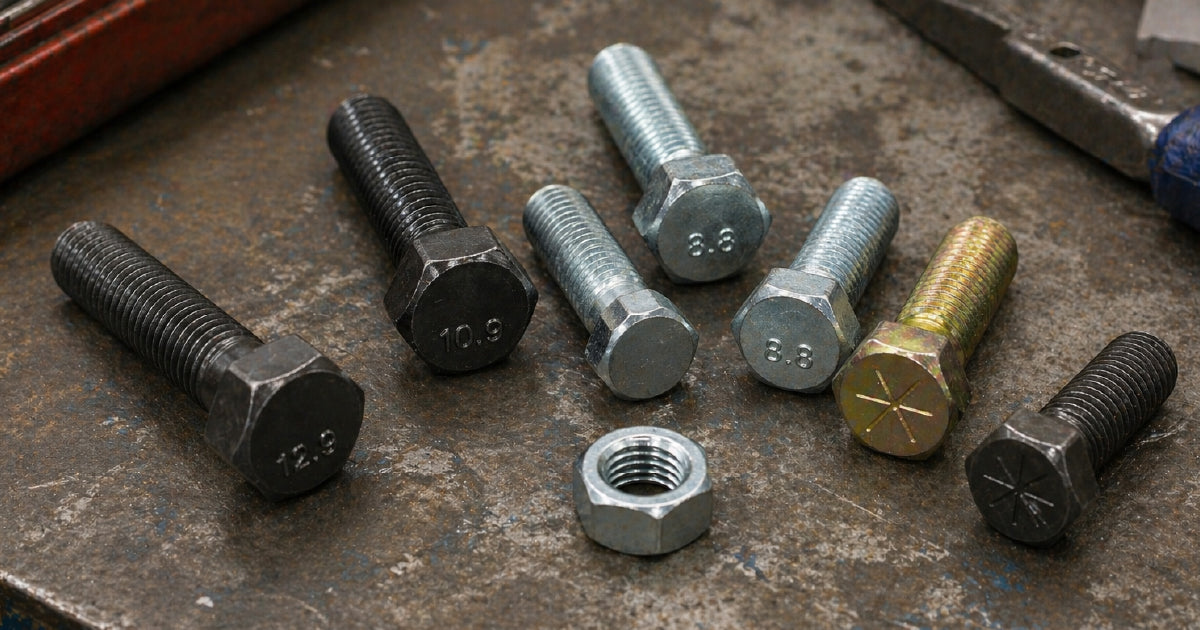
Every fastener has a grade — and that grade tells you exactly how much load it can carry before it yields or breaks. In a workshop or structural environment where bolts hold together frames, machinery mounts, flanges and pressure fittings, specifying the wrong grade produces an under-strength joint. Specifying the right grade means you never have to think about it again.
This guide covers the complete bolt grade system: metric property classes from 4.6 to 12.9, imperial SAE grades, stainless steel ISO 3506 grades, how to read head markings in the field, a grade 8.8 versus 10.9 versus 12.9 strength comparison, and a torque reference chart for common metric sizes. All grades are referenced against ISO 898, ISO 3506 and the relevant Australian standards.
This guide is part of AIMS Industrial's curated Engineering Reference Charts library — 78 reference articles across fasteners, threading, bearings, lubrication and safety standards.
Bolt Grade Quick Reference — Metric & Imperial
Bolt grades indicate tensile strength. Metric bolts use Property Class numbers (the first digit × 100 = ultimate tensile strength in MPa; the second × first × 10 = yield strength in MPa). Stainless fasteners use A2/A4 grades with property class suffixes (-70 = 700 MPa, -80 = 800 MPa).
| Grade | System | Tensile Strength | Yield Strength | Common Use |
|---|---|---|---|---|
| 4.6 | Metric | 400 MPa | 240 MPa | General fastening, mild steel |
| 5.8 | Metric | 500 MPa | 400 MPa | Light structural, general purpose |
| 8.8 | Metric | 800 MPa | 640 MPa | Standard structural grade — workshop default |
| 10.9 | Metric | 1,040 MPa | 940 MPa | High-tensile structural, machinery, automotive |
| 12.9 | Metric | 1,220 MPa | 1,080 MPa | Highest standard grade — critical assemblies, dies |
| A2-70 | Stainless 304 | 700 MPa | 450 MPa | General corrosion resistance, food-grade |
| A4-80 | Stainless 316 | 800 MPa | 600 MPa | Marine grade, chloride exposure |
What the Numbers on a Metric Bolt Mean
Metric fastener grades are called property classes and follow a two-number system defined in ISO 898-1 (adopted in Australia as AS/NZS 4291.1). The two numbers are separated by a decimal point and encode two mechanical properties simultaneously:
For safety-critical rotating-shaft assemblies (steering knuckles, axle stub shafts, suspension components), bolt grade is only half the equation — the castellated nut and split pin system is what prevents loosening under cyclic load. See the castle nut guide for slot count, AS 1112.4 / DIN 935 dimensions and torque-to-alignment procedure.
- First number × 100 = nominal tensile strength in MPa. A grade 8 bolt has a nominal tensile strength of 800 MPa; a grade 10 bolt has 1,000 MPa nominal (minimum actual: 1,040 MPa).
- Product of both numbers × 10 = minimum yield strength in MPa. For grade 8.8: 8 × 8 × 10 = 640 MPa. For grade 10.9: 10 × 9 × 10 = 900 MPa.
This gives you two critical values directly from the designation — no lookup required. The ratio of the second number to the first also tells you the yield-to-tensile margin. Grade 8.8 has a ratio of 0.8, meaning the bolt yields at 80% of its tensile capacity. Grade 10.9 has a ratio of 0.9 — a tighter margin with less deformation warning before fracture, which is why correct torque specification matters more at higher grades.
Metric Bolt Grade Chart: Property Classes 4.6 to 12.9
The table below covers the metric property classes in common industrial use. Grades 4.6 and 4.8 are mild steel. Grade 8.8 is the standard high-tensile grade. Grades 10.9 and 12.9 are alloy steel grades used where higher clamping force is required. For the density of common bolt steel grades and weight calculations on bolt assemblies, see our Material Density Chart.
For full metric bolt diameter / thread pitch / head dimension references across M3 through M24, see the AIMS Metric Bolt Size Guide.
| Property Class | Min Yield Strength | Min Tensile Strength | Typical Material | Typical Application |
|---|---|---|---|---|
| 4.6 | 240 MPa | 400 MPa | Low carbon steel | General purpose, non-structural, light-duty fixings |
| 4.8 | 320 MPa | 400 MPa | Low or medium carbon steel | General hardware, light mechanical assemblies |
| 5.6 | 300 MPa | 500 MPa | Low alloy or carbon steel | Medium-duty fixings, agricultural equipment |
| 5.8 | 400 MPa | 500 MPa | Low or medium carbon steel | General mechanical, light structural assemblies |
| 6.8 | 480 MPa | 600 MPa | Medium carbon steel | Machine frames, general industrial fastening |
| 8.8 | 640 MPa | 800 MPa | Medium carbon alloy steel, Q&T | High tensile standard — structural steel, machinery, flanges |
| 10.9 | 900 MPa | 1,040 MPa | Alloy steel, Q&T | High-load structural, automotive powertrain, pressure flanges |
| 12.9 | 1,080 MPa | 1,220 MPa | Alloy steel, Q&T | Maximum strength — cylinder heads, hydraulic equipment, tooling clamps |
Q&T = quenched and tempered. Values per ISO 898-1 / AS/NZS 4291.1.
What "high tensile" means in practice: In Australian industrial usage, any bolt of grade 8.8 or above is classified as high tensile. Grades below 8.8 — 4.6, 4.8, 5.8, 6.8 — are commercial or mild steel grades. Grade 8.8 is the minimum specified for structural steel connections in Australia under AS 4100. For decoding the manufacturer's identification mark, spotting counterfeit bolts, and applying AS/NZS 1252.1 to structural projects, see the sections below.
How to Identify a Bolt Grade from Its Head Markings
Reading bolt head markings is a practical field skill. The system differs between metric and imperial fasteners, and stainless steel bolts use a separate designation entirely.
Metric Bolt Head Markings
Metric bolts carry their property class number stamped or embossed directly onto the bolt head — typically on the top face or one of the hex flats. A grade 8.8 bolt will show "8.8". A grade 10.9 bolt shows "10.9". A grade 12.9 bolt shows "12.9". Most manufacturers include a maker's identification mark alongside the property class.
Lower-grade metric bolts (4.6, 4.8) may have minimal or no markings. If a metric hex bolt carries no head marking at all, treat it as grade 4.6 for design purposes — do not use it in any application calling for high tensile. Unmarked bolts of unknown origin have no certified strength.
Imperial (SAE) Bolt Head Markings
Imperial bolts use radial lines embossed on the hex head. The number of lines equals the grade minus two: Grade 5 has 3 radial lines, Grade 8 has 6 radial lines, Grade 2 has no lines.
| SAE Grade | Head Marking | Min Tensile Strength | Metric Equivalent (approx) | Typical Use |
|---|---|---|---|---|
| Grade 2 | No marks | 379–510 MPa (size-dependent) | ≈ 4.6 | Light-duty, non-structural |
| Grade 5 | 3 radial lines | 827 MPa | ≈ 8.8 | General automotive and machinery |
| Grade 8 | 6 radial lines | 1,034 MPa | ≈ 10.9 | High-strength automotive and industrial |
| ASTM A325 | "A325" stamped | 827 MPa | ≈ 8.8 | Structural steel connections |
| ASTM A490 | "A490" stamped | 1,034 MPa | ≈ 10.9 | High-strength structural connections |
Caution on grade equivalence: Imperial-to-metric equivalences are approximate. Always use the grade specified in the design — substituting a "similar" grade without checking yield strength, thread form and standards compliance can create an under-designed joint.
Stainless Steel Bolt Head Markings
Stainless fasteners are marked with their material designation and strength class — for example "A2-70" or "A4-80". The letter-number prefix identifies the steel family; the two-digit suffix is the minimum tensile strength divided by 10. A2-70 = 700 MPa tensile; A4-80 = 800 MPa tensile.
Common Manufacturer Marks (Australian Market)
Beside the grade marking, manufacturers stamp an identification symbol. The same code letter can mean different things across brands, so cross-check with supplier documentation.
- Bumax — "BUMAX" or stylised B logo. Swedish stainless high-tensile.
- Bossard — "BO" or full name. Swiss/global engineering fastener brand.
- Acton — "A" with manufacturer code. Strong AU/NZ distribution.
- Inox World — Australian-owned stainless specialist; mark varies by source mill.
- Champion — manufacturer's mark on automotive-grade fasteners.
- Generic Asian imports — typically a single letter (T, S, L, etc.) representing the mill, not the brand. Verify CoC for any safety-critical use.
Verifying the mark is part of due diligence. For structural projects, your engineer or QA team should hold a list of approved manufacturer codes against the project's specification.

Counterfeit High-Tensile Bolts — How to Spot Them
Counterfeit fasteners have been a persistent quality risk in global supply chains for two decades, and the rise of online wholesale platforms has made the problem worse. A counterfeit 8.8 bolt looks identical to a genuine one — until it shears.
Red flags:
- Grade marking poorly struck, shallow, off-centre, or with inconsistent depth across the head
- Missing manufacturer's identification mark
- Threads visibly cut (rough finish, machining marks) rather than rolled (smooth, polished crest)
- Weight inconsistent with claimed alloy (carbon steel vs supposedly higher-spec alloy)
- Pricing 30-50% below market rate from established suppliers
- No certificate of conformance available on request
- Heat-affected zone discolouration suggesting non-standard treatment
The reliable defence: source from suppliers who hold supplier-of-record relationships with major brands and who can produce a CoC traceable to a specific production batch on request. For structural, lifting, pressure, and other safety-critical applications, CoC is required by law or by insurance — it's not optional.
Magnetic Test — What It Does and Doesn't Tell You
Bring a magnet to a bolt and you learn one thing: whether the steel is austenitic stainless or not. Most carbon steels and martensitic stainless grades are magnetic. Austenitic stainless (A2-304, A4-316) is mostly non-magnetic, though cold-working can introduce slight magnetism.
So a non-magnetic bolt is probably stainless. A magnetic bolt could be ANY carbon grade — Grade 2 through 12.9 — and you still need the head marking to identify it. The magnet is a sorting aid, not a grade tester.
Identifying Worn, Corroded, or Painted Bolts
Original equipment bolts in older machinery often have markings worn down, corroded over, painted, or covered in grease. Working from the visible bolt alone:
- Clean the head carefully with a wire brush and degreaser. Avoid heavy abrasion that removes more material.
- Inspect under raking light — angled torchlight from the side reveals raised or recessed marks invisible under direct light.
- Check for replacement records — service history may identify the original spec.
- Consult the OEM — manufacturer service documents specify exact bolt class for critical joints.
- Bench test if critical — portable Rockwell hardness testers can indicate grade range (e.g. Grade 8 = 33-39 HRC, Grade 5 = 25-34 HRC) but won't give exact class.
When in doubt, replace. The cost of a new certified bolt is trivial against the cost of a failed joint. Specify the OEM grade or one class above; never assume an unmarked bolt is acceptable.
Safety warning: If you're removing seized fasteners during identification work and the head shears off, you may need to extract the shank. See our stuck bolt and nut removal guide for the escalation ladder.
High Tensile Bolts: What the Term Actually Means
The term "high tensile bolt" is used broadly but often without precision. In Australian industrial and structural practice, it refers to grade 8.8 and above — fasteners manufactured from medium carbon alloy steel that has been quenched and tempered to achieve a minimum certified tensile strength of 800 MPa.
The critical difference between grade 4.6 and grade 8.8 is not just strength — it is the manufacturing process. Low-grade bolts (4.6, 4.8) are cold-formed from plain carbon steel rod without heat treatment. High-tensile bolts (8.8 and above) are made from alloy steel and heat-treated to achieve controlled and certified mechanical properties. That consistency is why they are specified in engineering designs: the design loads are calculated against a known strength floor, not an estimate.
Is a stronger grade always a safe upgrade? From a tensile strength standpoint, yes — a higher-grade bolt of the same size carries more load. However, higher grades are harder and less ductile. Grade 12.9, in particular, is susceptible to hydrogen embrittlement in certain environments and becomes brittle under shock or impact loading. Do not automatically escalate to 12.9 without reviewing the application.
Can you replace 8.8 with 4.6? No. Substituting a lower grade in a joint designed for 8.8 is a structural failure waiting to happen, regardless of whether the bolt threads engage correctly. Grade is not just about fitting — it determines the clamping force the bolt can sustain under load.
Stainless Steel Bolt Grades: A2 and A4 Explained
Stainless steel fasteners are graded under ISO 3506-1, classifying them by steel family (A2 or A4) and strength class (70 or 80). The system is distinct from the property class system used for carbon and alloy steel.
| Grade | Steel Type | Min Tensile | Min Yield | Corrosion Resistance | Best For |
|---|---|---|---|---|---|
| A2-70 | 304 austenitic SS | 700 MPa | 450 MPa | Good — atmospheric and mild environments | Food processing, general outdoor, moderate corrosion duty |
| A2-80 | 304 austenitic SS | 800 MPa | 600 MPa | Good | Higher load applications where 304 SS material is acceptable |
| A4-70 | 316 austenitic SS | 700 MPa | 450 MPa | Excellent — chloride and marine environments | Marine, coastal, chemical plant, swimming pools |
| A4-80 | 316 austenitic SS | 800 MPa | 600 MPa | Excellent | High-strength marine and chemical applications |
A2 vs A4: The difference is the alloy. A2 is 304 stainless — the standard grade for atmospheric and mild environments. A4 is 316 stainless, which contains molybdenum and provides substantially better resistance to chlorides, salt water and industrial chemicals. Use A4 for anything coastal, marine, or exposed to chlorinated water or chemical attack. Do not use A2 in marine splash zones or direct saltwater immersion — it will corrode.
Can stainless replace high tensile carbon steel? Not in AS 4100 structural steel connections, which explicitly require carbon or alloy steel fasteners. A2-70 at 700 MPa falls short of grade 8.8 (800 MPa), and all stainless grades have significantly lower fatigue resistance and galling risk under high preload. For non-structural applications where corrosion resistance is the design priority, stainless is the correct choice — but verify the strength class meets the load requirement before specifying.
Stainless Equivalents and the Bumax Range
Carbon-steel grade markings (8.8, 10.9 etc.) do not apply to stainless. Stainless bolts use ISO 3506 markings: A-class (austenitic) plus a strength digit.
| Marking | Material | Tensile (MPa) | Carbon Equivalent |
|---|---|---|---|
| A2-50 | 304 stainless, soft | 500 | ~4.6 / 5.6 |
| A2-70 | 304 stainless, cold-worked | 700 | ~5.8 / 6.8 |
| A4-70 | 316 marine, cold-worked | 700 | ~5.8 / 6.8 |
| A4-80 | 316 marine, hardened | 800 | ~8.8 tensile only |
| Bumax 88 | Special A4-grade | 800 | = 8.8 |
| Bumax 109 | Special A4-grade | 1,000 | = 10.9 |
Standard A4-80 is not a true 8.8 substitute — its yield strength is around 600 MPa, lower than 8.8's 640 MPa. For a genuine stainless 8.8 (corrosion resistance and equal strength), Bumax 88 is the standard option. Bumax 109 reaches genuine 10.9-equivalent strength in stainless, used in offshore, chemical processing, and high-spec marine applications where 316 won't quite get you there.
See our stainless steel fasteners guide for the full grade picture and our Bumax range for high-tensile stainless availability.
Grade 8.8 vs 10.9 vs 12.9: Direct Comparison
These three grades cover the majority of high-strength fastener applications. Here is a direct comparison of their mechanical properties and practical characteristics:
| Grade 8.8 | Grade 10.9 | Grade 12.9 | |
|---|---|---|---|
| Min tensile strength | 800 MPa | 1,040 MPa | 1,220 MPa |
| Min yield strength | 640 MPa | 900 MPa | 1,080 MPa |
| Hardness range | 245–335 HV | 320–380 HV | 380–435 HV |
| Ductility | Good | Moderate | Low — brittle under shock load |
| Hydrogen embrittlement risk | Low | Moderate | High — avoid acid plating without baking |
| Typical finish | Yellow/clear zinc plate, hot-dip galvanised | Yellow zinc plate | Black oxide or black phosphate (typical) |
| Typical applications | Structural steel, machinery, flanges, general high-tensile | Automotive powertrain, slip-critical structural joints, heavy machinery | Cylinder heads, hydraulic equipment, precision tooling clamps |
On grade 12.9 and black finish: Grade 12.9 is commonly supplied in black oxide or black phosphate because these finishes do not involve acid pickling — which can induce hydrogen embrittlement in high-hardness fasteners, causing delayed brittle fracture under load. The black colour is a consequence of safe processing, not a grade marking. Not all black bolts are 12.9 — always read the head marking.
On hot-dip galvanising: Grade 8.8 can be hot-dip galvanised without significant embrittlement risk. Grade 10.9 and 12.9 should not be hot-dip galvanised — the hydrogen absorbed during pickling prior to galvanising is not adequately baked out and the high hardness makes these grades sensitive to delayed fracture. Use mechanical zinc plating or geomet coating for high-grade bolts requiring corrosion protection.
Structural Bolts in Australia: AS 4100 Requirements
Steel structures in Australia are designed to AS 4100, which specifies what fastener grades are acceptable for structural connections:
- Grade 4.6 (commercial bolt, AS 1111) — permitted only in bearing-type connections where the joint is designed for the lower strength, and only where specified by the engineer of record.
- Grade 8.8 (high-strength structural bolt, AS 1110) — the standard for all structural high-strength connections in Australia. Required for moment connections, column splices and base plates.
- Grade 10.9 — specified for friction-type (slip-critical) connections requiring higher bolt preload to develop full friction resistance between plies.
Mechanical properties for metric fasteners are governed by AS/NZS 4291.1 (equivalent to ISO 898-1) for bolts and AS/NZS 4291.2 for nuts. When specifying structural fasteners, always confirm the bolt carries the correct property class mark and request a certificate of conformance from the supplier. Counterfeit high-tensile fasteners — particularly unmarked or incorrectly marked imports — are a documented failure mode in industrial accidents.
AS/NZS 1252.1 — Australian Structural Bolting
AS/NZS 1252.1:2016 (Amdt 1:2018 incorporated) is the Australian/New Zealand standard for high-strength bolts, nuts, and washers used in structural steelwork. If you're working on a building, bridge, crane, or any AS 4100-designed steel structure, the bolts must comply.
Key requirements:
- Property class 8.8 or 10.9 only — no other classes accepted for structural use under this standard.
- Marking — property class plus manufacturer's identification mark, both legibly stamped or forged on the head.
- Matched assemblies — bolt, nut, and washer supplied as a certified set with the same batch certificate. Mixing brands or batches is non-conforming.
- Certificate of conformance (CoC) — supplier must provide a CoC traceable to the production batch, listing mechanical test results.
- Galvanising — 8.8 may be hot-dip galvanised under controlled conditions; 10.9 generally must not be HDG due to hydrogen embrittlement risk. AS/NZS 1252.2 covers protective coatings.
Buying a 1252.1 bolt and a generic 8.8 bolt off the same shelf looks identical, but only the 1252.1 supplier has documented the mechanical testing, traceability, and conformance you'll need if there's ever a structural failure investigation. Always specify "to AS/NZS 1252.1" in structural project orders and request the CoC at delivery.
Bolt Grade Selection Guide
The table below gives recommended minimum grades for common industrial and structural applications. These are starting-point recommendations — always verify against your design specification, equipment OEM data and the engineer of record for structural connections.
| Application | Recommended Grade | Notes |
|---|---|---|
| General hardware, cabinets, enclosures | 4.6 | No load-bearing requirement |
| Light machinery frames, guards, covers | 4.6 or 8.8 | 8.8 preferred where vibration is present |
| Structural steel connections (AS 4100) | 8.8 minimum | 4.6 only in bearing joints per engineer specification |
| Slip-critical (friction) structural connections | 8.8 or 10.9 | Per AS 4100 and engineer specification |
| Flange connections (pressure piping, ANSI flanges) | 8.8 (ASTM A193 B7 for high temp/pressure service) | Verify with P&ID and equipment specification |
| Machinery mounting, base plates, motor flanges | 8.8 | Standard high-tensile grade for industrial equipment |
| Automotive powertrain (con rods, cylinder heads) | 10.9 or 12.9 | Always use OEM-specified grade and torque — not negotiable |
| Hydraulic cylinder end caps, high-pressure fittings | 10.9 or 12.9 | Per engineering calculation and pressure rating |
| Food processing or general corrosive environments | A2-70 or A4-70 | A4-70 where chloride exposure is present |
| Coastal or marine environments | A4-80 or hot-dip galvanised 8.8 | A4-80 for immersion or chloride splash; HDG 8.8 for bolted steelwork above waterline |
Selection by Application
Structural steel and AS 4100 connections
Property class 8.8 or 10.9 to AS/NZS 1252.1. Matched assemblies (bolt + nut + washer + CoC). Specify HDG only on 8.8. Consult AS 4100 for joint design and tensioning method (snug-tight, fully tensioned, slip-critical) — see AIMS's dedicated guide to structural bolt tensioning, categories and washer selection for the full procedure.
Automotive — suspension, brake, engine
OEM specifies the grade — usually 10.9 for suspension components and 8.8 or 10.9 for engine mount and brake caliper bolts. Always replace with OEM-spec or higher. It's tempting to swap a corroding high-tensile bolt for a standard stainless one, but standard A2/A4 stainless doesn't match high-tensile strength — if the application genuinely calls for high tensile, use a high-tensile stainless grade such as Bumax 88/109, not a standard stainless substitute. "Looks the same" is not the same.
Marine and offshore
A4-80 (316 marine) for general corrosion service. Bumax 88 or 109 where you need genuine high-tensile strength plus 316 corrosion resistance. Avoid A2 (304) below the splash zone — chloride pitting will get you in 12-24 months.
Mining and heavy plant
Property class 10.9 for high-shock-load joints. 8.8 for general structural. Greasing and re-torque schedules per AS 4100 / OEM specification. Counterfeit risk is high in mining supply chains — insist on CoC for any safety-critical fastener.
Food processing and chemical
A4-80 (316 stainless) baseline for sanitary applications. Bumax for high-load joints needing both strength and 316 corrosion resistance. Confirm CIP/SIP cleaning compatibility with the manufacturer.
Pressure equipment and fired vessels
Strict compliance with AS 1210 / AS 4458 / ASME B&PV — typically 8.8, 10.9, or B7 stud bolts with full material traceability and pressure-class testing. Don't substitute outside the engineering spec.
Grade 8.8 and 10.9 Bolt Torque Reference Chart
The torque values below are indicative reference values calculated using a friction coefficient of k = 0.20 for dry (unlubricated) threads and k = 0.15 for lubricated or zinc-plated threads, targeting 70% of proof load — consistent with standard tightening practice for general applications.
These values are for guidance only. Always confirm torque against your equipment OEM specification, engineering design, or Australian Standard where safety-critical joints are involved. Thread condition, lubrication type, washer specification, joint material and plating type all affect the actual clamping force achieved at a given torque.
| Bolt Size (Coarse) | 8.8 — Dry (Nm) | 8.8 — Lubricated (Nm) | 10.9 — Dry (Nm) | 10.9 — Lubricated (Nm) |
|---|---|---|---|---|
| M6 × 1.0 | 10 | 8 | 14 | 11 |
| M8 × 1.25 | 25 | 19 | 35 | 26 |
| M10 × 1.5 | 49 | 37 | 69 | 52 |
| M12 × 1.75 | 84 | 63 | 119 | 89 |
| M16 × 2.0 | 209 | 157 | 295 | 221 |
| M20 × 2.5 | 408 | 306 | 575 | 431 |
| M24 × 3.0 | 710 | 533 | 1,000 | 750 |
| M30 × 3.5 | 1,420 | 1,065 | 2,000 | 1,500 |
| M36 × 4.0 | 2,450 | 1,838 | 3,450 | 2,588 |
Lubricated values apply to zinc-plated, oiled or waxed threads. Anti-seize compounds have a lower friction coefficient (k ≈ 0.13) and require a further torque reduction of approximately 30–35% from the dry value — check the anti-seize manufacturer's k-factor and recalculate. Fine-thread variants (e.g., M12 × 1.25) develop approximately 5–10% higher preload at the same torque than coarse-thread equivalents.
For the fastener dimensions, thread pitches and cross-reference between metric and imperial bolt sizes, see the AIMS Industrial Fastener Reference Chart. For a complete torque reference covering all property classes — including grades 4.6, 12.9 and stainless A2-70/A4-80 with coating and lubrication adjustment factors — see the dedicated AIMS Metric Bolt Torque Chart. Need torque values for SAE Grade 2, 5 or 8 imperial bolts instead? See the Imperial/SAE Bolt Torque Chart.
Frequently Asked Questions
What do the two numbers in a bolt grade mean?
The first number × 100 gives the nominal tensile strength in MPa. The product of both numbers × 10 gives the minimum yield strength in MPa. For grade 8.8: tensile = 800 MPa, yield = 8 × 8 × 10 = 640 MPa. For grade 10.9: nominal tensile = 1,000 MPa (actual minimum 1,040 MPa), yield = 10 × 9 × 10 = 900 MPa. The second number divided by the first gives the yield-to-tensile ratio — 0.8 for 8.8, 0.9 for 10.9.
Is grade 8.8 a high tensile bolt?
Yes. Grade 8.8 is the entry-level high tensile grade in the metric property class system. In Australian structural and industrial practice, any bolt of grade 8.8 or above is classified as high tensile. It is manufactured from medium carbon alloy steel that is quenched and tempered to achieve a minimum certified tensile strength of 800 MPa. Grades below 8.8 — 4.6, 4.8, 5.8, 6.8 — are commercial or mild steel grades and are not high tensile.
What is the difference between grade 8.8 and 10.9 bolts?
Grade 10.9 has approximately 30% higher tensile strength (1,040 MPa vs 800 MPa) and 40% higher yield strength (900 MPa vs 640 MPa) than grade 8.8. Both are high tensile alloy steel, but 10.9 is harder and less ductile. For a given bolt size, 10.9 develops higher clamping force — which is why it is specified for slip-critical structural connections and high-torque automotive applications. The tradeoff is greater brittleness and increased sensitivity to correct installation torque. Do not substitute 10.9 for 8.8 or vice versa without rechecking the design specification.
How do I identify a bolt grade from its head markings?
Metric bolts have the property class stamped on the head — look for "8.8", "10.9" or "12.9". Imperial (SAE) bolts use radial lines: Grade 5 has 3 radial lines, Grade 8 has 6 radial lines, Grade 2 has none. Stainless steel bolts are marked "A2-70", "A4-70", "A4-80" or similar. If a bolt has no marking, treat it as the lowest grade (4.6 for metric, Grade 2 for imperial) and do not use it in structural or high-load applications.
What bolt grade is required for structural steel connections in Australia?
AS 4100 — the Australian standard for steel structures — requires a minimum of grade 8.8 for high-strength structural connections. Grade 4.6 commercial bolts are permitted only in specific bearing-type connections as detailed by the structural engineer. All friction-type (slip-critical) connections require grade 8.8 or 10.9, installed to the specified proof load. Never substitute a lower grade without engineering approval.
What does A2-70 mean on a stainless steel bolt?
A2 identifies the steel as 304 austenitic stainless steel. 70 is the strength class — minimum tensile strength of 700 MPa. A4-70 uses 316 stainless (with molybdenum for chloride resistance) at the same 700 MPa strength. A4-80 uses 316 stainless at 800 MPa — the highest-strength standard stainless option for marine or chemical environments.
Can stainless steel bolts replace grade 8.8 high tensile bolts?
Not in AS 4100 structural steel applications. A2-70 at 700 MPa falls below grade 8.8 (800 MPa), and stainless fasteners have significantly lower fatigue strength and a high galling risk under the preload levels used in structural connections. A2-80 matches 8.8 tensile strength but is still not an approved substitute in structural steel joints, which require carbon or alloy steel fasteners. For non-structural applications where corrosion resistance is the design priority, stainless is the correct choice — verify the strength class is sufficient for the load.
What torque should I use for a grade 8.8 M12 bolt?
The reference torque for an M12 grade 8.8 bolt with dry coarse threads (pitch 1.75) is approximately 84 Nm. With lubricated or zinc-plated threads, reduce to approximately 63 Nm. These are indicative values based on 70% of proof load with a friction coefficient of k = 0.20 (dry) or k = 0.15 (lubricated). Always use the torque specified in your equipment manual or engineering design where one exists — these reference values are a starting point, not a substitute for a verified specification.
Why are grade 12.9 bolts often black?
Grade 12.9 bolts are commonly supplied with a black oxide or black phosphate finish because these processes do not involve acid pickling, which can cause hydrogen embrittlement in very high-hardness fasteners — leading to delayed brittle fracture under load. The black colour is a consequence of safe finishing practice for high-hardness steel, not a grade designation in itself. Not all black bolts are 12.9 — always verify by reading the head marking.
What is the strongest metric bolt grade commercially available?
Grade 12.9 is the highest standard metric property class under ISO 898-1, with minimum tensile strength of 1,220 MPa and yield strength of 1,080 MPa. For virtually all industrial and structural applications, 12.9 is the ceiling. It should only be specified where the application genuinely requires it — brittleness, galling sensitivity and installation precision requirements all increase significantly above 10.9.
Class 12.9 is the engineering default for socket head cap screws (Allen bolts / DIN 912). When a designer specifies a socket head cap screw without giving a grade, they almost always mean 12.9 — substituting a lower grade reduces clamping force significantly and can fatigue the joint. Hex bolts, by contrast, are most commonly stocked in Class 8.8 or 10.9.
What Australian standard covers metric bolt grades?
Metric bolt mechanical properties are covered by AS/NZS 4291.1, the Australian and New Zealand adoption of ISO 898-1. Physical dimensions and tolerances for metric hex bolts are in the AS 1110 series. For structural applications, the governing standard is AS 4100 (Steel Structures), which specifies acceptable fastener grades for structural steel connections and installation requirements.
Working across metric and imperial specifications? See the AIMS metric vs imperial fasteners guide — covering thread standards, near-miss diameter combinations, and Australia's preferred system for new work.
What does the manufacturer's mark next to the grade mean?
The manufacturer's identification mark (a letter, symbol, or short code stamped beside the grade marking) identifies the maker for traceability. ISO 898-1 and AS/NZS 1252 require it on certified high-tensile bolts so a non-conforming batch can be traced. If a bolt has a grade marking but no manufacturer mark, treat it with caution — it may be counterfeit or non-certified.
How do I tell a counterfeit high-tensile bolt from a genuine one?
Counterfeits typically show: poorly struck or shallow grade markings, missing or generic manufacturer mark, weight or magnetism inconsistent with claimed material, threads cut not rolled (rough finish), and pricing well below market. The only reliable defence is purchasing from established suppliers who provide a certificate of conformance (CoC) and batch traceability. Critical applications require CoC by law in many sectors.
Are bolts with no head markings always low grade?
No. Unmarked bolts may be low-grade commercial fasteners (Grade 2 equivalent), unmarked stainless, or counterfeit product where markings were never applied. They could also be specialty fasteners that don't carry standard markings. Without a marking and without a certificate of conformance, treat them as unknown grade — do not use in structural, lifting, or safety-critical applications.
Can I use a magnet to test bolt grade?
A magnet won't tell you grade, but it confirms steel family. Carbon steel bolts (Grades 5, 8, 8.8, 10.9, 12.9) are all magnetic. Austenitic stainless (A2-304, A4-316) is mostly non-magnetic, though may show slight magnetism after cold-working. Martensitic stainless (A1, A3) IS magnetic. So a non-magnetic bolt is almost certainly stainless — but a magnetic bolt could be any carbon grade, you still need the head marking.
Is AS/NZS 1252.1 the same as ISO 898-1?
Closely related but not identical. AS/NZS 1252.1 covers high-strength structural bolts, nuts and washers for steelwork, with property classes 8.8 and 10.9 — referencing ISO 898-1 for mechanical properties but adding Australian-specific requirements for marking, dimensions, and certification. Structural steel projects in Australia must use bolts that meet AS/NZS 1252.1, not generic 8.8 commercial bolts.
What is a Bumax 88 bolt and how does it compare to 8.8 carbon steel?
Bumax 88 is a high-performance stainless bolt (typically Bumax 88 = 800 MPa tensile / 640 MPa yield) matching the strength of 8.8 carbon steel but in an A4 (316-grade) stainless body. It's used where you need high tensile AND corrosion resistance — marine, food processing, chemical plants. Standard A4-70 stainless only reaches 700 MPa tensile, so Bumax bridges the strength gap.

Are gold-coloured (yellow zinc) bolts higher grade than silver?
No. Colour comes from a dye additive used during electroplating — yellow zinc and clear zinc both provide similar corrosion protection. Yellow was traditionally used to visually distinguish 8.8 from lower grades in some markets, but it's not a reliable indicator anymore. Always read the head marking, not the colour. Some manufacturers use yellow for any grade.
Does galvanising affect the grade of a high-tensile bolt?
Hot-dip galvanising (HDG) can affect 10.9 and 12.9 bolts due to hydrogen embrittlement risk — high-strength steel can crack under load after HDG. AS/NZS 1252.1 permits HDG only on 8.8 structural bolts under controlled conditions, not on 10.9 or 12.9. Mechanical galvanising and electroplated zinc are lower-risk options. Always check the specification before galvanising any bolt above 8.8.
What's the imperial equivalent of an M10 8.8 bolt?
Roughly a 3/8" Grade 5 — both sit around 830 MPa tensile, both are coarse-thread common engineering fasteners. For M12 8.8, the closest imperial is 1/2" Grade 5. For exact substitution always check tensile, yield, and proof load — never substitute by diameter alone, and never assume metric/imperial interchange in safety-critical joints.
What is the difference between a bolt and a setscrew?
A bolt has a partially threaded shank with an unthreaded section under the head, designed to clamp parts together with the smooth shank passing through the joint. A setscrew (or fully threaded bolt) is threaded the entire length and is used either to clamp where the shank doesn't need to pass through a clearance hole, or for adjustment (grub screws are a sub-type). Both can be high-tensile.
Can I weld high-tensile bolts?
Welding high-tensile bolts (Grade 8.8, 10.9, or 12.9) is not recommended without specific pre- and post-weld heat treatment. The heat from welding alters the metallurgy of the heat-affected zone, reducing hardness and potentially creating hydrogen embrittlement — especially in Grade 12.9 bolts. For weld studs and anchor applications, use purpose-made weldable mild-steel studs (Grade 4.6 or 4.8) instead.
What is the difference between tensile strength and proof load on a bolt?
Tensile strength is the maximum pull a bolt withstands before it fractures; proof load is the maximum it can carry without taking a permanent stretch, and is the practical working limit. A bolt is tightened to a clamp load below its proof load. The property class encodes both — a higher class has higher tensile and proof values. See our metric bolt torque chart.
Got the grade? Get the bolt.
Shop metric & imperial bolts across all grades
From commercial grade 4.6 to high tensile 12.9, stainless A2-70 & A4-80 — AIMS Industrial stocks bolts across all grades and standards, ready to ship Australia-wide.
People Also Ask — Bolt Grades
Q: How do I identify the grade of a bolt?
Metric bolt grades are marked on the head as two numbers separated by a dot — for example 8.8, 10.9, or 12.9. SAE imperial bolts use radial lines: three lines = Grade 5, six lines = Grade 8. Stainless fasteners are marked with A2-70 or A4-80, indicating the alloy and strength class. No markings usually indicate a lower-grade commercial bolt.
Q: What is the difference between Grade 8.8 and Grade 10.9 bolts?
Grade 8.8 bolts are the standard structural grade for general engineering, offering a good balance of strength and ductility. Grade 10.9 bolts are higher strength, suited to joints requiring greater preload in the same fastener size. Use Grade 10.9 where space constraints limit fastener diameter or where the design requires higher clamping force.
Q: What does the decimal point in a metric bolt grade mean?
The first number is the minimum ultimate tensile strength divided by 100 (in MPa). The second number, multiplied by 10, gives the yield strength as a percentage of tensile strength. For Grade 8.8: tensile strength 800 MPa, yield ratio 80%, yield strength 640 MPa. This lets you calculate the mechanical properties of any metric bolt from its grade alone.
Q: Should nut grade match bolt grade?
Yes. Nut and bolt grades must be compatible — a lower-grade nut will yield or strip before the bolt reaches its design preload. As a general rule, pair a Property Class 8 or higher nut with a Grade 8.8 bolt, and a Class 10 nut with a Grade 10.9 bolt. Mixing grades in a structural joint risks premature thread failure under load.
Q: What is Grade 12.9 used for?
Grade 12.9 bolts are among the highest commercially available metric grades, used in highly loaded applications such as hydraulic fittings, engine components, and precision mechanical assemblies. They are hardened through heat treatment and have minimal ductility compared to lower grades. Grade 12.9 should not be used in structural applications subject to shock or dynamic loading without specific engineering sign-off.
For permanent marking gear, browse the AIMS hand stamp set range (letter, number, and combination sets).