

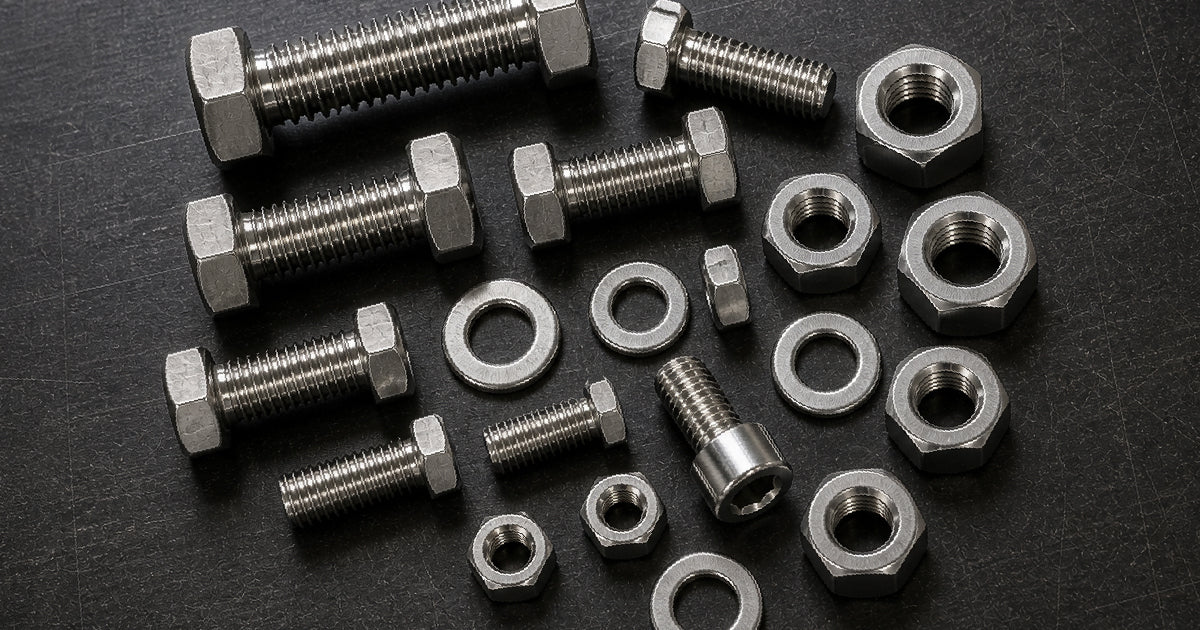
For most indoor and light-outdoor applications, A2 (304) stainless is the correct choice. Where chlorides are present — coastal environments, swimming pools, marine equipment, food processing — A4 (316) stainless is required. The critical difference is molybdenum: 316 contains 2–3% Mo, which raises its Pitting Resistance Equivalent Number (PREN) from roughly 18–20 (304) to 23–28.5 (316), giving it significantly better resistance to crevice and pitting corrosion in saline conditions.
Quick Reference: ISO 3506 Stainless Fastener Grades
| Grade | Steel Type | Cr % | Ni % | Mo % | Property Classes | Best For | Avoid When |
|---|---|---|---|---|---|---|---|
| A1 | Free-machining austenitic | 16–19 | 5–10 | ≤0.6 | -50, -70 | High-volume machined parts, mild environments | Welding, any corrosive environment |
| A2 (304) | Standard austenitic | 18–20 | 8–10.5 | — | -50, -70, -80 | General engineering, indoor, light outdoor | Marine, chloride exposure, SCC risk |
| A3 | Stabilised austenitic | 17–19 | 9–12 | — | -50, -70, -80 | Welded assemblies requiring post-weld service | High-stress, impact-loaded joints |
| A4 (316) | Mo-bearing austenitic | 16–18 | 10–14 | 2–3 | -50, -70, -80 | Marine, coastal, food, chemical, pools | Hot chloride >60°C (SCC risk) |
| A5 | Mo-bearing stabilised | 16–18 | 10–15 | 2–3 | -50, -70, -80 | Welded assemblies in corrosive environments | Overkill for standard bolted joints |
Property class suffix: -50 = 500 MPa UTS, -70 = 700 MPa UTS, -80 = 800 MPa UTS. A2-70 is the most common general-purpose stainless fastener specification.
What Is Stainless Steel — and Why Does It Corrode?
Stainless steel is a family of iron-chromium alloys containing a minimum of 10.5% chromium. The chromium reacts with atmospheric oxygen to form a thin, self-repairing chromium oxide passive layer — the source of stainless steel's corrosion resistance. This passive layer is invisible to the naked eye and reforms almost instantaneously if scratched under normal conditions.
The austenitic grades used in fasteners (A1 through A5) also contain nickel, which improves formability and low-temperature toughness, and in A4/A5 grades, molybdenum is added to enhance resistance to chloride-induced pitting and crevice corrosion.
Why Does Stainless Steel Sometimes Corrode?
Three failure modes account for the vast majority of stainless fastener corrosion problems in Australian industry:
Tea staining — brown surface discolouration in coastal or high-humidity environments. Not structural corrosion. The passive layer remains intact; iron-rich inclusions near the surface oxidise. Cosmetic issue only; clean with dilute oxalic acid solution and re-passivate if required.
Pitting corrosion — localised breakdown of the passive layer caused by chloride ions concentrating on the surface. Creates small pits that can penetrate the fastener cross-section over time. Prevented by selecting A4 grade in chloride environments and maintaining clean, unobstructed surfaces.
Crevice corrosion — oxygen-depletion attack in confined spaces such as under washers, in thread recesses, or between mating surfaces. The passive layer cannot reform in an oxygen-depleted zone. Prevention: use PTFE tape on threads, ensure tight joint face contact, select A4 grade in wet environments.
304 vs 316 Stainless Steel — Detailed Comparison
The 304 vs 316 choice is the single most common stainless specification question in Australian industry. The answer depends on environment, not cost.
Chemical Composition Comparison
| Element | A2 / 304 | A4 / 316 | Why It Matters |
|---|---|---|---|
| Chromium (Cr) | 18–20% | 16–18% | Passive layer formation |
| Nickel (Ni) | 8–10.5% | 10–14% | Austenite stability, toughness |
| Molybdenum (Mo) | trace / nil | 2–3% | Pitting and crevice corrosion resistance |
| Carbon (C) | ≤0.08% | ≤0.08% | Lower = better weldability (316L ≤0.03%) |
Composition ranges per ISO 3506-1:2020. Verified against thyssenkrupp-materials.co.uk and patta.com technical data sheets.
Pitting Resistance Equivalent Number (PREN)
PREN is calculated as: %Cr + 3.3 × %Mo + 16 × %N
A higher PREN indicates greater resistance to chloride-induced pitting corrosion.
| Grade | Typical PREN | Chloride Resistance |
|---|---|---|
| A2 / 304 | 18–20 | Mild only — rain, humidity, fresh water |
| A4 / 316 | 23–28.5 | Moderate — coastal, pools, food processing |
| Duplex 2205 | 33–38 | Severe — offshore, chemical plant |
| Super duplex 2507 | ~42 | Very severe — seawater immersion |
When to Use A2 / 304
A2 is appropriate for the majority of Australian industrial fastener applications: general engineering, HVAC ductwork, food-grade equipment in non-wet zones, architectural handrails inland, structural connections in non-corrosive environments, and any application where carbon steel would be used but corrosion resistance is preferred. A2 costs approximately 30–50% less than A4 in most grades and sizes.
When A4 / 316 Is Required
Specify A4 wherever chlorides are present or expected: marine structures and vessels within 1 km of the ocean, swimming pools and spa equipment, coastal architectural and structural applications, food and beverage processing environments with cleaning chemicals, chemical plant equipment exposed to acids or salt solutions, and pharmaceutical manufacturing. Do not assume A4 is "always better" — in hot concentrated chloride solutions above approximately 60°C, all austenitic stainless grades are susceptible to Stress Corrosion Cracking (SCC) regardless of molybdenum content.
When Neither 304 nor 316 Is Sufficient
Seawater immersion, offshore oil and gas, and chlorine-rich chemical plant environments may require duplex stainless (2205) or super duplex (2507) fasteners. These are outside the ISO 3506 austenitic grade range. Consult an engineer and the relevant process engineer for these applications.
ISO 3506 Grade System Explained
ISO 3506 is the international standard that defines the mechanical and chemical requirements for stainless steel fasteners. It was revised in 2020; the current editions are ISO 3506-1:2020 (bolts, screws and studs) and ISO 3506-2:2020 (nuts). Any fastener marked to "A2-70" or "A4-80" is manufactured to these requirements.
Grade Designator System
ISO 3506 uses a two-part designation: [Steel Group]-[Property Class]
The steel group letter (A1 through A5) indicates the alloy composition. The property class number indicates the minimum tensile strength level:
| Property Class | Min. Tensile Strength (MPa) | Min. Proof Load (approx.) | Common Usage |
|---|---|---|---|
| -50 | 500 | 210 MPa | Light-duty, non-structural |
| -70 | 700 | 450 MPa | General purpose — most common specification |
| -80 | 800 | 600 MPa | Higher-strength structural applications |
| -110 | 1100 | 820 MPa | High-strength (precipitation-hardened grades only) |
The most common specification in Australian industrial supply is A2-70 — austenitic 304 composition at 700 MPa tensile strength. This is the default grade for general-purpose stainless bolts, screws, and nuts unless otherwise specified.
Head Marking System
ISO 3506 fasteners are marked on the head with the manufacturer's trademark plus the grade designation (e.g., "A2-70"). This marking is mandatory for property classes -70 and above. If a fastener has no head marking, it should not be relied upon for structural or safety-critical applications.
Note on Australian Standards
The AS 4291 series covers mechanical properties of fasteners, but Parts 1 and 2 apply to carbon and alloy steel bolts and nuts respectively — not stainless steel fasteners. There is no Part 4 of AS 4291. For stainless fasteners in Australia, ISO 3506-1:2020 and ISO 3506-2:2020 are the directly applicable standards. Specifying "A2-70 per ISO 3506-1" is the correct Australian procurement specification for standard stainless bolts.
Magnetic Properties of Stainless Fasteners
A common field question: "Why is my A2 stainless bolt sticking to a magnet?" This is normal and does not indicate a substandard product.
Why Austenitic Stainless Can Become Magnetic
Austenitic stainless steels are nominally non-magnetic in their annealed (solution-treated) state. However, cold working — the mechanical deformation that occurs during thread rolling, heading, and drawing — induces a partial martensitic transformation. This martensite phase is magnetic. The amount of transformation depends on the degree of cold work and the alloy's composition stability.
In practical terms: A2 bolts and screws are typically weakly magnetic; heavy-section A2 bar and rod tends to be non-magnetic; A4 bolts are less prone to transformation due to their higher nickel and molybdenum content but can still exhibit slight magnetism in heavily cold-worked sections.
When Magnetic Properties Actually Matter
For most Australian industrial applications, the slight magnetism of stainless fasteners is irrelevant. It only matters in:
MRI facilities — No ferromagnetic materials permitted within 5 Gauss line. Use fully austenitic grades or confirm non-magnetic certification with supplier.
Sensitive scientific instruments — High-precision measurement equipment where magnetic fields would cause error. Specify non-magnetic certification and test with Gaussmeter.
Defence and naval applications — Some vessel degaussing systems require certified non-magnetic fasteners in specific zones.
For all other applications — food, marine, chemical, architectural, general engineering — magnetism in stainless fasteners is not a quality or performance indicator.
Galvanic Corrosion: Stainless Steel in Contact with Other Metals
Galvanic corrosion occurs when two dissimilar metals make electrical contact in the presence of an electrolyte (water, especially salt water). The less noble metal corrodes preferentially. Stainless steel sits near the noble (cathodic) end of the galvanic series, which has important practical consequences.
Galvanic Series Reference (per AS/NZS 2312.2:2014 — atmospheric/marine environments)
| Material | Relative Position | Notes |
|---|---|---|
| Graphite / Carbon | Most noble (cathodic) | Protects self, corrodes anything anodic to it |
| 316 Stainless (passive) | Very noble | Protected in most couples |
| 304 Stainless (passive) | Noble | Protected in most couples |
| Copper alloys | Moderately noble | Compatible with stainless in mild environments |
| Mild steel / Iron | Active | Corrodes when coupled to stainless |
| Aluminium alloys | Active | Galvanic risk with stainless in wet conditions |
| Zinc (galvanising) | Very active (anodic) | Sacrificial — corrodes to protect steel |
| Magnesium | Most active (anodic) | Fastest galvanic corrosion rate |
Stainless Fasteners into Galvanised Steel
Using stainless bolts through galvanised steel is a common cause of premature failure in Australian construction and infrastructure. The stainless is cathodic; the zinc coating on the galvanised steel is strongly anodic. In outdoor or wet conditions, the zinc coating adjacent to the fastener corrodes rapidly — accelerated by the large cathode-to-anode surface area ratio. The steel substrate is then exposed and begins corroding.
The correct approach: use galvanised or hot-dip galvanised fasteners with galvanised steel, and stainless fasteners with stainless or other compatible substrate materials. Where stainless fasteners must be used with galvanised steel, insert an isolating washer or sleeve to break the electrical circuit, and apply a compatible sealant. See our guide on zinc plated vs galvanised coatings for coating selection.
Stainless Fasteners into Aluminium
A4 stainless bolts into aluminium structures are widely used in marine applications, but galvanic corrosion of the aluminium occurs at the contact zone, particularly in salt-water environments. Mitigation measures: apply anodising or primer to the aluminium at fastener holes; use oversized washers to distribute load and reduce corrosion penetration; apply zinc chromate paste or lanolin grease between faying surfaces; re-torque periodically as aluminium creeps under load.
Thread Galling: Prevention and Anti-Seize Selection
Thread galling — also called cold welding — is the most common failure mode specific to stainless fastener installation. It occurs when the protective oxide layer on mating stainless threads is disrupted under load, causing direct metal-to-metal contact that generates sufficient heat and pressure to fuse the threads together. A galled fastener cannot be removed without destruction.
Why Stainless Galls More Than Carbon Steel
The same passive chromium oxide layer that provides corrosion resistance also promotes galling. Under thread-engagement loads, the oxide layer breaks and re-forms repeatedly; when re-formation cannot keep pace with damage — particularly under high surface pressure or fast installation — the base metal welds together. The high nickel content of austenitic stainless further increases the tendency to gall compared with carbon or alloy steel.
Risk Factors
Galling risk is highest when: installation speed is high (power tool installation of stainless into stainless); threads are contaminated with abrasive particles; fastener and nut are the same alloy (identical metals gall most readily); bolt diameter is large relative to thread pitch (coarse threads are lower risk than fine threads); threads are not properly lubricated; and overtightening occurs.
Anti-Seize Selection for Stainless Fasteners
| Anti-Seize Type | Application | Temp Range | Notes |
|---|---|---|---|
| Nickel-based (e.g., Loctite LB 8150) | Stainless into stainless, high-temp | To 1315°C | Best choice for stainless — nickel does not promote galvanic corrosion between stainless surfaces |
| Copper-based | Carbon steel, moderate temps | To 980°C | Avoid on stainless — copper is cathodic, galvanic risk |
| Moly paste (molybdenum disulfide) | High-load, moderate temp | To 400°C | Acceptable for stainless; may stain in food applications |
| PTFE paste / tape | Thread sealing + mild anti-galling | To 260°C | Low lubricity vs dedicated anti-seize; suited to fluid system threaded connections |
See our guides on anti-seize compound selection and Loctite product applications for detailed product selection.
Torque Correction Factor
Anti-seize lubricants reduce thread friction, which means a given torque value produces higher clamp load than expected. When applying a torque specification written for dry or lightly oiled threads, reduce the specified torque by 15–25% when using anti-seize to avoid overstressing the fastener or yielding threads. Always consult the equipment manufacturer's specification when torque is safety-critical.
Installation Best Practices
To minimise galling risk: always hand-start stainless fasteners before applying power tools; run the fastener in by hand until snug, then apply final torque with a calibrated torque wrench; use a nickel-based anti-seize on all stainless-into-stainless thread engagements; never use impact wrenches for final tightening of stainless fasteners; if resistance is felt during hand threading, back the fastener off and re-start — do not force through resistance.
Stress Corrosion Cracking and Crevice Corrosion
Stress Corrosion Cracking (SCC)
Stress Corrosion Cracking (SCC) occurs when three conditions are simultaneously present: a susceptible material, a corrosive environment, and tensile stress. For austenitic stainless fasteners, the classic SCC environment is hot chloride solution above approximately 60°C — steam condensate, hot seawater, chlorinated cooling water, and some chemical process streams.
In an SCC failure, cracks initiate and propagate intergranularly or transgranularly, often with little visible surface corrosion. Failure can be sudden and without significant plastic deformation — a fastener may appear intact until it fractures under load. SCC risk increases with: higher tensile stress (pretension or service load); higher chloride concentration; higher temperature; and lower alloy content (A2 is more susceptible than A4, though both are susceptible in severe conditions).
Where hot chloride SCC is a genuine risk, specify duplex stainless (2205) or super duplex fasteners, which have far greater SCC resistance due to their mixed austenite-ferrite microstructure.
Crevice Corrosion
Crevice corrosion occurs in confined spaces — under bolt heads, beneath washers, in thread recesses, between overlapping plates — where bulk solution access is restricted. In these zones, oxygen is depleted faster than it can be replenished, and the passive layer cannot maintain itself. The resulting oxygen-depleted, acidified environment aggressively attacks the metal surface even in grades that perform well in open environments.
Prevention: design out crevices where possible; use full-face gaskets rather than ring gaskets; ensure fasteners are tightened to proper clamp load to minimise gap at faying surfaces; apply thread sealants to close thread crevices in submerged or wet applications; select A4 grade in any environment where crevice corrosion is a risk.
Applications by Industry
Marine and Coastal
Specify A4-70 minimum for all above-water coastal applications within 1 km of the ocean. For marine deck hardware, engine room applications, and any below-waterline use, A4-80 or Bumax 88 high-strength stainless provides greater safety margin. Duplex stainless should be considered for critical structural connections on vessels operating in tropical saltwater environments. Anti-seize is mandatory on all A4 fasteners in marine service.
Food and Beverage Processing
A4 grade is the minimum specification for fasteners in direct food contact or in areas subject to regular wash-down with chlorinated cleaning agents. A2 may be acceptable in dry zones away from processing areas. Ensure fasteners are certified to the relevant material grade — food plant auditors may request ISO 3506 mill certificates. Bumax 88 stainless provides additional strength margin where vibration or thermal cycling is present.
Architectural and Structural
AS 4600 (cold-formed steel structures) and AS 4100 (steel structures) reference fastener standards including ISO 3506 for stainless applications. Coastal and marine architectural structures: A4-70 minimum, A4-80 for structural connections. Inland architectural: A2-70 acceptable for most exposed applications. All structural stainless fasteners should carry traceable grade markings and be supplied with material certificates.
Chemical and Process Plant
Consult a process engineer and corrosion engineer for chemical plant fastener selection. The appropriate grade depends on the specific chemical, concentration, temperature, and pH — no generalisation is adequate for chemical service. In many aggressive chemical environments, neither A2 nor A4 is sufficient, and alloy 625, Hastelloy, or titanium fasteners are required.
Mining and Resources
Mining equipment typically uses high-tensile carbon steel fasteners (ISO 898 Grade 8.8, 10.9, 12.9) for structural and mechanical connections where strength is the primary requirement. Stainless fasteners are used in instrumentation, control panels, equipment guards, electrical enclosures, and wash-down areas. In tropical and coastal mining environments, A4 grade is preferred for all exposed locations. Galling prevention is critical on mining equipment where fastener removal under maintenance conditions may be difficult.
Pharmaceutical Manufacturing
GMP environments require fasteners that are traceable, free from particulate generation, and resistant to the cleaning agents used. A4 (316) is the standard specification for pharmaceutical plant; 316L (low-carbon) is specified where welded assemblies will be subjected to post-weld passivation. Material certificates and surface finish specifications (Ra values) are routinely required by pharmaceutical facility validation programmes.
Standards Reference
Applicable Standards for Stainless Fasteners in Australia
| Standard | Edition | Scope |
|---|---|---|
| ISO 3506-1 | 2020 (current) | Mechanical and physical properties — bolts, screws, and studs — austenitic, martensitic, ferritic stainless |
| ISO 3506-2 | 2020 (current) | Mechanical and physical properties — nuts — austenitic, martensitic, ferritic stainless |
| AS/NZS 2312.2 | 2014 (current) | Guide to protection of structural steel from atmospheric corrosion: hot-dip galvanised coatings — includes galvanic series data referenced in this guide |
⚠ Wrong-Standard-Family Alert
A common specification error in Australian procurement documents: citing AS 1442 or AS 3678 for stainless steel fasteners. These standards cover hot-rolled carbon steel bars and structural steel plates respectively — they do not apply to stainless steel fasteners. Similarly, AS 4291 Parts 1 and 2 cover carbon and alloy steel bolts and nuts — not stainless. The correct Australian procurement specification is ISO 3506-1:2020 and ISO 3506-2:2020.
⚠ Verify Before Publish
Standard edition years should be verified at standards.org.au before use in technical documents or procurement specifications. Standards are periodically revised. As at the time of writing, ISO 3506-1:2020 and ISO 3506-2:2020 are the current editions.
AIMS Stainless Fastener Range
AIMS Industrial stocks stainless fasteners from two specialist brands: Inox World (192+ products — the broadest stainless fastener range in the AIMS catalogue) and Bumax (25+ products — ultra-high-strength premium stainless for demanding structural and safety-critical applications).
Inox World — AIMS's Primary Stainless Range
Inox World supplies A2 and A4 stainless fasteners across a comprehensive size range. Their range includes hexagon head bolts and sets screws, socket head cap screws (button, countersunk and socket varieties), machine screws, self-tapping screws, wood screws, threaded rod, nuts (hex, nyloc, wing), and washers (flat, spring, Nordlock-style). Available in metric sizes from M2 to M30+ and various property classes. Suitable for general engineering, food, marine, and architectural applications.
Bumax — Ultra-High-Strength Stainless
Bumax is the premium Swedish stainless fastener brand for applications requiring both corrosion resistance and strength beyond standard A2-70 or A4-70 specifications. Bumax 88 provides 880 MPa minimum tensile strength in 316 stainless — exceeding the -80 property class. Bumax 109 reaches 1090 MPa. Used in marine engineering, offshore equipment, food plant structural connections, and any application where a high-tensile carbon steel fastener would otherwise be specified but corrosion resistance is also required.
Application Selector
| Application | Recommended Grade | AIMS Range |
|---|---|---|
| General engineering, indoor | A2-70 | Inox World A2 |
| Coastal, outdoor, light marine | A4-70 | Inox World A4 |
| Food processing, chemical | A4-70 or A4-80 | Inox World A4 |
| High-strength with corrosion resistance | Bumax 88 | Bumax |
| Structural marine, safety-critical | Bumax 88 or 109 | Bumax |
Browse the full stainless range at Inox World and Bumax, or view all fasteners available at AIMS. Need help specifying the right grade? Contact our technical team — we'll help you match the fastener to the application.
Related guides: bolt grade chart (carbon steel comparison) | zinc plated vs galvanised coatings | anti-seize compound guide | Loctite application guide
Frequently Asked Questions
Q: What does A2-70 mean on a stainless bolt?
A2 indicates austenitic stainless steel equivalent to 304 composition (18–20% Cr, 8–10.5% Ni, no significant Mo). The -70 suffix indicates a minimum tensile strength of 700 MPa per ISO 3506-1:2020. A2-70 is the most common general-purpose stainless fastener specification used in Australian industry.
Q: What is the difference between A2 and A4 stainless steel?
The primary difference is molybdenum content. A2 (304) contains 18–20% Cr and 8–10.5% Ni with no significant molybdenum. A4 (316) contains 16–18% Cr, 10–14% Ni, and 2–3% Mo. The molybdenum raises A4's PREN (Pitting Resistance Equivalent Number) from ~18–20 to ~23–28.5, giving it significantly better resistance to chloride-induced pitting and crevice corrosion. Use A4 in marine, coastal, food processing, and pool environments; A2 is suitable for general engineering and non-chloride environments.
Q: Why is my A2 stainless bolt magnetic?
Slight magnetism in austenitic stainless fasteners is normal and does not indicate a defective or substandard product. Cold working during thread rolling and heading induces a partial martensitic transformation, which is magnetic. This does not affect corrosion resistance or mechanical properties for the vast majority of applications. It only matters in MRI facilities, certain scientific instruments, and specialised defence applications.
Q: How do I stop stainless steel bolts from seizing?
Apply a nickel-based anti-seize lubricant (such as Loctite LB 8150) to threads before installation. Nickel-based anti-seize is preferred over copper-based for stainless-into-stainless applications because it avoids galvanic corrosion risk. Always hand-start stainless fasteners; use power tools only for final snugging, then torque with a calibrated wrench. Reduce specified dry-thread torque values by 15–25% when using anti-seize. See our anti-seize compound guide for full product selection.
Q: Can I use stainless bolts with galvanised steel?
With caution. Stainless steel is cathodic relative to zinc (galvanising), so in wet or outdoor conditions the zinc coating corrodes accelerated by the galvanic couple. For short-term or indoor applications the risk is low. For outdoor, coastal, or permanently wet applications, use galvanised fasteners with galvanised steel, or isolate the stainless fastener from the galvanised surface using PTFE washers and sleeves. See our guide on zinc plated vs galvanised for coating selection and compatibility.
Q: What is ISO 3506 and is it relevant in Australia?
ISO 3506 is the international standard covering mechanical properties of stainless steel fasteners (Part 1 for bolts/screws/studs, Part 2 for nuts — both updated to 2020 editions). It is directly applicable in Australia; there is no separate Australian standard for stainless fastener mechanical properties. Specifying "A2-70 per ISO 3506-1:2020" or "A4-70 per ISO 3506-1:2020" is the correct Australian procurement description for stainless bolts.
Q: When should I use Bumax instead of standard A4 stainless?
Specify Bumax when you need both corrosion resistance and strength levels beyond standard A4-70 or A4-80. Bumax 88 delivers 880 MPa tensile strength in 316 stainless — useful for structural marine applications, safety-critical food plant connections, and anywhere a high-tensile carbon steel bolt would normally be used but corrosion is also a concern. Standard Inox World A4 fasteners are appropriate for the vast majority of corrosive-environment applications where tensile strength is not the primary driver.
Q: What stainless grade should I use for a pool fence?
A4 (316) is the mandatory minimum for pool fencing, pool decking, and any poolside structural hardware in Australia. Pool water is chlorinated, and splash zones create a concentrated chloride environment that will cause A2 (304) fasteners to pit and fail within 2–5 years. A4 used correctly should provide 20+ years of service in pool environments with normal maintenance.
Q: Does A4 stainless resist salt water?
A4 (316) provides good resistance to salt water spray, splash, and moderate saltwater exposure. It is suitable for coastal architectural and structural applications and most marine above-waterline applications. For submerged seawater service, particularly in tropical waters, A4 is susceptible to crevice corrosion and may also experience SCC over time. Duplex stainless (2205) or super duplex fasteners are recommended for seawater-immersed critical connections.
Q: What causes stress corrosion cracking in stainless fasteners?
Stress Corrosion Cracking (SCC) in austenitic stainless requires three simultaneous conditions: tensile stress, a susceptible material (austenitic stainless), and a corrosive environment (typically hot chloride solution above ~60°C). Common sources in industry include steam condensate systems, hot seawater, chlorinated cooling towers, and certain chemical process streams. SCC is insidious — the fastener may appear undamaged until fracture occurs under load. Where hot chloride SCC is a genuine design risk, specify duplex stainless fasteners.
Q: How do I identify the grade of an unmarked stainless fastener?
If the head has no grade marking, the fastener is non-compliant with ISO 3506 for property classes -70 and above — do not use for structural or safety-critical applications. For non-structural applications, a magnet test is a rough indicator (slight attraction = likely austenitic, strong attraction = may be ferritic or martensitic — i.e., not A2 or A4). For reliable grade identification, XRF (X-ray fluorescence) analysis is the definitive field test. Contact AIMS or a materials testing laboratory for XRF testing if grade verification is required.
Q: What is the torque specification for stainless steel bolts?
ISO 3506 does not specify installation torque values — these are a function of bolt size, property class, lubrication condition, and joint design. ISO 4017 and ISO 4014 (fastener dimensions) are also relevant. As a general guide for A2-70 and A4-70 bolts lubricated with anti-seize, reduce the dry-thread torque specification for equivalent-sized 8.8 carbon steel bolts by approximately 25% (lower yield strength) and a further 15–25% for the anti-seize lubrication factor. For safety-critical joints, always use a verified torque specification from the equipment manufacturer or a structural engineer. See our bolt grade chart for property class comparisons.
Q: Can I weld stainless steel bolts?
Standard A2 and A4 fasteners can be welded, but with important caveats. The heat-affected zone of a weld in standard (non-stabilised, non-L grade) stainless is susceptible to sensitisation — chromium carbide precipitation at grain boundaries that depletes the passive layer and creates zones vulnerable to intergranular corrosion. For applications where welded stainless assemblies will be in service in corrosive environments, specify A3 or A5 (stabilised) grades, or specify 316L / 304L (L = low carbon, ≤0.03% C) to minimise sensitisation risk.
Q: Is 316 stainless suitable for food contact?
Yes. A4 (316) stainless steel is widely used and accepted in food and beverage processing equipment in Australia. It is compatible with most food acids, cleaning chemicals (including chlorinated CIP solutions at correct concentration and temperature), and processing environments. Ensure fasteners are of traceable grade (ISO 3506 certified) and free from burrs or sharp edges that could harbour contamination. Surface finish may also be a specification requirement — consult AS 4674 (construction and fit-out of food premises) and your facility's validation requirements.
Q: Where can I buy stainless steel fasteners in Australia?
AIMS Industrial stocks Inox World and Bumax stainless fasteners available for next-business-day dispatch Australia-wide from our Milperra, Sydney warehouse. Browse Inox World for A2 and A4 standard range, and Bumax for ultra-high-strength stainless. Order online or call our technical team for grade and size selection advice. Trade accounts available with 30-day payment terms.
People Also Ask — Stainless Steel Fasteners
Q: What is the difference between 304 and 316 stainless steel fasteners?
304 stainless (A2 grade per ISO 3506) contains 18–20% chromium and 8–10.5% nickel with no significant molybdenum. 316 stainless (A4 grade) adds 2–3% molybdenum, which raises its PREN score from ~18–20 to ~23–28.5 and significantly improves resistance to chloride-induced pitting and crevice corrosion. Specify 304 for general engineering and indoor environments; specify 316 for marine, coastal, pool, food processing, and chemical applications where chlorides are present.
Q: What does A2-70 mean?
A2-70 is an ISO 3506 fastener designation. A2 denotes the steel composition — austenitic stainless equivalent to 304 (18–20% Cr, 8–10.5% Ni). The -70 denotes the property class, indicating a minimum tensile strength of 700 MPa. A2-70 is the most common general-purpose stainless bolt and nut specification used across Australian industry.
Q: Why do stainless steel bolts seize?
Stainless steel bolts seize (gall) because the protective chromium oxide layer that gives them corrosion resistance is disrupted under thread-engagement loads. When the oxide layer is damaged faster than it reforms — particularly under high surface pressure or fast installation speed — direct metal-to-metal contact occurs, generating friction heat that can fuse the threads together. Prevention: apply nickel-based anti-seize lubricant, hand-start fasteners, and use a torque wrench for final tightening rather than an impact driver.
Q: Is stainless steel suitable for outdoor use in Australia?
Yes, with grade selection matched to the environment. A2 (304) stainless is suitable for inland outdoor applications with normal rainfall and humidity. A4 (316) is required within 1–2 km of the coast, in pool and spa environments, and anywhere salt spray or chloride exposure is likely. In tropical regions, use A4 as the minimum for any outdoor exposed fastener regardless of distance from the coast, due to the combination of heat, humidity, and potential airborne salt.
Need stainless fasteners for your next project? Browse our full range at Inox World and Bumax, or contact our technical team for grade selection, trade pricing, and next-business-day dispatch from Sydney.
For key steel, see our key steel range stocked across Australia.