

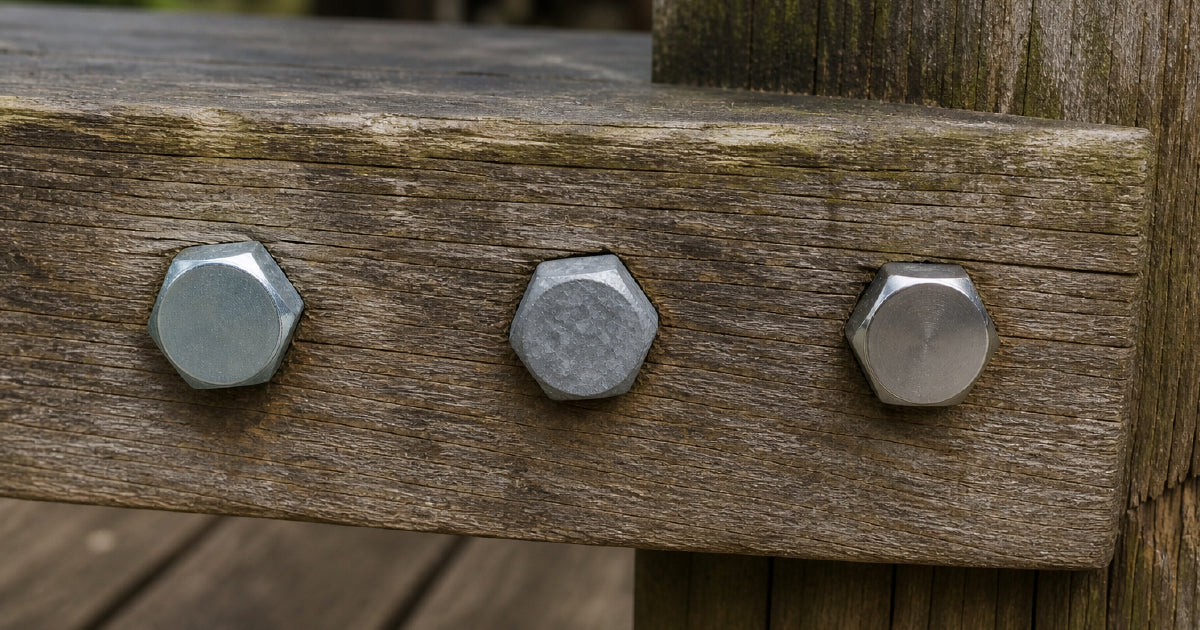
Will Zinc-Plated Rust? Zinc vs Galvanised Quick Reference
Both zinc-plating + galvanising protect steel from rust by sacrificing a zinc layer first. The difference is coating thickness — which directly determines how long the steel lasts before red rust appears. Direct comparison below.
| Finish Type | Zinc Thickness | Rust Resistance (typical) | Best For |
|---|---|---|---|
| Zinc-Plated (Electroplated) | 5 – 25 microns | 1 – 5 years indoor; weeks outdoor | Indoor + workshop, dry environments |
| Yellow Zinc / Yellow Chromate | ~8 microns + chromate seal | Slightly better than plain zinc | Automotive + workshop, slightly better corrosion |
| Hot-Dip Galvanised (HDG) | 50 – 100 microns | 25 – 50+ years outdoor | Outdoor + heavy industrial + marine-adjacent |
| Mechanically Galvanised | 40 – 70 microns | 15 – 30 years outdoor | Fasteners — better thread fit than HDG |
| Sherardised (Zinc Diffusion) | 15 – 40 microns | 10 – 20 years | Small + intricate parts |
| Zinc-Nickel Plate | 5 – 15 microns | 3 – 10× better than plain zinc | Premium automotive + aerospace |
| Stainless Steel 316 | N/A — alloy | Marine + chemical permanent | Coastal + chemical, premium cost |
Critical: Yes — zinc-plated will rust, typically within months of outdoor exposure or weeks in coastal AU. For anything exposed to weather, use HDG, stainless or zinc-nickel. AS/NZS 1214 covers zinc + galv coatings for fasteners. AIMS stocks stainless fasteners, fasteners, bolts, nuts, washers + Galmet galvanising paints.
Fastener Coating Types: What's Available and Why It Matters
Every steel fastener needs some form of protection against corrosion. Bare mild steel rusts within hours in the presence of moisture and oxygen — the coating is what determines how long the fastener lasts and where it can safely be used. Choosing the wrong coating doesn't just mean premature rust: it can mean structural failure, seized threads, or accelerated corrosion of the materials being joined.
The main coating options available for steel fasteners in Australia are:
| Coating | Process | Zinc thickness | Typical use |
|---|---|---|---|
| Zinc plated (electroplated) | Electrodeposition of zinc onto steel | 5–12 µm | Indoor, light-duty, dry environments |
| Hot dip galvanised (HDG) | Immersion in molten zinc bath | 45–85 µm | Outdoor, structural, exposed environments |
| Mechanically galvanised | Zinc powder tumbled onto steel | 25–75 µm | Fasteners unsuitable for hot-dip (springs, thin sections) |
| Stainless steel (A2/A4) | Inherent corrosion resistance via chromium oxide layer | N/A | Outdoor, marine, food-grade, chemical environments |
| Yellow zinc / Dacromet | Chromate conversion coating over zinc | 8–12 µm + chromate | Automotive, higher corrosion resistance than standard zinc plate |
| Black oxide | Chemical conversion coating | Minimal | Indoor only — primarily aesthetic, minimal corrosion protection |
| Phosphate and oil | Phosphate conversion + oil | Minimal | Temporary protection during storage and assembly |
The zinc-based coatings (electroplated, HDG, mechanical) all work on the same principle: zinc is less noble than steel in the galvanic series, so it corrodes preferentially, protecting the steel substrate even where the coating is scratched or damaged. This is known as cathodic protection or sacrificial protection. Stainless steel works differently — it relies on a self-repairing chromium oxide passive layer rather than sacrificial metal.
Browse the complete AIMS Industrial fasteners range — zinc plated, hot dip galvanised, stainless and specialty fasteners across all grades and drive types.
Zinc Plated vs Galvanised: The Core Difference
Both zinc plated and hot dip galvanised (HDG) fasteners use zinc to protect steel, but the coating thickness and method of application are fundamentally different — and so is the protection they provide.
Zinc Plated (Electroplated)
Zinc plated fasteners are coated by electrodeposition: the fastener is submerged in a zinc salt solution and an electrical current drives zinc ions onto the steel surface. The result is a thin, smooth, even coating typically 5–12 µm thick. The surface is bright silver in appearance, threads remain sharp and true to tolerance, and the fasteners can be used without modification in standard nuts and hardware.
The thin coating means limited protection. In salt spray testing (ASTM B117), standard zinc plated fasteners typically pass 96–120 hours before red rust appears. In real-world outdoor use in Australia, zinc plated fasteners will begin to rust within months in exposed conditions and should not be used outdoors as a primary structural fastener.
Hot Dip Galvanised (HDG)
Hot dip galvanising involves immersing the fastener in a bath of molten zinc at approximately 450°C. The zinc metallurgically bonds to the steel surface, forming a series of zinc–iron alloy layers with an outer pure zinc layer. The total thickness is typically 45–85 µm — roughly 6–10 times thicker than electroplated zinc.
The thicker coating provides dramatically better protection: HDG fasteners typically withstand 1,000+ hours in salt spray testing and can last 20–50 years in outdoor structural applications depending on environment. The coating is also harder and more abrasion-resistant than electroplated zinc due to the metallurgical bond.
The trade-off: the thick coating and the immersion process can affect thread tolerances. HDG nuts are typically tapped oversize after galvanising to allow mating with HDG bolts. Standard zinc plated or uncoated nuts may not thread onto HDG bolts without force, and standard-tolerance nuts should not be used with HDG bolts in structural applications.
| Zinc Plated | Hot Dip Galvanised | |
|---|---|---|
| Zinc thickness | 5–12 µm | 45–85 µm |
| Bond type | Adhesion (electrodeposition) | Metallurgical bond (diffusion) |
| Salt spray (red rust) | 96–120 hours | 1,000+ hours |
| Thread tolerance | Within standard tolerance | Oversize — HDG nuts required |
| Appearance | Bright silver, smooth | Dull grey, slightly rough |
| Suitable for outdoor use | No (short-term only) | Yes |
| Suitable for treated pine | No | H3/H4 only (not H5/H6 — use stainless) |
| Relative cost | Lower | Higher |
Galvanised vs Stainless Steel Fasteners
For outdoor and exposed applications, the choice typically comes down to hot dip galvanised or stainless steel. Both provide long-term corrosion resistance, but they achieve it through fundamentally different mechanisms and perform differently depending on the environment.
| Hot Dip Galvanised | Stainless Steel (A2-304) | Stainless Steel (A4-316) | |
|---|---|---|---|
| Corrosion mechanism | Sacrificial zinc layer | Passive chromium oxide layer | Passive layer + molybdenum |
| Outdoor (non-coastal) | Excellent | Excellent | Excellent |
| Coastal / marine | Poor — zinc attacked by chloride | Moderate — risk of pitting | Good |
| Treated timber (H3/H4) | Acceptable | Preferred | Preferred |
| Treated timber (H5/H6) | Not suitable | A4-316 required | Required |
| Relative cost | Lower | Moderate | Higher |
| Tensile strength | Grade 4.6 or 8.8 base steel | A2-70: 700 MPa min | A4-80: 800 MPa min |
| Galling risk | Low | Moderate — anti-seize recommended | Higher — anti-seize required |
For structural outdoor applications away from the coast, HDG is usually the cost-effective choice. For coastal environments within 1 km of the ocean, or for any application involving treated pine H5/H6, A4-316 stainless is the correct selection. A2-304 stainless is suitable for general outdoor use but is not recommended within direct coastal exposure.
For a complete breakdown of stainless fastener grades, see the AIMS stainless steel fastener grades guide. Browse the AIMS stainless steel fasteners range — A2-304 and A4-316 in hex bolts, socket head cap screws, set screws, nuts and washers.
The Galvanic Series: A Reference Chart for Fastener Selection
Galvanic corrosion occurs when two dissimilar metals are in electrical contact in the presence of an electrolyte (water, moisture, soil). The driving force is the difference in electrochemical potential between the metals — metals that are far apart in the galvanic series corrode faster when paired than metals that are close together.
The metal lower in the series (more active, anodic) corrodes to protect the metal higher in the series (more noble, cathodic). This is the same principle that makes zinc coatings work — zinc sacrifices itself to protect steel.
| Position | Metal / Alloy | Tendency |
|---|---|---|
| 1 (most active) | Magnesium |
ANODIC Corrodes preferentially (sacrificial) |
| 2 | Zinc | |
| 3 | Aluminium (alloys) | |
| 4 | Cadmium | |
| 5 | Mild steel / carbon steel | |
| 6 | Cast iron |
INTERMEDIATE Moderate activity |
| 7 | Lead | |
| 8 | Tin | |
| 9 | Copper | |
| 10 | Brass / Bronze | |
| 11 | Nickel |
NOBLE Protected — the other metal corrodes |
| 12 | Stainless steel (passive, 304/316) | |
| 13 | Silver | |
| 14 | Titanium | |
| 15 (most noble) | Gold / Platinum |
How to read this table: Find both metals. The one higher in the list (lower number) will corrode. The further apart the two metals are, the faster the corrosion. Pairs within 2–3 positions of each other are generally low risk in mild environments; pairs 5+ positions apart are high risk in any wet environment.
Practical examples:
- Zinc bolt + mild steel structure → low risk (close together, zinc slightly sacrificial — this is intentional)
- Aluminium panel + steel bolt → moderate risk (3 positions apart — isolate in outdoor/wet use)
- Zinc bolt + stainless structure → higher risk (10 positions apart — zinc corrodes rapidly in wet conditions)
- Copper fitting + steel pipe → high risk in water systems — the steel corrodes
Galvanic Corrosion: How It Works and How to Prevent It
Galvanic corrosion requires three conditions to be present simultaneously: two dissimilar metals, electrical contact between them, and an electrolyte (typically water or moisture). Remove any one of these three and galvanic corrosion stops.
The Area Ratio Effect
One of the most important and most misunderstood aspects of galvanic corrosion is the area ratio between the anode and cathode. A small anode connected to a large cathode corrodes very rapidly — the corrosion current from the large cathode is concentrated on the small anode surface. The reverse — a large anode with a small cathode — corrodes slowly because the current density on the anode is low.
This is why mixing coatings is not simply a yes-or-no question. A small stainless steel fastener joining large aluminium panels is a bad combination: the aluminium (large anode) corrodes moderately. A large galvanised structure with a small stainless bolt is a much worse combination: the zinc on the small bolt face corrodes rapidly because the current density is high. In practice: when mixing is unavoidable, make the more noble metal the smaller component.
Prevention Methods
| Method | How it works | Practical application |
|---|---|---|
| Select compatible metals | Choose metals close together on the galvanic series | Match fastener coating to the material being joined |
| Use isolation / insulation | Break electrical contact between the metals | Nylon washers, insulating sleeves, PTFE tape on threads |
| Apply a barrier coating | Prevent the electrolyte from completing the circuit | Paint, sealant, or anti-corrosion compound at the joint |
| Use a sacrificial anode | Introduce a more active metal to corrode preferentially | Zinc anodes on marine structures, hulls, and pipework |
| Favour larger anode area | Slow corrosion rate by reducing current density | When mixing is unavoidable, make the more noble metal the smaller piece |
Can You Mix Different Coatings?
This is one of the most common practical questions — particularly the pairing of stainless steel nuts with zinc plated or galvanised bolts (or vice versa). The answer depends on the environment and the area ratio.
Stainless steel is significantly more noble than zinc (approximately 10 positions apart on the galvanic series). When a zinc or galvanised fastener is paired with a stainless nut or stainless structure in a wet environment, the zinc becomes the sacrificial anode. In dry indoor conditions, this is low risk — without an electrolyte, the galvanic cell cannot operate. Outdoors or in any damp environment, the zinc will corrode faster than it would if paired with another zinc component.
The worst-case scenario is a zinc plated bolt passing through a large stainless steel structure in a coastal environment: the small zinc bolt face acts as a small anode against a large noble cathode, and corrosion is rapid and concentrated. The bolt can fail in months where a properly matched fastener would last years.
Practical rules for mixing coatings:
- Indoors, dry: Mixing is generally acceptable. No electrolyte means no galvanic cell.
- Outdoors, non-coastal: Avoid mixing zinc with stainless where the zinc component is small relative to the stainless area. If mixing is unavoidable, use isolation washers.
- Coastal or marine: Do not mix. Use stainless throughout, or galvanised throughout. Mixing zinc with stainless in coastal conditions will cause premature fastener failure.
- Thread compatibility: When pairing HDG bolts with stainless nuts, confirm thread tolerances — HDG fasteners may require oversize nuts.
Application Guide: Selecting the Right Coating by Environment
| Environment | Recommended coating | Notes |
|---|---|---|
| Indoor dry (workshops, warehouses, general fabrication) | Zinc plated | Standard choice. No corrosion risk in dry conditions. |
| Indoor wet (food processing, washdowns, wet areas) | A2-304 stainless minimum; A4-316 for chlorinated environments | Avoid zinc — frequent washdowns will degrade the coating quickly. |
| Outdoor sheltered (under eaves, covered structures) | HDG or A2-304 stainless | Zinc plated not suitable — seasonal moisture will cause rust. |
| Outdoor exposed (structural steel, fencing, rural) | HDG | Most cost-effective for general structural outdoor use. |
| Treated pine — H3/H4 (above-ground outdoor timber) | HDG or A2-304 stainless | Timber preservatives attack zinc plating. HDG is the minimum standard. |
| Treated pine — H5/H6 (in-ground, high-exposure) | A4-316 stainless | HDG not suitable — aggressive preservative chemistry degrades zinc coating. |
| Coastal (within 1 km of ocean) | A4-316 stainless | Chloride ions break down zinc coatings and attack A2 stainless. A4 is the correct choice. |
| Marine / submerged | A4-316 stainless or specialist marine grade | Continuous immersion. Zinc anodes required if mixed metal structures present. |
| Aluminium structures | Stainless (isolated) or aluminium fasteners | Steel and zinc both corrode in contact with aluminium in wet conditions. Use isolation or match materials. |
| Automotive / vibration | Yellow zinc / Dacromet | Higher corrosion resistance than standard zinc plate; suitable for underbody/engine bay use. |
Browse the complete AIMS Industrial fasteners range — including hot dip galvanised, zinc plated, stainless and specialty fasteners for every application and environment.
Treated Timber and Fastener Coatings: Australian Standards
Treated timber is one of the most aggressive environments for fasteners, and Australian building codes specify minimum fastener requirements by timber hazard class. The copper-based preservatives used in H3, H4, H5 and H6 treated pine actively attack zinc coatings and will corrode zinc plated fasteners rapidly.
Under AS 1684 (Residential timber-framed construction) and related standards, the minimum fastener requirements for treated timber are:
- H3 treated pine (above ground, exposed to weather): Hot dip galvanised (minimum 42 µm) or stainless steel A2/A4
- H4 treated pine (ground contact): Hot dip galvanised (minimum 42 µm) or stainless steel A2/A4
- H5 treated pine (in-ground, high moisture): Stainless steel A4-316 — HDG not adequate
- H6 treated pine (marine piling): Stainless steel A4-316 — specialist corrosion advice recommended
Zinc plated (electroplated) fasteners do not meet the minimum requirement for any treated timber application. Using zinc plated screws or bolts in H3 or H4 treated pine is a common error that results in fastener failure within 2–5 years.
For H5/H6 treated timber applications, browse the AIMS A4-316 stainless steel fasteners range — the correct specification for in-ground and high-exposure treated timber.
Frequently Asked Questions
What is the difference between zinc plated and galvanised?
Zinc plated (electroplated) fasteners have a thin zinc coating of 5–12 µm applied by electrical deposition. Hot dip galvanised (HDG) fasteners have a much thicker zinc coating of 45–85 µm, formed by dipping the steel in molten zinc at 450°C. The HDG coating is metallurgically bonded to the steel and provides 6–10× more corrosion protection. Zinc plated is suitable for indoor use; HDG is the minimum standard for outdoor structural applications.
What is galvanic corrosion?
Galvanic corrosion occurs when two dissimilar metals are in electrical contact in the presence of an electrolyte (water or moisture). The more active metal (lower on the galvanic series) acts as the anode and corrodes to protect the more noble metal (higher on the series). The driving force is the electrochemical potential difference between the two metals — the greater the difference, the faster the corrosion. Three conditions are required simultaneously: dissimilar metals, electrical contact, and an electrolyte. Remove any one and galvanic corrosion stops.
Can I use a stainless steel nut with a zinc plated or galvanised bolt?
In dry indoor environments, yes — without moisture there is no electrolyte and no galvanic cell. In outdoor or damp environments, mixing zinc and stainless is not recommended. Zinc is around 10 positions below stainless steel on the galvanic series, making it the sacrificial anode. The zinc fastener will corrode faster than it would if paired with another zinc component. The area ratio matters: a small zinc bolt face against a large stainless structure is the worst case — concentrated corrosion current on a small anode leads to rapid failure. In coastal environments, do not mix zinc and stainless under any circumstances.
Which bolts should I use with aluminium?
Stainless steel fasteners with physical isolation (nylon washers, insulating sleeves) are the preferred choice for bolting aluminium. Bare steel will corrode in contact with aluminium in wet conditions (aluminium is the anode, steel is the cathode). Zinc plated fasteners are slightly better than bare steel but still not ideal. If using stainless, use isolation to break the galvanic circuit — stainless and aluminium are close enough on the galvanic series that the risk is low in mild environments, but isolation is best practice.
Is zinc plated suitable for outdoor use?
No, not as a long-term structural fastener. Zinc plated fasteners will begin to show white zinc corrosion within weeks and red rust within months in typical outdoor Australian conditions. They are rated for indoor, dry environments. For any outdoor application — even sheltered outdoor — use hot dip galvanised as the minimum standard.
What is the galvanic series and how do I read it?
The galvanic series is a ranking of metals and alloys by their electrochemical potential in a given electrolyte (typically seawater). Metals near the top (anodic end) corrode preferentially; metals near the bottom (cathodic or noble end) are protected. To use it: find both metals in a joint. The one closer to the anodic end will corrode. The further apart they are, the faster the corrosion in a wet environment. Metals within 2–3 positions of each other are generally compatible in mild environments; metals 5+ positions apart should be isolated in any wet application.
Galvanised vs stainless steel — which is better for outdoor use?
For general outdoor structural use away from the coast, hot dip galvanised is the more cost-effective choice. For coastal environments (within 1 km of the ocean), A4-316 stainless is required — chloride ions attack zinc coatings and can cause pitting in A2-304 stainless. For treated pine H5/H6, stainless A4-316 is mandatory. Neither is universally "better" — the correct choice depends on the specific environment and the base material being fastened.
How do I prevent galvanic corrosion?
The three practical methods are: (1) select metals that are close together on the galvanic series so the potential difference is small; (2) break the electrical contact using isolation — nylon washers, insulating sleeves, PTFE tape, or non-conductive sealant; (3) apply a barrier coating (paint, sealant, or anti-corrosion compound) to prevent moisture completing the galvanic circuit. In practice, the most reliable approach is selecting compatible materials from the start rather than relying on isolation in demanding environments.
Can I use zinc plated bolts into treated pine?
No. Zinc plated fasteners do not meet the minimum requirement for any hazard class of treated timber under Australian standards. The copper-based preservatives in H3, H4, H5 and H6 treated pine actively corrode zinc coatings. The minimum standard for H3/H4 treated pine is hot dip galvanised (42 µm minimum) or stainless steel. For H5/H6, stainless A4-316 is required. Using zinc plated fasteners in treated pine is a common error that typically results in fastener failure within 2–5 years.
What does HDG mean on a bolt?
HDG stands for Hot Dip Galvanised. It indicates the bolt has been coated by immersion in a bath of molten zinc, producing a thick zinc–iron alloy coating of 45–85 µm. HDG should not be confused with zinc plated (electroplated), which produces a much thinner coating with significantly less corrosion protection. HDG fasteners require oversized nuts (also HDG) because the thick coating changes the thread dimensions.
When should I use stainless steel instead of galvanised?
Use stainless steel in preference to HDG when: (1) the environment is coastal or marine — zinc coatings are attacked by chloride ions; (2) the application involves treated pine H5/H6 — aggressive preservative chemistry degrades zinc; (3) food-grade or hygiene requirements apply — stainless is easier to clean and doesn't leach zinc; (4) the application involves wet indoor environments with regular washdowns; (5) appearance matters long-term — stainless does not develop the white zinc oxide patina that HDG develops with age. HDG remains the better choice for cost-effective structural outdoor use in non-coastal environments.
Got the right coating? Get the fastener.
Shop zinc plated, galvanised & stainless fasteners
From zinc plated bolts for indoor use to hot dip galvanised and A4 stainless for harsh outdoor and marine environments — AIMS Industrial stocks fasteners across all coatings, ready to ship Australia-wide.
Our Material Density Chart lists specific gravity and density for every engineering metal and plastic.
People Also Ask — Zinc Plated vs Galvanised vs Stainless Fasteners
Q: What is the difference between zinc plating and hot-dip galvanising?
Zinc plating (electroplating) deposits a thin layer of zinc onto a fastener through an electrochemical process, typically 5-12 microns thick. Hot-dip galvanising immerses the part in molten zinc, producing a much thicker coating that is metallurgically bonded to the base steel. Hot-dip galvanising provides significantly greater corrosion protection and is used for structural steel and outdoor applications. Zinc-plated fasteners are suited to indoor or mildly corrosive environments.
Q: Is zinc-plated steel safe for outdoor use?
Zinc-plated fasteners provide limited corrosion protection and are generally not recommended for long-term outdoor exposure, particularly in coastal, marine, or high-humidity environments. For outdoor applications where the fastener is exposed to weather, hot-dip galvanised, mechanically galvanised, or stainless steel fasteners are more appropriate choices. The exact service life depends on the zinc coating thickness, local environment, and whether the fastener is sheltered or fully exposed.
Q: Can I use galvanised bolts with stainless steel components?
Galvanised steel and stainless steel can be used in contact, but there is a potential for galvanic corrosion if an electrolyte (such as moisture) is present. Zinc is anodic to stainless steel, so the zinc coating may corrode preferentially — this may be acceptable in some applications. In marine or high-moisture environments, the risk is greater. A practical concern is also that hot-dip galvanising adds material to the thread, which can affect nut engagement.
Q: What is mechanical galvanising?
Mechanical galvanising (or mechanical plating) applies zinc to fasteners by tumbling them with zinc powder and glass beads, causing the zinc to cold-weld to the surface. It produces a thick, uniform zinc coating similar to hot-dip galvanising but without the heat that can affect fastener strength — which is a concern with hot-dip galvanising of high-strength fasteners. Mechanically galvanised fasteners are used where consistent coating thickness and minimal hydrogen embrittlement risk are important.
Q: When should I use stainless steel fasteners instead of galvanised?
Stainless steel fasteners are the preferred choice for marine environments, food processing, pharmaceutical and medical applications, swimming pools, or any application requiring both corrosion resistance and hygiene. Grade 316 stainless (molybdenum-bearing) provides better chloride corrosion resistance than 304 and is the standard choice for coastal and marine applications. Stainless steel is more expensive than galvanised but does not require periodic replacement due to coating degradation.
Need galmet? Browse the AIMS range at galmet.
Why does a galvanised finish look rougher than zinc plating?
Zinc plating is a thin, bright, smooth electrodeposited layer, so plated fasteners look shiny and even. Hot-dip galvanising dips the part in molten zinc, leaving a thicker, duller, slightly textured coating that can bridge threads — which is why hot-dip galvanised nuts are often tapped oversize to fit the coated bolt. That extra thickness is exactly what buys the longer outdoor life.
Does zinc plating protect steel the same way galvanising does?
Both work as a sacrificial (galvanic) coating: the zinc corrodes in preference to the steel underneath, so even a scratched coating keeps protecting the base metal. The difference is how much zinc there is — the thicker the layer, the longer that sacrificial protection lasts. This is why coating thickness, not just the word "zinc", drives outdoor life. For corrosion-critical work choose stainless fasteners.
Browse the full AIMS fastener assortments range.