

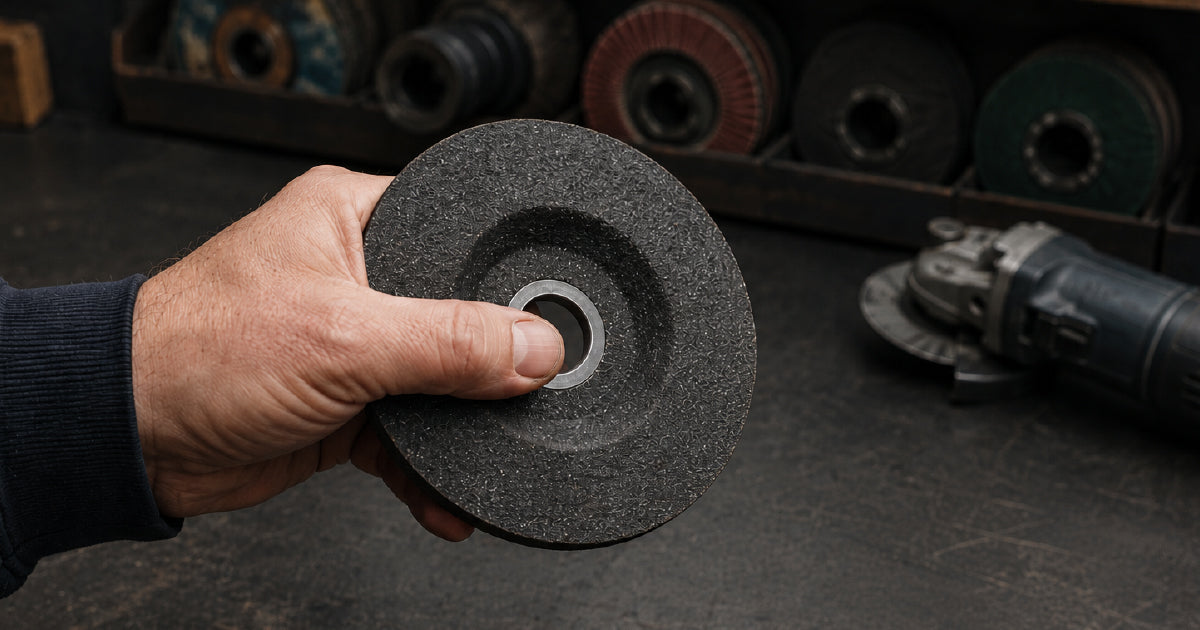
A grinding disc is a bonded abrasive product — abrasive grains held together by a bonding agent — that removes material by abrasion when rotated at speed. The same product is also called a grinding wheel (on bench and pedestal grinders) or an abrasive wheel. In everyday Australian trade usage, the term grinding disc typically refers to the depressed-centre discs used on angle grinders; grinding wheel refers to the thicker, straight-sided wheels used on bench and pedestal grinders. Both operate on the same principles.
This guide covers the complete selection process: reading the specification code printed on every wheel, matching abrasive type and grit to the material and task, understanding speed ratings, identifying wheel types by shape and application, and the critical safety requirements under Australian standard AS1788. Whether you are selecting a disc for an angle grinder on site or specifying bench grinder wheels for a toolroom, the same decision framework applies.
Browse the AIMS Industrial grinding wheels and accessories range — Norton, Pferd, Flexovit and Linishall stocked in Sydney with fast Australia-wide despatch.
Reading the Grinding Wheel Specification Code
Every grinding wheel and grinding disc carries a specification code printed on its blotter (paper label) or marked directly on the wheel. The code follows the standard structure set out in ISO 525 and AS1788, and contains six elements. Reading the code tells you exactly what the wheel is made from and what it is designed to do.
The Six-Part Specification Code
| Position | Element | What it Describes | Example Values |
|---|---|---|---|
| 1 | Abrasive type | The abrasive grain material | A (aluminium oxide), C (silicon carbide), Z (zirconia alumina) |
| 2 | Grit size | Grain particle size — lower number = coarser | 16, 24, 36, 46, 60, 80, 120 |
| 3 | Grade (hardness) | Strength of bond holding grains in place | A (soft) through Z (hard); F, G, H = soft; L, M, N = medium; R, S, T = hard |
| 4 | Structure | Spacing between grains — affects chip clearance | 1 (dense) through 15 (open); often omitted if standard |
| 5 | Bond type | The material bonding the grains together | V (vitrified), B (resinoid), R (rubber), BF (reinforced resinoid) |
| 6 | Manufacturer's symbol | Internal manufacturer code — for reference only | Varies by manufacturer |
Example: A 36 L 5 V — aluminium oxide (A), grit 36, medium-soft grade (L), structure 5, vitrified bond (V). This is a medium-grit aluminium oxide bench grinder wheel suitable for general steel grinding.
INOX Marking
Many angle grinder discs carry an INOX marking. This indicates the disc is formulated without iron, sulphur or chlorine — the three contaminants that can cause corrosion or contamination in stainless steel during grinding. An INOX-marked disc is safe for grinding stainless steel. A standard grinding disc used on stainless steel deposits iron particles into the surface, causing corrosion at the contact point over time. Always use INOX-rated discs on stainless steel and duplex alloys.
Abrasive Types: What Each Does
| Abrasive | Code | Characteristics | Best For | Avoid On |
|---|---|---|---|---|
| Aluminium Oxide | A | Tough, self-sharpening fracture, high heat resistance | Carbon steel, alloy steel, high-tensile steel, tool steel, wrought iron | Non-ferrous metals, cast iron, very hard materials |
| White Aluminium Oxide | WA | Friable (cool cutting), sharper than standard A | Heat-sensitive tool steels, HSS tooling, precision grinding where heat damage must be avoided | Heavy stock removal, rough work |
| Silicon Carbide | C | Very hard but brittle, sharp cutting action, not self-sharpening | Cast iron, non-ferrous metals (aluminium, copper, brass), stone, masonry, carbide, ceramics, plastics | Steel — reacts with iron and breaks down rapidly |
| Zirconia Alumina | Z or ZA | Extremely tough, high fracture toughness, long life under heavy loads | Heavy stock removal on stainless steel, hard steel, pressure grinding | Light finishing work, non-ferrous metals |
| Ceramic Alumina | SG or CA | Micro-crystalline structure, self-sharpens at grain level, longest life | Hardened steels, aerospace alloys, Inconel, titanium, difficult-to-grind materials | General workshop use — cost premium not justified for standard steel grinding |
| Diamond | D or SD | Hardest abrasive, extremely long life on very hard materials | Carbide tooling, ceramics, stone, glass, concrete, masonry | Steel — diamond reacts with iron at grinding temperatures |
| CBN (Cubic Boron Nitride) | B or CBN | Second-hardest abrasive, heat resistant to 1,000°C | Hardened steel, tool steel, HSS, chrome alloys, bearing steel — where diamond would react | Non-ferrous metals, ceramics, carbide |
The Practical Rule
Aluminium oxide for steel. Silicon carbide for everything else. This covers the vast majority of workshop and site grinding decisions. Refine from there: use white aluminium oxide (WA) when heat is a concern on tool steel; use zirconia alumina (Z) for heavy stock removal on hard or stainless steel; use diamond for concrete, stone and carbide.
Grit Size Selection
Grit size determines the rate of material removal and the surface finish produced. Lower numbers are coarser with faster removal; higher numbers are finer with better finish. Select by task first, then material.
| Grit Range | Classification | Material Removal | Surface Finish | Typical Applications |
|---|---|---|---|---|
| 16–24 | Very coarse | Very high | Rough | Heavy stock removal, snagging, foundry work, weld bead removal on thick plate |
| 30–46 | Coarse | High | Rough to medium | General steel grinding, weld grinding, deburring, shaping, most angle grinder grinding discs |
| 46–60 | Medium | Medium | Medium | General purpose bench grinding, tool sharpening, surface preparation |
| 60–80 | Medium-fine | Low-medium | Medium-fine | Finishing cuts, tool sharpening, preparing surfaces for coating |
| 80–120 | Fine | Low | Fine | Precision tool sharpening, finish grinding, HSS tool sharpening on bench grinders |
| 120–220+ | Very fine | Very low | Fine-very fine | Lapping, superfinishing, honing operations, CBN and diamond wheels |
For most angle grinder grinding discs on steel, grit 24–36 is the practical range — coarse enough for efficient removal, fine enough to avoid excessive roughness for subsequent weld preparation or coating. For finer finishing after grinding, see our Sanding Disc Guide. For bench grinder tool sharpening, grit 60 medium for the first wheel and grit 120 fine for the second wheel (two-wheel pedestal grinder setup) is the standard workshop configuration.
Grade (Hardness): Matching Wheel to Workpiece
Grade is the most misunderstood grinding wheel specification. Grade does not describe the hardness of the abrasive grain — it describes the strength of the bond holding the grains in the wheel. A hard-grade wheel holds grains tightly and releases them slowly. A soft-grade wheel releases grains quickly under cutting forces.
The selection rule is counterintuitive: use a soft-grade wheel on hard workpieces, and a hard-grade wheel on soft workpieces.
When grinding a hard workpiece (hardened steel, carbide), the grains dull quickly under load. A soft-grade bond releases these dull grains before they can rub and generate heat, exposing fresh sharp grains underneath — this is called self-dressing. A hard-grade wheel would hold dull grains too long, causing glazing, excessive heat, and wheel burn on the workpiece.
When grinding a soft workpiece (soft steel, aluminium), grains wear slowly and remain sharp. A hard-grade wheel retains them appropriately. A soft-grade wheel would shed sharp grains prematurely, shortening wheel life without benefit.
| Grade Letters | Classification | Use When |
|---|---|---|
| A–H | Soft | Hard workpieces — hardened steel, carbide, tool steel. Large contact area grinding. |
| I–P | Medium | General purpose — most workshop and production grinding. The default range. |
| Q–Z | Hard | Soft workpieces — mild steel, aluminium, soft metals. Small contact area, light cuts. |
Bond Types
| Bond | Code | Characteristics | Typical Application |
|---|---|---|---|
| Vitrified | V | Glass/ceramic bond, rigid, porous, unaffected by water or oil coolant | Precision grinding, bench grinder wheels, most production grinding. Standard bond for over 75% of grinding wheels. |
| Resinoid | B | Synthetic resin bond, flexible, impact resistant, operates at higher speeds than vitrified | Angle grinder discs, cut-off wheels, rough grinding, portable grinder work. Standard bond for all angle grinder applications. |
| Reinforced Resinoid | BF | Resinoid with fibreglass mesh reinforcement, higher burst strength | All Type 27 angle grinder discs and cut-off wheels. The fibreglass reinforcement prevents catastrophic fragmentation if wheel fails at speed. |
| Rubber | R | Flexible, shock absorbing, very smooth finish | Centreless grinding regulating wheels, polishing, cut-off on thin sections where chatter must be minimised |
| Shellac | E | Cool cutting, produces mirror finish | Cam grinding, roll grinding, highly polished surfaces |
Grinding Wheel and Disc Types by Shape
The shape designation (Type number) defines the wheel geometry and determines how it can be used safely. Using the wrong shape for the application is a common source of wheel failure.
| Type | Shape | Use |
|---|---|---|
| Type 1 | Straight wheel (flat disc, equal thickness) | Bench and pedestal grinders — peripheral grinding only. Also used as cut-off wheels. Do not use face of a Type 1 wheel for grinding. |
| Type 5 / Type 7 | Recessed one or two sides | Bench grinders with flanged spindles, surface grinders |
| Type 6 | Straight cup wheel | Tool and cutter grinders, face grinding applications |
| Type 11 | Flared cup wheel | Surface grinding, tool and cutter grinding, face grinding |
| Type 27 | Depressed centre disc | Angle grinder grinding discs — the standard shape for all portable angle grinder grinding applications. The depressed centre clears the nut/flange for flat grinding. |
| Type 28 | Saucer-shaped depressed centre | Angle grinders — shallow depressed centre for improved clearance at low angles of attack |
| Type 41 | Flat cut-off wheel | Cutting/parting — thin flat disc for straight cut-off on angle grinders. Do not use for grinding — lateral force will shatter the disc. |
| Type 42 | Depressed centre cut-off | Cut-off on angle grinders with better nut clearance |
Grinding Disc vs Cutting Disc: The Critical Distinction
This is the most important safety distinction for angle grinder work. Grinding discs (Type 27) are 6–8mm thick. Cutting/cut-off discs (Type 41/42) are 1–3mm thick.
A cutting disc is engineered only for straight, forward cutting motion with no lateral load. If used for grinding — pressing the flat of the disc against a surface at an angle — the thin disc flexes and can shatter explosively at operating speed. Angle grinder injuries from disc failure are most commonly caused by using a cut-off disc for grinding. The two are not interchangeable. Check the marking on every disc before use.
Flap Discs vs Grinding Discs
A flap disc consists of overlapping abrasive flaps bonded to a fibreglass or plastic backing plate. It is used on an angle grinder and spans the same range of applications as a grinding disc, but with different performance characteristics — see our full Flap Disc Guide for grit and type selection.
| Grinding Disc (Type 27) | Flap Disc | |
|---|---|---|
| Stock removal rate | High | Medium |
| Surface finish | Rough — requires follow-up finishing | Smooth — can grind and finish in one pass |
| Heat generation | High | Lower — flaps provide some heat dissipation |
| Conformability | Rigid | Conforms to curved and irregular surfaces |
| Weld blending | Fast removal but marks | Preferred — smooth blend with less follow-up work |
| Disc life | Long under heavy use | Shorter under heavy cutting load |
| Cost per disc | Lower | Higher |
Use a grinding disc for heavy material removal and rough grinding where finish is not a concern. Use a flap disc for weld blending, surface preparation for painting, and any application where a smoother result saves follow-up time. On stainless steel fabrication, a zirconia alumina flap disc (INOX-rated) is the preferred tool for weld blending.
Browse the AIMS Industrial flap disc range — aluminium oxide and zirconia alumina, all INOX variants available.
Material Selection Guide
| Material | Abrasive | Grit | Grade | Notes |
|---|---|---|---|---|
| Mild steel / structural steel | Aluminium oxide (A) | 24–36 | Medium (L–N) | Standard choice for weld grinding, deburring, general fabrication |
| Stainless steel | Zirconia alumina (Z) INOX | 24–36 | Medium (L–N) | Must be INOX-rated — no iron, sulphur or chlorine in formulation |
| Hardened steel / tool steel | White aluminium oxide (WA) | 46–60 | Soft (G–I) | Cool cutting essential — standard A causes heat damage on hardened material |
| HSS tooling | White aluminium oxide (WA) or CBN | 60–80 | Soft-medium | CBN preferred for production resharpening; WA for workshop toolroom |
| Cast iron | Silicon carbide (C) | 24–36 | Medium | Cast iron is best ground with silicon carbide — aluminium oxide works but loads quickly |
| Aluminium | Silicon carbide (C) or aluminium oxide with open structure | 24–36 | Medium-soft | Open structure critical — aluminium loads (clogs) dense wheels immediately; use grinding aid or lubricant |
| Concrete / masonry | Diamond or silicon carbide | Coarse | N/A (diamond) / Medium (SiC) | Diamond cup wheels for surface grinding; segmented diamond discs for angle grinder work |
| Tiles / ceramics | Diamond | Fine–medium | N/A | Continuous rim diamond disc for clean edges; segmented for fast material removal |
| Tungsten carbide | Diamond or CBN | Medium | N/A (diamond) | Diamond for most carbide grinding; CBN for some tungsten electrode sharpening applications |
Speed Ratings: The Non-Negotiable Safety Parameter
Every grinding wheel and disc carries a maximum operating speed (MOS), expressed in either surface speed (metres per second, m/s) or rotational speed (RPM). This rating is the most important specification on the wheel label. Exceeding it is the primary cause of catastrophic wheel failure.
At operating speed, a grinding disc experiences centrifugal forces proportional to the square of rotational speed. A disc run at 1.5× its rated speed experiences 2.25× the design load — well beyond the burst strength of most resinoid bonds. When a grinding disc fails at speed, it disintegrates into fragments that travel outward at the peripheral velocity of the wheel — typically 80–100 m/s (approximately 300 km/h). This is fatal at close range.
Matching Wheel Speed to Grinder Speed
The process is straightforward: the wheel's maximum operating speed (in RPM) must be greater than or equal to the no-load speed of the grinder. Do not attempt to calculate this from diameter unless you have confirmed the grinder's spindle RPM — motor nameplates often show input speed before gear reduction. Check the grinder's operating manual or nameplate for the tool's rated no-load RPM, then confirm the wheel MOS in RPM matches or exceeds it.
Standard 125mm angle grinders typically run at 10,000–12,200 RPM. Standard 230mm angle grinders run at 6,500–6,600 RPM. Confirm for your specific tool before fitting any wheel — see our Angle Grinder Guide for sizes and safe technique.
Never Modify a Wheel to Fit
Do not enlarge the bore of a grinding wheel, do not use adaptor bushes that are not specified by the wheel manufacturer, and do not mount a wheel designed for one spindle diameter on a different spindle using improvised bushings. The bore tolerance on a grinding wheel is designed to provide the correct fit with the correct flange. An incorrectly fitted wheel is an unbalanced wheel.
Safe Use of Abrasive Wheels: AS1788 and Australian Requirements
The Australian standard covering abrasive wheel design, construction, selection, care and use is AS1788 (Parts 1 and 2). Safe Work NSW and state work health and safety regulators require compliance with these standards for all abrasive wheel operation in workplaces. Before every mount: inspect the wheel visually, ring-test vitrified wheels, confirm the guard is fitted, and wear a full face shield over safety glasses.
For the complete compliance walkthrough — mounting procedure, work rest adjustment, full PPE table, silica dust control and more — see our Grinding Wheel Safety Guide.
Wheel Dressing and Truing — Restoring the Cutting Action
Two distinct operations on a grinding wheel are often used together but mean different things: dressing restores the wheel's sharpness; truing restores its concentricity and shape. Most workshop dressing tasks combine both — as you remove dulled grain to expose fresh cutting edges, you also tend to bring the wheel face back to round. But understanding the distinction matters when selecting the right tool and technique for the job.
| Operation | Purpose | What it corrects | Tool |
|---|---|---|---|
| Dressing | Expose fresh, sharp grain on the wheel face | Glazing, loading, dulled grains, worn cutting edges | Single-point diamond, multi-point diamond, star wheel dresser, or dressing stick |
| Truing | Restore concentricity, flatness or specific shape | Out-of-round wheel, chamfered edge, profile drift, side-face wear | Diamond holder fed across the wheel by the machine — requires a dressing fixture or tool post grinder; not achievable with a hand-held stick alone |
A new vitrified wheel always needs both truing and dressing before its first use — even a precision-balanced new wheel can have surface irregularity from packaging or handling, and the bond surface needs to be opened to expose grain. The standard practice on a new wheel: feed the diamond dresser across the face with light contact, taking 0.025 mm (0.001") per pass, until the entire face shows uniform fresh-grain texture and the wheel is concentric within the machine's accuracy. Expect to remove at least 0.25 mm (0.010") from a new wheel to fully true it.
For routine workshop dressing on a bench grinder, truing and dressing happen together with the same tool — a star wheel or single-point diamond fed across the face restores both shape and sharpness in one operation. For precision surface or cylindrical grinding, the two are deliberately separated: a diamond truing tool is used first to restore the geometry, then a dressing stick or fine-grit dresser refreshes the cutting surface for the work being ground.
Dresser Types — Single-Point Diamond, Multi-Point, Star Wheel and Stick
Five main dresser types serve different applications. The choice depends on the wheel material (vitrified, resin, diamond, CBN), the grinder type (bench grinder, surface grinder, cylindrical, tool & cutter), and the precision required.
| Type | Description | Best for | Cost tier |
|---|---|---|---|
| Single-point diamond dresser | One natural or synthetic diamond mounted by sintering in a steel shank. The most common workshop dresser. The diamond is set at a 10–15° angle to the dresser axis to give a controlled wear pattern as the diamond tip rotates with use. | General workshop use, surface grinder, tool & cutter grinder, hand-held bench grinder dressing. Vitrified aluminium oxide and silicon carbide wheels. | Mid — typical Maxigear / Norton single-point in 0.5 to 4.0 carat range, $40–$200 |
| Multi-point (cluster) diamond dresser | Several diamond points sintered into a compact cluster head. Multiple diamonds share the cutting load, giving longer effective tool life than single-point in production. | Production grinding where dresser life matters; rough dressing on aluminium oxide wheels up to 80 grit; coarse cylindrical wheel work. | Premium — Norton MultiPoint Truing Nib type, $300–$500+ |
| Star wheel dresser (Huntington type) | Mechanical dresser with hardened-steel star-shaped wheels that spin freely on a spindle. As the dresser is pressed against the rotating grinding wheel, the stars spin and break grain off the wheel face. No diamond used. | Bench grinder dressing — the standard low-cost workshop dresser. Suitable for vitrified wheels in coarse to medium grit. NOT suitable for diamond, CBN, or resin-bond wheels. | Entry — Maxigear, Linishall, Hafco star wheel dressers, $25–$80 |
| Dressing stick (abrasive stick) | Solid silicon carbide or aluminium oxide stick — typically 25 × 25 × 150 mm. Held against the wheel face by hand. Cuts the wheel surface to dress (refresh) but cannot true (correct geometry). | Diamond and CBN wheel dressing — the standard tool for refreshing diamond/CBN wheel surfaces. Also for hand-dressing fine-grit vitrified wheels where a star wheel would be too aggressive. | Entry — Norton aluminium oxide or silicon carbide dressing sticks, $20–$110 |
| Impregnated diamond dresser | Synthetic diamonds embedded in a metal matrix forming a layered cutting face. Self-renewing — as the matrix wears, fresh diamonds expose underneath. | Surface grinding production work; profile dressing where the dresser shape sets the wheel profile. Less common in general workshops. | Premium — specialised tool, $150–$500+ |
| Replacement cutter wheel dresser | Replaceable hardened steel cutter wheels mounted on a holder — the cutters are consumable; the holder lasts indefinitely. Functions like a star wheel dresser with replaceable parts. | Workshops that dress frequently and want to avoid replacing the whole tool when cutters wear. | Entry — Maxigear replacement cutter wheel dressers, $20–$60 for cutter packs |
Diamond carat rating. Single-point diamond dressers are sized by the carat weight of the diamond — 0.25, 0.50, 0.75, 1.00, 2.00, 3.00 or 4.00 carat. Larger diamond = longer life under heavy use. For a benchtop tool & cutter grinder or surface grinder seeing occasional use, 0.25 to 0.50 carat is sufficient. For production surface grinding, 1.00 to 2.00 carat. For heavy industrial truing of large wheels, 3.00 to 4.00 carat. Beyond what the application requires, larger diamond is wasted cost.
The diamond/CBN wheel rule. Diamond and CBN wheels (used to grind tungsten carbide and hardened steels) are NOT dressed with diamond dressers — they are dressed with abrasive dressing sticks (silicon carbide for diamond wheels, aluminium oxide for CBN wheels). Using a diamond dresser on a diamond wheel destroys both. The correct procedure: rub a Norton silicon carbide dressing stick across the resin-bond diamond wheel face to expose fresh diamond grain and clear loaded matrix.
How to Dress a Grinding Wheel — Technique by Grinder Type
Dressing technique varies with the type of grinder. The same tool (single-point diamond) is presented differently on a bench grinder, a surface grinder and a tool & cutter grinder. The principles common to all are: light contact, steady traverse, consistent depth, and protective equipment (face shield mandatory — dressing throws hot abrasive grain).
| Grinder type | Dresser presentation | Procedure |
|---|---|---|
| Bench grinder | Star wheel dresser or single-point diamond fed across the wheel face by hand, supported on the tool rest | Set the tool rest 1–2 mm from the wheel face, with the rest level or tilted slightly down (so the dresser cannot lift). Run the wheel at full speed. Press the dresser firmly against the wheel face — for a star wheel, the cutters spin and break grain; for a single-point diamond, light contact and traverse across the face. Move steadily side to side, taking 0.025–0.05 mm per pass. Stop when the wheel face shows uniform fresh-grain texture. |
| Surface grinder | Single-point diamond mounted in a magnetic dresser block on the chuck, presented to the wheel from below | Mount the dresser block on the magnetic chuck. Bring the wheel down by hand wheel until it just touches the diamond — note the position. Lift the wheel, traverse the chuck under the wheel, and lower 0.005–0.01 mm. Move the chuck back and forth across the wheel under the diamond for the full wheel width. Repeat with 0.005–0.01 mm depth-of-cut per pass until the wheel face shows uniform texture. Wipe the chuck clean of swarf before grinding. |
| Tool & cutter grinder | Single-point diamond mounted on the dressing fixture, presented at the working line of the wheel | The diamond must contact the wheel along the same line the workpiece will contact during grinding — not above or below. Otherwise the wheel is dressed at the wrong angle and the work surface won't be flat. Light contact, steady feed, multiple shallow passes. |
| Diamond / CBN wheel | Aluminium oxide or silicon carbide dressing stick held by hand | Run the wheel at operating speed. Hold the dressing stick against the wheel face with light hand pressure. Move the stick steadily across the face — the stick wears, exposing fresh diamond/CBN grain on the wheel as the bond matrix is cut back. Continue until the wheel cuts cleanly. Diamond and CBN wheels need infrequent dressing — typically only when the cut rate noticeably slows. |
| Cylindrical grinder | Diamond mounted in a fixture on the tailstock or work head, presented to the wheel | Position the diamond at the wheel centreline. Use the machine traverse to feed the diamond across the wheel face under power. Take 0.005–0.01 mm depth of cut per pass. Multiple passes for a freshly dressed face. |
The diamond dresser angle. Most single-point diamond dressers are set at 10–15° from the dresser axis — this gives a controlled wear pattern as the diamond tip rotates with use. To extend tool life, rotate the dresser shank 90° in its holder every few uses so a fresh part of the diamond presents to the wheel. A diamond worn flat on one side becomes ineffective; rotated to expose a fresh edge, it cuts again. Replace when the diamond is fully worn.
Safety reminders. Wheel dressing is high-energy work — hot grain flies in every direction at wheel-face speed. Always wear a full-face shield (not just safety glasses), close-fitting clothing, and gloves. Never dress with the wheel guard removed. Never dress a wheel above its maximum operating speed. After dressing, allow a few seconds for the wheel to settle before starting work — newly-dressed wheels can throw loose grain on first contact.
AIMS Industrial dresser range. AIMS stocks the full dresser range for Australian workshops:
- Norton Diamond Dressing Tool MultiPoint Truing Nib — 11 mm shank, multi-point cluster diamond. Premium production-grade dresser for surface grinding.
- Maxigear Carat Diamond Wheel Dresser — 0.5 carat single-point diamond, 40 × 120 mm shank. The standard workshop single-point dresser.
- Maxigear Wheel Dresser No. 1 (75) and No. 2 Large — star wheel dressers. Entry-level bench grinder dressing.
- Linishall GWDS1 Grinding Wheel Dresser Size 1 — Australian-made star wheel dresser for bench grinders.
- Maxigear Replacement Cutter Wheel Dresser — replacement star wheel cutters when the originals wear.
- Norton Dressing Stick Square Aluminium Oxide White — for dressing diamond wheels and fine-grit vitrified wheels.
- Norton Black Silicon Carbide Dressing Stick — for dressing diamond and CBN wheels.
- Pferd Mounted Point Dressing Stone (70 × 22 × 12 mm, 46 grit, pack of 5) — for truing mounted point grinding tools.
Standard Wheel Dimensions
Grinding wheel dimensions are expressed as diameter × width × bore in millimetres. Common angle grinder disc sizes are 100mm, 115mm, 125mm and 230mm diameter. Common bench grinder wheel sizes are 150mm, 175mm and 200mm diameter. The bore diameter must match the grinder spindle exactly — never use an undersized bore or attempt to enlarge the bore.
Browse the complete AIMS Industrial abrasives range — including grinding discs, cut-off wheels, flap discs, fibre discs and bench grinder wheels from Norton, Pferd, Flexovit, Linishall and Abbott & Ashby.
Got the spec? Get the disc.
Shop grinding discs & wheels for steel, concrete, aluminium & masonry
From depressed-centre grinding discs to bench grinding wheels — AIMS Industrial stocks abrasive wheels across all spec codes, grit grades, and diameters for angle grinders and bench grinders, ready to ship Australia-wide.
Frequently Asked Questions
What is the difference between a grinding disc and a cutting disc?
A grinding disc (Type 27) is 6–8mm thick and designed for surface grinding using the face of the disc at a shallow angle. A cutting disc (Type 41/42) is 1–3mm thin and designed only for straight cut-off applications with forward-only motion. Using a thin cutting disc for grinding — pressing it laterally against a surface — flexes the disc and can cause it to shatter at operating speed. The discs are not interchangeable. Check the type marking on every disc before use.
What do the numbers and letters on a grinding wheel mean?
The specification code on a grinding wheel follows the structure: abrasive type / grit size / grade / structure / bond. For example, A 36 L V means: aluminium oxide abrasive (A), grit 36 (coarse-medium), grade L (medium-soft bond), vitrified bond (V). The code tells you what the wheel is made from, how aggressively it cuts, how hard the bond holds the grains, and what bond material is used. This determines the correct application and the materials the wheel can safely grind.
What grinding disc should I use for stainless steel?
Use an INOX-rated disc — either zirconia alumina (Z) or aluminium oxide with an INOX designation. INOX indicates the disc is formulated without iron, sulphur or chlorine. These contaminants deposit on the stainless surface during grinding and cause corrosion at the contact points over time. A standard grinding disc used on stainless steel will cause discolouration and surface corrosion. Always confirm the INOX marking before grinding any stainless or duplex alloy.
What is the difference between aluminium oxide and silicon carbide grinding wheels?
Aluminium oxide (A) is a tough, self-sharpening abrasive suited to grinding high-tensile metals — carbon steel, alloy steel, tool steel and wrought iron. Silicon carbide (C) is a harder but more brittle abrasive suited to grinding cast iron, non-ferrous metals (aluminium, copper, brass), stone, masonry, carbide and ceramics. Using silicon carbide on steel is possible but the grain breaks down rapidly — it is not economical. Using aluminium oxide on cast iron or masonry works but loads quickly. Match the abrasive to the material.
Can I use a cutting disc for grinding?
No. A cut-off disc (Type 41/42) is 1–3mm thick and engineered for straight forward cutting only. Applying lateral pressure for grinding causes the thin disc to flex, generating bending stress it is not designed to withstand. Disc failure under these conditions is sudden and violent. Always use a Type 27 grinding disc (6–8mm thick) for surface grinding applications. This is one of the most common causes of angle grinder injuries in Australian workplaces.
How do I know if my grinding wheel is safe to use with my grinder?
Two checks: first, confirm the maximum operating speed on the wheel label (in RPM) is greater than or equal to the no-load RPM of your grinder (shown on the grinder's nameplate or operating manual). Never fit a wheel with a lower MOS than the grinder's speed. Second, confirm the bore diameter matches the grinder spindle exactly — no adaptor bushes unless specifically approved by the wheel manufacturer. These two checks are mandatory under AS1788.
What is the ring test for grinding wheels?
The ring test checks for cracks in vitrified-bonded grinding wheels before mounting. Suspend the wheel through its centre hole with a finger or a rod and tap it lightly with a non-metallic object — a wooden mallet handle is standard. An undamaged wheel produces a clear, resonant ringing tone. A cracked wheel produces a dull, dead sound. If the wheel fails the ring test, discard it immediately — do not mount it. Note that resinoid-bonded wheels (angle grinder discs) are inspected visually, not by ring test.
What is the difference between a flap disc and a grinding disc?
A grinding disc (Type 27) uses a solid bonded abrasive face for high stock removal with a rough surface finish. A flap disc uses overlapping abrasive flaps that wear progressively, producing a much smoother finish and conforming to curved surfaces. Flap discs are preferred for weld blending, surface preparation for painting, and finishing work where a grinder mark from a grinding disc would require additional follow-up. Grinding discs are preferred for maximum stock removal, heavy weld grinding and where surface finish is not a priority.
Why does my grinding wheel glaze over and stop cutting?
Glazing occurs when the abrasive grains wear flat without fracturing to expose fresh cutting edges, and the dulled grain faces rub the workpiece rather than cutting it. This is usually caused by using a wheel that is too hard (grade) for the workpiece material — the bond is too strong to release worn grains. The fix is dressing the wheel with a star wheel or diamond dresser to remove the glazed surface layer, then either continuing to use the wheel or, if glazing recurs quickly, switching to a softer-grade wheel that self-dresses more readily on your material.
What causes a grinding wheel to shatter or burst?
The three principal causes are: (1) exceeding the maximum operating speed — the most common cause of sudden catastrophic failure; (2) mounting a cracked or damaged wheel — always perform the ring test before mounting vitrified wheels; (3) applying side load to a wheel not designed for it, particularly using a cut-off disc for grinding. Secondary causes include incorrect bore fit, improperly sized or tightened flanges, thermal shock from overheating a cold wheel, and physical impact damage during storage or handling. Guards are mandatory because wheel failure, even from causes that cannot be prevented, must not result in injury.
How often should I dress a grinding wheel?
Dress whenever you notice any of the following: the wheel produces heat or burns the workpiece; the wheel cuts slowly despite correct pressure; the surface finish degrades without apparent cause; or the wheel appears glazed or loaded (grey, shiny face rather than open, rough texture). There is no fixed interval — dress on performance, not on a schedule. A sharp, freshly dressed wheel cuts at lower temperatures, extends wheel life, and produces better results. Dressing is a few seconds of work that protects both the workpiece and the wheel.
What is the difference between truing and dressing a grinding wheel?
Dressing restores the wheel's sharpness — it removes dulled or loaded grain to expose fresh cutting edges. Truing restores the wheel's concentricity, flatness or specific shape — it corrects out-of-round wheels, chamfered edges, profile drift or side-face wear. The two operations often happen together with the same tool (a star wheel dresser or single-point diamond cuts both fresh grain and round geometry in one pass), but they are technically distinct. A new wheel always needs both — true it first to remove out-of-round, then dress to expose fresh grain.
What dresser should I use for a bench grinder?
A star wheel dresser is the standard, low-cost choice for bench grinder dressing — Maxigear Wheel Dresser, Linishall GWDS1, or similar. The hardened-steel cutter stars break grain off the wheel face when pressed against it, refreshing the cutting surface in seconds. Single-point diamond dressers also work on bench grinders and give a finer finish, but cost 3–5× more than a star wheel and are usually overkill for general bench grinding work. For dressing diamond or CBN wheels (rare on bench grinders but possible), use a silicon carbide dressing stick instead — neither star wheels nor diamond dressers work on diamond/CBN wheels.
How do I dress a diamond or CBN grinding wheel?
Diamond and CBN wheels are dressed with abrasive dressing sticks, NOT with diamond dressers. Using a diamond dresser on a diamond wheel destroys both. The correct procedure: rub a Norton silicon carbide dressing stick across the resin-bond diamond wheel face while the wheel runs at operating speed. The stick wears, cutting back the bond matrix and exposing fresh diamond grain on the wheel surface. For CBN (cubic boron nitride) wheels, use an aluminium oxide dressing stick instead. Diamond and CBN wheels typically need much less frequent dressing than vitrified aluminium oxide wheels — only when the cut rate noticeably slows or the surface finish degrades.
What does the "grade" letter on a grinding wheel actually control?
The grade letter in the wheel's specification code indicates how tightly the bond holds the abrasive grains. A softer grade (earlier in the alphabet) releases dulled grains more readily for a self-sharpening action on hard materials, while a harder grade (later in the alphabet) holds grains longer, suiting softer materials. Using too hard a grade for the workpiece is a common cause of glazing.
Why isn't the ring test used on angle grinder discs?
The ring test relies on the clear, resonant tone produced by a rigid vitrified-bonded wheel. Resinoid-bonded discs — the type used on angle grinders — are more flexible and don't produce a reliable ring, so they're inspected visually for cracks, chips or delamination instead.
What's the mandatory speed check before fitting any grinding wheel?
Confirm the wheel's maximum operating speed (printed on the label, in RPM) is greater than or equal to the no-load RPM of your grinder. Never fit a wheel with a lower maximum operating speed than the grinder's speed — this check is mandatory under AS1788.
Can I use an adaptor bush to fit a grinding wheel with the wrong bore size?
No, not unless the wheel manufacturer specifically approves it. The bore diameter must match the grinder spindle exactly — using an unapproved adaptor bush to make an ill-fitting wheel work is a safety risk.
Need to read an engineering drawing? Our GD&T Symbols Guide explains every common geometric tolerance symbol.

