

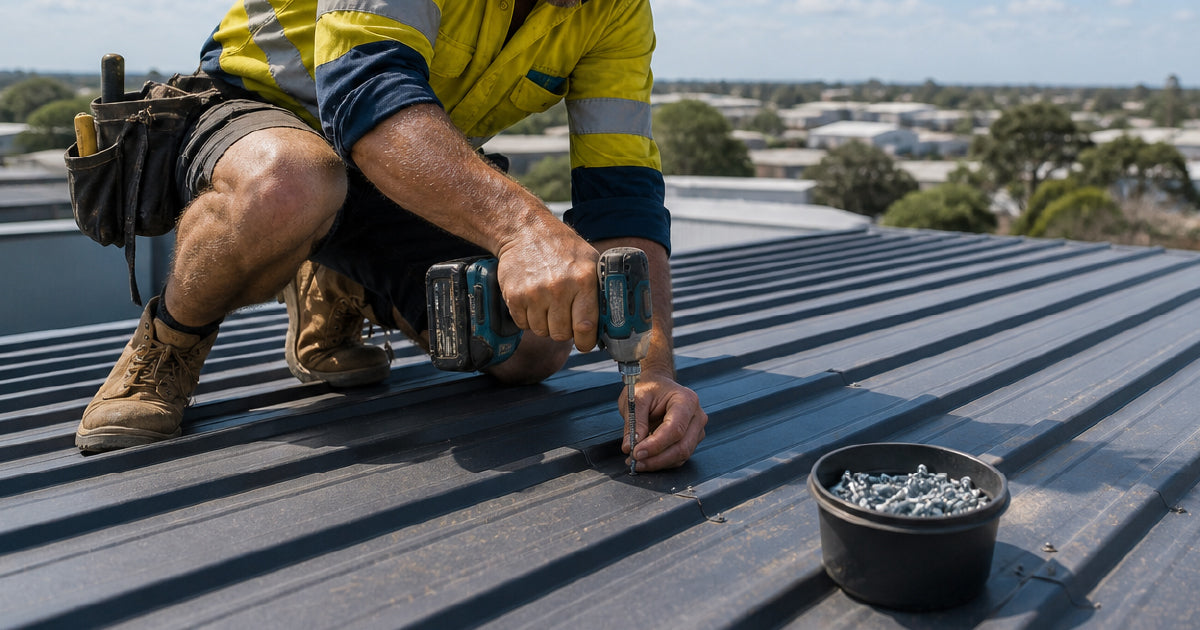
Walk into any hardware store in Australia and you'll find dozens of different screws labelled "self tapping", "self drilling", or "tek" — and they are not the same thing. Using the wrong one means either drilling a pilot hole you didn't need, stripping a thread you can't recover, or watching a roofing panel work loose after six months. This guide cuts through the confusion: what each type actually is, how the Series system for tek screws works, how to read gauge sizing, and exactly which screw to use for which job.
Self Tapping vs Self Drilling: The Difference That Matters
The most common source of confusion in the fastener aisle. These two terms are not interchangeable.
A self tapping screw cuts its own thread as it is driven in — but it cannot drill through metal on its own. It requires a pilot hole to be drilled first. The screw's threads then tap into the walls of that hole as it is driven, creating a secure fixing without a nut. Self tapping screws work in metal, timber, plastic and fibreglass provided the pilot hole is the right size.
A self drilling screw has a hardened drill tip (called a Tek point or drill point) that drills its own pilot hole and cuts threads in a single operation — no pre-drilling required. Self drilling screws are designed primarily for metal-to-metal and metal-to-timber applications.
| Feature | Self Tapping Screw | Self Drilling Screw (Tek) |
|---|---|---|
| Pilot hole required? | Yes — in metal and hard materials | No — drill point creates its own hole |
| Drill tip present? | No | Yes — fluted Tek point |
| Suitable for timber? | Yes (Type 17 point for timber) | Yes (Type 17 and drill point variants) |
| Suitable for steel? | Yes — with pilot hole | Yes — within the Series drilling capacity |
| Suitable for masonry? | With correct point (masonry screw) | No |
| Speed of installation | Two operations | Single operation |
The short answer: if the substrate is metal and you do not want to pre-drill, use a self drilling (tek) screw. If you are working in timber, plastic or pre-drilled metal, a self tapping screw is the right choice.
Screw Point Types
The point of a screw determines what it can penetrate and whether a pilot hole is required. There are four main point types used in Australian construction and manufacturing.
| Point Type | Description | Pilot Hole | Best For |
|---|---|---|---|
| Sharp point | Standard tapered point, no drilling capacity | Required in metal | Timber, plastic, fibreglass, pre-drilled metal |
| Type 17 | Auger-style fluted tip that removes material as it drives | Not required in timber | Hardwood and softwood — reduces splitting and drive torque |
| Tek / Drill point | Hardened fluted drill tip identical in shape to a twist drill | Not required | Steel and metal — drills and taps in one operation |
| Needle / Fine point | Extremely sharp narrow tip | Not required in thin sheet | Thin sheet metal, HVAC ducting, electrical enclosures |
Type 17 screws are the standard specification for structural timber framing in Australia. The fluted tip removes waste material, which is particularly important in dense hardwoods where standard sharp-point screws can split the timber or require excessive torque. In roof and wall framing, Type 17 hex head screws in 14g are the dominant specification.
Head Types
The head type determines how the screw sits in the material, what drive tool it requires, and whether it seals against weather ingress. Self-tapping and self-drilling screws are stocked in pan, hex, wafer, bugle and countersunk heads — for the full head-shape comparison across all screw types, see our Screw Head Types Guide.
| Head Type | Drive | Profile | Typical Application |
|---|---|---|---|
| Hex head | Nut setter / socket | Raised hex, often with integral washer | Structural steel, roofing, cladding, framing |
| Hex head with bonded seal | Nut setter | Hex head with EPDM sealing washer | Roofing and cladding — weather-tight fixing |
| Pan head | Phillips, Pozi, square drive | Low dome with flat bearing surface | Sheet metal, electrical enclosures, general fabrication |
| Wafer head | Phillips, Pozi, square drive | Very low profile, wide bearing surface | Timber, plywood, sheet metal where a flush bearing surface is needed |
| Bugle / countersunk | Phillips, square drive | Tapers to flush with surface | Plasterboard, timber decking, flooring |
| CSK (flat countersunk) | Phillips, Pozi | Flush or below surface | Sheet metal, brackets, hinges |
For roofing and cladding applications, hex head screws with a bonded EPDM sealing washer are the Australian standard. The washer compresses under the hex head to create a watertight seal around the fastener penetration. Without this seal, moisture ingress around the screw hole leads to rust staining, panel corrosion and leaks.
Drive style note: Pozi and square drive remain common on AU self-tapping screws, but premium decking, structural timber and Tek lines are increasingly supplied with Torx drive (typically T20, T25 or T30) for stripping resistance under impact-driver torque. For the full Torx size chart and bit selection guide, see our Torx Bit Sizes Guide.
Tek Screws: The Australian Standard for Metal Fastening
"Tek screw" has become the generic Australian term for any self drilling screw, in the same way "Biro" became the generic term for ballpoint pens. The name originates from the ITW Buildex Teks® brand, which set the standard for drill-point screws in Australian construction. Today, all self drilling screws for metal are commonly called tek screws regardless of manufacturer.
The Series System
Tek screws are rated by their Series number, which defines the maximum thickness of steel the drill point can penetrate before threads engage. Selecting the wrong Series — typically too low — means the drill point stalls before it breaks through the steel, the screw spins in place and the thread strips. This is the single most common tek screw installation failure.
| Series | Max Steel Thickness | Drill Point Length | Typical Application |
|---|---|---|---|
| Series 3 | Up to 1.5mm | Short | Light sheet metal, HVAC duct, thin steel framing |
| Series 4 | Up to 2.5mm | Medium-short | Steel purlins, light RHS, standard sheet metal |
| Series 5 | Up to 4.0mm | Medium | Steel framing, medium RHS and SHS, industrial sheeting |
| Series 6 | Up to 5.0mm | Medium-long | Heavy steel framing, thicker RHS, structural brackets |
| Series 12 | Up to 6.3mm | Long | Heavy structural steel, thick plate and angles |
| Series 16 | Up to 8.0mm | Extra long | Heavy fabrication, machinery enclosures, thick plate |
| Series 500 | Up to 12.0mm | 15mm | Very heavy structural steel, multiple layers, up to 12mm combined thickness |
The rule of thumb: measure the total thickness of steel the drill point must penetrate before it reaches the threaded section — that is the combined thickness of all layers, not just the top layer. Add 0.5mm as a margin and select the Series rated above that measurement.
Series 500
Series 500 screws (also designated SD500) are the heavy-duty specification for structural steel fastening. With a 24 TPI fine thread and a 15mm drill point, they are designed to penetrate steel up to 12mm thick — including through multiple layers with air gaps between them. The 12g Series 500 has a shank diameter of 5.5mm. Series 500 screws are the correct choice for fixing steel brackets to RHS columns, connecting heavy steel sections, and any application involving steel over 6mm.
A common error is using a standard Series 5 or 6 screw on structural steel that exceeds its drill capacity. The drill point contacts the steel, generates heat, work-hardens the surface and stalls — leaving the screw embedded and unusable. If in doubt on heavy steel, use Series 500.
Materials and Coatings
Corrosion is the primary cause of self tapping and self drilling screw failure in Australian conditions. The coating must be matched to the environment and the substrate — particularly for roofing, coastal, and treated timber applications.
Zinc Plated (Class 1)
Standard zinc electroplating provides minimal corrosion protection. Suitable for indoor applications only — protected from moisture and condensation. Not suitable for outdoor, coastal, or treated timber use.
Class 3 Galvanised
Hot dip or mechanically applied zinc coating to AS 3566 Class 3 specification. Suitable for outdoor use in non-coastal environments and for H2 treated timber. The standard for most residential and commercial roofing and cladding applications away from the coast. Class 3 tek screws are sometimes identified by a golden/yellow finish.
Class 4 Galvanised
Heavy duty galvanised coating to AS 3566 Class 4 specification. Required for coastal environments (within approximately 1km of the ocean), for H3 treated timber, and for aggressive industrial environments. Class 4 provides significantly greater corrosion resistance than Class 3 and is the minimum specification for coastal roofing and cladding.
Stainless Steel (304 and 316)
Stainless self tapping and self drilling screws in A2-304 and A4-316 provide the highest corrosion resistance. A4-316 stainless is required for marine environments, pools, food processing facilities, H4 and H5 treated timber, and any application where chloride exposure is ongoing. Note that stainless tek screws have a softer drill point than carbon steel equivalents — they cannot penetrate steel of the same thickness and are not suitable for heavy structural steel fastening. Their primary application is timber, light sheet metal and non-structural fixings where longevity is critical.
For a full guide to corrosion ratings, galvanic series and mixing metals, see our Fastener Coatings & Corrosion Guide. For stainless fastener grades in detail, see our Stainless Steel Fastener Grades Guide.
Self Tapping Screw Sizes: Gauge and Length Guide
Self tapping and self drilling screws in Australia are sized by gauge (shank diameter) and length (measured from underside of head to tip for pan and wafer heads; overall length for countersunk heads). The gauge system is expressed as a number — higher number means larger diameter.
| Gauge | Shank Diameter | Common Head Sizes | Typical Applications |
|---|---|---|---|
| 6g | 3.5mm | Hex, pan, CSK | Light sheet metal, thin steel fabrication, HVAC |
| 8g | 4.2mm | Hex, pan, wafer, CSK | General sheet metal, steel framing, light cladding |
| 10g | 4.8mm | Hex, pan, wafer | Mid-weight steel, structural cladding, purlin to rafter |
| 12g | 5.5mm | Hex, pan | Heavy steel framing, structural connections, Series 500 |
| 14g | 6.3mm | Hex, Type 17 | Structural timber framing, heavy RHS, large steel sections |
Selecting Length
The length of a self tapping or self drilling screw should be sufficient for the threaded section to pass fully through the top material and engage at least 3 full threads into the substrate. As a practical guide:
- For metal-to-metal fixing, the screw length should extend at least 3mm beyond the bottom layer.
- For metal-to-timber, select a length that penetrates at least 25mm into the timber after passing through the steel.
- For timber-to-timber with Type 17, the screw should engage a minimum of 40mm into the second member.
- Add the Series drill point length to the calculation — the drill section does not contribute to thread engagement.
Application Guide
Selecting the correct screw comes down to three questions: what substrate am I fastening into, how thick is it, and what environment will it be exposed to. The table below covers the most common Australian applications.
| Application | Screw Type | Point | Head | Coating |
|---|---|---|---|---|
| Thin sheet metal to thin sheet metal (≤1.5mm) | Self drilling | Series 3 Tek | Pan or hex | Zinc / Class 3 |
| Steel framing to steel framing (1.5–4mm) | Self drilling | Series 4–5 Tek | Hex | Class 3 or Class 4 |
| Heavy steel to heavy steel (4–12mm) | Self drilling | Series 6/12/500 | Hex | Class 3 or Class 4 |
| Roofing sheet to steel purlin | Self drilling | Series 3–4 Tek | Hex with EPDM washer | Class 3 (inland) / Class 4 (coastal) |
| Cladding sheet to steel framing | Self drilling | Series 3–4 Tek | Hex with EPDM washer | Class 3 (inland) / Class 4 (coastal) |
| Timber framing to timber framing | Self tapping | Type 17 | Hex head | Class 3 (H2) / Class 4 (H3) / Stainless (H4–H5) |
| Steel angle to timber | Self drilling | Type 17 / Tek | Hex | Class 3 or stainless |
| Pre-drilled metal (pilot hole present) | Self tapping | Sharp or needle | Pan or CSK | Zinc / Class 3 |
| HVAC ducting / thin steel | Self drilling | Needle / Series 3 Tek | Pan or hex | Zinc plated |
| Marine / coastal / pools | Self tapping or self drilling | Type 17 or Tek | Hex or pan | A4-316 stainless |
Installation Tips
Drive Speed
Self drilling screws require high speed to drill effectively but low torque once the thread engages to avoid stripping. Use a variable-speed drill or impact driver on a low clutch setting. For hex head screws, a magnetic hex nut setter is standard — 8mm for 8g/10g screws, 10mm for 12g/14g screws.
Avoiding Stripped Threads
Thread stripping is almost always caused by one of three things: the Series number is too low for the steel thickness (drill stalls, screw spins); the drive speed is too high once threads engage; or the screw is driven at an angle. Keep the drill perpendicular to the surface and ease off the trigger once resistance increases as the thread bites.
Pilot Hole Sizes for Self Tapping Screws
When using self tapping screws in metal with a pre-drilled pilot hole, the pilot diameter is critical. Too small and the screw requires excessive torque and may break. Too large and the thread has insufficient material to grip.
| Screw Gauge | Shank Diameter | Pilot Hole (Soft Metal) | Pilot Hole (Hard Metal) |
|---|---|---|---|
| 6g | 3.5mm | 2.8mm | 3.0mm |
| 8g | 4.2mm | 3.3mm | 3.6mm |
| 10g | 4.8mm | 3.9mm | 4.1mm |
| 12g | 5.5mm | 4.5mm | 4.8mm |
| 14g | 6.3mm | 5.0mm | 5.5mm |
EPDM Washer Compression
For roofing and cladding screws with bonded EPDM washers, the correct compression is when the washer is slightly flattened but has not been squeezed out beyond the hex head diameter. Under-compression leaves a gap for water ingress. Over-compression (over-torquing) ruptures the EPDM and permanently destroys the seal — and the screw cannot be re-torqued once the washer is damaged. It must be replaced.
Frequently Asked Questions
What is the difference between self tapping and self drilling screws?
A self tapping screw cuts its own threads but requires a pilot hole in metal — it cannot drill through material on its own. A self drilling screw (tek screw) has a hardened drill-point tip that drills its own pilot hole and taps threads in a single operation, with no pre-drilling required. The terms are often used interchangeably in Australian trade contexts, but they describe different types of screws with different applications.
Are tek screws and self drilling screws the same thing?
Yes. "Tek screw" is the Australian trade name for self drilling screws, derived from the ITW Buildex Teks® brand. All tek screws are self drilling screws, but the Series designation (Series 3 through Series 500) defines how thick a piece of steel the drill point can penetrate before threads engage. Selecting the correct Series for the steel thickness is the most important factor in getting tek screws to work correctly.
What is a Type 17 screw?
A Type 17 screw has an auger-style fluted tip that removes waste material as it is driven — similar in principle to a wood auger drill bit. This tip allows the screw to penetrate hardwood and softwood without pre-drilling and without splitting the timber. Type 17 is the standard specification for structural timber framing in Australia, typically in 14g hex head configuration. It is not a self drilling screw for metal — it is a self tapping screw for timber.
What is a Series 500 tek screw?
Series 500 (also called SD500) is the heavy-duty classification of self drilling screw, designed to penetrate steel up to 12mm thick. It has a 15mm drill point length and 24 TPI fine thread. Series 500 screws are used for structural steel connections, fixing steel brackets to heavy sections, and any application where multiple steel layers or thick plate is involved. The 12g Series 500 is the most common specification for general heavy structural use.
Do self tapping screws need a pilot hole?
In timber and soft plastics: no — a sharp-point or Type 17 self tapping screw will penetrate without pre-drilling. In metal: yes — a self tapping screw (not self drilling) requires a correctly sized pilot hole before it can engage. If you want to avoid pre-drilling in metal, use a self drilling (tek) screw rated for the steel thickness you are fastening into.
Can you reuse self tapping screws?
A self tapping screw can be reinstalled in the same hole if the threads in the substrate are undamaged. Removing and replacing the screw in a new location will require the screw to re-tap the threads on reinstallation, which is possible but slightly reduces the holding strength. If the original hole is stripped or oversized, the screw has no grip and must be replaced with the next gauge up.
What gauge self tapping screw should I use?
For light sheet metal and HVAC: 6g or 8g. For general steel fabrication, framing and cladding: 8g or 10g. For heavy steel framing, structural connections and Type 17 timber framing: 12g or 14g. In practice, 10g and 12g cover the majority of Australian construction applications. For Series 500 heavy steel, 12g is the standard gauge.
What is the difference between Class 3 and Class 4 tek screws?
Class 3 and Class 4 refer to the corrosion resistance classification under AS 3566 (Self-drilling Screws for the Building and Construction Industries). Class 3 is suitable for standard outdoor use in non-coastal environments and H2 treated timber. Class 4 is required for coastal environments (within approximately 1km of salt air), aggressive industrial environments, and H3 treated timber. Using Class 3 in a coastal application will result in premature rust and screw failure, often within 12–24 months.
Can self tapping screws be used in aluminium?
Yes — aluminium is soft enough that a standard sharp-point self tapping screw will cut threads without a pilot hole in thin sheet, though a pilot hole improves accuracy and reduces the risk of the screw walking. Use stainless steel screws (A4-316) rather than zinc-plated or galvanised — zinc in contact with aluminium in wet conditions creates a galvanic cell that corrodes the aluminium. Stainless and aluminium are close enough on the galvanic series to be safe with a sealant barrier.
Can self tapping screws be used in concrete or masonry?
Standard self tapping screws are not suitable for concrete or masonry. For direct fastening into concrete, brick or block, use a dedicated masonry screw anchor (also called a concrete screw or Tapcon-style screw) — these have a special hardened thread profile designed to cut into masonry with a hammer drill and correct diameter pre-drilled hole. Standard self tapping screws will not hold and may shatter in masonry.
What happens if I use the wrong Series tek screw for the steel thickness?
If the Series number is too low for the steel thickness, the drill point will contact the steel, begin to penetrate, then stall before it breaks through. Once the drill point stalls, the screw begins to spin without advancing — the heat generated work-hardens the steel surface and the screw becomes impossible to drive further. It must be drilled out and replaced with a higher Series screw. The solution is always to measure total steel thickness before selecting the Series number.
What drill bit speed should I use for self tapping screws?
For self drilling (tek) screws in metal, use high speed (2,000–2,500 RPM) during the drilling phase to generate enough heat and cutting action, then reduce to low speed once the thread engages to avoid stripping. For self tapping screws in pre-drilled metal or timber, use medium speed throughout. An impact driver on a low clutch setting is the preferred tool for production tek screw installation — it delivers consistent torque without over-driving.
Got the substrate? Get the screw.
Shop Tek screws, Type 17 & Series 500 self-tapping screws
From self-drilling Tek screws for steel to Type 17 for timber and Series 500 for roofing — AIMS Industrial stocks self-tapping and self-drilling screws across all gauges and coatings, ready to ship Australia-wide.
People Also Ask — Self-Tapping Screws
Q: What is the difference between a self-tapping and a self-drilling screw?
A self-tapping screw requires a pre-drilled pilot hole — it cuts a thread into the material but cannot pierce an undrilled surface. A self-drilling screw (Tek screw) has a drill bit point that drills its own hole and cuts a thread simultaneously, eliminating the pilot hole step. Self-drilling screws are faster for sheet metal and light structural steel.
Q: What pilot hole size do I need for a self-tapping screw?
The pilot hole should be slightly smaller than the thread outer diameter — typically the same diameter as the screw's minor (root) diameter. Too large a pilot hole and the screw won't grip; too small and you risk splitting the material or snapping the screw. Check the manufacturer's recommended pilot hole chart for the specific screw gauge and material.
Q: What materials can self-tapping screws be used in?
Self-tapping screws are designed for sheet metal, aluminium, plastic, fibreglass, and timber. Thread form varies by substrate: fine, closely spaced threads for harder materials like sheet metal; wider-spaced threads for softer materials like plastic and timber. Using the wrong thread form in a material leads to poor holding strength or stripped holes.
Q: What are the different head types available on self-tapping screws?
Common head types include pan, countersunk (CSK), raised countersunk, hex washer, and truss heads. Pan and hex washer heads sit above the surface and allow high torque application. Countersunk heads recess flush for a clean finish. Truss heads have a low-profile, wide bearing surface suited to thin or soft materials that risk pull-through.
Q: What does the gauge number on a self-tapping screw mean?
The gauge number is a standardised code for the screw's outer thread diameter. Common gauges are 6, 8, 10, 12, and 14. A higher gauge number means a larger diameter. For most sheet metal applications, gauge 8 to 12 covers the majority of fastening tasks. Refer to a screw gauge chart to convert gauge to millimetres for pilot hole sizing.
Which self-tapping screw suits plastic?
Plastic needs a screw that forms a clean thread without splitting the boss: a wide-pitch, thread-forming screw (often a tri-lobular or dedicated plastic-screw profile) spreads the load and resists back-out from vibration. Avoid fine machine-screw threads and over-torquing, which strip plastic bosses. A pilot hole sized to the screw's core is usually required.
Do self-drilling (Tek) screws come with corrosion coatings for outdoor use?
Yes. Tek screws for roofing and exterior cladding are supplied with corrosion coatings — commonly zinc plating for sheltered use, or a heavier proprietary coating or stainless capping for exposed and coastal roofing — so the fastener lasts as long as the sheet. Match the coating class to the environment and the sheet material. See self-drilling screws and the wider fasteners range.
AIMS Industrial stocks pan head screws — see the full range for trade and industrial use.