

Cross-reference our Spanner Size Chart when you need to size a spanner to a metric or imperial fastener head.
For metric to imperial socket cross-references and 1/4", 3/8" and 1/2" drive sizes, see our Socket Size Chart.
For impact driver selection (torque rating, brushless vs brushed, battery platforms), see our impact drivers range.
For matching ratchet and socket kits, see our ratchets and sockets range.
A broken bolt or stripped fastener stops a job dead. Bolt extractors are the recovery tools that get you out of that hole — but only when you pick the right one and use it correctly. There are two completely different tool classes both called "bolt extractor," and confusing them is the #1 source of "I've made it worse" failures. This guide covers spiral fluted screw extractors (Easy-Out style), square fluted, multi-spline, bolt extractor sockets, left-hand drill bits, the hardened-bolt failure mode that breaks tools inside bolts, and the weld-a-nut technique pros use when extractors won't work.
The three types of screw extractors — Quick Reference
Screw extractors all do the same job — bite the inside of a drilled pilot hole and back the broken bolt out — but the cutting geometry varies. The three families have meaningfully different success rates and failure modes:.
| Type | Geometry | How it bites | Best for | Failure mode |
|---|---|---|---|---|
| Spiral fluted (Easy-Out style) | Reverse-helical spiral grooves down a tapered body | Wedges deeper as you turn counterclockwise; spiral cuts threads into the pilot hole wall | Mild steel, brass, aluminium, bronze, plastic — softer materials that yield to the cutting action | Wedging action expands the bolt remnant, locking it tighter into the parent threads. Hard bolts crack the extractor in two. |
| Square (straight) fluted | Four flat sides on a tapered body, no spiral | Hammered into the pilot hole; sharp corners cut into the bolt wall as you apply reverse torque | Mid-grade steel, harder bronze, hardened brass — won't wedge-expand like spiral | Easier to break than multi-spline. Limited contact area on each face. |
| Multi-spline (six or more splines) | Six narrow straight splines down a tapered body | Splines cut into the pilot hole and grip with six contact points instead of four | Harder steels, broken Class 8.8 bolts, anywhere a spiral extractor would snap | Still breaks on Class 10.9 and 12.9 hardened bolts; harder to source in Australia. |
What is a bolt extractor?
"Bolt extractor" covers two distinct tool classes that work on opposite ends of the problem:
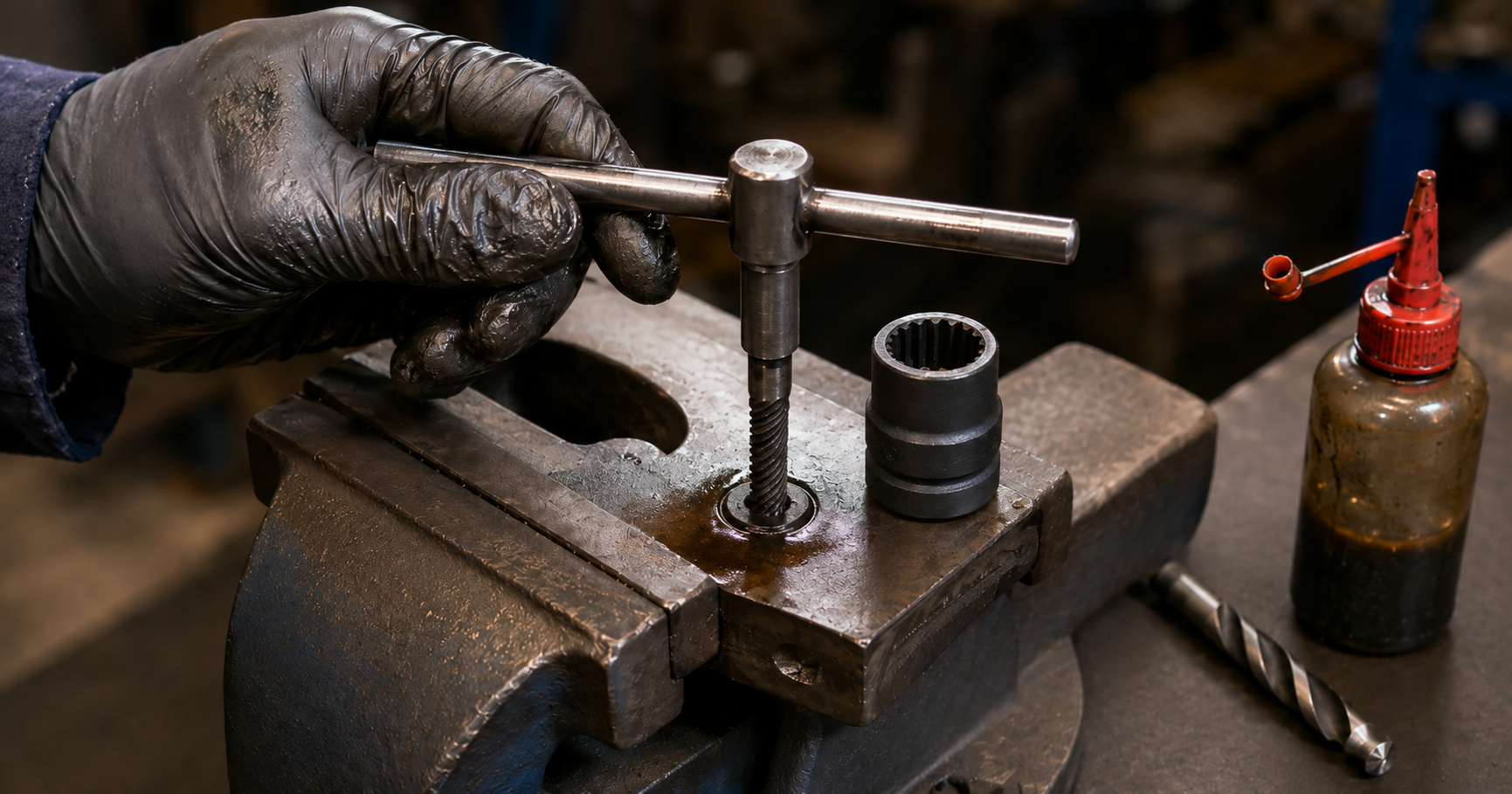
- Screw extractors (internal grip) — also called Easy-Outs, spiral fluted extractors, or reverse-spiral extractors. A pilot hole is drilled into the centre of the broken bolt, and the extractor is driven into the hole. Reverse-direction threads or splines bite into the inside of the bolt as you turn counterclockwise, gripping it from within and backing it out.
- Bolt extractor sockets (external grip) — reverse-spline sockets that fit over the outside of a rounded, painted, rusted or partly stripped hex bolt head. Internal helical splines bite into the corners of the damaged head as you apply reverse torque. They never touch the bolt body.
Both categories live under the same product collection at AIMS — screw extractors and bolt extractors — but they solve different problems and pick the wrong one for the situation and you'll either waste an hour or turn a broken bolt into a broken bolt with a snapped tool stuck inside it.
This guide covers both classes plus the supporting techniques that machinists, mechanics and maintenance fitters use when standard extraction fails: left-hand drill bits, the carbide masonry drill trick for hardened bolts, and the weld-a-nut method for sheared-flush bolts.
Bolt extractor vs screw extractor vs stud extractor — the disambiguation
Three product categories sound similar, work differently, and address different problems. The decision tree is geometry-based:
| Situation | Tool | How it grips |
|---|---|---|
| Stud still protrudes above the surface (HVAC pipe stud, header stud, set screw) | Stud extractor — see Stud Extractor Guide | Cam-grip roller or collet wraps around the outside of the stud |
| Bolt head sheared off; threaded shank below the surface | Screw extractor (spiral fluted, square, or multi-spline) | Driven into a drilled pilot hole; bites the inside of the bolt |
| Hex bolt head rounded, painted over, rusted or partly stripped — head still attached | Bolt extractor socket | Reverse-spline grip on the outside of the hex head |
| Broken stud below the surface — needs internal-grip recovery | Screw extractor (this article) | Same as broken bolt — drill, extract internally |
| Bolt removed but threads stripped in the parent material | Thread repair insert — see Stripped Thread Repair Guide | New threaded sleeve restores the female threads |
The recovery process often uses more than one of these tools in sequence: a broken hex bolt might need a bolt extractor socket first (head removal), then a screw extractor (drill out remaining stub), then a thread repair insert (restore stripped female threads).
One more scenario doesn't belong on this table at all: a screw that won't turn because it was designed that way. One-way (clutch-head) security screws grip a screwdriver on the tightening turn and cam straight out on the loosening turn — no amount of drilling, soaking or extractor technique will shift one using the methods in this guide, because there's nothing broken to fix. See our One-Way Screw Removal Guide for the four methods that actually work on these.
The three types of screw extractors
Screw extractors all do the same job — bite the inside of a drilled pilot hole and back the broken bolt out — but the cutting geometry varies. The three families have meaningfully different success rates and failure modes:
| Type | Geometry | How it bites | Best for | Failure mode |
|---|---|---|---|---|
| Spiral fluted (Easy-Out style) | Reverse-helical spiral grooves down a tapered body | Wedges deeper as you turn counterclockwise; spiral cuts threads into the pilot hole wall | Mild steel, brass, aluminium, bronze, plastic — softer materials that yield to the cutting action | Wedging action expands the bolt remnant, locking it tighter into the parent threads. Hard bolts crack the extractor in two. |
| Square (straight) fluted | Four flat sides on a tapered body, no spiral | Hammered into the pilot hole; sharp corners cut into the bolt wall as you apply reverse torque | Mid-grade steel, harder bronze, hardened brass — won't wedge-expand like spiral | Easier to break than multi-spline. Limited contact area on each face. |
| Multi-spline (six or more splines) | Six narrow straight splines down a tapered body | Splines cut into the pilot hole and grip with six contact points instead of four | Harder steels, broken Class 8.8 bolts, anywhere a spiral extractor would snap | Still breaks on Class 10.9 and 12.9 hardened bolts; harder to source in Australia. |
Practical Machinist consensus (multiple threads, including 387273 and 117537): square fluted extractors outperform spiral on anything harder than mild steel because they don't wedge-expand the bolt. The hammered-in style transfers torque without forcing the broken bolt outward into the parent threads. Spiral extractors are the dominant retail product because they look impressive and turn smoothly, but the working pros prefer square or multi-spline for any non-trivial extraction.
At AIMS the dominant brands are:
- Bordo Screw Extractor with Left Hand Stub Drill in sizes #1, #2, #3, #4 and #5 — the workshop default. Each kit pairs the matched left-hand drill with a spiral fluted extractor for a specific bolt size range. ~2,100 unit inventory across sizes.
- Bordo Square Screw Extractor and Square Screw Extractor Set — for jobs where spiral wedging is the wrong approach.
- Sutton Tools M601 Tungsten Chrome Easy-Out (premium tier, 1,312 units), M602 Chrome Steel Drill Set, M600 Carbon Steel (budget tier).
- Sutton M603S20L 10-piece Easy-Out Set with Left Hand Drills — the centrepiece combined kit pairing extractors with their matched left-hand drill bits.
- P&N 5-piece and 6-piece sets for general workshop use.
Bolt extractor sockets — external grip for rounded heads
Bolt extractor sockets are a different tool class entirely. They never enter the bolt body. Instead, they fit over the outside of the hex head — even when that head is rounded, painted, rusted, partly broken or stripped beyond what a normal socket can grip.
Inside the socket, helical reverse-spline flutes are cut into the bore. As you apply counterclockwise torque, the flutes bite into the corners of the damaged hex head and lock harder the more force you apply. The harder you turn, the tighter the grip — the opposite of a normal socket, which slips off a rounded head.
The product class only really took off in the last fifteen years. Older mechanics still reach for a "vise grip and a hammer" first; newer ones reach for a bolt extractor socket and have the bolt out in twenty seconds. Both work, but the socket is faster, cleaner, and less likely to wreck the surrounding workpiece.
At AIMS the standout is the Bordo Impact Rated 3/8" Square Drive Bolt Extractor Socket Set — 9 piece ($131.58). The set covers metric hex sizes from 10mm through 19mm plus a few imperial — the range that catches 95% of automotive and workshop work. Impact rated means you can run it on a rattle gun, not just a hand ratchet, which is critical because rounded bolts usually need impact wrench torque to break free.
| Bolt extractor socket vs screw extractor — when to use each |
|---|
| Use a bolt extractor SOCKET when: The hex head is still attached but rounded, painted over, rusted, or partly stripped. You want to grip the outside of the head and turn it out without drilling. |
| Use a SCREW extractor when: The bolt head has sheared off entirely, leaving a threaded stub at or below the surface. You need to drill a pilot hole and grip the inside of the bolt body. |
| Use both in sequence when: The rounded head finally rounds out completely or shears off. Step 1 = bolt extractor socket attempt. Step 2 = if that fails, screw extractor on the stub. |
Garage Journal threads 552925 and 481894 consensus: seasoned mechanics carry both. The bolt extractor socket gets reached for first because it's non-destructive. If it spins off or won't grip, then the bolt either gets cut/ground flush and drilled, or welded with a nut.
Premium US brands like GEARWRENCH Bolt Biter, Irwin/Hansen, and the Williams/Blue Point Turbo Sockets are not stocked at AIMS — Bordo Impact Rated is the AU industrial equivalent at a fraction of the Snap-on price. Contact us if you need a specific premium brand sourced through our supplier network.
When easy-outs FAIL — the hardened bolt warning
⚠️ THE #1 EASY-OUT FAILURE MODE — READ BEFORE YOU USE ONE
Easy-outs (spiral fluted screw extractors) are made from hardened tool steel. The bolts they're trying to extract — especially Grade 8.8, 10.9 and 12.9 high-tensile bolts — are also hardened steel. When the extractor is harder than the bolt, it bites and extracts. When the bolt is harder than the extractor, the extractor breaks inside the bolt.
Broken easy-outs are notorious for being impossible to drill out — they're so hard that HSS drills won't touch them. You've turned a stuck bolt into a stuck bolt with an unbreakable steel plug in the middle of it. Practical Machinist forum users repeatedly describe this as "10× worse than the original problem."
Practical rule: Do not use a spiral fluted easy-out on any bolt graded 8.8 or harder. Skip straight to: left-hand drill bit → square fluted or multi-spline extractor → weld-a-nut → drill out and Helicoil/TimeSert.
The forum-validated reality from Practical Machinist threads 78126 ("Drilling out broken Easy Out") and 83882 ("Broken off bolt head Options"): once an easy-out snaps inside a hardened bolt, the recovery options narrow dramatically. EDM (electrical discharge machining) becomes the cleanest route, but that's a specialty shop job, not a workshop fix. Carbide end mills will eventually grind through both the broken extractor and the bolt, but they cost ~$80–$200 per mill and you'll burn through several. The lesson is to avoid the failure mode in the first place.
Signs you're about to break the extractor:
- You're leaning hard on the tap handle and it's not turning. Stop. The extractor is about to snap.
- The bolt feels rock-solid — no give, no creak, no movement. The threads are seized or the bolt is harder than the extractor.
- You can hear the extractor creaking under load. Audible warning — back off immediately.
- The bolt is from a known hardened source: head bolts, suspension bolts, drivetrain bolts, brake caliper bolts, anchor bolts on heavy machinery.
When you see these signs, switch to a non-wedging tool (square fluted or multi-spline), increase the pre-extraction soak time, or escalate to weld-a-nut or drill-and-Helicoil.
The mandatory pre-extraction routine — 80% of the work
Practical Machinist consensus across dozens of broken-bolt threads: 80% of successful extractions come from what you do before you touch the extractor, not the extractor itself. The pre-extraction routine is not optional.
- Clean and inspect. Wire-brush the area. Identify the bolt's grade if possible (head markings on the stub, head still attached, paint colour clue, or context — head bolt, suspension bolt etc.). This determines tool selection.
- Soak with penetrating oil. See the Penetrating Oil Guide for product selection. The brand matters less than the time you let it sit. Workshop-grade penetrant (CRC 5.56, WD-40 Specialist Penetrant, Inox MX5, LPS-1 or Wurth Rost Off) all work. The ATF + acetone 50/50 home mix beats every commercial product in independent test rounds but stinks the workshop out.
- Wait. Twenty minutes minimum. Several hours is better. Overnight is best on rusty/heavily-corroded bolts. The penetrant has to wick down the threads by capillary action — that takes time. Trying to extract within five minutes of spraying is wasted spray.
- Apply heat. A propane torch around the parent material — not the bolt itself — for 30–60 seconds. The parent material expands away from the bolt body, breaking the seized friction interface. Wait for it to cool, then re-soak. Two or three heat cycles often free a bolt with no further intervention. Do not heat near fuel lines, fuel tanks, brake lines, electrical components, plastic parts, or anything painted.
- Work the bolt back-and-forth. Once you can apply torque (head still attached, or weld-a-nut applied), don't just heave on it. Apply moderate counterclockwise torque, then clockwise, then counterclockwise. Each cycle breaks more of the corrosion bond. Practical Machinist consensus: the back-and-forth motion does more than raw torque ever will.
- Vibrate the bolt. Light hammer taps on the head (or on the parent material adjacent to the bolt) help break the corrosion. A small air hammer or impact gun on its lowest setting at the bolt head transmits ideal vibration without snapping the head off.
Practical Machinist direct quote (thread 387273): "An easy-out will seldom remove a bolt without 'working' it first." The work is the soak, the heat, the vibration, the back-and-forth. Skip the work and the extractor turns into a broken-extractor recovery job.
Step-by-step: spiral fluted extractor procedure
For mild-to-mid steel bolts where spiral fluted is the right choice:
- Complete the pre-extraction routine above — soak, wait, heat, cool, re-soak.
- Grind or file the broken bolt stub flat. A clean, flat starting surface for the centre punch is essential. The drill won't track on a domed or angled stub.
- Centre punch the exact centre. See the Centre Punch & Scriber Guide. Two-stage prick-then-punch gives the most accurate divot.
- Apply cutting oil. Sulphurised cutting oil (Trefolex, Rocol RTD) for steel. The drill needs lubrication or it work-hardens the bolt and stops cutting. See the Cutting Fluids Guide.
- Drill a pilot hole with a RIGHT-HAND drill bit. Size determined by the extractor — see the drill bit pairing table below. Drill in slowly at low RPM (200–400 RPM for 6–10mm bits in steel) with steady pressure. Going too fast burns the drill and work-hardens the bolt.
- Drill straight. Off-centre drilling weakens one side of the bolt, and the extractor splits the bolt remnant outward into the parent threads. A drill press is ideal; if hand-drilling, use a square set against the surface as a sight line.
- Drill deep enough. The extractor needs at least 6mm of pilot depth for a #1, more for larger sizes. Refer to the extractor packaging.
- Insert the extractor. Hand-press it into the pilot hole. It should bite immediately on the inside walls.
- Turn counterclockwise with a tap handle. Use a tap handle (T-handle) for steady, even torque without sideways force. Do NOT use a wrench held off-axis — that's the most common cause of snapped extractors.
- Stop if it stops turning. If you can't easily back the bolt out, do NOT lean harder on the handle. Back off, re-soak with penetrant, apply heat, try again. Forcing a stuck spiral extractor breaks it inside the bolt.
Step-by-step: bolt extractor socket procedure
For rounded, painted or partly stripped hex bolt heads:
- Pre-extraction routine — soak, wait, heat if safe. Less critical than for sheared bolts but still helps.
- Select the closest-fitting socket. Bolt extractor sockets are usually marked with the nominal hex size they fit (10mm, 12mm, 13mm etc.). Pick the size that's a touch smaller than the original hex — the spline pattern needs to bite the corners.
- Hammer the socket onto the bolt head. A few solid taps with a dead-blow hammer drive the splines into the damaged corners. This is normal — the socket is designed to be hammered on.
- Apply reverse (counterclockwise) torque. Use an impact wrench on a low setting first, then progressively higher if needed. The Bordo Impact Rated set is built for this; standard chrome sockets are not.
- If it slips, hammer harder or go down a size. A perfectly-rounded head sometimes needs a smaller socket forced on with serious hammer blows. The set range from 10–19mm covers most situations.
- Once free, replace the bolt. A bolt that needed extraction socket recovery should not go back in. The threads may be damaged, the head is destroyed, and the bolt has been overstressed.
Forum-validated technique (Garage Journal thread 444731): Pros sometimes use a deep-impact bolt extractor socket and run it with a 1/2" cordless impact gun rather than a 3/8" — the extra rotational mass breaks the corrosion bond before the bolt has time to round out further. AIMS' Bordo Impact Rated set is 3/8" drive, suitable for most ute and 4WD work; for heavy plant and truck applications, contact us to source a 1/2" drive set through our supplier network.
Step-by-step: left-hand drill bit technique
Left-hand drill bits cut anticlockwise. They were invented to do exactly one job: drill into a broken bolt with the drill rotation working in the unscrew direction. Often the heat and the rotational drag are enough to spin the bolt out before you ever need the extractor.
This is the underrated workshop technique. Garage Journal thread 336133, Hobby-Machinist thread 117537, and Practical Machinist contributors repeatedly describe extracting bolts with the drill alone — the extractor was never needed because the drilling action backed the bolt out. The combined kit makes this the default workflow, not the exception.
AIMS combined kits — the buy-once solution:
- Sutton Tools M603S20L 10pc Easy-Out Set with Left Hand Drills — the workshop centrepiece. Five extractors plus five matched left-hand drill bits in one case. Pull out the left-hand drill first; if the bolt doesn't spin out, the extractor in the next pocket is the matched size.
- Bordo Screw Extractor with Left Hand Stub Drill in size #1, #2, #3, #4 and #5 — buy individual sizes or build the range. Each kit pairs one extractor with its matched left-hand stub drill.
- Bordo Screw Out Set — budget combined option for occasional use.
Procedure:
- Pre-extraction routine (soak, heat, cool, re-soak).
- Grind/file the bolt stub flat. Centre punch.
- Set the drill to REVERSE rotation. This is critical — a left-hand drill in normal rotation won't cut.
- Apply cutting oil.
- Drill slowly with moderate pressure. The drill bit cuts in reverse, working with — not against — the bolt's tightening direction.
- Watch for the bolt to spin out. Often somewhere between 2mm and 8mm of drilling depth, the heat from the cutting + the rotational drag breaks the corrosion bond and the bolt simply unscrews itself onto the drill bit. Stop drilling, run the drill in reverse to free the bolt from the bit.
- If the bolt doesn't spin out, finish drilling to extractor pilot depth.
- Insert the matched extractor from the combined kit and back the bolt out as per the spiral fluted procedure above.
💡 Workshop tip: The combined left-hand drill + extractor kits cost only marginally more than the extractor alone. Buying the combined kit means the better tool (left-hand drill) is ready first — not as an afterthought. AIMS stocks both Bordo (per-size combined kits) and Sutton M603S20L (10-piece combined set). For high-frequency workshop use, the Sutton 10-piece is the case-on-the-shelf solution.
Drill bit pairing — pilot size by extractor size
Each screw extractor size has a matched pilot drill diameter. Too small and the extractor splits the bolt outward. Too large and the extractor has nothing to bite. Combined kits (Bordo, Sutton M603) include the matched drill so this isn't a guessing exercise — but if you're buying separately, refer to this reference:
| Extractor size | Bolt size range (metric) | Bolt size range (imperial) | Pilot drill diameter |
|---|---|---|---|
| #1 | M3 – M5 | 3/16" – 1/4" | 2.5 – 3.0 mm (or 7/64") |
| #2 | M5 – M8 | 1/4" – 5/16" | 4.0 – 4.5 mm (or 11/64") |
| #3 | M8 – M12 | 5/16" – 7/16" | 5.5 – 6.5 mm (or 1/4") |
| #4 | M12 – M16 | 7/16" – 9/16" | 7.5 – 8.5 mm (or 5/16") |
| #5 | M16 – M20 | 9/16" – 3/4" | 10.0 – 11.0 mm (or 25/64") |
| #6 | M20 – M25 | 3/4" – 1" | 13.0 – 14.0 mm (or 33/64") |
Manufacturers vary slightly in their pilot recommendations — always check the size printed on the extractor packaging. Bordo and Sutton in Australia print the matched drill size on the packaging and the case.
Drilling hardened bolts — the carbide masonry drill trick
Grade 8.8, 10.9, and 12.9 hardened bolts can be impossible to drill with standard HSS bits. The bit work-hardens the bolt surface, the drill spins without cutting, and you've now burnished the bolt to an even harder finish than it started with — making the next attempt worse.
Practical Machinist thread 308422 ("cutting tool for work hardened broken bolts") consensus: a sharpened tungsten carbide masonry drill bit at low RPM with light constant pressure will cut hardened steel where HSS won't. The trick:
- Take a fresh carbide masonry drill (size as per the pilot drill table above).
- Re-sharpen the tip to a sharper point on a bench grinder — the factory grind is too blunt for steel.
- Run at low RPM (150–300 RPM in a drill press).
- Use sulphurised cutting oil.
- Apply light, constant pressure. Carbide is brittle — heavy pressure will shatter the tip.
- Let the drill cut at its own rate. Going slow is faster than burning out fresh HSS bits one after another.
For high-frequency hardened-bolt work, dedicated carbide-tipped drill bits (Sutton Cobalt range, premium tier sourced through our supplier network) are the long-term answer. The masonry-drill trick is the workshop improvisation that's worked for sixty years and still works today.
The alternative is cobalt HSS drill bits (M35 grade, 5% cobalt) which are more expensive than standard HSS but cheaper than carbide. They handle Grade 8.8 reliably and Grade 10.9 with patience. See the Cobalt Drill Bit Guide for the cobalt vs HSS selection breakdown.
Stainless steel work-hardening warning
Broken stainless bolts have their own failure mode that's different from carbon steel. Stainless steel (304, 316, A2-70, A4-80) work-hardens dramatically when machined improperly. The moment you let the drill stop cutting — by pausing, by letting it spin without feed pressure, by using a dull bit — the surface hardens to roughly twice its original hardness in the space of a second. From that point on, the drill won't cut at all.
YBW Forum thread 246151 ("Drilling out broken stainless steel bolt") + Practical Machinist consensus: the rule for drilling stainless is high constant feed pressure, sharp bit, generous cutting oil, low-to-medium RPM. The drill must always be cutting fresh material — never burnishing the surface.
Practical workshop steps:
- Use a brand-new or freshly-sharpened drill bit. Cobalt HSS is preferred for stainless.
- Apply cutting oil generously throughout the cut.
- Low RPM (200–400 RPM in a drill press for 6–10mm bits).
- Heavy, constant feed pressure. Lean on the drill.
- If the bit stops cutting, do NOT pull off and re-attempt. Pull off completely, re-sharpen the bit, re-apply oil generously, and resume with maximum feed pressure on the now-hardened surface (which carbide will cut but HSS won't).
Marine bolts, food-grade equipment bolts, and pharmaceutical machinery bolts are most often stainless — these are the broken-bolt jobs where the workshop drilling rules change.
Weld-a-nut — the pro technique for sheared-flush bolts
When a bolt has sheared flush with or below the parent surface, and the bolt is hard enough that extractors break inside it, the professional fix is to weld a nut to the stub and back it out with a wrench.
This is the most reliable extraction method ever invented. The success rate is so high that pros often skip directly to weld-a-nut on broken hardened bolts rather than wasting time with extractors. It also restores a hex head to grip, so you can apply full back-and-forth torque cycling.
The method (assumes basic MIG or stick welding capability):
- Clean the bolt stub. Grind it flat if domed.
- Pick a nut that's a size or two larger than the broken bolt — the nut's hole needs to clear the bolt stub.
- Place the nut on top of the bolt stub.
- Weld through the centre of the nut, fusing it to the stub. MIG with steel wire works on mild steel; stick with 7018 works on harder bolts. The heat from welding is also the magic ingredient — it expands the bolt, breaks the corrosion bond, and often the bolt is loose by the time the weld cools.
- Let it cool briefly (not fully — warm is good).
- Apply a wrench to the welded nut. Back-and-forth motion: counterclockwise, clockwise, counterclockwise. The heat-loosened bolt almost always backs out.
- If the nut breaks off (under-welded), repeat with a longer weld and a bigger nut.
Practical Machinist consensus (thread 376241 and others): weld-a-nut is the single most-recommended technique by working mechanics and machinists for sheared-flush bolts. The combination of mechanical grip restoration AND heat application is what makes it work where extractors fail. The downside is it requires welding capability — but for any workshop with a MIG or stick welder, it should be the first move on a hardened broken bolt, not the last resort.
Safety note: do not weld near fuel lines, fuel tanks, brake lines, plastic components, painted surfaces, hydraulic lines or electronics. Shield surrounding work with a welding blanket — see the Welding Blankets Guide.
Materials matrix — what each tool works on
The right extractor depends on the bolt material AND its grade:
| Bolt material / grade | Spiral fluted (Easy-Out) | Square fluted | Multi-spline | Bolt extractor socket | Left-hand drill | Weld-a-nut |
|---|---|---|---|---|---|---|
| Mild steel (low-grade, unmarked) | ✅ Good | ✅ Good | ✅ Good | ✅ (if head intact) | ✅ Often extracts alone | ✅ |
| Class 4.6 — general purpose bolts | ✅ Good | ✅ Good | ✅ Good | ✅ (if head intact) | ✅ Often extracts alone | ✅ |
| Class 5.8 — auto / fleet | ⚠️ Marginal | ✅ Good | ✅ Good | ✅ (if head intact) | ✅ | ✅ |
| Class 8.8 — high-tensile | ❌ Snap risk | ⚠️ Use with care | ✅ Best choice | ✅ (if head intact) | ✅ | ✅ Best choice |
| Class 10.9 — high-tensile | ❌ Will snap | ❌ Will snap | ⚠️ Marginal | ✅ (if head intact) | ⚠️ Cobalt drill required | ✅ Best choice |
| Class 12.9 — alloy steel | ❌ Will snap | ❌ Will snap | ❌ Likely snap | ✅ (if head intact) | ⚠️ Carbide drill required | ✅ Best choice |
| 304 stainless (A2-70) | ⚠️ Work-hardens | ✅ Good | ✅ Good | ✅ (if head intact) | ⚠️ Constant feed required | ✅ |
| 316 stainless (A4-80) | ⚠️ Work-hardens | ✅ Good | ✅ Good | ✅ (if head intact) | ⚠️ Constant feed required | ✅ |
| Brass / bronze | ✅ Best choice | ✅ Good | ✅ Good | ✅ (if head intact) | ✅ | ⚠️ Specialty rods needed |
| Aluminium / aluminium alloys | ✅ Best choice | ✅ Good | ✅ Good | ✅ (if head intact) | ✅ | ⚠️ Specialty welder needed |
See the Bolt Grade Chart for the full grade marking reference if you need to identify what you're working with.
Brand reality — what to buy and what to avoid
| Brand | Tier | Stocked at AIMS | Notes |
|---|---|---|---|
| Bordo (AU) | Workshop default | ✅ Dominant range | The workshop standard. Combined kits #1–#5, square extractors, screw out sets, and the Impact Rated Bolt Extractor Socket Set 9pc — the AU industrial benchmark. |
| Sutton Tools (AU) | Premium AU | ✅ Easy-Out range | M600 carbon steel (budget), M601 tungsten chrome (premium), M602 with drills, M603S20L 10pc with left-hand drills. Made in Thomastown VIC. |
| P&N (AU) | Workshop value | ✅ 5pc + 6pc sets | Good entry-level for occasional workshop use. Won't survive on hardened bolts. |
| Snap-on (US) | Top-tier premium | ❌ Not stocked | Industry gold standard. Source through supplier network for specialty applications. Premium pricing. |
| Mac Tools (US) | Top-tier premium | ❌ Not stocked | Mobile-mechanic premium. Source on request. |
| Irwin / Hansen (US) | Premium | ❌ Not stocked | Hansen makes some of the best US-market extraction tools; rebadged under multiple US tool brand names. Source through supplier network. |
| GEARWRENCH Bolt Biter (US) | Premium socket sets | ❌ Not stocked | Modern reverse-spline socket design; Bordo Impact Rated is the AU equivalent at lower cost. |
| Williams / Blue Point Turbo Sockets | Premium socket sets | ❌ Not stocked | US-market rounded-head socket gold standard. |
| GripEdge | Specialty | ❌ Not stocked | Specialty broken-bolt extractor brand. Source on request. |
| Harbor Freight QUINN | Budget | ❌ Avoid | Forum-flagged: fluted extractors will fail quickly under any real load. Fine for one-off light DIY; will not survive workshop use on hardened steel. |
| Bunnings / Supercheap / Repco own-label | Consumer | ❌ Avoid for workshop | Consumer-grade extractors marketed at the hobbyist tier. Underperform on anything beyond mild steel. |
The honest AU industrial choice for workshop use: Bordo combined kits + Bordo Impact Rated socket set + Sutton M603S20L premium set. Cover both classes (internal-grip screw extractor and external-grip socket), both ends of the price tier, and the left-hand drill workflow. Total kit investment under $250 covers 95% of broken-bolt scenarios.
Common mistakes — failure modes and fixes
| Mistake | What goes wrong | Fix |
|---|---|---|
| Using easy-out on a Class 8.8+ bolt | Extractor snaps inside the bolt — unrecoverable without EDM | Skip to left-hand drill or multi-spline. Better: weld-a-nut. |
| Skipping the soak / heat cycles | Bolt is seized harder than the extractor can break. Extractor snaps. | Soak overnight. Heat cycle. Re-soak. Patience beats torque. |
| Drilling off-centre | Pilot hole weakens one side of bolt; extractor splits remnant into parent threads | Centre punch carefully. Use drill press if available. Eyeball with a square if not. |
| Wrong pilot drill size | Too small = extractor can't bite. Too large = no material left to grip. | Match per the table above, or use a combined kit where the drill comes with the extractor. |
| Pulling sideways on the tap handle | Side-load snaps extractor. T-handles only. | Use a proper tap handle. Apply torque only along the axis. |
| Forcing a stuck extractor | Leaning hard on the handle when it stops turning = snapped extractor | Stop. Re-soak. Re-heat. Reconsider tool selection. |
| Using HSS drill on hardened bolt | Work-hardens surface, drill won't cut, makes problem worse | Cobalt HSS minimum. Carbide-tipped or sharpened masonry drill for Class 10.9+. |
| Hand-holding the work | Drill grabs and spins the work, broken drills, broken fingers | Vice or clamp. Clamp Types Guide for selection. |
AIMS supply — selection guide by application
Three-tier ladder for AU workshops:
Tier 1 — Occasional use / general workshop:
- Bordo Screw Extractor + Left Hand Stub Drill #2 and #3 (covers M5–M12 range, $13.13–$24.67 each)
- P&N 5pc Set ($5.95) as a backup case
- Add a good penetrating oil
Tier 2 — Regular workshop / mobile mechanic / fleet maintenance:
- Sutton M603S20L 10pc Easy-Out Set with Left Hand Drills — the buy-once combined kit
- Bordo Impact Rated 3/8" Bolt Extractor Socket Set 9pc ($131.58) — for rounded hex heads
- Bordo Square Screw Extractor Set — for harder bolts where spiral is wrong
Tier 3 — High-volume / heavy plant / production maintenance:
- Above plus dedicated carbide-tipped drill bits
- Cobalt drill bit set for Class 8.8+ work
- MIG welder for weld-a-nut technique on production-line broken bolts
- Specialty premium tier (Snap-on, Hansen, Irwin) sourced through our supplier network on request
The full range of extraction and removal tools is at /collections/screw-extractors and /collections/extraction-removal-tools. Call (02) 9773 0122 or contact us if you need help picking the right kit for your application.
When a fastener won't come loose with normal effort, walk through the full escalation in our How to Remove Stuck Bolts & Nuts guide — penetrant through to drill-out and weld-on.
Frequently Asked Questions
What's the difference between a bolt extractor and a screw extractor?
In common usage they're interchangeable terms for the same product class — internal-grip spiral fluted tools (often called Easy-Outs) that drill into the centre of a broken bolt and grip the inside. However, "bolt extractor" can also refer to bolt extractor SOCKETS — external-grip reverse-spline sockets that fit over a rounded hex head. Two different tools, both called bolt extractors. Context tells you which one is meant: if the bolt is sheared, "screw/bolt extractor" means the internal-grip tool. If the head is rounded but attached, "bolt extractor" usually means the socket type.
When should I use a bolt extractor vs a stud extractor?
Use a stud extractor when the broken stud protrudes above the surface — see the Stud Extractor Guide. Stud extractors are cam-grip or collet-style tools that wrap around the outside of the stud body. Use a bolt extractor (screw extractor) when the bolt head has sheared off and the stub is flush with or below the parent surface — you need to drill into the centre and grip from inside. The geometry decides: protruding = stud extractor, flush = screw extractor.
Do bolt extractors actually work?
Yes, on the right bolts. The success rate on mild steel, brass, aluminium and Class 4.6 bolts that have been properly soaked and pre-loosened with heat cycles is high — often 80%+ first attempt. The success rate on hardened bolts (Class 8.8 and above) without proper technique drops sharply, and snapped extractors stuck inside bolts are a known failure mode. Match the tool to the bolt, do the pre-extraction routine, and they work. Skip the prep, push too hard, or use spiral on hardened steel and you'll experience the failure mode firsthand.
Why do easy-outs break inside the bolt?
Three reasons. First, easy-outs are made from hardened tool steel — when the bolt is harder than the extractor (any Class 8.8 or above), the extractor cracks under torque. Second, spiral fluted extractors apply wedge force outward as they turn, expanding the broken bolt into the parent threads and locking it tighter; the extractor takes the entire load until it snaps. Third, side-loading from off-axis tap handles cracks them. Once broken inside, the extractor is too hard for HSS drills to remove — EDM or carbide milling become the only options.
Can you use an easy-out on hardened steel?
Spiral fluted easy-outs — no, not reliably. The Practical Machinist consensus is clear: spiral extractors will snap inside Class 8.8 and harder bolts. Square fluted extractors do better because they don't wedge-expand the bolt. Multi-spline extractors do better still with six contact points. But on Class 10.9 and 12.9 hardened bolts, the most reliable approach is to skip extractors entirely and use the left-hand drill + weld-a-nut combination. Drill out and Helicoil if extraction fails.
What size drill bit do I use with a screw extractor?
The size is specified by the extractor — refer to the drill bit pairing table in this guide, or the size printed on the extractor packaging. As a quick reference: #1 = 2.5–3.0mm, #2 = 4.0–4.5mm, #3 = 5.5–6.5mm, #4 = 7.5–8.5mm, #5 = 10.0–11.0mm. Combined kits (Bordo, Sutton M603S20L) include the matched drill in the case so there's no guesswork. Wrong drill size = failed extraction.
How do I remove a rounded hex bolt head?
Use a bolt extractor SOCKET, not a screw extractor. The Bordo Impact Rated 3/8" Bolt Extractor Socket Set 9pc is the AU workshop standard. Pick the socket marked closest to the original hex size, hammer it onto the rounded head, and apply reverse torque with an impact wrench. The reverse-spline flutes inside the socket bite into the damaged corners and grip harder as torque increases. For very heavily-rounded heads, go down a size and force the smaller socket on with serious hammer blows.
What's a bolt extractor socket and how does it work?
A bolt extractor socket fits over the outside of a damaged hex bolt head. Inside the socket bore, reverse-spline helical flutes are cut. When you apply counterclockwise torque, the flutes bite into the corners of the damaged head — the harder you turn, the harder it grips. It's the opposite mechanism to a normal six-point socket, which spreads load evenly and slips off rounded heads. Bolt extractor sockets are impact-rated and designed for use with an impact wrench. Once used, the bolt should be replaced — the head is destroyed.
Can I use an impact gun with a screw extractor?
Generally no — impact wrenches transmit sudden shock loads that snap spiral fluted extractors. Use a tap handle for screw extractors. Bolt extractor SOCKETS are different — they're impact-rated and designed for use with an impact gun (the Bordo Impact Rated set is specifically for this). The two tool classes have opposite impact requirements: socket = impact, screw extractor = controlled hand torque.
How does a left-hand drill bit work?
A left-hand drill bit has reverse-direction flutes — when run in a drill set to REVERSE rotation, it cuts material in the unscrew direction. When you're drilling into a broken bolt to set up an extractor, the rotation and the heat from drilling work in the same direction as the bolt's loosening direction. Often the bolt simply backs out onto the drill bit before you've finished drilling — no extractor needed. The combined kits (Bordo per-size, Sutton M603S20L) put the left-hand drill in the same case as the matched extractor, making this the default workflow rather than the exception.
What's the best brand of bolt extractor in Australia?
For AU workshop use, Bordo (Australian distributor brand) is the workshop standard — the combined Screw Extractor + Left Hand Stub Drill kits in sizes #1–#5 and the Impact Rated Bolt Extractor Socket Set 9pc cover most jobs. Sutton Tools (Thomastown VIC manufacturer) is the premium AU tier — the M601 Tungsten Chrome and M603S20L 10pc combined set are workshop centrepieces. For premium US-tier brands (Snap-on, Mac, Irwin/Hansen, GEARWRENCH Bolt Biter), source through our supplier network. Avoid Harbor Freight QUINN and consumer-tier own-label products — fine for one-off light use, will not survive workshop conditions on hardened steel.
Spiral fluted vs square fluted vs multi-spline — which type?
Spiral fluted is the most common, easiest to use, and works well on mild steel, brass, aluminium and Class 4.6 bolts. The wedging action is a problem on harder bolts — it expands the broken stub into the parent threads. Square fluted extractors are hammered straight into the pilot hole without wedge action — better for mid-to-high grade steel. Multi-spline extractors have six contact points instead of four and grip harder while resisting breakage — the best choice for Class 8.8 broken bolts. For Class 10.9 and 12.9, skip extractors entirely and use weld-a-nut.
How do I remove a broken easy-out?
This is the worst outcome — a hardened extractor stuck inside a hardened bolt, both too hard for HSS drills. Three real options: (1) EDM (electrical discharge machining) at a specialty shop — clean but expensive. (2) Carbide end mill in a milling machine to grind through both the extractor and the bolt — costs $80–$200 per carbide mill and you'll burn through several. (3) Annealing the extractor with localised heat from a TIG torch to soften it enough that HSS can drill it — works occasionally on smaller extractors. Prevention is the only real strategy: don't use spiral easy-outs on hardened bolts in the first place.
Can I extract a stainless steel broken bolt?
Yes, but stainless work-hardens dramatically when drilled improperly. The rules: cobalt HSS drill bit (not standard HSS), generous cutting oil throughout, low-to-medium RPM (200–400 RPM for 6–10mm bits), and heavy constant feed pressure. The drill must always be cutting — never burnishing. If you let the drill stop cutting for even a second, the surface hardens to about twice the original hardness and from that point only carbide will cut. Square fluted or multi-spline extractors handle the actual extraction; spiral fluted can wedge-expand stainless and lock it tighter.
When should I weld a nut to the broken bolt instead of using an extractor?
Weld-a-nut is the first move (not last resort) for any sheared-flush bolt that's Class 8.8 or harder. The combination of mechanical grip restoration (you get a hex head back) plus localised heat (the welding heat expands the bolt and breaks the corrosion bond) gives extraction success rates higher than any extractor on hardened bolts. The requirement is welding capability — a MIG or stick welder. For workshops with welding capability, weld-a-nut should be the default for sheared hardened bolts. Skip the extractor entirely and go straight to the technique that works.
For workshops needing AS 4114 / AS 4994 compliant fume control, the AIMS fume extraction range covers portable and fixed units.

