

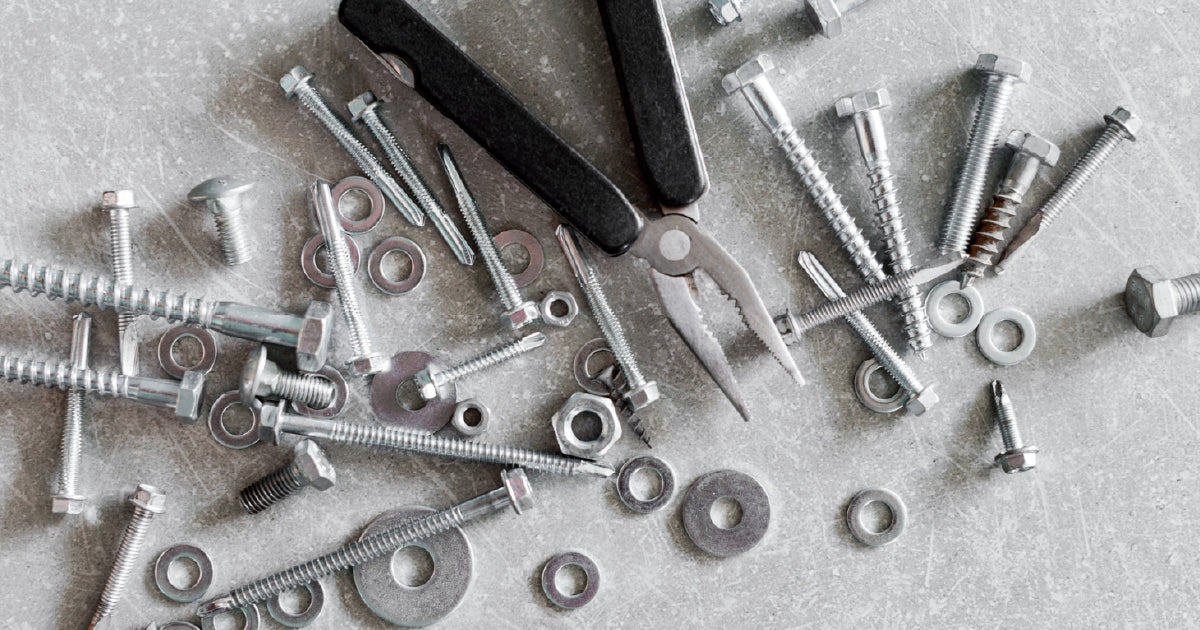
Metric to Imperial Fastener Quick Reference
The closest imperial equivalent to M8 is 5/16", M10 is 3/8", and M12 is 1/2". These are not exact replacements — metric and imperial threads have different pitches and are not interchangeable.
| Metric | Closest Imperial (UNC) | Closest Imperial (UNF) | Closest BSW |
|---|---|---|---|
| M3 | No.10 (3/16") | No.10-32 | 3/16" |
| M4 | No.8 (or 3/16") | No.8-36 | No.8 |
| M5 | No.10-24 | No.10-32 | 3/16" |
| M6 | 1/4"-20 | 1/4"-28 | 1/4" |
| M8 | 5/16"-18 | 5/16"-24 | 5/16" |
| M10 | 3/8"-16 | 3/8"-24 | 3/8" |
| M12 | 1/2"-13 | 1/2"-20 | 1/2" |
| M16 | 5/8"-11 | 5/8"-18 | 5/8" |
| M20 | 3/4"-10 | 3/4"-16 | 3/4" |
| M24 | 1"-8 | 1"-12 | 1" |
Grade comparison: Metric 8.8 ≈ SAE Grade 5; Metric 10.9 ≈ SAE Grade 8; Metric 12.9 ≈ SAE Grade 8 plus. Stainless steel: A2 (304 SS), A4 (316 SS). Metric grade markings appear on the bolt head as numbers (8.8, 10.9, 12.9). Imperial grade markings appear as radial lines (Grade 5 = 3 lines, Grade 8 = 6 lines).
Thread pitch: Metric coarse M8 pitch is 1.25mm. Metric fine M8 pitch is 1.0mm. UNC 5/16" pitch is 18 TPI (threads per inch). Always confirm metric vs imperial before ordering — a 5/16" UNC bolt will NOT start in an M8 tapped hole.
People Also Ask — Metric vs Imperial: How to Choose the Right Fastener for the Job
Q: What does M8 mean on a bolt?
M8 denotes a metric bolt with an 8 mm nominal thread diameter. The 'M' stands for metric ISO thread form. An M8 bolt typically uses a 13 mm spanner across the hex head for coarse-pitch (1.25 mm pitch) versions — the most common standard for general fastening.
Q: How do I identify a bolt grade from its head markings?
Metric bolts show grade markings as numbers on the head — 8.8 means tensile strength of 800 MPa with yield at 80% of that, while 10.9 and 12.9 are higher grades. Imperial grades use radial lines: 3 lines = SAE Grade 5, 6 lines = SAE Grade 8. Unmarked bolts are generally Grade 4.6 or lower.
Q: What is the difference between UNC and UNF threads?
UNC (Unified National Coarse) has fewer, larger threads per inch — stronger in soft materials and faster to assemble. UNF (Unified National Fine) has more threads per inch, giving better resistance to vibration loosening and finer adjustment. UNC is the default choice for most structural fastening; UNF suits precision applications.
Q: How do I choose between metric and imperial fasteners for Australian equipment?
Most modern Australian industrial equipment is metric, per AS/NZS standards. Imperial fasteners (BSW, BSF, UNC, UNF) are common in older machinery, American equipment, and agriculture. When mixing is unavoidable, use thread gauges to verify — mismatched threads can appear to engage but will fail under load.

