

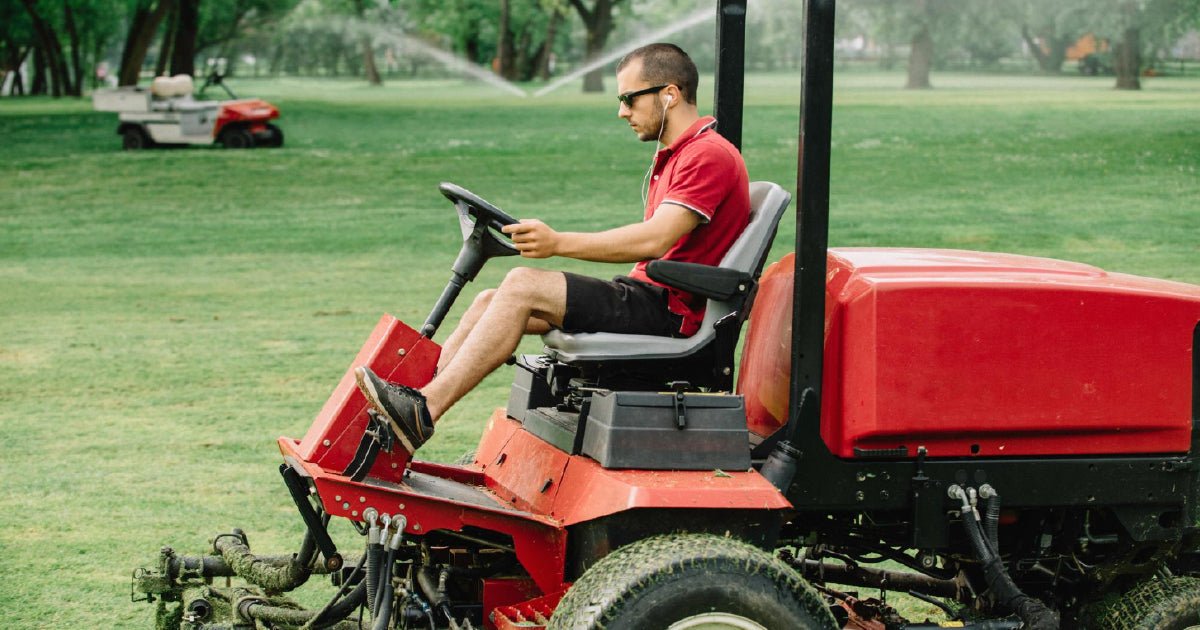
Ride-on mower belts are one of those parts you don't think about until they break — usually mid-paddock, mid-season, when there's grass to cut. The good news: ride-on mower belts fail predictably. Knowing how to identify the right replacement, what to inspect before you fit it, and the maintenance habits that extend belt life will keep your mower running through every season.
This guide is written for ride-on and zero-turn mower owners — homeowners with acreage, hobby farmers, contractors, councils, and groundskeepers. It covers V-belts (the section type used on the vast majority of ride-on mowers) for deck/spindle drive and transmission drive. If you're chasing belts for industrial drives, see our V-Belt Problems & Solutions guide instead.
Quick Reference — Ride-On Mower Belt Basics
| Drive | Common belt section | Typical life | Failure mode |
|---|---|---|---|
| Engine → PTO / deck | 4L, 5L, A, B (classical or fractional) | 100–200 hours | Heat, grass packing, blade strike shock |
| PTO → spindle/blade | 4L, 5L, A, B | 50–150 hours | Blade strike, debris cut, oil contamination |
| Transmission (hydrostatic / belt-driven) | 4L, AX, BX (cogged variants common) | 200–400 hours | Slip from worn idler, oil ingress |
| Variable-speed / drive pulley | Variable-speed belt (manufacturer-specific) | 150–300 hours | Sidewall wear from pulley sheave movement |
Figures are typical ranges for residential and light commercial ride-ons under normal Australian conditions. Heavy or contractor use shortens these significantly.
Belt Types on Ride-On Mowers
Most ride-on mowers in Australia use V-belts in fractional horsepower (4L, 5L) or classical (A, B) sections. The belt cross-section matters because it determines pulley compatibility and load capacity.
Engine-to-PTO / deck drive
This is the primary drive belt — it transfers power from the engine crankshaft pulley to the cutting deck or PTO (Power Take-Off) clutch. It's usually the longest belt on the mower and runs around multiple idlers. Failure here stops cutting entirely.
PTO-to-spindle (deck belt)
On most decks, a separate belt drives the cutting spindles. Twin-blade and triple-blade decks use a single belt routed across all spindles with idlers and tensioners maintaining wrap. This belt sees the most punishment — blade strikes, grass packing, and heat from the cutting environment.
Transmission drive
Belt-driven transaxles (common on entry-level ride-ons) use a V-belt or cogged V-belt from the engine to the transmission input. Hydrostatic transmissions still typically use a belt for the input side. This belt usually outlasts the deck belt because it sees less debris.
Variable-speed / drive pulley belts
Some older designs use variable-speed pulleys where the sheaves move apart and together to change effective ratio. These need a manufacturer-specific belt — never substitute a standard V-belt, the sidewall geometry and flexibility are different.
Identifying Your Belt
There are two ways to identify a ride-on mower belt, in order of reliability:
1. OEM part number (best)
Every mower manufacturer assigns a unique part number to each belt. It's printed on the belt itself (sometimes hard to read on a used belt) and in the owner's manual or parts diagram. Examples of where to find it:
- Stamped on the back or sidewall of the belt (most reliable on new belts; faded on worn ones)
- Owner's manual or operator's handbook — parts section
- Sticker on the deck or under the seat with model and serial number — cross-reference to parts catalogue
- Manufacturer's online parts lookup (model + serial number)
If you can find the OEM part number, that's all you need. Aftermarket suppliers cross-reference OEM numbers to equivalent aftermarket belts.
2. Physical measurement (fallback)
If the OEM number is unreadable and you can't find the parts diagram, you can measure. You need three numbers:
- Section / cross-section: Measure top width and depth with calipers. 4L = 12.7mm wide, 5L = 16.7mm wide, A = 13mm wide, B = 17mm wide. Cogged variants (AX, BX) have notches on the underside.
- Length: Lay the old belt flat in a circle and measure the outside circumference, or measure with a tape from the marked points. Some belts mark "outside length" (OL); others mark "effective length" (LP/LE). Manufacturers vary — check the AIMS V-Belt Sizing & Identification Guide for the conversion specifics.
- Top vs underside: Note if the belt has cogs/teeth on the underside (cogged), is plain rubber (classical), or has a Kevlar/aramid wrap.
If the belt is broken in pieces, lay the pieces end-to-end on a flat surface and measure the total length plus any missing chunk you can estimate. A pulley-to-pulley measurement on the mower itself works too if you can get a flexible tape around the actual routing.
Why Mower Belts Fail
Ride-on mower belts fail for reasons quite specific to the application. Understanding which cause is yours stops you replacing a belt only to wreck the new one the same way.
Grass packing in pulley grooves
Clippings, especially wet clippings, pack into pulley sheaves and around idlers. Packed grass changes the effective belt-to-pulley contact, causes the belt to ride high (slipping), and generates heat from friction. Symptoms: belt squeals, belt walks off pulleys, premature glazing on the belt sidewall.
Blade strike damage
Striking a buried rock, root, or piece of irrigation pipe sends a shock load through the spindle, pulley, and belt. The belt may survive but with internal cord damage that fails later. After any noticeable blade strike, inspect belts for cuts, frayed edges, and irregular vibration.
Heat
Mower engines run hot. Belt temperatures near a hot exhaust or engine block can exceed 100°C in continuous use. Heat hardens the rubber, glazes the sidewall, and reduces grip. Brown/black glazing on a belt's V-sides is a heat sign.
Oil and fluid contamination
Leaking engine oil, transmission fluid, or fuel onto a belt softens the rubber and destroys the grip. Once a belt is contaminated, it can't be cleaned back to spec — replace it and find the leak source first.
Idler and tensioner wear
Spring-loaded idlers lose tension over time. A worn idler bearing wobbles, throwing the belt off track. Often the belt isn't the problem — the idler is. Always inspect and replace the idler with the belt if it shows any play or roughness when spun by hand.
Multi-belt mismatch
On decks running two belts (engine-to-deck plus deck-to-spindles), replacing only one can cause uneven tension and premature wear on the new belt. If the surviving belt is more than half worn, replace both as a set.
Replacement Frequency — Signs to Replace Before Failure
Belts don't usually let go without warning. Watch for:
- Cracks on the V-sides or back — visible cracking means the rubber is brittle and within weeks of letting go
- Fraying along the edges — internal cord exposed, belt is at end of life
- Glazing — shiny, hard sidewalls from heat and slip; belt has lost grip
- Sidewall chunks missing — sometimes called "chunking", usually from heat and impact
- Belt sits high in the pulley sheave — worn V-sides have lost their wedge fit (the V should bottom out roughly flush with the pulley edge, not stick above)
- Slipping or squealing under load — engaging the PTO produces a squeal that doesn't fade in 1–2 seconds = belt has lost grip
- Cutting quality drop — uneven cut, ragged edges, or the deck bogging down under thicker grass
Replace at the first sign rather than waiting for the snap. A belt that breaks while cutting can damage the deck, jam the spindle, and cost more than the belt itself.
⚠ SAFETY FIRST — BEFORE YOU TOUCH A BELT
Never service a mower belt with the engine running, the spark plug connected, or the blades still able to spin freely. The minimum safety sequence:
- Park on flat ground, parking brake engaged
- PTO disengaged, key out
- Engine cold (belts and pulleys near the engine can burn skin)
- Spark plug lead pulled off the spark plug (petrol mowers) — prevents accidental crank-start
- Battery disconnected (electric-start and zero-turn mowers)
- Blades visually confirmed stationary — wear cut-resistant gloves anywhere near them
The mower deck on a ride-on can drop. Block it up with timber or a deck-support block — never rely on hydraulic lift alone.
Replacement Walkthrough
Step 1 — Gather the right info
Before you order a belt, write down:
- Mower brand and model (e.g. Husqvarna LT2317 CMA)
- Serial number (sticker under the seat or on the deck)
- OEM belt part number (from the old belt or owner's manual)
- Belt section and length if you measured
- Which belt — deck/spindle, engine-to-PTO, or transmission
Step 2 — Decide OEM or aftermarket
OEM belts (manufacturer-branded, in manufacturer packaging) are the safe choice but typically cost more. Quality aftermarket belts — Gates is the industry standard, with their Lawn & Garden and PoweRated® ranges matching OEM specifications — perform as well or better than OEM at lower cost. Cheap unbranded belts are a false economy: short life, slip, and risk of pulley damage. AIMS stocks Gates Lawn & Garden belts for the most common ride-on applications and the full Gates range for cross-referenced replacements.
Step 3 — Remove the old belt
- Photograph the belt routing before you remove anything — phone camera, three or four angles around the deck. This single step prevents 90% of "where does this idler go?" headaches later.
- For deck belts: lower the deck to its lowest cutting height, remove the deck per the owner's manual (usually 2–4 retaining pins and the lift link), then access belt routing
- Release the tensioner spring slowly — these springs can be strong. Use a spring tool or pliers, not your fingers
- Slip the belt off the pulleys in reverse routing order
Step 4 — Inspect pulleys, idlers, and tensioner
Don't skip this. Spin every pulley and idler by hand:
- Smooth, quiet rotation = good
- Roughness, grinding, or play = bearing is failing, replace the idler/pulley
- Visible groove wear in the sheave = pulley is worn, will eat the new belt — replace
- Cracked or warped sheaves = replace
Idler pulleys typically have a tab/back plate that wears too. AIMS stocks replacement idler pulleys and V-pulleys for common ride-on applications.
Step 5 — Clean the pulley grooves
Wire brush packed grass, dirt, and old belt rubber out of every pulley groove. A clean groove restores the V-wedge contact and stops the new belt being damaged on day one.
Step 6 — Fit the new belt
Route the new belt per your photographs (or the owner's manual diagram). Check:
- Belt orientation — some belts are directional, marked with an arrow
- Belt sits centred in every pulley sheave, not riding up the side
- Idler swings through full range without binding
- No twists in the belt
Step 7 — Tension check
Spring-loaded idlers self-tension — your job is to confirm the spring is hooked correctly and the idler swings freely. For manual tensioners, follow the manufacturer's spec (usually a deflection measurement at a specified force — typical light commercial spec is 6–10mm deflection at midspan under 5kg load).
Step 8 — Test run
With the deck still off the mower (if applicable), or with the mower jacked safely so blades are clear:
- Reconnect spark plug, start engine
- Engage PTO at low engine speed
- Listen for unusual noise — squeal, knock, grinding
- Watch belt run — should sit centred, no walking, no slipping
- Run for 2–3 minutes, shut down, recheck pulley alignment and belt seating
Then refit the deck (if removed) and do a short cutting test in light grass to confirm performance under load.
Pulley & Idler Inspection — What to Look For
Worn pulleys and idlers shorten the life of any new belt. Signs a pulley needs replacement:
- Smooth, shiny groove bottom — wear has flattened the V, belt now bottoms out instead of wedging on the sides
- Step or ridge in the sheave — old belt has cut into the metal, will cut the new belt the same way
- Bearing play — grip the pulley and push side to side; any movement = bearing replacement (or whole pulley, often easier)
- Roughness when spun — failing bearing, replace before it seizes mid-cut
- Cracks radiating from the bore or mounting holes — fatigue failure, replace immediately
On idler pulleys specifically: if the belt has been running off-track or chunking, the most common cause is a tilted idler from a worn bushing or bent bracket. Inspect the bracket alignment with a straight edge.
Tensioning Done Right
The two tensioning systems on ride-ons:
Spring-loaded (auto-tension)
Most modern ride-ons use a spring-loaded idler that automatically maintains tension as the belt stretches in. Your job is simple: make sure the spring is correct strength (right spring, properly hooked) and the idler arm is free to pivot. Replace the spring if it's stretched out, rusted, or weakened — a weak spring lets the belt slip under load even though it looks fine at rest.
Manual tensioner
Some older or commercial mowers use a manual tensioner with a locking bolt. Set per manufacturer spec — usually a specified deflection at a specified force, or simply "snug then back off ½ turn" type instructions in the owner's manual. Overtightening manual tensioners is a top cause of premature belt and bearing failure. Tight belts don't last longer — they wear pulleys, kill bearings, and snap.
Extending Belt Life — Maintenance That Works
Belts that should last 100 hours can last 200 with simple maintenance. Belts that should last 200 can fail at 50 if you ignore the deck.
- Clean the deck after every use — scrape packed grass from the underside and around the spindle housings. This is the single biggest belt-life extender.
- Clear grass from pulley grooves monthly — wire brush or compressed air. Wet grass especially packs hard into V-grooves.
- Inspect belt and idlers every 25 hours — visual check for cracks, fraying, glaze, idler play. Five minutes saves a mid-paddock breakdown.
- Avoid wet grass when possible — wet clippings stick to belts and pulleys, pack into grooves, and cause slip.
- Engage PTO at idle, not high RPM — engaging at full throttle shock-loads the belt. Idle → engage → ramp up.
- Disengage PTO before crossing rough ground — kerbs, exposed roots, gravel — anything that might cause a blade strike. Re-engage when you're back on lawn.
- Replace springs when you replace belts — a $15 spring extends the next belt's life significantly. Don't reuse a stretched spring.
- Park dry — storing the mower wet (especially with wet grass clinging) accelerates rust on idler bearings and pulley grooves, and degrades belt rubber.
Common false economy: replacing a belt without replacing a clearly worn idler. The new belt will fail in a fraction of its expected life because the bad idler is still there causing the original problem. Inspect every time.
Notes on Common Australian Mower Brands
Specific part numbers change by model and year — always verify with your owner's manual or the manufacturer's parts lookup. The notes below are general guidance.

Husqvarna
Husqvarna ride-on and zero-turn mowers commonly use 4L and 5L section belts on deck drives, with cogged variants on smaller decks for tighter pulley wraps. Look up part numbers via the Husqvarna AU parts portal using your model and serial number.
John Deere
John Deere ride-ons (LA, LT, LX, X series, Z-Trak zero-turns) use a mix of OEM-specific belts (often with proprietary part numbers and unique profiles for variable-speed systems) and standard fractional V-belts. Variable-speed belts on older units are NOT interchangeable with standard 4L/5L — verify before ordering.
Greenfield
Greenfield mowers (Australian-built, Outback and Evolution ranges) use predominantly classical A and B section belts with some 4L on smaller decks. Greenfield's parts catalogue cross-references most belts to OEM Gates equivalents.
Cox
Cox Australia ride-ons use mostly classical A and B section belts with cogged variants (AX, BX) on tighter routing. As an Australian manufacturer, parts availability is generally good via Cox dealers.
Rover
Rover ride-ons (now under MTD/Cub Cadet ownership) use predominantly 4L and 5L section belts on residential ride-ons. Parts are widely cross-referenced with MTD part numbers — useful if a Rover-branded belt is unavailable.
Toro / Cub Cadet / Honda / Victa
All use a mix of standard V-belts and OEM-specific belts depending on model. Honda walk-behinds and small ride-ons sometimes use unique belts that require OEM sourcing. Always start with the OEM part number for these brands.
Note: brand-specific belt section and part number conventions change with new model releases — always confirm against the current owner's manual or manufacturer parts catalogue before ordering.
OEM vs Aftermarket — When Each Makes Sense
| Choice | When it's the right call | Watch for |
|---|---|---|
| OEM (manufacturer brand) | Variable-speed pulley systems, unique profiles, warranty work, "first replacement" while learning the mower | Premium price; sometimes just rebranded Gates anyway |
| Gates aftermarket (PoweRated®, Lawn & Garden range) | Most standard ride-on applications — direct OEM cross-reference, often the same or better construction | None — Gates is the industry reference standard |
| Other quality aftermarket (Bando, Mitsuboshi, Optibelt) | If supplier confirms direct OEM cross-reference | Verify part number cross-reference; less common in mower section |
| Cheap unbranded | Never on a working mower. Maybe for one-off restoration where mower is parked otherwise | Short life, sidewall failure, potential pulley damage |
AIMS' Note on Sourcing Ride-On Mower Belts
We hold Gates Lawn & Garden belts for the most common ride-on applications, with the broader Gates range covering cross-referenced replacements. We're a Gates distributor and can source from the full catalogue.
To match a belt for you, send through:
- Mower brand, model, and serial number
- OEM part number (from belt or owner's manual)
- Which drive — deck, spindle, engine-to-PTO, transmission
- Photo of the old belt if available
Email sales@aimsindustrial.com.au or call (02) 9773 0122. We'll cross-reference to the right Gates equivalent or source the OEM part if needed. For broader V-belt sizing and identification work outside the mower space, see our V-Belt Sizing & Identification Guide and How to Measure a V-Belt.
Frequently Asked Questions
Can I use an automotive V-belt as a mower belt replacement?
No. Automotive V-belts use different rubber compounds and cord construction designed for continuous low-shock service. Mower belts need to absorb shock loads from blade engagement and impact, and run cooler under heat. Substituting an automotive belt typically results in fast slippage, glazing, or failure within hours of use, and can damage pulleys.
How long should a ride-on mower belt last?
Residential ride-on deck belts typically last 100–200 operating hours under normal conditions. Engine-to-PTO and transmission belts usually outlast deck belts, often 200–400 hours. Contractor and commercial use shortens these significantly. Belt life depends heavily on how clean you keep the deck, how worn the idlers are, and whether you avoid wet grass and blade strikes.
What's the difference between OEM and aftermarket mower belts?
OEM (Original Equipment Manufacturer) belts come in the mower brand's packaging with the manufacturer's part number. Quality aftermarket belts — Gates is the industry standard — cross-reference to OEM specs and are typically built to the same or better specification at a lower price. Many OEM mower belts are actually manufactured by Gates anyway and simply re-branded. Cheap unbranded belts are a false economy and should be avoided.
How do I find my mower belt part number?
The OEM part number is usually printed on the back or sidewall of the belt itself (faded on used belts). If that's unreadable, check your owner's manual parts diagram, or look up your mower's model and serial number in the manufacturer's online parts portal. If you can find the part number, an aftermarket cross-reference is straightforward.
My new belt failed within a few hours — why?
The most common causes: a worn idler pulley you didn't replace at the same time; a worn or stretched tensioner spring; a damaged pulley sheave that's cutting the new belt; oil or fluid contamination from an undetected leak; or installation error (wrong routing, twisted belt, belt rubbing on a bracket). Inspect every pulley and idler before fitting a new belt, and find the leak source if there's any oil contact.
Should I replace both deck belts at the same time if my mower has two?
Yes, unless the surviving belt is genuinely fresh (less than 25% of expected life). Replacing only one belt of a pair causes uneven tension and accelerates wear on the new belt. The cost saving from re-using a half-worn belt is small compared to the cost of replacing the new one early.
What's a "back-bending" or "double-sided" belt?
Some mower deck designs route the belt around idlers that contact the back of the belt as well as the V-sides — meaning the back of the belt also acts as a friction surface. These applications need a belt with a reinforced back (often labelled "back-bend resistant" or "double V" by Gates). Standard V-belts in this routing will crack on the back and fail early. Check your owner's manual for routing — if the belt back contacts a flat idler, use the right belt.
Why does my belt squeal when I engage the PTO?
A brief squeal (1–2 seconds) at engagement is normal — that's the belt taking up slack and gripping. A persistent squeal under load means the belt is slipping. Causes: worn belt (glazed sidewalls), weak tensioner spring, oil on the belt, worn pulley sheaves, or engaging PTO at high engine RPM (always engage at idle).
Can I tighten a slipping belt instead of replacing it?
If the mower has a manual tensioner and the belt is otherwise in good condition (no cracks, fraying, or glaze), a tension adjustment can restore performance. But if the belt is glazed, cracked, or sits high in the pulley sheave, no tension adjustment will fix it — replace the belt. Overtightening a worn belt damages bearings and rarely lasts more than a few hours.
How do I check pulley alignment?
With the belt off, lay a long straight edge across the faces of the engine pulley and the driven pulley. They should be in the same plane — straight edge contacts both faces evenly. Misalignment of more than ~3mm will cause the belt to walk off, run hot on one V-side, or fail prematurely. Misalignment usually means a bent bracket, missing washer, or worn mounting bushes.
Do mower belts need to be broken in?
Yes, lightly. Run the new belt at moderate engine speed (not full throttle) for the first 30 minutes of use, ideally in light grass. This lets the belt seat into the pulley grooves evenly. After break-in, recheck tension — new belts stretch slightly in the first few hours.
Can I clean an oil-contaminated belt instead of replacing it?
No. Once oil or fuel has soaked into the belt rubber, it can't be cleaned out. Surface wipe-off doesn't help — the rubber's grip properties are permanently changed. Replace the belt and find and fix the leak source before fitting the new one, otherwise you'll be doing it again.
What does it cost to replace a ride-on mower belt?
The belt itself ranges from around $25 to $80 AUD for most ride-on applications, depending on length and section. If you do the labour yourself, that's the total cost (plus any worn idlers you replace at the same time — typically $25–$60 each). Dealer fitment adds labour, usually $50–$150 depending on access and mower model. Replacing belts yourself is well within most owners' capability with basic tools.
How do I store the mower over winter to protect the belts?
Clean the deck thoroughly — remove all packed grass. Store the mower under cover, off concrete (concrete sweats and rusts bearings), and out of direct sun. If the deck has a lift, lower it so spring tension is minimised on idler springs. Belts last best when not under continuous tension during long storage.
Need a hand identifying or sourcing a belt? Email us at sales@aimsindustrial.com.au or call (02) 9773 0122 with your mower brand, model, and OEM belt number. We'll cross-reference to the right Gates equivalent and get it to you.
People Also Ask — Ride-On Mower Belts
Q: How do I know when my ride-on mower belt needs replacing?
Signs that a mower deck belt needs replacing include fraying or visible cracks along the belt edges, glazing or hardening of the belt surface, squealing or slipping during operation, uneven cutting, and the belt jumping off the pulleys. Regular visual inspection at the start of each mowing season catches most problems early.
Q: What type of belt does a ride-on mower use?
Most ride-on mowers use standard V-belts sized to the manufacturer's specification. The correct belt is identified by its cross-section such as A, B, or light-duty sizes and its outside circumference or part number found in the mower's owner manual.
Q: How tight should a mower deck belt be?
A mower deck belt should have minimal slack when the deck engagement is disengaged, and should run without slipping when engaged at operating speed. Excessive tension accelerates bearing wear on the spindles and idler pulleys; too little tension causes slipping and premature belt glazing. Consult the machine's service manual for the specified tension or deflection measurement.
Q: Can I use a generic V-belt instead of the OEM mower belt?
A correct cross-section and length V-belt from a reputable industrial supplier will generally perform as well as the OEM part at lower cost. The key is matching the belt's cross-section code and length exactly to the machine specification. Belts that are too long slip; those that are too short overload the pulleys and bearings.
For finer power transmissions, see our finer power transmissions range stocked across Australia.