

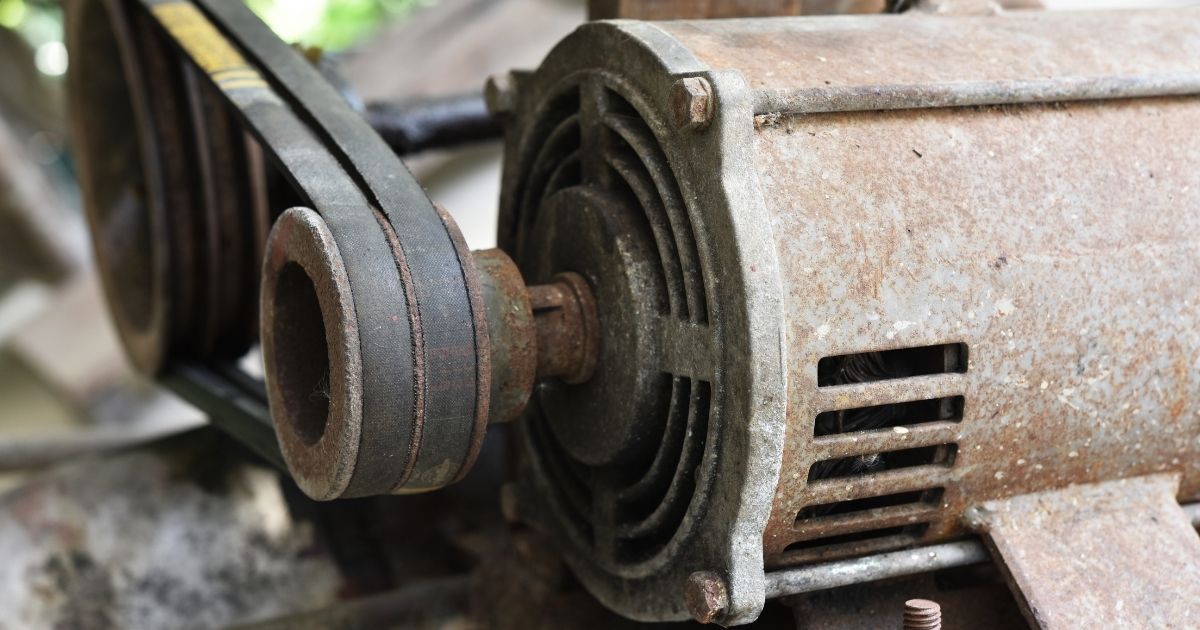
Pulley Speed Ratio Formula
The pulley speed ratio is the relationship between drive and driven pulley diameters that determines how fast the driven pulley turns. The formula:
V2 = V1 × (D1 ÷ D2)
Worked example: a 100mm drive pulley spinning at 1,800 RPM connected by belt to a 200mm driven pulley. V2 = 1,800 × (100 ÷ 200) = 900 RPM. The driven pulley turns at half the speed but produces roughly double the torque.
Rule of thumb: a smaller driven pulley (relative to the drive) spins faster with less torque; a larger driven pulley spins slower with more torque. To increase driven speed, fit a smaller driven pulley or a larger drive pulley.
The formula can also solve for required pulley size: D2 = D1 × (V1 / V2).
Common questions answered by this formula: what happens if I change pulley size; does a bigger drive pulley increase speed; how do I slow down a driven shaft.
People Also Ask — Pulley Speed Ratio Calculator & Formula Explained
Q: How do I calculate pulley speed ratio?
Speed ratio = Driver diameter ÷ Driven diameter. If the driving pulley is 100 mm and the driven pulley is 200 mm, the ratio is 0.5:1 — the driven shaft runs at half the motor speed. To find driven shaft speed: V2 = V1 × (D1 ÷ D2), where V1 is motor RPM and D1/D2 are the pulley diameters.
Q: How do I increase torque using pulleys?
Use a larger driven pulley relative to the driver — the driven shaft slows down but torque increases proportionally (ignoring belt slip and friction losses). For example, a 2:1 ratio (driver 100 mm, driven 200 mm) doubles the torque at the output shaft. This is the standard approach for conveyor drives, fans, and compressors requiring high torque at lower speed.
Q: What happens if my pulleys are misaligned?
Belt misalignment causes uneven wear on one edge of the belt, premature sidewall cracking, and increased bearing load. Symptoms include belt squealing under load, rapid belt failure, and visible tracking to one side. Check alignment with a straight edge across both pulley faces — grooves must be co-planar within approximately 1 mm per 300 mm of centre distance.
Q: How do I choose the right pulley size for my motor?
Start with the required output speed, then work backwards: D1 = D2 × (V2 ÷ V1). Account for belt slip (1–2% for V-belts). Also check that the pulley diameter is within the minimum recommended for your belt section — using undersized pulleys causes excessive bending stress, generating heat and shortening belt life significantly.

