

Feeler Gauge Size Chart: Metric and Imperial Reference — Quick Reference
Standard metric feeler gauge sets cover a range from 0.05mm to 1.00mm, with smaller sets focused on the most-used automotive range. Industrial and machinist sets extend thinner (0.02mm) and thicker (up to 3.00mm) for a wider application range.
| Metric (mm) | Imperial (inches) | Common application |
|---|---|---|
| 0.02 mm | 0.0008" | Precision machining, fine bearing clearances |
| 0.03 mm | 0.0012" | Precision machining |
| 0.04 mm | 0.0016" | Precision machining |
| 0.05 mm | 0.002" | Fine valve clearances, precision fits |
| 0.06 mm | 0.0024" | Fine valve clearances |
| 0.07 mm | 0.0028" | Valve clearance lower range |
| 0.08 mm | 0.003" | Valve clearance (intake, many Japanese engines) |
| 0.10 mm | 0.004" | Valve clearance, 3D printer bed |
| 0.12 mm | 0.005" | Valve clearance |
| 0.15 mm | 0.006" | Valve clearance (common intake spec) |
| 0.18 mm | 0.007" | Valve clearance |
| 0.20 mm | 0.008" | Valve clearance, spark plug gap (small engines) |
| 0.25 mm | 0.010" | Valve clearance, piston ring gap lower range |
| 0.30 mm | 0.012" | Valve clearance (exhaust), spark plug gap |
| 0.35 mm | 0.014" | Valve clearance (exhaust), spark plug gap |
| 0.40 mm | 0.016" | Spark plug gap, bearing clearance check |
| 0.45 mm | 0.018" | Spark plug gap |
| 0.50 mm | 0.020" | Spark plug gap, piston ring gap |
| 0.60 mm | 0.024" | Spark plug gap (wider, modern ignition) |
| 0.70 mm | 0.028" | Spark plug gap, piston ring gap |
| 0.80 mm | 0.031" | Piston ring gap, spark plug gap |
| 1.00 mm | 0.039" | Piston ring gap, flatness checking |
| 1.50 mm | 0.059" | Industrial clearances, flatness |
| 2.00 mm | 0.079" | Industrial clearances, large clearance checking |
| 3.00 mm | 0.118" | Industrial, die gaps, heavy equipment |
What Is a Feeler Gauge?
A feeler gauge is a set of precision-ground steel blades — or wires — each stamped with its exact thickness, used to measure the gap between two surfaces. You insert blades from thin to thick until you find the one that slides through with a consistent, slight drag. That blade's marked thickness is your gap measurement.
Unlike a ruler or caliper, a feeler gauge doesn't require you to see what you're measuring — it works by touch, in spaces that are too narrow to fit any other measuring tool. That's what makes it essential for engine work, machinery setup, and precision fitting.
The name says it plainly: it's a gauge you feel. And that's the key to using one correctly — developing the right sense of drag, not just reading numbers.
Feeler gauges are used by mechanics, maintenance engineers, machinists, and tradespeople for tasks including spark plug gap setting, valve clearance adjustment, bearing clearance checking, piston ring gap measurement, and industrial machine setup. They are one of the most widely used precision tools in any workshop or maintenance environment.
In Australia, feeler gauges are available as metric sets, imperial sets, and dual-marked (metric/imperial) sets. For most trade and maintenance work in AU, a metric or dual-marked set is the right choice — though older equipment and American-spec engines may call for imperial measurements.
Types of Feeler Gauges
Not all feeler gauges are the same tool. Different types suit different applications, and choosing the wrong type can give you a false reading. Here's what's available and when each one is the right choice.
Blade (Leaf) Feeler Gauges
The most common type. A set of flat, hardened steel blades folded into a fan arrangement, each blade stamped with its thickness. Standard blade sets come in 10 to 32 blades, covering thicknesses from 0.02mm to 3.00mm depending on the set.
Blade gauges suit the vast majority of feeler gauge applications: valve clearance, piston ring gap, bearing clearances, machine setup, and flatness checking. The flat blade profile gives an accurate reading on flat or parallel surfaces.
One limitation: the flat blade can rock on a curved surface. For curved applications — particularly spark plug electrodes — use a wire gauge instead (see below).
Wire Feeler Gauges
Wire feeler gauges use round cross-section wires of specific diameters instead of flat blades. The round profile seats correctly against curved surfaces — which is exactly why they exist.
The primary application is spark plug gapping. A spark plug's ground electrode curves. If you press a flat blade against a curved surface, the blade rocks slightly, giving you a thinner reading than the actual gap. A wire gauge sits in the gap correctly, giving an accurate measurement.
For everything else — valve clearance, ring gap, bearing work — use blade gauges. Wire gauges are purpose-built for spark plugs. Using a wire gauge on a flat surface is awkward and unnecessary.
Rule of thumb: Wire gauge for spark plugs; blade gauge for everything else.
Go/No-Go (Stepped) Feeler Gauges
A Go/No-Go feeler gauge has a blade with two distinct thicknesses — a thinner "Go" end and a thicker "No-Go" end. The gap being checked must allow the Go end to pass and reject the No-Go end. If both conditions are met, the gap is within tolerance.
Go/No-Go gauges are used in production and quality control environments where speed matters and the acceptable range is defined. Instead of finding the exact gap size, you're checking whether the gap is within specification. A single blade gives you a pass/fail answer without progressively working through a set.
They're also used in automotive and motorcycle work by experienced mechanics who set valve clearances frequently and prefer the bracketing method over the single-blade technique.
Offset (Angled) Feeler Gauges
Offset feeler gauges have a bent or stepped blade tip — the blade angles away from the handle to allow access to gaps that a straight blade can't reach. The most common use is valve train work, where the valve adjustment locknut and surrounding engine components obstruct a straight-entry blade.
Many automotive feeler gauge sets include at least a few offset blades for this reason. If you're doing valve adjustments on a tight engine and finding a straight blade difficult to position correctly, an offset blade will often solve the problem.
Tapered Feeler Gauges
A tapered feeler gauge narrows toward the tip, allowing it to enter constricted openings where a parallel-sided blade would need to be forced in. Useful for applications where clearance is very tight at the entry point but the gap widens slightly beyond it, such as some industrial vessel inspections and slot gauging.
Less commonly stocked than blade or offset types, but available from precision tool suppliers and used in specific industrial and metrology applications.
Long Blade Feeler Gauges
Standard feeler gauge blades are 75–100mm long. Long blade sets extend to 200mm, 300mm, or even 600mm. These are used when the measurement point is deep inside an engine or machine assembly — reaching bearing clearances at the back of an engine block, for example, or checking die gaps on wide industrial rollers.
Long blade sets are a specialist item, but essential when standard length isn't enough to reach the measurement point.
Plastic (Non-Metallic) Feeler Gauges
Plastic feeler gauges are non-conductive and non-marring. They suit applications where a metal blade would risk scratching a delicate surface (coated components, soft metal alloys, precision lapped surfaces) or where electrical conductivity is a concern (working around live circuitry or in electronics assembly).
Not typically used in general trade or maintenance work, but found in electronics manufacturing, aerospace, and some precision assembly environments.
Feeler Gauge Materials
The blade material affects the gauge's suitability for different environments. Most trade sets use hardened steel, but there are situations where an alternative material is the right call.
Hardened (Tempered) Steel
Standard for the vast majority of feeler gauges. Hardened steel blades hold their ground flatness under repeated use, resist wear, and are stable in normal workshop conditions. Virtually all general-purpose trade and automotive sets are hardened steel.
Limitation: steel is susceptible to surface rust in humid or wet environments if not stored and maintained correctly. Light surface rust on a blade face adds a small amount to the effective thickness, so inspect blades before use if they've been sitting unused in a damp environment.
Stainless Steel
Corrosion-resistant and suitable for marine environments, food processing facilities, pharmaceutical manufacturing, and outdoor or humid workshop conditions. Stainless steel blades maintain their dimensions without the rust risk of standard steel.
Common in professional-grade sets from brands like Stahlwille. Most AIMS precision feeler gauge sets are stainless steel or stainless-faced for this reason.
Brass
Brass feeler gauges are non-sparking and non-magnetic. They're used in explosive atmospheres (fuel, gas, chemical plants) where a steel blade creating a spark against a metal surface is a safety risk. Also used in environments where ferromagnetic contamination must be avoided, such as near certain electrical equipment or MRI environments.
Brass is softer than steel, so brass gauges wear faster with frequent use. They're used where the material properties are required, not as a general-purpose substitute.
Plastic (Polymer)
As above — non-conductive, non-marring, and suitable for electronics assembly and delicate surface applications. Not a precision material for tight tolerances, but serviceable for applications where the measurement range is broader and surface protection is the priority.
How to Use a Feeler Gauge: The Technique
This is where most guides fall short — and where most feeler gauge errors happen. The measurement is in the feel, not just the fit. Here is how to do it correctly.
Step 1: Clean the Surfaces and the Blades
Before inserting any blade, wipe both mating surfaces clean with a lint-free cloth. Do the same with the blades you plan to use. Debris — oil, carbon, fine metal particles — adds to the effective thickness and gives a false reading. This step is especially important on engine work where carbon deposits are common around valve faces and spark plug electrodes.
Step 2: Select a Starting Blade
Start with a blade you believe is slightly thinner than the gap you're measuring. If you don't have a starting estimate, begin with the thinnest blade in the set and work up.
For most valve clearance work, the service manual will specify the target clearance. Start two to three blade sizes below that spec. For example, if the spec is 0.15mm, start at 0.10mm.
Step 3: Insert the Blade Flat
Insert the blade parallel to the surfaces — flat and aligned with the gap direction. Do not tilt or angle the blade as it enters. A blade that enters at a slight angle presents its diagonal dimension to the gap, making it feel thinner than it actually is. This is a common error and leads to adjusting to the wrong clearance.
Use the centre of the blade's width, not the edges. The edges can be slightly thinner due to manufacturing radius, giving an optimistically thin reading.
Step 4: Find the Correct Drag
Work up through blade sizes until you reach one that enters with a slight, consistent resistance. The correct feel is often described as "gum stuck to your shoe" — the blade moves freely but with a noticeable drag throughout its travel. It should not require force to push in, and should not fall through loosely.
The correct blade is the thickest blade that passes through the gap with this light, consistent drag.
To confirm:
- Try the next blade down (one size thinner). It should move freely with no resistance. If it does, you have the bracket — your gap is between those two sizes, and the dragging blade is the measurement.
- Try the next blade up (one size thicker). It should not enter, or should require force. If it does enter freely, your gap is larger than you thought — work up further.
This three-blade check — target, under, over — confirms your measurement and eliminates guesswork.
Step 5: Do Not Force the Blade
A blade forced through a gap scratches both surfaces and gives a false reading. If a blade requires more than light pressure to enter, it's too thick for that gap. Use the blade below it.
For engine applications like valve adjustment, forcing a blade is especially harmful because it can disturb the adjustment you've just made, requiring you to start over.
A Note on Temperature
For high-precision industrial work (machine fitting, bearing clearances to close tolerance), temperature matters. Metal expands when warm. If the component and the gauge are at different temperatures, the reading can shift slightly. In trade and maintenance settings this is rarely critical — you're measuring at the operating temperature the service manual specifies, not at workshop ambient. Follow the service manual's instructions on whether to measure cold or warm.
Feeler Gauge Applications
Feeler gauges are used across a wide range of workshop and industrial applications. Below are the most common, with the key specs and technique notes for each.
Spark Plug Gap
Setting the correct spark plug gap is one of the most common uses for a feeler gauge in trade and DIY work. The gap — between the centre electrode and the ground electrode — affects spark intensity, ignition timing, and fuel combustion.
Use a wire gauge, not a blade gauge. The ground electrode on most spark plugs is curved. A flat blade rocks slightly on a curved surface and gives a thinner reading than the actual gap. A wire gauge's round cross-section seats correctly against the curved electrode and gives an accurate reading.
Typical spark plug gap specs range from 0.6mm to 1.8mm depending on the vehicle and ignition system. Modern electronic ignition systems typically call for wider gaps (1.0–1.4mm) than older points-type systems. Always check the manufacturer's specification for the specific vehicle — do not assume a standard gap applies.
To adjust: if the gap is too wide, gently tap the ground electrode against a firm surface to close it. If too narrow, use a spark plug gapping tool or the slot of a wire gauge set to carefully lever the electrode open. Work in small increments and check after each adjustment.
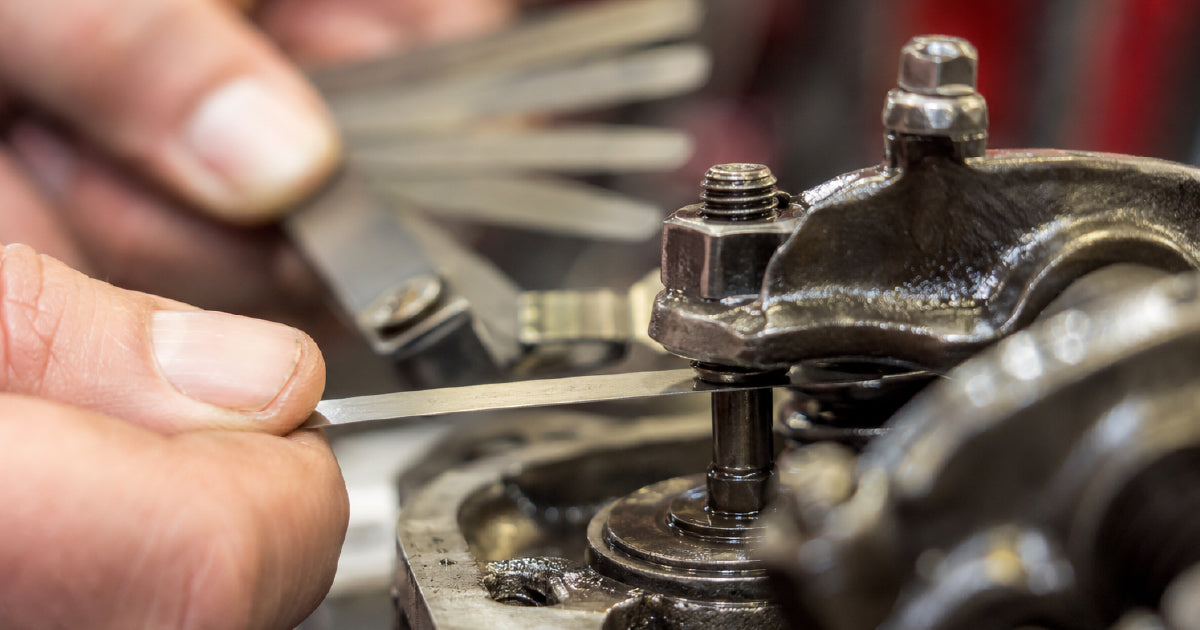
Valve Clearance (Tappet Clearance)
Valve clearance — also called tappet clearance or valve lash — is the gap between the rocker arm or cam follower and the valve stem. The correct clearance allows for thermal expansion of the valve train components at operating temperature. Too tight and the valve may not fully close (burning the valve face); too loose and the engine will be noisy and timing will be affected.
This is the most precise feeler gauge application most trade mechanics will encounter, and correct technique is critical.
Key technique points:
- Intake and exhaust clearances are different. Intakes are typically tighter (0.10–0.20mm) than exhausts (0.15–0.30mm). Always check both against the service manual specification — do not assume.
- Measure with the engine at the temperature specified in the service manual. Some manufacturers specify cold clearance; others warm. The thermal state changes the gap.
- The blade must be absolutely flat when inserted. Use an offset blade if a straight blade can't enter flat due to obstruction from the rocker or cam cover.
- The correct feel is a light, consistent drag — not free movement, not resistance requiring force.
- If adjusting clearance with a locknut-style adjuster: set the adjusting screw with the correct blade inserted, tighten the locknut while holding the adjuster still, then re-check. Tightening the locknut tends to slightly change the clearance — usually tightening it. Account for this when setting.
Offset feeler gauges are often essential for this application on modern engines where the valve train is tightly packaged. Having both straight and offset blades available saves time.
Piston Ring Gap
When fitting new piston rings during an engine rebuild, the end gap must be checked and set to the correct clearance. Too small and the ring ends will butt together as the ring expands at operating temperature, causing seizure. Too large and blow-by past the ring increases oil consumption and reduces compression.
Method: remove the ring from the piston and square it in the cylinder bore by pushing it down with the piston crown. Insert a feeler blade into the ring end gap and find the size that gives the characteristic light drag. Compare to the manufacturer's specification.
Typical end gap for a standard bore rebuild: 0.25–0.50mm for compression rings, slightly more for oil control rings. Always confirm against the service manual for the specific engine and ring set.
If the gap is too small, the ring must be filed carefully on a flat file — working in small increments and measuring frequently. If the gap is too large, the ring is out of specification and must be replaced.
Bearing Clearance
Feeler gauges can be used to check radial clearances on plain (sliding) bearings and thrust bearing side clearances during engine assembly. For main and rod bearing oil clearances, however, the preferred tool is Plastigauge — a soft plastic material that deforms to the actual oil film gap and measures via colour-matched scale. Using a feeler blade on a precision bearing surface risks scratching the bearing material.
Feeler gauges are appropriate for:
- Thrust bearing side clearance (crankshaft end float) — the axial gap between the crankshaft thrust face and the thrust bearing. A blade gauge can be inserted from the side without bearing contact risk. Typical spec: 0.05–0.25mm depending on engine.
- Plain bearing housings where the clearance is being checked before assembly with a new bearing shell, and the bearing material is not at risk.
- Industrial plain bearings (babbitt, bronze) during inspection for wear, where the bearing clearance has grown beyond specification.
Industrial and Machining Applications
Beyond automotive engine work, feeler gauges are standard tools in industrial maintenance, machining, and quality control environments.
Surface and machine flatness: Place a feeler gauge blade beneath a straight edge or reference surface to check flatness. If the blade passes under the straight edge at any point, that point is low by the blade's thickness. Used to check machine beds, surface plates, flange faces, and precision work surfaces.
Extruder die gap: In plastics and rubber extrusion, the die gap controls product thickness. Feeler gauges are used to set and verify die gap uniformity across the full die width. Long blade sets are often needed for wide dies.
Tooling and fixture setup: Setting the clearance between cutting tool and workpiece, checking jaw alignment on presses and forming tools, verifying the gap in jigs and fixtures before production runs.
Pressure vessel and weld inspection: Checking root gap and fit-up before welding, verifying slot dimensions in flanges and covers.
3D printer bed levelling: A niche but widely used application — the 0.1mm feeler gauge blade is the standard reference for first-layer height calibration on FDM printers. This is an unexpected secondary market that has driven demand for precision feeler gauge sets among hobbyists.
Feeler Gauge Size Chart: Metric and Imperial Reference
Standard metric feeler gauge sets cover a range from 0.05mm to 1.00mm, with smaller sets focused on the most-used automotive range. Industrial and machinist sets extend thinner (0.02mm) and thicker (up to 3.00mm) for a wider application range.
The following table shows the most common metric blade thicknesses and their imperial equivalents. Note that metric and imperial values are approximations of each other — an exact metric equivalent of 0.010" is 0.254mm, which may not be a blade in every metric set.
| Metric (mm) | Imperial (inches) | Common application |
|---|---|---|
| 0.02 mm | 0.0008" | Precision machining, fine bearing clearances |
| 0.03 mm | 0.0012" | Precision machining |
| 0.04 mm | 0.0016" | Precision machining |
| 0.05 mm | 0.002" | Fine valve clearances, precision fits |
| 0.06 mm | 0.0024" | Fine valve clearances |
| 0.07 mm | 0.0028" | Valve clearance lower range |
| 0.08 mm | 0.003" | Valve clearance (intake, many Japanese engines) |
| 0.10 mm | 0.004" | Valve clearance, 3D printer bed |
| 0.12 mm | 0.005" | Valve clearance |
| 0.15 mm | 0.006" | Valve clearance (common intake spec) |
| 0.18 mm | 0.007" | Valve clearance |
| 0.20 mm | 0.008" | Valve clearance, spark plug gap (small engines) |
| 0.25 mm | 0.010" | Valve clearance, piston ring gap lower range |
| 0.30 mm | 0.012" | Valve clearance (exhaust), spark plug gap |
| 0.35 mm | 0.014" | Valve clearance (exhaust), spark plug gap |
| 0.40 mm | 0.016" | Spark plug gap, bearing clearance check |
| 0.45 mm | 0.018" | Spark plug gap |
| 0.50 mm | 0.020" | Spark plug gap, piston ring gap |
| 0.60 mm | 0.024" | Spark plug gap (wider, modern ignition) |
| 0.70 mm | 0.028" | Spark plug gap, piston ring gap |
| 0.80 mm | 0.031" | Piston ring gap, spark plug gap |
| 1.00 mm | 0.039" | Piston ring gap, flatness checking |
| 1.50 mm | 0.059" | Industrial clearances, flatness |
| 2.00 mm | 0.079" | Industrial clearances, large clearance checking |
| 3.00 mm | 0.118" | Industrial, die gaps, heavy equipment |
Typical 13-blade metric set (most common automotive/trade set): 0.05, 0.10, 0.15, 0.20, 0.25, 0.30, 0.35, 0.40, 0.45, 0.50, 0.60, 0.80, 1.00mm
Typical 20-blade metric set (wider range): 0.05, 0.06, 0.07, 0.08, 0.09, 0.10, 0.12, 0.14, 0.15, 0.18, 0.20, 0.25, 0.30, 0.35, 0.40, 0.45, 0.50, 0.60, 0.80, 1.00mm
Typical 26-blade imperial set (precision machining): Covers 0.0015" to 0.025" (0.038mm to 0.635mm) in fine increments for close tolerance work.
Metric vs Imperial Feeler Gauges in Australia
Australia works in metric. Most modern vehicles, machinery, and industrial equipment sold in Australia use metric specifications — valve clearances in millimetres, ring gaps in millimetres, bearing clearances in millimetres.
However, older vehicles, US-spec engines, and some imported American or older British industrial equipment use imperial specifications. If you're working on a pre-1970s vehicle, an American V8, or older US-built industrial machinery, you'll likely be reading clearance specs in inches.
The practical recommendation for most Australian workshops: buy a dual-marked (metric/imperial) set that shows both measurements on each blade. This handles both systems without needing to convert, and means one set covers everything you'll encounter.
If you need to convert between the two systems, the formula is straightforward:
- To convert inches to millimetres: multiply by 25.4 (e.g. 0.010" × 25.4 = 0.254mm)
- To convert millimetres to inches: divide by 25.4 (e.g. 0.20mm ÷ 25.4 = 0.0079")
Common conversions for trade reference:
- 0.002" = 0.051mm
- 0.004" = 0.102mm
- 0.006" = 0.152mm
- 0.008" = 0.203mm
- 0.010" = 0.254mm
- 0.012" = 0.305mm
- 0.015" = 0.381mm
- 0.020" = 0.508mm
- 0.025" = 0.635mm
- 0.030" = 0.762mm
- 0.040" = 1.016mm
Can You Stack Feeler Gauge Blades?
Yes. Stacking blades to achieve a size not in your set is a widely accepted and legitimate practice. If you need 0.09mm and your set jumps from 0.08mm to 0.10mm, stacking 0.05mm + 0.04mm (or 0.07mm + 0.02mm, if you have those sizes) gives you the right total.
This is documented in the Machinery's Handbook and used by professional mechanics and machinists regularly. It's especially useful for valve clearance work where the specification may fall between standard blade thicknesses.
Rules for stacking correctly:
- Clean each blade face before stacking. Oil or debris between stacked blades adds to the effective thickness.
- Use as few blades as possible to get the target size. Two blades is the practical limit for accurate work; three blades introduces enough tolerance accumulation to affect a tight-spec measurement.
- For precision work (close tolerance machining, bearing fits), check the stack with a micrometer before using it.
- Single blades are always more accurate than stacks for the same reason. When you can choose, use a single blade.
One practical note from experienced mechanics: when stacking blades for valve clearance work, use the broadest, flatest blades you have. Thin, narrow blades can splay slightly when stacked, making the entry feel different from a single blade of the same nominal thickness.
How to Choose a Feeler Gauge Set
The right feeler gauge set depends on what you're measuring and how often you're measuring it. Here's what to consider.
Blade Range
For automotive and general trade work, a set covering 0.05mm to 1.00mm covers the vast majority of applications: valve clearances, spark plug gaps, piston ring gaps, and most bearing work. A 13-blade metric set at this range is the minimum viable option.
For industrial and machining work, a wider range — 0.02mm to 3.00mm — gives you coverage for both fine precision fits and larger industrial clearances.
For spark plug work specifically: a wire gauge set or a dedicated gapping tool with wire gauges covers 0.6mm to 1.8mm in fine increments. Useful alongside a blade set, not a replacement for it.
Number of Blades
More blades means finer increments, which means better resolution between adjacent sizes. A 10-blade set at 0.05mm increments is adequate for rough clearance work. A 20 or 26-blade set at 0.01–0.02mm increments is the right tool for precise valve timing or close-tolerance fitting.
For professional trade and maintenance use, 13–20 blades covering the standard metric range is the practical sweet spot.
Metric, Imperial, or Dual-Marked
As discussed above: for Australian workshops, a dual-marked set that shows both mm and inches on each blade is the most versatile single purchase. It removes the need to carry two sets or convert on the fly.
If you exclusively work on modern Australian or Japanese vehicles and equipment, metric-only is fine. If you work on American equipment or older gear, dual-marked or imperial is the right call.
Blade Length
Standard blades (75–100mm) suit most applications. Long blade sets (200mm+) are needed for deep-access engine work or wide industrial applications. If you're setting valve clearances on a standard engine, standard length is fine. If you're reaching bearing clearances deep inside a transmission or checking a wide industrial die, a long blade set may be necessary.
Material
Hardened steel or stainless steel for most applications. Stainless adds corrosion resistance without sacrificing precision. Brass for explosive or non-magnetic environments. Plastic for delicate surfaces and electronics.
Quality
This matters more than it might seem. Cheap feeler gauge sets — particularly unbranded sets from automotive parts stores or discount retailers — may have blades that don't match their marked thickness. This has been documented in machinist communities and precision tool user forums. For occasional DIY use, a mid-range set is adequate. For professional trade use or precision industrial work, a quality brand is worth the investment.
Quality brands guarantee their blade tolerances are within specification. Cheap sets offer no such assurance, and a blade that reads 0.15mm but measures 0.13mm with a micrometer will cause incorrect adjustments every time.
Feeler Gauge Brands Available in Australia
Several reputable feeler gauge brands are stocked in Australia by industrial and trade tool suppliers including AIMS Industrial.
Stahlwille (Germany): A benchmark for precision measurement tools. Stahlwille feeler gauges are hardened and tempered steel with tight tolerance control, used in professional mechanical, automotive, and industrial environments. AIMS stocks Stahlwille sets including the SW11095/13 (13 blades, 0.05–1.00mm), SW11095/20 (20 blades, 0.05–1.00mm), and SW11097/26 (26 blades, imperial). Stahlwille is the correct choice where reliability and calibration traceability matter.
Maxigear: Practical, professionally-priced feeler gauge sets and individual steel strip gauges for workshop and industrial use. The Maxigear range includes metric strip gauges in individual thicknesses (useful for single-thickness applications such as shim stacks and die gap reference), available in both metric and imperial. Well-suited to maintenance workshops and industrial environments.
Grip: The Grip 32-blade set is a dual-marked metric/imperial combination covering 0.0015–0.035" (0.038–0.889mm). A practical option for workshops that need both systems covered in one compact set.
Kincrome (Australia): A well-known Australian trade brand available through major tool retailers. Kincrome feeler gauge sets are widely stocked and suited to general automotive and trade work.
Starrett (USA): A precision metrology brand used extensively in quality control and calibration environments. Starrett feeler gauges are manufactured to close tolerances and are appropriate where traceable calibration matters. Available through precision tool distributors.
For most trade and maintenance applications, a Stahlwille or Maxigear set from AIMS Industrial gives you the reliability and range needed without going to calibration lab pricing. Browse the full range at AIMS Industrial — Feeler Gauges.
How to Care for Your Feeler Gauges
Feeler gauges are precision tools. They're not delicate, but poor storage and maintenance shortens their working life and affects accuracy.
After use: Wipe each blade you've used with a clean, dry cloth to remove any oil, carbon, or debris. Don't return a dirty blade to the set — contamination spreads to other blades and to the gap being measured on next use.
Light oil application: A very thin film of light oil (3-in-1 or equivalent) on the blades prevents surface rust on steel sets. Wipe off excess — you want protection, not a thick film that contaminates measurements.
Storage: Store with blades folded into the handle. Don't leave the set open — the free-hanging blades can bend if weight is applied, and bent blades give false readings. Store in a dry location. A drawer or tool roll is fine; leaving a steel set in a damp toolbox will cause surface rust over time.
Inspection: Before using a blade, hold it up to the light and check the face. Rust, pitting, or a visible step (where a blade has been over-bent) means that blade should not be used for measurement. Individual blades can be replaced on most quality sets.
Checking accuracy: For trade use, regular micrometer checks are not normally required — if the set is from a reputable brand and stored correctly, it will hold its dimensions. If you have reason to doubt a particular blade (it's been bent, dropped, or heavily worn), check it with a well-calibrated micrometer. If it reads out of spec, replace it.
Bent blades: A kinked or bent blade presents its diagonal dimension to the gap, reading thicker than it actually is. A feeler blade that has been bent — even slightly — should be replaced. Trying to straighten a blade risks work-hardening and cracking.
Measure it right. Every time.
Shop blade, wire & go/no-go feeler gauges — metric & imperial stocked
From standard blade sets for valve clearance and spark plug gaps to offset and go/no-go gauges for production inspection — AIMS Industrial stocks feeler gauges in metric and imperial across a full range of blade counts and thickness steps, ready to ship Australia-wide.
Frequently Asked Questions
What is a feeler gauge used for?
A feeler gauge measures the gap between two surfaces — tasks including spark plug gapping, valve clearance adjustment, piston ring gap checking, bearing clearance inspection, machine flatness checking, and industrial tooling setup. It's used wherever the gap is too narrow for a caliper and the measurement needs to be made by feel rather than sight.
What is the difference between a wire feeler gauge and a blade feeler gauge?
A wire feeler gauge uses round-section wires instead of flat blades. Wire gauges are designed specifically for spark plug gap measurement — the round cross-section seats correctly against the curved spark plug electrode, where a flat blade would rock and give a falsely thin reading. For all other feeler gauge applications (valve clearance, ring gap, flatness checking, bearing work), use blade gauges.
How do you use a feeler gauge correctly?
Clean the surfaces and blades first. Start with a blade thinner than the expected gap and work up. Insert the blade flat — not angled. The correct blade is the thickest one that passes through with a light, consistent drag — often described as feeling like "gum on your shoe." Confirm by checking one blade size under (should be free) and one size over (should not enter). Do not force any blade through the gap.
What does Go/No-Go mean on a feeler gauge?
A Go/No-Go feeler gauge has a stepped blade with two distinct thicknesses. The thinner "Go" end must pass through the gap; the thicker "No-Go" end must not. If both conditions are met, the gap is within tolerance. This type is used in production and quality control environments for fast pass/fail inspection without working through a full set of blades.
What size feeler gauge do I need for spark plugs?
Spark plug gap specifications vary by vehicle and ignition system — always check your service manual or the plug manufacturer's specification. Most modern petrol engines specify gaps in the range of 0.9–1.4mm (0.035"–0.055"). Use a wire-type gauge, not a flat blade, because the blade can rock against the curved ground electrode and give a false reading. A wire gauge set or a coin-style disc gauge with wire inserts is the right tool for this job.
What size feeler gauge do I need for valve clearance?
Valve clearance specifications vary by engine — there is no single standard. Intake clearances are typically tighter than exhaust clearances, often in the range of 0.10–0.20mm intake and 0.15–0.30mm exhaust, but specific engines vary significantly from this range. Always use the manufacturer's specification for the engine you're working on. A metric set covering 0.05–0.50mm covers the vast majority of automotive valve clearance work.
Can you stack feeler gauge blades?
Yes — stacking two or three blades to reach a size not available in the set is widely accepted and documented in the Machinery's Handbook. Clean each blade face before stacking to avoid adding debris thickness. For precision work, verify the stack with a micrometer before using it. Use as few blades as possible — two is the practical limit for accurate work. A single blade of the correct thickness is always more accurate than a stack.
How do I read the markings on a feeler gauge?
Each blade in the set is stamped with its thickness in millimetres, inches, or both. The number stamped on the blade is its thickness. Select the blade, insert it into the gap, and if it passes with the correct light drag, the gap is equal to the number on that blade. On dual-marked sets, both the metric and imperial thickness are shown on each blade — use whichever unit matches your service manual specification.
What is the difference between metric and imperial feeler gauges?
Metric gauges are marked in millimetres (e.g. 0.10mm, 0.25mm, 0.50mm). Imperial gauges are marked in thousandths of an inch (e.g. 0.004", 0.010", 0.020"). Dual-marked sets show both measurements on each blade. For most work in Australia, metric or dual-marked is the right choice. If you work on older American or British equipment with imperial specifications, you need imperial or dual-marked blades.
What feeler gauge do I need to check bearing clearance?
For crankshaft thrust bearing side clearance (end float), a blade feeler gauge inserted axially between the thrust face and crankshaft flange is the standard method — typically measuring 0.05–0.25mm depending on the engine. For main bearing and rod bearing oil clearances (the running clearance in the oil film), Plastigauge is the preferred tool rather than a feeler gauge — a feeler blade risks scratching the bearing surface, and Plastigauge gives a more accurate result for oil clearances below 0.10mm.
Why does blade material matter on a feeler gauge?
Hardened steel blades hold their flatness and dimensional stability under repeated use — suitable for most workshop environments. Stainless steel adds corrosion resistance for humid, marine, or food-processing environments. Brass blades are non-sparking and non-magnetic, required in explosive atmospheres or near sensitive electrical equipment. Plastic blades are non-conductive and non-marring, used in electronics assembly or on soft precision surfaces where a metal blade would scratch. Most trade and maintenance applications use hardened or stainless steel.
What is an offset feeler gauge and when would I use one?
An offset (angled) feeler gauge has a blade tip that bends away from the handle at an angle, allowing it to reach gaps that are obstructed by surrounding components. The most common use is valve train clearance adjustment on engines where the rocker arm cover, cam follower, or adjacent components prevent a straight blade from entering the gap at the correct flat angle. If you're doing valve adjustments and finding your straight blade won't enter flat, an offset blade is the solution.
How do I know if my feeler gauge is still accurate?
Check each blade visually before use — look for corrosion, pitting, bends, or visible steps (wear steps near the tip indicate the blade has been heavily used or abused). Any blade with surface damage should not be trusted for measurement. To verify a blade's thickness, check it with a well-calibrated micrometer. For reputable brand sets in good condition, regular micrometer checks aren't normally required for trade use. If you've bought a cheap unbranded set and want confidence in the marked dimensions, measure a few blades with a micrometer before relying on them for close-tolerance work.
How do I check surface flatness with a feeler gauge?
Place a precision straight edge or reference surface across the area to be checked. Select a feeler gauge blade at the flatness tolerance you're checking to (e.g. 0.05mm or 0.10mm). Attempt to slide the blade under the straight edge at multiple points across the surface. If the blade passes at any point, the surface is low at that point by (approximately) the blade thickness. Work systematically across the surface, noting high and low points. This method is used for machine bed inspection, cylinder head face checking, and precision fixture alignment.
What is the difference between a tapered and a parallel feeler gauge?
A parallel feeler gauge blade has a constant thickness along its full working length — the thickness you read on the blade is consistent from tip to handle end. A tapered feeler gauge narrows toward the tip, allowing it to enter a constricted opening where a parallel blade would need to be forced in. Tapered gauges are used in specific industrial applications where access is restricted at entry but the gap opens up beyond the entry point. For most trade and maintenance applications, parallel blades are the standard and correct choice.
Need to read an engineering drawing? Our GD&T Symbols Guide explains every common geometric tolerance symbol.
For micrometer selection (outside, inside, depth, digital, vernier), see our micrometers range.
Can feeler gauges be used in explosive or hazardous atmospheres?
Yes — brass feeler gauges are non-sparking and non-magnetic, making them suitable for explosive atmospheres such as fuel, gas, and chemical plants where a steel blade striking a metal surface would create a spark hazard. Brass is softer than steel and wears faster with frequent use, so it's used where the material property is required rather than as a general-purpose substitute for standard sets.
What is the "three-blade check" method for confirming a feeler gauge reading?
Once you find a blade that enters with a light, consistent drag, confirm the reading with two checks: try the next size down — it should move freely with no resistance; then try the next size up — it should not enter, or should require force. This target-under-over check confirms your gap is genuinely between those two sizes and eliminates guesswork, rather than relying on a single blade's feel alone.
Are stainless steel feeler gauges better than standard steel?
For corrosion resistance, yes. Stainless steel blades maintain their dimensions without the surface rust risk of standard hardened steel, making them suited to marine environments, food processing, pharmaceutical manufacturing, and humid or outdoor workshop conditions. Most AIMS precision feeler gauge sets are stainless steel or stainless-faced for this reason, though standard hardened steel remains perfectly adequate for general trade and automotive use in dry conditions.
What is a long blade feeler gauge and when do I need one?
Standard feeler gauge blades run 75-100mm long. Long blade sets extend to 200mm, 300mm, or even 600mm, used when the measurement point is deep inside an engine or machine assembly — reaching bearing clearances at the back of an engine block, or checking die gaps on wide industrial rollers, for example. They're a specialist item, but essential when a standard-length blade can't physically reach the measurement point.
People Also Ask — Feeler Gauges
Q: What are feeler gauges used for in engineering and maintenance?
Feeler gauges are thin, precisely ground metal blades used to measure small gaps or clearances between components. In engine work, they measure and set valve clearances (tappet gaps) and spark plug electrode gaps. In machining and fitting, they check clearances between mating parts, bearing fits, and the parallelism of surfaces. In fabrication, they verify weld joint gaps before welding. The principle is always the same — select the blade or combination of blades that slides into the gap with a defined resistance: a light, consistent drag indicates the correct size has been found.
Q: How do you read a feeler gauge correctly?
Each blade in a feeler gauge set is stamped with its thickness — in millimetres (e.g. 0.05mm, 0.10mm) for metric sets, or in thousandths of an inch (e.g. 0.002", 0.004") for imperial sets. Insert a single blade or a stack of blades into the gap and slide them back and forth. The correct size is the one that produces a light, consistent drag — not loose enough to fall through freely, and not so tight that force is required. Combining blades (e.g. 0.05mm + 0.10mm = 0.15mm) measures gaps between standard single-blade sizes.
Q: What is the difference between a metric and imperial feeler gauge set?
Metric feeler gauge sets provide blade thicknesses in millimetres — common sets range from approximately 0.03mm to 1.0mm. Imperial sets give thicknesses in thousandths of an inch — common sets range from 0.002" to 0.040". The difference matters because engine specifications are quoted in the units matching the design origin: Japanese and European engines use metric; older US and British engines may use imperial. Some sets are dual-marked with both metric and imperial values on each blade, covering both measurement systems in a single tool.
Q: How should feeler gauges be maintained to stay accurate?
Feeler gauge blades should be kept clean and free from oil, grit, and moisture — contamination adds effective thickness and gives false readings. After use, wipe blades clean and apply a light coat of oil before storage to prevent rust. Check blades periodically for nicks, burrs, or bending — a damaged blade no longer gives accurate readings and should be replaced. Store the gauge in its protective case with blades folded back to prevent them snagging and bending on other tools. Never use feeler gauges as pry tools, shims, or spacers — bending and marking the blades destroys their accuracy.
Q: Can feeler gauges be used to set spark plug gaps?
A round wire feeler gauge (gap tool) is the preferred method for spark plug gaps because round wire better represents the shape of the electrode gap and gives a more accurate reading than flat blade gauges on worn or tapered electrodes. Flat blade gauges can be used on new spark plugs with square-edged centre electrodes. The gap is adjusted by carefully bending the side electrode using the notch or ramp on the gap tool until the correct wire size passes through with a light drag. Re-check the gap after each adjustment, as bending the electrode slightly can change the gap unpredictably, particularly on worn electrodes.
For pipe, tube, and conduit benders, see the AIMS bender range.

