

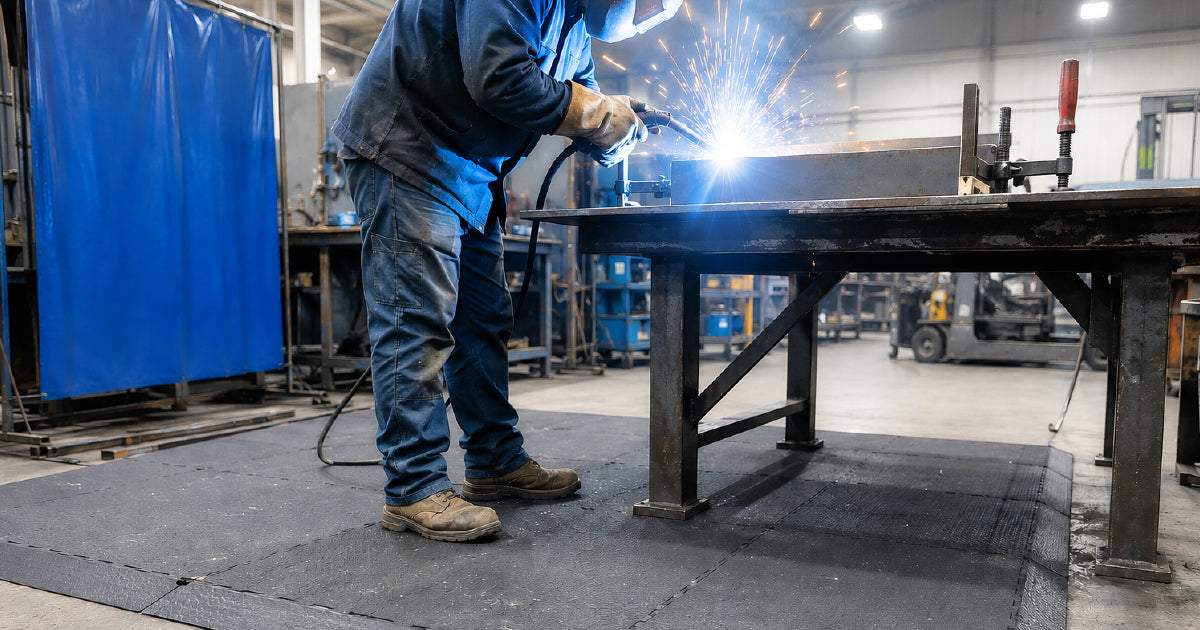
Most floor mat guides are written for office receptions, retail entrances and restaurant kitchens. AIMS customers stand on concrete next to TIG welders, surface grinders, lathes and milling machines. They drop hot spatter, cutting fluid, hydraulic oil and swarf on the mat under their feet. They roll loaded parts trolleys, tool cabinets and drum dollies across it. They need the mat to survive 5 years of trade abuse — not 18 months of foot traffic. This guide is for workshop, factory, fabrication, mining, food-processing and marine floor mats — the trade applications where the wrong mat costs more in downtime than it saved at purchase.
Honest scope: AIMS stocks 23 industrial floor mat products in our floor mats collection — The Mat Group dominant (19 products spanning anti-fatigue, anti-slip safe walk, entrance/dirt-stop, interlocking rubber, specialty wet/sanitising) plus Mackay (anti-vibration EPDM + anti-fatigue/anti-slip workshop). AIMS does NOT stock NoTrax, 3M Safety-Walk industrial, Wearwell, Andersen, Notrax — flagged source-on-request via supplier network. The Mat Group positioned as the AU industrial workshop standard; we don't compete with Bunnings/Officeworks/retail-tier on entrance carpet matting for offices.
Six Workshop Mat Categories — Match to the Station
The biggest floor mat selection mistake is buying a generic "anti-fatigue mat" for the welding bay or "non-slip mat" for the parts washer area. Workshop mats are application-specific. Match the mat to the work happening on it, not just to the room it sits in.
| Workshop Station | Primary Hazard | Mat Type Required | AIMS Pick |
|---|---|---|---|
| Welding bay | Hot spatter, slag, swarf, sparks | Fire-resistant rubber (ignition >500°C); nitrile rubber preferred | 24/Seven Interlocking Rubber Solid ($95.54), Recycled Rubber Matting ($61.31) |
| Machine shop / CNC / lathe | Cutting fluid, swarf, oil, long standing | Anti-fatigue with drainage holes; nitrile or natural rubber | Soft N Safe Anti-fatigue Holes ($172.54), 24/Seven Interlocking Holes ($82.71) |
| Assembly / fitter bench | Long standing, hand fatigue | Solid anti-fatigue, ribbed or gel cushion | Soft N Safe Solid ($172.54), Comfy Rib Premier ($89.83), Diamond Plate Gel ($118.35) |
| Parts washer / degreaser area | Wet, oily, slip hazard | Anti-slip drainage mat with chemical resistance | 24/Seven Interlocking Holes ($82.71), Multiguard ($85.55) |
| Spray booth / paint shop | Solvents, paint overspray, slip | Chemical-resistant rubber, replaceable | Recycled Rubber Matting ($61.31) |
| Drum / chemical handling | Wet, oil/chemical spill, trolley traffic | Heavy interlocking rubber with edge ramp | 24/Seven Solid ($95.54) + Mat Ramp ($21.39) |
| Workshop entry / boot scrape | Tracked-in dirt, water, contamination | 3-zone entry system — scrape + dry + finish | Waterhog Classic ($94.11), Spiral Loop Entrance ($48.48), Entry Plush ($156.85) |
| Food prep / pharma / biosecurity | Hygiene, boot contamination, audit compliance | Sanitising boot dip mat | Sanitising Foot Bath / Boot Dip Mat ($154.00) |
| Machinery foot / vibration base | Machine vibration transfer to floor | Anti-vibration EPDM pad | Mackay Anti-Vibration EPDM 450x450x8 ($16.17) |
| General workshop walking floor | Slip prevention, general traffic | Safe walk anti-slip mat, low profile | Safe Walk Standard 910x1520 ($49.91), Safe Walk Premium ($34.22) |
The Welding Bay Mat — Don't Use the Wrong Rubber
What makes a mat suitable for a welding bay:
- Ignition point above 500°C — standard rubber, vinyl and PU foam don't meet this
- Solid (non-open) construction OR fire-rated open construction — open-hole drainage mats need spatter pass-through or the spatter sits in the hole and burns the mat from inside
- Chemical/oil resistance — welding bays double as grinding/oil-spill areas in most workshops
- Replaceable in sections — welding mats wear in localised hot spots; interlocking systems let you replace one square not the whole mat
AIMS mat range suitable for welding bay use:
- 24/Seven Interlocking Rubber Mat Solid ($95.54) — sectional, replaceable, rubber base, can be ramped at edges with Mat Ramp ($21.39)
- Recycled Rubber Matting ($61.31) — bulk roll for spray booth, welding bay floor, machinery base
For specialty welding-specific mats (e.g. Wearwell WeldSafe, Greatmats welding mat, AMCO Weldmaster), source-on-request — flagged outside AIMS standard supply.
Anti-Fatigue Mats — Does Standing on Rubber Actually Help?
Yes, and the forum-validated practitioner reality is consistent across Garage Journal, Practical Machinist, MIG Welding Forum and Sawmill Creek: "Standing for years on a concrete floor can play havoc with your back and the circulation in your legs." Anti-fatigue mats genuinely reduce lower-back pain and leg fatigue at the end of an 8-hour shift, particularly when combined with good footwear and decent insoles. The mat alone won't fix bad shoes; the right shoes don't compensate for bare concrete.
The mechanism is twofold:
- Compression deformation — when you stand still, the mat compresses microscopically under each foot. Your body unconsciously corrects, recruiting small leg muscles to stay balanced. This micro-movement keeps blood flowing through the calf and thigh muscles (the calf is your secondary heart pump).
- Compliance under load — the mat absorbs the shock of weight transfer between feet, reducing peak joint load on knees, hips and lumbar spine.
The trade-off forum users mention: "Standing on the mat, people move less and focus better on the job" — operators sometimes report less natural shifting movement when on a mat, which can be a downside for very long-cycle work. The fix is a slightly larger or thicker mat that allows natural step-shifting.
Thickness — The 10-19mm Sweet Spot
Anti-fatigue effectiveness peaks in the 10-19mm thickness range:
- Under 8mm — too thin to deform enough for compression-recovery cycle; minimal benefit
- 10-15mm — workshop sweet spot, good fatigue reduction with stable footing
- 15-19mm — premium tier (Soft N Safe), maximum cushioning, slight loss of foot stability for precision work
- Over 25mm — gym/fitness mat territory; too soft for precision standing work
Slip Resistance Decoded — R-Ratings vs P-Ratings vs AS Standards
The single most confused area of mat specification. Three rating systems are in active use in Australia and they don't directly translate. Workshops need to know which one applies to their compliance situation.
| Rating System | Test Method | Range | AU Application |
|---|---|---|---|
| R-rating (DIN 51130) | Ramp test with motor oil + heeled boots; measures angle at slip | R9 (low) → R13 (very high) | Industrial barefoot/heavy-duty wet area floor specification |
| P-rating (AS 4586:2013) | Wet pendulum test with shod foot; measures friction coefficient | P0 (low) → P5 (very high) | Current AU standard — workplace floor + mat compliance |
| AS 3661.1 SRV (historical) | Wet pendulum (older standard, now superseded by AS 4586) | SRV 0-100; COF 0.4 = SRV 39 | Still referenced in older WHS documentation; AU industry minimum |
| AS 4663 | Dry surface oil-wet friction test | For oil-contaminated dry floors | Workshop/mechanic shop floor surface evaluation |
Workshop P-Rating Minimum Requirements
- Dry walkway, low-risk: P3 minimum acceptable
- Wet area, occasional water: P4 minimum (the modern workshop default)
- Wet area, continuous exposure (parts washer, food prep): P5 required
- Slope ≥5°, all areas: P5 required
The AS 3661 → AS 4586 transition matters because older WHS audit reports still reference SRV / COF figures, but new mat purchases should target P4+ as the current standard. Safe Work Australia statistics show slips, trips and falls account for 20-30% of long-term workplace absences — workshop mat compliance is the single highest-ROI WHS spend in most facilities.
Mat Material Performance — What Actually Holds Up in a Workshop
| Material | Oil/Chemical Resistance | Heat / Spatter | Castor / Trolley Traffic | Service Life |
|---|---|---|---|---|
| Natural rubber | Poor (softens, swells in oil) | Marginal (chars above 200°C) | Good | 3-5 years dry, 1-2 years wet/oily |
| Nitrile rubber (NBR) | Excellent (resists oil, fuel, hydraulic fluid) | Good (ignition >500°C welding-bay compatible) | Excellent | 5-10 years |
| EPDM rubber | Poor for hydrocarbons; good for water/steam | Good (heat-resistant, UV stable) | Good | 5-10 years; outdoor/UV applications |
| Recycled rubber (mixed) | Variable — check specification | Variable | Excellent (high-density) | 5-10 years; cost-effective bulk option |
| PVC / Vinyl | Good water; poor oil/solvent | Poor — DO NOT USE in welding bay (melts/burns) | Marginal — flat spots from parked trolleys | 2-4 years |
| PU foam (polyurethane) | Marginal (degrades with prolonged solvent contact) | Poor — DO NOT USE in welding bay | Poor — flat spots permanent | 1-3 years industrial; longer in light commercial |
| Gel composite | Good — vinyl/PU cover with gel core | Poor (vinyl surface — keep away from welding) | Marginal | 3-5 years bench/assembly use |
| Vinyl-backed carpet (entrance mats) | N/A — entrance use only | N/A — entrance only | Excellent | 5-7 years high-traffic entrance |
Workshop default: nitrile rubber. It's the only material that simultaneously handles oil, cutting fluid, hydraulic fluid, hot spatter, trolley traffic and 8-hour standing. The premium AIMS anti-fatigue range (Soft N Safe) and the 24/Seven interlocking range both use rubber compounds suited to industrial duty.
Castor & Trolley Traffic — The Mat Killer Most Buyers Forget
If your mat sits in a path used by parts trolleys, drum dollies, tool cabinets on castors, or pallet jacks, conventional anti-fatigue mats fail within months. Three failure modes:
- Curled edges — soft mats lift at the perimeter under trolley wheel pressure. Curled edges become trip hazards.
- Flat spots / compression set — PU foam and soft rubber compress permanently under parked equipment. The dent stays after the trolley moves.
- Wheel cut-through — small-diameter trolley castors (50-75mm) concentrate load on a tiny contact patch. Soft mats tear under repeated cut-through.
Solutions for traffic areas:
- Heavy interlocking rubber (24/Seven Solid $95.54) — high-density rubber, low-profile, doesn't curl under trolley wheels. Edges ramped with matching Mat Ramp ($21.39).
- Recycled rubber matting (Recycled Rubber Matting $61.31) — bulk roll, can be cut to fit, doesn't curl.
- Avoid PU foam and thick gel mats in any trolley path.
- Specify castors with appropriate wheel material for the mat — see the castor wheels guide for matching wheel + floor combinations.
The 3-Zone Workshop Entry System
Workshops bringing dirty boots, oil, water, swarf and contamination from the yard into the clean work area need a 3-zone entry mat system to capture 90%+ of tracked-in contamination before it reaches the production floor.
| Zone | Function | Length Recommended | AIMS Mat |
|---|---|---|---|
| Zone 1 — Outdoor scraping | Coarse scraping of large debris, mud, swarf | 1.5m minimum | Spiral Loop Entrance Mat ($48.48) — aggressive PVC loop, sheds mud |
| Zone 2 — Transition drying | Water absorption + finer dirt removal | 1.5m minimum | Waterhog Classic ($94.11) or Waterhog Fashion ($94.11) — water-absorbing polypropylene |
| Zone 3 — Indoor finishing | Final dirt absorption + clean boot transition | 1.5m minimum | Entry Plush Mat ($156.85) or Dirtstopper PET Carpet ($129.76) |
Total system length 4.5m + minimum. Workshops compressing this into a single 1.5m doormat capture only 30-40% of contamination, then track the rest across the production floor. The 3-zone investment pays back in floor cleaning labour and reduced slip incidents.
For biosecurity, food processing and pharmaceutical facilities, the sanitising boot dip mat (Sanitising Foot Bath / Boot Dip Mat $154.00) sits at Zone 0 (before Zone 1) with quaternary ammonium or peracetic acid disinfectant solution. AS 4674:2004 (food premises construction) compliance reference.
Total Cost of Ownership — Why Cheap Mats Are Expensive
The single most-missed economic calculation in workshop fit-out:
| Mat Type | Initial Cost | Service Life | 5-Year Mat Cost | Plus: Replacement Labour | 5-Year Total |
|---|---|---|---|---|---|
| Bunnings PU foam (consumer) | $25 | ~12 months industrial | $125 (5× replacement) | $200 labour | $325 |
| Mid-tier anti-fatigue (Comfy Rib) | $90 | 3-5 years | $90-180 (1-2 mats) | $40-80 | $130-260 |
| Premium (Soft N Safe / Diamond Gel) | $120-173 | 5-10 years | $120-173 (1 mat) | $40 once | $160-213 |
The economic reality: cheap consumer-tier mats cost more over 5 years than premium industrial-tier mats once you include replacement frequency and downtime. The TCO crossover happens within 18-24 months in most workshops.
Add the WHS exposure factor: a single slip injury in a workshop costs the employer $15,000-$60,000+ in WorkCover claims, lost productivity, and potential AS 4801 audit consequences. Investing in P4+ rated mats across slip-risk areas is the single highest-ROI WHS spend in most workshops.
Mat Material Compatibility with Workshop Chemicals
| Chemical | Natural Rubber | Nitrile (NBR) | EPDM | PVC |
|---|---|---|---|---|
| Hydraulic oil | Poor (swells) | Excellent | Poor | Marginal |
| Cutting fluid (soluble) | Good | Excellent | Good | Good |
| Petrol/diesel | Poor | Excellent | Poor | Marginal |
| Brake fluid (DOT 3/4) | Poor | Marginal | Excellent | Poor |
| Solvents (acetone, MEK) | Poor | Marginal | Good | Poor |
| Caustic / cleaning chemicals | Good | Good | Excellent | Good |
| Hot water + steam | Marginal (degrades) | Marginal | Excellent | Poor (deforms) |
| Battery acid (dilute) | Marginal | Good | Excellent | Good |
Workshop rule of thumb: if you don't know what the mat will encounter, choose nitrile rubber — best all-rounder for hydrocarbon-environment workshops. EPDM only for water/steam/caustic environments without hydrocarbon exposure.
Anti-Vibration Mats — Different Category, Same Floor
Anti-vibration mats sit under machinery feet (compressors, pumps, generators, lathes) to isolate the floor from machine vibration. They're a different product to anti-fatigue mats — different material, different mounting, different purpose.
The standard AIMS option: Mackay Anti-Vibration Mat EPDM 450x450x8mm MA165 ($16.17). EPDM rubber pad, sized to fit standard machinery foot, 8mm thickness provides effective vibration damping for compressors, pumps and bench-mounted machinery up to ~200kg per foot. For heavier machinery or precision-tolerance vibration isolation, specialist anti-vibration mounts may be required — source-on-request.
Interlocking Modular Mats — The Workshop Floor System
For large workshop areas, modular interlocking rubber mats let you cover unlimited floor area with replaceable individual tiles. When one tile gets damaged (welding burn, oil saturation, chemical spill) you replace just that tile, not the whole mat.
The 24/Seven interlocking range:
- 24/Seven Interlocking Rubber Mat Solid ($95.54) — closed top, ideal for general workshop floor, welding bay, dry assembly areas
- 24/Seven Interlocking Rubber Mat Holes ($82.71) — drainage holes, ideal for machine shop with cutting fluid, parts washer area, wet processing
- 24/Seven Interlocking Mat Ramp ($21.39) — bevelled edge piece, prevents trip hazard at mat perimeter
System install: rule out the area, lay solid tiles where dry, holes tiles where wet, ramp tiles around the entire perimeter. Workshop bays of 6m × 4m typically use 50-70 tiles + 30-40 ramp pieces.
AS Standards Reference — What Applies to Workshop Mats
| Standard | What It Covers | When It Applies to Mats |
|---|---|---|
| AS 4586:2013 | Slip resistance — wet pendulum P-rating | Current workplace slip resistance standard |
| AS 3661.1 (historical) | Slip resistance — SRV / COF | Older WHS audit reference; superseded by AS 4586 |
| AS 4663 | Dry/oil-wet friction test | Oil-contaminated workshop floor evaluation |
| AS 4801:2001 | OHS management systems | Workplace slip/trip/fall risk management framework |
| AS 1657:2018 | Fixed industrial walkways, ladders, stairs | Mat use on platforms, mezzanines, raised walkways |
| AS 4674:2004 | Food premises construction + fit-out | Sanitising mats + entrance hygiene compliance |
| DIN 51130 (international) | Ramp test R-rating (R9-R13) | Industrial barefoot/heavy-duty area specification |
| DIN 51097 (international) | Wet barefoot ramp test (A/B/C) | Pool deck, change room mat specification |
For workplace WHS compliance audit, target P4 minimum on wet areas, P3 on dry walkways. The Mat Group product specs publish AS 4586 P-rating data on most industrial mat ranges.
Common Workshop Mat Mistakes
| Mistake | Consequence | Fix |
|---|---|---|
| PVC or PU foam mat in welding bay | Mat melts/scorches; fire hazard | Nitrile rubber or fire-rated rubber (ignition >500°C) |
| Solid mat where cutting fluid pools | Pooled fluid = slip hazard + mat saturation | Drainage-hole mat (Soft N Safe Holes, 24/Seven Holes) |
| Cheap foam mat in trolley path | Curled edges + flat spots in 6 months | High-density interlocking rubber + edge ramp |
| Single 1.5m entrance mat | Captures only 30-40% of tracked-in contamination | 3-zone system (4.5m+ total) — scrape + dry + finish |
| Anti-fatigue mat as anti-slip mat | Wrong design — fatigue mat surface may not meet P4 slip rating | Specify P-rating for slip-critical areas; anti-fatigue + anti-slip are different products |
| No edge ramping on interlocking mat | Trip hazard at mat perimeter | Always specify matching ramp pieces around perimeter |
| Buying on price only | 5-year TCO higher than premium tier; WHS exposure risk | Calculate 5-year cost including replacement + labour; factor WHS injury exposure |
| Wrong material for chemical exposure | Mat degrades within months | See chemical compatibility table; nitrile for hydrocarbons, EPDM for water/steam |
| Anti-vibration mat used as anti-fatigue | Wrong stiffness — too rigid for fatigue relief | Anti-vibration = machinery base; anti-fatigue = under operator feet |
| Skipping the boot dip / sanitising mat in food prep | AS 4674 non-compliance + biosecurity audit failure | Sanitising foot bath mat at all production-area entry points |
AIMS Floor Mat Range — Supply Ladder
Anti-fatigue tier ($38-$172): Ribbed Cushion Mat ($38.50), Mackay Anti-Fatigue Slip Mat 900x1500x12 ($64.68), Comfy Rib Premier Black ($89.83), Supreme Comfort Natural Recycled Rubber ($102.67), Diamond Plate Gel Mat ($118.35), Diamond Plate Gel Per Linear Metre ($121.21), Soft N Safe Solid ($172.54), Soft N Safe Holes — drainage ($172.54).
Anti-slip / Safe Walk tier ($34-$86): Safe Walk Premium ($34.22), Safe Walk Standard 910x1520 Black ($49.91), Multiguard Mat ($85.55).
Entrance / dirt-stop tier ($48-$157): Spiral Loop Entrance Mat ($48.48), Waterhog Classic ($94.11), Waterhog Fashion ($94.11), Dirtstopper PET Carpet Vinyl Backing ($129.76), Entry Plush Mat ($156.85).
Interlocking / modular tier ($21-$96): 24/Seven Interlocking Mat Ramp ($21.39), 24/Seven Holes — drainage ($82.71), 24/Seven Solid — closed top ($95.54).
Specialty tier ($16-$154): Mackay Anti-Vibration EPDM 450x450x8 ($16.17), Gym Mat Domestic + Light Commercial ($57.04), Recycled Rubber Matting ($61.31), Sanitising Foot Bath Boot Dip 620x820x13 Black ($154.00).
Brand Reality — Stocked vs Source-on-Request
| Brand | Position | AU Availability |
|---|---|---|
| The Mat Group | AU industrial — full anti-fatigue, anti-slip, entrance, interlocking + specialty ranges | Stocked at AIMS |
| Mackay | AU rubber specialist — anti-vibration EPDM + workshop anti-fatigue/anti-slip | Stocked at AIMS |
| NoTrax (US) | US industrial premium — broad workshop + entrance range | Specialty importer — source-on-request |
| Wearwell (US) | US premium — WeldSafe welding mat, SpongeCote anti-fatigue | Specialty importer — source-on-request |
| 3M Safety-Walk | US premium — heavy-duty anti-slip + welding mat | Specialty importer — source-on-request |
| Andersen | US premium — entrance specialty + clean-room mats | Specialty importer — source-on-request |
| AMCO Weldmaster (AU) | AU welding-specific anti-fatigue mat | Source-on-request via supplier network |
Selection Checklist
- What's the workshop station? Welding bay, machine shop, assembly, parts washer, entry, food prep, machinery base — different mat for each.
- Wet, dry, or oily? Drives drainage hole vs solid + material selection (nitrile for oil, EPDM for water/caustic).
- Hot spatter exposure? Welding bay = fire-resistant rubber only. NO PVC, NO PU foam.
- Castor / trolley traffic? High-density interlocking rubber + edge ramp. Avoid soft mats.
- Standing duration? 1-2 hours/day = entry-tier anti-fatigue. 8+ hours/day = premium tier (Soft N Safe, Diamond Gel).
- Slip resistance target? P4 minimum wet areas. P3 acceptable dry walkways. P5 for slopes + continuous wet.
- Compliance audit? AS 4586 P-rating data sheet required from supplier. Specify on quote.
- Service life expectation? Calculate 5-year TCO including replacement + labour. Premium tier almost always wins.
- Edge ramping? Always specify ramp pieces around interlocking mat perimeters.
- 3-zone entry? 4.5m+ total length for full contamination capture.
Your floor works as hard as you do.
Shop anti-fatigue, welding bay & anti-slip floor mats for Australian workplaces
From AS 4586-rated anti-slip wet area mats to fire-resistant welding bay mats and ergonomic anti-fatigue matting — AIMS Industrial stocks industrial floor mats built for the demands of Australian workshops, factories, and warehouses, ready to ship Australia-wide.
Frequently Asked Questions
What's the best floor mat for a welding bay?
A fire-resistant rubber mat with ignition point above 500°C, ideally nitrile rubber. Standard PVC and PU foam anti-fatigue mats are a fire hazard in welding bays — spatter and slag melt or ignite the mat surface. AIMS-stocked option: 24/Seven Interlocking Rubber Mat Solid ($95.54) or Recycled Rubber Matting ($61.31) bulk roll. For specialty welding-specific mats (Wearwell WeldSafe, AMCO Weldmaster, Greatmats welding mat), AIMS sources via specialty importer network.
Do anti-fatigue mats actually work?
Yes — forum-validated practitioner consensus across Garage Journal, Practical Machinist, MIG Welding Forum is consistent: anti-fatigue mats reduce lower-back pain, leg fatigue and standing-floor circulation problems over 8-hour shifts. The mechanism is compression deformation (micro-movement keeps blood flowing) plus shock absorption (reduces peak joint load). The mat alone won't fix bad footwear, but mat + good shoes + decent insoles is dramatically better than bare concrete.
What's the right thickness for an anti-fatigue mat?
10-19mm is the sweet spot. Under 8mm is too thin for meaningful compression-recovery. Over 25mm is gym/fitness territory — too soft for precision standing work. The Mat Group Soft N Safe range (19mm) is the workshop premium standard; Mackay Anti-Fatigue Slip Mat (12mm) is the mid-tier workshop default.
What does P4 slip resistance mean for a workshop mat?
P4 is the AS 4586:2013 wet pendulum test rating that workplace mats need to meet for wet areas (parts washer area, kitchen, wash bay). P-ratings run P0 (very low) to P5 (very high). P4 is the minimum modern workshop wet-area compliance standard, with P5 required for continuously wet areas and slopes 5° or steeper. P3 is acceptable for dry walkways only.
What's the difference between R-rating and P-rating?
Two different test methods. R-rating (DIN 51130 ramp test with motor oil and heeled boots) ranges R9 to R13 and is used for industrial barefoot/heavy-duty area specification. P-rating (AS 4586:2013 wet pendulum test with shod foot) ranges P0 to P5 and is the current Australian workplace standard. They don't directly translate but generally: R10 ≈ P3-P4, R11 ≈ P4, R12-R13 ≈ P5. For AU workplace compliance, target the P-rating from the supplier data sheet.
What mat should I put under a trolley path?
High-density interlocking rubber with bevelled edge ramps — AIMS-stocked 24/Seven Interlocking Solid ($95.54) with matching Mat Ramp pieces ($21.39). Avoid soft anti-fatigue mats, PU foam, gel mats and thick rubber in any trolley path — they curl at edges (trip hazard) and develop flat spots from parked equipment. The interlocking rubber system can be replaced one tile at a time when individual tiles wear out.
What's the best mat for a workshop entrance?
A 3-zone entry system, not a single mat. Zone 1 outdoor scraping (Spiral Loop Entrance Mat $48.48) → Zone 2 transition drying (Waterhog Classic or Fashion $94.11) → Zone 3 indoor finishing (Entry Plush Mat $156.85 or Dirtstopper PET $129.76). Total 4.5m+ minimum. A single 1.5m doormat captures only 30-40% of tracked-in contamination; the 3-zone system captures 90%+.
How long should a workshop anti-fatigue mat last?
Premium nitrile/natural rubber industrial mats (The Mat Group Soft N Safe, Diamond Plate Gel) typically last 5-10 years under daily workshop use. Mid-tier ribbed cushion or recycled rubber mats last 3-5 years. Cheap consumer-tier PU foam mats from retail tiers commonly fail within 12 months in workshop conditions. The 5-year TCO crossover (premium vs cheap) happens within 18-24 months in most workshops.
What's the best mat for a parts washer or wet area?
Drainage-hole rubber mat with chemical resistance — AIMS-stocked Soft N Safe Holes ($172.54) for anti-fatigue + drainage, or 24/Seven Interlocking Holes ($82.71) for modular wet-floor coverage. Nitrile rubber handles the typical solvent/degreaser exposure. Skip PVC and PU foam mats in any wet/oily area.
Are gel mats good for workshops?
Yes for assembly benches, inspection stations and precision work where the operator is at a fixed station. The Diamond Plate Gel Mat ($118.35) is the AIMS workshop gel option. Trade-off: gel mats have a vinyl surface (not nitrile rubber), so they're not suitable for welding bays, parts washer areas with solvent exposure, or trolley paths. Match to use case.
What is an anti-vibration mat and is it different to an anti-fatigue mat?
Different category. Anti-vibration mats sit under machinery feet (compressors, pumps, lathes, generators) to isolate the floor from machine vibration. Anti-fatigue mats sit under operator feet to reduce standing-floor fatigue. Different stiffness, different material, different mounting. AIMS stocks Mackay Anti-Vibration EPDM 450x450x8mm ($16.17) for machinery base use. Don't substitute one for the other.
Why does my floor mat curl at the edges?
Three causes: (1) trolley/castor traffic catching the edge and lifting the perimeter; (2) cheap mat material with insufficient density or weight; (3) thermal cycling (heated workshop → cooled overnight → contraction). Fix: heavy interlocking rubber with bevelled ramp edge pieces, or specify a heavy-density single-piece mat with anti-curl construction. Avoid lightweight PU foam in any high-traffic area.
What is the AS 4674 sanitising mat requirement for food prep?
AS 4674:2004 (food premises construction) requires hygiene barriers at production area entry. A sanitising boot dip mat with quaternary ammonium or peracetic acid disinfectant solution at the entry threshold meets this requirement. AIMS stocks the Sanitising Foot Bath / Boot Dip Mat 620x820x13mm Black ($154.00). For pharmaceutical or biosecurity facilities, additional hygiene compliance (gowning area + dedicated footwear) may be required.
How do I clean and maintain a workshop floor mat?
Daily: sweep or shop-vac to remove debris, swarf, dust. Weekly: hose down or pressure wash (rubber mats), or extract clean (entrance carpet mats). Monthly: inspect for curling edges, flat spots, tears, chemical degradation. Replace any mat showing damage that compromises slip resistance or trip-hazard creation. The Mat Group + Mackay mat surfaces are designed for hosing — vinyl carpet entrance mats need extraction cleaning.
What's the cheapest workshop mat that actually works?
The Mackay Anti-Fatigue Slip Mat ($64.68) is the AIMS workshop value-tier option that genuinely delivers — 12mm, anti-fatigue + anti-slip combined, sized at 900x1500mm. Below this price point you're typically in retail consumer-tier PU foam or gel mat territory that won't survive workshop conditions. For larger areas at lower cost-per-square-metre, the Recycled Rubber Matting bulk roll ($61.31) is the workshop value flooring.
Which floor mat material is best for a hydraulic oil spill?
Nitrile (NBR) rubber is the best all-rounder for hydrocarbon environments — it rates excellent against hydraulic oil, cutting fluid, petrol/diesel and cleaning chemicals. Natural rubber swells and performs poorly against hydraulic oil and petrol/diesel, so if you're not certain what a mat will be exposed to, nitrile rubber is the safer workshop default.
Which mat material holds up best to hot water and steam?
EPDM rates excellent against hot water and steam, and is also the strongest performer against caustic and cleaning chemicals and battery acid. Natural rubber and nitrile only rate marginal against hot water/steam, and PVC is poor — it deforms. EPDM is the material to specify for wash-down or steam-cleaning areas.
What's the advantage of interlocking modular mat tiles over a single large mat?
Interlocking rubber tiles let you cover an unlimited floor area and replace just the damaged tile — from a welding burn, oil saturation or chemical spill — rather than the whole mat. The AIMS 24/Seven range includes a solid closed-top tile for dry assembly and welding bay areas and a drainage-hole tile for machine shops and wet processing, plus a bevelled ramp piece to remove the trip hazard at the mat edge.
Do cheap consumer floor mats actually cost more long-term than industrial mats?
Yes — the total cost of ownership crossover happens within 18-24 months in most workshops. A Bunnings-tier PU foam mat costs around $25 but only lasts about 12 months industrially, so five years of replacement plus labour comes to roughly $325. A premium industrial mat costing $120-173 can run 5-10 years, bringing the 5-year total down to around $160-213 once replacement frequency and downtime are factored in.
For complete workshop fit-out context, see our companion guides: safety boots guide (the other half of the standing-on-concrete equation), castor wheels guide (mat traffic compatibility), industrial vacuum guide (workshop floor cleanup), hand cleaner guide (workshop hygiene system), welding blankets and screens guide (welding bay fit-out).
Need help specifying floor mats for a specific workshop application? Browse the full floor mats collection (23 products), call AIMS Industrial on (02) 9773 0122, or contact our trade team — we'll match mats to your workshop stations, slip rating compliance, and source specialty options (Wearwell WeldSafe, NoTrax, 3M Safety-Walk, AMCO Weldmaster) through our supplier network.
Need to calculate the weight of a steel bar, aluminium plate or brass rod? Our Material Density Chart covers every common engineering material.
Pair this with the right flow-aid — see the AIMS industrial pneumatic vibrators collection.

