

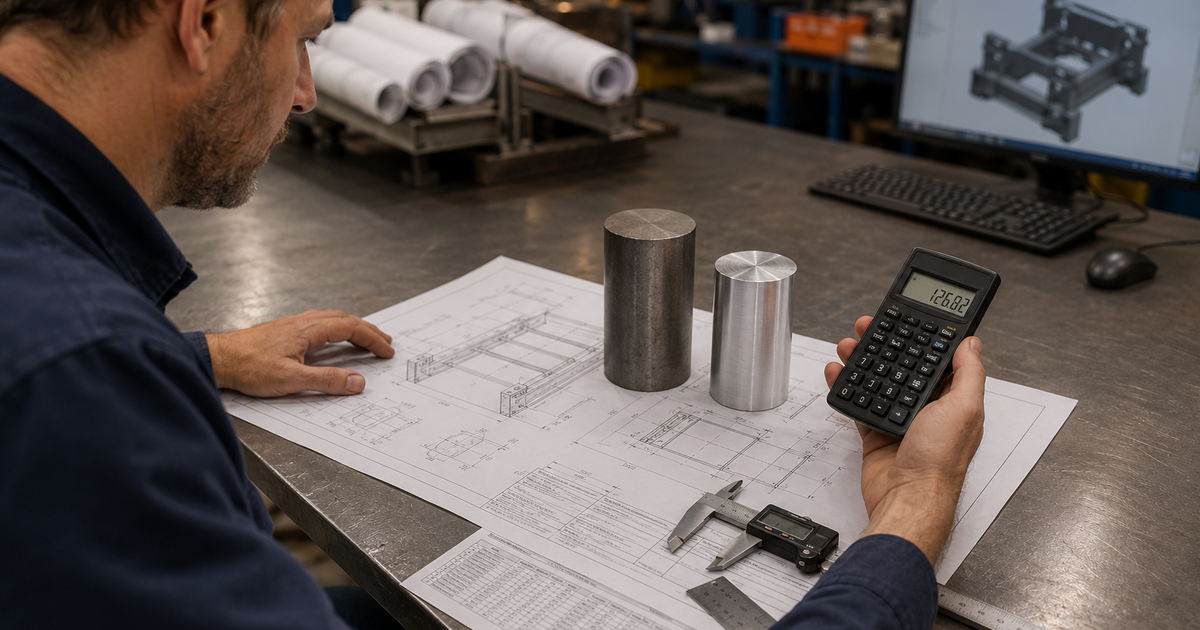
Material density is the foundation of every weight calculation in engineering and the workshop — what a steel beam weighs, how heavy a finished part will be, what postage costs to ship a casting, whether a structure can carry the load. Get the density right and the rest of the maths follows. Get it wrong and you're either over-engineering and wasting money or under-engineering and risking failure.
Quick answer — common material densities (kg/m³)
Metals: Mild steel = 7,850 · Stainless 304/316 = 7,900-8,000 · Aluminium = 2,700 · Brass = 8,500 · Copper = 8,960 · Cast iron = 7,300 · Lead = 11,340 · Titanium = 4,510 · Zinc = 7,140
Engineering plastics: Acetal/POM = 1,410 · Nylon = 1,150 · PVC = 1,380 · PTFE = 2,200 · UHMWPE = 940 · Acrylic = 1,180
Weight calc shortcut: Volume (m³) × density (kg/m³) = weight (kg). For a steel plate: length × width × thickness × 7,850.
This guide is the comprehensive Australian engineering material density reference: a master chart of common metals, alloys, plastics, woods and building materials in kg/m³ and lb/in³, with the practical formulas and worked examples that turn density figures into actual weights. Includes the ranges that matter (alloy variation, moisture content for timber, heat treatment effects) and the calculation traps that trip up first-time users.
This article sits in the reference content cluster alongside our Lathe RPM Formula Guide, GD&T Symbols Guide and Cutting Speeds and Feeds Chart. It draws on the same workshop reference tradition as the Engineer's Black Book — the kind of material that lives in the toolbox and gets used every day.
For more engineering reference charts and selection tables, see our Engineering Reference Charts hub — covering fasteners, bearings, lubrication, measuring, welding and Australian standards.
What is density — and why it matters for engineering work
Density is mass per unit volume — how much a given amount of material weighs. The standard engineering units are kilograms per cubic metre (kg/m³) for SI work and pounds per cubic inch (lb/in³) for imperial. Sometimes expressed as g/cm³ (which numerically equals tonnes per cubic metre, or t/m³).
The conversions:
- 1 g/cm³ = 1,000 kg/m³ = 1 t/m³
- 1 g/cm³ = 0.0361 lb/in³
- 1 lb/in³ = 27,679 kg/m³ = 27.68 g/cm³
Density matters in engineering for four practical reasons:
- Weight calculations. Volume × density = mass. The fundamental calculation behind shipping costs, lifting plans, structural loading, and material orders by weight rather than volume.
- Material selection. Strength-to-weight ratio (specific strength) is a primary design criterion. Aluminium is one-third the density of steel for similar strength in many alloys — that's why aircraft are aluminium and not steel.
- Floatation and fluid handling. Materials lighter than water (density < 1.0 g/cm³) float; heavier ones sink. Critical for tank design, separator selection, marine work.
- Structural loading. Self-weight contributes to load on supporting structures. A steel beam loads its supports with its own weight before any external load is added.
The numbers in this guide are engineering-grade reference values — accurate to about ±1% for clean alloys at standard temperature (20°C). Production-grade calculations use the values from material certificates or supplier data sheets when sub-1% accuracy matters; reference values are sufficient for design, estimation and most workshop work.
Density vs specific gravity — the difference and when each is used
Density and specific gravity (SG) are related but not the same:
- Density has units (kg/m³, g/cm³, lb/in³). Tells you mass per unit volume directly.
- Specific gravity is dimensionless. It's the ratio of a material's density to the density of water (1.000 g/cm³ at 4°C).
The conversion is trivial: SG = density (g/cm³) / 1.000, so steel at 7.85 g/cm³ has SG = 7.85, and aluminium at 2.70 g/cm³ has SG = 2.70.
When each is used:
- Density dominates engineering work — strength calculations, structural loading, weight estimates. Always quoted with units.
- Specific gravity dominates fluid handling, brewing/distilling, battery acid testing, lab work, geology. The dimensionless figure is convenient when comparing materials to water reference and when working across imperial/metric units.
For engineering material density work — bars, plates, castings, fabrications — use density in kg/m³ or g/cm³. Specific gravity is correct but rarely the first choice in a workshop or fabrication context.
Master density table — common engineering materials
Densities at 20°C standard temperature. All values are typical — alloy variation, heat treatment and processing can shift figures by ±1–2%. Sorted by material category for navigation.
| Material | Density (kg/m³) | Density (g/cm³) | Density (lb/in³) |
|---|---|---|---|
| Ferrous metals | |||
| Mild steel (general structural) | 7,850 | 7.85 | 0.284 |
| Carbon steel (1018, 1045) | 7,850 | 7.85 | 0.284 |
| Alloy steel (4140, 4340) | 7,850 | 7.85 | 0.284 |
| Tool steel (D2) | 7,700 | 7.70 | 0.278 |
| Tool steel (M2 / HSS) | 8,160 | 8.16 | 0.295 |
| Stainless steel 304/316 (austenitic) | 8,000 | 8.00 | 0.289 |
| Stainless steel 410 (martensitic) | 7,750 | 7.75 | 0.280 |
| Stainless steel 17-4 PH (precipitation hardened) | 7,800 | 7.80 | 0.282 |
| Cast iron (grey) | 7,150 | 7.15 | 0.258 |
| Cast iron (ductile / nodular) | 7,200 | 7.20 | 0.260 |
| Cast iron (white) | 7,700 | 7.70 | 0.278 |
| Non-ferrous metals | |||
| Aluminium (pure, 1100) | 2,710 | 2.71 | 0.098 |
| Aluminium 6061-T6 | 2,700 | 2.70 | 0.098 |
| Aluminium 2024 (aircraft) | 2,780 | 2.78 | 0.100 |
| Aluminium 7075 | 2,810 | 2.81 | 0.102 |
| Copper (pure) | 8,940 | 8.94 | 0.323 |
| Brass (60/40 yellow) | 8,500 | 8.50 | 0.307 |
| Bronze (phosphor) | 8,800 | 8.80 | 0.318 |
| Titanium (pure) | 4,510 | 4.51 | 0.163 |
| Titanium Ti-6Al-4V (Grade 5) | 4,430 | 4.43 | 0.160 |
| Inconel 718 | 8,190 | 8.19 | 0.296 |
| Monel 400 | 8,800 | 8.80 | 0.318 |
| Lead | 11,340 | 11.34 | 0.410 |
| Zinc | 7,140 | 7.14 | 0.258 |
| Tin | 7,290 | 7.29 | 0.263 |
| Tungsten | 19,300 | 19.30 | 0.697 |
| Gold | 19,320 | 19.32 | 0.698 |
| Silver | 10,490 | 10.49 | 0.379 |
| Engineering plastics | |||
| UHMW polyethylene | 930 | 0.93 | 0.034 |
| HDPE | 950 | 0.95 | 0.034 |
| Polypropylene (PP) | 905 | 0.91 | 0.033 |
| ABS | 1,050 | 1.05 | 0.038 |
| Nylon 6/6 | 1,140 | 1.14 | 0.041 |
| PVC (rigid) | 1,400 | 1.40 | 0.051 |
| Acetal / Delrin / POM | 1,410 | 1.41 | 0.051 |
| PEEK | 1,320 | 1.32 | 0.048 |
| PTFE (Teflon) | 2,200 | 2.20 | 0.080 |
| Polycarbonate | 1,200 | 1.20 | 0.043 |
| Acrylic / PMMA | 1,180 | 1.18 | 0.043 |
| Woods and timber (kiln-dried, 12% MC) | |||
| Radiata pine | 500 | 0.50 | 0.018 |
| Hardwood (typical Australian) | 800 | 0.80 | 0.029 |
| Spotted gum | 1,010 | 1.01 | 0.036 |
| Plywood (structural) | 600 | 0.60 | 0.022 |
| MDF | 750 | 0.75 | 0.027 |
| Building materials | |||
| Concrete (normal) | 2,400 | 2.40 | 0.087 |
| Brick | 1,920 | 1.92 | 0.069 |
| Glass (window) | 2,500 | 2.50 | 0.090 |
| Fibreglass (typical laminate) | 1,800 | 1.80 | 0.065 |
| Rubber (natural) | 950 | 0.95 | 0.034 |
| Reference fluids | |||
| Water (4°C) | 1,000 | 1.00 | 0.036 |
| Diesel | 830 | 0.83 | 0.030 |
| Engine oil (15W40) | 870 | 0.87 | 0.031 |
| AdBlue (urea solution) | 1,090 | 1.09 | 0.039 |
Carbon and structural steels
Carbon and alloy steels are the workhorses of fabrication, machining and structural work. The engineering convention for steel density is 7,850 kg/m³ (7.85 g/cm³) — the universal default used in most calculations and design codes. Actual densities vary slightly across alloys and heat treatments but rarely outside the range 7,750–7,900 kg/m³.
| Steel grade | Density (kg/m³) | Common applications |
|---|---|---|
| 1018 (low carbon) | 7,870 | General machining, fasteners, mild steel substitute |
| 1020 mild steel | 7,870 | Structural sections, plate, general fabrication |
| 1045 medium carbon | 7,850 | Shafts, axles, gears (heat treatable) |
| 4140 alloy steel | 7,850 | High-stress machine parts, gears, shafts |
| 4340 alloy steel | 7,850 | Aircraft structural, high-strength shafts |
| EN8 (1040) | 7,840 | British/AU equivalent of 1040, general machining |
| EN24 (4340-equivalent) | 7,840 | British/AU spec, high-tensile shafts |
| Structural steel (S275, S355) | 7,850 | Beams, channels, plate (Australian Standard AS/NZS 3678/3679) |
| Galvanised mild steel | 7,850 | Density unchanged; zinc coating ~0.05–0.10mm adds negligible mass |
| Spring steel (1095) | 7,850 | Springs, knife blades, blade applications |
Three points to remember:
- Heat treatment doesn't change density meaningfully. Hardened 4140 (e.g. quenched and tempered to 32 HRC) is the same density as annealed 4140. The microstructure changes (pearlite/martensite ratio) but the volumetric atomic packing barely shifts. This is a common misconception — hardness and density are unrelated within a single alloy.
- Galvanising and surface coatings are negligible for weight calculations. A typical galvanising layer (0.05–0.10 mm) adds well under 1% to the total mass of the part.
- Use 7,850 kg/m³ as the universal calculation default for any unspecified carbon/alloy steel. The error against actual alloy density is at worst 1%, and 7,850 is the figure used in design codes, structural tables and the AS/NZS standards.
Stainless steels
Stainless steel density varies more than carbon steel because the alloying elements (chromium, nickel, molybdenum) have different atomic packing than iron. The three main microstructure families have different densities:
| Stainless grade | Type | Density (kg/m³) | Notes |
|---|---|---|---|
| 304 / 304L | Austenitic (18% Cr, 8% Ni) | 8,000 | The default stainless for most fabrication |
| 316 / 316L | Austenitic (18% Cr, 10% Ni, 2% Mo) | 8,000 | Marine, food, chemical applications |
| 321 (Ti-stabilised) | Austenitic | 8,030 | High-temperature service |
| 904L | Super-austenitic | 7,950 | Severe corrosion service |
| 410 | Martensitic (12% Cr) | 7,750 | Hardenable, knife blades, valve trim |
| 420 | Martensitic (13% Cr) | 7,750 | Higher carbon than 410, harder when treated |
| 440C | Martensitic (17% Cr, high C) | 7,650 | Highest hardness stainless, bearings, blades |
| 17-4 PH (630) | Precipitation hardening | 7,800 | Aerospace, marine, high-strength |
| 2205 (duplex) | Duplex (mixed austenitic/ferritic) | 7,800 | Marine, oil & gas |
| 2507 (super duplex) | Super duplex | 7,800 | Severe corrosion + high strength |
For weight calculations on stainless fabrications:
- Austenitic (300 series): use 8,000 kg/m³. Covers 304, 316, 321 and most fasteners.
- Martensitic (400 series): use 7,750 kg/m³. Slightly lighter than austenitic.
- Duplex and PH: use 7,800 kg/m³. Between austenitic and martensitic.
For a quick sanity check: most stainless steel fabrications can be calculated at 7,900 kg/m³ without significant error if you don't know the specific grade. The variation between 304 (8,000) and 410 (7,750) is about 3%.
Cast irons
Cast iron density varies more than steel because the carbon doesn't dissolve uniformly — it forms graphite flakes (grey iron), nodules (ductile iron), or carbides (white iron). Each form has different volumetric density:
| Cast iron type | Density (kg/m³) | Carbon form | Common use |
|---|---|---|---|
| Grey cast iron (CI grade 200, 250) | 7,150 | Graphite flakes | Machine bases, cylinder blocks, manifolds |
| Ductile (nodular) cast iron (SG iron) | 7,200 | Graphite nodules | Crankshafts, gears, structural castings |
| Malleable cast iron | 7,200 | Tempered carbon | Pipe fittings, hardware, agricultural parts |
| White cast iron | 7,700 | Iron carbide (cementite) | Wear-resistant linings, balls (rare in workshop) |
| High-chrome white iron | 7,500 | Chromium carbides | Mining wear plates, slurry pump impellers |
| Compacted graphite iron (CGI) | 7,180 | Vermicular graphite | Modern engine blocks, exhaust manifolds |
Grey cast iron is the lightest at 7,150 kg/m³ — about 9% lighter than mild steel — because the graphite flakes are essentially carbon (density 2.27 g/cm³) replacing iron volume. White iron with no free graphite is heavier (7,700 kg/m³), much closer to steel.
Aluminium and aluminium alloys
Aluminium is roughly one-third the density of steel — 2,700 kg/m³ vs 7,850 kg/m³ — which is the entire reason it dominates aircraft, lightweight transport, and weight-sensitive applications. The density variation across alloys is small (±5%), driven by alloying elements (copper in 2024, zinc in 7075, magnesium in 6061).
| Aluminium alloy | Density (kg/m³) | Key alloying | Applications |
|---|---|---|---|
| 1100 (commercial pure) | 2,710 | 99%+ Al | Cookware, electrical, food contact |
| 2024-T3 | 2,780 | Cu (4.4%) | Aircraft structural, high strength |
| 3003 | 2,730 | Mn (1.2%) | Architectural, sheet metal, food/beverage |
| 5052 | 2,680 | Mg (2.5%) | Marine, fuel tanks, sheet for forming |
| 5083 | 2,660 | Mg (4.4%) | Marine grade, shipbuilding plate |
| 6061-T6 | 2,700 | Mg, Si | The general workshop default — extrusions, plate, bar |
| 6063-T5/T6 | 2,690 | Mg, Si | Architectural extrusions, window frames |
| 7075-T6 | 2,810 | Zn (5.6%), Mg, Cu | Aerospace high-strength, racing |
| Cast aluminium A356 | 2,680 | Si, Mg | Wheel castings, engine blocks, manifolds |
| Cast aluminium 380 | 2,710 | Si, Cu | Die-cast housings, automotive |
For practical workshop and fabrication weight calculations, use 2,700 kg/m³ as the universal aluminium default. The variation across all common alloys is under 4% — well within calculation tolerance for most purposes.
Copper, brass and bronze
The copper alloy family is among the densest of common engineering metals — copper itself at 8,940 kg/m³ is heavier than steel. Brass and bronze are copper alloys with zinc or tin respectively; their densities depend on the proportion of alloying element.
| Material | Density (kg/m³) | Composition | Common use |
|---|---|---|---|
| Copper (pure, C110) | 8,940 | 99.9% Cu | Electrical, plumbing, heat exchangers |
| Brass C260 (cartridge brass, 70/30) | 8,530 | 70% Cu, 30% Zn | Sheet, forming, decorative |
| Brass C360 (free-machining, 60/40) | 8,500 | 60% Cu, 40% Zn (with Pb) | Machined fittings, valve bodies |
| Brass C385 (architectural) | 8,470 | 57% Cu, 40% Zn, 3% Pb | Plumbing fittings, decorative hardware |
| Naval brass (60/39/1) | 8,410 | 60% Cu, 39% Zn, 1% Sn | Marine hardware, condenser tubes |
| Phosphor bronze (C510) | 8,800 | 95% Cu, 5% Sn | Springs, bushings, electrical contacts |
| Aluminium bronze (C95400) | 7,650 | Cu with 9–11% Al | Marine, wear-resistant bushings |
| Silicon bronze (C655) | 8,520 | Cu, 3% Si | Marine fasteners, welding rod |
| Beryllium copper (C172) | 8,250 | 97.9% Cu, 2% Be | Springs, non-sparking tools, electrical |
| Gunmetal (LG2) | 8,800 | 88% Cu, 10% Sn, 2% Zn | Bearings, valve bodies, marine |
Quick reference: brass ≈ 8,500 kg/m³, bronze ≈ 8,800 kg/m³, copper ≈ 8,940 kg/m³. Aluminium bronze is the outlier — it's significantly lighter (7,650 kg/m³) because of the aluminium content. If you're working with aluminium bronze, don't use the brass or bronze default.
Titanium and titanium alloys
Titanium sits between aluminium (2,700) and steel (7,850) in density — about 56% the density of steel but with comparable strength in alloy form. That's the basis of its aerospace and medical applications.
| Titanium grade | Density (kg/m³) | Use |
|---|---|---|
| Grade 1 (CP titanium, soft) | 4,510 | Heat exchangers, chemical service |
| Grade 2 (CP titanium, standard) | 4,510 | General industrial, medical |
| Grade 5 (Ti-6Al-4V) | 4,430 | Aerospace, medical implants — the workhorse |
| Grade 7 (Ti-Pd) | 4,510 | Severe corrosion, chemical processing |
| Grade 9 (Ti-3Al-2.5V) | 4,480 | Aerospace tubing, bicycle frames |
| Grade 23 (Ti-6Al-4V ELI) | 4,430 | Medical implants, low-oxygen variant |
For practical use, 4,430–4,510 kg/m³ covers the vast majority of titanium grades. Use 4,500 as the workshop default. Titanium components are typically light enough that small density variations don't materially change the weight calculation.
Nickel alloys (Inconel, Monel, Hastelloy)
Nickel-based superalloys are used where temperature, corrosion or both are extreme — gas turbine components, chemical processing, marine. Densities are similar to or slightly higher than steel.
| Alloy | Density (kg/m³) | Use |
|---|---|---|
| Inconel 600 | 8,470 | High-temperature service, heat exchangers |
| Inconel 625 | 8,440 | Marine, chemical, aerospace |
| Inconel 718 | 8,190 | Aerospace turbines, high-temperature fasteners |
| Monel 400 | 8,800 | Marine, chemical processing |
| Monel K500 | 8,460 | Marine, age-hardened high strength |
| Hastelloy C-276 | 8,890 | Severe corrosion, chemical processing |
| Nickel 200 (commercially pure) | 8,890 | Caustic service, electrochemistry |
Nickel alloys span 8,200–8,900 kg/m³. Use 8,500 as a reasonable default for unspecified Inconel-type alloys, 8,800 for Monel and Hastelloy. The variation is meaningful (±5%) for accurate calculations — check the specific alloy if precision matters.
Engineering plastics
Engineering plastic densities span a wide range — from UHMW polyethylene at 0.93 g/cm³ (floats on water) to PTFE (Teflon) at 2.20 g/cm³ (heavier than aluminium). The ratio across the range is over 2:1.
| Plastic | Density (kg/m³) | Floats on water? | Use |
|---|---|---|---|
| Polypropylene (PP) | 905 | Yes | Containers, tanks, low-cost engineering |
| UHMW polyethylene | 930 | Yes | Wear plates, food handling, low friction |
| HDPE | 950 | Yes | Tanks, pipe, sheet |
| LDPE | 920 | Yes | Film, soft tubing |
| ABS | 1,050 | No (just) | Injection moulded parts, automotive trim |
| Nylon 6/6 | 1,140 | No | Bushings, gears, structural plastic |
| Acrylic / PMMA | 1,180 | No | Glazing, signage, optical |
| Polycarbonate (PC) | 1,200 | No | Impact-resistant glazing, machine guards |
| PEEK | 1,320 | No | High-performance bushings, aerospace |
| Acetal / Delrin / POM | 1,410 | No | Precision parts, gears, bearings |
| PVC (rigid) | 1,400 | No | Pipe, fittings, sheet, electrical conduit |
| PET | 1,380 | No | Bottles, fibres, films |
| Polyurethane (cast) | 1,200 | No | Wheels, rollers, flexible parts |
| PTFE (Teflon) | 2,200 | No (sinks fast) | Seals, gaskets, low friction, chemical resistance |
| Filled PTFE (with glass/bronze) | 2,300–2,400 | No | Bearing surfaces, mechanical seals |
Three points worth knowing:
- Most plastics are roughly 1/7 to 1/8 the density of steel. A given volume of nylon weighs about 1.14/7.85 ≈ 14% of the same volume of steel. This is why plastic engineering parts are dramatically lighter for the same overall dimensions.
- UHMW and PP are unusual — they float. The only common engineering plastics with density below 1.0 g/cm³. Useful for marine and water-handling applications.
- PTFE is heavy. At 2.20 g/cm³, PTFE is denser than aluminium (2.70 g/cm³ for the metal but PTFE is at 2.20). Filled PTFE (glass-fibre or bronze-filled) is heavier still. Don't assume "plastic = light" with PTFE.
Woods and timber
Wood density varies enormously by species and moisture content. The same piece of timber kiln-dried (12% moisture content) versus freshly cut (50%+ MC) can differ in weight by 60% or more. Always specify moisture content when quoting wood density.
| Timber | Density at 12% MC (kg/m³) | Use |
|---|---|---|
| Radiata pine (kiln-dried structural) | 500 | Framing timber, general construction (AS 1684) |
| Cypress pine | 670 | Decking, structural, termite-resistant |
| Hoop pine | 540 | Plywood, mouldings, joinery |
| Tasmanian oak (Eucalyptus) | 720 | Flooring, joinery, structural |
| Spotted gum | 1,010 | Heavy structural, decking, sleepers |
| Iron bark | 1,100 | Engineering applications, sleepers, posts |
| Jarrah | 820 | WA hardwood, flooring, decking |
| Blackbutt | 900 | Structural, flooring, marine pile |
| Merbau (Kwila) | 840 | Decking, exterior joinery |
| Plywood (structural F11/F14) | 600 | Bracing, flooring, formwork |
| MDF | 750 | Furniture, joinery, internal lining |
| Particleboard | 650 | Furniture, flooring substrate |
| OSB (oriented strand board) | 650 | Sheathing, structural |
| Plywood (marine grade) | 650 | Boatbuilding, exterior joinery |
Two practical rules:
- Australian standard reference is 12% moisture content (MC). All AS/NZS density figures and structural timber weight calculations assume kiln-dried 12% MC. Fresh-cut, water-soaked or unseasoned timber is significantly heavier — sometimes 1.5× the kiln-dried figure.
- "Heavy hardwood" range starts at about 800 kg/m³. Anything below is softwood or light hardwood; anything above is dense hardwood (spotted gum, ironbark, jarrah). The density-to-strength relationship is approximately linear for structural timber.
Common building materials
| Material | Density (kg/m³) | Notes |
|---|---|---|
| Concrete (normal weight, 25 MPa) | 2,400 | Standard structural concrete |
| High-strength concrete (50+ MPa) | 2,500 | Pre-cast, post-tensioned applications |
| Lightweight concrete (with vermiculite) | 1,200–1,800 | Insulation, fire protection |
| Mortar | 2,100 | Brick laying, render |
| Brick (clay) | 1,920 | Standard fired clay brick |
| Brick (cement) | 2,000 | Concrete masonry |
| Glass (window, soda-lime) | 2,500 | Standard glazing |
| Glass (Pyrex / borosilicate) | 2,230 | Lab glassware, oven-safe |
| Glass (lead crystal) | 3,000–3,800 | Decorative, optical |
| Fibreglass laminate (typical) | 1,800 | Boat hulls, composite parts |
| Carbon fibre composite (typical) | 1,600 | Aerospace, performance applications |
| Rubber (natural) | 950 | Floats — slightly less than water |
| Rubber (filled, for industrial) | 1,100–1,400 | Tyres, conveyor belts, sealing |
| Sand (dry) | 1,600 | Loose; compacted closer to 1,800 |
| Gravel (loose) | 1,800 | Drainage, concrete aggregate |
Weight calculation formulas — bar, plate, tube, pipe
The fundamental calculation is always the same: weight = volume × density. The shape determines the volume calculation. Below are the practical formulas with worked examples in metric.
Round bar / rod
Volume (m³) = π × (D/2)² × L = π × D² × L / 4 (D and L in metres)
Weight (kg) = π × D² × L × ρ / 4 (with ρ in kg/m³, D and L in m)
Worked example: 25 mm diameter mild steel bar, 6 m long.
- D = 0.025 m, L = 6 m, ρ = 7,850 kg/m³
- Volume = π × 0.025² × 6 / 4 = 0.00295 m³
- Weight = 0.00295 × 7,850 = 23.1 kg
Practical shortcut for round bar: weight per metre (kg/m) = D² × ρ × π / 4 / 1,000,000 (D in mm, ρ in kg/m³). Even simpler: kg/m = D² × 0.00617 for steel, D² × 0.00212 for aluminium, D² × 0.00702 for copper, D² × 0.00668 for brass.
Square / rectangular bar
Weight (kg) = W × H × L × ρ (all in metres, ρ in kg/m³)
Worked example: 50 × 25 mm flat bar mild steel, 3 m long.
- Volume = 0.050 × 0.025 × 3 = 0.00375 m³
- Weight = 0.00375 × 7,850 = 29.4 kg
Plate / sheet
Weight (kg) = L × W × T × ρ (length, width, thickness in m, ρ in kg/m³)
Worked example: 6 mm mild steel plate, 1.2 m × 2.4 m.
- Volume = 1.2 × 2.4 × 0.006 = 0.01728 m³
- Weight = 0.01728 × 7,850 = 135.6 kg
Practical shortcut for steel plate: kg per m² = thickness (mm) × 7.85. So 6 mm steel plate is 47.1 kg/m². Multiply by area in m² for total weight.
Tube / pipe (hollow round)
Volume (m³) = π × (OD² − ID²) × L / 4
Weight (kg) = π × (OD² − ID²) × L × ρ / 4 (all in m, ρ in kg/m³)
Worked example: 50 mm OD × 3 mm wall mild steel tube, 6 m long.
- OD = 0.050 m, ID = 0.044 m (50 − 2×3 = 44 mm), L = 6 m
- Volume = π × (0.050² − 0.044²) × 6 / 4 = π × (0.0025 − 0.001936) × 1.5 = 0.00266 m³
- Weight = 0.00266 × 7,850 = 20.9 kg
Practical shortcut for steel tube/pipe: kg/m = (OD − wall) × wall × 0.0246 for steel (OD and wall in mm). For 50 OD × 3 wall: (50−3) × 3 × 0.0246 = 3.47 kg/m × 6 m = 20.8 kg.
The "162 formula" for steel rebar
An Australian and Asian construction shorthand: for round steel reinforcing bar, kg/m = D² / 162 (D in mm). Worked check on 12 mm bar: 12² / 162 = 144/162 = 0.889 kg/m. Compare to the formal calculation: π × 12² × 0.001 × 7,850 / 4 / 1000 = 0.888 kg/m. The 162 shorthand matches to 3 decimal places. Any time you need to estimate rebar weight quickly, D²/162 in kg/m works.
Common mistakes and assumptions
- Mixing units mid-calculation. Volume in cm³ × density in kg/m³ doesn't give weight in kg. Convert everything to consistent units first (metric-metric or imperial-imperial). The most common error: cm³ for volume × g/cm³ for density gives grams, not kilograms — divide by 1,000 to get kg.
- Using density of water (1.0 g/cm³) when SG is meant. A material with SG = 2.5 has density 2.5 g/cm³ = 2,500 kg/m³. Don't multiply by 1,000 again unless you're converting g/cm³ to kg/m³ for the formula.
- Forgetting tube wall versus solid bar. A 50 mm OD steel pipe with 5 mm wall is roughly half the weight of a 50 mm solid bar. The hollow centre is missing volume.
- Assuming heat treatment changes density. Hardened 4140 = annealed 4140 in density. Microstructure changes (pearlite to martensite) involve negligible volumetric change.
- Ignoring moisture content for timber. Fresh-cut timber can be 1.5× the kiln-dried density. Always specify "kiln-dried 12% MC" or note the actual moisture content.
- Assuming all stainless is the same density. 304 (8,000) and 410 (7,750) differ by 3%. Significant on large structures or accurate weight calcs.
- Confusing density and specific weight (specific weight = density × gravity). Specific weight is in N/m³ (force per volume) and is mainly used in fluid mechanics. Density (kg/m³) is what you want for weight calculations on structures.
- Forgetting unit conversion for bar weight shortcuts. "kg/m = D² × 0.00617" requires D in mm. Plug in metres and you get a number 1,000,000× too small.
- Using ambient density for cryogenic or high-temperature applications. Steel at 700°C is about 2% lower density than at 20°C due to thermal expansion. For most engineering work this is negligible; for high-precision work specify the temperature.
- Galvanising and coatings. Most surface treatments add <1% to mass and don't materially change density — but thick rubber linings, polymer coatings or refractory linings can add significant mass. Calculate substrate and coating separately.
For deeper coverage of related engineering topics, see our Lathe RPM Formula Guide (where material density indirectly affects cutting force calculations), Bolt Grade Chart (steel grade context), Stainless Steel Fastener Grades (austenitic vs martensitic context), Rolling Bearings Guide (bearing steel grades) and GD&T Symbols Guide (engineering drawing reference).
A note on AIMS and engineering reference materials
This is a reference article, not a sales pitch. AIMS Industrial keeps it focused on the data and formulas engineers, fabricators and machinists actually use. We don't sell raw material density — we sell the cutting tools, fasteners, bearings and power transmission, welding consumables and precision measuring equipment that get used on the materials covered here. If you have a workshop equipment or tooling question, give us a call on (02) 9773 0122 or use our contact page.
For machinists and engineers who want a comprehensive workshop reference covering material properties, threads, drill sizes, tolerances and hundreds of other technical tables in one pocket-sized book, the Engineer's Black Book is the AU industry standard — comprehensive enough to live next to the lathe and tough enough to survive the toolbox.
We don't sell density — we sell what works on it.
Shop cutting tools, fasteners, bearings & measuring equipment at AIMS
Whether you're machining steel, drilling aluminium, fastening stainless, or measuring a finished part — AIMS Industrial stocks the tooling and equipment that get used on every material in this chart, ready to ship Australia-wide.
Frequently Asked Questions
Quick reference answers to the most common questions on material density, weight calculations and engineering materials.
What is the density of steel?
Steel density is universally taken as 7,850 kg/m³ (7.85 g/cm³, or 0.284 lb/in³) for engineering calculations. This is the standard reference value used in design codes, structural tables and AS/NZS standards. Actual densities vary slightly across alloys — carbon steel is typically 7,850–7,870 kg/m³, alloy steel 4140 is 7,850, tool steels range from 7,700 (D2) to 8,160 (M2/HSS), stainless 304/316 is 8,000, stainless 410 is 7,750. For most calculations the 7,850 default is accurate to within 1%.
What is the density of aluminium?
Pure aluminium and most common aluminium alloys are around 2,700 kg/m³ (2.70 g/cm³, 0.098 lb/in³). 6061-T6 (the workshop default) is exactly 2,700; 1100 commercial pure is 2,710; 5052 marine grade is 2,680; 7075 high-strength is 2,810. For practical fabrication and weight calculations, use 2,700 kg/m³ as the universal aluminium default — variation across common alloys is under 4%, well within calculation tolerance for most purposes.
What is the density of stainless steel?
Austenitic stainless (304, 316, 321 — the 300 series) is 8,000 kg/m³. Martensitic stainless (410, 420, 440C — the 400 series) is lighter at 7,650–7,750 kg/m³. Precipitation-hardened stainless (17-4 PH, 15-5 PH) and duplex grades (2205, 2507) sit around 7,800 kg/m³. For unspecified stainless, 7,900 kg/m³ is a reasonable weighted-average default. The variation between 304 (8,000) and 410 (7,750) is about 3% — meaningful on large fabrications.
What is the density of brass?
Common brass (60/40 yellow brass C360, the free-machining workshop standard) is 8,500 kg/m³ (8.50 g/cm³, 0.307 lb/in³). Cartridge brass (70/30, C260) is slightly heavier at 8,530. Naval brass (60/39/1 with tin) is 8,410. Architectural brass (C385) is 8,470. Pure copper at 8,940 is denser than any brass; brass density tracks zinc content — more zinc = lighter brass. For workshop calculations on unspecified brass, 8,500 kg/m³ is the right default.
What is the density of copper?
Pure copper (C110, 99.9% Cu) is 8,940 kg/m³ (8.94 g/cm³, 0.323 lb/in³). Copper is one of the densest common engineering metals — heavier than steel, brass, bronze and most stainless grades. Copper tubing, bar, plate and electrical wire all use the 8,940 kg/m³ density value for weight calculations. Copper alloys are slightly different: brass is 8,500, bronze 8,800, beryllium copper 8,250.
What is the density of cast iron?
Cast iron density depends on the type. Grey cast iron (graphite flakes) is 7,150 kg/m³ — the lightest cast iron because the graphite reduces effective density. Ductile (nodular/SG) iron is 7,200. White cast iron (no free graphite) is 7,700. High-chrome white iron is 7,500. Compacted graphite iron (CGI) is 7,180. Grey iron is about 9% lighter than mild steel; white iron is much closer to steel density. For unspecified "cast iron" in machining or general workshop work, 7,200 kg/m³ is the reasonable default (covering grey and ductile).
Why is steel density 7,850 kg/m³ if alloys vary?
7,850 kg/m³ is the engineering convention used in design codes, structural standards and most calculations. Actual carbon and alloy steel densities range from about 7,750 to 7,900 kg/m³ depending on alloying elements (chromium, nickel, manganese all shift density slightly). The 7,850 figure is a practical compromise — accurate to within ±1% for the vast majority of structural and machining steels, simple to remember, used universally in design tables. For accurate weight calculations on specific alloys, look up that grade's actual density (e.g. tool steels can be 7,700 to 8,160), but 7,850 is the right default when you don't have a specific certificate.
What's the difference between density and specific gravity?
Density has units (kg/m³, g/cm³, lb/in³) and tells you mass per unit volume directly. Specific gravity (SG) is dimensionless — the ratio of a material's density to the density of water (1.000 g/cm³ at 4°C). The conversion is trivial: SG = density (g/cm³) / 1.000. Steel at 7.85 g/cm³ has SG = 7.85; aluminium at 2.70 g/cm³ has SG = 2.70. For engineering material calculations use density in kg/m³ or g/cm³. Specific gravity dominates fluid handling, brewing, battery testing, lab work, and geology — places where comparison to water is the natural reference.
How do I calculate the weight of a steel bar?
Weight = volume × density. For round bar: weight (kg) = π × D² × L × ρ / 4 (with D and L in metres, ρ in kg/m³). Worked example: 25 mm bar, 6 m long, mild steel: π × 0.025² × 6 × 7,850 / 4 = 23.1 kg. Practical shortcut for steel round bar: kg/m = D² × 0.00617 (D in mm). For square/rectangular: weight = W × H × L × ρ. For plate: kg per m² = thickness (mm) × 7.85 for steel, then multiply by area. For tube/pipe: weight = π × (OD² − ID²) × L × ρ / 4 (everything in m and kg/m³). Always convert units consistently before plugging in.
What is the 162 formula for steel weight?
An Australian and Asian construction shorthand for steel reinforcing bar (rebar) weight: kg/m = D² / 162, where D is bar diameter in mm. Quick check on a 12 mm bar: 12² / 162 = 0.889 kg/m. Compare to the formal calculation: π × 12² × 0.001 × 7,850 / 4 / 1000 = 0.888 kg/m. The 162 shortcut matches to three decimal places because 162 ≈ 4 × 1,000,000 / (π × 7,850). It's a memorisable construction-site shorthand specifically for round steel bar — works for any diameter, any length (multiply kg/m × length in metres for total weight).
Does heat treatment change material density?
Practically no. Hardened 4140 has the same density as annealed 4140 within about 0.1%. The microstructure changes (pearlite, ferrite, austenite, martensite have slightly different atomic packing), but the volumetric change is below the precision of typical calculations. For engineering weight calculations, use the same density value regardless of heat treatment condition. The hardness and density of a steel grade are independent properties — hardness reflects how the carbon is distributed; density reflects the bulk atomic packing of iron with its alloying elements. This is a common misconception worth correcting.
What are the densest engineering materials?
By single element: osmium (22,590 kg/m³) is the densest natural element, followed by iridium (22,560), platinum (21,450), gold (19,320) and tungsten (19,300). Of common engineering materials, tungsten (19,300 kg/m³) is the densest commonly used metal — workshop applications include radiation shielding, balance weights, and electrical contacts. Lead (11,340) is the next workshop-common heavy material. Tungsten carbide cutting tools (around 14,500–15,000 kg/m³ in practice) sit between. For general engineering work the densest commonly handled materials are copper (8,940), bronze (8,800), nickel alloys (8,500), and stainless steel (8,000).
Why are plastics so much lighter than metals?
Plastics are made of polymer chains of carbon, hydrogen, oxygen and nitrogen — light atoms with low atomic mass and lots of empty space in the chain structure. Metals are crystalline lattices of much heavier atoms (iron, copper, aluminium) packed densely. The atomic mass difference shows up directly in density: most plastics range 0.9–1.5 g/cm³; common metals range 2.7 (aluminium) to 19.3 (tungsten) g/cm³. Most engineering plastics are roughly 1/7 to 1/8 the density of steel — same volume, far less weight. Exceptions: PTFE (Teflon) at 2.20 g/cm³ is heavier than aluminium because of fluorine in the chain; filled PTFE (with bronze or glass) is heavier still.
How does timber moisture content affect density?
Massively. Fresh-cut timber can be 1.5× the kiln-dried density because water inside the wood adds substantial mass. Australian Standards (AS 1684, AS 1720) reference 12% moisture content (kiln-dried) as the standard for structural calculations. Examples: radiata pine kiln-dried 500 kg/m³, fresh-cut potentially 850+ kg/m³; spotted gum kiln-dried 1,010 kg/m³, freshly milled potentially 1,200+. For structural calculations, weight estimation, freight or any application where weight matters, always specify moisture content. "Kiln-dried" or "12% MC" is the engineering default. "Fresh" or "green" timber should be calculated separately if weight is critical.
Should I use kg/m³ or g/cm³ for density calculations?
Either — they're directly equivalent. 1 g/cm³ = 1,000 kg/m³. The choice depends on your other units. If your dimensions are in metres and you want answers in kilograms, use kg/m³. If your dimensions are in centimetres (or inches converted to cm) and you're working in grams, use g/cm³. For most engineering and fabrication work in Australia, kg/m³ is the standard because dimensions are in metres or millimetres and weights are in kilograms. The number is just larger by 1,000× — 7.85 g/cm³ = 7,850 kg/m³ for steel. Pick one and stick with it through the calculation.
For CRC Evaporust and other rust-removal chemistries, see AIMS Rust Treatments.
People Also Ask — Material Density
Q: What is material density and why does it matter in engineering?
Density is mass per unit volume, measured in kilograms per cubic metre (kg/m³) or grams per cubic centimetre (g/cm³). In engineering, density determines the weight of a component for a given size. Choosing a lower-density material reduces weight without changing volume — critical in aerospace, automotive and portable equipment design. Density also affects buoyancy calculations, shipping weight, and the ability to assess whether a component is the correct material by weighing it.
Q: What is the approximate density of common engineering metals?
Approximate densities of common engineering metals: steel (carbon and alloy grades) approximately 7,850 kg/m³; stainless steel approximately 7,900–8,000 kg/m³; cast iron approximately 7,200 kg/m³; aluminium and alloys approximately 2,700 kg/m³; copper approximately 8,900 kg/m³; brass approximately 8,500 kg/m³; bronze approximately 8,800 kg/m³; titanium approximately 4,500 kg/m³; zinc approximately 7,100 kg/m³. These are standard reference values; exact density varies slightly with alloy composition and temper.
Q: Why is aluminium used instead of steel when weight reduction is important?
Aluminium has approximately one-third the density of steel (around 2,700 kg/m³ versus 7,850 kg/m³ for carbon steel). While steel is significantly stronger per unit volume, aluminium provides adequate strength at a fraction of the weight for many applications. This makes aluminium the preferred choice for aircraft structures, automotive parts, ladders, portable tools and marine components where weight reduction is a primary design requirement. Its natural oxide layer also provides good corrosion resistance without additional surface treatment.
Q: How do I use a material density chart to calculate component weight?
Calculate weight using the formula: Weight (kg) = Volume (m³) × Density (kg/m³). First calculate the volume of the component (length × width × height for rectangular stock, or π × radius² × length for round bar). Convert dimensions to metres. Then multiply by the material's density from the reference chart. For example: a 500mm × 50mm × 25mm mild steel flat bar has a volume of 0.5 × 0.05 × 0.025 = 0.000625 m³. At 7,850 kg/m³, weight = 0.000625 × 7,850 ≈ 4.9 kg.
Q: Are plastic and polymer materials lighter than metals?
Yes — most engineering plastics and polymers are substantially lighter than metals. Common engineering polymer densities: nylon approximately 1,100–1,150 kg/m³; polypropylene approximately 900 kg/m³; PTFE (Teflon) approximately 2,200 kg/m³; UHMWPE approximately 930–960 kg/m³; polycarbonate approximately 1,200 kg/m³. These compare to steel at 7,850 kg/m³ and aluminium at 2,700 kg/m³. Polymers can replace metals in non-structural or corrosion-prone applications to achieve major weight savings — important for wear strips, guides, bushings and housings.
See AIMS's full key steel range — trade pricing and Australia-wide despatch.

