

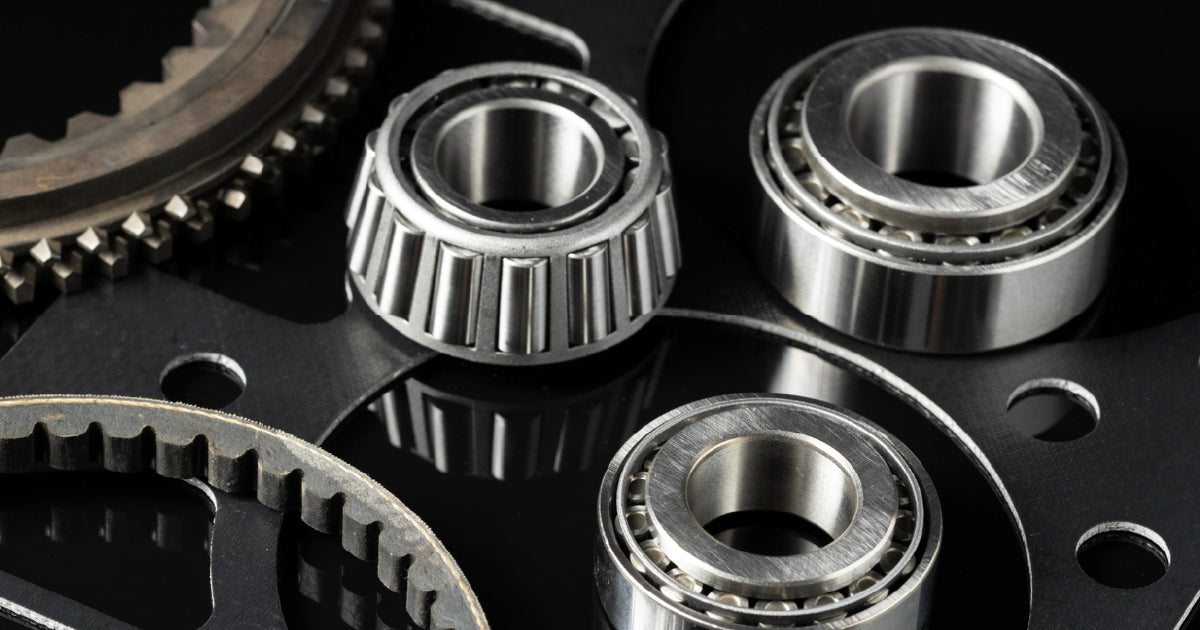
What Is a Rolling Bearing?
Rolling bearings carry load via rolling elements — balls or rollers — between hardened inner and outer raceways. They are present in virtually all rotating industrial equipment: electric motors, pumps, fans, gearboxes, agricultural machinery, conveyor systems, and workshop equipment. Choosing the right bearing for the application, fitting it correctly, and lubricating it properly is the difference between years of reliable service and a costly premature failure.
Rolling bearings are broadly divided into two families: ball bearings (spherical rolling elements) and roller bearings (cylindrical, tapered, needle, or barrel-shaped rolling elements). Roller bearings offer higher load capacity for a given size; ball bearings offer lower friction and are better suited to higher speeds. A third category — plain bushings — uses no rolling elements and is covered in the Plain Bushings section below.
This guide covers every major type of rolling bearing used in industrial settings, explains how to decode ISO bearing designation numbers, walks through selection criteria, and details correct installation, lubrication, and maintenance practice. Whether you are replacing a worn bearing on a motor, specifying a bearing for a new conveyor drive, or diagnosing why a bearing failed ahead of schedule, this is the reference to start with.
Types of Rolling Bearings
| Bearing Type | Load Direction | Speed Suitability | Self-Aligning | Typical Applications |
|---|---|---|---|---|
| Deep Groove Ball | Radial + moderate axial (bidirectional) | Low to high | No | Motors, pumps, fans, gearboxes, conveyors |
| Angular Contact Ball | Combined radial + axial (one direction) | Medium to high | No | Pump impeller shafts, spindles, screw conveyors |
| Self-Aligning Ball | Radial + light axial | Low to medium | Yes (up to ~3°) | Long shafts, misaligned mountings |
| Tapered Roller | Heavy combined radial + axial (one direction per bearing) | Low to medium | No | Wheel hubs, gearboxes, crushers |
| Cylindrical Roller | Heavy radial only (standard NU/N) | Low to medium-high | No | Large motors, gearbox main shafts, rolling mills |
| Spherical Roller | Heavy radial + moderate axial | Low to medium | Yes (up to ~1.5°) | Heavy conveyors, mining, fans, industrial gearboxes |
| Needle Roller | High radial (compact section) | Low to medium | No | Automotive gearboxes, camshafts, hydraulic motors |
| Thrust Ball | Axial only (light–moderate) | Low to medium | No | Screw jacks, machine tables, low-load thrust faces |
| Thrust Roller | Axial only (heavy) | Low | No | Crane hooks, propeller shafts, heavy presses |
| Plain Bushing | Heavy radial; generally low speed | Low | Spherical variants yes | Agricultural machinery, conveyor pivots, hydraulic cylinders |
Table: Rolling bearing types at a glance. Self-aligning capability and speed suitability are general guides — always verify against manufacturer specifications for the specific series.
Deep Groove Ball Bearings
The most common bearing in industrial use. Deep raceway grooves allow the bearing to carry radial loads as its primary function while also accommodating moderate bidirectional axial (thrust) loads. Low friction makes it suitable for high speeds.
Available in three sealing configurations:
- Open: no shields or seals. Requires external lubrication and protection from contamination.
- Shielded (ZZ): steel shields on both sides reduce grease loss and particle ingress but do not fully seal the bearing. Suitable for clean to lightly contaminated environments; marginally lower friction than sealed variants and capable of slightly higher operating speeds.
- Sealed (2RS): rubber contact seals on both sides fully retain grease and exclude contamination. The correct choice for dusty, wet, or outdoor applications.
Typical applications: electric motors, pumps, fans, gearboxes, conveyor idlers, agricultural equipment.
Designation example: 6205 2RS C3 — 25 mm bore, light series, rubber sealed both sides, C3 internal clearance.
Angular Contact Ball Bearings
Similar in construction to deep groove ball bearings but with a defined contact angle (typically 15°, 25°, or 40°) between the ball contact line and the radial plane. This geometry allows the bearing to carry combined radial and axial loads simultaneously. The greater the contact angle, the higher the axial load capacity.
Because each bearing reacts axial force in one direction only, angular contact bearings are almost always mounted in matched pairs — back-to-back (DB), face-to-face (DF), or tandem (DT) arrangements.
Typical applications: pump impeller shafts, high-speed spindles, screw conveyor end bearings, hydraulic gear pumps.
Self-Aligning Ball Bearings
A double-row ball bearing with a spherically curved outer raceway, allowing the inner ring and shaft to pivot relative to the outer ring by up to approximately 3°. This compensates for shaft deflection under load and for imperfect alignment at installation. Load capacity is lower than an equivalent deep groove bearing of the same size.
Typical applications: long shafts subject to deflection, hard-to-align mountings, oscillating mechanisms.
Tapered Roller Bearings
Tapered rollers are arranged so their rolling surfaces converge at a common apex on the bearing axis. This geometry allows the bearing to carry heavy combined radial and axial loads efficiently. Because they develop axial force in one direction when radially loaded, tapered roller bearings are always mounted in opposing pairs.
Setting correct axial preload at installation is critical — too much preload generates heat and accelerates wear; too little allows rollers to skid on the raceways.
Typical applications: wheel hubs, gearbox output shafts, heavy conveyor drives, quarrying and mining equipment, vehicle differentials.
Cylindrical Roller Bearings
Cylindrical rollers in line contact with the raceways provide significantly higher radial load capacity than ball bearings of the same size. Standard types (NU, N) have no flanges on one or both rings and carry no axial load. Types with one or two flanged rings (NJ, NF, NUP) accommodate light axial loads in one direction.
Typical applications: electric motors, main gearbox shafts, rolling mill rolls, heavy countershafts where high radial loads are present.
Spherical Roller Bearings
A double row of barrel-shaped rollers runs on a spherically curved outer raceway. This combination delivers high radial and moderate axial load capacity along with self-aligning capability (up to approximately 1.5° of misalignment). The most robust bearing type for heavy loads in contaminated or poorly aligned conditions.
Typical applications: industrial fans, heavy conveyor drives, crushers, mining equipment, large gearboxes, paper mills.
Needle Roller Bearings
Small-diameter rollers with a high length-to-diameter ratio (≥4:1) give very high radial load capacity in a compact cross-section. Particularly useful where radial space is severely limited. Not suitable for axial loads. For full coverage of needle bearing types — drawn cup vs solid race, caged vs full complement, thrust and combined types — plus the critical shaft hardness rules, see our Needle Roller Bearing Guide.
Typical applications: automotive gearboxes, camshafts, small hydraulic motors, universal joints, thin-section industrial applications.
Thrust Bearings
Designed specifically to carry axial (thrust) loads, with rolling elements arranged to react force along the bearing axis. Two main variants:
- Ball thrust bearings: suitable for light-to-moderate axial loads at low-to-medium speeds. A washer-style unit with a single row of balls between two flat raceways.
- Roller thrust bearings: cylindrical or tapered roller elements provide substantially higher axial load capacity for heavy applications.
Important: thrust bearings are not designed to carry radial loads. Where combined loading is present, angular contact or tapered roller bearings are the correct selection.
Typical applications: crane hooks, screw jacks, propeller shafts, vertical pump thrust faces, machine tool tables.
For a detailed look at thrust bearing types, load ratings, fit tolerances, and axial clearance, see the AIMS Thrust Bearing Guide.
Plain Bushings
Bushings are plain bearings — cylindrical sleeves that sit between a shaft and housing to reduce friction and wear without rolling elements. They are a cost-effective, compact solution for applications where loads are moderate, speeds are low, and continuous relubrication is not always practical.
Common bushing types:
- Plain (sleeve) bushings: the most common type; carry radial loads at low-to-medium speeds. Used in hinges, linkages, and general shaft support.
- Flanged bushings: a sleeve with an integrated flange to handle combined radial and one-directional axial loads. Common in automotive suspension and industrial pivots.
- Spherical bushings: a ball-and-socket design that accommodates angular misalignment. Found in steering linkages, suspension arms, and aircraft control rods.
- Thrust bushings: flat washer-style bearings that carry axial loads only. Used in gearboxes, valve stems, and rotating assemblies.
- Self-lubricating bushings: impregnated with oil or PTFE to operate maintenance-free. Ideal for food processing, medical equipment, and hard-to-access assemblies.
Typical applications: agricultural machinery, conveyor systems, hydraulic cylinders, automotive components, pumps, and industrial pivot points where simplicity and low maintenance are priorities.
Bearing Housings
In many applications, bearings are supplied as pre-assembled units — the bearing factory-installed in a housing ready to bolt directly to a machine frame or surface. These bearing units eliminate the need for precision machined housings and simplify installation and replacement.
Pillow Block (Plummer Block) Bearings
A pillow block consists of a UC-series insert bearing (a deep groove ball bearing with a spherical outer ring) pre-installed in a two-bolt cast iron or pressed steel housing with a flat base plate. The shaft passes through the inner bore; the housing bolts to any flat surface.
The spherical outer ring of the insert bearing accommodates modest shaft misalignment and angular misalignment of the mounting surface, making pillow blocks tolerant of imperfect installation conditions.
Naming note: “Pillow block” is the standard Australian and US term. “Plummer block” is the UK/European equivalent — both terms refer to the same unit, and both are in common use in Australian industry.
Designation example: UCP205 — pillow block housing (P), UC insert bearing, 25 mm bore. To decode the bore: multiply the last two digits by 5 (05 × 5 = 25 mm).
Typical shaft range: 15 mm to 100+ mm bore.
Flanged Bearing Units
The same insert bearing as a pillow block but in a flanged housing for mounting against a vertical face, wall, or machine upright. Common variants:
- 2-bolt flanged (UCFL): two mounting holes, oval flange. Common for smaller shafts.
- 4-bolt flanged (UCFB / UCFC): four mounting holes, round or square flange. More rigid mounting for larger loads.
Take-Up Units
Used where tensioning adjustment is required along the shaft axis. The bearing housing slides within a rectangular frame to allow belt or chain tension adjustment. Common in conveyor and flat belt drive applications.
Cartridge Units
A bearing pre-mounted in a cylindrical housing for direct insertion into a machined bore. Allows bearing replacement without disassembling the surrounding structure.
How to Read Bearing Designation Numbers
The ISO bearing designation system encodes bearing type, cross-section, bore size, and specification into a standardised part number. Understanding the system allows you to cross-reference bearings between manufacturers, specify the correct replacement, and select the right clearance or sealing option.
Anatomy of a Bearing Number
Example: 6205 2RS C3
| Part of Number | Code | Meaning |
|---|---|---|
| Bearing type | 6 | Deep groove ball bearing (single row) |
| Diameter series | 2 | Light diameter series |
| Bore code | 05 | 25 mm bore (05 × 5 = 25 mm) |
| Suffix | 2RS | Rubber contact seals, both sides |
| Suffix | C3 | Greater than normal internal clearance |
Bearing Type Codes
| Code | Bearing Type |
|---|---|
| 1 | Self-aligning ball bearing |
| 2 | Spherical roller bearing |
| 3 | Tapered roller bearing |
| 4 | Deep groove ball bearing (double row) |
| 5 | Thrust ball bearing |
| 6 | Deep groove ball bearing (single row) |
| 7 | Angular contact ball bearing |
| N / NU / NJ | Cylindrical roller bearing (various flange configurations) |
| NA / NK | Needle roller bearing |
Bore Size Codes
For bore codes 00–03, the bore diameter is fixed as below. From bore code 04 onwards, multiply the two-digit code by 5 to get the bore in millimetres.
| Bore Code | Bore Diameter |
|---|---|
| 00 | 10 mm |
| 01 | 12 mm |
| 02 | 15 mm |
| 03 | 17 mm |
| 04 and above | Bore code × 5 (e.g. 04 = 20 mm, 05 = 25 mm, 06 = 30 mm, 08 = 40 mm, 10 = 50 mm, 12 = 60 mm) |
Suffix Codes
Suffixes follow the basic designation number and define sealing, clearance, cage type, and other specification details. The most commonly encountered suffixes are:
| Suffix | Meaning | When to Use |
|---|---|---|
| ZZ | Steel shields both sides (non-contact) | Clean to lightly contaminated environments. Marginally lower friction than 2RS; can run at slightly higher speeds. |
| 2RS | Rubber contact seals both sides (fully sealed) | Contaminated, dusty, wet, or outdoor environments. Retains grease for life. |
| RS / Z | Rubber seal or steel shield one side only | Where one side needs sealing and the other requires access for lubrication. |
| CN | Normal internal clearance (default) | Standard applications — no suffix needed; CN is assumed. |
| C3 | Greater than normal internal clearance | Electric motors, tight shaft/housing fits, elevated operating temperatures. |
| C4 | Greater than C3 internal clearance | Very tight interference fits, very high operating temperatures. |
| M | Brass cage (instead of pressed steel) | Higher speed applications, where cage integrity at speed is required. |
| NR | Snap ring groove on outer ring | Where axial location of the outer ring in the housing is required. |
Note: different manufacturers use different suffix conventions for the same specification. When cross-referencing between brands, always verify the full specification against the manufacturer’s catalogue — particularly for seal and clearance designations.
Suffix Cross-Reference: Major Brands
The table below shows equivalent suffixes across the six major brands stocked or referenced in Australia. The underlying specification is identical — only the suffix notation differs.
| Specification | NACHI | KOYO | NSK | NTN | SKF | FAG |
|---|---|---|---|---|---|---|
| Steel shields both sides | ZZ | ZZ | ZZ | ZZ | 2Z | 2Z |
| Rubber seals both sides | 2NSE | 2RD | 2RS | 2RS | 2RS1 | 2RSR |
| Seal/shield one side | NSE / Z | RD / Z | RS / Z | RS / Z | RS1 / Z | RSR / Z |
| Normal clearance (CN) | CN | CN | CN | CN | — | — |
| C3 clearance | C3 | C3 | C3 | C3 | C3 | C3 |
| C4 clearance | C4 | C4 | C4 | C4 | C4 | C4 |
| Brass cage | M | M | M | M | M | M |
| Snap ring groove | NR | NR | NR | NR | NR | NR |
Note: SKF and FAG use no suffix for normal (CN) clearance — the absence of a clearance suffix indicates CN. Always cross-reference the manufacturer’s catalogue when substituting bearings across brands, particularly for seal designations.
Selecting the Right Bearing
No single bearing type suits every application. Selection is driven by load direction and magnitude, operating speed, alignment tolerance, and the operating environment.
Load Type and Direction
- Predominantly radial load: deep groove ball (light to moderate), cylindrical roller NU type (heavy).
- Combined radial and axial: angular contact ball (high speed, moderate combined), tapered roller (heavy loads, lower speed), spherical roller (heavy loads, moderate speed, misalignment tolerance).
- Predominantly axial: thrust ball (light to moderate, low speed) or thrust roller (heavy, low speed).
- Heavy radial, low speed, minimal relubrication: plain bushing — cost-effective where rolling element bearings are impractical or unnecessary.
Load Magnitude
- Light to moderate loads: ball bearings — lower friction, lighter, and generally less expensive.
- Heavy loads: roller bearings (tapered, cylindrical, spherical) offer significantly higher radial and combined load capacity for a given bore size.
Speed
- High speed (motors, spindles, pumps): deep groove ball or angular contact ball. Lower friction and better high-speed dynamics.
- Moderate speed, higher load: cylindrical roller or spherical roller.
- Low speed, very high load: tapered roller or spherical roller.
Misalignment
- Good alignment (rigid shaft, precision housing): any standard bearing type.
- Moderate misalignment or shaft deflection: self-aligning ball (light loads, up to 3°) or spherical roller (heavy loads, up to 1.5°).
Angular contact and cylindrical roller bearings are sensitive to misalignment — alignment must be correct for these types.
Operating Environment
- Clean and dry: open or shielded (ZZ) bearings are acceptable where external lubrication can be managed.
- Contaminated, dusty, or wet: sealed (2RS) bearings or bearings in sealed housings (pillow blocks with grease nipples).
- High temperature (continuous >80°C): review grease specification; specify C3 or C4 clearance to allow for thermal shaft expansion.
Internal Clearance
Internal clearance is the total play between rolling elements and raceways before installation. It must be matched to the application — thermal expansion at operating temperature consumes clearance, and a bearing running tighter than designed generates excess heat and fails early.
| Clearance Grade | Clearance vs Normal | Typical Temp Range | Typical Applications |
|---|---|---|---|
| C2 | Less than normal | –10°C to +60°C | Precision spindles, machine tools — tight fits where minimal play is critical |
| CN (Normal) | Standard / default | 0°C to +80°C | General purpose motors, pumps, gearboxes operating under normal conditions |
| C3 | Greater than normal | +60°C to +150°C | Electric motors, conveyor drives, applications with elevated operating temperatures or interference fits on both rings |
| C4 | Greater than C3 | +120°C to +200°C | Induction furnace fans, dryer drums, kilns, heavy industrial machinery with significant heat generation |
| C5 | Greater than C4 | +180°C to +250°C+ | Steel mill rolls, glass manufacturing, high-temperature process equipment — specialist applications only |
Rule of thumb: as operating temperature rises, internal clearance is consumed by thermal expansion of the shaft and housing. Selecting a higher clearance grade (C3, C4) ensures sufficient running clearance remains at operating temperature and prevents bearing seizure.
Lubrication note at elevated temperatures: standard greases typically have an upper limit of +120°C to +150°C. At C4 and C5 operating ranges, standard lubricants will break down and fail to protect the bearing. High-temperature greases (synthetic base oils with polyurea or lithium complex thickeners) must be specified. Above +180°C, circulating oil lubrication or specialised solid lubricants should be considered.
Fitting a Bearing Correctly
Incorrect fitting is the most common preventable cause of premature bearing failure. Bearings are precision components manufactured to tolerances measured in micrometres — they must be treated accordingly.
Interference Fits
Bearings are designed to operate with a controlled interference fit between the inner ring and shaft, and between the outer ring and housing bore.
- Rotating inner ring (most applications): the inner ring must have an interference fit to the shaft to prevent creep under load. Common tolerance classes: k5, m5, n6 (progressively tighter).
- Stationary outer ring: typically a transition or light clearance fit to the housing to allow axial float and simplify removal. Common tolerance classes: H7, J7, K7. These tolerances are typically achieved by reaming the housing bore to the specified class — see our Reamer Guide for pre-ream drill sizing, the H7 tolerance band by hole diameter, and the speeds and feeds that produce a clean bearing seat.
Critical rule: never apply fitting force through the rolling elements. Driving force through the balls or rollers onto the opposite ring creates localised high stress on the raceways — this is called brinelling and permanently damages the bearing before it is even run.
Mechanical Fitting — Bearing Press or Fitting Kit
For small and medium bearings, a bearing press or fitting sleeve (drift) kit is the correct method. Fitting sleeves contact only the ring being fitted:
- Fitting inner ring to shaft: use a sleeve that contacts the inner ring face only.
- Fitting outer ring into housing: use a sleeve that contacts the outer ring face only.
- Fitting both rings simultaneously: use a fitting tool that contacts both rings equally and simultaneously.
If a hammer must be used in the field, strike only through a fitting sleeve or proper drift — never directly on the bearing. Even a single direct hammer blow can cause brinelling.
Thermal Fitting — Induction Heater
For medium and large bearings with an interference fit to the shaft, thermal fitting using an induction bearing heater is the preferred industrial method. Heating the bearing expands the bore, allowing it to slide onto the shaft without force.
- Target temperature: 80–100°C. Never exceed 120°C for standard bearings — above this, the steel begins to lose hardness.
- Method: heat bearing on the induction heater for the required time, slide immediately onto shaft, hold in position until it cools and grips.
- Safety: always use insulated gloves when handling hot bearings.
Induction bearing heaters are standard equipment in any serious maintenance workshop. They eliminate raceway damage risk from improper pressing and speed up installation significantly.
Hydraulic Method
For large bearings on adapter sleeves — common with spherical roller bearings in pillow block housings — the hydraulic nut and oil injection method is used. Oil injected under pressure through a port in the shaft bore expands the bearing for controlled fitting and removal. Essential for large-diameter bearings where thermal or mechanical methods are impractical.
Lubrication
Studies consistently show that inadequate or incorrect lubrication accounts for approximately 50% of all premature bearing failures — making it by far the single largest cause, ahead of contamination, misalignment, overloading, and incorrect fitting. Whether through under-lubrication, over-lubrication, degraded grease, or the wrong lubricant type, the result is accelerated wear, heat build-up, and ultimately raceway or rolling element damage. Getting lubrication right is the most effective single step in any bearing maintenance programme.
Grease Lubrication
Grease is the standard lubricant for most industrial rolling bearings. It is retained within the bearing and housing without requiring a circulating system, making it practical for most plant and field applications.
- General industrial use: lithium-based EP (extreme pressure) grease, NLGI Grade 2. Suitable for moderate temperatures and speeds. Operating range approximately –20°C to +120°C.
- High temperature (>120°C): polyurea or synthetic ester-based grease. Calcium sulphonate complex grease suits very high temperature applications.
- Food and beverage: NSF H1-rated white mineral or synthetic grease.
- Low temperature (<–20°C): synthetic grease with low pour point (PAO or silicone-based).
Over-greasing is as damaging as under-greasing. Excess grease churns inside the bearing, increases operating temperature, and accelerates lubricant degradation. Sealed (2RS) bearings are factory-filled for their service life and should not be re-greased.
Relubrication Intervals
Intervals depend on bearing size, speed, load, and environment. Practical guidelines:
- Light duty, low speed, clean environment: 6–12 months.
- Moderate industrial duty: 3–6 months.
- Heavy duty, high temperature, or contaminated environment: monthly or more frequent.
Where bearings are fitted in pillow block housings with grease nipples, follow the housing manufacturer’s specification for quantity and interval. Most manufacturers specify a set number of strokes from a hand grease gun — do not exceed it.
Oil Lubrication
Used where splash, bath, or circulating oil systems are available — common in gearboxes, high-speed spindles, and precision machine tools. Oil provides better cooling than grease and is appropriate for higher operating speeds, but requires a sealed housing to contain the lubricant.
Grease Compatibility
Do not mix grease types. Different thickener systems (lithium, polyurea, calcium sulphonate) are often incompatible, and their mixture can result in a product with inferior performance — sometimes dramatically so. When re-greasing with a different product, purge old grease out completely before introducing the new type, or standardise on a single grease throughout a machine. This is one of the most commonly overlooked causes of bearing failure in field maintenance.
Bearing Failure: Causes and Identification
When a bearing fails before its calculated service life, identifying the failure mode is essential for preventing recurrence. Replacing like-for-like without addressing root cause will result in repeat failure.
| Failure Mode | How to Identify | Primary Cause(s) |
|---|---|---|
| Flaking / Spalling | Pitting, cratering, or flaking of raceways or rolling elements | End of service life (normal); overloading; contamination; incorrect fit |
| Wear | Matt, abraded surface on raceways; increased noise and clearance | Abrasive contamination in lubricant; lubricant starvation |
| Smearing | Polished, smeared marks on raceways/rolling elements | Sudden load reversal; excessive speed; insufficient radial load on rollers |
| Corrosion | Reddish-brown pitting; discolouration | Moisture ingress; condensation; corrosive media; inadequate sealing |
| Electrical erosion (fluting) | Regular groove/crater pattern across raceway; burnt grease smell | Stray current from VFD-driven motors; inadequate shaft grounding |
| Overheating | Discolouration of rings (yellow→brown→blue) | Over-greasing (most common); incorrect clearance; bearing running tight; lubricant breakdown |
| Brinelling (true) | Regular indentation marks spaced equal to rolling element pitch | Overloading of stationary bearing; impact shock loading |
| False brinelling | Similar indentation marks but from vibration rather than overload | Vibration while stationary — e.g. in transit, during installation, or on idle standby plant |
Flaking (Spalling)
In a correctly selected and fitted bearing operating within its load and speed ratings, fatigue spalling occurs only at the end of the bearing’s calculated service life — this is expected and normal. Premature spalling indicates one of: overloading, contamination damage to the raceways, incorrect interference fit, or operation with insufficient internal clearance.
Electrical Erosion (Fluting)
Electrical fluting is increasingly common in motor-driven plant since the widespread adoption of variable frequency drives (VFDs). The high-frequency switching of a VFD generates capacitively induced shaft voltages that discharge through the bearing as high-frequency current pulses, eroding the raceways into a characteristic washboard groove pattern.
Prevention options:
- Electrically insulated bearings: e.g. SKF INSOCOAT (suffix VA228), FAG insulated bearings. Ceramic coating on outer ring prevents current flow.
- Hybrid bearings: steel rings with silicon nitride (ceramic) rolling elements completely break the current path and are one of the most effective long-term solutions.
- Shaft grounding rings: conductive fibre ring provides a low-impedance path to ground, bypassing the bearings entirely.
- Conductive bearing grease: specially formulated lubricants that safely dissipate current without allowing arc discharge to concentrate on the raceways.
- Common mode chokes / EMI filters: fitted to the VFD output to reduce high-frequency leakage current at the source before it reaches the motor.
- Shielded motor cables: with the shield bonded at both ends to reduce capacitive coupling and limit circulating currents.
- Equipotential bonding: ensuring the motor frame, driven equipment, and base plate share a common earth point eliminates potential differences that drive current through the bearing path.
If a motor bearing is failing regularly in a VFD application, electrical erosion should be the first failure mode investigated — look for the evenly spaced groove pattern and smell for burnt grease.
Bearing Brands
AIMS Industrial stocks bearings from globally recognised manufacturers. All major brands are manufactured to ISO standards and are dimensionally interchangeable where the designation matches — a 6205 2RS from NACHI, KOYO, NSK, or SKF is dimensionally identical to ISO specifications.
| Brand | Origin / Background | Notable Strengths |
|---|---|---|
| NACHI | Japan. Originated from Fujikoshi Corporation, with roots in precision tooling and steel manufacturing. | High-precision bearings across deep groove, angular contact, and cylindrical roller ranges. Strong in machine tool and automotive applications. Stocked by AIMS. |
| KOYO | Japan. Part of the JTEKT Corporation alongside Toyoda. | Strong OEM presence in automotive and industrial sectors. Well regarded for needle roller, tapered roller, and hub unit bearings. Stocked by AIMS. |
| NSK | Japan. Comparable to SKF for industrial applications. | Strong in automotive-derived precision bearings, high-speed applications, and electric motor bearings. |
| SKF | Sweden. The global benchmark for quality. | Widest product range, strong technical support. Deep groove, cylindrical, and spherical roller bearings are the global standard. |
| FAG / Schaeffler | Germany. Part of the Schaeffler Group. | Common in European-origin machinery. Strong range of tapered roller and large-bore spherical roller bearings. |
| Timken | USA. Established name in tapered roller bearings. | Strong position in Australian heavy transport, mining, and agriculture applications. |
For standard industrial replacement, AIMS stocks NACHI and KOYO as primary range bearings, with NSK and SKF available for OEM-specified applications. Cross-reference is available for all major alternative part numbers. Where a machine OEM specifies a particular brand, matching that brand is recommended for warranty compliance.
Browse the AIMS Industrial bearings range
Frequently Asked Questions
What is the difference between a ZZ and a 2RS bearing?
ZZ bearings have steel shields on both sides. The shields are non-contact — they reduce grease loss and particle ingress but do not fully seal the bearing. ZZ bearings generate marginally lower friction and can operate at slightly higher speeds and higher ambient temperatures than equivalent 2RS sealed bearings. 2RS bearings have rubber contact seals on both sides, which fully seal the bearing against lubricant loss and contamination ingress. For contaminated, dusty, or wet environments, 2RS is the correct choice. ZZ suits clean to lightly contaminated conditions where higher speed or temperature operation is a factor.
What does C3 clearance mean on a bearing?
C3 designates a bearing with greater than normal internal (radial) clearance between the rolling elements and raceways. Normal clearance is CN. C3 is specified when the bearing will experience thermal shaft expansion from elevated operating temperatures, when tight interference fits are used on both rings simultaneously, or in standard electric motor applications. Using CN clearance where C3 is required results in the bearing running tight as it heats up, generating additional heat and leading to premature failure. See the clearance grade table in the Selection section for a full comparison of C2 through C5.
How do I decode a bearing part number?
The standard ISO format is: bearing type digit(s) + diameter series digit + two-digit bore code + suffix(es). Taking 6205 2RS C3 as an example: ‘6’ = deep groove ball bearing; ‘2’ = light diameter series; ‘05’ = 25 mm bore (05 × 5 = 25); ‘2RS’ = rubber sealed both sides; ‘C3’ = greater than normal clearance. Brand prefixes (SKF, NSK, NTN, NACHI) are not part of the ISO designation and can be ignored when cross-referencing. For bore codes 00–03, the bore size is fixed (see the Bore Size Codes table above); from 04 onwards, multiply by 5.
What type of bearing handles both radial and axial loads?
The three main choices are: angular contact ball bearings (high speed, moderate combined load — mount in matched pairs); tapered roller bearings (heavy combined loads, lower speed — also mounted in opposing pairs); and spherical roller bearings (heavy loads, moderate speed, with self-aligning capability). Deep groove ball bearings handle moderate combined loads and are suitable where axial load is a minor component of the total load.
What is a pillow block bearing?
A pillow block (also called a Plummer block) is a pre-assembled unit: a UC-series insert bearing mounted in a cast iron or pressed steel housing with a flat base for direct mounting to any flat surface. The spherical outer ring of the insert bearing allows modest shaft misalignment. Pillow blocks eliminate the need for precision machined housings and are the simplest way to add a bearing mounting point to a frame or structure. Designation example: UCP205 = pillow block housing (P), UC insert bearing, 25 mm bore (05 × 5 = 25).
How do I fit a bearing without damaging it?
Apply fitting force only to the ring being fitted — never through the rolling elements. For small bearings, use a bearing press with fitting sleeves that contact the inner ring face only (when pressing onto a shaft) or the outer ring face only (when pressing into a housing). For medium and large bearings on interference-fit shafts, use an induction heater to expand the bore before fitting (80–100°C; never exceed 120°C). If a hammer must be used in the field, always use a fitting sleeve, dead blow hammer, or proper drift — never strike the bearing directly. One blow directly on the bearing face can cause brinelling that destroys the bearing before it has run a single revolution.
What grease should I use in a bearing?
For most general industrial applications, lithium-based EP grease at NLGI Grade 2 is the correct choice — it suits electric motors, pumps, fans, and gearbox auxiliaries up to approximately 120°C. For higher temperatures, specify polyurea or synthetic grease. For food processing or beverage applications, use NSF H1-rated food-grade grease. Do not mix grease types — different thickener systems are often incompatible, and their mixture can produce an inferior product. Always use the manufacturer’s recommended lubricant grade and avoid over-greasing, which is as damaging as under-greasing.
What is the most common cause of premature bearing failure?
Studies consistently show that lubrication-related causes account for approximately 50% of all premature bearing failures — through under-lubrication, over-lubrication, wrong lubricant type, or degraded grease. Contamination (abrasive particles and moisture ingress) is the next largest cause, degrading the lubricant and directly damaging raceway surfaces. Incorrect fitting — particularly striking the outer ring when fitting the inner ring, thereby forcing load through the rolling elements — causes brinelling before the bearing is even run. Correct sealing, proper fitting technique, and regular lubrication eliminate the majority of preventable failures.
When should I use a spherical roller bearing instead of a deep groove ball bearing?
Spherical roller bearings are the correct choice when: loads are heavy (well beyond the capacity of ball bearings of a similar bore size); combined radial and axial loading is present; operating conditions are harsh or contaminated; or shaft deflection or mounting misalignment cannot be fully controlled. For light to moderate loads in clean conditions with good alignment, deep groove ball bearings are more than adequate and considerably less expensive.
What is electrical fluting and how do I prevent it?
Electrical fluting is a failure mode where stray current from variable frequency drives (VFDs) discharges through the bearing, eroding a regular washboard groove pattern into the raceways. The evenly spaced grooves are distinctive and the grease typically smells burnt. Prevention options include: electrically insulated bearings (e.g. SKF INSOCOAT, suffix VA228), hybrid bearings with ceramic rolling elements, shaft grounding rings, conductive bearing grease, common mode chokes on the VFD output, shielded motor cables bonded at both ends, and equipotential bonding of the motor frame and driven equipment. If a motor bearing is failing regularly in a VFD application, electrical erosion should be the first failure mode investigated.
Got the spec? Get the bearing.
Shop our full range of rolling bearings — ball, roller & housed units
From deep groove ball bearings to tapered roller, spherical, and needle roller — AIMS Industrial stocks SKF, FAG, NTN, NSK, Nachi and more, ready to ship Australia-wide.
A loose or spinning bearing fit — inner race on the shaft, outer race in the housing — is one of the most common causes of premature bearing failure, and it's often fixable with a retaining compound rather than a full re-machine. See our Loctite Retaining Compound Guide for grade selection by fit type and clearance.

