

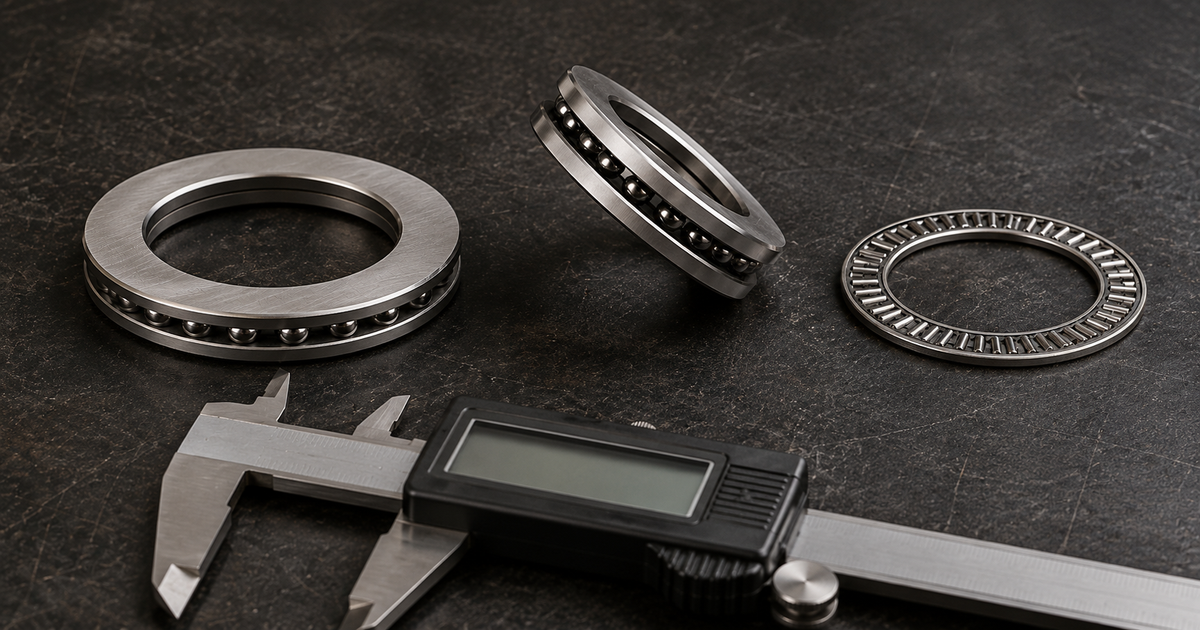
What Is a Thrust Bearing?
A thrust bearing is a bearing designed to support axial loads — forces acting along the shaft axis, rather than across it. Where a standard radial bearing carries the weight of a rotating shaft (load perpendicular to the shaft), a thrust bearing handles the push-and-pull along the shaft itself. They're used in gearboxes, automotive clutches, pump impellers, marine drives, machine tool spindles, and any rotating assembly where axial load must be carried without restricting rotation.
For a full comparison of the Japanese Tier-1 bearing brands AIMS distributes — plus specialty brands like Timken, McGill, BECO and RBC — see the AIMS Bearing Brand Comparison guide.
What are the main types of thrust bearings?
The main types are ball thrust, cylindrical roller thrust, tapered roller thrust, spherical roller thrust, and needle roller thrust. Ball thrust suits light loads at higher speeds; roller thrust types carry heavier loads at lower speeds. Tapered and spherical roller thrust bearings can also handle a degree of radial load alongside the axial load.
Bookmark our Engineering Reference Charts hub for related sizing tables, conversion charts and Australian standard references across 9 topic clusters.
Thrust Bearing Types — Quick Reference
Industrial supply across Australia stocks five thrust bearing geometries. Each is optimised for a different load magnitude, speed envelope, and mounting style.
| Type | Rolling element | Best for | Trade-off |
|---|---|---|---|
| Thrust ball bearing | Steel balls | Light to moderate axial load, moderate to high speed, low cost | Limited axial capacity vs roller types |
| Thrust needle roller bearing | Long, thin needle rollers | High axial load in a thin-profile package | Lower speed than ball; precise alignment required |
| Cylindrical roller thrust bearing | Cylindrical rollers | High axial load, moderate speed, predictable load distribution | Larger axial profile than needle |
| Tapered roller thrust bearing | Tapered rollers | Combined high axial AND moderate radial load | Higher cost; specific shaft geometry |
| Spherical roller thrust bearing | Barrel-shaped rollers in a curved race | Heavy axial load with shaft misalignment tolerance | Highest cost; primarily heavy industrial use |
What Is a Thrust Bearing and Why It's Different from a Radial Bearing
A thrust bearing is a rotating-machinery bearing designed to carry axial load — force acting along the shaft axis — rather than radial load (force perpendicular to the shaft). Where a deep groove ball bearing or roller bearing supports a shaft against the weight of the components rotating on it, a thrust bearing supports a shaft against the push or pull along the shaft. Different load direction, different bearing geometry.
Visually, a thrust bearing looks like a flat washer-and-ring sandwich rather than a tube. The bearing has two flat washers (one rotates with the shaft, one stays with the housing) and a row of balls or rollers between them. The balls or rollers run in shallow grooves machined into each washer's face, transmitting the axial load while allowing rotation. Compare this to a radial bearing where the rolling elements run between an outer ring and an inner ring — entirely different geometry for entirely different load directions.
Thrust bearings are the right answer when an industrial component generates axial force during rotation: vehicle steering systems (the steering column needs to rotate while supporting the weight pressing down through it), helical and bevel gears (the helix angle generates an axial thrust component during torque transmission), pumps and compressors (impeller pressure creates an axial reaction force), turntables and rotary indexers (vertical-axis rotation supporting a load), and aerospace control surfaces (precision rotation supporting heavy actuator forces). Wherever a rotating shaft has a force trying to push it along its length, a thrust bearing handles that force.
Many machines use both radial bearings and thrust bearings on the same shaft. The deep groove ball bearings on a worm gear shaft handle the radial load (shaft weight, gear-mesh radial component); a thrust bearing at one shaft end handles the axial component generated by the worm-gear helix angle. The two bearing types complement each other rather than substitute.
The full AIMS Industrial thrust bearing range — covering thrust ball bearings, thrust needle roller bearings, cylindrical and tapered roller thrust bearings, and matching washers — is in the Thrust Bearings & Washers collection.
The Five Thrust Bearing Types — Quick Comparison
Industrial supply across Australia stocks five thrust bearing geometries. Each is optimised for a different load magnitude, speed envelope, and mounting style.
| Type | Rolling element | Best for | Trade-off |
|---|---|---|---|
| Thrust ball bearing | Steel balls | Light to moderate axial load, moderate to high speed, low cost | Limited axial capacity vs roller types |
| Thrust needle roller bearing | Long, thin needle rollers | High axial load in a thin-profile package | Lower speed than ball; precise alignment required |
| Cylindrical roller thrust bearing | Cylindrical rollers | High axial load, moderate speed, predictable load distribution | Larger axial profile than needle |
| Tapered roller thrust bearing | Tapered rollers | Combined high axial AND moderate radial load | Higher cost; specific shaft geometry |
| Spherical roller thrust bearing | Barrel-shaped rollers in a curved race | Heavy axial load with shaft misalignment tolerance | Highest cost; primarily heavy industrial use |
For most light-to-moderate AU industrial applications, thrust ball bearings or thrust needle roller bearings cover the range. Heavier industrial applications (mining, marine, large pumps and gearboxes) move into cylindrical, tapered, or spherical roller thrust bearings.
Thrust Ball Bearings — Single and Double Direction
The most common thrust bearing in AU industrial supply. A thrust ball bearing consists of a row of balls in a retainer (cage), running between two flat washers — one washer rotates with the shaft (the shaft washer or "tight" washer), the other stays with the housing (the housing washer or "loose" washer). The shaft washer has a tighter bore tolerance to grip the shaft; the housing washer has a looser fit so it can sit against a flat housing face.
Single-direction thrust ball bearings (51XXX series)
A single-direction thrust ball bearing handles axial load in one direction only — the load must push the rotating component toward the bearing. The bearing cannot tolerate reversed axial load and will release if loaded the wrong way. Standard designation: the 511XX, 512XX, and 513XX series under ISO 104.
Examples in the AIMS thrust bearing range: 51105 (Koyo/JTEKT, 25 × 42 × 11 mm), 51106 (Nachi equivalent, 30 × 47 × 11 mm), 51107 (Koyo/JTEKT, 35 × 52 × 12 mm), and the larger 51124 from NTN (120 × 155 × 25 mm). Browse the Thrust Bearings & Washers collection for the full size range.
Double-direction thrust ball bearings (52XXX series)
A double-direction thrust ball bearing has two rows of balls with three washers — a centre shaft washer flanked by two housing washers, with balls between each face pair. The bearing handles axial load in both directions, suiting applications where the axial load reverses or where the shaft can be pushed either way during normal operation. Standard designation: 522XX, 523XX, and 524XX series.
The trade-off: double-direction bearings are larger, heavier, and more expensive than single-direction. Use them only when the application genuinely requires bidirectional thrust capacity. Worm gearboxes, vertical-shaft pumps with impeller suction reversal, and certain machine tool spindles are common applications.
Designation system
Thrust ball bearing numbers follow ISO 104:
- First digit: 5 = thrust ball bearing
- Second digit: 1 = single direction; 2 = double direction
- Third digit: dimension series (1, 2, 3, 4 = light, medium, heavy, extra-heavy)
- Last two digits: bore size code — multiply by 5 to get bore in mm (for codes 04 and above)
So 51106 = 5 (thrust ball) + 1 (single direction) + 1 (light series) + 06 (06 × 5 = 30 mm bore). The pattern recurs across all bearing standard designations — see our Rolling Bearings Guide for the full designation system explanation.
Thrust Needle Roller Bearings — High Capacity in a Slim Profile
For full coverage of all needle bearing types — drawn cup, solid race, caged vs full complement, combined radial-thrust, cam followers and one-way clutches — plus the critical shaft hardness rules, see our Needle Roller Bearing Guide.
A thrust needle roller bearing replaces the balls of a thrust ball bearing with long, thin cylindrical needles. Each needle has a much larger contact area against the washers than a ball, multiplying the bearing's axial load capacity by 3–5× over a same-diameter ball thrust bearing while keeping the bearing's axial profile thin.
The trade-offs against thrust ball: lower maximum speed (line contact between needle and washer generates more friction at high RPM); requires more precise shaft and housing surface preparation (the washer faces must be flat and square because needle contact is sensitive to alignment); slightly higher cost per bearing.
Construction
The classic thrust needle roller bearing has a precision-pressed steel cage holding the needle rollers in position, with the needles running directly against hardened steel washers (typically supplied as a separate part — washer flat faces are critical and shouldn't be substituted). IKO is the AU-stocked specialist brand for thrust needle bearings; the IKO catalogue covers AS-prefix (cage and needles only, washers separate), AXK-prefix (cage with both washers), and NTB-prefix (heavier-duty variants with thicker cage construction).
Common AU sizes and applications
The AIMS range covers from very small (AS-1024 needles in a 10 × 24 mm cage envelope) up through 80+ mm diameter packages. Typical applications: automotive transmissions and transfer cases, automotive air conditioning compressor pulleys, industrial gearboxes, agricultural equipment, off-road and motorcycle components.
Examples in the AIMS IKO range: AS2035 (20 × 35 × 2 mm cage and needles), NTB1024 (10 × 24 mm needle thrust bearing). For the full IKO range and dimensions, see the IKO Thrust Needle Roller Bearings Catalogue or browse the collection.
Cylindrical Roller Thrust Bearings
Cylindrical roller thrust bearings carry higher axial loads than ball thrust bearings while running at moderate speeds — the chunkier rollers spread load over a larger contact area. Common in industrial gearboxes, marine drive shafts, and large pumps where load magnitude exceeds the ball-bearing range.
Two main configurations: single-direction (one set of rollers between two washers) and double-direction (two sets of rollers either side of a central shaft washer). The 81XXX series designation pattern follows ISO conventions similar to ball thrust bearings.
Trade-offs vs ball thrust: lower max speed (line contact friction); higher load capacity at the same envelope size; more sensitive to misalignment; higher cost. Use cylindrical roller thrust where the application genuinely needs the additional axial capacity.
Tapered Roller Thrust Bearings
A tapered roller thrust bearing carries combined axial AND radial load — the tapered rollers contact both a tapered shaft washer and a tapered housing washer. The taper geometry resolves applied load into axial and radial components, with the radial component reacted by the bearing housing.
The applications: heavy-duty machine tool spindles, vertical-shaft turbines and pumps, mining drives, marine propeller shafts. Wherever a shaft carries both significant axial AND radial load and a single bearing must handle both, a tapered roller thrust is the answer.
Specification considerations: tapered roller thrust bearings have a defined preload — they need to be installed with a specified axial gap (measured with a feeler gauge) or specific torque on the retaining nut. Under-tightened: the bearing rattles and wears prematurely. Over-tightened: the rollers run hot and seize. Manufacturer torque specifications must be followed precisely.
Spherical Roller Thrust Bearings
The premium thrust bearing — barrel-shaped rollers running in a concave shaft race and a convex housing race. The spherical geometry allows the bearing to tolerate angular misalignment between the shaft and housing (typically up to ±2°) without binding or premature failure. Heavy industrial applications: large vertical pumps, mining mill shafts, marine propulsion, paper machine drying drums.
Spherical roller thrust bearings carry the highest combined axial-and-radial loads of any thrust bearing type. Cost reflects this — typically 5–10× the cost of an equivalent thrust ball bearing. Specify only when the application genuinely justifies the cost: precision misalignment tolerance, heavy load magnitude, or extended service life requirements that smaller bearings cannot meet.
Thrust Bearing Designation Numbers — Decoding the Standards
Thrust bearings follow ISO 104 and the same general designation pattern as radial bearings. Decoding the number from the bearing's outer-diameter etching:
| Series | Type | Direction | Notes |
|---|---|---|---|
| 511XX | Single-direction thrust ball | One way | Light load, common general-purpose |
| 512XX | Single-direction thrust ball | One way | Medium load |
| 513XX | Single-direction thrust ball | One way | Heavy load |
| 522XX | Double-direction thrust ball | Two way | Light bidirectional load |
| 523XX, 524XX | Double-direction thrust ball | Two way | Medium and heavy bidirectional |
| 811XX, 812XX | Single-direction cylindrical roller thrust | One way | Light and medium roller thrust |
| 892XX | Cylindrical roller thrust | One way | Heavy industrial |
| 293XX, 294XX | Spherical roller thrust | Combined | Heavy industrial misalignment-tolerant |
| AS-prefix | Thrust needle roller (cage + needles) | One way | IKO designation; washers separate |
| AXK-prefix | Thrust needle (cage + 2 washers) | One way | IKO complete assembly |
| NTB-prefix | Thrust needle heavy-duty | One way | IKO heavy-cage variants |
The dimension code at the end of the bearing number gives the bore size — codes 04 and above are bore in mm × 5 (so 51108 = 8 × 5 = 40 mm bore). Smaller codes (00, 01, 02, 03) follow a separate small-size convention (10, 12, 15, 17 mm respectively). For the full bearing designation reference covering all bearing types, see our Rolling Bearings Guide.
Selecting a Thrust Bearing — Load, Speed, Mounting, Direction
Five factors drive thrust bearing selection. Work through them in order.
Step 1 — Load magnitude and direction
The bearing must be rated for the applied axial load with appropriate safety factor. Manufacturer catalogues give the bearing's basic dynamic load rating C₀a (continuous load capacity at a defined service life) and basic static load rating (load that won't permanently deform the bearing). For continuous-duty applications, the basic dynamic rating drives selection — typically with a 3–5× safety factor over the actual operating load.
Step 2 — Single direction or double direction
If the axial load only acts one way during normal operation, single-direction is correct and saves cost and space. If load reverses (some pumps, certain machine tools, vertical shafts with start-stop reversal) — double-direction is required.
Step 3 — Operating speed
Thrust ball bearings handle higher speeds than thrust roller types. As a rough rule:
- Up to 500 RPM — any thrust type
- 500 to 2,000 RPM — ball or needle preferred
- Above 2,000 RPM — ball preferred; check manufacturer speed limit
- Above 5,000 RPM — specialist precision-grade ball thrust required
Step 4 — Mounting space
Thrust needle roller bearings have the slimmest axial profile — useful in space-constrained applications (automotive A/C compressors, transmission internals, packaging machinery). Thrust ball is slightly larger; cylindrical and tapered roller are larger again; spherical roller is the largest envelope.
Step 5 — Operating environment
Standard bearings suit clean indoor industrial environments. For wet, corrosive, or marine environments, specify stainless steel races and rolling elements (typically 440-grade stainless). For high-temperature applications (above 120°C continuous), specify bearings with high-temperature retainer materials or open-cage construction. For food-grade and pharmaceutical applications, specify bearings with food-grade lubrication and stainless construction.
Mounting and Lubrication
Mounting orientation
Thrust bearings are direction-sensitive. The shaft washer goes on the rotating shaft side; the housing washer sits against the stationary housing face. Reversing them — putting the housing washer on the shaft and the shaft washer on the housing — causes immediate failure: the looser-fit washer rotates relative to its mounting and the bearing skids inside its envelope.
For double-direction bearings (522XX series), the central shaft washer goes on the shaft, with the two housing washers either side against the housing faces. Reversed orientation produces the same skidding failure.
Surface preparation
The shaft and housing faces in contact with the bearing washers must be:
- Flat — within manufacturer-specified flatness tolerance (typically 0.01–0.02 mm)
- Square to the shaft axis — angular tolerance typically within 1–2 minutes of arc
- Hardened for needle roller and high-load thrust bearings — minimum 55 HRC contact surface; soft surfaces require separate hardened steel washers
- Smooth — surface roughness Ra 0.4–0.8 μm typical
Lubrication
Thrust ball bearings can run with grease (most common in industrial applications) or oil bath (for higher-speed continuous-duty applications). Thrust needle roller bearings strongly prefer oil — the line contact between needle and washer needs full-film lubrication that grease struggles to deliver at higher speeds. The full lubrication selection matrix is in our Industrial Lubricants Guide.
Removal and replacement
Thrust bearings are extracted with conventional bearing-puller technique — internal pullers grip the inner bore of the shaft washer; external pullers hook behind the housing washer. The geometry favours external pullers in most installations because the housing washer is exposed. For complete extraction technique, see our Bearing Puller Guide.
Thrust bearings are sensitive to misalignment and contamination — consistent inspection matters. See the Bearing Maintenance Guide for step-by-step inspection procedures, lubrication schedules and replacement triggers applicable to all industrial bearing types.
Common Failure Modes and Causes
Smearing on the contact face
Cause: insufficient lubrication, or load applied while the bearing is stationary (bearings need to be rotating before significant load is applied for proper film formation). Symptom: silver-grey smeared streaks on the washer face. Fix: address lubrication — increase grease quantity, switch to higher-viscosity oil, ensure bearing is rotating before peak load applies.
Brinelling
Permanent dimples in the washer face caused by static overload — load applied while the bearing is stationary, exceeding the bearing's static load capacity. Symptom: regular dimple pattern matching ball/roller spacing on the washer face; bearing rattles when rotated. Fix: replace the bearing; review whether the load is exceeding static rating during start-up; consider higher-rated bearing.
Skewing (cage failure)
Cause: bearing operating outside its alignment tolerance. The cage is forced sideways by misaligned load; cage pockets fatigue and eventually break. Symptom: noisy bearing, eventual cage fragments in the lubricant. Fix: address shaft alignment; consider moving to spherical roller thrust if alignment cannot be improved.
Heat damage
Symptom: bearing washers show blue/straw-yellow heat tinting. Cause: over-tightened preload, inadequate cooling, lubrication breakdown, or running outside speed envelope. Fix: replace the bearing (heat-tinted bearings have lost hardness and will fail rapidly); review cause and address before installing replacement.
Reversed direction failure
Single-direction bearings installed with the load direction reversed. Symptom: bearing immediately releases, shaft drops, complete failure within minutes. Fix: verify orientation; specify double-direction bearing if axial load can reverse.
AIMS Industrial Thrust Bearing Range
The full AIMS thrust bearing range covers all five major types with stocked brands matched to application tier:
Thrust ball bearings — Koyo/JTEKT, NTN
- Koyo/JTEKT 51105 Thrust Ball Bearing — 25 × 42 × 11 mm, single direction
- Nachi 51106 Equivalent — Single-Direction Thrust Ball Bearing — 30 × 47 × 11 mm, single direction
- Koyo/JTEKT 51107 Thrust Ball Bearing — 35 × 52 × 12 mm, single direction
- Larger metric series: NTN 51124 (120 × 155 × 25 mm) and equivalent up to 200+ mm bore
- Double-direction (52XXX series) on order across the same bore range
- Inch-series single-direction available (vintage US machinery and aerospace)
Thrust needle roller bearings — IKO
- IKO AS2035 Thrust Needle Roller Bearing — 20 × 35 × 2 mm cage and needles
- NTB1024 Thrust Needle Roller Bearing — 10 × 24 mm heavy-duty needle
- Full IKO range — AS, AXK, NTB prefixes — covering 5 mm to 80+ mm
- Matching hardened steel washers (separate part number) for soft-housing applications
- Reference: IKO Thrust Needle Roller Bearings Catalogue (PDF)
Cylindrical, tapered, and spherical roller thrust
- 81XXX series cylindrical roller thrust — heavy industrial
- Tapered roller thrust — combined axial and radial load applications
- Spherical roller thrust (293XX, 294XX series) — heavy industrial misalignment-tolerant; available to order
Browse the full range
- Thrust Bearings & Washers collection — full thrust bearing range with matching washers
- Bearings parent category — all bearing types
Companion product guides
- Rolling Bearings Guide (Art 14) — bearing types, selection, fitting, and failure modes; the bearings hub
- Bearing Puller Guide (Art 600) — extraction tools for any bearing type
- Linear Bearing Guide (Art 199) — linear motion bearings
- Shaft Coupling Guide (Art 33) — coupling types that generate axial thrust
- Synchronous Timing Belt Guide (Art 23) — helical-tooth pulleys generate axial thrust on shafts
- Industrial Lubricants Guide — thrust bearing lubrication selection
Frequently Asked Questions
What is a thrust bearing used for?
A thrust bearing carries axial load — force acting along the shaft axis — while allowing the shaft to rotate. They're used wherever a rotating component generates or experiences axial thrust: vehicle steering systems, helical and bevel gear shafts (the helix angle creates an axial thrust component), pumps and compressors (impeller pressure creates axial reaction force), turntables and rotary indexers, aerospace control surfaces, and worm gearboxes. Many machines use both radial bearings (for shaft weight and radial loads) and thrust bearings (for axial loads) on the same shaft — the two bearing types complement each other rather than substitute.
What is the difference between a thrust bearing and a radial bearing?
A radial bearing — like a deep groove ball bearing or roller bearing — supports the shaft against load perpendicular to the shaft axis (radial load). A thrust bearing supports the shaft against load along the shaft axis (axial load). Visually, a radial bearing is a tube with rolling elements between an inner and outer ring; a thrust bearing is a flat washer-and-ring sandwich with rolling elements between two flat washer faces. Different geometry for different load directions. Many shafts use both bearing types simultaneously — radial bearings for shaft weight and radial mesh loads, thrust bearings for axial thrust.
What is the difference between a thrust ball bearing and a thrust needle roller bearing?
Thrust ball bearings use steel balls between flat washer races; thrust needle roller bearings use long thin cylindrical rollers (needles) instead. The needles' line contact carries 3 to 5 times the axial load of the same-diameter ball thrust bearing in a slimmer axial profile — but at lower max RPM and with stricter alignment requirements. Use thrust ball for moderate-load high-speed applications and where space allows. Use thrust needle for high axial load in space-constrained applications (automotive transmissions, A/C compressors, packaging machinery). Both are stocked at AIMS — Koyo/JTEKT and NTN brand for thrust ball, IKO brand for thrust needle.
What is a single-direction vs double-direction thrust bearing?
A single-direction thrust bearing (51XXX series) handles axial load in one direction only — the load must push the rotating component toward the bearing. The bearing cannot tolerate reversed axial load. A double-direction thrust bearing (52XXX series) has two rows of balls or rollers either side of a central shaft washer, handling axial load in both directions. Use single-direction when the load only acts one way (most pumps, most gearbox configurations) — saves cost and space. Use double-direction when the load reverses (some pumps, machine tool spindles, vertical shafts with start-stop reversal).
How do I read a thrust bearing number like 51106?
Standard ISO 104 designation: 5 = thrust ball bearing (the first digit identifies the bearing type); 1 = single direction (second digit; 2 means double direction); 1 = light dimension series (third digit; 1, 2, 3, 4 = light, medium, heavy, extra-heavy); 06 = bore size code, multiply by 5 to get 30 mm bore. So 51106 = single-direction thrust ball bearing, light series, 30 mm bore. The 51107 has 35 mm bore (07 × 5), the 51108 has 40 mm bore (08 × 5), and so on.
Can a thrust bearing handle radial load?
Standard thrust bearings are designed for axial load only and tolerate very little radial load — typically less than 5 to 10 percent of their axial rating. Side-loading a thrust bearing causes the rolling elements to skid against the washers, generating heat and accelerated wear. For combined axial AND radial load applications, specify a tapered roller thrust bearing (designed for combined load by geometry) or a spherical roller thrust bearing (also designed for combined load with misalignment tolerance). Or use a separate radial bearing alongside the thrust bearing — common configuration on industrial shafts.
How do I install a thrust bearing the right way around?
The shaft washer (tighter bore tolerance, often called the tight washer) goes on the rotating shaft side. The housing washer (looser bore, often called the loose washer) sits against the stationary housing face. The shaft washer is identifiable by its tighter bore fit — slip fit on the shaft, grip is firm. The housing washer slips loosely into the housing recess. Reversing them — fitting the housing washer to the shaft — causes immediate failure: the loose-fit washer rotates relative to its mounting and the bearing skids. Most manufacturers mark the shaft washer with the bearing number; the unmarked washer is the housing washer. When in doubt, the manufacturer's data sheet or installation guide will identify the correct orientation.
Do thrust bearings need to be greased?
Yes — like all bearings, thrust bearings need lubrication. Thrust ball bearings can run with grease (the standard for general industrial applications) or oil bath (for higher-speed continuous-duty applications). Thrust needle roller bearings strongly prefer oil — the line contact between needle and washer requires full-film lubrication that grease struggles to deliver at higher speeds. Re-lubrication intervals depend on operating conditions: for grease-lubricated thrust bearings running in clean indoor industrial environments, every 6 to 12 months; for harsher environments (high temperature, contamination, wash-down) more frequently. Match grease grade to operating temperature — see our Industrial Lubricants Guide.
What is the most common thrust bearing failure cause?
Insufficient lubrication, leading to smearing of the washer faces — silver-grey streaks where the rolling elements have skidded rather than rolled. Underlying cause: applying load before the bearing has rotated enough to develop a lubrication film, inadequate grease quantity, or wrong-grade lubricant for the operating temperature. Other common failure modes: brinelling (static overload causing permanent dimples), skewing (alignment-induced cage failure), heat damage (over-tightening, inadequate cooling, lubrication breakdown), and reversed-direction failure (single-direction bearing fitted with load reversed). Most failures trace to lubrication, alignment, or installation orientation rather than the bearing itself.
What size thrust bearing do I need?
Size selection by four factors: (1) bore diameter — must match the shaft within manufacturer's interference fit specification; (2) outer diameter — must fit the housing recess; (3) axial height — must fit the available space along the shaft axis; (4) load rating — basic dynamic load rating (Coa) at least 3 to 5 times the actual operating axial load for normal service life. The bearing data sheet lists all dimensions and load ratings. Match shaft and housing fits to the manufacturer's specified tolerance class — typically j5 or k5 on shaft, K6 or J6 on housing. For specific application sizing, contact the AIMS technical team.
What's the difference between thrust ball bearings and angular contact bearings?
Both can carry combined axial and radial loads, but they're optimised differently. A thrust ball bearing's washer geometry primarily resists axial load, with limited radial capacity (about 5 to 10 percent of axial rating). An angular contact bearing's race geometry is angled relative to the shaft axis — it carries significant radial load AND axial load in one direction simultaneously, and is typically used in pairs (back-to-back or face-to-face) to handle bidirectional axial loads. Use thrust ball where the load is predominantly axial. Use angular contact where the load is genuinely combined (machine tool spindles, automotive wheel hubs, precision spindles).
Are thrust bearings interchangeable between brands?
Mostly yes — thrust bearings to ISO 104 dimensions are dimensionally interchangeable across SKF, Koyo/JTEKT, NTN, NSK, IKO, and other major manufacturers. A 51106 from any of these brands has the same 30 × 47 × 11 mm dimensions and fits the same housing. Differences between brands are in: precision class (P0 standard, P5, P4, P2 progressively tighter); cage material (steel, brass, polymer); special features (high temperature, low friction, sealed). For industrial replacement, any major brand to the same designation works dimensionally; for precision spindle work, match the original brand and precision class. For a full suffix decoder and brand-to-brand equivalents across SKF, NSK, NTN, FAG, Koyo, NACHI and more, see the AIMS Bearing Cross Reference Guide.
Why is my thrust bearing making a clicking sound?
A clicking thrust bearing is usually one of three problems: (1) brinelling — permanent dimples in the washer face from static overload, the rolling elements click as they pass over the dimples; replace the bearing and review whether load magnitude exceeds static rating during start-up; (2) inadequate preload on a tapered roller thrust bearing — rollers rattle in the cage; check installation torque against manufacturer specification and re-tighten; (3) cage damage — broken cage pockets allowing rolling elements to clash; replace the bearing and address the underlying alignment or skew issue. A clicking bearing rarely fails immediately but degrades fast — schedule replacement at the next service window.
Can I reuse a thrust bearing once removed?
Generally no — thrust bearings are not designed for reuse once removed. The extraction process can damage the cage, the bore (shaft washer), or the contact faces in ways that aren't visible to the eye but cause early failure if reinstalled. Bearing manufacturers consistently recommend single-use installation: extract for replacement only, install new each time. Exception: if the bearing has been removed during disassembly for access (not failure), and the bearing was previously verified within tolerance, it may be reused at the maintenance technician's risk — but new is always the safer call. The cost of a thrust ball bearing is typically a small fraction of the labour cost to remove and refit it, so reuse rarely makes economic sense.
Where can I buy thrust bearings in Australia?
AIMS Industrial stocks the full thrust bearing range across major brands. Common metric thrust ball bearings (51XXX series) from Koyo/JTEKT and NTN are stocked in popular sizes; thrust needle roller bearings from IKO cover the AS, AXK, and NTB prefix ranges. Larger and specialty thrust bearings (cylindrical, tapered, spherical roller thrust) are available to order. The dedicated Thrust Bearings & Washers collection covers both stocked items and special-order options. For specification questions, replacement of unidentified existing bearings, or sourcing matched washers for IKO needle bearings, contact the AIMS technical team via /pages/contact.
For shaft retention solutions used alongside thrust bearings, also see the AIMS Circlips range.
For geometric dimensioning and tolerancing symbols (AS/NZS 1100, ASME Y14.5, ISO 1101), see our GD&T Symbols Guide.
Our Metric Bolt Torque Chart lists tightening torque in Nm for every common metric bolt size and grade.