

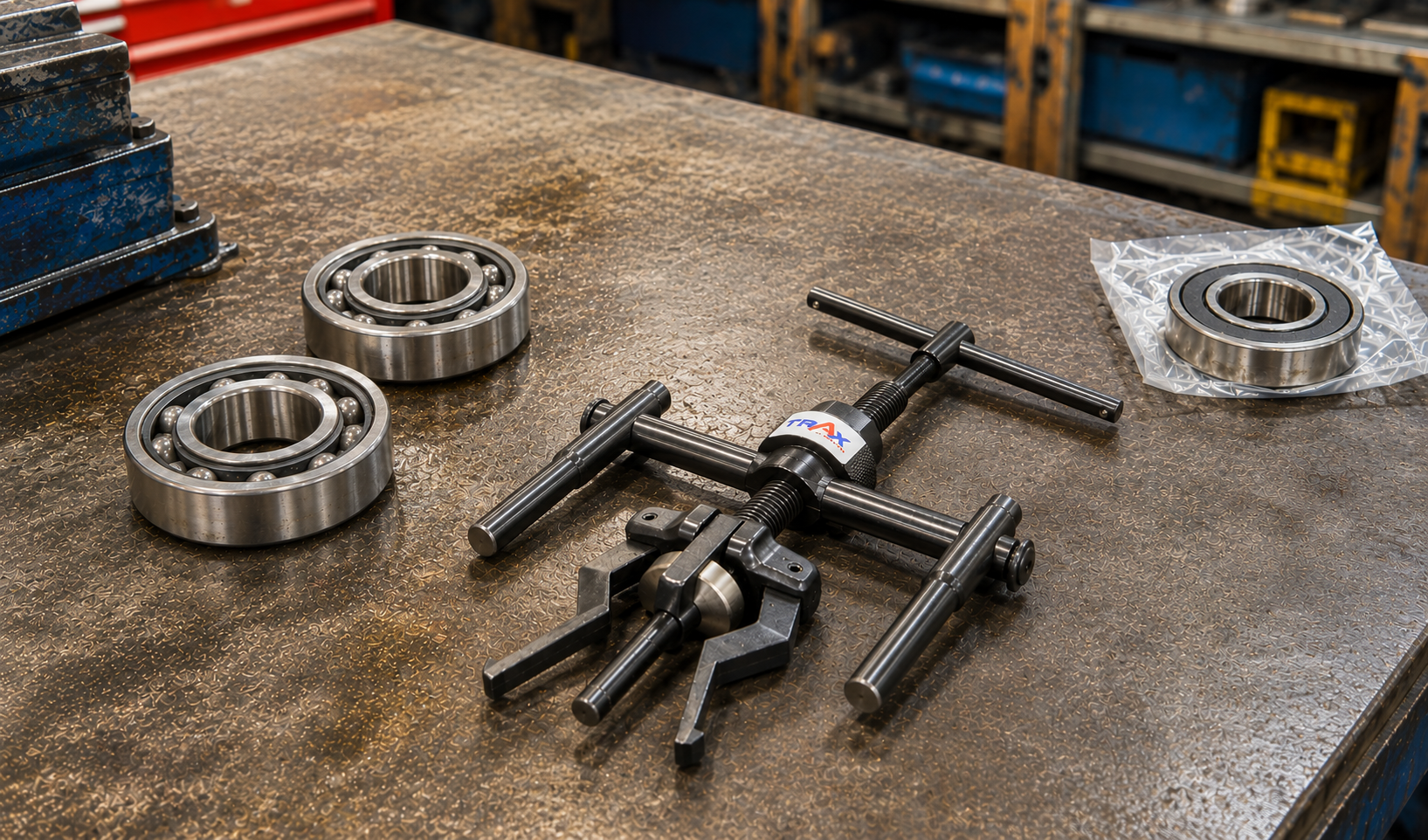
What Is a Bearing Puller and When You Need One
A bearing puller is a mechanical extraction tool used to remove a bearing from its mounting — whether that's a shaft, a housing bore, or a hub — without damaging the bearing seat, the shaft, or the surrounding components. Bearings are press-fitted (interference-fitted) into their seats during manufacture; the same interference fit that holds them in place under load also makes removal impossible with hand pressure or a hammer alone. A bearing puller applies controlled, axial force precisely where it's needed, breaking the friction grip and walking the bearing off the shaft or out of the bore in a controlled motion.
See the AIMS Bearing Brand Comparison guide for a full honest breakdown of the Japanese Tier-1 brands (NACHI, NSK, Koyo, NTN) plus specialty brands including Timken and McGill.
Bearings need pulling for three core reasons: scheduled replacement (a bearing has reached its service life and is being swapped before failure), repair after failure (a damaged bearing has seized, vibrated, or run hot and needs to come out so a new one can go in), and access for other work (a bearing is in the way of repairing or replacing another component, and must be temporarily removed). All three are routine in Australian workshops, manufacturing plants, mines, agricultural operations, and on the home garage floor.
The right puller for the job depends on three factors: where the bearing sits (on a shaft, in a blind bore, in a through-bore, in a wheel hub), what's accessible (can you grip the outer race, the inner race, the bore, or only one face), and how much force is required (light press fit on a small bearing, or hydraulic-grade force on a large industrial pillow block). This guide covers all four major puller types, how to choose between them, and which AU-stocked products suit which application.
The full AIMS Industrial bearing puller range — including external jaw pullers, internal slide hammer kits, blind hole extraction sets, and 1-ton hydraulic-class pullers from Trax — is in the Bearing Pullers collection.
The 4 Main Bearing Puller Types — Quick Decision Guide
Industrial supply across Australia stocks four core bearing puller types, each optimised for a different access condition. The decision tree is straightforward once you understand which face of the bearing you can reach.
| Puller type | Access required | Best for | AIMS-stocked example |
|---|---|---|---|
| External jaw puller | Outer race face accessible (jaws hook behind it) | Bearings on shafts where outer race can be gripped from behind | Trax Large Ball End Bearing Puller Kit (ARX-OR705L) |
| Internal puller | Inner race face accessible from one side, jaws expand into the bore | Bearings in housings where outer race is buried, inner race is exposed | Trax Internal Bearing Puller Set 3pc (ARX-YC610) |
| Blind hole / slide hammer puller | Only the bearing's inner-race front face is accessible (no rear access) | Bearings in blind bores — spigot/pilot bearings, blind motor bores, gearbox housings | Trax Blind Bearing Puller Kit (ARX-YC675) |
| Hydraulic puller | External or internal access PLUS heavy seizure or large bearing | Large industrial bearings, badly seized bearings, pillow blocks, heavy plant | Specialty industrial pullers (specify by capacity) |
An accompanying class — bearing separators — is sometimes counted as a fifth type. Separators destroy the bearing during removal (the cage and balls/rollers are sacrificed) but provide grip when no jaw or slide-hammer puller can engage. Useful as a last resort and covered in a later section.
External Pullers — 2-Jaw, 3-Jaw and Reversible
The external jaw puller is the most familiar bearing extraction tool in Australian workshops. A central forcing screw threads through a yoke; two or three legs (jaws) hang from the yoke and reach behind the bearing. Tightening the forcing screw drives the screw point against the end of the shaft while the jaws pull the bearing toward the yoke — extracting it cleanly off the shaft.
2-jaw pullers

A 2-jaw puller has two jaws on opposite sides of the bearing, applying force along a single axis. Suited to applications where there is clearance behind the bearing on opposite sides but not on all three sides — common on flywheel bearings, machine tool spindles, and some gearbox bearings. The 2-jaw configuration is more compact than a 3-jaw and fits into tighter spaces, but applies asymmetric load — if the bearing isn't dead-square to the puller axis, it can cant during extraction.
3-jaw pullers

The standard general-purpose external puller. Three jaws spaced 120° apart distribute load symmetrically around the bearing, eliminating the cant risk. Self-centring under load. The default choice for most external bearing extraction work — pulleys, sprockets, gears, and bearings on accessible shafts.
Reversible pullers
A reversible puller has jaws that can flip — gripping inward (external pull) or outward (internal pull). Effectively two pullers in one tool. Compact, versatile, and suit garage and field-service applications where carrying multiple dedicated pullers isn't practical. The Grip® Internal and External Puller Kit stocked at AIMS is a reversible-style set covering both pulling modes in one kit — ideal for the workshop that handles a mix of jobs.
| External puller | Capacity (typical) | Best for |
|---|---|---|
| Small reversible 2-jaw (75–100 mm reach) | 0.5–1 ton | Garage, motorcycle, small machinery |
| Standard 3-jaw (100–200 mm reach) | 1–3 ton | Automotive, light industrial, agricultural |
| Heavy 3-jaw (200–300 mm reach) | 3–10 ton | Heavy industrial, mining, marine |
| Twin-ball / large-ball end | 5–15 ton | Large diameter pulleys, sheaves, sprockets |
The Trax Large Ball End Bearing Puller Kit (ARX-OR705L) is a heavy-duty external puller designed for larger pulleys, sheaves, and heavy-industrial bearings — twin-ball end engagement gives positive grip on radiused or chamfered bearing back faces. The Trax 19–35 mm Bearing Puller 1 Ton (ARX-AB1) is the small-bearing equivalent — 1-ton capacity, 19–35 mm bearing diameter range, ideal for motorcycle, automotive, and small machinery.
Internal Bearing Pullers — Inner Race Pullers
An internal puller (also called an inner race puller or inside puller) extracts a bearing where the outer race is inaccessible — buried in a housing, pressed into a hub, or otherwise unreachable from behind. The puller's collet or expanding jaw inserts into the bearing's inner bore, expands to grip the inner race, and a separate slide hammer or threaded stud applies extraction force.
Two main designs:
Threaded forcing internal puller
A central threaded shaft with an expanding collet on one end. Insert the collet into the bearing bore, tighten an expanding nut to lock the collet against the inner race, then thread a forcing screw against a backing plate to drive the puller (and bearing) outward. Slow, controlled, predictable force — preferred for delicate work where slide hammer impact would damage adjacent components.
Slide hammer internal puller
Same expanding collet engagement, but extraction force comes from a slide hammer (a heavy weight that slides along a shaft, striking against an end stop). Each strike imparts an impact force often measured in thousands of pounds-force. Faster than threaded pullers, particularly on stuck bearings — but the impact load can damage adjacent bearings, seals, or thin housings if not controlled.
The Grip® Inner Bearing Puller Set, 5 Pieces stocked at AIMS is a typical threaded forcing internal puller — five collet sizes covering the common bearing bore range, with a quality slide hammer for impact-driven extraction. Heat-treated drop-forged components and black oxide finish — professional-grade tool. The Trax Internal Bearing Puller Set (ARX-YC610) is a 3-piece slide-hammer-driven internal puller for larger bearings.
Blind Hole and Pilot Bearing Pullers — Slide Hammer Type

A blind hole bearing is a bearing in a bore that's closed at one end — no access from behind. Common examples: pilot bearings (also called spigot bearings) in the back of a vehicle crankshaft that support the front of the gearbox input shaft; blind alternator bearings; distributor and water pump bearings on older vehicles; some gearbox layshaft bearings. You can't reach behind them with a jaw puller. You can't push them through the bore. The only way out is forward — pulling the bearing toward you. Drawn cup needle bearings — the thin-walled stamped type used in transmission shafts, motorcycle clutch baskets and U-joint caps — are particularly common in blind-hole applications and almost always destroyed in removal; see our Needle Roller Bearing Guide for needle bearing replacement guidance.
How a blind hole puller works
A blind hole bearing puller has an expanding collet sized to the bearing's inner bore. The procedure:
- Select the collet size that matches the bearing's inner bore diameter
- Insert the collet into the bearing
- Drive an expanding wedge or thread an expanding nut to lock the collet against the inner race
- Connect the slide hammer to the puller shaft
- Operate the slide hammer — the impact pulls the puller (and bearing) toward the operator
- The bearing walks out of the blind bore in stages until it clears
Pilot / spigot bearing applications
Pilot bearings (the term used in North American mechanic vernacular) and spigot bearings (the equivalent UK and AU term — same component) are AU automotive workshop's most common blind-hole extraction job. The pilot bearing sits in a recess at the rear of the crankshaft and supports the gearbox input shaft. When replacing a clutch — the most common reason to access this area — the pilot bearing is routinely changed at the same time.
A 3-jaw pilot bearing puller (like the Repco RST175 or equivalent) is one specific design — three legs are fed into the bearing bore, expand against the inner race, and a slide hammer impacts to extract the bearing. Designed specifically for the 19–38 mm pilot bearing range common in AU vehicles.
The full slide hammer kit
For workshops handling a range of blind-hole jobs — pilot bearings, alternator bearings, oil seals, bushings, flange-type axles — a comprehensive slide hammer kit is the better investment than individual pullers. The Grip® Slide Hammer Kit at AIMS is exactly this — slide hammer with multiple adapters covering common bore sizes, oil seal extractors, and bushing pullers in one case. The Trax Slide Hammer Puller Set (13Pc, ARX-YC701/13) is a more comprehensive 13-piece kit for the heavier-duty workshop.
Hydraulic Bearing Pullers — Heavy-Duty Industrial

For large bearings (typically over 100 mm bore) or badly seized bearings that resist mechanical pullers, hydraulic pullers apply force via a hydraulic cylinder rather than a forcing screw. Hand-pump or air-driven hydraulic actuation can deliver 10, 20, 50 tons of pulling force or more — enough to move bearings that have galled into their seats from corrosion, heat damage, or wrong-fit installation.
How hydraulic pullers work
The hydraulic puller's body replaces the threaded forcing screw with a hydraulic ram. A hand pump (or air-driven pump) pressurises the cylinder; the ram extends, applying axial force to the puller. Jaws or a centring spider distribute load to the bearing. The operator monitors a pressure gauge to know how much force is being applied — a critical safety feature when working with large bearings that can release suddenly with high stored energy.
When hydraulic is justified
- Bearing diameter above 100 mm — mechanical pullers run out of practical force
- Visibly seized bearings (corrosion in the seat, heat-galled inner race)
- Large pulleys / sheaves stuck on driveshafts
- Industrial pillow block and split-housing bearings
- Mining, marine, agricultural drive shaft applications
- Production settings where mechanical pullers have failed and downtime is expensive
Hydraulic pullers are higher-cost capital tools — typically purchased by maintenance departments rather than mobile mechanics. AIMS supplies industrial-grade pullers across the capacity range; for specific application sizing, contact our team via /pages/contact.
Wheel Bearing Pullers — Automotive Use
Wheel bearings are the most common bearing replacement job in Australian automotive workshops. The bearings sit in the wheel hub, support the axle, and carry both radial load (vehicle weight) and axial load (cornering forces). They wear and need replacement every 100,000 to 250,000 km depending on vehicle, driving conditions, and whether the bearings have been re-greased on schedule.
Front wheel bearing extraction
Front wheel bearings on most AU passenger cars are integrated bearing+hub assemblies — the bearing is pressed into the hub housing and is replaced as a complete unit. Extraction requires:
- Removing the wheel, brake calliper, and brake disc
- Removing the axle nut and disconnecting the lower ball joint
- Pressing the wheel hub assembly out of the steering knuckle (often requires a specific bearing press or a slide hammer with hub adapter)
- Pressing the bearing race out of the hub (workshop press required for most makes)
Front wheel bearing pullers are typically slide-hammer-based with vehicle-specific hub adapters. Generic 3-jaw pullers struggle on integrated hub assemblies because the hub flange surrounds the bearing. The Trax wheel bearing puller range and equivalent purpose-built kits address the integrated-hub challenge with adapter sets.
Rear wheel bearing extraction
Rear wheel bearings on rear-wheel-drive vehicles, on trailers, and on caravans/RVs are typically separate bearing assemblies pressed into a hub — extractable with conventional internal pullers and slide hammers. Trailer and caravan wheel bearing replacement is one of the most common DIY-mechanic jobs in Australia, particularly approaching Christmas-and-Easter caravan-touring season.
The wheel bearing puller buyer landscape — Bunnings, Supercheap, Repco, AIMS
AU customers searching for wheel bearing pullers commonly compare retail tool stores. The retail stack runs:
- Bunnings — DIY-grade, mostly Daytona / VEVOR brand kits, typically 1-ton capacity, suitable for occasional use on small bearings
- Supercheap Auto and Repco — automotive-focused retail, Toledo and house-brand kits, mid-range capacity, suitable for one-off automotive jobs
- Sydney Tools and Total Tools — tradie-grade, broader brand range (Sykes-Pickavant, OTC, Toledo professional)
- AIMS Industrial — industrial / professional-grade, Trax and Grip® brands, with extended capacity range, designed for repeated workshop use rather than DIY-occasional use
The AIMS positioning: workshop-grade pullers designed to be used hundreds of times across years of service, not consumer-grade pullers designed for the once-per-decade home job. If you're a workshop, agricultural operator, mining maintenance department, or commercial fleet operator buying pullers as workshop infrastructure — AIMS is the right tier. If you're a one-time home job on the family car, Bunnings or Repco DIY kits will get you through.
Bearing Separators — When You Have to Sacrifice the Bearing

When no jaw, internal, or slide hammer puller can engage — for example, when a bearing has no accessible inner-race face, no usable outer-race face, and no internal bore that a collet can grip — the only remaining option is a bearing separator (also called a bearing splitter).
A bearing separator is a clamping plate-and-screw assembly that grips the bearing across its outside diameter — the two halves of the separator clamp together with through-bolts, biting into the bearing's outer race or cage. The separator is then engaged by an external puller's jaws. The bearing comes apart during extraction — the cage shears, balls or rollers fall out, the inner race may separate from the outer race — but the bearing comes off the shaft.
When to use a separator
- The bearing has no accessible face for jaw or collet engagement
- The bearing is dead anyway (already failed, scheduled for replacement) — destruction during extraction is acceptable
- A new bearing is on hand and ready to install
- No other puller in the workshop has worked
Don't use a separator on a bearing you intend to reuse. The clamping force damages the bearing irreversibly. The separator is a destructive last-resort tool, not a primary extraction method.
The Selection Decision Tree — Which Puller for Which Job
The decision tree to follow when selecting a bearing puller for a specific job:
| Step | Question | Yes | No |
|---|---|---|---|
| 1 | Is the outer race rear face accessible (can a jaw hook behind it)? | External jaw puller (2- or 3-jaw) | Go to step 2 |
| 2 | Is the inner race accessible from one face, with the bore open? | Threaded internal puller (controlled force) | Go to step 3 |
| 3 | Is there only ONE accessible face (blind bore)? | Slide hammer / blind hole puller | Go to step 4 |
| 4 | Is the bearing >100 mm bore OR badly seized? | Hydraulic puller (specify capacity) | Go to step 5 |
| 5 | Is the bearing dead and replacement on hand? | Bearing separator (destructive) | Stop — call a specialist (heat / induction / press) |
The "stop and call a specialist" outcome at step 5 is genuinely the right answer when the application defies all five tool types. Some bearings — particularly bearings galled in by serious corrosion or heat damage — need induction heating or a hydraulic press to release. Forcing extraction with the wrong tool damages the shaft, the housing, or the operator.
How to Use a Bearing Puller — Step-by-Step Procedure
Generic procedure for bearing extraction. Specific tool documentation may vary slightly — always read the manufacturer's instructions for the puller you're using.
Step 1 — Prepare the work area
- Isolate any electrical or hydraulic power on the equipment
- Remove guards, retainers, snap rings, lock washers — anything holding the bearing axially
- Wire-brush the bearing's outer face to expose the rear race for jaw access
- If the bearing has been seized for a long time, apply penetrating oil overnight before pulling
Step 2 — Select and check the puller
- Select a puller rated for the bearing diameter and the expected pull force
- Inspect the jaws / collet for cracks, deformed hooks, or worn threads — discard damaged tools
- Apply anti-seize compound or oil to the forcing screw threads
Step 3 — Position the puller
- External puller: hook the jaws behind the bearing's outer race, with the forcing screw centred on the shaft end
- Internal / blind hole puller: insert the collet, expand to grip the inner race firmly
- Confirm the puller is square to the shaft — any cant pulls the bearing crooked
Step 4 — Apply force progressively
- Forcing-screw pullers: tighten the screw quarter-turn at a time, watching for movement
- Slide hammer pullers: start with light strokes; increase intensity if the bearing doesn't move
- Hydraulic pullers: pump slowly, monitoring pressure gauge; pause if pressure rises without movement (re-check grip)
- Apply heat to the bearing's surrounding housing (gentle blowtorch on the housing, not the bearing) if the pull stalls — thermal expansion of the housing eases the bearing's grip
Step 5 — Extract and inspect
- Once the bearing breaks free, walk it off the shaft progressively — don't yank
- Inspect the shaft for galling, scoring, or fretting (these need correction before installing the new bearing)
- Check the housing bore for wear or out-of-round (worn housings cause repeat bearing failure)
- For shaft preparation guidance, see our Rolling Bearings Guide
Once the old bearing is out, how you install and maintain the replacement determines how long it lasts. The Bearing Maintenance Guide covers lubrication intervals, inspection methods and contamination control for all common industrial bearing types. To identify the replacement bearing number or match it across brands — SKF to NTN, NSK to Koyo, NACHI and FAG equivalents — use the AIMS Bearing Cross Reference Guide.
Common Problems and Solutions
Problem: Jaws keep slipping off the bearing
Most common cause: jaws aren't biting cleanly behind the bearing's outer race. Solutions: switch to a 3-jaw puller (more even load distribution); re-position so jaws hook deeper; use a smaller-reach puller with sharper hooks; clean rust or scale from the bearing's rear face so jaws can grip cleanly.
Problem: Bearing won't move even at full force
The bearing has galled into its seat. Solutions: apply penetrating oil and leave overnight; apply gentle heat to the surrounding housing (not the bearing — hot bearing expands harder into the seat); switch to a higher-capacity puller (or hydraulic) if the issue is force rather than seizure; if the bearing is dead anyway, switch to a separator and accept destructive removal.
Problem: Shaft is bending or damaging during pull
Cause: puller force is being concentrated on the shaft's end face. Solutions: place a hardened steel cap or button between the forcing screw and the shaft to spread load; check the shaft end for square — a chamfered or burred end deflects screw force; reduce force and apply heat to housing instead; if shaft end is already damaged, address that before installing new bearing.
Problem: Slide hammer not generating enough force
Cause: slide hammer mass too light for the application. Solutions: use a heavier slide hammer (most kits include multiple weights); increase stroke (longer slide travel = more impact velocity); switch to a threaded forcing puller for steady high force.
Problem: Bearing comes off but inner race stays on shaft
Common with badly worn or two-piece bearings — cage and balls extract, inner race remains seized on shaft. Solutions: use a bearing separator clamped behind the inner race (it's now accessible), then pull with external puller; or carefully grind a relief slot in the inner race (controlled depth — don't damage the shaft) and split the inner race off with a chisel.
Problem: Puller cant during extraction (bearing comes off crooked)
Cause: forcing screw not aligned with shaft axis, jaws unevenly engaged, or 2-jaw puller used where 3-jaw was needed. Solutions: re-position the puller for symmetric grip; switch to 3-jaw; insert a centring cup or button under the forcing screw to keep it on the shaft axis.
Alternatives When You Don't Have a Puller
The hard answer: there are alternatives, but most professionals recommend buying or borrowing the correct puller for any non-trivial extraction. Improvised methods damage components more often than they succeed. With that warning stated, the legitimate alternatives:
Heat (induction or torch)
Thermal expansion of the bearing's surrounding housing eases the bearing's grip. An induction heater (the gold-standard professional method) heats only the bearing or only the housing in seconds, with precise temperature control. A propane or oxy-acetylene torch achieves similar results on accessible work but with less control — risk of overheating the bearing's hardened race (above 120°C the race tempers and is ruined; the new bearing must be installed cold).
The torch method works best when combined with a basic puller — heat first, pull immediately while the housing is expanded. For applications with no puller available, heat alone may walk the bearing out far enough to grip with pliers or a screwdriver — destroying the bearing in the process.
Hydraulic press
If the component (shaft, hub, or housing) can be removed and brought to a workshop press, the press can drive the bearing out with controlled axial force. Far safer than slide-hammer impact for delicate components, and the press can apply far more force than any portable puller. The press is the workshop-installed equivalent of a hydraulic puller — preferred for repeat work and large bearings.
The "wrong tool" workarounds
Workshop folklore includes various bodge jobs:
- Hammer and drift — striking the bearing's inner race directly through a soft drift. Sometimes works for a free-fit bearing; usually damages the bearing or the shaft.
- Threaded rod through bearing — making a temporary internal puller from threaded rod, washers, and nuts. Possible but laborious; torque limits usually too low for stuck bearings.
- Chain through housing — wrapping a chain around the bearing's outer race and pulling with leverage. Distorts the bearing and rarely succeeds on press-fit bearings.
None of these are recommended — they damage components, take longer than just buying the right puller, and frequently fail. AU bearing puller kits start at well under $100 (the Trax 1-ton 19–35 mm puller); buying the right tool is almost always the better outcome.
Bearing Puller Brands in Australia
The AU bearing puller market spans consumer DIY kits to industrial-grade professional tools. The brands cluster into four broad tiers:
| Tier | Brands | Where to buy | Best for |
|---|---|---|---|
| Consumer / DIY | Daytona, VEVOR, ChgImposs, OEM-generic | Bunnings, Amazon AU, eBay | Once-per-decade home job |
| Mid-range automotive | Toledo, TTI house brands, Kincrome | Supercheap Auto, Repco, Total Tools | Occasional automotive workshop jobs |
| Tradie / professional | Trax, Grip®, Sykes-Pickavant, OTC, SP Tools | AIMS Industrial, Total Tools, Sydney Tools | Daily workshop and industrial use |
| Premium industrial | SKF, Stahlwille, Klann | Industrial bearing specialists, AIMS | Heavy industrial, mining, marine |
Trax — Australian-distributed brand specialising in workshop-grade automotive and industrial extraction tools. The ARX series numbers (ARX-OR705L, ARX-YC610, ARX-AB1, ARX-YC701/13) appear across the AIMS Trax range and identify specific kit configurations. Designed for repeated workshop use — heat-treated forgings, hardened threads, properly-rated slide hammers.
Grip® — broader hand-tool brand with strong representation in bearing pullers, slide hammers, and adapter sets. Heat-treated drop-forged components, black oxide finish for corrosion resistance. Stocked at AIMS for the workshops that want professional-grade tooling without specialty-brand pricing.
Toledo — Australian wholesale brand (distributed via Tridon). Common in automotive workshops and chain stores. Mid-range capacity and capability.
Sykes-Pickavant — UK-origin professional tools, distinctive yellow housing. Premium pricing; distributed via Total Tools and trade channels.
OTC / Stant — US automotive/industrial premium brand. Common in heavy-truck, agricultural, and mining workshops where OE-spec tooling matters.
SKF — Swedish bearing manufacturer with a comprehensive puller range matched to their bearing catalog. Premium positioning; suit applications where SKF bearings dominate (heavy industrial, food processing, marine).
AIMS Industrial Bearing Puller Range
The AIMS bearing puller range covers external jaw pullers, internal pullers, blind-hole slide hammer kits, and small-bearing specialty pullers. All stocked items are workshop / professional-grade — not consumer-DIY tier — selected for repeated industrial use.
External pullers — heavy duty
- Trax Large Ball End Bearing Puller Kit (ARX-OR705L) — twin-ball end engagement for large pulleys, sheaves, and heavy industrial bearings
Small-bearing pullers
- Trax 19–35 mm Bearing Puller 1 Ton (ARX-AB1) — compact 1-ton puller for motorcycle, automotive, and small machinery bearings
Internal / inner race pullers
- Trax Internal Bearing Puller Set 3-piece (ARX-YC610) — slide-hammer-driven internal puller for the common bearing bore range, heat-treated forged collets, professional-grade tooling for larger bearings
Blind hole and slide hammer kits
- Trax Blind Bearing Puller Kit (ARX-YC675) — slide-hammer-driven kit with multiple adapters for blind-hole bearings, pilot bearings, and bushings in one case
- Trax Pilot Bearing Puller (ARX-PB1238, 12–38 mm) — dedicated pilot bearing puller for the common automotive pilot bore range
- Trax Alternator Bearing Puller (TOP-ATP3252, 32–52 mm) — specialty puller for alternator bearings
Reversible internal/external kits
- Trax 3-Way Bearing Puller Kit (ARX-OR705-2) — versatile reversible-jaw kit covering both internal and external pulling with one tool
Browse the full range
- Bearing Pullers collection — dedicated bearing puller sub-collection
- Pryers & Pullers parent collection — broader pulling and pry-bar range
Companion product guides
- Rolling Bearings Guide (Art 14) — bearing types, selection, fitting, and failure modes; the bearings hub
- Linear Bearing Guide (Art 199) — linear motion bearings, LM series, rail-guided bearings
- Pulley Types Guide (Art 165) — V-belt sheaves and pulleys (which are pulled with the same external pullers)
- Taper Lock Bush Guide (Art 172) — taper-lock bushes have specific extraction procedures distinct from pressed-fit bearings
Frequently Asked Questions
What is a bearing puller called?
The same tool is called several things depending on the context. "Bearing puller" is the most common general term in Australia. "Gear puller" describes the same tool used on gears and pulleys (the puller works the same way regardless of what's being extracted). "Jaw puller" refers specifically to external pullers with hooked legs. "Inner race puller" or "internal puller" or "inside puller" describe pullers with expanding collets that grip the bearing's inner bore. "Blind hole bearing puller" or "slide hammer puller" describe the tools designed for blind-bore extraction. "Bearing separator" or "bearing splitter" refers to the destructive clamping tool used as a last resort. All are types of bearing puller — the right name follows the application.
How to pull a bearing out without a puller?
The legitimate alternatives, in rough order of preference: (1) heat the surrounding housing with an induction heater or a propane torch (thermal expansion eases the bearing's grip — combine with any available pulling method while housing is hot); (2) use a hydraulic press if the component can be removed and brought to a workshop press; (3) borrow or hire a proper puller — bearing puller hire from tool libraries and hire shops costs a fraction of a damaged shaft. The "wrong tool" methods (hammer and drift, chain leverage, threaded rod improvisations) damage components more often than they succeed and are not recommended for non-trivial bearings. Buying a basic 1-ton puller (Trax ARX-AB1 or equivalent) costs less than $100 and is the better outcome for most situations.
What is an alternative to a bearing puller?
Three legitimate alternatives, none of which fully replace a puller for all applications: (1) induction heater — heats the bearing's housing for thermal expansion-assisted extraction; the professional preferred method when extreme force is needed; (2) hydraulic press — workshop-installed press applies controlled axial force when the assembly can be brought to it; superior to any portable puller for press-fit bearings on removable shafts; (3) bearing separator — destructive clamping tool that grips the bearing's outer surface; suits cases where no puller can engage and the bearing is dead anyway. For most workshop situations, the right answer is to use the right puller for the access conditions; alternatives are situational supplements rather than substitutes.
What are common problems when using a bearing puller?
The most common problems and their fixes: (1) jaws slip off the bearing — switch to 3-jaw, hook deeper, clean rust off the rear face; (2) bearing won't move at full force — apply penetrating oil overnight, heat the housing, switch to higher-capacity or hydraulic puller; (3) shaft bending under pull — place hardened steel cap between forcing screw and shaft, reduce force and rely on heat; (4) slide hammer not generating enough force — use heavier slide hammer or longer stroke, switch to threaded forcing puller for steady high force; (5) inner race stays on shaft after bearing comes off — use bearing separator behind the inner race; (6) puller cants during pull — re-position for symmetric grip, switch from 2-jaw to 3-jaw. Most problems trace to wrong-tool selection or insufficient preparation; the fix is usually returning to step 1 of the procedure rather than forcing the wrong setup.
What is the difference between an internal and external bearing puller?
An external puller has hooked legs (jaws) that grip the bearing from the outside — hooking behind the bearing's outer race face — and a forcing screw that drives extraction force against the end of the shaft the bearing sits on. An internal puller has an expanding collet that fits inside the bearing's inner bore — locking against the inner race — with extraction force applied via a slide hammer or a threaded forcing screw acting against an external backing plate or housing. Use external when you can hook behind the bearing; use internal when you can only access from one side of the assembly. Reversible pullers (jaws that flip) handle both modes in a single tool — useful for workshop-grade kits that need to cover varied jobs without owning multiple dedicated pullers.
What is a blind hole bearing puller?
A blind hole bearing puller is a specialty extraction tool designed for bearings sitting in closed-end bores with no rear access — pilot bearings (also called spigot bearings) in vehicle crankshafts, blind motor bearings, alternator bearings, and similar applications. The puller's expanding collet inserts into the bearing's inner bore from the open face, expands to grip the inner race, and a slide hammer connected to the puller shaft applies impact force to pull the bearing toward the operator. The bearing walks out of the blind bore in stages until it clears the housing. The Grip® Slide Hammer Kit and Trax 13-piece slide hammer set stocked at AIMS are typical professional-grade blind hole pullers covering the common AU bearing range.
How does a slide hammer bearing puller work?
A slide hammer is a heavy weight (typically 1–3 kg) that slides along a central shaft, with end stops at each end of the slide travel. The operator pulls the weight rapidly along the shaft and lets it impact the end stop — the impact force transfers through the puller shaft to the bearing being extracted. Each impact delivers thousands of pounds of force in milliseconds. Slide hammers excel at breaking the initial friction grip on a stuck bearing and at driving extraction in confined spaces where a threaded forcing puller can't fit. They're also useful for bearing seals, oil seals, bushes, and dent-pulling automotive panels — the same impact-driven extraction principle. Be aware: slide hammer impact can damage adjacent components if used aggressively, and the operator's hand technique affects force consistency.
Which bearing puller for a wheel bearing?
The right wheel bearing puller depends on the vehicle. Modern AU passenger cars typically have integrated bearing-and-hub assemblies — the bearing is pre-installed in the hub and replaced as a complete unit; extraction requires a slide hammer with hub adapter or a vehicle-specific kit. Older vehicles, rear-wheel-drive layouts, trailers, caravans, and 4WD wheel hubs typically have separate bearings in a hub, extractable with conventional internal pullers and slide hammers (Trax Blind Bearing Puller Kit ARX-YC675, Trax 1-ton 19–35 mm ARX-AB1, or larger 3-piece kits cover the common range). For workshops servicing a fleet, a comprehensive slide hammer kit with multiple hub adapters is the right investment. For one-off jobs on a specific vehicle, vehicle-specific puller kits (purchased or hired) are often the practical choice.
What is a pilot bearing puller?
A pilot bearing puller (also called a spigot bearing puller) is a specialty blind-hole bearing puller sized for the small-diameter bearings (typically 19–38 mm bore) used as pilot bearings in the rear of vehicle crankshafts. Pilot bearings support the front of the gearbox input shaft when the clutch is disengaged. Replacing a pilot bearing is routine during clutch replacement — the most common AU automotive application for blind-hole pullers. Three-jaw pilot bearing pullers (Repco RST175 and similar) feed three legs into the bearing bore, expand against the inner race, and extract via slide hammer impact. The compact size and the specific 19–38 mm range distinguish pilot pullers from general blind-hole pullers; comprehensive slide hammer kits typically include a pilot-bearing-sized collet as one of several adapters.
Can I use a bearing puller on a pulley or sprocket?
Yes — bearing pullers and gear/pulley pullers are essentially the same tool. The 2-jaw and 3-jaw external puller architecture works equally well on V-belt pulleys, timing pulleys, sprockets, gears, and bearings — anything press-fit on a shaft. The Trax Large Ball End Bearing Puller Kit at AIMS is rated for both bearings and large pulleys. The puller jaws hook behind the component (whichever it is), the forcing screw drives against the shaft end, and the component walks off the shaft. The selection criteria — capacity, jaw reach, jaw count — apply identically. For pulley-specific extraction guidance, see our Pulley Types Guide.
What size bearing puller do I need?
Size selection by two factors: (1) bearing diameter — the puller must reach across the bearing and engage cleanly behind it; oversized pullers waste capacity, undersized pullers can't reach; (2) pulling force — most bearings need 0.5 to 5 ton extraction force; large industrial bearings need 10 to 50 ton (hydraulic). For motorcycle and small machinery (bearings 15–35 mm), a 1-ton puller (Trax ARX-AB1) suffices. For automotive (35–80 mm), 3-ton mid-range pullers cover most jobs. For light industrial (50–150 mm), 5-ton 3-jaw external pullers are the common workshop tool. For heavy industrial (above 150 mm), 10+ ton hydraulic pullers are typically required. When in doubt, a comprehensive workshop kit covering multiple sizes is more flexible than a single-size puller. AIMS stocks across the full capacity range — contact our team for application-specific sizing.
How much does a bearing puller cost in Australia?
Bearing puller prices span a wide range. Entry-level consumer pullers (Daytona, VEVOR, generic kits) at Bunnings, Supercheap, and online sellers run $50 to $150 for basic 2-jaw or small kit configurations. Mid-range automotive and tradie tools (Toledo, TTI, SP Tools, Trax 1-ton and 1.3-ton bearing puller kits) at automotive retailers and AIMS run $150 to $500 for kits and individual pullers. Professional / industrial-grade equipment (Sykes-Pickavant, OTC, larger Trax kits, comprehensive slide-hammer sets) runs $300 to $1500+. Premium industrial-grade and hydraulic pullers (SKF, Stahlwille, large hydraulic units) start at $1000 and run to $10,000+ for heavy industrial capacity. The price-quality relationship is real — DIY pullers fail at the wrong moment; professional kits last decades of workshop use. Match the tier to the use frequency.
Can a bearing puller damage the shaft?
Yes, if used incorrectly. Common shaft damage from bearing pullers: (1) forcing screw galling the shaft end (use a hardened steel cap or button between screw and shaft); (2) shaft bending from off-axis pulling (3-jaw pullers reduce this risk); (3) thread damage on shaft ends (don't drive screws against threaded ends); (4) galling on shaft surface from slide hammer impact (most common with internal pullers used on integrated hubs). Mitigation: select the right puller type for the access; align it square to the shaft; apply progressive force rather than maximum force; combine with heat to reduce required pull force; inspect the shaft after extraction and address any galling before installing the new bearing — see our Rolling Bearings Guide for shaft inspection criteria.
What is the difference between a bearing puller and a bearing separator?
A bearing puller extracts the bearing as a complete assembly — the bearing comes off intact and could potentially be reused (though replacement is usually preferred). A bearing separator destroys the bearing during extraction — the cage shears, balls or rollers fall out, and the inner and outer races may separate. The separator is two clamping plates with through-bolts that grip the bearing's outside surfaces; the assembly is then engaged by an external puller. Use the separator when no puller can engage the bearing's faces — common with bearings that have no accessible rear face for jaws and no internal bore for collets. The separator is the destructive last-resort tool, not a primary extraction method; only use it when the bearing is being scrapped anyway.
Where can I buy a bearing puller in Australia?
The AU bearing puller market spans four buying tiers: (1) DIY / home use — Bunnings, Supercheap Auto, Repco for entry-level kits; (2) automotive workshop — Repco, Total Tools, Sydney Tools for Toledo, Kincrome, and TTI house brands; (3) professional and industrial — AIMS Industrial for Trax and Grip® workshop-grade tools, dedicated Bearing Pullers collection at /tools/hand-tools/pryers-pullers/bearing-pullers/; (4) premium industrial — SKF distributors, specialty bearing tool importers for SKF, Stahlwille, Klann premium products. Match the supplier to the use intensity. For repeated workshop use (more than a couple of jobs per year), professional-grade tools from AIMS or equivalent industrial supplier outlast and outperform consumer pullers by years and prevent the component damage that the cheap pullers cause.
People Also Ask — Bearing Pullers
Q: When should I use a 2-jaw versus a 3-jaw bearing puller?
A 2-jaw puller provides higher pulling force per jaw for a given forcing screw load — making it better for very tight bearings and large-diameter applications where maximum force is needed. A 3-jaw puller distributes the pulling force more evenly around the bearing race and is less likely to slip off during extraction, making it more stable and suited to general workshop use. Where access is tight or the bearing has limited grip area, 2-jaw pullers are easier to position. For most workshop bearing and gear removal work, a 3-jaw puller is the preferred choice; 2-jaw pullers are selected for large press-fit bearings and where jaw clearance is restricted.
Q: Can I apply heat to help remove a stuck bearing?
Yes — controlled heat application can significantly reduce the force needed to remove a press-fit bearing by causing thermal expansion of the housing bore. Apply heat evenly to the housing (not to the bearing itself) using a heat gun or oxy-acetylene torch on a low flame, working in a circular pattern to avoid distortion. The goal is to expand the housing slightly, breaking the interference fit. Never apply heat directly to the bearing — heating the bearing raises its temperature relative to the shaft and will cause it to tighten further. Avoid heating near seals, lubricants, or flammable materials. On aluminium housings, moderate heat is sufficient due to aluminium’s high expansion rate.
Q: How do I protect the shaft end when using a bearing puller?
The forcing screw of a bearing puller bears directly on the shaft centre during extraction. Without protection, the screw point can damage the shaft centre bore or end face, which then interferes with further machining or reassembly with a lathe centre. A hardened protective cap or shaft protector cup placed between the forcing screw tip and the shaft end distributes the contact area and prevents marking. Many quality puller sets include a set of interchangeable shaft protectors in different diameters. Improvised protection using a hardened washer or brass pad also works. Inspect the shaft end after extraction and dress any marks before reassembly.
Q: What do I do when the inner race stays on the shaft after removing the bearing?
If the outer bearing assembly separates and the inner race remains on the shaft, a bearing inner ring puller (also called an internal bearing puller or bearing race separator) is required. This tool uses split wedge-shaped jaws that slide between the inner race and the shoulder or snap ring behind it, then expand to grip the inner race face. The forcing screw then drives against the shaft end to press the inner race off. Bearing race separators are available in sets covering a range of bore sizes. In some cases, a slide hammer with internal puller attachment is used instead of a pressing force, particularly where access behind the inner race is restricted.
Q: What is the difference between a pilot bearing and a spigot bearing, and how are they removed?
A pilot bearing (also called a spigot bearing or clutch pilot bearing) is a small bearing pressed into the centre of a flywheel or crankshaft flange to support the transmission input shaft nose. In automotive applications, they are typically small ball bearings or bronze bushes pressed into a blind bore — they cannot be reached from behind. Removal requires a slide hammer with an internal expanding collet that grips the inner bore of the bearing, or a dedicated clutch pilot bearing puller. A common improvised method uses a punch and grease packed into the bore — hydraulic pressure from tapping the punch forces the bearing out. This method works on bushes and smaller bearings in blind bores where the bore has no rear access.
For hand winches and cable pullers, see the AIMS manual winches range.
What is a hydraulic bearing puller and when is it worth it?
A hydraulic puller uses a hand or powered hydraulic ram instead of a screw to generate the pulling force, delivering far more controlled force with much less effort — worth it for large or seized bearings and for repetitive workshop use where a screw puller is slow and tiring. For occasional small bearings a mechanical screw puller is fine. See bearing pullers.
Should I heat a bearing to fit it, and how does that differ from removal?
For installation, controlled heating (an induction heater or oil bath to around 80-120°C) expands the inner race so it slides onto the shaft without force — the clean way to fit an interference-fit bearing. That's the opposite of removal, where a puller does the work. Never heat a bearing with an open flame or above the manufacturer's limit, as it destroys the hardness. See our bearing maintenance guide.
Can I reuse a bearing after pulling it off?
Generally no. Pulling force applied through the outer race (rather than the inner) brinells the raceways, and removal often damages the seals — so a pulled bearing should usually be replaced, not refitted. If a bearing must be reused, pull only on the race being removed from its fit and inspect it closely first. Browse replacement bearings.
A bearing that resists a puller more than expected may have been installed with a retaining compound rather than a straight press fit — worth checking before assuming corrosion is the only culprit. See our Loctite Retaining Compound Guide for how these compounds are applied and removed.

