

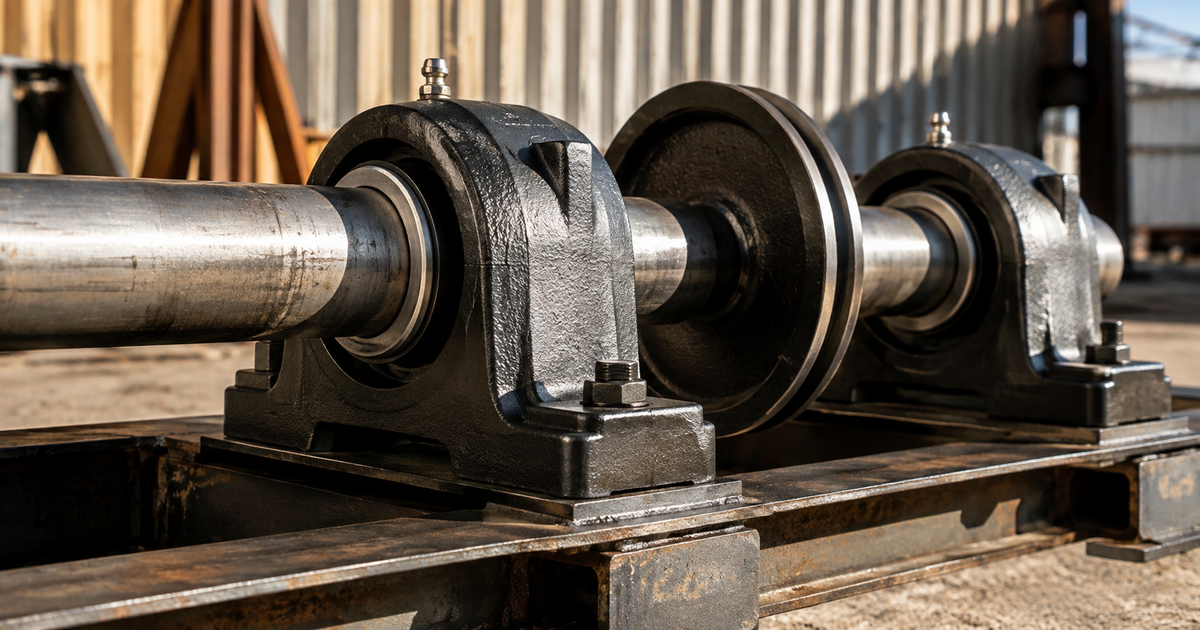
Pillow Block Bearings & Bearing Housings: A Complete Selection Guide
A pillow block bearing is one of the most common bearing assemblies in industrial machinery — a pre-aligned, self-contained unit that combines an insert bearing with a cast housing, ready to bolt directly to a structure. It is used wherever a rotating shaft needs a fixed support point: conveyors, fans, agricultural equipment, packaging machinery, pumps, gearbox output shafts, and hundreds of other applications. The appeal is simplicity: the bearing seats in a spherical housing bore, compensating for minor shaft misalignment without requiring machined journals, and the whole assembly mounts on a flat surface with two bolts.
Not sure which bearing brand suits your application? The AIMS Bearing Brand Comparison guide covers NACHI, NSK, Koyo, NTN and the specialty brands AIMS distributes for niche applications.
Despite that simplicity, pillow blocks fail regularly — and almost always for the same reasons: wrong locking method for the drive direction, incompatible greases, undersized bore, or a housing type selected for convenience rather than for the load direction and mounting surface. This guide covers the full picture: how the designation system works, which housing type suits which application, how to lock the bearing to the shaft correctly, how to grease it without causing failure, and when to use stainless or food-grade variants.
Whether you are replacing a failed unit, designing a new drive, or trying to understand why your current bearings keep failing, this guide gives you the engineering basis to select correctly and install it right first time.
What is a bearing housing?
A bearing housing is a rigid enclosure that holds a rolling-element bearing in a fixed position on a structure. The housing locates the bearing axially and radially, provides a sealing environment to retain lubricant and exclude contaminants, and transfers the shaft load to the mounting surface or frame.
In most industrial applications, the bearing housing is paired with an insert bearing (also called a bearing insert or Y-bearing) — a deep-groove ball bearing with a spherical outer race. The spherical outer race seats into a matching spherical bore in the housing, which is what gives the assembly its self-aligning capability. Small shaft deflections, thermal expansion, and minor installation errors are accommodated without inducing additional radial load on the bearing.
The housing itself comes in several forms depending on how the shaft is oriented and what surface the housing mounts to:
- Plummer block (split housing) — a two-piece housing with a removable cap; suited to heavy-duty applications and large shaft diameters where the shaft cannot be threaded through the housing.
- Cartridge unit — a close-tolerance housing designed to fit into a machined bore in a structure, providing accurate shaft location in both radial directions.
- Take-up unit — a housed bearing mounted in an adjustable frame (T-bolt or screw-adjust), used to tension chain, belt, or conveyor runs by sliding along slotted rails.
- Pressed steel housing — a lightweight, cost-effective alternative for lower-load, lower-speed applications (fans, agricultural, light conveyor work).
The vast majority of applications use cast iron or cast steel housings with UC-series insert bearings. This is the UC/UCP/UCF/UCFL family covered in detail below.
Pillow block vs plummer block: what is the difference?
In everyday industrial usage in Australia, "pillow block" and "plummer block" are often used interchangeably — but they refer to different things in engineering and in catalogue terminology.
A pillow block is a one-piece (solid) cast housing with two bolt holes in the base, designed to sit on a horizontal flat surface. The UCP series is the canonical pillow block. The term "pillow block" is common in American and Australian industrial usage.
A plummer block (also spelt "plumber block") is a split two-piece housing — a base and a cap joined by bolts. The split allows the bearing to be installed without threading the shaft through the housing, which is essential for large shaft diameters or where shafts cannot be disassembled. Plummer blocks (SN, SNH, SD series from major OEMs) accept adapter-sleeve mounted spherical roller bearings and are found in heavy-duty, large-shaft applications: aggregate crushers, mining conveyors, paper mills, and steel processing lines.
In everyday conversation, "plummer block bearing" and "pillow block bearing" are often treated as synonyms — and many suppliers use them interchangeably for solid UCP-type housings. For precision, a plummer block has a removable cap; a pillow block is solid. If you are working in heavy industry with shaft diameters above 60–80 mm, you are likely looking at a plummer block. Most light-to-medium industrial use (shafts 12–60 mm) uses solid UCP-type pillow blocks.
Bearing housing types explained
The UC-series bearing system uses a standardised insert bearing that fits into multiple housing types. This means the same insert bearing (e.g. UC205, 25 mm bore) can be ordered in a UCP, UCF, UCFL, or UCPA housing without changing the bearing insert itself. Understanding the housing types allows correct selection based on mounting surface and load direction.
| Designation | Common name | Mounting | Bolt holes | Typical use |
|---|---|---|---|---|
| UCP | Pillow block | Flat horizontal surface (base-mount) | 2 | Conveyors, fans, pumps — standard horizontal shaft support |
| UCF | Square flange | Vertical surface (wall or face-mount) | 4 | Wall or panel-mounted shafts, drives close to a vertical surface |
| UCFL | Oval flange | Vertical surface — compact footprint | 2 | Where space is limited; lighter-duty alternative to UCF |
| UCPA | Wide triangular flange | Vertical or angled surface | 3 | Less common; used where three-point mounting suits the structure |
| UCFC | Round flange | Circular face mount | 4 (circular pattern) | End-of-shaft mounting, circular flanged faces |
| UCTH / UCT | Take-up unit | Sliding adjustable frame | N/A (sliding) | Belt and chain tensioning, conveyor take-up stations |
| SN / SNH | Split plummer block | Flat surface, split cap | 2–4 | Heavy-duty large shafts, mining, aggregate, process industries |
UCP — the standard pillow block
The UCP is the most common bearing housing in light-to-medium industrial use. It mounts flat on any horizontal surface, accepts the shaft through the housing bore, and is held down by two bolts. The UCP is designed for shafts running horizontally or close to horizontal. Standard UCP housings in cast iron are suitable for most industrial environments. For exposed or washdown environments, pressed steel housings (UCPX) or stainless housings (SUCP) are alternatives.
UCF — square flange
The UCF is a square four-bolt flange unit designed to mount against a vertical surface — a wall, plate, gearbox face, or panel. The four-bolt pattern provides excellent load distribution and makes the UCF the preferred choice for wall-mounted shaft supports carrying moderate to higher loads. Because the housing mounts face-on, the shaft runs perpendicular to the mounting surface, which is the opposite geometry to a UCP.
UCFL — oval flange
The UCFL is the compact two-bolt alternative to the UCF. It occupies a smaller footprint on the mounting surface and is lighter. The trade-off is that with only two bolts, it is less rigid under high or cyclically varying loads. Use UCFL where space is constrained and loads are moderate. For higher-load face-mount applications, prefer UCF.
Insert bearing designations: the UC series
The insert bearing that sits inside the housing is designated with a UC prefix followed by a series number and bore code. Understanding the designation lets you order the correct bearing insert separately when only the insert has worn (the housing may be serviceable).
A typical designation: UC 205-16
- UC — deep-groove ball bearing insert with spherical outer race for housed-unit use.
- 2 — series (200 = light series, 300 = medium series — see bore sizing below).
- 05 — bore code. For the UC200 and UC300 series, the bore code × 5 gives the bore in millimetres. So UC205 = 25 mm bore, UC208 = 40 mm bore, UC210 = 50 mm bore.
- -16 — inch bore suffix. When an inch suffix appears, the bore is in inches: -16 means 1" bore. Inch-bore bearings look the same externally but are NOT interchangeable with metric-bore equivalents.
The locking method is also encoded in the designation. Insert bearings with a standard set screw carry no additional suffix. Bearings designed for use with an eccentric locking collar carry an E suffix (e.g. UC205E or EC205). Always confirm locking method when ordering replacements — the housing is the same, but the insert machining differs.
Bore sizing: 200 vs 300 series
The two most common UC insert bearing series are the 200 series and the 300 series. Both are available in the same bore sizes, but the 300 series has a larger outer race diameter, wider internal geometry, and higher static and dynamic load ratings.
| Series | Bore range | Load rating | Housing size | Typical use |
|---|---|---|---|---|
| UC200 | 12–60 mm | Standard | Compact | Light to medium loads, fans, conveyors, packaging, general machinery |
| UC300 | 12–80 mm | Higher | Larger for same bore | Higher radial loads, agricultural drives, heavier conveyor work |
In practice, a UC205 (25 mm bore, 200 series) and a UC305 (25 mm bore, 300 series) have the same shaft bore but different outer race diameters. They fit into correspondingly different housing sizes — a UCP205 housing will not accept a UC305 insert. When upgrading from 200 to 300 series for higher load capacity, the entire unit (housing + insert) must be replaced or the correct 300-series housing obtained.
Selecting the right housing for your application
Selecting a bearing housing is a four-factor decision: mounting surface, shaft orientation, load magnitude and direction, and environment. Work through these in order.
Mounting surface and shaft orientation determine the housing type. Horizontal shaft on a flat base: UCP. Shaft perpendicular to a wall or panel: UCF or UCFL. Shaft in an adjustable tensioning frame: take-up unit.
Load magnitude determines series (200 vs 300) and bore size. Confirm the shaft diameter first — the bore must match the shaft, with correct tolerance (see shaft fit section). Then check the dynamic load rating (C) and static load rating (C₀) in the bearing catalogue against your calculated radial load. As a rough guide: 200 series housings for loads up to 5–10 kN at the bearing; 300 series for higher. For shock-loaded, high-belt-tension, or heavy-conveyor applications, step up a series or use a spherical roller insert housing (Y-bearing or SN/SNH) rather than a ball insert.
Load direction matters for flange units. A UCF mounted on a wall carries predominantly axial load relative to the housing flange — ensure the housing is rated for this. UCF units are designed for this, but confirm maximum axial load in the catalogue for the specific size.
Environment determines materials and sealing. Standard cast iron with rubber seals suits clean, dry-to-moderate environments. Washdown (food, beverage, laundry, marine): use stainless SUCP or polymer housings. High-dust or abrasive (aggregate, mining, grain): specify units with double-lip seals or triple-lip (SLH) sealing. High-temperature (kilns, ovens): use high-temperature grease and confirm seal compound rating.
Locking methods: set screw vs eccentric collar
The locking method fixes the inner ring of the insert bearing to the shaft, preventing axial movement and ensuring torque is transmitted correctly. Two methods dominate standard housed-unit applications.
Set screw locking
Set screw locking uses one or two grub screws (set screws) threaded radially through the inner ring of the insert bearing. Tightening the screws presses directly against the shaft surface, locking the inner ring in place.
Advantages: Simple, low-cost, no additional components, works in either rotation direction. Limitations: The screws indent the shaft surface, making removal difficult and potentially damaging the shaft. Under heavy or shock loads, set screws can loosen, allowing the inner ring to creep on the shaft. Set screw locking is adequate for light-to-moderate, unidirectional, steady-load applications.
Eccentric collar locking
An eccentric locking collar is an asymmetric collar that fits over the bearing inner ring. When the collar is rotated in the direction of shaft rotation, its eccentricity causes it to cam inward, clamping the inner ring firmly to the shaft without indenting the surface. The collar is then locked with a set screw.
Advantages: Higher clamping force than set screws alone, less shaft damage, better performance under shock and variable loads. Better for oscillating or intermittent service where set screws would work loose.
An eccentric collar relies on shaft rotation to maintain its clamping force. The collar cams into the locked position when the shaft rotates in one direction. If the shaft reverses direction — even briefly — the eccentric action works in reverse, the collar uncams, and the inner ring becomes free on the shaft. This causes immediate fretting, rapid wear, and bearing failure.
Eccentric collar bearings must only be used on unidirectional drives. For reversing drives, bi-directional operation, frequent start/stop under load, or any application where the shaft may turn backwards (gravity rollback on inclines, backdriving pumps, reversing conveyors), use set screw locking or specify a bearing with an adapter sleeve.
Which to choose?
For steady, unidirectional, light-to-moderate loads: either works — set screw is simpler. For shock loads, vibration, higher torques, or oscillating service (unidirectional): eccentric collar is preferred. For reversing drives or any application where direction of rotation is uncertain: set screw only.
Shaft fit and housing tolerance
Getting the shaft-to-bore fit right is critical. Too loose, and the inner ring spins on the shaft (fretting corrosion, shaft wear, rapid bearing failure). Too tight, and the inner ring cannot be removed for maintenance, or the press fit reduces internal bearing clearance and causes premature fatigue.
For UC-series insert bearings with set screw or eccentric collar locking, the bore is made to a loose fit (H7 bore tolerance) — this is intentional. The mechanical locking provides the grip; the bore is not press-fitted. The correct shaft tolerance for this type of insert bearing is h6 or h9 — a clearance or light clearance fit. The shaft should slide into the bore with light hand pressure when the locking mechanism is released. If the shaft requires force to insert, the shaft is oversized for the bore.
For comparison: conventional press-fit bearing applications (where the bearing is driven onto the shaft with no mechanical lock) use interference fit shafts (k5 or m5), which close the internal clearance. Insert bearings are specifically designed not to require an interference fit — the locking mechanism does the job.
Shaft condition matters. The shaft surface in the bearing seating area must be clean, smooth (Ra ≤ 1.6 µm), and within the correct diameter tolerance. Corroded, scored, or undersize shafts will compromise locking even with correct procedure. Do not fit a new bearing onto a worn or corroded shaft without addressing the shaft surface first.
How to mount a pillow block bearing
Correct installation is what separates a bearing that lasts its rated life from one that fails within weeks. Follow this sequence.
- Inspect the shaft. Confirm diameter is within tolerance (h6/h9 for the bore size). Clean the seating area. Remove burrs, corrosion, and sharp edges with a fine file and emery cloth. Apply a thin film of clean oil or anti-seize to the shaft seating area — not thick grease, which prevents correct feel of the fit.
- Check the housing. Confirm housing mounting face is clean and flat. Check that the spherical bore is free of debris. Verify that the housing and insert bearing bore code match (200 series insert into 200 series housing, etc.).
- Position the housing loosely. Place both housings (or all housings on a shaft) on the mounting surface. Do not fully tighten any housing until all housings on the shaft are aligned.
- Slide the shaft through the housings. With the set screws/eccentric collar released, the insert bearing bores should accept the shaft with light hand pressure. Do not drive or hammer the shaft through.
- Align the housings. The self-aligning spherical bore compensates for minor angular misalignment, but does not correct gross positional misalignment. Ensure all housings are at the same height and that the shaft runs parallel to the mounting surface before tightening the housing base bolts.
- Tighten housing bolts. Tighten to the torque specified in the housing manufacturer's catalogue. Do not substitute a larger bolt without checking thread size — housing bolt bosses are sized for the specified bolt. Standard UCP cast iron housings: typically M10 or M12 bolts depending on housing size.
- Lock the bearing to the shaft. For set screws: tighten the set screws to the specified torque using the correct Allen key. Apply thread-locking compound (Loctite 243 or equivalent) to prevent vibration-induced loosening. For eccentric collars: rotate the collar in the direction of intended shaft rotation until it cams tight, then tighten the collar set screw.
- Check rotation. Rotate the shaft by hand. It should turn smoothly with uniform drag. Any roughness, grinding, or binding indicates a problem — misalignment, incorrect fit, or a damaged bearing.
- Grease if required. New housed units are typically pre-greased from the factory. If the housing has been opened, cleaned, or is a bare unit, fill to approximately one-third of the free space with the correct grease before operation.
Vertical shaft mounting
Standard UCP pillow block bearings are designed and tested for horizontal shaft operation. Mounting a standard UCP with the shaft running vertically is not forbidden, but it introduces a significant and often overlooked risk: grease starvation.
In a horizontal bearing, gravity helps distribute grease across the contact surfaces. In a vertically mounted bearing, grease pools at the bottom of the housing bore. Under operating conditions, the lower portion of the bearing can become over-greased while the upper portion — where the bearing is doing most of the work against gravity — runs progressively dry. This leads to premature wear, elevated temperatures, and failure that looks like under-greasing even when the housing has plenty of grease.
The solution for vertical shaft applications:
- Use a bearing unit specifically rated for vertical operation. Many manufacturers offer vertical-rated housed units with internal labyrinth or contact seals designed to retain grease against gravity.
- If using a standard UCP vertically, shorten the re-greasing interval significantly (at minimum halve the horizontal interval). Over-grease cautiously — pumping too much grease into a bearing already over-filled at the bottom causes seal damage and overheating.
- Consider a split plummer block with a proper lubrication circuit for high-speed or critical vertical applications.
Lubrication and re-greasing
Grease starvation is the leading cause of premature bearing failure. Under-greasing causes metal-to-metal contact and fatigue. Over-greasing causes churning, elevated temperature, and seal failure. The goal is correct fill quantity and correct grease type, renewed at the correct interval.
Grease type
Most major manufacturers pre-grease UC-series housed units with a polyurea-thickened (lithium-complex or polyurea base) grease — typically NLGI 2 consistency. This is a high-performance, high-temperature grease suitable for most standard applications. Common examples: SKF LGWA 2, NSK Grease LG2, NTN Uni-Temp.
For replacement greasing, suitable types include:
- Lithium-complex NLGI 2 — compatible with most pre-greased units, excellent load capacity, wide temperature range (−20°C to +150°C).
- Polyurea NLGI 2 — same base as factory fill, ideal for refilling polyurea pre-greased units. Good high-temperature performance.
- Calcium sulphonate NLGI 2 — excellent water resistance and corrosion protection; preferred for wet or washdown environments.
Not all greases are compatible with each other. Mixing incompatible thickener types causes the grease structure to collapse, producing a soft, oily fluid that does not stay in the bearing. The contact surfaces run unlubricated, and failure follows within hours to days.
The most commonly encountered incompatibility in Australian industrial maintenance: polyurea grease (factory fill) + lithium grease (top-up) = failure. Polyurea and standard lithium-thickened greases are incompatible — they produce a liquid mixture with no film strength.
If you do not know what grease is in a bearing housing, do not top up with a different grease type. Either purge the housing completely (pump in new grease until old grease appears at the purge fitting), or disassemble and clean before re-filling with the correct grease. A compatibility chart from your grease supplier will confirm which thickener types can be safely mixed.
Re-greasing interval
For standard UC-series pillow blocks in moderate industrial conditions (ambient temperature, clean environment, continuous operation):
- Light to moderate duty: every 2,000–4,000 hours of operation, or every 3–6 months (whichever is sooner).
- High temperature (>70°C housing surface): halve the interval.
- Dusty, wet, or abrasive environment: every 500–1,000 hours.
- Vertical mounting: halve the horizontal interval at minimum.
When re-greasing a housing fitted with a grease fitting (Zerk/Schrader), pump in small quantities slowly — typically 1–3 strokes on a standard grease gun. Pump whilst the machine is running if safe to do so; this distributes grease evenly. Do not pump until the bearing seal lips blow out. If the housing does not have a grease fitting, it is either pre-lubricated for life (lighter-duty units) or requires disassembly to re-lubricate — check the product data sheet. See the Grease Nipple Guide for thread-standard identification (BSP vs UNF vs NPT vs metric) when ordering replacement fittings.
Food-grade and stainless steel bearing housings
Standard cast iron housed units are not acceptable in food, beverage, pharmaceutical, or other hygienic processing environments. Three reasons: cast iron corrodes and contaminates product, standard greases are not approved for incidental food contact, and the housing geometry (recesses, bolt pockets) traps product and resists cleaning.
SUCP — stainless pillow block
The SUCP designation identifies a pillow block with both a stainless steel insert bearing and a stainless steel housing. The S prefix denotes stainless throughout — not just a stainless insert in a standard cast housing (which would be a different partial designation). SUCP housings are available in 304 and 316 grades. 316 grade is preferred for saline, acidic, or high-chloride environments (seafood processing, coastal, dairy with high CIP chemical concentrations).
Features of a proper food-grade housed-unit specification:
- Housing material: 304 or 316 stainless steel.
- Insert bearing: stainless inner and outer rings, stainless balls.
- Grease: NSF H1-registered grease (approved for incidental food contact). Common examples: Kluber Paraliq GTE 703, Molykote L-3462, Shell Cassida Grease RLS 2.
- Seals: FDA/EC-approved elastomer (EPDM or PTFE-lip seals).
- Surface finish: smooth, crevice-free — not standard cast finish. Look for housings specifically marketed as "hygienic design" or EHEDG-compliant for the most demanding food environments.
Some manufacturers offer polymer housings (glass-filled nylon or thermoplastic) as an alternative to stainless. Polymer housings are lighter, chemically resistant, non-sparking, and non-magnetic — useful in metal detection lines. They are not suitable for high temperatures or heavy mechanical loads.
NSF H1 certification on the grease is the minimum requirement for incidental food contact. NSF H2 grease (non-food-contact areas only) is not acceptable inside bearings that may contact product or product surfaces. Confirm certification on every grease drum — some greases marketed as "food grade" are not formally NSF-registered.
When to replace pillow block bearings
Condition indicators
Pillow block bearings should be replaced when any of the following are present:
- Noise: grinding, rumbling, clicking, or squealing from the housing. A new bearing runs quietly. Any metallic noise indicates raceway damage, ball damage, or contamination.
- Elevated temperature: housing temperature consistently >80°C in normal operating conditions, or any sudden rise in temperature without change in load or speed.
- Visible wear: fretting on the shaft at the bore contact point, discolouration of the insert, degraded seals with grease weeping out.
- Shaft play: any axial or radial movement when the shaft is loaded by hand with the machine stopped indicates inner ring wear or inadequate locking.
- Vibration: increased vibration measured at the housing (where baseline is known) is a reliable early indicator of raceway or ball damage.
Replace in pairs
When one bearing in a pair fails prematurely, the temptation is to replace only the failed unit. This is false economy. The two bearings on a shaft have operated the same number of hours under the same conditions. If one has reached its fatigue life, the other is at the same point or close to it. Replacing only the failed bearing leaves a unit on the verge of failure, and the replacement bearing will typically fail within a fraction of the first bearing's service life because it was installed in a shaft that may have been deflected or misaligned by the original failed unit.
Always replace pillow block bearings in pairs (or in the full set for multiple-bearing shafts). The cost difference between replacing one and replacing the pair is minor compared to the downtime cost of a second unplanned failure a few weeks later. When ordering the replacement insert bearing, use the AIMS Bearing Cross Reference Guide to match the designation across SKF, NTN, NSK, FAG, Koyo, NACHI and other brands.
Frequently asked questions
What is the difference between a pillow block and a plummer block?
A pillow block is a solid one-piece housing — the UCP type — with two bolt holes in the base. A plummer block is a two-piece split housing with a removable cap, used for large-shaft, heavy-duty applications where the shaft cannot be threaded through a solid housing. In common Australian industrial usage, the terms are often used interchangeably, but technically they are different designs. Most light-to-medium industrial applications use solid pillow blocks (UCP); large shaft (>80 mm) heavy-duty applications use split plummer blocks (SN, SNH series).
What do UCP, UCF, and UCFL mean?
These are designations in the UC housed-unit system. UC identifies the deep-groove ball insert bearing with spherical outer race. The housing type letter follows: P = pillow block (flat base, 2-bolt, horizontal surface); F = square flange (4-bolt, vertical surface); FL = oval flange (2-bolt, vertical surface, compact). The number after (e.g. 205) identifies the series and bore: first digit is series (2 = 200 series, 3 = 300 series), next two digits × 5 give bore in mm. So UCP205 = pillow block housing, 200 series, 25 mm bore.
How do I choose the right bore size?
The bore must match the shaft diameter exactly. Measure the shaft with a micrometer at the seating location — not with a calliper, which lacks sufficient precision. The shaft tolerance for UC-series insert bearings is h6 or h9 (a light clearance fit). The mechanical locking (set screw or eccentric collar) provides the grip; the bore is not press-fitted. If the shaft measures 24.97–25.00 mm, select a 25 mm bore. Do not round up — a 30 mm bore on a 25 mm shaft will not lock correctly.
What is the difference between a set screw bearing and an eccentric collar bearing?
A set screw bearing locks to the shaft using grub screws threaded radially through the inner ring, bearing directly on the shaft surface. An eccentric collar bearing uses a separate asymmetric collar that cams inward as it rotates in the direction of shaft rotation, clamping the inner ring without indenting the shaft. Eccentric collar bearings provide higher clamping force and cause less shaft damage, but they only work on unidirectional drives — see the question on reversing drives below.
Can I use an eccentric collar bearing on a reversing or bi-directional drive?
No. Eccentric collar bearings rely on shaft rotation in one direction to maintain clamping force. If the shaft reverses, the collar uncams and releases. This happens even briefly — a gravity rollback on a stopped incline conveyor is enough. The result is immediate fretting and rapid bearing failure. For any drive where the shaft may turn in both directions, or where reversal is possible even momentarily, use set screw locking only, or specify an adapter sleeve arrangement.
What grease should I use in a pillow block bearing?
Most UC-series units are factory-filled with polyurea or lithium-complex NLGI 2 grease. For re-greasing, use the same thickener type as the factory fill, or confirm compatibility before mixing. Lithium-complex NLGI 2 is widely available and compatible with most factory fills. For washdown or food-grade applications, use an NSF H1-registered NLGI 2 grease (e.g. Kluber Paraliq GTE 703, Shell Cassida RLS 2). Never assume a grease is food-grade unless it carries a current NSF H1 registration.
Can I mix greases in a pillow block bearing?
Only if the greases are confirmed compatible by thickener type. Polyurea-thickened grease (factory fill in many brands) mixed with lithium-thickened grease produces an incompatible mixture that liquefies and provides no lubrication. If you do not know the factory fill type, purge the housing completely before adding new grease, or disassemble and clean before re-filling. Do not rely on the assumption that any two greases from reputable brands will be safe to mix — thickener type, not brand, determines compatibility.
Can I mount a pillow block bearing with a vertical shaft?
You can, but standard UCP units are not optimised for vertical shaft operation. Grease pools at the bottom of the housing under gravity, leaving the upper portion of the bearing under-lubricated. To manage this, shorten the re-greasing interval (at minimum halve the horizontal interval), check housing temperature regularly, and consider a bearing unit specifically rated for vertical operation if the application is critical or high-duty. Never rely on the standard re-greasing interval for a vertically mounted unit.
What is a SUCP bearing?
SUCP is a pillow block housed unit in which both the housing and the insert bearing are made from stainless steel. The S prefix means stainless throughout — not just a stainless insert in a standard cast housing. SUCP units are used in food and beverage processing, pharmaceutical manufacturing, marine, and any application where standard cast iron is unacceptable due to corrosion or contamination risk. For food-contact environments, pair the SUCP housing with an NSF H1-registered grease and FDA-approved seals.
How often should I re-grease a pillow block bearing?
In standard moderate-duty conditions (clean environment, ambient temperature, continuous operation), re-grease every 2,000–4,000 hours or every 3–6 months, whichever comes first. Halve this interval for high-temperature operation (>70°C housing surface), dirty or wet environments, or vertical shaft mounting. Always re-grease after washdown events or extended shutdown periods. When in doubt, more frequent small quantities of fresh grease are better than large quantities at long intervals.
Should I replace pillow block bearings in pairs?
Yes. When one bearing on a shaft reaches the end of its service life, the other bearing on the same shaft has operated the same number of hours under the same conditions. It is at the same wear point or close to it. Replacing only the failed bearing typically results in the second unit failing within a short period, causing a second unplanned shutdown. The cost of replacing both at the same time is almost always less than the cost of a second unplanned outage. Replace in pairs — or as a full set for multi-bearing shafts.
Why is my pillow block bearing running hot?
The most common causes are over-greasing (churning raises temperature), grease incompatibility (liquefied grease cannot carry heat), incorrect shaft fit (oversized shaft increases bearing preload), misalignment (angular load not accommodated by the spherical bore), or a failed seal allowing contamination. Check housing temperature with an infrared thermometer — normal operating temperature is typically 40–70°C above ambient. Anything above 80°C surface temperature warrants investigation. A sudden temperature rise without load change almost always indicates a lubrication problem or seal failure.
AIMS Industrial stocks pillow block bearings, flanged housings, and take-up units across the full UC200 and UC300 series, including stainless and food-grade options. If you need help selecting the right housed unit for your application, contact our team — we can confirm bore, series, housing type, and locking method from your existing unit or shaft dimensions.
Pair this with our GD&T Symbols Guide for the AS/NZS 1100 and ASME Y14.5 symbol reference.
Cross-reference our Metric Bolt Torque Chart when tightening grade 8.8, 10.9 or 12.9 fasteners.
People Also Ask — Pillow Block Bearings and Bearing Housings
Q: What is a bearing housing and what does it do?
A bearing housing is an enclosure that mounts a bearing to a structure — typically a frame, shaft support, or conveyor — and provides alignment, protection, and lubrication retention for the bearing inside. It simplifies installation by combining the bearing and mounting in a single unit.
Q: What is the difference between a pillow block and a plummer block?
A pillow block bearing is a compact, self-contained unit with an insert bearing pre-fitted into the housing, ready to mount on a flat surface. A plummer block is a more robust industrial-grade housing designed to accept a separate bearing and used in heavier-duty or more demanding applications.
Q: What does the UC designation mean on an insert bearing?
UC is the standard designation prefix for a deep-groove ball bearing insert in a wide-inner-ring housing unit. The digits following UC indicate the bore size and series — for example, UC205 indicates a 25mm bore in the 200 series housing.
Q: What is the difference between the 200 and 300 series bearing insert?
The 200 series bearing inserts have a lighter section and are suited to moderate-duty applications. The 300 series have a larger cross-section and higher load capacity for the same shaft size, suited to heavier-duty service where a 200 series insert would be marginal.
Q: What bearing housing types are commonly available?
Common housing types include pillow block (flat surface mounting, horizontal shaft), flanged units (two-bolt or four-bolt, for vertical surface or end plate mounting), and take-up units with an adjustable sliding base for tensioning a belt or chain drive.
AIMS Industrial stocks o-rings and o-ring kits — see the full range for trade and industrial use.
Need thrust bearings? Browse the AIMS range at thrust bearings.
Q: What shaft tolerance should I use with a UC-series insert bearing?
UC-series insert bearings with set screw or eccentric collar locking use a loose H7 bore tolerance, so the correct shaft tolerance is h6 or h9 — a clearance or light clearance fit. The shaft should slide into the bore with light hand pressure when the lock is released; the mechanical locking mechanism provides the grip, not an interference fit.
Q: Why would I need a stainless SUCP housing instead of a standard cast iron pillow block?
Standard cast iron housed units aren't acceptable in food, beverage or pharmaceutical processing — the cast iron can corrode and contaminate product, standard greases aren't food-contact approved, and the housing geometry traps product and resists cleaning. An SUCP unit has both a stainless insert bearing and a stainless housing throughout, available in 304 or 316 grade for saline, acidic or high-chloride environments.
Q: What are the warning signs that a pillow block bearing needs replacing?
Watch for grinding, rumbling or squealing noise from the housing; housing temperature consistently above 80°C or a sudden temperature rise; visible fretting or discolouration at the shaft contact point; any axial or radial shaft play when loaded by hand with the machine stopped; and increased vibration measured at the housing.
Q: What shaft surface condition does a pillow block bearing need for correct locking?
The shaft surface in the bearing seating area needs to be clean, smooth (Ra ≤1.6 µm) and within the correct diameter tolerance. A corroded, scored or undersize shaft will compromise the locking mechanism even if the bearing is fitted correctly — don't fit a new bearing onto a worn shaft without addressing the shaft surface first.
Where a bearing has developed clearance in its housing rather than a true press fit, a retaining compound can restore the fit without machining a new housing. See our Loctite Retaining Compound Guide for grade selection.