

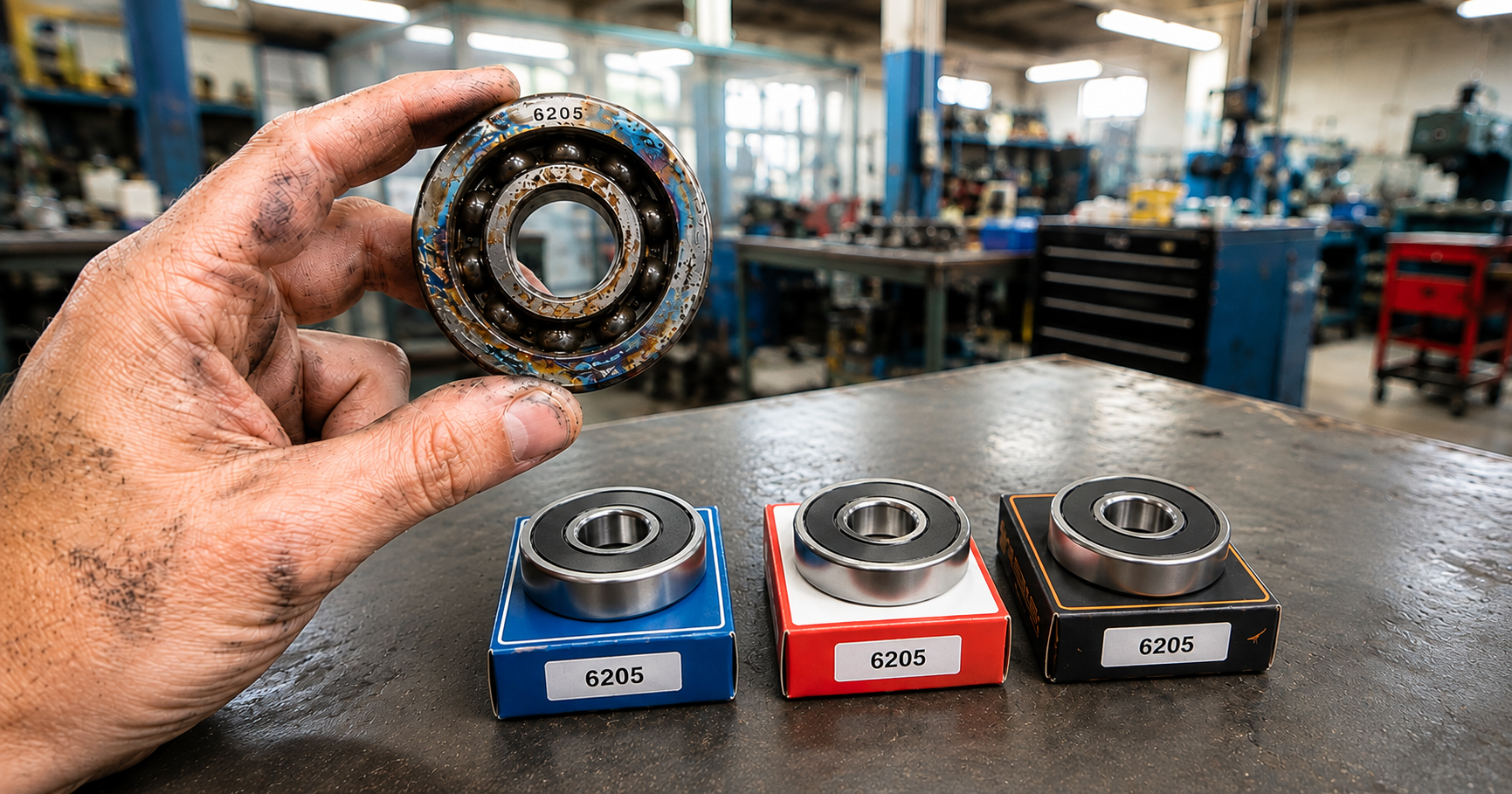
If you've ever pulled a failed bearing and found yourself staring at a number like 6205-2RS1 C3 or 6305ZZ and wondered whether the NSK, NTN, or FAG equivalent on the shelf will do the job — this guide is for you. Bearing cross-referencing is one of the most common tasks in maintenance and engineering, and it causes confusion because every brand uses different suffix codes for the same features. The base number is standardised. The suffix is not.
This guide covers the ISO bearing numbering system that makes cross-referencing possible, a complete suffix decoder for all major brands, brand profiles across the full market spectrum from premium Japanese and European to budget Chinese, common series equivalents across the 6000, 6200, 6300, 7000 and spherical roller families, and a practical 3-step process for confirming an equivalent before you install it. Whether you're replacing a failed bearing on a critical gearbox or sourcing a common 6205 in bulk, use this as your reference.
For more engineering reference charts and selection tables, see our Engineering Reference Charts hub — covering fasteners, bearings, lubrication, measuring, welding and Australian standards.
For a full comparison of the Japanese Tier-1 bearing brands AIMS distributes — plus specialty brands like Timken, McGill, BECO and RBC — see the AIMS Bearing Brand Comparison guide.
Why Bearing Numbers Look the Same Across Brands — ISO 15:2017
The ISO 15:2017 standard (Rolling bearings — Radial bearings — Boundary dimensions) defines the physical dimensions — bore diameter, outside diameter, and width — for every standard bearing in the world. A 6205 bearing from SKF, NSK, NTN, Koyo, NACHI, FAG, or any other ISO-compliant manufacturer has exactly the same bore (25 mm), outside diameter (52 mm), and width (15 mm). No exceptions. This dimensional standardisation is what makes cross-referencing possible at all.
The ISO standard covers all major bearing series: single-row deep groove ball bearings (6000 series), angular contact ball bearings (7000 series), self-aligning ball bearings (1200/2200 series), cylindrical roller bearings (NJ, NU, N series), taper roller bearings (30000 series), and spherical roller bearings (22000/23000 series). Needle roller bearings follow ISO 1206 and related standards using a different naming convention. For the full needle bearing series guide (HK, BK, NA, NKI, AXK, NAX, NAXR and others) plus selection by application, see our Needle Roller Bearing Guide.
What the ISO standard does not standardise is the suffix — the letters and numbers that follow the base bearing number. These describe the bearing's sealing, shielding, internal clearance, cage material, and special features. Every major manufacturer invented their own suffix system before any attempt at harmonisation, and those legacy systems remain in use today. That is why a SKF 6205-2RS1 C3, an NSK 6205DDU CM, and an NTN 6205LLB C3 are functionally equivalent bearings — but you would never know it from the part numbers alone unless you know what each suffix means.
The practical implication: for standard catalogue bearings, the ISO base number is the cross-reference. Once you confirm the base number matches, you use the suffix tables below to confirm sealing, clearance, and cage type are equivalent for your application. Physical dimensions will be identical.
How to Read a Bearing Number
A standard bearing designation is made up of a base number (defined by ISO) followed by a brand-specific suffix. Understanding the base number structure means you can decode virtually any standard bearing without a catalogue.
| Section | Digits/Letters | Meaning | Example |
|---|---|---|---|
| Type prefix (some brands) | None or letter | Bearing type modifier — not universal | UC = insert bearing with housing; E = reinforced (FAG) |
| Series number | 2 digits | Bearing type + dimension series (width × OD) | 62 = deep groove ball, light (02 series); 63 = deep groove ball, medium (03 series) |
| Bore code | 2 digits | Bore diameter: 00=10mm, 01=12mm, 02=15mm, 03=17mm; 04 and above = code × 5 = bore in mm | 05 = 25mm bore; 12 = 60mm bore |
| Suffix | Letters + numbers | Sealing, clearance, cage, special features — brand-specific | 2RS1, ZZ, C3, M, TN9, N, NR |
Working examples:
- 6205-2RS1 C3 (SKF) — 6 = deep groove ball bearing, 2 = light series, 05 = 25mm bore, 2RS1 = 2 contact rubber seals (SKF designation), C3 = C3 internal clearance
- 6205DDU CM (NSK) — Same bearing: 6205 = same base, DDU = 2 contact rubber seals (NSK designation), CM = internal clearance equivalent to C3
- 6205LLB C3 (NTN) — Same bearing: LLB = 2 contact rubber seals (NTN designation), C3 = C3 clearance. Bore, OD, width: identical
- 6205-2RSR C3 (FAG) — Same bearing: 2RSR = 2 contact rubber seals (FAG designation), C3 = C3 clearance
For bearings outside the standard two-digit bore code range (bore above 495mm, or for miniature bearings with bore below 10mm), different coding conventions apply — consult the brand catalogue directly. For the vast majority of bearings in Australian industrial and maintenance applications, the two-digit bore code and standard series numbering applies.
Bearing Suffix Cross-Reference — All Major Brands
This is the core reference table. The suffix function is listed in the left column; the brand-specific code for each function is in the corresponding column. Where a brand does not publish a standard suffix for a function, the cell is marked with a dash. Always verify critical substitutions against the manufacturer's current catalogue — suffix conventions do change across product generations and market regions.
| Function | SKF | NSK | NTN | Koyo | NACHI | FAG / Schaeffler | INA | Timken | IKO |
|---|---|---|---|---|---|---|---|---|---|
| 2 metal shields | ZZ | ZZ | ZZ | ZZ | ZZ | 2Z | 2Z | ZZS | ZZ |
| 1 metal shield | Z | Z | Z | Z | Z | Z | Z | ZS | Z |
| 2 contact rubber seals | 2RS1 | DDU | LLB | 2RD | 2NSE | 2RSR | 2RSL | 2RS | 2RS |
| 2 non-contact rubber seals | 2RSL | VV | LLH | — | — | 2RSH | RSL | — | — |
| 1 contact rubber seal | RS1 | DU | LB | RD | NSE | RSR | RSL | RS | RS |
| C3 internal clearance | C3 | C3 or CM | C3 | C3 | C3 | C3 | C3 | C3 | C3 |
| C4 internal clearance | C4 | C4 | C4 | C4 | C4 | C4 | C4 | C4 | C4 |
| C5 internal clearance | C5 | C5 | C5 | — | C5 | C5 | C5 | — | — |
| Snap ring groove (no ring) | N | N | N | N | N | N | N | — | N |
| Snap ring groove + ring | NR | NR | NR | NR | NR | NR | NR | — | NR |
| Pressed steel cage | (standard, no suffix) | (standard) | (standard) | (standard) | (standard) | (standard) | (standard) | J | (standard) |
| Brass cage | M or MA | M | — | — | — | MA | MA | MA | — |
| Polyamide (nylon) cage | TN9 | P | P | P | — | TVP / TV | — | — | — |
Notes on specific brand conventions:
- NSK CM: CM indicates internal clearance "C3 equivalent" in NSK's own clearance grading system. In practice, CM and C3 can be treated as equivalent for substitution purposes — CM is NSK's internal designation, C3 is the ISO designation. Some NSK catalogues use both.
- FAG 2Z vs ZZ: This is the most common confusion point. FAG (Schaeffler) uses 2Z where all other major brands use ZZ. The bearing is identical — 2 pressed steel shields on each face. FAG 6205-2Z = SKF 6205 ZZ = NSK 6205 ZZ. Do not be misled by the different notation.
- FAG 2RSR: The RSR suffix indicates a specific seal geometry in FAG's system — the R indicates that the seal lip contacts the inner ring on the radial face. The functional result is the same as other brands' contact rubber seals (2RS1, DDU, LLB).
- NTN LLB vs LLH: LLB = contact seal (lip contacts inner ring — higher friction, better ingress protection). LLH = non-contact seal (lip does not touch inner ring — lower torque, slightly less ingress protection but adequate for most applications). SKF 2RS1 is contact; 2RSL is non-contact. Most catalogue equivalents list LLB as the NTN equivalent of SKF 2RS1.
- Timken: Timken is primarily known for taper roller bearings, where they use a completely separate designation system (e.g., 32205 or cup/cone references like 14138A/14276). For Timken deep groove ball bearings, their suffixes generally follow the same conventions above.
- INA (Schaeffler): INA and FAG are both part of the Schaeffler Group and share catalogue infrastructure. INA focuses on needle roller bearings, cam followers, and linear motion products; FAG handles most ball and roller bearing lines. INA ball bearing suffixes largely mirror FAG convention.
Bearing Brand Profiles — Quality Tiers, Origins, and Specialities
Not all bearing brands are equal, and understanding the quality tier of a brand matters significantly when substituting in critical applications. A premium-brand bearing in an agricultural gearbox or a general conveyor is rarely worth the cost premium. A premium-brand bearing in a high-speed spindle, a critical pump, or an electric motor with 24/7 uptime requirements is almost always the right call.
| Brand | Country | Tier | Speciality | AU Market |
|---|---|---|---|---|
| SKF | Sweden | Tier 1 Premium | Full range; particularly strong in sealed deep groove ball, spherical roller, linear motion | Wide — Blackwoods, Motion, specialists |
| NSK | Japan | Tier 1 Premium | Full range; precision spindle bearings, automotive, deep groove ball bearings | Wide — major distributors |
| NTN | Japan | Tier 1 Premium | Full range; known for high-quality deep groove ball and taper roller bearings | Wide — major distributors including AIMS |
| Koyo / JTEKT | Japan | Tier 1 Premium | Full range; Toyota-group company, excellent taper roller and automotive bearings | Wide — specialist bearing distributors |
| NACHI | Japan | Tier 1 Premium | Full range; steel manufacturer that makes its own bearing steel — strong quality consistency | Moderate — specialist distributors |
| FAG / Schaeffler | Germany | Tier 1 Premium | Full range; particularly strong in spherical roller, cylindrical roller, and precision bearings | Wide — Blackwoods, Motion, specialists |
| INA / Schaeffler | Germany | Tier 1 Premium | Needle rollers, cam followers, linear motion, drawn cup bearings | Moderate — specialist industrial |
| Timken | USA | Tier 1 Premium | Taper roller bearings — the global standard reference; also spherical roller, cylindrical roller | Moderate — heavy industry focus |
| IKO (Nippon Thompson) | Japan | Tier 1 Premium | Needle roller bearings, cam followers, linear ball bushings | Moderate — motion control specialists |
| EZO / Fujikoshi | Japan | Tier 1 Premium | Precision miniature and small-bore ball bearings; dental, medical, instrument applications | Limited — specialist precision |
| SNR (NTN-SNR) | France | Tier 1 Premium | Automotive, agricultural, and industrial ball bearings; now part of NTN Group | Limited — some distributors |
| RHP / NSK-RHP | UK / Japan | Tier 1 Premium | Industrial ball and roller bearings; now part of NSK Group | Available — some distributors carry RHP-branded stock |
| FYH / Asahi | Japan | Tier 2 Quality | Insert bearings and housed bearing units (UCF, UCP, UCFL); strong in plummer blocks and flanges | Wide — popular in AU industrial |
| Dodge / ABB | USA | Tier 2 Quality | Housed bearing units, plummer blocks; heavy industry and mining focus | Moderate — industrial distributors |
| Link-Belt (Rexnord) | USA | Tier 2 Quality | Housed units, taper roller bearings, mining applications | Limited — heavy industry |
| NMB (Minebea) | Japan | Tier 2 Quality | Precision miniature ball bearings; aerospace, instrumentation | Limited — precision specialists |
| KBC | Korea | Tier 2 Quality | Full range of standard industrial bearings; strong value-quality ratio | Some Australian distributors |
| ZWZ (ZWZB) | China | Tier 2 Established | Standard industrial bearings; long-established Chinese manufacturer, OEM to some European brands | Some distributors |
| LYC (Luoyang) | China | Tier 2 Established | Full range; one of China's largest and oldest bearing manufacturers | Some distributors |
| C&U (Changzhou) | China | Tier 2 Established | Standard industrial bearings; large volume manufacturer with reasonable quality consistency | Some distributors |
| CRAFT | Poland | Tier 2 Quality | Agricultural and industrial bearings; European manufactured | Some Australian bearing distributors |
| IBB / MTB | India / various | Tier 2 | Standard industrial bearings for cost-sensitive applications | Limited |
| Generic / unbranded Chinese | China | Budget / caution | Highly variable quality — suitable for non-critical, low-load, easily-replaceable applications only | Widely available (online, some trade) |
A note on Chinese bearing brands: ZWZ, LYC, and C&U are established manufacturers who supply OEM product to some European customers and have genuine quality management systems. They are not in the same class as SKF or NSK, but they are not interchangeable with anonymous unbranded Chinese bearings either. For non-critical conveyor, agricultural, and light-duty applications, these brands are a reasonable choice at a lower price point. For electric motors, pumps, gearboxes, and any application with high loads, high speeds, or high-temperature operation, a Tier 1 brand is the correct specification. For any application where a bearing failure has safety implications, Tier 1 is not optional.
Common Bearing Series — Equivalent Numbers Across Brands
The following tables show the standard equivalent designation across major brands for the most common bearing series in Australian industrial applications. Because the ISO base number is identical, this is a straightforward substitution table — only the suffix changes.
6000 Series — Extra-Light Deep Groove Ball Bearings
The 6000 series is the lightest dimension series for deep groove ball bearings. Common in small motors, fans, household appliances, and light machinery.
| Bore (mm) | Designation (all brands) | SKF sealed | NSK sealed | NTN sealed | FAG sealed | Koyo sealed | NACHI sealed |
|---|---|---|---|---|---|---|---|
| 10 | 6000 | 6000-2RS1 | 6000DDU | 6000LLB | 6000-2RSR | 6000-2RD | 6000-2NSE |
| 12 | 6001 | 6001-2RS1 | 6001DDU | 6001LLB | 6001-2RSR | 6001-2RD | 6001-2NSE |
| 15 | 6002 | 6002-2RS1 | 6002DDU | 6002LLB | 6002-2RSR | 6002-2RD | 6002-2NSE |
| 17 | 6003 | 6003-2RS1 | 6003DDU | 6003LLB | 6003-2RSR | 6003-2RD | 6003-2NSE |
| 20 | 6004 | 6004-2RS1 | 6004DDU | 6004LLB | 6004-2RSR | 6004-2RD | 6004-2NSE |
| 25 | 6005 | 6005-2RS1 | 6005DDU | 6005LLB | 6005-2RSR | 6005-2RD | 6005-2NSE |
| 30 | 6006 | 6006-2RS1 | 6006DDU | 6006LLB | 6006-2RSR | 6006-2RD | 6006-2NSE |
| 35 | 6007 | 6007-2RS1 | 6007DDU | 6007LLB | 6007-2RSR | 6007-2RD | 6007-2NSE |
| 40 | 6008 | 6008-2RS1 | 6008DDU | 6008LLB | 6008-2RSR | 6008-2RD | 6008-2NSE |
| 45 | 6009 | 6009-2RS1 | 6009DDU | 6009LLB | 6009-2RSR | 6009-2RD | 6009-2NSE |
| 50 | 6010 | 6010-2RS1 | 6010DDU | 6010LLB | 6010-2RSR | 6010-2RD | 6010-2NSE |
6200 Series — Light Deep Groove Ball Bearings
The 6200 series is the most widely used bearing series in Australian industry — motors, pumps, fans, gearboxes, conveyors, and general machinery. The 6205 and 6206 are among the most common bearings in the world.
| Bore (mm) | Base Number | SKF sealed / C3 | NSK sealed / C3 | NTN sealed / C3 | FAG sealed / C3 | Koyo sealed / C3 | NACHI sealed / C3 |
|---|---|---|---|---|---|---|---|
| 10 | 6200 | 6200-2RS1 C3 | 6200DDU CM | 6200LLB C3 | 6200-2RSR C3 | 6200-2RD C3 | 6200-2NSE C3 |
| 12 | 6201 | 6201-2RS1 C3 | 6201DDU CM | 6201LLB C3 | 6201-2RSR C3 | 6201-2RD C3 | 6201-2NSE C3 |
| 15 | 6202 | 6202-2RS1 C3 | 6202DDU CM | 6202LLB C3 | 6202-2RSR C3 | 6202-2RD C3 | 6202-2NSE C3 |
| 17 | 6203 | 6203-2RS1 C3 | 6203DDU CM | 6203LLB C3 | 6203-2RSR C3 | 6203-2RD C3 | 6203-2NSE C3 |
| 20 | 6204 | 6204-2RS1 C3 | 6204DDU CM | 6204LLB C3 | 6204-2RSR C3 | 6204-2RD C3 | 6204-2NSE C3 |
| 25 | 6205 | 6205-2RS1 C3 | 6205DDU CM | 6205LLB C3 | 6205-2RSR C3 | 6205-2RD C3 | 6205-2NSE C3 |
| 30 | 6206 | 6206-2RS1 C3 | 6206DDU CM | 6206LLB C3 | 6206-2RSR C3 | 6206-2RD C3 | 6206-2NSE C3 |
| 35 | 6207 | 6207-2RS1 C3 | 6207DDU CM | 6207LLB C3 | 6207-2RSR C3 | 6207-2RD C3 | 6207-2NSE C3 |
| 40 | 6208 | 6208-2RS1 C3 | 6208DDU CM | 6208LLB C3 | 6208-2RSR C3 | 6208-2RD C3 | 6208-2NSE C3 |
| 45 | 6209 | 6209-2RS1 C3 | 6209DDU CM | 6209LLB C3 | 6209-2RSR C3 | 6209-2RD C3 | 6209-2NSE C3 |
| 50 | 6210 | 6210-2RS1 C3 | 6210DDU CM | 6210LLB C3 | 6210-2RSR C3 | 6210-2RD C3 | 6210-2NSE C3 |
| 55 | 6211 | 6211-2RS1 C3 | 6211DDU CM | 6211LLB C3 | 6211-2RSR C3 | 6211-2RD C3 | 6211-2NSE C3 |
| 60 | 6212 | 6212-2RS1 C3 | 6212DDU CM | 6212LLB C3 | 6212-2RSR C3 | 6212-2RD C3 | 6212-2NSE C3 |
6300 Series — Medium Deep Groove Ball Bearings
The 6300 series has a larger outside diameter than the 6200 for the same bore — a wider cross-section for higher load capacity. Common in electric motors, gearboxes, and heavier machinery.
| Bore (mm) | Base Number | SKF sealed / C3 | NSK sealed / C3 | NTN sealed / C3 | FAG sealed / C3 | Koyo sealed / C3 | NACHI sealed / C3 |
|---|---|---|---|---|---|---|---|
| 10 | 6300 | 6300-2RS1 C3 | 6300DDU CM | 6300LLB C3 | 6300-2RSR C3 | 6300-2RD C3 | 6300-2NSE C3 |
| 12 | 6301 | 6301-2RS1 C3 | 6301DDU CM | 6301LLB C3 | 6301-2RSR C3 | 6301-2RD C3 | 6301-2NSE C3 |
| 15 | 6302 | 6302-2RS1 C3 | 6302DDU CM | 6302LLB C3 | 6302-2RSR C3 | 6302-2RD C3 | 6302-2NSE C3 |
| 17 | 6303 | 6303-2RS1 C3 | 6303DDU CM | 6303LLB C3 | 6303-2RSR C3 | 6303-2RD C3 | 6303-2NSE C3 |
| 20 | 6304 | 6304-2RS1 C3 | 6304DDU CM | 6304LLB C3 | 6304-2RSR C3 | 6304-2RD C3 | 6304-2NSE C3 |
| 25 | 6305 | 6305-2RS1 C3 | 6305DDU CM | 6305LLB C3 | 6305-2RSR C3 | 6305-2RD C3 | 6305-2NSE C3 |
| 30 | 6306 | 6306-2RS1 C3 | 6306DDU CM | 6306LLB C3 | 6306-2RSR C3 | 6306-2RD C3 | 6306-2NSE C3 |
| 35 | 6307 | 6307-2RS1 C3 | 6307DDU CM | 6307LLB C3 | 6307-2RSR C3 | 6307-2RD C3 | 6307-2NSE C3 |
| 40 | 6308 | 6308-2RS1 C3 | 6308DDU CM | 6308LLB C3 | 6308-2RSR C3 | 6308-2RD C3 | 6308-2NSE C3 |
| 45 | 6309 | 6309-2RS1 C3 | 6309DDU CM | 6309LLB C3 | 6309-2RSR C3 | 6309-2RD C3 | 6309-2NSE C3 |
| 50 | 6310 | 6310-2RS1 C3 | 6310DDU CM | 6310LLB C3 | 6310-2RSR C3 | 6310-2RD C3 | 6310-2NSE C3 |
7200 / 7300 Series — Angular Contact Ball Bearings
Angular contact ball bearings handle combined radial and axial loads. The 7200 series is light; the 7300 series is medium (larger OD for same bore). They are commonly used in pairs (back-to-back DB or face-to-face DF arrangement) in gearbox shafts, spindles, and precision machinery. Contact angle is specified as a suffix: A = 30°, B = 40°, C = 15°. Most standard catalogue angular contact bearings default to 40° contact angle.
| Bore (mm) | Base Number | SKF (2RS1/ZZ) | NSK (DDU/ZZ) | NTN (LLB/ZZ) | FAG (2RSR/2Z) |
|---|---|---|---|---|---|
| 10 | 7200 | 7200 BECBP (open) | 7200A5 | 7200B | 7200-B-JP |
| 15 | 7202 | 7202 BECBP | 7202A5 | 7202B | 7202-B-JP |
| 17 | 7203 | 7203 BECBP | 7203A5 | 7203B | 7203-B-JP |
| 20 | 7204 | 7204 BECBP | 7204A5 | 7204B | 7204-B-JP |
| 25 | 7205 | 7205 BECBP | 7205A5 | 7205B | 7205-B-JP |
| 30 | 7206 | 7206 BECBP | 7206A5 | 7206B | 7206-B-JP |
| 35 | 7207 | 7207 BECBP | 7207A5 | 7207B | 7207-B-JP |
| 40 | 7208 | 7208 BECBP | 7208A5 | 7208B | 7208-B-JP |
Angular contact bearings have more complex suffix conventions because contact angle and arrangement are critical parameters. Always verify contact angle (15°, 30°, 40°) and pair arrangement (DB, DF, DT) match your application before substituting brands. For precision spindle applications, also verify tolerance class (P5, P4 or equivalent).
22000 / 22200 / 22300 Series — Spherical Roller Bearings
Spherical roller bearings self-align to accommodate shaft deflection and housing misalignment. They carry heavy radial and moderate axial loads. Common in mining equipment, heavy conveyors, crushers, fans, gearboxes, and paper mill rollers. The 22200 series is the light-medium series; 22300 is the heavy series with a larger OD for the same bore.
| Bore (mm) | Light-Medium Series | SKF | NSK | NTN | FAG | Heavy Series | SKF | NSK |
|---|---|---|---|---|---|---|---|---|
| 25 | 22205 | 22205 E/C3 | 22205EAKE4C3 | 22205BKD1C3 | 22205-E1-K-C3 | 22305 | 22305 E/C3 | 22305EAKE4C3 |
| 30 | 22206 | 22206 E/C3 | 22206EAKE4C3 | 22206BKD1C3 | 22206-E1-K-C3 | 22306 | 22306 E/C3 | 22306EAKE4C3 |
| 35 | 22207 | 22207 E/C3 | 22207EAKE4C3 | 22207BKD1C3 | 22207-E1-K-C3 | 22307 | 22307 E/C3 | 22307EAKE4C3 |
| 40 | 22208 | 22208 E/C3 | 22208EAKE4C3 | 22208BKD1C3 | 22208-E1-K-C3 | 22308 | 22308 E/C3 | 22308EAKE4C3 |
| 45 | 22209 | 22209 E/C3 | 22209EAKE4C3 | 22209BKD1C3 | 22209-E1-K-C3 | 22309 | 22309 E/C3 | 22309EAKE4C3 |
| 50 | 22210 | 22210 E/C3 | 22210EAKE4C3 | 22210BKD1C3 | 22210-E1-K-C3 | 22310 | 22310 E/C3 | 22310EAKE4C3 |
| 55 | 22211 | 22211 E/C3 | 22211EAKE4C3 | 22211BKD1C3 | 22211-E1-K-C3 | 22311 | 22311 E/C3 | 22311EAKE4C3 |
| 60 | 22212 | 22212 E/C3 | 22212EAKE4C3 | 22212BKD1C3 | 22212-E1-K-C3 | 22312 | 22312 E/C3 | 22312EAKE4C3 |
Notes on spherical roller suffixes: SKF E = reinforced internal geometry for higher load capacity (the standard SKF spherical roller — always specify E). NSK EAK = E-type + adapter sleeve bore (K suffix = tapered bore 1:12). NTN BKD1 = their equivalent reinforced design with adapter taper. FAG E1-K = reinforced with tapered bore. The K/adapter suffix indicates a 1:12 tapered bore that fits standard SKF adapter sleeves (H, HA series) — this is the preferred arrangement for easy mounting and removal in heavy applications. For solid bore (cylindrical bore) spherical rollers, omit the K/adapter sleeve reference.
UC Insert Bearings and Housed Bearing Units
Insert bearings (UCxx series) and their plummer block, flanged, and pillow block housings are designated using a different system. UC = ball insert bearing (set screw locking); UCFC = pillow block unit; UCFL = flanged unit; UCFB = 2-bolt flanged. The bore code follows the same ISO convention (UC205 = 25mm bore). Brand equivalents:
| Bore (mm) | SKF | NSK | NTN | FYH / Asahi | Koyo |
|---|---|---|---|---|---|
| 20 | UC204 | UC204 | UC204 | UC204 | UC204 |
| 25 | UC205 | UC205 | UC205 | UC205 | UC205 |
| 30 | UC206 | UC206 | UC206 | UC206 | UC206 |
| 35 | UC207 | UC207 | UC207 | UC207 | UC207 |
| 40 | UC208 | UC208 | UC208 | UC208 | UC208 |
| 45 | UC209 | UC209 | UC209 | UC209 | UC209 |
| 50 | UC210 | UC210 | UC210 | UC210 | UC210 |
For plummer blocks and housed units, the UC bearing inserts are interchangeable across brands that use the standard UC designation — a FYH UC205 bearing insert will fit an SKF SY 25 TF housing because both conform to the same physical envelope standard. FYH (Asahi) is particularly well regarded for housed bearing units in Australian industrial applications and represents excellent value versus premium Japanese brands for this product category. For more on bearing housings and plummer blocks, see the AIMS Bearing Housing and Plummer Block Guide.
Internal Clearance — What C3, C4, and C5 Actually Mean
Internal clearance (also called radial internal clearance or RIC) is the amount of looseness or play between the rolling elements and the raceway when the bearing is unmounted. It is one of the most important bearing specifications — and one of the most misunderstood.
ISO 5753 defines five standard clearance groups: C2 (less than normal), CN (normal — no suffix needed), C3, C4, and C5 (each progressively greater than normal). In most catalogue listings, the absence of a clearance suffix means CN (normal) clearance. C3 has greater clearance than normal; C4 has greater clearance than C3; C5 has greater clearance than C4.
Why clearance matters for substitution: Electric motor bearings almost universally require C3 clearance. The reason is thermal — the motor generates heat, the shaft expands, and a bearing installed with normal (CN) clearance would become interference-fit as the shaft heats up, leading to premature failure through overloading of the rolling elements. C3 clearance provides the additional room needed for thermal expansion. If you are replacing a bearing in an electric motor and the original has C3 (or NSK's CM designation), the replacement must also be C3 — not CN. Substituting a CN-clearance bearing in a motor application is one of the most common bearing specification errors in general maintenance.
C4 is specified in applications with even greater temperature differentials or where shaft-to-housing fits are particularly tight. C5 is used in very high-temperature applications such as furnace conveyor drives and is rarely stocked off-the-shelf — it is typically a special-order item.
Initial, mounted and operating clearance — three different things
One of the most common technical confusions in bearing selection is the difference between three clearance states. Catalogue specifications and most marketing literature only quote the first one, but the third is what actually matters in service.
- Initial clearance (also called unmounted clearance or RIC): the radial play measured in the bearing as supplied — sitting on the bench, free of any shaft or housing fit. This is what ISO 5753 and the manufacturer catalogue tables specify. C3, C4, and C5 grades all refer to initial clearance ranges.
- Mounted clearance (also called residual clearance): the clearance remaining after the bearing has been pressed onto its shaft and into its housing. The interference fit on the inner ring squeezes it inward, the housing fit (usually slip or light interference) may compress the outer ring slightly, and both effects reduce the initial clearance. Mounted clearance is always lower than initial clearance.
- Operating clearance: the clearance during running operation, after thermal effects. The shaft heats up and expands more than the outer race in most applications. Operating clearance is typically lower than mounted clearance again — sometimes dramatically so.
The whole point of specifying C3 instead of CN in an electric motor is that operating clearance must remain positive. If you start with CN (normal) initial clearance, take 60–80% off it through the interference fit on the shaft, then reduce it further as the rotor heats and the shaft expands, you can easily reach zero or negative clearance — which means the bearing is preloaded against itself, runs hotter, makes more noise, and fails early.
The 80% rule — how interference fit reduces clearance
The most important practical rule in bearing clearance selection comes from forum-validated engineering practice (Eng-Tips, SKF and Schaeffler technical literature): roughly 80% of the inner-ring shaft interference becomes a reduction in radial internal clearance.
Worked example using the figures from a typical industrial application:
- Bearing: 6207 deep groove ball bearing, C3 clearance — initial RIC range 13–28 μm (ISO 5753)
- Shaft tolerance: k5 (interference fit common for inner ring on most industrial shafts) — interference range 2–18 μm depending on actual shaft and bore dimensions
- 80% rule applied: reduction in RIC = 80% × interference = 1.6–14.4 μm reduction
- Mounted clearance range = initial – reduction = (13 – 14.4) to (28 – 1.6) = −1.4 to 26.4 μm
Note the lower bound. With the worst-case combination (minimum initial clearance + maximum interference) the 6207 C3 has gone to negative mounted clearance — interference loaded — before any thermal effect even starts. This is precisely why CN clearance would be wrong: the same bearing with CN initial clearance (5–20 μm) would land at −9.4 to 18.4 μm mounted, deep into preload territory and almost guaranteed to overheat.
For the housing side: outer-ring fits are usually clearance or light interference (J7, K7, M7), and the reduction effect is smaller — typically 40–60% of any housing interference becomes a reduction in clearance. The shaft side dominates the maths.
Thermal expansion and operating clearance
The third reduction comes from thermal effects in operation. Three quantities matter:
- Inner race / shaft temperature
- Outer race / housing temperature
- The temperature difference between them
In most rotating equipment the shaft and inner race run hotter than the housing because the rolling elements transfer heat outward but the housing has more thermal mass and is closer to ambient. A typical electric motor running steady-state shows shaft temperatures 15–30°C above housing temperature.
The thermal reduction in radial clearance is approximately:
ΔRIC = 0.0011 × bearing bore (mm) × ΔT (°C)
Where ΔT is the temperature difference between inner ring and outer ring (not the absolute temperature). For a 35 mm bore bearing with a 25°C inner-to-outer temperature difference: ΔRIC = 0.0011 × 35 × 25 = 0.96 μm reduction. For larger bearings the effect grows: a 100 mm bore with the same 25°C ΔT loses 2.75 μm.
For high-temperature applications (paper machine drying rolls, kiln drives, furnace conveyors) where ΔT can reach 60°C or more on a 100 mm bore, thermal reduction can hit 6–8 μm — which is the entire CN clearance band gone before any interference fit reduction is applied. Hence C4 or C5 specification for these duties.
ISO 5753 radial internal clearance — actual values by bore size
The full ISO 5753 RIC tables run to many pages across all bearing types. The summary below gives the most commonly referenced values for deep groove ball bearings, which are the bearings that account for the majority of motor, pump and gearbox installations in Australian industry.
Deep groove ball bearings — radial internal clearance per ISO 5753 (values in μm):
| Bore Ø (mm) | C2 min–max | CN min–max | C3 min–max | C4 min–max | C5 min–max |
|---|---|---|---|---|---|
| 10 to 18 | 0–9 | 3–18 | 11–25 | 18–33 | 25–45 |
| 18 to 24 | 0–10 | 5–20 | 13–28 | 20–36 | 28–48 |
| 24 to 30 | 1–11 | 5–20 | 13–28 | 23–41 | 30–53 |
| 30 to 40 | 1–11 | 6–20 | 15–33 | 28–46 | 40–64 |
| 40 to 50 | 1–11 | 6–23 | 18–36 | 30–51 | 45–73 |
| 50 to 65 | 1–15 | 8–28 | 23–43 | 38–61 | 55–90 |
| 65 to 80 | 1–15 | 10–30 | 25–51 | 46–71 | 65–105 |
| 80 to 100 | 1–18 | 12–36 | 30–58 | 53–84 | 75–120 |
| 100 to 120 | 2–20 | 15–41 | 36–66 | 61–97 | 90–140 |
| 120 to 140 | 2–23 | 18–48 | 41–81 | 71–114 | 105–160 |
Reading the table: a 6207 (35 mm bore) deep groove ball bearing in C3 clearance has a radial internal clearance between 15 and 33 μm when measured unmounted. The same bearing in CN has 6–20 μm; in C4 has 28–46 μm.
Spherical roller bearings follow a different table with broader ranges (typical CN for a 100 mm bore is 70–100 μm; C3 is 100–140 μm). Cylindrical roller bearings have their own table again. SKF, NSK, NACHI, KOYO and FAG all publish their full RIC tables in their interactive bearing catalogues — these are the authoritative source for any specific part number. The deep groove table above is reference-quality for the most common bearings in industrial maintenance.
How to measure radial internal clearance
Three methods are used in practice depending on bearing type and access:
Feeler gauge method (spherical roller bearings, larger sizes): the standard procedure. Position the bearing horizontally with the inner ring lifted by hand to seat one row of rollers at the top. Insert a feeler gauge between the unloaded uppermost roller and the outer race. The thickness at which the feeler just slides through with light drag is the radial internal clearance. Repeat at three positions (rotate the inner ring 120°) and take the average. This works well for bearings where the rolling elements are accessible from the side — typically 50 mm bore and larger.
Lift method (deep groove ball bearings, smaller sizes): mount the bearing on a fixture or arbor with the inner ring fixed. Use a dial test indicator against the outer race. Lift the outer race vertically as far as it will go, zero the indicator, then push it down as far as it will go. The total indicator reading is the radial internal clearance. Some manufacturers specify a measuring force (typically 50–500 N depending on bearing size) to remove gauge variation.
Reduction-during-mounting method (taper-bore spherical roller bearings): the standard mounting procedure for adapter-sleeve and tapered-bore SRBs. Measure RIC with a feeler gauge before mounting. Drive the bearing up the taper in increments, checking RIC after each. The bore expands as the bearing is driven onto the taper, reducing RIC progressively. The manufacturer specifies the target RIC reduction for correct mounting (typically 30–45 μm reduction for 100 mm bore; varies by size and specification). When the target reduction is reached, the bearing is correctly seated. Over-driving causes preload and early failure; under-driving leaves the bearing free on the sleeve and risks fretting.
For motor maintenance and most general industrial work, the bearing's clearance class is read from the suffix on the marking — direct measurement is reserved for installation verification on critical bearings or for diagnosing a suspected wrong-clearance failure.
Application selection — when to specify each grade
| Application | Typical clearance | Why |
|---|---|---|
| Standard pump (low-temperature, normal load, no significant heat rise) | CN | Operating temperature close to ambient, normal interference fit, CN provides adequate operating clearance |
| Electric motor (most industrial — fan, pump, conveyor drive) | C3 | Thermal expansion of shaft, typical 30–50°C rise above ambient, interference fit on inner ring |
| High-speed motor or generator (high duty, sealed) | C3 or C4 | Greater thermal differential between inner and outer race; tighter fits common |
| Vibrating screen / shaker | C3 or C4 (often manufacturer-specified) | High dynamic loading, tight housing fits to resist outer-race rotation |
| Paper machine drying section | C4 | Sustained 80–120°C temperatures, large temperature differentials between inner and outer rings |
| Kiln drive trunnion / furnace conveyor | C4 or C5 | Sustained high-temperature operation; very large thermal differentials |
| Mining vibrating equipment, large gearboxes | C3 or C4 (manufacturer's spec) | Heavy-duty cyclic loads; interference fits required to resist creep on rotating ring |
| Hand wheel, pulley, light idler | CN (or C2 for precision) | Low load, low speed, minimal thermal effect; tighter clearance may improve quietness |
| Precision spindle, machine tool | C2 or matched preloaded pair | Stiffness and runout are critical; angular contact bearings, not deep groove ball, are the usual answer |
| Belt-driven equipment with high belt tension | C3 | Belt tension creates radial preload; greater initial clearance allows for this |
The single most reliable rule: match the original equipment specification. If the bearing being replaced has C3 in the suffix, replace with C3. If it shows NSK CM (motor clearance, equivalent to C3), replace with C3 or another brand's CM. The OEM has already done the analysis — your job is to match it, not second-guess it.
The C3 motor myth and other forum-validated traps
Three patterns recur in forum threads (Eng-Tips, Practical Machinist, Reddit r/AskEngineers) where bearing selection has gone wrong:
Myth: "All electric motors need C3." Mostly true but with exceptions. Motors specifically designed with light interference fits and lower operating temperatures (some fractional-HP fans, low-duty cycle stop-start motors, hermetically sealed compressor motors) are designed around CN. Putting C3 in these can cause excess startup vibration and a noisier bearing. The rule is "match the OEM spec" — not "always C3 in motors." The safest assumption when no information is available is C3, because the failure mode of CN-in-a-motor (thermal preload) is more dramatic than C3-in-a-CN-application (slightly noisier).
Myth: "Bigger clearance is always safer." Wrong. Excessive clearance causes its own failure modes: noise (knocking under reversing load), fatigue from concentrated load on fewer rolling elements, vibration that telegraphs to gears or seals downstream. C5 in a CN application is just as wrong as CN in a C3 application — the bearing is undersized for the load distribution intended.
Trap: substituting NSK CM for SKF C3. These are functionally equivalent for replacement. NSK CM stands for "motor clearance" and falls within the C3 RIC range. Don't refuse the substitution because the suffix is different — confirm the brand's documentation says CM = C3 equivalent (NSK explicitly does), then replace.
Trap: forgetting to apply the 80% rule when designing a custom installation. Specifying C3 then designing for h6 shaft (slip fit) gives a different result than C3 with k5 shaft (light interference). The clearance class in the catalogue is BEFORE mounting effects. Mounted clearance changes with the fit you choose. For non-standard shafts, run the maths.
Trap: assuming "clearance" and "preload" are the same continuum. They're not. A bearing has positive radial clearance (free play between elements and races) OR zero clearance OR preload (interference between elements and races). Angular-contact bearings can be installed with intentional preload — that is a designed feature for stiffness. Deep groove ball bearings should never be in preload; if they end up there because of wrong clearance class, they fail.
For more detail on bearing lubrication, regreasing intervals, and maintenance procedures that affect bearing life, see the AIMS Bearing Maintenance Guide. For information on bearing removal techniques, see the AIMS Bearing Puller Guide.
Understanding Bearing Quality — What You Pay For
All ISO-standard bearings from all brands have the same dimensional envelope — bore, OD, and width are identical. What differs between a $6 budget bearing and a $28 SKF is not the external geometry but everything inside: the steel quality, internal geometry tolerances, surface finish on the raceways, heat treatment consistency, cage engineering, and sealing system quality.
Steel quality and consistency: Premium Japanese and European brands manufacture their own bearing steel (or source from qualified steel mills under strict specifications) and maintain tight control over inclusion content, hardness depth, and heat treatment. NACHI is particularly notable — as a steel manufacturer that also makes bearings, their steel supply chain is fully vertical. Budget brands source steel commercially, and quality control over the incoming material is significantly less rigorous.
Raceway finish and geometry: The surface finish on the inner and outer raceway, and the precise geometry of the groove radius and contact angle, determine how loads are distributed across the rolling elements. Premium brands hold surface finish tolerances measured in nanometres. The noise floor (dB) and vibration levels at speed are substantially better on premium brands — relevant in electric motors, high-speed spindles, and precision gearboxes where vibration contributes to ancillary wear.
Seal quality: The rubber compound used in sealed bearings determines temperature range, chemical resistance, and contact force on the seal lip. Cheap seals run hotter (higher friction at the lip) and fail faster in wet or contaminated environments. SKF's 2RS1 seal runs cooler than generic equivalents and has measurably better ingress resistance in the same application.
Cage engineering: The cage (retainer) determines how the rolling elements are spaced and guided. Budget bearings almost universally use basic pressed steel cages — adequate for normal applications. Brass cages (M, MA suffixes) are used in high-temperature and high-speed applications because brass does not fatigue in the same way as steel at elevated temperatures. Polyamide cages (TN9, P suffix) are lighter and run quieter, used in high-speed applications where cage mass is a parameter.
The practical guidance: For non-critical, easily accessible, frequently replaced positions — agricultural equipment, conveyors running general goods, basic fans — a quality Tier 2 or established budget brand is perfectly adequate and the cost saving is real. For motors, pumps, gearboxes, precision equipment, and any position where a bearing failure causes a production shutdown or safety incident, use Tier 1. The cost differential is typically $5–$30 per bearing; the cost of an unplanned breakdown is rarely less than $500, and often much more.
Counterfeit Bearings — A Real Problem in the Australian Market
Counterfeit SKF, NSK, NTN, and FAG bearings have been seized at Australian borders and found in circulation in the domestic industrial supply chain. They are manufactured to look identical to genuine product — same packaging, same laser marking, same part number format — but the internal quality ranges from poor to dangerously inadequate. Counterfeit bearings have been found with incorrect heat treatment (raceway hardness well below specification), undersized rolling elements, incorrect cage geometry, and seals that fail on first contact with lubricant.
How to reduce counterfeiting risk:
- Buy from authorised distributors. Authorised distributors have direct supply chain traceability to the manufacturer. Grey-market and online marketplace sellers often cannot provide traceability.
- Check the packaging. Genuine premium brand packaging is consistent — same font, same box construction, same label quality across every unit. Counterfeit packaging often has subtle printing inconsistencies.
- Use manufacturer authentication tools. SKF, NSK, and FAG all provide smartphone apps or web tools to verify product authenticity via QR code or unique pack code on genuine packaging.
- Price is an indicator. Genuine SKF and NSK bearings have a floor price in the market. If pricing is significantly below normal trade pricing, the product warrants scrutiny.
AIMS sources bearings directly through authorised distribution channels. If you need verified genuine product with supply chain traceability for a critical application, contact our team.
How to Find an Equivalent Bearing — 3-Step Process
Given a bearing you need to cross-reference, follow this process:
Step 1 — Identify the ISO base number. Read the full marking on the bearing. Separate the ISO base number from the suffix. The base number is typically 4–6 digits/letters (e.g., 6205, 22210, 7207, NJ312). The suffix is everything after — 2RS1, ZZ, C3, M, E, NR, etc. If the bearing is severely worn or unmarked, measure bore, OD, and width with a digital calliper and look up the dimensions in any bearing dimension table.
Step 2 — Decode the suffix using the tables above. For each suffix element, find the equivalent in your target brand using the suffix cross-reference table. Pay particular attention to: (a) sealing type — contact vs non-contact rubber seals and shields are not interchangeable for all applications; (b) internal clearance — C3 is not interchangeable with CN for motor applications; (c) cage type — if the original has a brass or polyamide cage, understand why before substituting a steel cage equivalent.
Step 3 — Verify critical parameters match your application. Confirm that load ratings (dynamic C and static C0), speed limits, and temperature range of the replacement match or exceed the original specification for your application. For standard non-critical substitutions this check is normally a formality. For high-load, high-speed, high-temperature, or precision applications, confirm load ratings from the target brand's catalogue — they can vary slightly between brands for the same ISO number due to differences in internal geometry and manufacturing tolerance.
For specific bearings not covered in the standard series tables above, use the brand manufacturer's online cross-reference tools (SKF's Bearing Select, NSK's iGo search, NTN's CAD/catalogue search) or contact your bearing distributor with the full part number — including all suffix characters. The suffix is not optional information — an NSK 6205 and an NSK 6205DDU CM are different products with significantly different service lives in a sealed application.
AIMS Bearing Range
AIMS Industrial stocks a comprehensive range of bearings for Australian maintenance, engineering, and industrial applications — deep groove ball bearings, angular contact, spherical roller, taper roller, cylindrical roller, insert bearings, and housed units across multiple quality tiers. We carry stock of NSK, NTN, Koyo, and other quality brands as well as value-tier options for non-critical applications.
If you have a cross-reference question, need a bearing in a brand not in our standard stock range, or are sourcing in quantity for a planned maintenance programme, contact the AIMS team — (02) 9773 0122 or via the contact form. We can cross-reference by part number, source specific brands, and advise on the most cost-effective option for your application. Browse the AIMS bearings range online.
For guidance on bearing removal, see the AIMS Bearing Puller Guide. For deep groove ball bearing selection guidance, see the AIMS Deep Groove Ball Bearing Guide. For thrust bearing selection, see the AIMS Thrust Bearing Guide. For bearing grease selection and regreasing intervals, see the AIMS Grease Types and Selection Guide. For linear bearing and shaft guidance, see the AIMS Linear Bearing Guide.
Frequently Asked Questions — Bearing Cross Reference
Is an NSK 6205 the same as a SKF 6205?
Yes — the base dimensions are identical. Both bearings have a 25mm bore, 52mm outside diameter, and 15mm width, as defined by ISO 15:2017. The difference is in the suffix. An NSK 6205 (open, no seals) is dimensionally identical to a SKF 6205 (open). A sealed version requires matching the suffix: NSK 6205DDU = SKF 6205-2RS1 (both are 2 contact rubber seals). NSK 6205DDU CM = SKF 6205-2RS1 C3 (both sealed with C3 clearance). Bore, OD, and width are always the same across ISO-compliant brands.
What does 2RS mean on a bearing — and does it mean the same thing for every brand?
2RS generically means two rubber seals, one on each side. However, the specific designation varies by brand: SKF uses 2RS1 (contact rubber seal, optimised design); NSK uses DDU (double contact rubber seal); NTN uses LLB (contact rubber seal); FAG uses 2RSR; Koyo uses 2RD; NACHI uses 2NSE. All of these mean the same thing — two contact rubber seals — despite looking completely different. All are functionally equivalent for most substitution purposes. The key distinction to understand is contact seal vs non-contact seal: a contact seal (all the above) has the seal lip touching the inner ring, giving better contamination exclusion but slightly higher running friction. A non-contact seal (SKF 2RSL, NSK VV, NTN LLH) has the lip just clearing the inner ring, giving lower torque but slightly less protection.
What is the difference between ZZ (shielded) and 2RS (sealed) bearings?
ZZ means two pressed metal shields, one on each side. The shields are pressed steel plates that extend close to the inner ring but do not touch it — they block larger contaminants but are not a sealed barrier. 2RS (in all its brand variants) means two rubber seals that physically contact or nearly contact the inner ring — providing a much tighter barrier against fine particles, dust, moisture, and lubricant loss. Shielded (ZZ) bearings are slightly cooler-running and are appropriate where contamination is low and regreasing through the shields is possible on open designs. Sealed (2RS) bearings are used where contamination ingress is a concern and the bearing is grease-lubricated for life. For most maintenance applications in Australian industrial environments, 2RS (sealed) is the correct specification.
What does C3 clearance mean and when is it required?
C3 indicates greater-than-normal internal clearance between the rolling elements and raceways. C3 is required primarily in electric motors, where the motor generates heat and the shaft expands during operation. If a bearing with normal (CN) clearance is installed in a motor, thermal expansion of the shaft tightens the bearing against the raceway, creating excessive load and leading to premature failure. C3 clearance provides the additional room needed for thermal expansion. C3 is also specified in applications with tight shaft-to-housing fits, high-temperature environments, and high-speed applications. If the bearing you are replacing carries a C3 suffix (or NSK's CM designation), the replacement must also be C3 — never substitute a CN-clearance bearing in an electric motor application.
Can I replace a SKF bearing with an NSK, NTN, or FAG equivalent?
Yes — for standard ISO catalogue bearings, substituting between any Tier 1 premium brands (SKF, NSK, NTN, FAG, Koyo, NACHI) is technically sound provided you match the base number and correctly decode the suffix. A SKF 6205-2RS1 C3 replaced with an NSK 6205DDU CM or an NTN 6205LLB C3 is a direct equivalent. The only situations where brand substitution requires more care are: (1) precision tolerance class bearings (P5, P4 — used in spindles and precision gearboxes) where internal geometry specifications differ slightly between brands; (2) specialty application bearings where the brand has application-specific internal design; (3) applications under OEM warranty where specifying a non-OEM brand may affect warranty coverage. For general industrial and maintenance applications, any Tier 1 brand cross-reference using correct suffix matching is acceptable.
Why does FAG use 2Z and 2RSR instead of ZZ and 2RS like every other brand?
FAG (Schaeffler) developed their suffix system independently, as did every other major bearing manufacturer, before ISO attempted to harmonise bearing designations. FAG's convention for two metal shields is 2Z (literally "2 Zinc" from the German tradition — though modern shields are pressed steel, not zinc). All other major brands use ZZ. FAG's convention for two contact rubber seals is 2RSR (2 Rubber Seals, Radial contact). All of this is purely a naming convention difference — the physical bearing is identical. FAG 6205-2Z = SKF 6205 ZZ = NSK 6205 ZZ. FAG 6205-2RSR = SKF 6205-2RS1 = NSK 6205DDU. Same bearing, different labels.
What is the NSK CM designation and is it the same as C3?
NSK's CM suffix stands for "C3 equivalent clearance" in NSK's internal grading system — it is functionally the same as the ISO C3 clearance designation. Some NSK catalogues list bearings with C3; others use CM; some show both. For substitution purposes, NSK 6205DDU CM and NSK 6205DDU C3 are the same specification, and both are equivalent to SKF 6205-2RS1 C3. If you are ordering NSK bearings and specifying C3 clearance, either C3 or CM will be understood by any NSK distributor.
How do I find the equivalent of a bearing when the marking is worn or unreadable?
If the bearing marking is unreadable, measure bore diameter, outside diameter, and width with a digital calliper. Even basic worn bearings usually retain enough dimensional integrity to measure accurately. Once you have the three dimensions, cross-reference in a bearing dimension table — ISO 15:2017 dimension tables are freely available online from any major manufacturer. The correct base number will emerge directly from the dimensions. For example, bore 25mm, OD 52mm, width 15mm = 6205 series; bore 25mm, OD 62mm, width 17mm = 6305 series. Once you have the base number, choose the appropriate suffix for your application using the tables in this guide.
Which bearing brand is the best quality?
SKF, NSK, NTN, FAG (Schaeffler), Koyo, and NACHI are all Tier 1 premium brands with equivalent quality levels for standard industrial applications — none is objectively superior across all product families. SKF has the broadest range and strongest service/engineering support network in Australia. NSK and NTN are particularly strong in deep groove ball and angular contact bearings for electric motors. FAG/Schaeffler is often specified for European-made machinery where FAG was the OEM supplier. Koyo is the Toyota Group bearing manufacturer and is extremely strong in automotive and general industrial bearings. NACHI's vertical integration (own steel production) gives it particularly tight consistency in steel quality. For any standard maintenance or industrial application, any of these brands is an excellent choice — brand preference often comes down to what the maintenance team is familiar with or what the machine's OEM specified.
Can I mix bearing brands in the same machine — for example, one SKF and one NSK on the same shaft?
For standard radial bearing positions (deep groove ball, spherical roller, cylindrical roller), mixing Tier 1 brands on the same shaft or in the same gearbox is perfectly acceptable — there is no technical reason to avoid it. The bearings are dimensionally identical per ISO 15:2017 and operate independently in their respective positions. The exception is paired angular contact bearings, where a matched pair (DB, DF, or DT arrangement) must always be from the same brand and batch — mixed-brand pairs cannot be guaranteed to meet the preload specification. SKF and NSK both mark paired angular contact bearings with matching set identification. For all other bearing types in general industrial applications, brand mixing is a non-issue.
What is the difference between a premium bearing and a budget Chinese bearing?
Beyond dimensional compliance, the differences are in steel quality, internal geometry tolerances, raceway surface finish, heat treatment, cage engineering, and seal quality. Premium Japanese and European bearings are manufactured to extremely tight internal tolerances with high-quality bearing steel. Budget Chinese bearings from unknown sources are manufactured to looser tolerances with commercially-grade steel, resulting in higher noise, shorter service life, and less consistent performance. Not all Chinese bearings are equivalent — ZWZ, LYC, and C&U are established manufacturers with reasonable quality control and are suitable for non-critical applications. For electric motors, precision equipment, high-speed or high-temperature applications, and any safety-critical position, Tier 1 premium brands are the correct specification. The cost difference is typically $5–30 per bearing; the cost of premature failure is almost always greater.
What does the NTN LLB suffix mean and how does it compare to SKF 2RS1?
NTN LLB indicates two contact rubber seals, one on each side — the NTN equivalent of SKF 2RS1. Both are contact seals, meaning the seal lip physically contacts the inner ring, providing good contamination exclusion. NTN also makes LLH (non-contact rubber seals) — the equivalent of SKF 2RSL. For substitution purposes, NTN 6205LLB C3 = SKF 6205-2RS1 C3 = NSK 6205DDU CM = FAG 6205-2RSR C3. All are two contact rubber seals with C3 clearance and identical ISO dimensions.
What is a UC insert bearing and how do I cross-reference between brands?
A UC insert bearing is a spherical outer surface deep groove ball bearing designed to sit in a housed bearing unit (plummer block, flanged unit, etc.). The UC designation (e.g., UC205 for 25mm bore) is standardised across all major brands — SKF, NSK, NTN, FYH/Asahi, Koyo, and most Chinese brands all use the same UC numbering convention, and they are physically interchangeable. The bearing insert from any brand will fit a housing from any brand that uses the standard UC specification. FYH (Asahi) is a popular choice in Australia for UC insert bearings and housed units — they are Japanese-manufactured, quality-tier, and typically priced below the big four (SKF, NSK, NTN, FAG) for equivalent performance in general industrial applications.
Do bearing manufacturers supply each other or rebadge bearings?
Yes — cross-supply and rebadging occurs throughout the bearing industry, particularly at the OEM level. SKF has historically purchased certain bearing types from NTN and other manufacturers to fill catalogue gaps. RHP (originally British) is now part of NSK and some RHP-branded product is NSK-manufactured. SNR (French) is now part of NTN Group. Koyo and JTEKT are the same company (JTEKT is the parent; Koyo is the bearing brand). Many "in-house branded" bearings sold by equipment manufacturers are produced by Tier 1 Japanese or European manufacturers under OEM agreement. The practical implication: an OEM-branded bearing from a machinery manufacturer is often an NSK or NTN with a private label, and a Tier 1 brand cross-reference is a direct equivalent at lower cost.
How do I verify that a replacement bearing is genuine and not counterfeit?
Buy from authorised distributors with verifiable supply chain traceability to the manufacturer. SKF, NSK, and FAG all provide smartphone authentication apps or web tools that validate genuine product via QR codes or pack codes printed on genuine packaging. Check packaging consistency — font, print quality, box construction, and label placement should be identical across all units from the same batch. Price is an indicator — genuine Tier 1 brand bearings have a floor price in the Australian market that counterfeit product often undercuts significantly. If a price seems too good for the brand claimed, verify authenticity before installation. AIMS sources through authorised distribution channels with supply chain traceability.
Need help cross-referencing a specific bearing or sourcing a brand we haven't mentioned? Contact the AIMS Industrial team — (02) 9773 0122. We stock NSK, NTN, Koyo, and other quality brands across the common series, and can source specific brands for planned maintenance programmes or critical applications.
Our Metric Bolt Torque Chart lists tightening torque in Nm for every common metric bolt size and grade.
For matched cable-entry hardware, browse the AIMS grommet range (rubber, plastic, and metal-reinforced).

