

This guide is part of AIMS Industrial's curated Engineering Reference Charts library — 78 reference articles across fasteners, threading, bearings, lubrication and safety standards.
Common Metric O-Ring Sizes — Quick Reference
The table below lists common metric o-ring sizes by cross-section series. Dimensions are ID × CS in millimetres.
| ID × CS (mm) | OD (mm) | Common Use |
|---|---|---|
| 2.0 × 1.0 | 4.0 | Small valves, instrument fittings |
| 3.0 × 1.0 | 5.0 | Small valves, connectors |
| 4.0 × 1.0 | 6.0 | Hydraulic fittings, small cylinders |
| 5.0 × 1.0 | 7.0 | Tap spindles, small fittings |
| 6.0 × 1.0 | 8.0 | Tap spindles, hydraulic fittings |
| 8.0 × 1.0 | 10.0 | Pneumatic fittings, flow control |
| 10.0 × 1.0 | 12.0 | Pneumatic fittings, valves |
| 12.0 × 1.0 | 14.0 | Valves, small pipe fittings |
What Is an O-Ring?
An o-ring is a loop of elastomer — rubber or synthetic rubber — with a circular cross-section. The name comes from the shape: a torus, or donut, that sits in a machined groove and seals the gap between two mating surfaces or around a shaft.
For BSP/JIC hydraulic fitting sealing where an O-ring would need a groove, the Dowty washer (bonded seal) is the standard alternative — a metal washer with a moulded nitrile or Viton lip that seals against a flat face under the fitting flange. See the Dowty washer and bonded seal guide for BSP-G size charts and material selection.
When compressed by assembly, the o-ring deforms slightly and fills the gap it's seating in. That contact force is what creates the seal. The principle is elegantly simple: squeeze the rubber, block the path, stop the leak.
O-rings are used wherever a pressure boundary needs to be maintained — hydraulic cylinders, pneumatic fittings, tap spindles, fuel systems, pumps, valves, pipe unions, and thousands of other industrial and plumbing applications. They are one of the most widely used sealing components in engineering.
But not all o-rings are the same. Choose the wrong material for the fluid or temperature, and the o-ring will fail — sometimes immediately, sometimes over weeks. This guide covers what you need to know: sizes, materials, applications, and how to select and replace them correctly.
O-Ring Materials: The Critical Choice
The single most important decision when selecting an o-ring is material. Size is easy to measure. Material is where people get it wrong — and where failures happen.
There are four materials you'll encounter in most Australian industrial, hydraulic, and plumbing applications: NBR (Nitrile), Viton (FKM), EPDM, and Silicone. Each has distinct strengths, a specific weakness, and a different cost point. HNBR is a fifth option for demanding applications.
Quick Comparison
| Material | Colour (common) | Temp Range | Good For | Not Suitable For | Relative Cost |
|---|---|---|---|---|---|
| NBR (Nitrile) | Black | −40°C to +120°C | Petroleum oils, hydraulic fluid, fuels, water, compressed air | Ozone, aromatic solvents, ketones, brake fluid | Low |
| Viton (FKM) | Brown / black | −20°C to +200°C | High temp, aggressive chemicals, fuels, acids, hydraulic fluids | Steam above 100°C, amines, ketones, low-temperature applications | High (5–10× NBR) |
| EPDM | Black / grey | −55°C to +150°C | Water, hot water, steam, ozone, weathering, brake fluid, phosphate-ester hydraulic fluid | Petroleum oil, petrol, diesel, most mineral oils — will swell and fail catastrophically | Low–medium |
| Silicone | Red / translucent / white | −60°C to +200°C | Extreme temperatures, food contact (food-grade grade), ozone, UV | High-pressure dynamic applications (low tensile strength), petroleum products (standard grades) | Medium |
| HNBR | Black / green | −30°C to +150°C | High-temp oil, refrigerants, ozone, automotive applications | Aromatic hydrocarbons, strong acids | Medium–high |
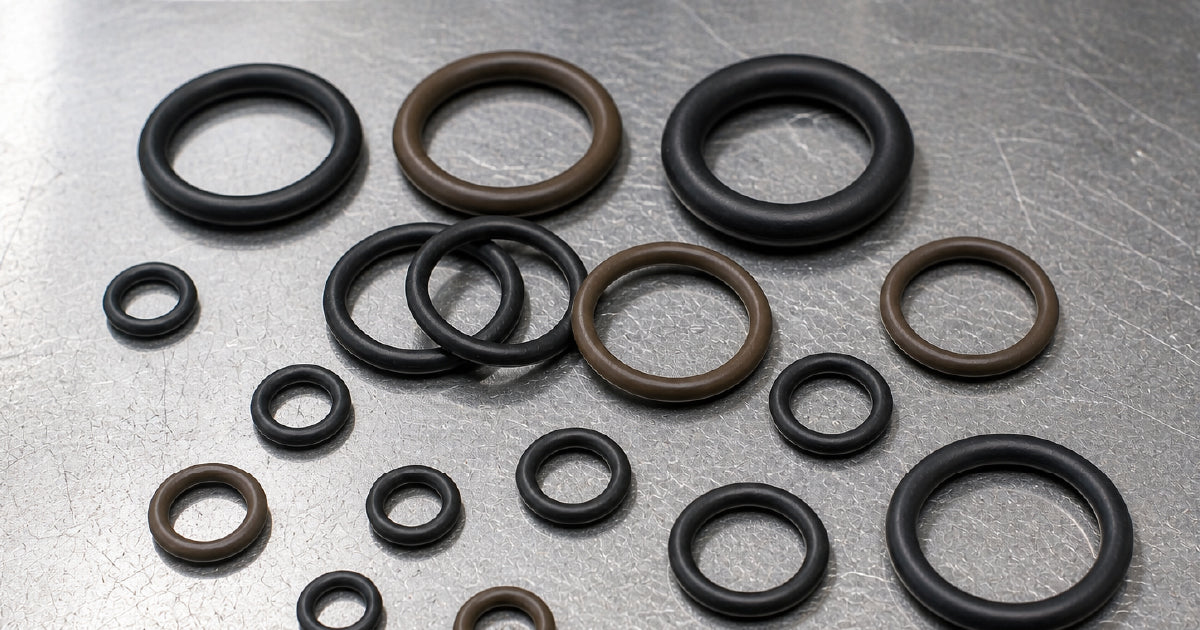
Colour is a guide, not a guarantee. Manufacturers can add dye to any compound. A black o-ring could be NBR, EPDM, Viton, or HNBR. When material matters — and it usually does — confirm by specification, not by appearance.
NBR (Nitrile) O-Rings: The Industrial Standard
NBR — Nitrile Butadiene Rubber, also called Buna-N — is the default choice for the vast majority of industrial sealing applications. If you're ordering o-rings without a specific material requirement, NBR is what you'll get in most standard kits.
NBR has excellent resistance to petroleum-based fluids: mineral oils, hydraulic oils, diesel, petrol, and greases. It also seals reliably against water, compressed air, and inert gases at standard temperatures. The temperature window of −40°C to +120°C covers most workshop and plant environments.
Use NBR for:
- Hydraulic cylinders and systems (mineral oil-based)
- Pneumatic and compressed air fittings
- Fuel systems (petrol and diesel)
- General water and fluid handling
- Tap spindles and plumbing components
- Most general industrial applications
Do not use NBR with: ozone exposure, aromatic solvents, ketones (MEK, acetone), esters, or brake fluid. EPDM will outlast it significantly in outdoor weathering or steam applications.
Viton (FKM) O-Rings: The Performance Upgrade
Viton is a brand name of DuPont (now Chemours) for fluorocarbon rubber — generically known as FKM. It is the premium sealing material for demanding applications where NBR reaches its limits.
Viton's key advantages are temperature resistance (up to +200°C continuous, +250°C short-term) and broad chemical resistance to aggressive fluids. It outperforms NBR with concentrated acids, fuels with additives, high-temperature hydraulic fluids, and chemical process environments.
The cost premium is real — Viton typically costs 5 to 10 times more than a comparable NBR o-ring. That cost is justified when the application demands it. Replacing a blown Viton seal in a high-pressure hydraulic system costs less than repairing the equipment it was protecting.
Use Viton for:
- High-temperature hydraulic systems (above 120°C)
- Chemical handling — acids, solvents, fuel additives
- Engine fuel systems and injectors
- Aggressive petroleum products and synthetic lubricants
- Process equipment with demanding chemical exposure
Do not use Viton with: steam above 100°C (use EPDM instead), amines and ammonia, low-molecular-weight esters and ketones, or low-temperature applications below −20°C where it becomes brittle.
EPDM O-Rings: The Water and Steam Specialist
EPDM — Ethylene Propylene Diene Monomer — is the material of choice for water, hot water, steam, and outdoor applications. It resists ozone, UV radiation, and weathering exceptionally well, which makes it standard in automotive weather seals, roofing membranes, and outdoor fittings.
EPDM performs at temperatures from −55°C up to +150°C. For steam applications, it is the primary choice where Viton is unsuitable. It also handles brake fluid and phosphate-ester hydraulic fluids that NBR cannot.
Critical warning — EPDM and petroleum do not mix. If you expose an EPDM o-ring to mineral oil, petrol, diesel, or petroleum-based hydraulic fluid, it will absorb the oil, swell to over double its original volume, and fail completely — turning soft and gummy, jamming valve internals, and causing exactly the kind of leak it was meant to prevent. The same compatibility rules apply to EPDM diaphragms in diaphragm valves and diaphragm pumps — match the elastomer to the chemistry or the diaphragm fails the same way. This is a common and costly mistake when o-rings are replaced without confirming the original material.
Use EPDM for:
- Drinking water and potable water systems
- Hot water and steam applications
- Outdoor fittings exposed to ozone and weathering
- Brake hydraulic systems
- Phosphate-ester hydraulic fluids (fire-resistant)
Do not use EPDM with: any petroleum-based fluid — mineral oil, hydraulic oil, fuel, grease. NBR or Viton is required for those applications.
Silicone O-Rings
Silicone (VMQ) covers the temperature extremes that other elastomers cannot — from −60°C to +200°C. It is also inert, making it suitable for food-contact and pharmaceutical applications when certified to food-grade specifications.
Silicone's weakness is mechanical strength. It has low tensile strength and poor abrasion resistance compared to NBR and Viton, which limits it to static sealing applications and rules it out for dynamic (moving) seals under high pressure. For static seals in high-temperature environments where no petroleum contact is expected, silicone is a cost-effective alternative to Viton.
O-Ring Dimensions: How Sizes Work
Every o-ring is defined by two dimensions:
- ID — Inside Diameter: the diameter of the hole in the centre of the o-ring, measured in mm (metric) or inches (imperial)
- CS — Cross Section: the diameter of the rubber cord itself — essentially, how thick the o-ring is
You may also see OD (Outside Diameter) listed, but it is derived: OD = ID + (2 × CS). The two defining numbers are always ID and CS.
For example, an o-ring specified as 20 × 2.5 has an inside diameter of 20 mm and a cross-section of 2.5 mm. Its outside diameter is 25 mm (20 + 2 + 2 + 1 + 1 = ... no: OD = 20 + 2×2.5 = 25 mm).
Sizing Standards
O-rings are manufactured to several standards depending on the application and region:
- Metric (BS 4518 / ISO 3601) — the predominant standard in Australia and most of the world for industrial applications
- AS 1646 — the Australian standard for elastomeric seals for waterworks purposes (pipe joints and fittings in water infrastructure)
- AS568 (SAE) — the North American inch-based standard, common in imported US-specification equipment
- JIS B2401 — Japanese standard, used in Japanese-manufactured equipment and hydraulic components
In practice, most off-the-shelf o-rings in Australia are stocked to metric dimensions. When replacing a seal on imported equipment, check whether the original is metric or AS568 — the ID and CS dimensions may not align between standards even for nominally similar sizes.
Common Metric O-Ring Sizes
The table below lists common metric o-ring sizes by cross-section series. Dimensions are ID × CS in millimetres.
CS 1.0 mm Series
| ID × CS (mm) | OD (mm) | Common Use |
|---|---|---|
| 2.0 × 1.0 | 4.0 | Small valves, instrument fittings |
| 3.0 × 1.0 | 5.0 | Small valves, connectors |
| 4.0 × 1.0 | 6.0 | Hydraulic fittings, small cylinders |
| 5.0 × 1.0 | 7.0 | Tap spindles, small fittings |
| 6.0 × 1.0 | 8.0 | Tap spindles, hydraulic fittings |
| 8.0 × 1.0 | 10.0 | Pneumatic fittings, flow control |
| 10.0 × 1.0 | 12.0 | Pneumatic fittings, valves |
| 12.0 × 1.0 | 14.0 | Valves, small pipe fittings |
CS 1.5 mm Series
| ID × CS (mm) | OD (mm) | Common Use |
|---|---|---|
| 4.0 × 1.5 | 7.0 | Hydraulic ports, small cylinders |
| 5.0 × 1.5 | 8.0 | Tap cartridges, instrument ports |
| 6.0 × 1.5 | 9.0 | Tap spindles, plug valves |
| 8.0 × 1.5 | 11.0 | Hydraulic ports, banjo fittings |
| 10.0 × 1.5 | 13.0 | Hydraulic fittings, cylinder ports |
| 12.0 × 1.5 | 15.0 | Hydraulic ports, fluid connectors |
| 15.0 × 1.5 | 18.0 | Hydraulic ports, manifold fittings |
| 20.0 × 1.5 | 23.0 | Pipe unions, manifold seals |
| 25.0 × 1.5 | 28.0 | Pipe unions, hydraulic cylinders |
CS 2.0 mm Series
| ID × CS (mm) | OD (mm) | Common Use |
|---|---|---|
| 6.0 × 2.0 | 10.0 | Hydraulic cylinders, rod seals |
| 8.0 × 2.0 | 12.0 | Hydraulic cylinders, fittings |
| 10.0 × 2.0 | 14.0 | Hydraulic cylinders, pneumatic ports |
| 12.0 × 2.0 | 16.0 | Hydraulic cylinders, valves |
| 15.0 × 2.0 | 19.0 | Cylinders, unions, valve bodies |
| 18.0 × 2.0 | 22.0 | Cylinder bores, large fittings |
| 20.0 × 2.0 | 24.0 | Cylinder bores, manifold seals |
| 25.0 × 2.0 | 29.0 | Cylinder bores, pipe unions |
| 30.0 × 2.0 | 34.0 | Large cylinders, flanges |
| 40.0 × 2.0 | 44.0 | Large bore cylinders, housings |
| 50.0 × 2.0 | 54.0 | Large cylinders, vessel lids |
CS 2.5 mm Series
| ID × CS (mm) | OD (mm) | Common Use |
|---|---|---|
| 10.0 × 2.5 | 15.0 | Hydraulic cylinders, shaft seals |
| 12.0 × 2.5 | 17.0 | Hydraulic cylinders, piston rods |
| 15.0 × 2.5 | 20.0 | Cylinder piston rods, valve stems |
| 20.0 × 2.5 | 25.0 | Cylinder bores, large piston rods |
| 25.0 × 2.5 | 30.0 | Large cylinders, flanged connections |
| 30.0 × 2.5 | 35.0 | Large bore cylinders, heavy flanges |
| 40.0 × 2.5 | 45.0 | Large bore cylinders, equipment housings |
| 50.0 × 2.5 | 55.0 | Large bore cylinders, vessel covers |
CS 3.0 mm Series
| ID × CS (mm) | OD (mm) | Common Use |
|---|---|---|
| 10.0 × 3.0 | 16.0 | Hydraulic cylinders, high-pressure ports |
| 15.0 × 3.0 | 21.0 | Hydraulic cylinders, large ports |
| 20.0 × 3.0 | 26.0 | Cylinder pistons, large valve bodies |
| 25.0 × 3.0 | 31.0 | Cylinder pistons, heavy-duty flanges |
| 30.0 × 3.0 | 36.0 | Large bore cylinders, flanged joints |
| 40.0 × 3.0 | 46.0 | Large bore cylinders, equipment covers |
| 50.0 × 3.0 | 56.0 | Large cylinders, vessel covers |
| 63.0 × 3.0 | 69.0 | Large bore hydraulic cylinders |
| 75.0 × 3.0 | 81.0 | Large bore cylinders, heavy equipment |
| 100.0 × 3.0 | 106.0 | Large bore cylinders, vessel flanges |
Sizes shown are representative. Non-standard and custom o-ring sizes are available on request.
Imperial and British Standard (BS) O-Ring Sizing
Australia inherited a large installed base of UK-spec industrial machinery — compressors, hydraulic systems, pumps, cylinders, and valves specified to British Standard dimensions. In this equipment, o-ring sizes are defined by the BS1806 standard and referenced by a BS number rather than an ID × CS measurement. Understanding BS numbers is essential for anyone maintaining older Australian industrial equipment.
Imperial o-rings are also encountered on US-designed equipment, where the equivalent standard is AS568. Both systems use similar cross-section groups but different size increments — they are not interchangeable with metric o-rings, even where dimensions appear close.
The BS1806 Numbering System Explained
A BS number is not a random reference code. It tells you the cross-section group directly from the number range. BS1806 defines five cross-section groups, and the hundreds digit of the BS number tells you which group you are in:
| BS number range | Cross-section (CS) | CS in inches | Typical use |
|---|---|---|---|
| BS001–BS099 | 1.78 mm | 0.070″ | Small fittings, instrument valves, miniature hydraulics |
| BS100–BS199 | 2.62 mm | 0.103″ | General hydraulic and pneumatic fittings, valve stems |
| BS200–BS299 | 3.53 mm | 0.139″ | Most common industrial range — cylinders, couplings, ports |
| BS300–BS399 | 5.33 mm | 0.210″ | Large bore cylinders, flanged joints, heavy hydraulics |
| BS400–BS932 | 6.99 mm | 0.275″ | Very large bore seals, vessel covers, heavy plant |
Once you know the cross-section group, the number within the group tells you the inside diameter. BS numbers increase in approximate step sizes within each group — consecutive BS numbers are not always the same ID increment, so always confirm dimensions against the reference table rather than estimating.
BS200 Series Reference Table
The BS200 series (CS = 3.53 mm) is the most widely stocked and most commonly required series in Australian industrial maintenance. All dimensions are to BS1806.
| BS number | ID (mm) | CS (mm) | OD (mm) |
|---|---|---|---|
| BS201 | 2.57 | 3.53 | 9.63 |
| BS202 | 3.68 | 3.53 | 10.74 |
| BS203 | 4.47 | 3.53 | 11.53 |
| BS204 | 5.28 | 3.53 | 12.34 |
| BS205 | 6.07 | 3.53 | 13.13 |
| BS206 | 7.65 | 3.53 | 14.71 |
| BS207 | 9.25 | 3.53 | 16.31 |
| BS208 | 10.82 | 3.53 | 17.88 |
| BS209 | 12.42 | 3.53 | 19.48 |
| BS210 | 13.94 | 3.53 | 21.00 |
| BS211 | 15.54 | 3.53 | 22.60 |
| BS212 | 17.12 | 3.53 | 24.18 |
| BS213 | 18.72 | 3.53 | 25.78 |
| BS214 | 20.30 | 3.53 | 27.36 |
| BS215 | 22.22 | 3.53 | 29.28 |
| BS216 | 24.99 | 3.53 | 32.05 |
| BS217 | 28.17 | 3.53 | 35.23 |
| BS218 | 30.37 | 3.53 | 37.43 |
| BS219 | 32.92 | 3.53 | 39.98 |
| BS220 | 37.47 | 3.53 | 44.53 |
| BS221 | 41.28 | 3.53 | 48.34 |
| BS222 | 44.04 | 3.53 | 51.10 |
| BS223 | 47.22 | 3.53 | 54.28 |
| BS224 | 50.39 | 3.53 | 57.45 |
| BS225 | 56.74 | 3.53 | 63.80 |
| BS226 | 62.87 | 3.53 | 69.93 |
| BS227 | 69.22 | 3.53 | 76.28 |
| BS228 | 75.57 | 3.53 | 82.63 |
| BS229 | 82.14 | 3.53 | 89.20 |
| BS230 | 88.49 | 3.53 | 95.55 |
BS232 onwards and non-standard sizes are available on request. Contact us if you need sizes outside this range, or a full BS100 or BS300 series reference chart.
Imperial Sizing Without a BS Number
Some equipment — particularly US-designed machinery — does not reference BS numbers. Instead, the o-ring is specified by ID and CS in inches. To identify the correct replacement, convert both dimensions to millimetres (multiply by 25.4) and match against the cross-section group table above and the BS200 series table.
A common point of confusion: a metric o-ring with dimensions that look similar to an imperial size is not a valid substitute. A metric 3.0 mm CS o-ring and a BS200 series 3.53 mm CS o-ring will not seat correctly in each other’s groove — the groove depth is machined to the CS of the original standard. Fitting a 3.0 mm CS ring in a 3.53 mm CS groove leaves the ring under-compressed; it will not seal under pressure. Fitting a 4.0 mm CS ring will over-compress the seal and accelerate fatigue. Always replace a BS o-ring with the correct BS size.
AS568 — The US Equivalent
Equipment designed to US standards uses AS568 rather than BS1806. AS568 uses “dash numbers” (e.g., -214, -332) with the same five cross-section groups as BS1806 but different ID increments. AS568 and BS1806 sizes are not directly interchangeable — a BS214 and an AS568 -214 are different o-rings. When sourcing replacements for US-designed equipment, confirm which standard applies before ordering. AS568 sizes are available on request — contact us with your dash number and application details.
How to Measure an O-Ring for Replacement
Two situations require different measurement approaches:
Measuring an Undamaged Original O-Ring
Use a digital calliper. Measure the ID (the gap across the centre hole) and the CS (the thickness of the rubber cord). Both should be measured gently without compressing the rubber.
- Place the o-ring on a flat surface for ID measurement — it should sit naturally circular
- Measure CS at the thickest point of the cross-section, not at an angle
- For larger IDs (>100 mm), a steel rule or Pi tape gives a more accurate reading
Measuring from the Groove (Preferred for Static Seals)
If the original o-ring is compressed, deformed, or visually aged, do not measure it. Compressed o-rings take a set — they permanently deform to the shape of the groove. Measuring a compressed or aged seal gives dimensions smaller than the original, and you will install an undersized replacement that will not seal correctly.
Instead, measure the groove:
- Groove ID = the diameter of the groove's inner wall. This approximates the o-ring ID.
- Groove depth = determines CS. A common rule: CS = groove depth ÷ 0.75 (15–20% compression is normal for static face seals).
- For cross-section: groove width should be approximately 1.3–1.5× the CS to allow slight bulge when compressed.
When in doubt, take both measurements — the old o-ring and the groove — and cross-reference against a standard size chart. If the old o-ring is clearly compressed flat, trust the groove.
Application Guide: Which O-Ring Material for Your Job?
Use this reference to match material to application. When in doubt, confirm with the equipment manufacturer's service manual. Note: o-rings work in designed grooves under controlled compression. For bolted flange joints on process piping — where the seal sits between flat raised faces with no groove — the standard alternative is a spiral wound gasket; see our Spiral Wound Gasket Guide.
Hydraulic Systems (Mineral Oil-Based)
| Condition | Recommended Material | Notes |
|---|---|---|
| Standard hydraulic oil, to 80°C | NBR | Default choice — cost-effective and reliable |
| High-temperature hydraulic oil, 80–150°C | HNBR or Viton | HNBR is more flexible at low temps; Viton for above 120°C |
| Very high temp or aggressive additives, >150°C | Viton (FKM) | Required for synthetic lubricants and EP additives |
| Fire-resistant phosphate-ester hydraulic fluid | EPDM | NBR and Viton are attacked by phosphate esters |
Pneumatic and Compressed Air
| Condition | Recommended Material | Notes |
|---|---|---|
| Dry or lubricated compressed air, standard temps | NBR | Most common choice for air tools, pneumatic cylinders |
| Oil-free air, food or pharmaceutical use | EPDM or Silicone (food grade) | No petroleum contamination risk |
| High-temperature air or inert gas | Viton or Silicone | Confirm compatibility with any oil mist present |
Water and Plumbing
| Condition | Recommended Material | Notes |
|---|---|---|
| Cold and hot water to 80°C (taps, plumbing) | NBR or EPDM | Both suitable; EPDM preferred for drinking water — more inert |
| Hot water above 80°C | EPDM | NBR softens and degrades above 90–100°C in water |
| Steam | EPDM | Viton is not recommended for steam; EPDM handles it well |
| Potable water / drinking water | EPDM | Ensure AS 4020 certified for drinking water contact |
Chemical and Fuel Applications
| Fluid | Recommended Material | Notes |
|---|---|---|
| Petrol and diesel (standard) | NBR | Good fuel resistance to 60–80°C |
| Petrol with ethanol blends (E10, E85) | Viton | Ethanol swells NBR; Viton required for high ethanol content |
| Strong acids and solvents | Viton | Check specific chemical compatibility — no material resists everything |
| Brake fluid (glycol-ether based) | EPDM | NBR and Viton are attacked by brake fluid |
| Refrigerants (R134a, R410a) | HNBR or Viton | Confirm compatibility with specific refrigerant and lubricant used |
Comprehensive Chemical Resistance Chart
The Application Guide above covers most workshop scenarios by use category. For specific chemical compatibility — when you know exactly what fluid the o-ring will see and need to look up the right material — use the alphabetical chart below. Combined with the material descriptions earlier in this guide, this chart gets you to a defensible material choice for most Australian industrial applications.
How to read the ratings:
| Rating | Meaning |
|---|---|
| A — Excellent | Long service life. The default material recommendation. Minimal degradation in extended exposure. |
| B — Good | Suitable for most applications. Some degradation over time; check service life expectations. |
| C — Limited | Marginal. Use only when no better option exists; expect short service life or check higher-spec alternatives. |
| D — Not recommended | Material attacked, swells, hardens, or fails. Use a different elastomer. |
| — | Insufficient data. Verify with the manufacturer datasheet before specifying. |
Ratings are at room temperature unless otherwise noted. Elevated temperatures generally degrade chemical resistance — a material rated A at 20°C may drop to B or C at 80°C. Concentration also matters: many ratings change at concentrations above 50%. The chart below covers common concentrations encountered in industrial use; verify with the manufacturer's datasheet for non-standard concentrations or temperatures.
| Chemical / Fluid | NBR (Nitrile) | Viton (FKM) | EPDM | Silicone (VMQ) | Notes |
|---|---|---|---|---|---|
| Acids | |||||
| Acetic acid (10%) | C | B | A | B | EPDM preferred for dilute organic acids |
| Acetic acid (glacial) | D | C | B | C | Concentrated form attacks most elastomers |
| Citric acid | B | A | A | B | Food and beverage applications |
| Hydrochloric acid (dilute, <10%) | C | A | B | C | Viton standard for HCl service |
| Hydrochloric acid (concentrated) | D | B | C | D | Viton or specialty FFKM |
| Hydrofluoric acid | D | C | D | D | Specialty perfluoroelastomer territory |
| Nitric acid (dilute) | D | B | C | C | Strong oxidiser |
| Nitric acid (concentrated) | D | C | D | D | FFKM or PTFE only |
| Phosphoric acid | B | A | A | B | Common process chemical |
| Sulphuric acid (dilute, <50%) | C | B | B | C | Battery acid territory |
| Sulphuric acid (concentrated) | D | B | D | D | Viton above 50% concentration |
| Alkalis | |||||
| Ammonia (gas) | B | D | A | B | EPDM for ammonia refrigeration |
| Ammonium hydroxide | B | D | A | B | Viton degrades |
| Calcium hydroxide | B | A | A | B | Limewater, alkaline cleaners |
| Potassium hydroxide | B | D | A | B | EPDM standard for caustic potash |
| Sodium hydroxide (caustic, dilute) | B | D | A | B | Common process chemical |
| Sodium hydroxide (concentrated) | C | D | A | C | EPDM is the workhorse |
| Alcohols | |||||
| Ethanol (ethyl alcohol) | B | A | A | B | Industrial alcohol, sanitiser |
| Glycerol (glycerine) | A | A | A | A | All materials work |
| Isopropyl alcohol (IPA) | B | A | A | B | Cleaning, electronics |
| Methanol | D | C | A | B | NBR swells significantly |
| Hydrocarbons — Aromatic | |||||
| Benzene | D | A | D | D | Viton only viable choice |
| Toluene | D | A | D | D | Viton only |
| Xylene | D | A | D | D | Viton only |
| Hydrocarbons — Aliphatic | |||||
| Hexane | A | A | D | D | NBR or Viton — EPDM degrades |
| Kerosene | A | A | D | D | NBR is cost-effective |
| Mineral oil | A | A | D | C | NBR for hydraulic systems |
| Petroleum ether | A | A | D | D | NBR or Viton |
| Fuels | |||||
| Diesel fuel | A | A | D | D | NBR standard for diesel |
| Petrol (unleaded) | B | A | D | D | Viton preferred for modern petrol |
| Petrol with 10% ethanol (E10) | C | A | D | D | Viton — ethanol attacks NBR over time |
| Petrol with 85% ethanol (E85) | D | B | D | D | Viton; specialty fuel-resistant grades |
| Jet fuel (Jet A, JP-8) | B | A | D | D | Viton standard for aviation |
| LPG (propane / butane) | A | A | D | D | NBR for LPG service |
| Brake fluids | |||||
| DOT 3 / DOT 4 (glycol-ether) | D | D | A | D | EPDM only — never NBR or Viton |
| DOT 5 (silicone) | A | A | A | D | Silicone fluid attacks silicone seals |
| DOT 5.1 (glycol-ether, high-temp) | D | D | A | D | EPDM only |
| Hydraulic fluids | |||||
| Mineral-based hydraulic oil (HLP) | A | A | D | C | NBR is the cost-effective default |
| Water-glycol hydraulic (HFC) | A | B | A | C | Fire-resistant glycol |
| Phosphate ester hydraulic (HFD-R, Skydrol) | D | D | A | D | EPDM only — aircraft hydraulic systems |
| Synthetic hydraulic (PAO-based) | A | A | D | C | NBR or Viton |
| Vegetable-based hydraulic (HETG) | A | B | D | C | Biodegradable alternative |
| Solvents | |||||
| Acetone | D | D | A | C | EPDM only |
| Carbon tetrachloride | D | A | D | D | Viton only (largely banned) |
| Ethyl acetate | D | D | A | C | EPDM |
| Methylene chloride (DCM) | D | C | D | D | Specialty FFKM |
| MEK (methyl ethyl ketone) | D | D | A | C | EPDM |
| Trichloroethylene (TCE) | D | A | D | D | Viton only |
| White spirit / mineral turpentine | A | A | D | D | NBR or Viton |
| Refrigerants | |||||
| R12 (CFC, legacy) | A | A | D | C | NBR — historical only |
| R22 (HCFC, legacy) | A | A | D | C | Phased out in AU |
| R134a (HFC) | B | A | C | C | HNBR (hydrogenated NBR) preferred |
| R410a (HFC blend) | B | A | C | C | HNBR or Viton; check compressor oil compatibility |
| R744 (CO₂, transcritical) | — | B | — | — | Specialty seal compounds |
| R1234yf, R1234ze (HFO) | B | A | — | — | Modern automotive refrigerants |
| Water and steam | |||||
| Water (cold, <40°C) | A | A | A | A | All materials suitable |
| Water (hot, 40–80°C) | B | A | A | B | EPDM preferred for sustained hot water |
| Water (hot, 80–120°C) | D | A | A | B | EPDM or Viton |
| Steam (low pressure, <150°C) | D | D | A | C | EPDM is the steam standard |
| Steam (high pressure, >150°C) | D | D | B | D | EPDM with care; FFKM for severe service |
| Demineralised / deionised water | B | A | A | A | EPDM common in pharma |
| Seawater | B | A | A | B | All workable; check temperature |
| Glycols and coolants | |||||
| Ethylene glycol (engine coolant) | B | A | A | B | EPDM standard for radiator hoses; NBR fine for static seals |
| Propylene glycol | B | A | A | B | Food-grade and pharma applications |
| Food and beverage | |||||
| Beer / wine | B | A | A | A | EPDM and silicone food-grade certified |
| Dairy (milk, cream) | C | A | A | A | EPDM or silicone for hot CIP cleaning |
| Edible oils / fats | A | A | D | C | NBR for static, Viton for hot |
| Sugar syrups | A | A | A | A | All work |
| Vinegar (4–6% acetic) | C | A | A | B | EPDM common |
| Gases | |||||
| Air (compressed, lubricated) | A | A | B | B | NBR standard |
| Air (compressed, oil-free) | A | A | A | A | EPDM or silicone for food/pharma |
| Carbon dioxide (CO₂, gas) | A | A | A | A | All materials |
| Hydrogen sulphide (H₂S) | D | D | C | C | HNBR or specialty for sour gas |
| Natural gas (mains, LPG-grade) | A | A | D | D | NBR standard |
| Nitrogen (gas) | A | A | A | A | All materials |
| Oxygen (industrial) | D | B | B | C | Viton or EPDM (oxygen-cleaned grade required) |
| Ozone (low concentration, atmospheric) | C | A | A | B | EPDM or Viton — NBR cracks under ozone |
Important caveats when reading any chemical resistance chart — including this one:
- Temperature changes the rating. Most ratings drop one or two grades for every 30–40°C above ambient. A material rated A at 20°C may be C at 80°C. If your application runs hot, derate accordingly or check a temperature-specific chart from the seal manufacturer.
- Concentration matters. A 10% solution is rated very differently to a 90% solution of the same chemical. Concentrated acids, bases and solvents attack elastomers far more aggressively. Where this chart shows "dilute" or "concentrated", verify your actual concentration against the manufacturer datasheet.
- Trade names and additives. Hydraulic fluids, brake fluids and refrigerants vary by manufacturer. The base fluid type controls compatibility, but additive packages can change behaviour. When in doubt, check the manufacturer's seal specification rather than relying on a generic chart entry.
- Static vs dynamic service. Static seal applications tolerate marginal compatibility better than dynamic (rotating shaft, reciprocating piston). A chart rating of B might give long static life but fail quickly in a dynamic seal where surface contact is constant.
- Service life expectations. A "B — Good" rating means the material works but may have shorter life than an A-rated material. For critical or expensive-to-access seals, choose A-rated whenever possible.
- This chart covers common industrial chemicals. For specialty chemicals (solvent blends, proprietary process fluids, mixed-component systems) consult the manufacturer's complete chemical compatibility datasheet or contact the seal supplier with the specific chemical and temperature.
For a wider AU industry view of which o-ring material suits which class of application, see the Application Guide section above. For the full alphabetical chemical list with extended ratings, the Parker O-Ring Handbook (ORD 5700) is the global reference text and covers thousands of chemicals across all elastomer families.
O-Ring Kits
An o-ring kit is an assorted pack containing multiple sizes and (usually) materials. They are practical for workshop use, field maintenance, or anywhere you need to replace a seal without knowing the exact size in advance.
NBR kits are the most common — typically 200 to 500 pieces across the standard metric size range. They suit most hydraulic, pneumatic, and general industrial applications. A well-stocked workshop should have one as standard.
Viton kits are available for applications where temperature and chemical resistance justify the cost premium. Useful for workshops that regularly service high-temp or chemically aggressive equipment.
Mixed material kits contain both NBR and EPDM (or NBR and Viton) across a range of sizes. These are useful where the same workshop handles both water/steam sealing and oil-based hydraulic work.
The limitation of an assorted kit is that you may not find an exact size for a non-standard or large-bore application. For those, select an individual o-ring to the exact ID × CS specification.
View the AIMS Industrial o-ring and seal kit range: O-Rings & O-Ring Kits
Why O-Rings Fail
Most o-ring failures fall into six categories. Recognising the failure mode tells you whether the fix is a like-for-like replacement or a design change.
1. Compression Set
Over time, all elastomers lose their ability to spring back from compression. The o-ring takes a permanent flat, no longer fills the groove, and starts to leak. This is normal end-of-life behaviour — not a failure of the material. Scheduled replacement is the answer. Viton and HNBR resist compression set better than NBR at elevated temperatures.
2. Extrusion
Under high pressure, an o-ring can be forced into the gap (clearance) between the mating faces — extruding out of the groove and getting sheared. This is a design issue: either the gap is too large for the pressure, the o-ring is too soft (too low a Shore hardness), or both. The fix is to reduce the clearance, increase o-ring hardness (higher Shore A), or add a backup ring.
3. Chemical Attack
The o-ring swells, hardens, or both — depending on whether the fluid causes absorption or plasticiser extraction. The most common example: EPDM in mineral oil swells dramatically and fails. The fix is always correct material selection from the start.
4. Thermal Degradation
Operating above the material's temperature limit causes hardening, cracking, and compression set acceleration. NBR above 120°C, EPDM above 150°C, silicone in high-pressure dynamic applications — all will fail faster than expected. Match material to operating temperature, not just ambient temperature.
5. Installation Damage
Twisted, cut, or pinched o-rings are a common workshop problem. A twisted o-ring will leak from day one. Cuts happen on sharp threads, chamfers, or ports. Use lubrication on installation (see below), and ensure sharp edges are deburred before fitting. Where possible, use an installation cone or sleeve to guide the o-ring over threads.
6. Abrasion (Dynamic Applications)
In dynamic seals — rotating shafts, reciprocating piston rods — the o-ring is in constant motion against a surface. Without adequate lubrication and surface finish, it wears through. Standard o-rings in high-cycle dynamic applications may need to be replaced with purpose-designed lip seals or quad-rings.
O-Ring Lubrication
Lubrication on installation reduces installation damage and extends service life. The key rule: use a lubricant compatible with both the o-ring material and the system fluid.
- NBR o-rings in oil or hydraulic systems: use a thin coat of the system oil or hydraulic fluid itself. Clean, simple, compatible.
- NBR o-rings in water or air systems: use a silicone-based grease or petroleum jelly (Vaseline). Both are compatible with NBR and will not contaminate water or compressed air systems.
- EPDM o-rings in water systems: silicone grease is the standard choice. Do not use petroleum jelly on EPDM — petroleum-based products will cause EPDM to swell.
- Viton o-rings: silicone grease or a Viton-compatible assembly paste. Avoid petroleum-based greases if the Viton is in a non-petroleum application.
- Food-grade applications: use only NSF H1 certified food-grade grease.
Never use WD-40 as an o-ring lubricant. It is a water displacer and penetrating oil, not a grease — it will evaporate quickly and may degrade certain elastomers over time.
Frequently Asked Questions
What is an o-ring and how does it work?
An o-ring is a loop of elastomer with a circular cross-section that sits in a machined groove. When assembled, it is slightly compressed, causing the rubber to deform and fill the gap between mating surfaces. This contact force creates the seal. The greater the pressure difference across the seal, the harder the o-ring is forced against the groove wall, which increases sealing force — o-rings are inherently self-energising under pressure.
How do I measure an o-ring for replacement?
Measure inside diameter (ID) and cross-section (CS) using a digital calliper. ID is the gap across the centre of the o-ring; CS is the thickness of the rubber cord. If the original o-ring is compressed, deformed, or aged, measure the groove instead — a compressed o-ring has taken a set and will give incorrect dimensions. Groove ID approximates o-ring ID; groove depth divided by 0.75 approximates the CS required.
What is the difference between NBR, Viton, and EPDM o-rings?
NBR (Nitrile) is the standard for petroleum oils, hydraulic fluids, fuels, and compressed air at normal temperatures (−40°C to +120°C). Viton (FKM) is the premium choice for high temperatures (up to +200°C) and aggressive chemicals — it costs 5–10× more than NBR. EPDM is the right choice for water, steam, and outdoor/ozone environments, but fails catastrophically if exposed to petroleum or mineral oil. Choose based on fluid and temperature, not appearance.
Which o-ring material should I use for hydraulic oil?
NBR is the standard choice for mineral oil-based hydraulic systems operating below 80°C. For temperatures between 80–150°C, use HNBR. Above 150°C or with synthetic hydraulic fluids and aggressive additives, use Viton (FKM). If the hydraulic fluid is a fire-resistant phosphate-ester type, use EPDM — both NBR and Viton are attacked by phosphate esters.
Which o-ring material is correct for compressed air?
NBR is the standard choice for compressed air applications — air tools, pneumatic cylinders, fittings, and compressor components. It handles both dry and lubricated compressed air at normal temperatures reliably. For oil-free air in food or pharmaceutical environments, use EPDM or a food-grade silicone to avoid any petroleum contamination risk.
Can EPDM o-rings be used with oil or petroleum products?
No. This is one of the most important rules in o-ring selection. EPDM exposed to mineral oil, petroleum, petrol, diesel, or most hydrocarbon-based greases will swell dramatically — often to more than double its original volume — and turn soft and gummy. This can jam valve internals and cause immediate, total seal failure. NBR or Viton must be used in petroleum applications. EPDM is only for water, steam, and non-petroleum environments. The same material compatibility rules apply to butterfly valve seats — for a full seat material selection chart by fluid type, see our Butterfly Valve Guide.
What is o-ring compression set, and why does it cause leaks?
Compression set is the permanent deformation an o-ring develops after prolonged compression. All elastomers compress slightly during service. Over time, the rubber loses its ability to spring back, leaving the o-ring flattened in the groove rather than maintaining firm contact pressure against the sealing faces. Once the contact force is lost, the seal leaks. This is normal wear — the o-ring should be replaced. Viton and HNBR have better compression set resistance than NBR at elevated temperatures.
How do I read an o-ring size code?
Metric o-rings are specified as ID × CS in millimetres — for example, 20 × 2.5 means an inside diameter of 20 mm and a cross-section (cord thickness) of 2.5 mm. The outside diameter (OD) is derived: OD = ID + (2 × CS), so a 20 × 2.5 o-ring has an OD of 25 mm. AS568 imperial sizes use a dash number (e.g., -012) that maps to a table of inch dimensions. AS 1646 is the Australian standard for waterworks seals.
What is cross-section (CS) and why does it matter?
Cross-section is the diameter of the o-ring's cord — how thick the rubber ring is. It determines how much the o-ring compresses in the groove. Standard compression for static seals is 15–25% of CS. If CS is too small for the groove depth, the o-ring will not be sufficiently compressed and will leak. If CS is too large, the o-ring will be over-compressed, which accelerates compression set and can cause extrusion at high pressures. Groove design specifies CS as precisely as it specifies ID.
Should I measure the old o-ring or the groove to find the right replacement size?
If the old o-ring is in good condition and undamaged, measure it directly. If it shows any compression set, deformation, or age hardening, measure the groove instead. A compressed o-ring has permanently deformed to a smaller size than its original specification — measuring it and ordering to that size will result in installing an undersized seal that will not compress properly and will leak sooner. Groove ID gives a reliable ID reference; groove depth divided by 0.75 approximates the required CS.
What lubricant can I use on o-rings?
For NBR o-rings in hydraulic or oil systems, a thin coat of the system fluid itself is ideal. For water or air systems, use silicone grease. For EPDM o-rings, silicone grease is the standard choice — do not use petroleum jelly on EPDM as petroleum products cause swelling. For food-grade applications, use only NSF H1 certified food-grade grease. Do not use WD-40 as a lubricant — it is a water displacer, not a grease, and will not provide lasting lubrication.
Why do o-rings fail?
The six main causes are: (1) Compression set — normal end-of-life where the rubber permanently flattens; (2) Extrusion — forced into the clearance gap at high pressure due to too-soft a material or excessive clearance; (3) Chemical attack — wrong material choice for the fluid (e.g. EPDM in oil); (4) Thermal degradation — operating above the material's temperature rating; (5) Installation damage — twisted, cut, or pinched during assembly; (6) Abrasion in dynamic applications without adequate lubrication or surface finish. Each failure mode has a distinct appearance that helps diagnose the root cause.
What is the difference between a static and dynamic o-ring application?
A static application is one where the mating surfaces do not move relative to each other after assembly — pipe unions, cylinder end caps, flange seals, hydraulic port plugs. A dynamic application involves movement: a reciprocating piston rod, a rotating shaft. O-rings are well-suited to static sealing. In dynamic applications, they work but wear faster; for high-cycle dynamic seals, purpose-designed lip seals, U-cups, or quad-rings typically provide better service life. Surface finish and lubrication are critical in any dynamic o-ring application.
What is a BS o-ring number and how do I read it?
A BS number (e.g. BS214) is a British Standard BS1806 size reference. The hundreds digit tells you the cross-section group: BS001–099 = 1.78 mm CS, BS100–199 = 2.62 mm CS, BS200–299 = 3.53 mm CS, BS300–399 = 5.33 mm CS, BS400+ = 6.99 mm CS. The number within the group specifies the inside diameter. BS numbers are commonly found in parts lists for older UK and Australian industrial machinery, compressors, and hydraulic equipment. Once you have the BS number, look it up in a BS1806 reference table to confirm the ID and OD in millimetres before ordering.
What is the difference between metric and imperial o-ring sizes?
Metric o-rings are specified by ID × CS in millimetres (e.g. 20 × 3.0 mm). Imperial o-rings follow BS1806 (British Standard) or AS568 (US standard) and are referenced by a BS number or AS568 dash number. Beyond the measurement system, the critical difference is that the groove in the housing is machined to match the CS of the original standard. Metric and imperial o-rings with similar dimensions cannot be interchanged: the compression ratio will be wrong and the seal will either leak or fail prematurely.
Can I use a metric o-ring instead of a BS imperial one if the size looks close?
No. Even if the inside diameter appears similar, the cross-section must match the groove depth of the original design. BS200 series has a CS of 3.53 mm; the nearest common metric CS values are 3.0 mm and 4.0 mm — neither will compress correctly in a 3.53 mm groove. A ring that is too thin sits loose and may extrude or bypass under pressure. A ring that is too thick will be over-compressed, causing rapid fatigue and compression set. Replace a BS o-ring with the correct BS size in the correct material.
My machine’s parts list shows a BS number — how do I find the right o-ring?
Identify the cross-section group from the hundreds digit: BS2xx = 3.53 mm CS (most common), BS1xx = 2.62 mm CS, BS3xx = 5.33 mm CS. Then look up the full BS number in the reference table to confirm the ID and OD. Specify the BS number, the required material (NBR for standard oil, air, and water service; Viton for chemical resistance or high temperatures above 120°C), and the quantity. If you have the old o-ring available, measure the ID and CS with a calliper as a cross-check before ordering. We stock NBR and Viton in the BS200 series range — view the range or contact us for other series.
When should I use a silicone o-ring?
Silicone o-rings handle a very wide temperature range and resist ozone, UV and weather, which suits static seals in hot or cold air, food and medical equipment, and outdoor gear. They have low strength and poor abrasion and oil resistance, so they're not for dynamic seals or hydrocarbon service — use nitrile or Viton there. Match the compound to the fluid and temperature. See the o-ring range.
What is an o-ring backup ring and when do I need one?
At high pressure an o-ring can extrude into the clearance gap of its groove and fail. A backup ring — a stiffer anti-extrusion ring fitted behind the o-ring — closes that gap and lets the seal hold higher pressure. It's common on hydraulic pistons and high-pressure static joints. If an o-ring is nibbling or extruding, a backup ring is usually the fix.
What is an X-ring (quad ring) and how does it differ from an o-ring?
An X-ring (quad ring) has a four-lobed cross-section instead of the o-ring's round one, giving two sealing surfaces and needing less squeeze to seal. That means lower friction and better performance on dynamic (moving) rods and pistons, with less chance of spiral twist. For static seals a standard o-ring is usually all you need. For flange sealing see our spiral wound gasket guide.
Got the size & material? Get the o-ring.
Shop metric & imperial o-rings — NBR, Viton & EPDM stocked
From NBR kits for hydraulic and pneumatic use to Viton for high-temperature and chemical applications — AIMS Industrial stocks individual o-rings and assorted kits in metric and BS200 series sizes, ready to ship Australia-wide.
Match the lift with the right hydraulic kit — browse hydraulic rams and tools at AIMS.
Build out the chemical-handling side of the workshop with the AIMS chemical pump range.
O-rings are compression seals and shouldn't normally be glued in place — but where a static rubber component genuinely needs bonding rather than compressing, see our Loctite 406 Guide for rubber-specific instant adhesive.