

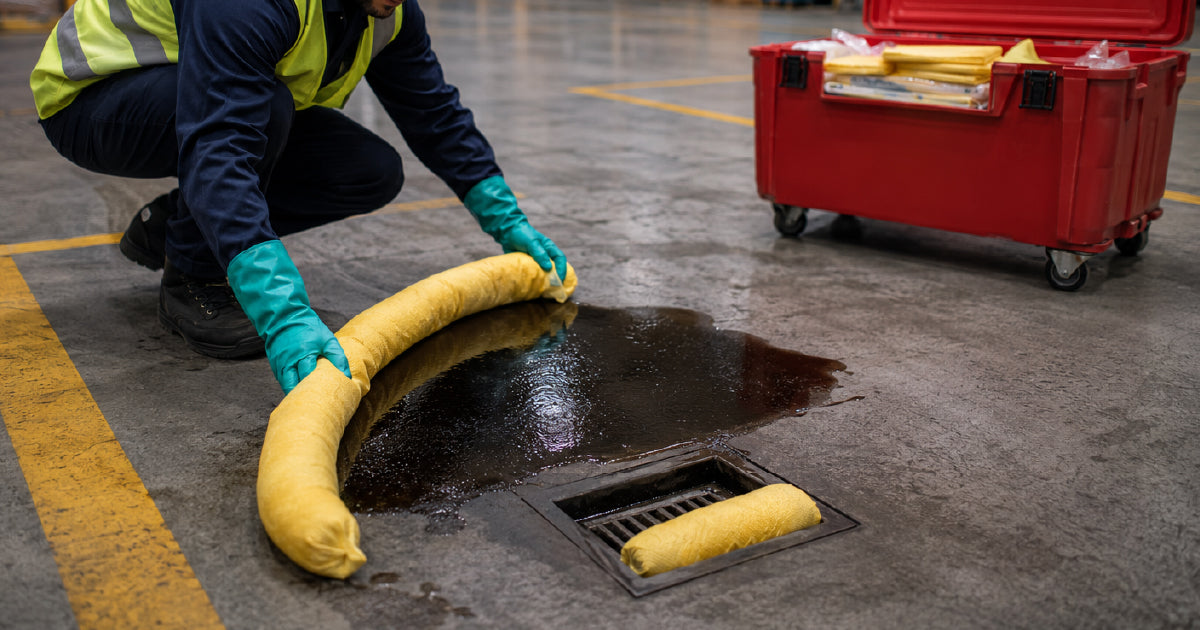
What is bunding?
Bunding is a containment barrier built around storage tanks, drum stores, or chemical handling areas to capture spills and prevent escape into drains or soil. Australian law (AS 1940 for flammable liquids, the Protection of the Environment Operations Act, and state EPA regulations) requires bunded containment for most stored chemicals. Bunds can be permanent (concrete walls, retrofit metal dykes) or portable (collapsible polyethylene bund mats, modular pallet bunds, IBC spill pallets). Capacity must hold at least 110% of the largest single container OR 25% of the total stored volume, whichever is greater.
Spill kits and spill containment systems do two jobs: they let you respond to a spill within seconds (kits) and they stop spills reaching drains, waterways or the ground in the first place (bunds, IBC containment, drum pallets). In Australia, both jobs are governed by AS 1940:2017 (flammable and combustible liquids), AS 3780 (corrosive substances), state EPA waste classification rules, and the AusSpill Association standard for spill response kits.
This guide walks through the three-class hazard decision (oil & fuel, general purpose, hazchem), the AS 1940 Clause 5.9 bund capacity formula that most procurement guides simplify wrong, the absorbent chemistry that determines whether your kit will actually work on the spill you face, kit sizing, AU disposal compliance, and a forum-validated workshop comparison of commercial absorbent versus the kitty-litter shortcut. It covers what AIMS Industrial stocks (39 SKUs across nine brands at our spill control range) and gives an honest take on the categories we source on request rather than stock from the shelf.
Hazard-class decision matrix — Quick Reference
The single biggest selection mistake in spill kits is buying the wrong chemistry for the spill you face. There are three primary classes — and they are not interchangeable.
| Kit class | Absorbent type | Lid colour (AU convention) | Best for | Will NOT absorb |
|---|---|---|---|---|
| Oil & Fuel | Polypropylene hydrophobic — repels water, absorbs hydrocarbons | Blue / clear | Diesel, petrol, hydraulic oil, engine oil, lubricant, kerosene, solvents (non-aggressive) | Water-based fluids: AdBlue/DEF, glycol coolant, water-based degreaser, aqueous acids/bases |
| General Purpose | Polypropylene universal — absorbs both water and hydrocarbons | Grey | Mixed-fluid workshops, fleet bays, food processing, unknown chemistry, water-based plus oil | Aggressive chemistry — strong acids, alkalis, oxidisers, solvents that attack polypropylene |
| Hazchem | Chemical-resistant pad fabric, neutralising sorbents | Yellow | Acids, alkalis, oxidisers, aggressive chemicals, laboratory spills, plating shops | Mismatched-chemistry kits — confirm the SDS before deploying |
What is a spill kit?
A spill kit is a pre-assembled, weather-resistant container holding absorbent media (pads, booms, granules), PPE, disposal bags and instructions, designed to let an operator respond to a liquid spill before it escapes the immediate area. Australian Standard AS 1940:2017 Section 9.4 sets out the minimum contents for a compliant spill response kit on premises that store Class 3 flammable liquids, and the AusSpill Association publishes a national standard for kit composition that goes beyond the AS 1940 minimum.
The kit is the response side of spill management. The other side — prevention — is spill containment: bunded pallets, IBC bunds, spill trays, drum spillshaks and rack-mounted spill containers that hold a leak inside a controlled compound. AS 1940 Clause 5.9 sets the required capacity of that compound. AIMS Industrial stocks both response and containment as a complete range.
Hazard-class decision matrix
The single biggest selection mistake in spill kits is buying the wrong chemistry for the spill you face. There are three primary classes — and they are not interchangeable.
| Kit class | Absorbent type | Lid colour (AU convention) | Best for | Will NOT absorb |
|---|---|---|---|---|
| Oil & Fuel | Polypropylene hydrophobic — repels water, absorbs hydrocarbons | Blue / clear | Diesel, petrol, hydraulic oil, engine oil, lubricant, kerosene, solvents (non-aggressive) | Water-based fluids: AdBlue/DEF, glycol coolant, water-based degreaser, aqueous acids/bases |
| General Purpose | Polypropylene universal — absorbs both water and hydrocarbons | Grey | Mixed-fluid workshops, fleet bays, food processing, unknown chemistry, water-based plus oil | Aggressive chemistry — strong acids, alkalis, oxidisers, solvents that attack polypropylene |
| Hazchem | Chemical-resistant pad fabric, neutralising sorbents | Yellow | Acids, alkalis, oxidisers, aggressive chemicals, laboratory spills, plating shops | Mismatched-chemistry kits — confirm the SDS before deploying |
The procurement reality this hides: a workshop that handles both diesel (oil-only) and AdBlue (water-based) needs two kits, or one general-purpose kit. A workshop that uses brake-cleaner solvent and acid pickling needs general-purpose and hazchem. Diesel-only fleet bays are the only sites where a single oil-only kit covers everything.
AIMS stocks all three classes — see the Accumax 40L Oil & Fuel Spill Kit, Accumax 40L General Purpose and Accumax 40L Hazchem — plus larger MAXSorb 120L and 240L versions for higher-volume sites.
The hydrophobic absorbent trap — why oil-only kits fail on AdBlue and coolant
Polypropylene oil-only pads are hydrophobic — they actively repel water and selectively absorb hydrocarbons. That is by design and it makes them brilliant on a diesel spill in a wet outdoor environment, where you want the absorbent to grab the diesel and ignore the rainwater. It also makes them useless on a water-based fluid spill.
The trap is industrial workshops that have switched to AdBlue (Diesel Exhaust Fluid, a urea-water solution) as Euro 6 emissions diesel engines proliferate. From Whirlpool Forums Australia: "I hope you have an AdBlue Dedicated Spill Kit to clean up any spill because an Oil and Fuel Spill Kit (hydrophobic) won't absorb water based fluids like AdBlue."
The same trap catches glycol coolant spills, water-based parts washer fluid, and water-extended hydraulic fluids. The fix is either a dedicated water-absorbent kit, or a general purpose kit with universal polypropylene that handles both chemistries. AIMS supplies general-purpose kits across Accumax, MAXSorb and SpillFix — see Accumax 40L General Purpose, MAXSorb 120L General Purpose and SpillFix FXSKBAG bag kit.
AusSpill Association standard + AS 1940 §9.4 — what a compliant kit contains
The AS 1940:2017 standard Section 9.4 sets the minimum contents for a spill response kit on premises storing Class 3 flammable liquids. The AusSpill Association — the Australian industry body for spill control — publishes a national standard that mirrors and extends AS 1940 across all three hazard classes.
| Item | Why it's mandatory |
|---|---|
| Absorbent pads (sheet, hydrophobic or universal) | Surface absorption on hard floors and equipment underlays |
| Absorbent booms / socks | Perimeter containment to stop spread, drain protection |
| Loose absorbent (granules / coir / zeolite) | Large-area liquid pickup, irregular surfaces, residual cleanup |
| PPE — chemical-resistant gloves, safety glasses or goggles | Operator protection during response (AS/NZS 2161.10, AS/NZS 1337) |
| Disposal bags + ties + labels | Contaminated waste containment for licensed disposal |
| Weather-resistant container (drum / bin / bag / cabinet) | Kit integrity over multi-year service life |
| Instruction sheet | Response procedure under stress conditions |
| Contents inventory | Refill traceability, audit compliance, AS 1940 demonstration |
AusSpill-certified kits and AS 1940-compliant kits sold through industrial suppliers carry a documented contents inventory and traceable refill SKUs — exactly the audit trail that distinguishes a real spill kit from a generic bag of clay absorbent. AIMS stocks AusSpill-aligned kits across Accumax, MAXSorb, and SpillFix wheelie bin kits.
Kit sizing — match capacity to your largest single container
The selection rule that gets missed most often: the kit's absorbent capacity (in litres) must exceed the volume of your largest single container. If your site stores 200L drums, a 20L spill kit is undersized — you need at least a 240L kit to handle the worst-case full-drum failure. If your largest container is a 1000L IBC, the spill kit alone won't manage it; you need an IBC bund (secondary containment) plus the kit for residuals.
| Largest container on site | Minimum kit capacity | Recommended kit + AIMS product |
|---|---|---|
| 5L jerry cans, small bottles | 20–40L | SpillFix FXSKUTE Ute Kit or Accumax 40L |
| 20–60L drums | 40–80L | Accumax 40L General Purpose or SpillFix FXSKBAG |
| 200L drums (single) | 240L | MAXSorb 240L Oil & Fuel or MAXSorb 240L General Purpose |
| Multiple drums or 1000L IBC | Bunded containment + 240L kit | MAXBund 4-Drum Pallet + MAXSorb 240L kit |
| Mobile fleet / vehicle service | 20–60L mobile kit | Alemlube Quick Response Mobile Kit |
Wheelie-bin kits (like the SpillFix Wheelie Bin Spill Kit) sit between 240L kits and full bund installations — they're the sweet spot for warehouses and workshops with a fleet of 200L drums but no dedicated bunding compound.
Spill kit colour codes — the AU industry convention
Spill kits in Australia follow a near-universal lid colour code that lets a worker pick the right kit under stress, without reading labels. Confirm the colour on the container before you deploy.
| Lid colour | Class | Typical use |
|---|---|---|
| Yellow | HAZCHEM | Acids, alkalis, oxidisers, aggressive chemistry — confirm SDS compatibility |
| Grey | General Purpose | Mixed water-and-hydrocarbon workshops, fleet bays, food and beverage |
| Blue / clear | Oil & Fuel (hydrophobic) | Diesel, petrol, lubricant, hydraulic oil — repels water |
| Red / orange | Biohazard / medical (not stocked at AIMS) | Blood, body fluid, biological — healthcare scope only |
AIMS scopes to workshop and industrial hazard classes — yellow, grey and blue lids. Healthcare biohazard kits are a different product class served by medical-specialist suppliers.
Bunded pallets, IBC bunds and secondary containment
Where a spill kit is the response, secondary containment is the prevention layer. A bunded pallet, IBC bund, drum spillshak or rack-mounted spill container holds a leak inside an engineered compound, preventing fluid reaching drains, walkways or the environment. AS 1940:2017 Clause 5.9 sets the required capacity of that compound for flammable liquids, with parallel requirements in AS 3780 for corrosives and state EPA frameworks for chemicals more broadly.
The major secondary-containment formats:
- Bunded drum pallets (2-drum, 4-drum) — flat-bottom or ramped, hold 200L drums above a sump that captures leaks. Example: MAXBund Polyethylene 4-Drum Bunded Pallet (1290×1290×250mm), Alemlube Stackable 4-Drum Spill Container SJ-110-006, Alemlube Flat Bottom Spill Pallet SJ-120-002.
- IBC bunds (single, double) — sized for 1000L Intermediate Bulk Containers, with a 110%+ bund capacity rated to AS 1940. Example: Accumax Single IBC Bunded Pallet 1000L Bund (MXP6001), Accumax Double IBC Bunded Pallet, Alemlube Single IBC Spill Container SJ-510-001, Alemlube Double IBC Spill Container SJ-520-001.
- Drum spillshaks — fully enclosed 4-drum containment with lockable lid for outdoor or weather-exposed storage. Example: Alemlube 4 Drum Spillshak SJC4.
- Rack-mounted + under-racking spill containers — slide-in trays for pallet racking, protecting against drips and leaks from stored chemistry. Example: Alemlube Rack Polyethylene Spill Container, Alemlube Under Racking Spill Container.
- Modular workfloor + small container bunds — for benchtop, decanting bay or small-container holding. Example: Alemlube Modular Workfloor, Alemlube Small Container Spill Container w/ Platform.
- Drum trolleys with integral bund — mobile drum handling with built-in spill containment. Example: Alemlube Poly Spill Container Drum Trolley SJ-400-001.
- Spill trays with platform — entry-level point-of-use containment under decanting taps, drum pumps and dispensing equipment. Example: Alemlube Jonesco Spill Tray with Platform.
From r/brisbane (130+ comment thread on a Brisbane refinery spill): "the spill was contained within the bund and no oil made it into any waterways." That is the AS 1940 Clause 5.9 design intent working as specified — the bund earned its capital cost in one event.
AS 1940 Clause 5.9 bund capacity — the "110% rule" is a simplification
The most-cited shortcut for bund capacity is "110% of the largest container." That's a reasonable rule of thumb for a single drum or small tank, but it's not the AS 1940 actual formula and it under-sizes the bund at scale.
The actual AS 1940:2017 Clause 5.9 formula for flammable and combustible liquids:
The capacity of the spillage containment compound shall be at least 100% of the volume of the largest package, plus 25% of the storage capacity up to 10,000L, plus 10% of the storage capacity between 10,000L and 100,000L, plus 5% above 100,000L.
State EPA frameworks add variation on top. Compare the three most-cited regulators:
| Regulator / standard | Bund capacity formula | Applies to |
|---|---|---|
| AS 1940:2017 Clause 5.9 | 100% largest package + 25% (up to 10,000L) + 10% (10,000–100,000L) + 5% (above) | Flammable and combustible liquids storage Australia-wide |
| EPA SA Bunding Guideline | 120% of net capacity of largest tank | South Australia EPA-licensed sites, chemicals broader than AS 1940 scope |
| Generic "110% rule" | 110% of largest container (rule of thumb) | Single-container drum or tank — practical shortcut, not standard-compliant at scale |
| UK COSHH (comparison) | 110% of largest tank OR 25% of total volume, whichever is greater | Cross-border reference, not AU regulatory |
Worked example: a workshop stores four 200L diesel drums (800L total) on a bunded pallet. Under AS 1940 the bund needs to hold 100% of the largest package (200L) + 25% of storage capacity (200L) = 400L minimum sump capacity, not 880L (110% of total) or 220L (110% of largest). Most ready-made 4-drum pallets like the MAXBund 4-Drum Pallet and Alemlube SJ-110-006 carry sump capacities in the 220–250L range and meet the AS 1940 200L+25%(800L) calculation — but always confirm against your specific volume.
For 1000L IBC storage, AS 1940 requires 100% (1000L) + 25% (250L) = 1250L bund minimum on a single IBC, scaling further for multiple containers. The Accumax Single IBC Bunded Pallet 1000L Bund meets the AS 1940 minimum; for double-IBC and beyond, scale to Accumax Double IBC or Alemlube Double IBC SJ-520-001.
Absorbent chemistry — polypropylene vs coir vs clay vs zeolite
Spill absorbents fall into four core chemistry families. Each has trade-offs in cost, absorption rate, biodegradability and disposal classification.
| Absorbent | Chemistry | Absorbs | Disposal pathway | Best for |
|---|---|---|---|---|
| Polypropylene synthetic (pads, booms) | Plastic fibre, hydrophobic (oil-only) or universal | Hydrocarbons (oil-only) OR both water + hydrocarbons (universal) | Landfill as solid waste OR hazardous waste depending on what was absorbed | Workshop, fleet bay, industrial — precision pickup, no dust |
| Coir-organic (SpillFix) | Coconut husk fibre, biodegradable | Oil, fuel, hydrocarbons, mild chemistry | Biodegrades in landfill IF non-contaminated; otherwise treated as the absorbed contaminant class | Sites with environmental disposal priorities, dust-sensitive workshops, marine |
| Clay granules (DrySorb, Fuller's Earth, "kitty litter") | Diatomaceous clay or attapulgite | Oil, fuel, water, broad chemistry | Solid waste IF no free liquid (USEPA 9095 Method) — otherwise hazardous | Large-area spills on hard floors, residual cleanup after pads, outdoor |
| Natural zeolite (Garrick) | Crystalline aluminosilicate | Hydrocarbons, broad chemistry, lower dust than clay | Solid waste IF no free liquid; reusable in some applications | Workshops with respiratory concerns, food processing, low-dust requirement |
AIMS stocks DrySorb 20kg granules, Garrick Natural Zeolite, and the SpillFix Universal Coir Organic Absorbent across this chemistry range. Polypropylene pads come in dedicated hydrophobic (MAXSorb Oil & Fuel Pads) and universal (EverSoak FXPAD) variants.
Pads, booms, socks, granules — when to use what
The shape and format of the absorbent is as important as the chemistry. The four core formats map to four distinct application zones.
| Format | Application zone | AIMS product examples |
|---|---|---|
| Pads / mats (sheet) | Drip catch, equipment underlay, precision surface pickup, residual cleanup after granules | MAXSorb Oil & Fuel Pads, EverSoak FXPAD, SpillFix bio-waste pads |
| Booms / socks (cylindrical) | Perimeter containment, drain protection, channel diversion, leak-line capture along equipment | Accumax Oil & Fuel Minibooms, Accumax General Purpose Minibooms, SpillFix Organic Boom |
| Loose granules | Large-area liquid sweep on hard floors, irregular surfaces, residual cleanup, outdoor | DrySorb 20kg, Garrick Zeolite, SpillFix Coir |
| Pre-packed kits (mixed format) | Single-grab response with PPE, bags, instructions — workshop default | Accumax 40L kits, MAXSorb 120L/240L kits, SpillFix wheelie-bin and ute kits |
The pattern most workshops underuse is booms-first deployment. The first action on a large hydrocarbon spill should be to throw booms around the perimeter to stop spread, then attack the centre with pads and granules. Operators who lead with pads on a large spill end up chasing a spreading edge while the fluid reaches a drain — the AS 1940-aligned response order is contain, then absorb.
AS 1940 + EPA disposal classification — used absorbent is not always general waste
The disposal trap that catches workshops: used absorbent is not automatically general solid waste. Whether it can go to landfill depends on what it absorbed and how much free liquid remains.
Under the NSW EPA Waste Classification Guidelines, used oil absorbent qualifies as General Solid Waste (non-putrescible) only if both conditions are met:
- The absorbent contains only non-volatile petroleum hydrocarbons (used engine oil, lubricant, hydraulic fluid — not petrol, kerosene, solvents).
- No free liquid is released, tested using the USEPA 9095 Method (gravity drain at room temperature for a defined period).
If either condition fails, the used absorbent is classified as hazardous waste requiring tracking, a licensed transport contractor, and disposal at a licensed facility. Material absorbed from solvents, brake cleaner, petrol, acids, alkalis or hazchem-class chemicals defaults to hazardous waste regardless of free-liquid status.
State variations apply — EPA SA, EPA Victoria, WA DWER and NT EPA each publish their own controlled-waste classifications. The National Environment Protection Measure (NEPM — Movement of Controlled Waste) governs cross-border transport.
Bag, drum or container all contaminated absorbent for collection. Label per AS 1216 with hazard class. Engage a licensed liquid waste contractor — most AU industrial regions have nationwide services through Cleanaway and Veolia, with specialist regional operators for higher-risk waste.
Kitty litter vs commercial absorbent — the workshop debate
Search any mechanic forum for "workshop spill" and the top answer is almost always "kitty litter." From r/MechanicAdvice on a thread with 440+ comments about a collapsed oil container: top voted answer is "Cat litter to soak it all up. Then scrub brush, dawn dish soap and hot water."
The forum-validated reality on cost: cheap non-clumping clay kitty litter is materially cheaper per kilogram than branded oil absorbent for the same chemistry. Practitioner comment from r/MechanicAdvice: "As far as I can tell it's the same stuff. Just don't buy any kitty litter that is marketed [as clumping]." The clay is Fuller's Earth or diatomaceous — the same chemistry that goes into branded products like Oil-Dri, Floor-Dry and PowderSorb.
So why pay for commercial absorbent? Three reasons commercial buys you:
- WHS audit trail. AusSpill-certified and AS 1940-aligned kits carry a documented contents list, traceable refill SKUs, and a paper trail your WHS auditor can verify. A bag of supermarket cat litter under the workbench fails that audit.
- Absorption rate. Branded oil absorbents (DrySorb, Floor-Dry) are sized, graded and rated for industrial spill response — they absorb faster than supermarket clay and pose less dust risk.
- Disposal classification. Commercial absorbents carry a known SDS and a defined waste classification. Generic cat litter from a supermarket carries neither — and that matters when the spill is anything more aggressive than engine oil.
The honest workshop answer is that kitty litter works fine for residual cleanup after a known hydrocarbon spill where you also have a commercial absorbent kit available for the audit-and-disposal side. The mistake is replacing your commercial kit with cat litter and assuming you're compliant. From r/britishproblems: "Just had a bollocking at work for using an oil spill kit [for the wrong thing]." Misuse of a real kit is also a workplace audit issue — not just selecting the wrong absorbent.
AIMS supplies DrySorb 20kg granules as the commercial-grade workshop alternative — clay-based, AusSpill-aligned, with documented absorption rate and known waste-classification chemistry.
5-step spill response procedure — the 3 C's framework
Australian industry trains spill response around the 3 C's of spill control: Contain, Control, Clean up. The full operational sequence expands that to five steps.
- Assess — identify the spilled material from labels, SDS or container markings. Confirm the absorbent class in your kit matches the chemistry. Don PPE: chemical-resistant gloves, eye protection, respirator if vapours are involved (respirator-guide). Open dock doors or ventilation if indoors and vapours present. Do not proceed without confirming chemistry.
- Stop the source — upright a tipped drum, plug a leak, isolate a pump, close a valve. If the source can't be stopped immediately, move directly to containment.
- Contain — deploy booms or socks around the spill perimeter, protect drains, channel flow away from waterways or sensitive surfaces. This is the highest-priority step on large or fast-spreading spills.
- Absorb — pads on the wet area, granules on irregular surfaces and residuals. Work from the outside inward to reduce spread.
- Recover and dispose — bag contaminated absorbent, label per AS 1216, store pending licensed collection. Refill your spill kit immediately. Document the incident.
Common procedural failure from r/Warehouseworkers: "We had a spill kit, gloves and basic masks, but they didn't want to open dock doors to let fresh air in for 'safety'." Ventilation is not optional during chemical response — vapour build-up is often more dangerous than the spill itself.
Kit selection by site type
| Site type | Typical chemistry | Recommended kit + bund |
|---|---|---|
| Single-mechanic workshop | Engine oil, diesel, brake cleaner, coolant | Accumax 40L General Purpose + DrySorb 20kg granules |
| Fleet bay / vehicle service | Diesel, oil, AdBlue, coolant, hydraulic fluid | MAXSorb 120L General Purpose + Alemlube Quick Response Mobile Kit + drum bund |
| Heavy transport / trucking | Diesel bulk, lubricant, AdBlue, glycol | MAXSorb 240L General Purpose + SpillFix Ute Kit (per vehicle) + IBC bund |
| Mining / quarrying / civil | Diesel, hydraulic, slurries, sometimes hazchem | Multiple 240L kits + 4-Drum Spillshak + mobile response kits |
| Manufacturing / plating shop | Acids, alkalis, electroplating chemistry | Accumax 40L Hazchem + dedicated zone-based kits + chemical-resistant bunds |
| Food processing | Sanitiser, caustic CIP, glycol, low-temperature oil | Accumax 40L General Purpose + SpillFix Coir (food-grade biodegradable) + spill trays |
| Pharmaceutical / lab | Solvents, acids, alkalis, specialty chemistry | Hazchem kits + per-bench small-container kits + specialist sourcing on request |
| Marine / fuel handling | Diesel, petrol, lubricants in wet environment | Oil & Fuel kits + SpillFix Organic Boom + Accumax Oil & Fuel Minibooms |
Common spill response mistakes
| Mistake | Fix |
|---|---|
| Using oil-only hydrophobic absorbent on AdBlue, coolant or water-based fluid | Use General Purpose or dedicated water-absorbent kit — oil-only repels water |
| Closing dock doors during chemical response "for safety" | Open ventilation first — vapour build-up is often the bigger hazard |
| Disposing used absorbent in general waste without classification | Test for free liquid (USEPA 9095), classify per state EPA, use licensed waste contractor if hazardous |
| Approaching spill without PPE | Don gloves, eye protection, respirator if vapours — confirm SDS first |
| Ignoring drain protection in initial response | Booms or drain mats deployed before absorbents — contain first, absorb second |
| Spill kit too small for largest container on site | Match kit capacity to largest single container (200L drum = 240L kit minimum) |
| Expired or missing contents not refilled after use | Refill immediately after deployment — document contents inventory monthly |
| No spill kit sign / inaccessible location | AS 1216 signage at kit location, kit at point of risk not in remote stores |
| Replacing commercial kit with bag of cat litter | Keep AusSpill-aligned kit for audit + chemistry coverage; cat litter is fine for residual on hydrocarbon spills only |
AIMS supply tiers — what we stock and what we source on request
AIMS Industrial stocks 39 SKUs across nine brands in our spill control and containment range, spanning four product tiers.
Tier 1 — Heavy industrial containment (Alemlube + Accumax + MAXBund): Alemlube dominates the high-end with 14 SKUs including the 4-Drum Spillshak SJC4, single and double IBC spill containers, drum-trolley-with-bund, modular workfloor and rack-mounted containers. Accumax adds Single IBC Bunded Pallet, Double IBC, and PVC cover/galvanised frame. MAXBund is the everyday 4-drum poly pallet.
Tier 2 — Ready-to-deploy spill kits: Accumax 40L kits in Hazchem, Oil & Fuel and General Purpose. MAXSorb scales up to 120L and 240L in both Oil & Fuel and General Purpose. SpillFix covers Wheelie Bin, FXSKBAG bag, FXSKUTE ute and FXSKBW Bio-Waste kits. Alemlube Quick Response Mobile Kit serves vehicle and field response.
Tier 3 — Loose absorbents and media: DrySorb 20kg clay granules, Garrick Natural Zeolite, SpillFix Coir Organic Absorbent and Bio-Waste Absorbent. Pads from MAXSorb Oil & Fuel Pads and EverSoak FXPAD. Booms from Accumax Oil & Fuel Minibooms, General Purpose Minibooms and SpillFix Organic Boom.
Tier 4 — Spill trays and point-of-use containment: Alemlube Jonesco Spill Tray, small container spill containers, base-only spill containers, workfloor ramp.
Honest scope — not stocked at AIMS: Spill Station, Stratex, Global Spill, Ecospill, Cleanaway-branded kits, Brady Spill products, Justrite, Sorbent Solutions, Spill Crew, Spill Pro. Each is a respected AU industry brand and we can source through supplier network on request — but they're not in AIMS day-to-day stock.
AIMS selection checklist — 7 pre-purchase questions
- What is the largest single container of fluid on your site? Sets your minimum kit capacity (and triggers secondary containment above 1000L).
- What chemistry do you store? Hydrocarbon-only = Oil & Fuel kit. Water-based or mixed = General Purpose. Acids/alkalis = Hazchem.
- Indoor or outdoor storage? Outdoor with weather exposure = drum spillshak or covered IBC bund. Indoor = pallet or rack bund.
- Single drum, 4-drum, or IBC? Pick the bund format to match.
- Mobile or fixed? Vehicle, ute or field response = mobile kit. Workshop or facility = fixed wall-mounted or zone-based.
- What's your refill plan? Confirm refill SKU availability and contents traceability for audit.
- What state EPA framework applies? NSW, Vic, Qld, SA, WA, NT each have variations on waste classification and bund capacity. Check the local rule before procurement.
Need help speccing a kit, sizing a bund or building a complete spill response program for your site? Contact the AIMS team — we work across spill control, fuel storage, lubrication, and drum handling, and can match products to your hazard class, site size and compliance requirements.
Be ready before the spill happens.
Shop spill kits & containment — general purpose, oil & fuel, chemical stocked
From general purpose kits for workshops to hydrocarbon oil & fuel kits for outdoor and marine environments, and chemical hazchem kits for laboratories and chemical storage — AIMS Industrial stocks spill control and containment solutions for WHS-compliant Australian workplaces, ready to ship Australia-wide.
Frequently Asked Questions
What should a typical spill kit include?
A compliant spill kit includes absorbent pads, absorbent booms or socks, loose absorbent granules, PPE (chemical-resistant gloves and eye protection), disposal bags with ties and hazard labels, an instruction sheet, and a contents inventory. All packed in a weather-resistant container. AS 1940:2017 Section 9.4 sets the minimum contents for flammable liquids kits, and the AusSpill Association standard extends this across all three hazard classes.
What is in a spill kit Australia?
Australian spill kits follow AusSpill Association and AS 1940:2017 Section 9.4 standards. A typical AU kit contains absorbent pads (15–50 depending on size), absorbent booms (2–6), loose absorbent granules or coir (1–10kg), nitrile chemical-resistant gloves, safety glasses or goggles, disposal bags with ties, hazard labels per AS 1216, an instruction sheet, and a contents inventory in a weather-resistant container (drum, bin, bag or cabinet).
What are the 7 steps of the spill kit?
Industry standard procedure has 5–7 steps depending on framework. AIMS follows the AS 1940-aligned 5-step procedure: (1) Assess the spill and don PPE; (2) Stop the source; (3) Contain with booms; (4) Absorb with pads and granules; (5) Recover, label and dispose through licensed waste contractor. Some training programs split assessment and PPE into separate steps, and recovery and disposal into separate steps, giving a 7-step version.
What are the 3 C's of spill control?
The 3 C's of spill control are Contain, Control, Clean up. Contain stops the spread (booms, drain protection). Control isolates the source and reduces hazard (stop the leak, ventilate, evacuate non-essential personnel). Clean up absorbs the spill and disposes of contaminated material through proper waste channels. The framework is taught across AU industry training and aligns with AS 1940 Section 9.4 response procedure.
How much should a bund hold?
Under AS 1940:2017 Clause 5.9 for flammable and combustible liquids, the bund must hold at least 100% of the largest package + 25% of total storage capacity up to 10,000L + 10% from 10,000–100,000L + 5% above. EPA SA uses 120% of largest tank net capacity. The commonly cited "110% rule" is a practical shortcut that works for single small containers but under-sizes the bund at scale. Always calculate against your specific volume and the applicable standard or EPA framework.
How do you calculate the capacity of a bund?
For a bunded pallet under AS 1940:2017: bund sump capacity ≥ 100% of largest package + 25% of total storage capacity. Worked example for four 200L drums (800L total): 200L (largest) + 25% × 800L (200L) = 400L minimum bund capacity. For a 1000L IBC: 1000L + 25% × 1000L (250L) = 1250L bund minimum. Bund manufacturers publish sump capacity ratings — confirm before procurement.
What is a bunded pallet?
A bunded pallet is a drum or IBC pallet with an integral sump (the "bund") underneath the storage surface that captures liquid in the event of a leak or container failure. Bunded pallets are typically polyethylene or steel, sized for 2-drum, 4-drum or 1000L IBC storage, with sump capacity rated to AS 1940 Clause 5.9 or equivalent state EPA frameworks. Common formats include flat-bottom, ramped, stackable, and rack-mounted variants.
What is the difference between an oil-only and a universal spill kit?
Oil-only spill kits use hydrophobic polypropylene absorbents — they actively repel water and selectively absorb hydrocarbons (diesel, petrol, oil, lubricant). They're brilliant on hydrocarbon spills in wet environments because they ignore rainwater. They are useless on water-based fluids like AdBlue, glycol coolant or water-extended hydraulic fluid. Universal (General Purpose) spill kits absorb both water and hydrocarbons. If your site handles AdBlue, coolant or mixed chemistry, choose Universal — or maintain both kit types.
Will an oil spill kit absorb AdBlue or coolant?
No. Oil-only spill kits use hydrophobic polypropylene that repels water. AdBlue (Diesel Exhaust Fluid, urea-water solution) and glycol-water coolant are both water-based and will run straight off an oil-only pad without being absorbed. Workshops handling Euro 6 emissions diesel vehicles or modern engines with AdBlue dosing need either a General Purpose universal kit or a dedicated water-absorbent kit.
What soaks up oil the best?
For workshop-grade oil cleanup, the most effective absorbents are clay granules (DrySorb, Floor-Dry, Oil-Dri — chemically Fuller's Earth or diatomaceous clay) and hydrophobic polypropylene pads. Both absorb roughly 1–1.5 times their own weight in oil. Coir-organic absorbents (SpillFix) absorb less per kg but are biodegradable. Natural zeolite (Garrick) is lower-dust and better for indoor or food-area use. The fastest commercial response is a pad on the surface plus granules on residuals.
Is kitty litter the same as oil absorbent?
Non-clumping clay kitty litter is chemically very similar to branded oil absorbents (Fuller's Earth or diatomaceous clay) — and r/MechanicAdvice forum users routinely confirm the materially lower cost of supermarket cat litter compared with branded oil absorbent. For residual cleanup after a known hydrocarbon spill, cheap kitty litter does work. What it does not provide: AusSpill or AS 1940 audit compliance, a documented SDS, traceable refill SKUs, or a defined waste classification. Use commercial absorbent for compliance-critical sites and refill traceability; use kitty litter only for incidental residual.
How big a spill kit do I need?
Match kit absorbent capacity to your largest single container. For 5L jerry cans choose a 20L kit. For 60L drums choose 40L. For 200L drums choose a 240L kit minimum. For 1000L IBC storage, you need both a bunded pallet (secondary containment) and a 240L+ spill kit for residual response. Mobile fleet operations should carry a 20–60L mobile or ute kit per vehicle plus a fixed kit at the depot.
Can I put used spill absorbent in general waste?
Sometimes — depending on what was absorbed and the state regulator. Under NSW EPA Waste Classification Guidelines, used absorbent is General Solid Waste only if it contains exclusively non-volatile petroleum hydrocarbons AND releases no free liquid (USEPA 9095 Method test). Used absorbent from petrol, solvents, brake cleaner, acids, alkalis or hazchem-class chemicals defaults to hazardous waste — requiring tracking, licensed transport and disposal at a licensed facility. Check your state EPA framework: NSW, Vic, Qld, SA, WA, NT all have variations.
What is hazchem absorbent made of?
Hazchem (chemical hazard) absorbents use chemical-resistant pad fabrics and neutralising sorbents specifically designed for acids, alkalis and aggressive chemistry that would attack standard polypropylene pads. Many hazchem kits include acid-neutraliser and alkali-neutraliser components that buffer the spill while absorbing it. Always confirm SDS compatibility before deploying any kit — even a hazchem kit has chemistry limits.
How often should a spill kit be checked and refilled?
AS 1940-aligned practice is monthly inspection (contents inventory check, container integrity, signage) and immediate refill after any deployment. Replace expired PPE (gloves, eye protection have shelf life limits — typically 3–5 years). Document each inspection in your WHS records. Refill SKUs from the original manufacturer ensure contents remain AS 1940 + AusSpill compliant — generic substitutions can fail audit.
Our Thread Standards Guide identifies every common Australian pipe and fastener thread.
For die grinders and air grinding tools (straight, angle, micro), see our air grinding tools range.
What colour lid should I look for on a spill kit?
Australian spill kits follow a near-universal lid colour code: yellow for hazchem (acids, alkalis, oxidisers, aggressive chemistry — confirm SDS compatibility), grey for General Purpose (mixed water-and-hydrocarbon workshops, fleet bays, food and beverage), and blue/clear for Oil & Fuel hydrophobic kits (diesel, petrol, lubricant, hydraulic oil — repels water). Red/orange is reserved for biohazard/medical kits, which are a healthcare-specialist product AIMS does not stock.
When should I use absorbent booms or socks instead of pads or granules?
Booms and socks (cylindrical format) are for perimeter containment, drain protection, channel diversion and leak-line capture along equipment — they stop a spill spreading. Pads and mats (sheet format) suit drip catch, equipment underlay, precision surface pickup and residual cleanup after granules. Loose granules suit large-area liquid sweep on hard or irregular floors, outdoors and residual cleanup. Contain first with booms, then absorb with pads or granules — not the other way around.
Should I open or close doors during a chemical spill response?
Open ventilation first, rather than closing doors 'for safety' as an instinctive reaction — vapour build-up is often the bigger hazard in a chemical spill than the visible liquid itself. Closing doors to contain a spill can trap and concentrate hazardous vapours in the workspace. Confirm the correct response for the specific chemical from its SDS, since ventilation requirements vary by substance.
Why should I check the SDS before approaching a spill?
Approaching a spill without first confirming the Safety Data Sheet risks using the wrong PPE, the wrong absorbent chemistry, or missing a vapour or reactivity hazard that isn't obvious from appearance alone. The SDS tells you what PPE to don (gloves, eye protection, respirator if vapours are present), whether an oil-only, general purpose or hazchem kit is the correct absorbent for that substance, and any special handling or ventilation requirements before response begins.
People Also Ask — Spill Kits and AS 1940 Compliance
Q: What bunding capacity does AS 1940 require?
AS 1940 Clause 5.9 requires bunding to contain the greater of: 110% of the capacity of the largest single container stored within the bunded area, or 25% of the total volume of all containers stored in that area. This ensures the bund can contain a full single-tank failure plus spillage, or handle bulk accumulation from multiple smaller containers under normal conditions.
Q: What type of spill kit do I need for oil?
For petroleum-based oils, hydraulic fluids, and fuels, use a hydrocarbon-specific (oil-only) spill kit. These contain white polypropylene absorbents that repel water and absorb hydrocarbons, making them ideal for outdoor use around rain or wet surfaces. General-purpose (grey) kits absorb oil but also absorb water, which reduces capacity. Never use oil-only kits for water-soluble chemicals.
Q: How do you size a spill kit?
Match the kit absorbency (in litres) to the largest foreseeable spill in that area — typically the largest single container. Include a safety margin of at least 25–30%. A 205-litre drum area should have a kit capable of absorbing at least 250 litres. For multiple hazard types (oil and chemicals), select a kit rated for the most hazardous substance, or stage separate kits for each risk.
Q: How often should spill kits be inspected?
Spill kits should be inspected at regular intervals — at minimum every six months — and immediately after any spill event. Check that all components are present, absorbents are dry and undamaged, PPE (gloves, goggles) is serviceable, and disposal bags are intact. After any use, replace consumed components before returning the kit to service. Log inspections as part of your site's environmental management records.
Q: Can used spill kit absorbents go in general waste?
No. Absorbents contaminated with hydrocarbons, chemicals, or hazardous materials are classified as contaminated waste and must be disposed of in accordance with state EPA requirements and the relevant Safety Data Sheet for the spilled substance. Store used absorbents in sealed, labelled bags or drums until collection by a licensed waste contractor. Never place contaminated absorbents in general waste bins.
For complementary storage hardware, browse the AIMS fuel and diesel storage tanks range.
For matching chemical-handling equipment, browse the AIMS chemical pumps collection.