

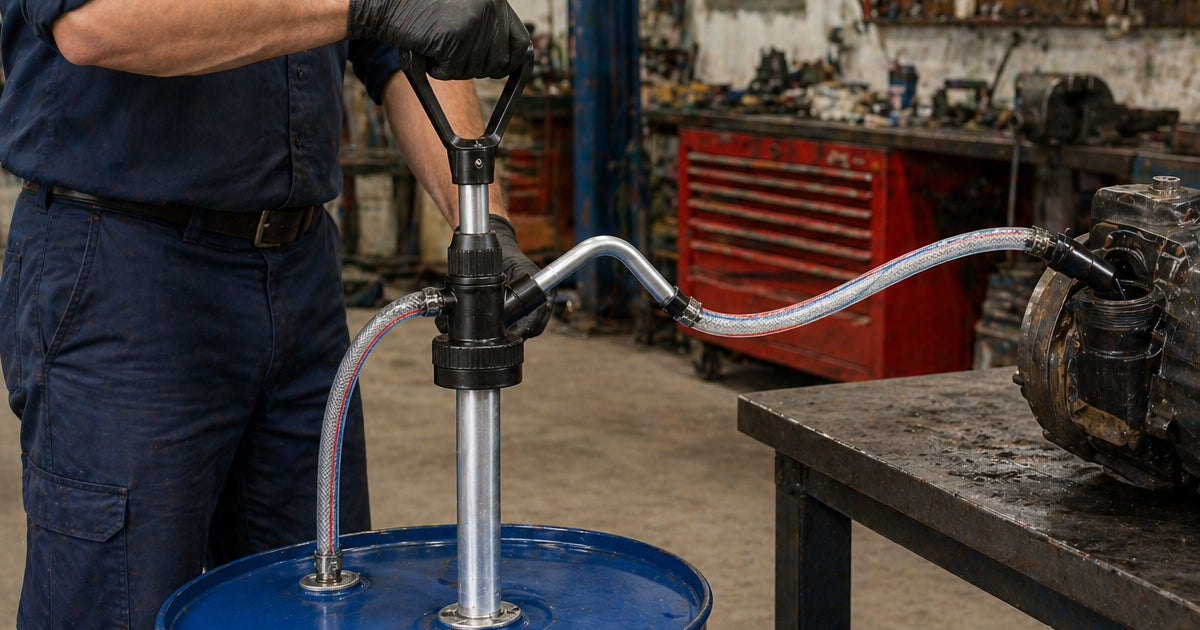
The question sounds simple — which pump do I need to move diesel from a storage tank to my equipment? The answer depends on flow rate, power source, duty cycle, what else you want to pump, and whether the pump is actually rated for diesel in the first place. A significant number of fuel pump failures in Australia come from the wrong pump being fitted: wrong seal material, wrong duty cycle, or a water pump pressed into service because it was already on-site.
This guide covers how fuel transfer pumps work, the difference between 12V and 240V options, flow rate and duty cycle selection, the accessories that make a pump installation functional rather than just operational, and answers to the questions that come up most often — including whether you can use a water pump for diesel, and whether a diesel pump will handle oil.
What Is a Fuel Transfer Pump? (And What It Is Not)
A fuel transfer pump moves liquid fuel — diesel, petrol, AdBlue, oil — from one container to another. In the context of diesel storage, it typically sits at the tank outlet and draws fuel up through a suction line, then pushes it along a delivery hose to the equipment being refuelled.
It is important to distinguish a fuel transfer pump from two other types of pump that share the word "pump" in automotive and diesel contexts:
A diesel lift pump (or fuel feed pump) is a low-pressure pump built into a diesel engine's fuel system. It draws fuel from the vehicle's own tank and feeds it at low pressure to the high-pressure injection pump. This is an engine component, not a transfer pump. If a diesel mechanic says "your lift pump is failing," they are talking about an engine part, not a refuelling pump.
A diesel injection pump (or high-pressure fuel pump) pressurises diesel to the extreme pressures required to inject it into the combustion chamber — typically 200 bar to over 2,000 bar in modern common-rail systems. This is also an engine component with no relation to tank-side fuel transfer.
A fuel transfer pump operates at very low pressures — typically 0.2 to 1 bar — and is designed purely to move bulk fuel at practical flow rates. These are the pumps we are discussing here.
How Fuel Transfer Pumps Work
For the wider view of how pump categories (centrifugal vs positive displacement) and selection criteria apply across industrial fluid handling, see our Industrial Pump Guide.
Most diesel transfer pumps use one of two operating principles:
Rotary Vane Pumps
Rotary vane pumps are the dominant technology in 12V and smaller 240V diesel transfer pumps. A slotted rotor with spring-loaded vanes rotates inside an eccentric chamber. As the vanes sweep around, they trap and compress pockets of liquid, pushing it through the pump. Rotary vane pumps are positive displacement — they move a fixed volume of fluid per rotation regardless of pressure — which makes them self-priming and reliable for drawing fuel from tanks located below the pump. They handle diesel cleanly and efficiently, and their seals and vanes are rated for hydrocarbon fuels. They cannot handle abrasives or entrained air well.
Centrifugal Pumps
Larger 240V diesel transfer pumps and diesel-powered water pumps sometimes use centrifugal impellers. These are not self-priming and require priming before use if the pump is located above the fluid source. They produce higher flow rates at lower pressures and are well-suited to high-volume fixed installations. They are less common for diesel transfer than rotary vane designs because of the priming requirement.
Diaphragm Pumps
Diaphragm pumps use a reciprocating flexible membrane to move fluid. They are self-priming, can handle some solids in suspension, and are well-suited to low-flow, high-pressure applications. They are not a common choice for bulk diesel dispensing but appear in some portable and drum pump applications. For full coverage of air-operated double diaphragm (AODD) pumps, electric and hydraulic diaphragm pumps, diaphragm material selection (PTFE, EPDM, FKM), pump curves and chemical compatibility, see our Diaphragm Pump Guide.
Power Source: 12V DC vs 240V AC
The power source is the first and most important selection decision. It is determined by what power is available at your storage tank location.
12V DC Diesel Transfer Pumps
12V DC pumps run from a vehicle battery, a dedicated 12V battery bank, or a solar-charged battery system. They are the standard choice for:
- Farm fuel tanks without mains power at the tank site
- Construction sites where power is not yet connected
- Portable diesel pods and fuel trailers
- Remote and off-grid locations
- Ute-mounted refuelling setups
A good 12V diesel transfer pump will deliver 40–80 litres per minute, which is sufficient for refuelling tractors, excavators, trucks and generators efficiently. The limiting factor is almost always the duty cycle of the motor, not the flow rate.
Duty cycle is the ratio of on-time to rest time the motor can sustain without overheating. Most entry-level 12V pump motors are rated intermittent duty: 20–30 minutes on, then 20–30 minutes rest. For a 5,000-litre tank serving one or two machines a day, this is rarely a constraint — a typical tractor tank fill takes 3–5 minutes. For fleet refuelling operations where the pump runs continuously for extended periods, specify a continuous-duty motor — these use different motor windings that tolerate sustained use without thermal damage.
Current draw: 12V diesel pumps typically draw 12–20 amps at full flow. If running from a vehicle battery without the engine running, keep sessions to 15 minutes or less, or run the vehicle to maintain battery charge during long fills. A dedicated 100Ah AGM battery charged by a solar panel is a more reliable solution for high-use installations.
240V AC Diesel Transfer Pumps
Where mains power is available at the tank, a 240V AC pump is the superior choice for anything above light-use applications. Advantages over 12V:
- Higher flow rates: 80–150 L/min is typical for 240V commercial transfer pumps, compared to 40–80 L/min for 12V
- Continuous duty: 240V motors are generally rated for continuous operation, making them suited to fleet refuelling depots and workshops
- Longer service life: Larger motors run cooler and last longer than small 12V motors at equivalent loads
- Higher head pressure: 240V pumps can push fuel further and higher — useful if the tank outlet is below grade or the delivery point is elevated
240V installations require appropriate weatherproof switchgear, correctly rated cabling and a pump motor rated for outdoor use. The installation must meet AS/NZS 3000 wiring requirements. For commercial depots and fixed industrial installations, a licensed electrician should connect the pump to the power supply.
Battery-Powered Portable Pumps
Tool-battery-powered fuel transfer pumps — most notably the Milwaukee M18 series — have become a practical option for tradespeople and contractors who already carry 18V or 20V tool batteries. These offer genuine portability (no cables, no vehicle battery connection), self-priming operation, and reasonable flow rates of 30–40 L/min. They are well-suited to occasional use in situations where no power source is available, but their battery life limits them to shorter sessions than a hardwired 12V or 240V pump.
Selecting the Right Pump: Specification Checklist
Once you have determined the power source, the following specifications guide the final choice:
"Can pump handle diesel, petrol, oil, AdBlue?"
| Specification | What It Means | Typical Range |
|---|---|---|
| Flow rate (L/min) | Volume of fuel delivered per minute at rated head pressure | 12V: 40–80 L/min | 240V: 80–150 L/min |
| Maximum head (metres) | Maximum vertical height the pump can lift or push fuel against | 12V: 3–8 m | 240V: 6–20 m |
| Suction lift (metres) | Maximum height below the pump from which fuel can be drawn | Rotary vane: 3–5 m self-priming |
| Duty cycle | How long the pump can run continuously before requiring rest | Intermittent: 20–30 min on/off | Continuous: unlimited |
| Inlet/outlet size | Thread size for hose connection | ¾" BSP to 1½" BSP — match to hose diameter |
| Seal material | Must be rated for diesel — Viton (FKM) seals are the standard choice | Viton / FKM for diesel; NBR for some fuels; avoid EPDM |
| Self-priming | Whether the pump can draw fluid up from below without manual priming | Most rotary vane pumps: yes | Centrifugal: no |
| Fluid compatibility | Always check manufacturer specification — not all pumps handle all fluids |
Hose selection: Match hose bore to the pump outlet. A 25mm (1") bore hose with a 40 L/min pump is appropriate; a larger bore hose reduces friction loss and is worth specifying if the delivery hose run is long (over 6 metres). Use fuel-rated hose — never standard garden hose or water suction hose, which will degrade and contaminate diesel with plasticisers.
12V Diesel Transfer Pump Installations: Practical Setup
For the typical farm or construction site setup — self-bunded poly tank, 12V pump, filling tractors and excavators — the complete installation consists of:
- Pump: Rotary vane 12V, 40–60 L/min, Viton seals, rated for diesel
- Suction line: Fuel-rated flexible hose or rigid pipe from tank outlet to pump inlet. Fit a foot valve at the tank end to maintain prime when the pump is below the tank level.
- In-line strainer/filter: 10–30 micron on the suction side to protect the pump from particulates; 2–5 micron on the delivery side to protect equipment injectors. A water-absorbing filter on the delivery side is strongly recommended.
- Delivery hose: 25mm fuel-rated hose, 4–6 metres. A spring retractor reel keeps the hose tidy and prevents kinking.
- Nozzle: Automatic shut-off nozzle prevents overfill and keeps hands clean. Specify a nozzle rated for diesel — petrol nozzles may not be rated for prolonged diesel use.
- Flow meter: Digital or mechanical in-line flow meter. Essential for fuel cost allocation, theft detection and reconciliation against delivery receipts.
- Power cable: Correctly rated cable from battery to pump with an in-line fuse close to the battery. 12V diesel pump cables should be sized for the maximum current draw — undersized cable causes voltage drop, reduced flow rate and cable overheating.
Can You Use a Water Transfer Pump for Diesel?
No — and this is one of the most common and costly mistakes in fuel management. The reasons are specific and serious:
Seal incompatibility: Water pumps use seal and impeller materials suited to water — commonly EPDM rubber, which is excellent for water but swells and degrades rapidly on contact with hydrocarbons. A diesel transfer pump must use Viton (FKM) seals, which are chemically resistant to diesel and petrochemicals. Put diesel through a water pump and the seals will fail — leading to fuel leaks, pump seizure, and potential fire risk depending on the installation.
Ignition risk: Water pumps are not designed or rated for use with flammable liquids. Their electrical components, motor windings and switch gear may not meet the ignition protection requirements for fuel service. This is a genuine safety issue, not a minor regulatory technicality.
Flow rate degradation: Even setting aside the seal and safety issues, diesel has different viscosity and flow characteristics to water. A centrifugal water pump will not perform as rated when pumping diesel, and the head/flow curve will be different.
A pump rated for diesel will clearly state "diesel" or "fuel" in its specification. If you are unsure, look for Viton seals, fuel-rated housing materials, and a manufacturer specification that lists diesel as a compatible fluid. Do not use a water pump for diesel transfer under any circumstances.
Will a Diesel Transfer Pump Work for Oil?
This depends on the oil type, the pump type, and the viscosity at your operating temperature. The answer is: sometimes, with important caveats.
Most diesel transfer pumps use rotary vane mechanisms that can physically move lubricating oil, hydraulic oil or gear oil. The pump seals (Viton) are compatible with petroleum-based oils. However:
Viscosity is the critical variable. Diesel at 20°C has a viscosity of approximately 3–4 centistokes. Light engine oil (0W-20) at 20°C is around 50 centistokes. Heavy gear oil (SAE 90) at 20°C can exceed 500 centistokes. Rotary vane pumps are rated for specific viscosity ranges. An undersized 12V diesel pump may refuse to draw heavy gear oil up a suction line in cold conditions, or may run with severely reduced flow rate and motor overload.
Flow rate will be significantly lower for oil than for diesel — often 30–60% of the rated diesel flow rate, depending on viscosity and temperature.
If you need to regularly transfer lubricating or hydraulic oils, select a pump specifically rated for oil — gear pumps are the traditional choice for oil transfer and handle high-viscosity fluids far better than rotary vane designs. A dedicated oil pump is the right tool — see the Oil Pump & Drum Pump Guide covering lever, rotary, air-operated ratio pumps (1:1 / 3:1 / 5:1 / 10:1) and battery-operated drum pumps for lubrication oil dispensing. Using a diesel pump for occasional low-viscosity oil transfers (such as engine oil top-ups from a drum) is generally acceptable if the pump manufacturer's specification permits it — check before assuming.
AdBlue (DEF) — A Special Case
AdBlue (also known as Diesel Exhaust Fluid or DEF) cannot be pumped through a standard diesel transfer pump. AdBlue is a urea solution — it is not a petroleum product, it is corrosive to many metals and seal materials, and it crystallises on contact with air. Pumping AdBlue through a diesel pump will contaminate the AdBlue with diesel residues and damage the pump seals. AdBlue requires dedicated AdBlue transfer pumps with stainless steel and EPDM construction — the exact materials that are incompatible with diesel. Keep AdBlue equipment entirely separate from diesel transfer equipment.
Essential Accessories for a Fuel Transfer Pump Installation
Flow Meters
A flow meter on the delivery line is not optional for any commercial or farm installation — it is essential for fuel reconciliation. Without a flow meter, there is no accurate way to track fuel usage by machine or operator, detect theft or leakage, or verify that delivery quantities match what was ordered. Digital flow meters with a resettable counter are the most practical format. Oval gear flow meters give accurate readings across a range of flow rates and are the standard choice for diesel installations. Turbine flow meters are also common and suit higher flow rates. Mount the meter in a position where it is easy to read and reset without leaning over the pump or hose. For full coverage of flow meter types, oval gear vs turbine, mechanical vs digital, AdBlue compatibility, K-factor calibration and AU brand selection, see our Flow Meter Guide.
Automatic Shut-Off Nozzles
An automatic shut-off nozzle stops fuel flow when the receiving tank is full, preventing overfill. Specify a nozzle rated for diesel at your pump's flow rate — a nozzle rated for 40 L/min connected to an 80 L/min pump may not shut off reliably. Nozzles for diesel are available in manual (squeeze grip only) and automatic (cut-off on full) versions. For routine use, automatic shut-off is strongly recommended — operator attention lapses during long fills.
Fuel Filters and Water Separators
A two-stage filtration arrangement is best practice for any pump installation:
- Suction side strainer (30–50 micron): Protects the pump from large particulates and rust from the tank wall. Clean or replace every 3–6 months.
- Delivery side filter/water separator (2–10 micron with water-absorbing element): Protects equipment — particularly common-rail diesel injectors — from fine particles and water. Replace at the specified element change interval.
Injectors on modern common-rail diesel engines are machined to tolerances of 1–2 micron and are destroyed by contaminated fuel. A filter that costs $60 prevents a $2,000–$10,000 injector replacement. This is not where to economise.
Hose Reels
A spring-return hose reel keeps the delivery hose tidy, prevents trip hazards, and significantly extends hose life by preventing kinking and UV exposure. For the complete diesel + fleet hose reel selection — Retracta F-Series 1" and 1 1/2" sizes, Macnaught twin-pedestal heavy fleet variants, metered vs unmetered, and ATEX-certified mining sourcing — see the Industrial Hose Reel Guide. Wall-mount or pole-mount reels are available for fixed installations. For portable pump setups, a manual crank reel is a practical addition. Specify a reel rated for fuel — not water — hose and ensure the internal seals are fuel-compatible.
Earthing and Bonding Cables
Static build-up during fuel transfer can occur when fuel moves through hoses and nozzles at higher flow rates. For diesel, which has a high flash point, this is less of an ignition risk than for petrol, but earthing is still good practice and is required by AS1940 for some installation types. An earthing lead — a 3–5 metre cable with crocodile clips — connects the receiving vessel to earth before and during the fill.
Diesel Bowsers: Pump, Tank and Meter in One Unit
A diesel bowser is a self-contained fuel dispensing unit that combines a storage tank (typically 500–2,000 litres), a transfer pump, a flow meter, a hose and a nozzle in a single skid-mounted unit. Bowsers are designed for fleet depots and commercial operations where a permanent dispensing station is required. They are typically 240V powered for continuous-duty operation. The all-in-one format simplifies installation, provides a clean dispensing point for multiple vehicles, and makes fuel management and reconciliation straightforward.
For farm and construction applications where portability is needed, portable fuel pods — similar to a bowser but on a trailer or skid designed for transport — provide the same integrated functionality without being fixed in place.
Installation and Safety Checklist
Before commissioning a fuel transfer pump installation:
- Confirm the pump is rated for diesel (Viton seals, fuel-rated housing)
- Confirm the power supply is correctly rated and fused for the pump's current draw
- Ensure all hose connections are secure and hose is fuel-rated
- Confirm the delivery nozzle rating matches the pump flow rate
- Install filtration on both suction and delivery sides before first use
- Test all connections for leaks before full-flow operation — run at low flow initially and inspect every joint
- Confirm the dispensing area is within the bunded zone and drains will not allow a spill to reach waterways
- Post "No Smoking / No Naked Flame" signage at the dispensing point
- Confirm the flow meter is zeroed and calibrated before first use
For the tank setup that feeds your transfer pump, see our Diesel Fuel Storage Guide for bunding requirements, tank selection and AS1940 compliance.
Frequently Asked Questions: Diesel Transfer Pumps
What is the purpose of a transfer pump on a diesel engine?
In the context of a diesel engine, a "lift pump" or "fuel feed pump" moves diesel from the vehicle's fuel tank to the high-pressure injection pump at low pressure. This is an internal engine component — not the same as a diesel transfer pump used for bulk fuel dispensing. When people ask about a fuel transfer pump in the context of refuelling, they are asking about a separate pump used to move diesel from a storage tank to equipment — the two are unrelated in function and application.
What fuel transfer pump is compatible with diesel?
Any pump with Viton (FKM) seals, fuel-rated housing materials, and a specification that lists diesel as a compatible fluid. Rotary vane pumps are the most common type for diesel transfer and are available in 12V DC and 240V AC configurations. Do not use pumps with EPDM or standard rubber seals — these are designed for water and will degrade rapidly in contact with diesel. Always check the pump manufacturer's fluid compatibility list before purchase.
Can you use a water transfer pump for diesel?
No. Water transfer pumps use seals and impeller materials (typically EPDM rubber) that are not compatible with hydrocarbons. Diesel will swell and degrade these seals within hours of operation, leading to fuel leaks and pump failure. Water pumps are also not electrically rated for use with flammable liquids — using one with diesel creates a genuine fire risk. A diesel transfer pump must be specifically rated for fuel service, with Viton seals and a fuel-compatible specification from the manufacturer.
Will a diesel transfer pump work for oil?
Possibly, but with significant limitations. The seals in most diesel pumps (Viton) are chemically compatible with petroleum-based oils. However, lubricating oil and gear oil are far more viscous than diesel, which means flow rates drop substantially — often to 30–60% of the diesel-rated flow. In cold conditions, heavy gear oil may not draw through a suction line at all. If you need to regularly transfer lubricating or hydraulic oil, specify a gear pump designed for oil transfer rather than using a diesel pump. For occasional, light oil duties, check with the pump manufacturer that oil is within the rated viscosity range.
What flow rate do I need for a diesel transfer pump?
For most farm and light commercial applications — filling tractors, excavators, trucks and generators — a 40 L/min pump is sufficient. At 40 L/min, a 200-litre tractor tank takes 5 minutes to fill, and a 500-litre excavator tank takes 12–13 minutes. If you are running fleet refuelling where multiple vehicles fill in quick succession, or if you want faster fill times, 60–80 L/min is practical. A faster pump reduces the time each operator waits at the bowser. For high-volume commercial depots, 240V pumps at 100–150 L/min are appropriate.
What is the difference between a 12V and a 240V diesel transfer pump?
12V DC pumps run from a vehicle battery or dedicated 12V system — they are portable, require no mains power, and are the standard choice for farms, construction sites and remote locations. They typically deliver 40–80 L/min and many are rated for intermittent use only (20–30 minutes on, then rest). 240V AC pumps require mains power, deliver higher flow rates (80–150 L/min), and are generally rated for continuous-duty operation — making them the appropriate choice for fleet depots, workshops and commercial installations where the pump operates frequently or for extended periods.
What is a diesel bowser?
A diesel bowser is a self-contained fuel dispensing unit that combines a storage tank, transfer pump, flow meter, hose and nozzle in a single skid-mounted installation. They are designed for fleet depots and commercial premises as a permanent, managed fuel dispensing point. Portable bowsers — often called fuel pods — mount on a trailer for site-to-site use. Both formats typically include an automatic shut-off nozzle, a resettable digital flow meter, and a lockable dispensing point for fuel security and reconciliation.
How do I prime a diesel transfer pump?
Rotary vane diesel transfer pumps are self-priming — they can draw fuel up from below the pump inlet without manual priming, typically to a suction lift of 3–5 metres. If the pump fails to prime, check: (1) all suction line connections are airtight — even a small air leak will prevent priming; (2) the suction line is not kinked or blocked; (3) if the pump has not been used for a long period, the pump chamber may have dried out — pour a small quantity of diesel directly into the pump inlet and retry. Centrifugal pumps are not self-priming and must be manually primed before first use or after running dry.
How long do 12V diesel transfer pumps last?
A quality 12V diesel transfer pump in regular farm or light commercial use should provide 3–7 years of reliable service with basic maintenance. Key factors affecting longevity: running the pump within its rated duty cycle (overheating shortens motor life dramatically); keeping fuel clean and filtered so that particulates do not damage the pump chamber and vanes; and protecting the motor from rain and dust ingress. Low-cost pumps typically use lower-quality vanes and motor windings that fail significantly sooner than premium units. The cost difference between an entry-level and a quality 12V pump is typically $100–$200 — small relative to the total installation cost.
Do I need a flow meter on a diesel transfer pump?
For any commercial, farm or fleet application: yes. A flow meter is how you track fuel usage by machine or operator, reconcile deliveries against consumption, detect theft or unexplained losses, and allocate fuel costs accurately. Without a flow meter, fuel management is effectively an estimate. A digital in-line flow meter with a resettable counter adds modest cost to the installation and pays for itself in the first instance of detecting an unexplained discrepancy. For very low-use private installations, a flow meter is optional but still useful.
Can a diesel transfer pump run dry?
Running dry — operating the pump with no fuel flowing through it — is harmful to most diesel transfer pumps. The pump chamber and vanes rely on the fuel itself for lubrication and cooling. A rotary vane pump run dry for more than a few seconds will experience increased vane wear; run dry for minutes, it may seize. Fit a low-level float switch or a tank sight gauge and make it standard practice to check the tank level before operating the pump. If you suspect the pump has run dry, do not force it to restart — allow it to cool, then prime the chamber manually before restarting.
What are the different types of diesel pump seals, and which should I choose?
Seal material is the single most important specification when selecting a fuel transfer pump. The three main seal materials you will encounter are:
Viton (FKM): The correct choice for diesel, petrol, biodiesel blends and most petroleum-based fuels. Viton is chemically resistant to hydrocarbon fuels across a wide temperature range and will not swell or degrade on contact with diesel. All pumps specified for fuel service should carry Viton seals. If the specification sheet does not state "Viton" or "FKM," ask before purchasing.
EPDM (Ethylene Propylene Diene Monomer): Excellent for water, hot water, steam, and many chemicals — but will swell and fail rapidly in contact with diesel or petrol. EPDM is the seal material in most water transfer pumps. Using a water pump with EPDM seals for diesel is the most common cause of premature pump failure in fuel storage applications.
NBR (Nitrile Butadiene Rubber): Reasonable hydrocarbon resistance for light fuel duties, but inferior to Viton at elevated temperatures and with modern diesel blends containing biodiesel. Acceptable in some lower-cost pumps for intermittent use, but Viton is the correct specification for any regular fuel transfer application.
The practical rule: if the pump spec sheet says Viton or FKM seals and lists diesel as a compatible fluid, you are on solid ground. Everything else requires verification before use.
Will a diesel transfer pump work for petrol?
In terms of seal compatibility, yes — Viton seals handle both diesel and petrol. However, there is an important safety distinction. Petrol has a flash point below 23°C, classifying it as a Class 3 flammable liquid — significantly more hazardous than diesel (Class C2, flash point above 61°C). A pump used for petrol must be specifically rated for flammable liquids: this means explosion-proof or ignition-protected motor windings, non-sparking impeller materials, and earthing provisions. Many 12V diesel transfer pumps are not rated to this standard. Check the manufacturer specification for explicit petrol/flammable liquid approval before using a diesel pump with petrol. Using a diesel-rated pump that is not explosion-proof for petrol transfer creates a genuine ignition risk.
Why does my diesel transfer pump keep stopping?
The most common cause is thermal overload — the motor's built-in thermal protection is cutting out to prevent damage from overheating. This almost always means the pump is being run beyond its duty cycle. Most 12V diesel transfer pumps are rated for intermittent use: typically 20–30 minutes of continuous operation followed by an equal rest period. Running the pump continuously beyond this — for example, filling multiple large machines in quick succession without a break — will trigger the thermal cutout. Allow the pump to cool for 20–30 minutes, then resume. If this is a regular occurrence, the pump is undersized for the application and you need either a continuous-duty 12V motor or a 240V pump.
Other causes worth checking: a partially blocked suction strainer creating back-pressure on the motor; low battery voltage causing the motor to draw higher current and overheat faster; or a kinked delivery hose causing excessive pump pressure. Clear any blockages and ensure the battery is fully charged before attributing the issue to duty cycle alone.
What suction lift can a diesel transfer pump handle?
Rotary vane diesel transfer pumps are self-priming and can typically draw fuel up from a suction lift of 3-5 metres below the pump inlet without manual priming.
Are diesel transfer pumps rated for continuous or intermittent duty?
It depends on the pump. Most 12V diesel transfer pumps are rated for intermittent use — typically 20-30 minutes of continuous operation followed by an equal rest period. 240V AC pumps are generally rated for continuous-duty operation, making them the appropriate choice for depots and workshops where the pump runs frequently or for extended periods.
What brands of diesel transfer pumps does AIMS stock?
AIMS Industrial stocks diesel transfer pumps from Alemlube, Macnaught, Lubemate and Piusi, covering 12V rotary vane pumps through to 240V bowser units, ready to ship Australia-wide.
What else besides duty cycle can cause a diesel transfer pump to keep tripping out?
Besides exceeding the rated duty cycle, other common causes are a partially blocked suction strainer creating back-pressure on the motor, low battery voltage causing the motor to draw higher current and overheat faster, or a kinked delivery hose causing excessive pump pressure. Clear any blockages and confirm the battery is fully charged before attributing the issue to duty cycle alone.
Ready to transfer diesel efficiently?
Shop our full range of diesel transfer pumps
From 12V rotary vane pumps to 240V bowser units — AIMS Industrial stocks diesel transfer pumps from Alemlube, Macnaught, Lubemate, and Piusi, ready to ship Australia-wide.
AIMS stocks a comprehensive O-Ring range — metric and imperial, individual sizes and assortment kits in nitrile, Viton and EPDM.

