

What Is a Key and Keyway?
A keyway is a slot machined into a shaft, and a matching slot machined into the bore of a component — a pulley, sprocket, gear, coupling, or flywheel. A small precision piece of metal called a key is inserted into these two aligned slots. The key locks the shaft and the component together rotationally, so that torque applied to one is transmitted to the other without slippage.
Without a key, a component fitted to a shaft can rotate freely around the shaft when torque is applied — which is exactly what happens when a key shears or a keyway wears. The shaft spins inside the bore while the pulley or sprocket sits still. The drive is lost.
Keys and keyways are one of the oldest and most reliable methods of shaft-to-hub torque transmission in mechanical engineering. They are simple to fit, cheap to replace, and standardised globally — meaning a pulley from one manufacturer and a shaft from another will accept the same key if both conform to the same standard.
Types of Keys
Parallel Key (Square or Rectangular)

The most common key type in industrial use. A parallel key has a constant cross-section — it is the same width and height along its entire length. Square parallel keys are used on smaller shafts; rectangular (flat) parallel keys are used on larger shafts where the shaft-to-key height ratio would make a square key too deep. Parallel keys sit half in the shaft keyway and half in the hub keyway, transmitting torque through the sides of the key.
Parallel keys can be retained in one of two ways: a close fit in both the shaft and hub keyways (used where the key must locate precisely, such as in gearboxes), or a sliding fit in the hub with a close fit on the shaft — this allows the component to slide axially on the shaft while still transmitting rotation. The latter arrangement is called a feather key.
Feather Key
A feather key is a parallel key fitted tightly in the shaft keyway but with a sliding clearance fit in the hub keyway. This allows the hub component to slide axially along the shaft (in and out) while still transmitting torque. Feather keys are used in gearboxes (sliding gear selectors), variable-position sprockets, and adjustable-position components. The key is often secured to the shaft with one or two socket head cap screws through the key body to prevent it moving axially with the hub.
Woodruff Key

A Woodruff key is semicircular in cross-section — shaped like a half-disc. The curved portion sits in a circular milled pocket in the shaft; the flat top protrudes into a conventional keyway in the hub. Woodruff keys are self-aligning (the curved base automatically centres in the shaft pocket) and work well in tapered shaft applications, such as motor shafts, small engine crankshafts (lawnmowers, chainsaws, whipper snippers), and machine tool spindles.
Woodruff keys are widely stocked at consumer hardware and automotive stores — this is why searches for "woodruff key bunnings" and "woodruff key supercheap" are common. Small engine crankshaft keys are almost always Woodruff type. In industrial applications, Woodruff keys are less common than parallel keys because the deep shaft pocket weakens the shaft more than a parallel keyway.
Gib-Head (Taper) Key

A taper key is driven in axially — it wedges between the shaft and hub, locking everything together by friction from the taper. A gib-head key has a head (like a nail head) on one end to allow extraction with a puller or screwdriver. Taper keys generate a clamping force that holds the component on the shaft even without any other retention. They are used in older machinery and some heavy industrial applications. Disadvantage: the wedging action can force the shaft eccentric relative to the bore if not fitted carefully.
Scotch Key (Flat Saddle Key)

A Scotch key (also called a saddle key or flat key) fits into the hub keyway only — there is no keyway in the shaft. The key bears on the top of the shaft. Scotch keys transmit only small torques via friction and are a field expedient when a shaft keyway is not present or has been damaged. They are not suitable for heavy-duty torque transmission. The search term "scotch key" has notable volume in Australia, reflecting their use as a quick-fix solution in agricultural and field maintenance applications.
Round Key (Pin Key)

A round key or pin key is a cylindrical pin driven into a hole drilled half through the shaft and half through the hub. Simple to cut and fit. Used in light-duty applications and some hand tools. Not suitable for high-torque transmission.
Key Steel: What It Is and How to Use It
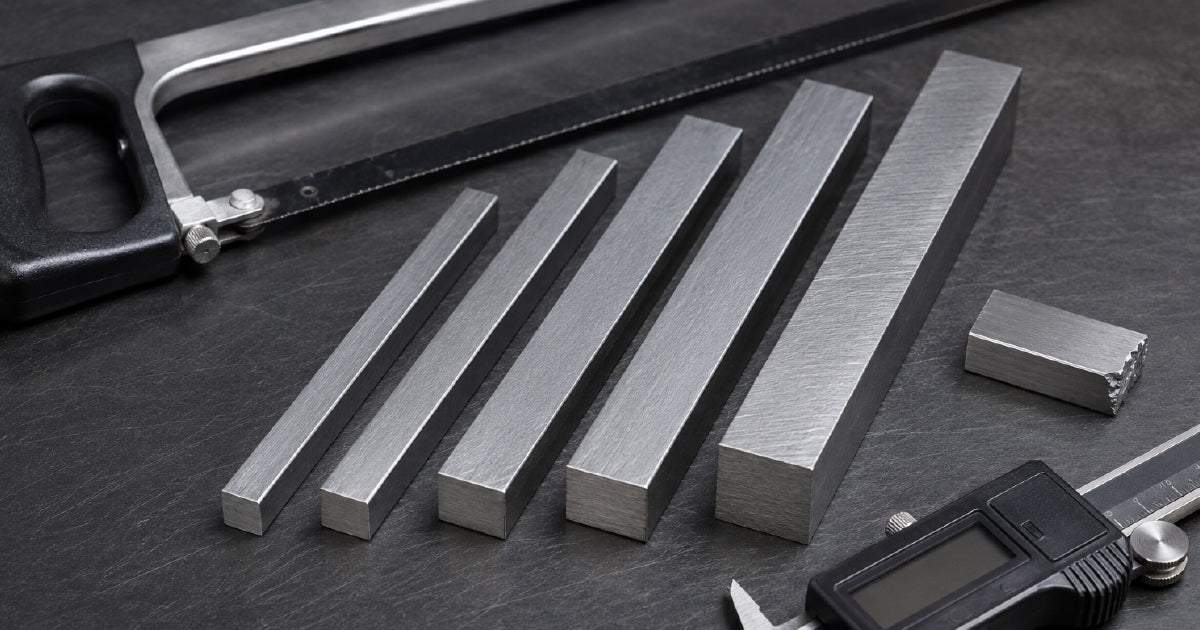
Key steel (also called keyway steel or key stock) is bright steel bar supplied in standard cross-sectional dimensions matching common key sizes — 3×3, 4×4, 5×5, 6×6, 8×7, 10×8, 12×8, 14×9, 16×10, and so on. It is supplied in straight 300mm and 1-metre lengths and is cut to fit the specific keyway length needed.
Key steel is typically manufactured from carbon steel (C45 or equivalent — Australian Grade AS1442 Grade 1045), which provides adequate strength for most drive applications. The bright (cold-drawn) finish holds dimensional tolerances that allow a correct sliding or press fit in machined keyways without further finishing in most cases.
How to Cut Your Own Key from Key Steel
Fitting a key from bar stock is a standard workshop skill, particularly for replacing worn or sheared keys in pulleys and sprockets:
- Measure the keyway. Measure the width and depth of the shaft keyway and the hub keyway separately. Width should be consistent. Depth in the shaft is typically equal to the key height divided by two (half the key sits in the shaft, half in the hub).
- Select the correct key steel. Choose bar stock matching the keyway width (and nominally matching the key height). The standard keyway dimensions table below will confirm the correct key section for the shaft diameter.
- Cut to length. The key should be 0.5–1.5mm shorter than the keyway length to allow for thermal expansion and to ensure the key does not bottom out axially. Cut with a hacksaw or cold saw.
- Check the fit. The key should be a snug sliding fit in the shaft keyway — it should push in by hand or with light mallet taps, with no side play. In the hub, a normal fit has a small clearance (the hub can slide axially). For a close fit (in precision applications), the hub fit should also be snug with no measurable play.
- Chamfer the leading edge. Lightly file or grind a chamfer on the leading end of the key to guide entry into the hub keyway during assembly.
Standard Keyway Dimensions — Parallel Keys (ISO 773 / AS 1654)
The following table gives standard key and keyway dimensions for parallel keys. The shaft keyway depth (t1) is the depth of the slot cut in the shaft. The hub keyway depth (t2) is the depth of the slot in the bore of the component. Key height = t1 + t2 (approximately — with small fitting allowances). This standard applies to both the AIMS key steel range and to components (pulleys, sprockets, couplings) supplied in metric sizes.
| Shaft Diameter (mm) | Key Width × Height (mm) | Shaft Keyway Depth t1 (mm) | Hub Keyway Depth t2 (mm) |
|---|---|---|---|
| 6–8 | 2 × 2 | 1.2 | 1.0 |
| 8–10 | 3 × 3 | 1.8 | 1.4 |
| 10–12 | 4 × 4 | 2.5 | 1.8 |
| 12–17 | 5 × 5 | 3.0 | 2.3 |
| 17–22 | 6 × 6 | 3.5 | 2.8 |
| 22–30 | 8 × 7 | 4.0 | 3.3 |
| 30–38 | 10 × 8 | 5.0 | 3.3 |
| 38–44 | 12 × 8 | 5.0 | 3.3 |
| 44–50 | 14 × 9 | 5.5 | 3.8 |
| 50–58 | 16 × 10 | 6.0 | 4.3 |
| 58–65 | 18 × 11 | 7.0 | 4.4 |
| 65–75 | 20 × 12 | 7.5 | 4.9 |
| 75–85 | 22 × 14 | 9.0 | 5.4 |
| 85–95 | 25 × 14 | 9.0 | 5.4 |
| 95–110 | 28 × 16 | 10.0 | 6.4 |
| 110–130 | 32 × 18 | 11.0 | 7.4 |
Dimensions per ISO 773 / AS 1654 — Rectangular and Square Parallel Keys and Their Corresponding Keyways. Nominal dimensions shown; refer to the standard for full tolerance specifications.
⚠️ Imperial keyways: Some older Australian equipment and imported machinery (particularly from North America) uses inch-sized keyways. A 1-inch shaft in imperial standard takes a 1/4" × 1/4" key. These dimensions do not directly correspond to metric equivalents — a 25mm shaft takes a 8×7mm key, not a 1/4"×1/4" key. If you are fitting a key to older equipment or imported machinery, confirm whether the keyway is metric or inch before cutting from bar stock.
International Keyway Standards Cross-Reference
Australian industrial workshops encounter drawings and equipment from every major industrial economy. The keyway standards used internationally look different on the drawing but are largely equivalent in dimension. Knowing the standards alignment lets you read a German DIN drawing, a Japanese JIS drawing, an American ANSI drawing or an Italian UNI drawing without re-measuring every feature. The table below maps the major keyway standards used on AU industrial equipment.
| Standard | Country / Region | Scope | Equivalent |
|---|---|---|---|
| ISO 773 | International | Parallel keys and keyways | Reference standard — others align to it |
| DIN 6885-1 | Germany | Parallel keys, standard form | Equivalent to ISO 773 (forms A, B, AB) |
| DIN 6885-2 | Germany | Parallel keys, drive-fit / feather form, reduced keyway | Used where the key remains fixed in the shaft and slides in the hub |
| DIN 6885-3 | Germany | Low-profile parallel keys | For hubs with limited radial space |
| DIN 6888 | Germany | Woodruff keys | Equivalent to ISO 3912 |
| DIN 6887 | Germany | Taper keys (gib head) | Equivalent to ISO 774 |
| JIS B 1301 | Japan | Parallel and taper keys, metric | Largely equivalent to ISO 773 (relevant for Sumitomo, Mitsubishi, Hitachi gearboxes) |
| ANSI B17.1 / ASME B17.1 | USA | Square and rectangular keys, imperial | Different sizing convention from ISO/DIN — inch-based, see Imperial Keyway Sizes section below |
| ANSI B17.2 | USA | Woodruff keys, imperial | Used in US-spec automotive and small engine applications |
| BS 4235-1 | United Kingdom | Parallel and taper keys, metric and imperial | Largely aligned to ISO 773 with imperial supplements |
| UNI 6604 | Italy | Parallel keys | Italian designation for ISO 773 (the same standard) |
| AS 1654 | Australia (withdrawn) | ISO fits and keyway dimensions | Withdrawn — Australia now references ISO 773 directly |
The practical takeaway: if a drawing references ISO 773, DIN 6885-1, JIS B 1301 or UNI 6604 for a metric parallel key, the dimensions are the same. The standards differ in how they are referenced in the drawing notes and which language the original document is written in — they do not differ in keyway width, depth or shaft diameter range. Imperial-spec equipment under ANSI B17.1 follows a different sizing convention covered separately below.
Parallel Key Forms — A, B, and AB
Parallel keys come in three end-shape variations defined by ISO 2491 and DIN 6885. The form is selected based on the keyway machining method used in the shaft.
| Form | End shape | Matching keyway | Typical use |
|---|---|---|---|
| Form A | Both ends rounded | End-milled keyway with fully radiused ends | Most common form — keyway machined with a slot drill or end mill leaving radiused ends |
| Form B | Both ends square (90°) | Side-milled keyway with square ends | Keyway machined with a horizontal mill, slotter or shaper — full-length flat-bottomed slot |
| Form AB | One end rounded, one end square | End-milled keyway open at one end | Keyway open at the shaft end — closed-end is radiused, open-end is square |
Form A is the dominant variant on modern CNC-machined parts because end-milling is the standard keyway-cutting method. Form B is common on older equipment and on parts where a horizontal mill or shaper was used. Form AB is used where the keyway is open at the shaft end (typical of motor shafts and pulley shafts).
DIN 6885 / ISO 773 Sizing Reference (Metric Parallel Keys)
This is the comprehensive metric parallel key sizing reference per DIN 6885-1 and the equivalent ISO 773. The table covers shafts from 6 mm to 200 mm — the range that covers most Australian industrial applications, from small gearboxes through to large drive shafts and rolling mill couplings.
| Shaft Ø (mm) | Key b × h (mm) | Key length range (mm) | Shaft keyway depth t1 (mm) | Hub keyway depth t2 (mm) |
|---|---|---|---|---|
| over 6 to 8 | 2 × 2 | 6 – 20 | 1.2 | 1.0 |
| over 8 to 10 | 3 × 3 | 6 – 36 | 1.8 | 1.4 |
| over 10 to 12 | 4 × 4 | 8 – 45 | 2.5 | 1.8 |
| over 12 to 17 | 5 × 5 | 10 – 56 | 3.0 | 2.3 |
| over 17 to 22 | 6 × 6 | 14 – 70 | 3.5 | 2.8 |
| over 22 to 30 | 8 × 7 | 18 – 90 | 4.0 | 3.3 |
| over 30 to 38 | 10 × 8 | 22 – 110 | 5.0 | 3.3 |
| over 38 to 44 | 12 × 8 | 28 – 140 | 5.0 | 3.3 |
| over 44 to 50 | 14 × 9 | 36 – 160 | 5.5 | 3.8 |
| over 50 to 58 | 16 × 10 | 45 – 180 | 6.0 | 4.3 |
| over 58 to 65 | 18 × 11 | 50 – 200 | 7.0 | 4.4 |
| over 65 to 75 | 20 × 12 | 56 – 220 | 7.5 | 4.9 |
| over 75 to 85 | 22 × 14 | 63 – 250 | 9.0 | 5.4 |
| over 85 to 95 | 25 × 14 | 70 – 280 | 9.0 | 5.4 |
| over 95 to 110 | 28 × 16 | 80 – 320 | 10.0 | 6.4 |
| over 110 to 130 | 32 × 18 | 90 – 360 | 11.0 | 7.4 |
| over 130 to 150 | 36 × 20 | 100 – 400 | 12.0 | 8.4 |
| over 150 to 170 | 40 × 22 | 110 – 400 | 13.0 | 9.4 |
| over 170 to 200 | 45 × 25 | 125 – 400 | 15.0 | 10.4 |
Source: DIN 6885-1 and ISO 773. b = key width, h = key height, t1 = depth of keyway in shaft, t2 = depth of keyway in hub. The sum t1 + t2 should equal h (key height) plus the small clearance specified in the standard.
Length selection. Key length is selected to match the hub width or shaft engagement length, then rounded to one of the standard preferred lengths: 6, 8, 10, 12, 14, 16, 18, 20, 22, 25, 28, 32, 36, 40, 45, 50, 56, 63, 70, 80, 90, 100, 110, 125, 140, 160, 180, 200, 220, 250, 280, 320, 360, 400 mm. Choose the longest standard length that fits within the hub width without overhanging the keyway ends.
Imperial Keyway Sizes — ANSI B17.1 (Square and Rectangular Keys)
Imperial keyways follow ANSI B17.1-1967 (R2013), still the current US standard. The defining difference from the metric standards is the square-vs-rectangular split: square keys are used for shaft diameters up to and including 6-1/2 inches, rectangular keys are used for shaft diameters above 6-1/2 inches. Square keys have equal width and height; rectangular keys have width greater than height. Both are slotted into shaft and hub keyways with depth approximately half the key height.
| Shaft diameter (in) | Square key W × H (in) | Rectangular key W × H (in) | Shaft keyway depth (in) |
|---|---|---|---|
| 5/16 to 7/16 | 3/32 × 3/32 | — | 3/64 |
| over 7/16 to 9/16 | 1/8 × 1/8 | — | 1/16 |
| over 9/16 to 7/8 | 3/16 × 3/16 | 3/16 × 1/8 | 3/32 (sq) / 1/16 (rect) |
| over 7/8 to 1-1/4 | 1/4 × 1/4 | 1/4 × 3/16 | 1/8 (sq) / 3/32 (rect) |
| over 1-1/4 to 1-3/8 | 5/16 × 5/16 | 5/16 × 1/4 | 5/32 (sq) / 1/8 (rect) |
| over 1-3/8 to 1-3/4 | 3/8 × 3/8 | 3/8 × 1/4 | 3/16 (sq) / 1/8 (rect) |
| over 1-3/4 to 2-1/4 | 1/2 × 1/2 | 1/2 × 3/8 | 1/4 (sq) / 3/16 (rect) |
| over 2-1/4 to 2-3/4 | 5/8 × 5/8 | 5/8 × 7/16 | 5/16 (sq) / 7/32 (rect) |
| over 2-3/4 to 3-1/4 | 3/4 × 3/4 | 3/4 × 1/2 | 3/8 (sq) / 1/4 (rect) |
| over 3-1/4 to 3-3/4 | 7/8 × 7/8 | 7/8 × 5/8 | 7/16 (sq) / 5/16 (rect) |
| over 3-3/4 to 4-1/2 | 1 × 1 | 1 × 3/4 | 1/2 (sq) / 3/8 (rect) |
| over 4-1/2 to 5-1/2 | 1-1/4 × 1-1/4 | 1-1/4 × 7/8 | 5/8 (sq) / 7/16 (rect) |
| over 5-1/2 to 6-1/2 | 1-1/2 × 1-1/2 | 1-1/2 × 1 | 3/4 (sq) / 1/2 (rect) |
| over 6-1/2 to 7-1/2 | (square not preferred) | 1-3/4 × 1-1/2 | 3/4 |
| over 7-1/2 to 9 | (square not preferred) | 2 × 1-1/2 | 3/4 |
| over 9 to 11 | (square not preferred) | 2-1/2 × 1-3/4 | 7/8 |
| over 11 to 13 | (square not preferred) | 3 × 2 | 1 |
Source: ANSI B17.1-1967 (R2013), Square and Rectangular Keys and Keyseats. W = key width, H = key height. Above 6-1/2" shaft diameter, rectangular keys are preferred — square keys at large sizes lose efficiency relative to material cost.
Imperial keyway tolerance practice. ANSI B17.1 specifies a minimum tolerance window of +0.002"/0 on key width — that is, the key may be at nominal width or up to 0.002" oversize, but never undersize. The mating shaft keyway is typically held at +0.002"/0 as well, giving a sliding fit on assembly. For interference-fit applications (gears, sprockets where the key must not slide), an oversize key is selected and the keyway is honed to fit. The standard recognises both Class 1 (clearance) and Class 2 (interference) fits — the drawing should specify which.
Hub Keyway vs Shaft Keyway — The t1/t2 Depth Split
One of the most common keyway-fitting errors is assuming the keyway depth on the shaft equals the keyway depth on the hub. It does not. ISO 773 and DIN 6885 specify different depths for the shaft (t1) and the hub (t2) — the shaft takes a deeper keyway, the hub takes a shallower one. The two depths together accommodate the key plus a small clearance specified in the standard.
| Why the split exists | What it means in practice |
|---|---|
| Shaft is more critical | The shaft sees the full bending and torsional stress. The deeper keyway in the shaft means the key sits low and is supported by a larger contact area on the keyway sides (the working faces). |
| Hub keyway is shallower | The hub sees primarily torque transfer. A shallow hub keyway preserves bore-wall thickness and reduces the hub's tendency to crack or split under heavy load. |
| Key engagement is on the sides, not top/bottom | The clearance between the top of the key and the bottom of the hub keyway is intentional. The key transmits torque through the shear faces (key sides), not through interference at the top. |
| The clearance accommodates manufacturing tolerance | If the key were a tight fit top-to-bottom AND on the sides, every minor variation would create installation difficulty. The top clearance lets the key seat without binding. |
Worked example. A 30 mm shaft uses an 8 × 7 mm key. Per DIN 6885-1, the shaft keyway depth t1 = 4.0 mm; the hub keyway depth t2 = 3.3 mm. Total depth available = t1 + t2 = 7.3 mm. Key height h = 7 mm. Clearance at the top of the key = 0.3 mm — small, but specified.
The Practical Machinist field rule. When cutting a keyway from scratch without a drawing, the long-standing workshop convention is: shaft keyway depth = (key height ÷ 2) + 0.010 inch (0.25 mm). This produces a slightly deeper keyway than ISO/DIN specify but works as a safe field rule when the original drawing is unavailable. For a 1/2" key the depth would be 0.250" + 0.010" = 0.260". This rule has been the standard answer in machinist forums for decades and produces a workable keyway when drawings are not at hand.
Keyway Tolerance Classes — H9, N9, P9, JS9
The tolerance class on a keyway width controls how the key fits in the slot. ISO 286 (the international fits and limits standard) provides four classes commonly used on shaft and hub keyways. The drawing specifies which class applies — H9 for free-running, N9 for normal/light press, JS9 for transition (an even split of clearance and interference), and P9 for pressed/fixed.
| Tolerance class | Fit type | Where it is used | Description |
|---|---|---|---|
| H9 | Free running (clearance) | Hub keyway in feather-key applications where the hub slides along the shaft (sliding gear assemblies) | Largest clearance — key slides freely in the hub keyway |
| N9 | Normal (transition / light interference) | Hub keyway, standard production assembly | The default for most applications. Key fits with a light push or light tap. Standard hub keyway tolerance. |
| JS9 | Transition (symmetrical) | Shaft keyway in feather-key applications | Balanced clearance and interference — about half the assemblies will be slip fit, half light press. Used where the key remains fixed in the shaft. |
| P9 | Press fit (interference) | Shaft keyway in fixed-key applications | Maximum interference — the key is pressed in and stays. Used where the key must not move under heavy reversing torque. |
The numerical tolerance windows for these classes vary with key width:
| Key width b (mm) | H9 (clearance) | N9 (normal) | JS9 (transition) | P9 (press) |
|---|---|---|---|---|
| over 3 to 6 | +0.030 / 0 | 0 / -0.030 | ±0.015 | -0.012 / -0.042 |
| over 6 to 10 | +0.036 / 0 | 0 / -0.036 | ±0.018 | -0.015 / -0.051 |
| over 10 to 18 | +0.043 / 0 | 0 / -0.043 | ±0.0215 | -0.018 / -0.061 |
| over 18 to 30 | +0.052 / 0 | 0 / -0.052 | ±0.026 | -0.022 / -0.074 |
| over 30 to 50 | +0.062 / 0 | 0 / -0.062 | ±0.031 | -0.026 / -0.088 |
Tolerance values in millimetres per ISO 286-2. The shaft-side keyway typically takes JS9 or P9; the hub-side keyway typically takes N9 or H9. The combination determines the overall fit.
The standard combinations. A typical fixed-key drive uses P9 in the shaft and N9 in the hub — the key is pressed into the shaft and slides into the hub. A typical feather-key drive (where a sliding gear runs on the shaft) uses JS9 in the shaft and H9 in the hub — the key stays put in the shaft, the hub slides over it. Reverse the convention only when the application calls for it.
Woodruff Key Sizing — DIN 6888 / ISO 3912 / ANSI B17.2 Reference
Woodruff keys (semi-circular keys, also called moon keys) are standardised under three parallel standards depending on the equipment origin. The metric standards DIN 6888 and ISO 3912 are equivalent. The imperial standard ANSI B17.2 covers the inch sizes used on US-spec automotive, agricultural and small engine equipment. The three numbering conventions are not directly interchangeable — confirm which standard the original equipment was built to before ordering a replacement.
| Designation | Width × Diameter (mm or in) | Key height (mm or in) | Standard | Typical use |
|---|---|---|---|---|
| 1.5 × 7 | 1.5 × 7 mm | 2.6 mm | DIN 6888 / ISO 3912 | Small motor shafts, instrument drives |
| 2 × 7 | 2 × 7 mm | 2.6 mm | DIN 6888 / ISO 3912 | Small motor shafts |
| 2.5 × 10 | 2.5 × 10 mm | 3.7 mm | DIN 6888 / ISO 3912 | Small fan shafts, gear shafts |
| 3 × 13 | 3 × 13 mm | 5.0 mm | DIN 6888 / ISO 3912 | Common on European motor shafts |
| 4 × 16 | 4 × 16 mm | 6.5 mm | DIN 6888 / ISO 3912 | Medium motor shafts, fan hubs |
| 5 × 19 | 5 × 19 mm | 7.5 mm | DIN 6888 / ISO 3912 | Medium-duty drives |
| 6 × 22 | 6 × 22 mm | 8.5 mm | DIN 6888 / ISO 3912 | Heavy-duty motor shafts, agricultural drives |
| 8 × 28 | 8 × 28 mm | 10.5 mm | DIN 6888 / ISO 3912 | Heavy industrial drives |
| #204 | 1/16 × 1/2 in | 0.203 in | ANSI B17.2 | Lawn mower spindles, small engines |
| #404 | 1/8 × 1/2 in | 0.203 in | ANSI B17.2 | Briggs & Stratton, Honda, Tecumseh small engines |
| #505 | 5/32 × 5/8 in | 0.250 in | ANSI B17.2 | Crank-mounted pulleys, small motorcycle drives |
| #606 | 3/16 × 3/4 in | 0.313 in | ANSI B17.2 | Marine engines, motorcycle countershafts |
| #808 | 1/4 × 1 in | 0.438 in | ANSI B17.2 | Heavy motorcycle, automotive crank shafts |
| #1212 | 3/8 × 1-1/2 in | 0.594 in | ANSI B17.2 | Industrial agricultural and heavy automotive |
The ANSI Woodruff key number encodes the dimensions: the last two digits are the diameter in 1/8-inch increments; the digits before that are the width in 1/32-inch increments. So #606 = 6/32" × 6/8" = 3/16" × 3/4". The metric DIN 6888 designation lists width × diameter in millimetres directly.
Lost Woodruff key replacement — the practical Australian guide. Loss of the Woodruff key on small engines, motorcycles, agricultural equipment and aftermarket pulleys is one of the most common DIY repair scenarios. The key falls out when the pulley or component is removed, slips into the work area, and is gone. To identify the correct replacement: measure the keyway slot in the shaft (width and the depth of the curved profile), measure the keyway in the hub (width and depth), and match to the metric DIN 6888 or imperial ANSI B17.2 table above. AIMS Industrial stocks a range of metric Woodruff keys to DIN 6888 — for imperial Briggs & Stratton, Tecumseh and Honda small engine sizes, an assorted ANSI B17.2 kit from a small engine specialist is often the most practical solution.
Key Fits: Loose, Normal, and Close
Not all key applications use the same fit between key and keyway. Three standard fits apply:
| Fit Type | Shaft Keyway Fit | Hub Keyway Fit | Application |
|---|---|---|---|
| Loose (Transit) | Slight clearance | Moderate clearance | Guide and sliding applications; components that must slide freely |
| Normal | Close sliding fit | Slight clearance | Standard general-purpose drives — pulleys, sprockets, couplings |
| Close (Precision) | Press/interference fit | Close sliding fit | Precision drives, gearboxes; no movement permitted in either direction |
For most AIMS customer applications — V-belt pulleys, chain sprockets, conveyor drives — a normal fit is correct. The key slides into the shaft keyway with hand pressure and sits with a small clearance in the hub, allowing the component to be pushed on axially before the set screw is tightened.
Keys in Pulleys, Sprockets, and Couplings
Pulleys and sprockets are the most common applications where AIMS customers encounter keys and keyways. Understanding how the system works helps diagnose failures and order the correct replacement parts.
Standard Bore Configurations
Pulleys and sprockets are supplied in several bore configurations:
- Pilot bore: A small pre-bored hole (usually 10–20mm) with no keyway. The customer bores and broaches the finished bore and keyway to suit their specific shaft diameter in their own workshop.
- Finished bore: Bored to a specific finished diameter with a machined keyway and set screw hole, ready to fit directly onto a shaft of that diameter.
- Taper lock bore: Uses a taper lock bush — described below.
When ordering a finished-bore pulley or sprocket, specify: (1) the finished bore diameter, (2) the keyway size (which will be standard for that bore diameter if the supplier follows ISO 773), and (3) whether a set screw is required.
Set Screws and Their Role
Most finished-bore pulleys and sprockets have one or two threaded set screw holes in the hub — one typically positioned over the keyway, one on the opposite side. The set screw locks the component axially on the shaft (preventing it from sliding off) but does not transmit rotational torque. Torque is transmitted by the key. A common mistake is over-tightening set screws and expecting them to hold the component without a key — set screws alone are not designed for that function in a keyed bore.
For the pulley side of this — V-belt sheave profiles SPZ/SPA/SPB/SPC, taper lock vs pilot bore vs bored-and-keyed mounting, pitch diameter sizing, and alignment — see our Pulley Types Guide.
Taper Lock Bushes: An Alternative to Conventional Keyways
Taper lock bushes (or taper-lock bushings) are a system that eliminates the need for precision keyway fitting in the field. The bush is a split tapered sleeve with its own internal keyway. The component (pulley, sprocket, coupling) has a tapered bore to match. When the bush is drawn into the component taper using cap screws, it clamps onto the shaft by compression, gripping the shaft far more securely than a conventional key-and-set-screw arrangement.
Advantages over conventional keyed bores: faster installation and removal, no precision keyway broaching required in the field, the same pulley can be used on different shaft sizes by changing the bush, and the clamping force distributes load more evenly around the shaft circumference. Taper lock bushes are available in standard sizes (1008, 1108, 1210, 1215, 1310, 1610, 2012, 2517, 3020, 3525, 4030, and so on) and take a standard parallel key in the bush keyway.
If you are regularly fitting and removing pulleys or sprockets, or working with shafts that require frequent repositioning, taper lock is worth specifying. See the AIMS pulleys range and sprockets range for taper lock bore options.
Why Keys Shear — and Why That's Intentional
A sheared key is one of the most common failures encountered in drive systems. It often comes as a surprise to operators — but key shear is, in many applications, an intentional design feature rather than a failure.
The key is the weakest link in the drivetrain by design. When a drive system is subjected to a sudden shock load — a jam, a jam in a conveyor, striking a rock on a mower deck, or a sudden mechanical stop — the key is designed to shear before the shaft twists, the pulley cracks, or the gearbox is destroyed. A key costs a few dollars. A shaft, gearbox, or pulley costs orders of magnitude more.
This is why replacement key steel is routinely stocked by maintenance teams, and why knowing the key dimensions for critical drive shafts is part of good machinery maintenance practice.
What Causes Premature Key Failure (Before Genuine Overload)
While key shear under overload is by design, premature key failures indicate problems that need addressing:
- Incorrect key size: Using a key smaller than the standard dimension for the shaft — under-dimensioned keys shear at loads the drive should handle easily. Always use the correct ISO 773 key size for the shaft diameter.
- Poor keyway fit (sloppy keyway): If the key has side play in either the shaft or hub keyway, impact loads concentrate at one end of the key rather than distributing along its length. A sloppy keyway in a sprocket or pulley will shear keys repeatedly. The root cause is the worn keyway, not the key.
- Missing or loose set screw: Without axial retention, the hub can move along the shaft and cause the key to bear load on one corner rather than its full face area.
- Notch in keyway corner: Sharp corners at the ends of a keyway are stress concentration points. In machined keyways, end mills leave a rounded profile — fitting a square-ended key into a radiused-end keyway creates a stress riser at the corner. Either use a key with chamfered ends or ensure the keyway corners match the key geometry.
Sloppy Keyways in Pulleys and Sprockets: What to Do
A worn or oversized keyway in a pulley, sprocket, or hub is a common problem on older or heavily used machinery. Symptoms: repeated key shear, metallic rattling from the drive when loaded, visible chatter marks on the key face, or the component rotating slightly relative to the shaft at low load.
Options for a sloppy keyway:
- Oversize key: If the keyway has only minor wear (0.1–0.2mm oversize), an oversize key cut from key steel can restore the fit. File the key to a snug fit in the worn keyway. This is a temporary repair.
- Repair with Loctite 638 or similar retaining compound: For slight looseness, applying retaining compound to the key surfaces before assembly can take up the clearance and restore torque capacity. This is a repair, not a permanent fix for a heavily worn keyway.
- Replace the component: If the keyway in the pulley or sprocket is significantly worn or wallowed out, the component should be replaced. A worn keyway will continue to damage keys and eventually damage the shaft keyway as well.
- Machine a new keyway: If the shaft keyway is sound but the hub is worn, a new keyway can be broached or milled at 90° or 180° to the worn one. This requires a machine shop.
- Upgrade to taper lock: Converting a worn keyed-bore pulley to a taper lock configuration permanently solves the problem and provides superior holding power going forward.
How to Fit a Key
Proper key fitting is straightforward but a few details matter:
- Clean all surfaces. Remove any burrs, scale, or debris from the shaft keyway, the hub keyway, and the key itself. Burrs prevent the key from seating fully and create false tight spots.
- Fit the key to the shaft first. The key should be a close sliding fit in the shaft keyway — entering smoothly by hand or with light mallet taps, no rocking or side play. If the key is tight, check for burrs. Never force a key that does not want to enter — forcing causes galling and may split the hub when assembled.
- Check the key height. The key should protrude above the shaft surface by exactly t2 (the hub keyway depth). A simple way to verify: compare the key protrusion against the hub keyway depth using a depth gauge or a feeler gauge at the hub face.
- Slide on the component. Align the hub keyway with the key and push the component on axially. It should enter smoothly. Resistance indicates misalignment or the key is sitting too high (check for burrs under the key).
- Fit the set screw. Apply a small amount of medium-strength Loctite (blue, 243) to the set screw thread and tighten to the manufacturer's specification. The set screw provides axial retention only — do not over-tighten expecting it to do the key's job.
Key Steel Sizes Stocked by AIMS Industrial
AIMS Industrial stocks bright key steel bar in standard ISO 773 metric sizes, supplied in 300mm and 1-metre lengths. Common sizes include 5×5, 6×6, 8×7, 10×8, 12×8, 14×9, and 16×10mm. Key steel can be cut to length with a hacksaw and fits directly into standard metric keyways without further surface treatment in most applications. Browse the full range at aimsindustrial.com.au/collections/key-steel.
For pulleys, sprockets, and taper lock bushes, see:
Got the keyway size? Get the key.
Shop parallel keys, Woodruff keys & key steel bar
From ISO 773 parallel keys to Woodruff keys and key steel bar cut to size — AIMS Industrial stocks shaft keys across all widths, heights, and lengths for power transmission applications, ready to ship Australia-wide.
Frequently Asked Questions
What is a keyway used for?
A keyway is a slot machined into a shaft and into the bore of a component (pulley, sprocket, gear, coupling). A key inserted into both slots locks the two parts together rotationally, transmitting torque from the shaft to the component without slippage.
What is the difference between a parallel key and a Woodruff key?
A parallel key is a rectangular or square bar that sits in a straight slot machined along the shaft. It is the standard key type for industrial pulleys, sprockets, and couplings. A Woodruff key is semicircular — it sits in a circular milled pocket in the shaft. Woodruff keys are self-aligning and commonly used on tapered shafts, small engine crankshafts, and motor shafts. They are less suitable for high-torque industrial drives because the deep shaft pocket weakens the shaft.
What is key steel and what sizes does it come in?
Key steel is bright carbon steel bar (typically AS1442 Grade 1045 or equivalent) manufactured to standard parallel key cross-section dimensions. Common metric sizes: 3×3, 4×4, 5×5, 6×6, 8×7, 10×8, 12×8, 14×9, 16×10, 18×11, 20×12mm. Supplied in 300mm and 1-metre lengths for cutting to fit. The bright drawn finish maintains the close tolerances needed for a correct keyway fit.
How do I know what key size to use on a shaft?
Key size is determined by shaft diameter. ISO 773 (and the equivalent AS 1654) specifies the key width × height for each shaft diameter range — for example, a 25mm shaft takes an 8×7mm key. See the keyway dimensions table above. If the existing key is worn or missing, measure the keyway width with a vernier caliper — the key width matches the keyway width.
Why do keys shear?
Key shear under overload is intentional — the key is the weakest link in the drivetrain by design, protecting the shaft and more expensive components from damage during jams or shock loads. Premature key shear (at normal operating loads) indicates a problem: incorrect key size, a sloppy/worn keyway, missing set screw allowing axial movement, or a stress concentration from a sharp keyway corner. Repeated key shear in the same location always has a root cause — find and fix it rather than just replacing the key.
How tight should a key fit in a keyway?
In the shaft keyway, the key should be a close sliding fit — entering smoothly by hand or with light mallet taps, no detectable side play. In the hub keyway (for normal-fit applications such as pulleys and sprockets), a small clearance is correct — the hub should slide on easily. A key that requires heavy driving into the shaft keyway is likely oversize or has burrs.
What is a feather key?
A feather key is a parallel key fitted tightly to the shaft keyway but with a sliding clearance fit in the hub. This allows the hub component to slide along the shaft axially while still transmitting torque rotation. Used in sliding gears, variable-position drives, and machine tool feed mechanisms. The key is usually fastened to the shaft with cap screws to prevent it moving with the hub.
What is a taper lock bush and when should I use one?
A taper lock bush is a split tapered sleeve that clamps onto a shaft when drawn into a matching tapered bore in a pulley or sprocket. It requires no precision keyway broaching in the field, provides superior clamping force compared to a set screw, and allows easy removal and repositioning. Specify taper lock for new installations, for applications requiring frequent removal, or to solve repeated key/keyway problems in existing equipment.
My pulley keeps shearing keys. What is the real problem?
Repeated key shear in the same pulley indicates a worn or oversize keyway in the pulley bore — the key has side play and impact loads concentrate at the key ends rather than distributing along its length. Check the keyway width with a vernier caliper against the key width. If the clearance exceeds 0.1–0.2mm, the pulley keyway is worn. Replace the pulley, or upgrade to a taper lock bore configuration to permanently resolve the problem.
Can I cut a key from mild steel flat bar?
Technically yes, but bright key steel is the correct material and is not significantly more expensive. Mild steel flat bar (Grade 250) has lower strength than key steel (Grade 1045) and will shear at lower loads than a correctly specified key. For any drive application, use proper key steel in the correct ISO 773 dimensions. Substituting mild steel flat bar risks a key shearing before it should — potentially at inconvenient or unsafe moments.
What is the difference between a keyed bore and a plain bore?
A keyed bore has a machined keyway slot — it is designed to be driven by a key on a keyed shaft. A plain bore has no keyway — it is used for components that rotate freely on the shaft (idler pulleys, bearing housings) or that are retained by other means (shrink fit, spline, set screw alone for very light duty). Taper lock bore is a third option, using a taper lock bush rather than a conventional key.
How do I measure a worn keyway to know what key size to order?
Measure the keyway width with an outside micrometer or digital vernier caliper across the slot opening. The nominal key width should match this measurement. For worn keyways, measure both ends of the slot — wear is often uneven. If the slot width varies by more than 0.15–0.2mm, the keyway is too worn for a standard key and the component should be replaced or the keyway repaired.
What is the difference between DIN 6885 and ISO 773?
DIN 6885 (German) and ISO 773 (international) specify the same metric parallel keyway dimensions. They are equivalent standards — DIN 6885-1 corresponds to the standard parallel key form covered by ISO 773. A drawing referencing DIN 6885 and a drawing referencing ISO 773 will produce the same keyway for the same shaft diameter. The difference is which standards body issued the document and which language the original is written in. UNI 6604 (Italian) is also equivalent. JIS B 1301 (Japanese) is largely equivalent. Australian drawings now reference ISO 773 directly since AS 1654 was withdrawn.
What is a P9 keyway tolerance?
P9 is an interference-fit tolerance class per ISO 286 used on the keyway width when the key must be pressed in and stay put. For a 10 mm wide keyway, P9 specifies a tolerance window of -0.018 to -0.061 mm — meaning the keyway is cut slightly UNDER nominal width, so the key (typically held to h9, slightly under nominal) is pressed in with interference. P9 is the standard tolerance for the shaft keyway in fixed-key drives (gears, sprockets, pulleys that should never spin on the shaft). For the hub keyway, the standard companion tolerance is N9 (zero-to-negative window, light press fit). For feather-key drives where the hub slides on the shaft, use JS9 in the shaft and H9 in the hub instead.
Are Form A, Form B, and Form AB parallel keys interchangeable?
Functionally yes, but mechanically only if the keyway accommodates the form. Form A keys have both ends rounded — they fit keyways machined with an end mill or slot drill (the standard CNC method). Form B keys have both ends square — they fit keyways machined with a horizontal mill, slotter or shaper, leaving square ends. Form AB has one rounded end and one square end — typical for keyways open at the shaft end. A Form A key cannot fit a Form B keyway without leaving gaps at the ends. A Form B key cannot fit a Form A keyway without filing the key ends to match. When ordering replacement keys, match the form to the keyway you have — or specify Form A by default since end-milled keyways are most common.
What size keyway does a 1 inch shaft take?
A 1 inch (25.4 mm) shaft sized under ANSI B17.1 takes a 1/4 × 1/4 inch square key in a 1/8 inch deep shaft keyway. Under metric ISO 773 / DIN 6885, the closest standard shaft size range is 'over 22 to 30 mm' which calls for an 8 × 7 mm key in a 4.0 mm deep shaft keyway. Imperial and metric keys are NOT interchangeable on a 1 inch shaft — a 1/4 inch (6.35 mm) imperial key will be loose in a metric 8 mm keyway, and an 8 mm metric key will not fit at all in a 1/4 inch imperial keyway. Confirm whether the equipment is imperial-spec (typical for older US machinery and agricultural equipment) or metric-spec before ordering.
How do I identify a lost Woodruff key for replacement?
Measure two dimensions in the shaft keyway: the slot WIDTH (use a feeler gauge or vernier caliper across the slot opening) and the DEPTH of the curved profile at its deepest point. Match these to the DIN 6888 / ISO 3912 metric table or the ANSI B17.2 imperial table. Common metric sizes on European motor shafts are 3 × 13 mm, 4 × 16 mm and 5 × 19 mm. Common imperial sizes on Briggs & Stratton and Honda small engines are #404 (1/8 × 1/2 in) and #505 (5/32 × 5/8 in). If the shaft keyway diameter is not directly measurable, an assorted Woodruff key kit from a small engine or bearing specialist often provides the cheapest path to a working repair — install the key that fits the slot snugly, with the curved bottom seated fully and the flat top flush with the shaft surface.
People Also Ask — Keyways, Parallel Keys & Woodruff Keys
Q: What is a keyway used for?
A keyway is a rectangular slot machined into a shaft and its mating hub — gear, pulley, or sprocket — to accept a key. The key locks the two parts together to transmit torque, preventing relative rotation while allowing the hub to be assembled and removed. Keyways are used wherever moderate torque transmission and easy serviceability are both required.
Q: What is the difference between a parallel key and a Woodruff key?
A parallel key (sunk key) is rectangular and fits straight slots in both shaft and hub, suited to longer hubs and higher torque. A Woodruff key is semicircular, self-aligning, and fits a circular slot milled into the shaft — better for tapered shafts and lighter-duty applications. Parallel keys are more common in power transmission; Woodruff keys in automotive and light machinery.
Q: How do you select the correct key size for a shaft?
Key dimensions are standardised relative to shaft diameter. Key width and height are selected from a table based on the shaft diameter range — approximately one-quarter of the shaft diameter as a general rule. Key length is determined from the torque to be transmitted, hub length, and keyway depth. Match the key exactly to the standard size for the shaft diameter in use.
Q: What is key steel and when do you use it?
Key steel is precision-dimensioned square or rectangular bar stock used to cut shaft keys to length on-site. It is manufactured to tight tolerances in standard widths and heights matching key dimension standards. Common materials are EN8 (carbon steel) for standard service and stainless steel 316 for corrosive environments. Key steel simplifies procurement — buy by the metre and cut what you need.
Q: What is a keyway fit class, and which one should I use?
Keyway fit class describes the dimensional tolerance between the key and the keyway slot. Class N (normal clearance) allows easy assembly and disassembly — standard for most applications. Class T (interference fit) requires pressing the key in and gives better location under reversing loads. Choose normal clearance unless the application involves frequent load reversals or high dynamic loading.
A key and keyway handle the drive torque, but a retaining compound on the same shaft-to-hub fit adds backup against fretting and clearance that develops over time. See our Loctite Retaining Compound Guide for grade selection.