

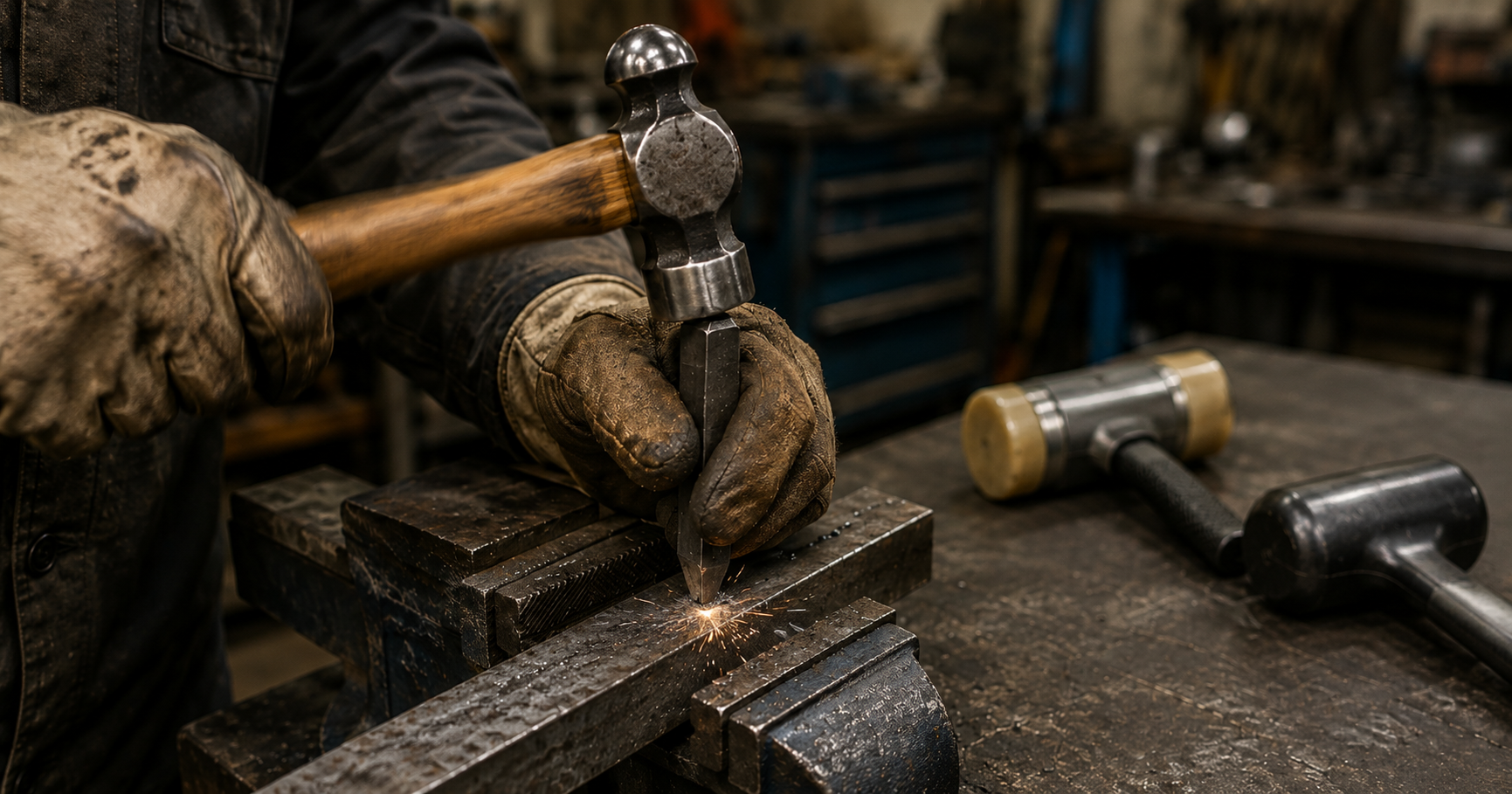
Hammers look simple. They are not. The hammer you reach for changes the outcome of the strike — a claw hammer on a metal chisel rounds the chisel and chips the hammer face; a steel hammer on a precision-machined dowel pin mushrooms the pin; a thin TIG glove's worth of dexterity isn't worth keeping if a hard-face hammer cracks the part you're trying to assemble. This guide is the engineering and workshop hammer reference — ball pein, dead blow, soft face (Thor system explained), sledge, drilling and chipping hammers. AIMS stocks the engineering range deeply (Thor, Nupla, Stahlwille, Bossweld, Trax pneumatic) but not carpentry hammers (claw, framing, brick) — those are covered briefly with an honest "see other retailers" note. Use the right hammer; protect the work.
The three pein hammer types are ball pein, cross pein, and straight pein. The ball pein has a rounded peen used for shaping rivets and metal forming, and is the most common engineer's hammer in Australian workshops. The cross pein has a wedge-shaped peen at right angles to the handle for starting nails between the fingers. The straight pein has the wedge in line with the handle for shaping in tight spots. All three are general-purpose engineer's hammers in 100 g to 1.5 kg head weights.
Pein Hammer Types — Quick Reference

| Type | Peen shape | Used for |
|---|---|---|
| Ball pein | Rounded ball, opposite the flat face | Shaping rivets, peening metal, general workshop |
| Cross pein | Wedge, perpendicular to the handle | Starting nails, light forging across the grain |
| Straight pein | Wedge, in line with the handle | Forging along the grain, tight-access shaping |
Engineer's hammers all share a hardened steel face. For non-marring work, see the dead blow, soft face (Thor copper / rawhide / nylon) and rubber mallet sections below.
Why hammer choice matters — strike the right way
Workshop hand injuries from hammers fall into two big categories: missed strikes (struck thumb, struck workpiece edge) and recoil/shock injuries (wrist strain, elbow tendinitis from daily-use mismatched hammers). The wrong hammer doesn't just damage the work — it damages the user over time. Wood handles transmit shock through the wrist; fibreglass and aluminium dampen it. Hardwood-handle sledge hammers on cold steel chisels split handles routinely; dead-blow hammers eliminate the rebound that drives most strain injuries.
The other failure pattern is using the wrong face material for the workpiece: a hardened steel face on a precision-ground surface either marks or deforms it. A soft-face hammer (rawhide, copper, plastic, nylon) prevents marking but won't deliver the strike force needed to drive a hardened cold chisel. Three hammers minimum cover most workshop jobs — ball pein for steel work, dead blow for assembly, and a soft-face for precision parts.
This guide assumes you already have PPE sorted: safety glasses (essential — chipped hammer faces and struck steel send fragments), hearing protection for sustained hammer work in confined spaces, and work gloves for grip and cushioning. PPE doesn't replace the right hammer choice — it complements it.
Driving hammers vs soft-face hammers — the two big categories

Every hammer in this guide falls into one of two functional categories. Driving hammers have hardened steel faces and deliver maximum force into the workpiece — ball pein, sledge, drilling, claw. Soft-face hammers have replaceable or fixed soft faces (rubber, plastic, nylon, copper, rawhide, lead) and protect the workpiece from marking — Thor, Nupla soft-face, Stahlwille plastic. Pick the category first, then narrow on face material and weight.
| Category | Face | Job | Typical weight | Best for |
|---|---|---|---|---|
| Driving hammers (hardened steel face) | Drop-forged carbon steel, case-hardened | Maximum strike force into the work | 16oz–20lb (450g–9kg) | Striking chisels and punches, driving pins, hot-work peening, demolition, sledge work |
| Soft-face hammers (replaceable or fixed soft face) | Rawhide, plastic, nylon, copper, rubber, lead — interchangeable on Thor and Stahlwille | Strike without marking the workpiece | 4oz–7lb (110g–3.2kg) | Assembly, fitting, machining, precision dowel/pin driving, automotive panel work |
A handful of hammers cross the line — a dead-blow hammer uses a shot-filled head inside a hard plastic or rubber outer shell, so it delivers driving-hammer force without driving-hammer rebound. We'll cover dead blow in its own section.
AIMS dives deep on the engineering side of both categories: Thor for the soft-face range (15+ active models including the workshop-standard Thor Rawhide Face hammer and the premium Thor Rawhide Size 4 (2000g)), Nupla for driving hammers (Nupla Ball Pein, Nupla Drilling Hammer, Nupla Sledge 20lb), Bossweld for chipping, Stahlwille for premium plastic-face, and Trax for pneumatic air hammers. What we don't stock: claw hammers, framing hammers, brick/mason hammers — see the "carpentry hammers" section below for the honest scope.
Ball pein hammers — the workshop generalist

A ball pein hammer (UK and AU spelling) — also called ball peen hammer (US spelling, same tool) — is the engineering shop's general-purpose hammer. It has two ends: a flat striking face for driving chisels, punches and steel pins, and a rounded "ball pein" on the opposite end for peening work (shaping rivet heads, drawing curves in sheet metal, work-hardening). Most workshop traditions teach the ball pein before any other hammer.
What makes a ball pein different from a claw hammer: the face is harder. Ball pein hammers are case-hardened steel — the outer surface is tough, the inside softer for shock absorption. This lets the face strike hardened cold chisels and steel punches without rolling or chipping. A claw hammer's face is softer (designed for nail driving into wood) and will deform if used on hardened steel — and worse, can chip and send hardened fragments flying. Quoting r/Tools (240+ comments thread): "A ball peen is my go-to, general purpose hammer. I never use a claw hammer for anything else other than driving nails into wood."
Typical sizes: 8oz for fine work and engraving; 12oz–16oz for general bench fitting; 24oz for general workshop and metal forming; 32oz–48oz for heavy fitting and rivet work. The Nupla Ball Pein Hammer (rubber grip) at AIMS is the workshop standard — drop-forged head with fibreglass handle and rubber grip for shock absorption.
The "pein" end uses:
- Peening rivet heads — strike the ball end repeatedly around the rivet stem to mushroom the head and lock the rivet (still common in trailer building, restoration, aircraft sheet metal)
- Drawing curves in sheet metal — controlled strikes shape a panel without marking the show surface
- Work-hardening edges — repeated peening strikes increase surface hardness on softer metals
- Stretching metal — peening expands the struck zone, useful in metal forming and panel beating
The flat-face end uses:
- Striking cold chisels and bolster chisels — the harder face matches the hardened chisel
- Driving pins, punches and drift pins — hardened tool steel strike on hardened tool steel
- Light demolition with a chisel — controlled chipping of concrete, mortar, weld slag
- Driving nails when no carpentry hammer is to hand — works, but the heavier head fatigues the wrist faster
Forum-validated weight rule: a 24oz ball pein is "very heavy for anything other than serious workshop and metal forming. 16oz for general bench, 12oz for fine work" (r/Tools 100+ comments). Pick the lightest weight that still delivers the strike force you need.
Cross pein, straight pein and the pein variations

The "pein" of a hammer is the back end opposite the flat face — the shaped end designed for specialised metalwork tasks. Ball pein is the most common in AU workshops but two variants exist:
- Cross pein — wedge-shaped pein at 90 degrees to the handle. Used for starting small nails (the wedge end positioned between fingers to hold the nail), striking curves in sheet metal in a linear direction, and traditional metalworking technique. Less common in AU industrial supply than ball pein.
- Straight pein — wedge-shaped pein aligned with the handle. Similar uses to cross pein but the wedge runs lengthwise. Mostly historical / specialist blacksmith use.
- Ball pein — rounded pein for peening, drawing curves, work-hardening rivets. The AU/UK standard.
For most AU engineering work, ball pein is the right pick. AIMS stocks ball pein; cross-pein and straight-pein are sourced through supplier network on request. Call (02) 9773 0122 for specialty pein requirements.
Dead blow hammers — strike without rebound

A dead blow hammer has a hollow head filled with steel shot or sand, encased in a hard rubber or plastic outer shell. The shot moves on impact — absorbing the rebound that would otherwise bounce a normal hammer back at your wrist — so the full strike energy transfers into the workpiece. No rebound, no missed second strike, no shock back through the handle. Dead blow is the workshop's go-to for assembly, automotive panel work, and anywhere a precision part needs persuasion without marking.
Why dead blow matters (forum-validated, r/harborfreight 130+ comments, Garage Journal):
- "There is no real recoil and you get a lot more impact force with a dead blow."
- "Dead blow ball peens are a lot better on the arms and wrist. You can have all that after-shock with those wooden handles."
- Steel caps prevent the outer shell from being destroyed quickly
- The shot-filled head means the same strike force into the work without the same wrist strain
AIMS dead blow range:
- Nupla Dead Blow Hammer 1350g / 3lb — $194.90. Premium fibreglass handle, full Nupla construction. The heavy assembly hammer for serious shop use.
- Thor Dead-Blow Hammer (White Nylon Face, Aluminium Handle) — $91.55. Lighter weight, premium Thor build with vibration-dampening aluminium handle.
Common applications: driving precision dowel pins into housings, seating bearings into bores (paired with a bearing installation kit for press-fit work), tapping panel beats, assembling automotive parts, persuading misaligned components. Combined with light keyway and shaft work, dead blow is the assembly hammer.
When NOT to use dead blow: striking hardened cold chisels (use ball pein — the soft outer shell of a dead blow will deform against the chisel handle), driving wedges into wood (use a sledge or club hammer — dead blow energy disperses before fully driving the wedge), peening rivets (use a ball pein — dead blow can't shape the rivet head).
Soft-face hammers — the Thor system explained

Soft-face hammers are the workshop's precision-assembly tool. They strike without marking the workpiece — critical for machined surfaces, polished panels, copper-plated work, plastic and aluminium parts. The Thor system (a UK premium brand AIMS stocks deeply) defines the soft-face category in AU industrial supply: a hammer head bored to accept replaceable threaded inserts of different materials, sized 38mm or 50mm face diameter.
The five Thor face materials, ordered by softness:
| Face material | Softness | Best for | AIMS product |
|---|---|---|---|
| Rawhide | Softest — won't mark even soft brass or copper | Finest assembly, jewellery, polished surfaces, fitting precision parts | Thor Rawhide Face |
| Plastic (Thorex) | Soft-medium — replaceable Thorex inserts (orange) | General assembly, panel work, light machining | Thor Thorex Plastic 650g |
| Nylon | Medium — harder than rawhide, more durable than plastic | Heavier assembly, light dolly work, panel beating | Thor Nylon Face |
| Copper | Medium-firm — won't mark steel parts but soft enough to absorb the strike | Steel pin driving, machinery assembly, machining shop standard | Thor Copper Hammer Face |
| Aluminium | Firmest soft-face option — harder than copper but still won't mark steel | Heavy pin driving where copper deforms too quickly | Replacement face — sourced |
Why "soft-face hammer" is a workshop term, not a single product: the soft-face concept covers any hammer designed to strike without marking. The Thor system is the most flexible — buy the head and handle once, swap faces as they wear or as the job changes. The Thor Rawhide Size 4 (2000g, fibreglass handle) and Thor Copper Size 4 (2930g, fibreglass handle) are the premium heavy-duty options at AIMS — both 50mm face diameter, both ~$265-$269.
Why machinists use brass and copper hammers (r/interestingasfuck 460+ comments, r/Machinists workshop threads): "In machining we use brass hammers so we don't damage parts." Copper and brass are softer than the hardened steel of precision machined parts, so the hammer absorbs the strike — the part doesn't deform. Critical for tolerance-critical work where a millimetre's mark on a precision dowel pin is a scrap-out.
Stahlwille — the premium German alternative: the Stahlwille Plastic Hammer with Interchangeable Head ($35.70) is the premium German engineering alternative to Thor. Same replaceable-face concept, different brand heritage. Common in European-spec machinery workshops.
Chipping hammers — for welding slag removal

Chipping hammers are the welder's slag-removal tool. After a stick weld or flux-cored MIG weld, slag covers the bead and must be chipped away before inspection or further welding. A chipping hammer has a pointed end (for breaking slag at the weld toe) and a chisel end (for sweeping the slag clear). They're a specialty tool, sized small (typically 400g–500g) for one-handed use over the welding helmet's fume zone.
AIMS chipping hammer range:
- Bossweld Chipper Professional Chipping Hammer 400g — $21.32. Workshop standard chipping hammer with cone/chisel ends and conventional handle.
- Bossweld Spring Handle Chipping Hammer — $9.35. Budget spring-handle version. The coiled-wire handle absorbs shock and lets the user maintain grip through repeated strikes.
Pair with safety glasses (essential — slag fragments fly), gloves and a welding chipping brush. For stick welding technique that requires good slag removal, see the Stick Welding Guide; for MIG welding with flux-cored wires (also producing slag), see the MIG Welding Guide.
Sledge hammers — heavy demolition and driving

Sledge hammers are the workshop's biggest hand-driven impact tool. Weights range 2lb–20lb (900g–9kg), with longer handles for two-handed swing on the heavier weights. Common applications: driving heavy stakes and posts, breaking concrete and masonry (the "sledge" of demolition work), driving heavy wedges for shaft work, persuading stuck machinery components, and any job where mass × velocity is the answer.
AIMS sledge hammer:
- Nupla Sledge Hammer 8.96kg / 20lb — $579.13. The heaviest in the AIMS range. Nupla fibreglass handle (unbreakable under normal use), drop-forged steel head. Inventory typically 10 units — niche product. The 20lb sledge is for demolition, post driving, and very heavy work; not a one-handed tool.
For lighter sledge work (4lb–8lb range), AIMS supply is currently thin — the Grip range was discontinued (vendor cancellation). For 4lb–10lb sledge hammers, the supplier network can source — call (02) 9773 0122. Common AU brands in this weight range include Estwing, Stanley, Vaughan and Hultafors (none currently stocked by AIMS).
Replacement parts: the Nupla Sledge Hammer Handle ($91.44) and the Nupla Epoxy Kits ($27.27) let you replace a broken or loose handle without binning the whole tool. The epoxy kit is the workshop standard for re-bedding a Nupla head onto a replacement handle — same approach for ball pein and drilling hammers in the Nupla range.
Club, drilling and engineer's hammers — the short-handled striker

A drilling hammer (also called a club hammer, lump hammer, or engineer's hammer) is a short-handled 2–4lb hammer used one-handed for striking masonry chisels and bolster chisels, light demolition, and bench fitting where a full ball pein would be unwieldy. The short handle (~250mm) gives precise control; the heavy head (1.5–2kg) delivers enough force to drive a cold chisel through stone or steel.
AIMS supply:
- Nupla Drilling Hammer — $138.47, inventory 182 (strong stock). Fibreglass handle, drop-forged steel head. The AIMS workshop standard for chisel work.
The drilling hammer fills the gap between a ball pein (too long-handled for confined chisel work) and a sledge (too heavy for one-handed precision). Most fitting and maintenance trades carry one alongside a ball pein. Common applications: striking bolster chisels for masonry, cold chisel work in confined spaces, light demolition, driving small spikes, freeing stuck pins.
Carpentry hammers — honest scope (AIMS doesn't stock)

Claw hammers, framing hammers, brick hammers, roofing hammers, drywall hammers and tack hammers are the carpentry and construction side of the hammer market. AIMS does not stock these. Our engineering supply focus means we don't carry the Estwing, Stanley, Stiletto, Martinez, Vaughan or Hultafors lines that dominate the AU carpentry market — they're better-served by Bunnings, Sydney Tools, Total Tools, Trade Tools and similar retailers.
| Carpentry hammer | Job | AIMS stock? |
|---|---|---|
| Claw hammer (16oz–20oz) | Nail driving and pulling for general carpentry | ❌ Bunnings, Sydney Tools, Total Tools |
| Framing hammer (20oz–28oz) | Heavy timber framing, waffle face for grip on big nails | ❌ Trade Tools, Sydney Tools |
| Brick / mason hammer | Chisel end + flat face for masonry work, brick splitting | ❌ Bunnings, hardware |
| Roofing hammer / shingle hatchet | Hatchet end + nail-driving face for shingle work | ❌ Roofing supply |
| Drywall hammer | Convex face for dimpling drywall + hatchet end for cutting | ❌ Plaster supply |
| Tack hammer (4oz–8oz) | Magnetic face for upholstery and panel tack driving | ❌ Specialty supply |
If your job is mixed engineering and carpentry — fitter who also frames the workshop walls, for example — buy carpentry hammers from a hardware retailer and keep them separate from the engineering tools. A claw hammer used on a steel chisel is one of the most common workshop tool-destruction events; keep the two categories clearly identified.
Handle materials — wood, fibreglass, steel, aluminium
The handle determines shock transmission, durability, weight, and cost. Four materials dominate, each with distinct trade-offs.
| Material | Shock transmission | Durability | Weight | Cost | Best for |
|---|---|---|---|---|---|
| Hickory (wood) | High — transmits more shock to wrist | Replaceable; can break if mis-struck on the handle | Light | Cheapest | Traditional feel; replaceable; lighter weight ball pein and soft-face |
| Fibreglass | Medium — better dampening than wood | Very high — won't break under normal use | Medium | Mid | Industrial workshop default — Nupla and Thor heavy range use it |
| Aluminium | Low — best wrist dampening | High; won't snap but can bend on extreme strike | Light | Premium | Premium dead-blow and soft-face for daily-use; Thor Dead-Blow uses it |
| Steel (one-piece) | Highest — full shock transmission | Highest — virtually indestructible | Heaviest | Premium | Demolition; tradies; some Estwing carpentry hammers |
Forum-validated wrist-strain reality (r/Machinists "best hammers that reduce strain on my wrists"): daily-use machinist hammers should have shock-dampening handles — wood is OK for occasional use, but fibreglass and aluminium reduce repetitive-strain injuries (RSI) over time. The Thor Dead-Blow with aluminium handle and the Nupla Ball Pein with rubber grip both address this directly.
What goes wrong with wood handles: mis-strikes hit the handle, not the head — wood splinters and eventually splits. The Nupla Sledge Hammer Handle + Nupla Epoxy Kits let you re-fit a Nupla head to a fresh handle, so a $580 sledge isn't binned because a $90 handle broke.
Hammer weight selection — match weight to the job
Heavier doesn't mean better. The right weight is the lightest hammer that delivers the strike force for the job, because everything heavier costs you in fatigue, wrist strain and reduced control. The forum-validated three-hammer minimum (YouTube Flat Rate Master, Garage Journal): a large ball pein (48oz / ~1350g), a dead blow (45oz / ~1280g) and a brass or copper hammer (24-32oz / 680-900g) covers the engineering workshop spectrum.
| Application | Recommended weight | AIMS option |
|---|---|---|
| Fine engraving, jewellery, model work | 4–8oz (110–230g) | Small ball pein — sourced |
| Bench fitting, general light work | 12–16oz (340–450g) | Light ball pein, Thor 650g Thorex |
| General workshop, metal forming, light demolition | 24oz (680g) | Nupla Ball Pein |
| Heavy fitting, assembly | 32–48oz (900–1350g) | Nupla Dead Blow 1350g, Thor Rawhide 2000g |
| Heavy assembly, dolly work | 3–7lb (1.3–3.2kg) | Thor Rawhide Size 4 (2000g), Thor Copper Size 4 (2930g) |
| Drilling / club hammer (chisels) | 2–4lb (900g–1800g) | Nupla Drilling Hammer |
| Sledge / demolition | 4–20lb (1.8–9kg) | Nupla Sledge 20lb |
Buying counsel: err lighter rather than heavier for your first hammer in any category. You can always swing a 16oz ball pein harder if you need to; you can't make a 32oz hammer lighter when your wrist starts complaining at hour three.
Replaceable-face systems — when they pay off
Premium soft-face hammers — Thor, Stahlwille, Nupla soft-face — use threaded replaceable faces. The head is bored and tapped; faces screw in and out. When a face wears (rawhide deforms; plastic mushrooms; copper rounds), you replace the $5–$25 face rather than buying a new hammer.
Replacement face economics:
| Replacement face | Price | Whole hammer replacement | Break-even |
|---|---|---|---|
| Thor Rawhide Face | $24.25 | $127.23 | Replace face every ~6 months vs full hammer every ~2 years = saves $80+ per cycle |
| Thor Copper Face | $25.13 | $54.94 | One face replacement saves $30+ |
| Thor White Nylon Face | $16.47 | $48.52 | One face replacement saves $32+ |
| Nupla Soft Face Yellow Tip | $167.41 | Buy the head — replace tip annually | Premium yellow-grade soft face for heavy industrial assembly |
When the system pays off: daily-use workshop where the hammer sees multiple jobs a day across different face needs. The Thor system means one head + handle + 3-4 different faces (rawhide, copper, nylon, plastic) covers 90% of engineering assembly work. Long-term economy beats buying four separate hammers.
When it doesn't pay off: occasional use where a single fixed-face hammer lasts years. The Thor Thorex Plastic Hammer with Wood Handle at $40.27 is the budget option that fits this scenario.
Pneumatic air hammers — the adjacent category

Pneumatic air hammers (also called air chisels, air palm hammers) are powered tools, not hand hammers. They replace repetitive hammer-and-chisel work with a compressed-air-driven reciprocating action: rust removal, sheet metal cutting, panel beating, body work, exhaust separation. AIMS stocks the Trax range for industrial pneumatic work.
- Trax ARX-715H 11mm Hex Shank Long Air Chisel Hammer — $128.10. Standard workshop air chisel, hex-shank chisels.
- Trax ARX-515 1/4"PT Air Palm Hammer — $256.90. Palm-grip pneumatic hammer for panel work and assembly.
- Trax Slide Hammer Puller Set, 13pc — $193.20. Dent puller / slide hammer set for panel beating and bearing removal.
Air hammers require a compressor — see our companion guide on air supply via the AIMS pneumatic tools collection. Pneumatic chisels and slide hammers are different audiences from hand hammers (automotive panel work, demolition, sheet metal); included here for completeness, not deep-dived.
AIMS hammer range — Thor, Nupla, Bossweld, Stahlwille, Trax
The complete AIMS hammer range covers the engineering, workshop, fitting and welding shop spectrum:
Thor (premium UK soft-face — the dominant brand at AIMS):
- Heavy fibreglass-handle: Rawhide Size 4 2000g, Copper Size 4 2930g, Nylon 2300g ($265-$269 range)
- Workshop standard: Rawhide Face, Copper & Rawhide Wood Handle, Copper Face Wood Handle, Nylon Wood Handle ($41-$127)
- Thorex plastic: Thorex Plastic 650g, Plastic Face Plastic Handle, Plastic Face Wood Handle ($40-$60)
- Dead-blow: Dead-Blow White Nylon Face, Aluminium Handle ($91.55)
- Replacement faces: Copper, White Nylon, Rawhide ($16-$25)
Nupla (premium fibreglass-handle workshop tier):
- Ball Pein Hammer (rubber grip) — $86.28
- Dead Blow 1350g / 3lb — $194.90
- Drilling Hammer — $138.47
- Sledge Hammer 8.96kg / 20lb — $579.13
- Soft Face Hammer Tip Extra Hard Yellow — $167.41 (replacement face)
- Sledge Handle + Epoxy Kits (re-bedding consumables)
Bossweld (welding chipping): Chipper Professional 400g ($21.32), Spring Handle Chipping Hammer ($9.35).
Stahlwille (premium German): Plastic Hammer with Interchangeable Head ($35.70).
Trax (pneumatic, adjacent category): Air Chisel Hammer, Air Palm Hammer, Slide Hammer Puller Set.
For brands AIMS doesn't stock at retail (Estwing, Stanley, Stiletto, Martinez, Vaughan, Hultafors), call the AIMS team on (02) 9773 0122 — we can source through supplier network for specific brand requirements.
Common mistakes — 8 forum-validated errors
| Mistake | Why it fails | Fix |
|---|---|---|
| Using a claw hammer on a metal chisel | Claw hammer face is softer (designed for nails). Strikes on hardened chisel either chip the hammer face (sending fragments at speed) or roll the chisel head. | Use a ball pein for chisel work. Keep carpentry and engineering hammers physically separated in the workshop. |
| Using a hardened steel hammer on machined surfaces | Marks, deforms or cracks the workpiece. Common scrap-out on tolerance-critical machinery assembly. | Use a soft-face hammer (Thor copper / nylon / rawhide). The whole point of soft-face is preventing this damage. |
| Buying too heavy a hammer "for power" | Heavier weight = more wrist fatigue, less control, and eventual RSI. A 32oz ball pein swung 200 times a day causes injuries a 24oz wouldn't. | Buy the lightest weight that gets the job done. Up-size only when light hammer falls short of strike force. |
| Striking with the side of the hammer face (the "cheek") | The cheek isn't hardened — strikes there can chip the hammer head and send fragments flying. Also damages the workpiece angle. | Strike with the centre of the face. Adjust your stance to align hammer-to-target. |
| Ignoring loose handles | A loose head + handle on a ball pein or sledge will fly off mid-swing — a serious workshop injury risk. | Check the wedge / pin / epoxy bond before each heavy use. Re-bed with epoxy or replace if the handle is loose. |
| Wood handle mis-strikes hitting the handle | Wood splinters where the head meets the handle, weakening the bond. A wood handle abused this way breaks unpredictably. | Practice strike form; use fibreglass for heavy daily-use. Replace worn wood handles before they fail. |
| One-hammer-fits-all approach | Trying to use a single hammer for everything either damages workpieces (soft-face needed for assembly) or under-performs (need a ball pein for chisel work). | Build the three-hammer minimum: ball pein + dead blow + soft-face. Add specialty hammers as job range expands. |
| Striking without safety glasses | Chipped hammer faces, struck steel and broken chisel fragments fly at face level. Eye injuries are the #1 hammer-related workshop injury. | Wear safety glasses for every hammer task. AS/NZS 1337 standard minimum. |
Hit harder. Hit smarter.
Shop Thor, Nupla & Stahlwille hammers at AIMS Industrial
From Thor soft-face and rawhide hammers to Nupla ball pein, sledge, and drilling hammers — AIMS Industrial stocks the engineering and workshop hammer range trusted by Australian tradespeople, ready to ship Australia-wide.
Frequently Asked Questions
What is a ball pein hammer used for?
A ball pein hammer is the engineering shop's general-purpose hammer. It has a hardened flat face for striking cold chisels, punches, drift pins and steel pins, and a rounded "ball pein" on the opposite end for peening rivet heads, drawing curves in sheet metal, and work-hardening metal edges. Standard workshop weight is 24oz (680g); 16oz for lighter bench work, 32oz–48oz for heavy fitting and rivet work. The Nupla Ball Pein Hammer with rubber grip and fibreglass handle is the AIMS workshop standard.
What's the difference between a ball pein and a claw hammer?
Ball pein is case-hardened steel — designed to strike hardened cold chisels and steel punches without rolling or chipping. Claw hammer face is softer steel — designed for driving nails into wood. Using a claw hammer on a metal chisel can chip the hammer face (sending fragments at speed) and roll the chisel head. Using a ball pein for nail driving works but is heavier than needed. Keep them separate in the workshop: ball pein for engineering and metalwork, claw for carpentry.
What is the difference between "ball pein" and "ball peen"?
Same tool, different spelling. "Ball pein" is the UK and Australian spelling; "ball peen" is the US spelling. Google now treats them as equivalent search terms ("Including results for ball peen…"). Both refer to a hammer with a rounded peen opposite the flat face. AIMS uses "ball pein" but supply both spelling variants in product descriptions so AU and US-trained workshop staff can find the same product.
What is a dead blow hammer used for?
A dead blow hammer is the workshop's go-to for assembly work where you need driving-hammer force without driving-hammer rebound. The hollow head is filled with steel shot or sand — when you strike, the shot moves on impact, absorbing the rebound that would otherwise bounce the hammer back at your wrist. The full strike energy transfers into the workpiece. Common applications: driving precision dowel pins into housings, seating bearings into bores, panel beating, automotive assembly, persuading misaligned components. The Nupla Dead Blow 1350g (heavy assembly) and Thor Dead-Blow with aluminium handle (lighter daily-use) are the AIMS options.
What's the difference between a hammer and a mallet?
The terms overlap. Generally: a hammer has a hardened steel face designed for high-force impact (ball pein, sledge, claw, drilling); a mallet has a soft-face head (wood, rubber, plastic, rawhide) designed to strike without marking the workpiece. Most "mallets" are technically soft-face hammers, and the Thor and Stahlwille soft-face products are commonly called mallets in workshop conversation. The terminology isn't precise — focus on face material and intended use rather than the label.
Why do machinists use copper or brass hammers?
Copper and brass are softer than the hardened steel of precision-machined parts — so when you strike a dowel pin, key or component with a copper hammer, the hammer absorbs the strike and deforms slightly, not the part. Critical for tolerance-critical work where a mark on a precision pin is a scrap-out. From r/interestingasfuck (460+ comments): "In machining we use brass hammers so we don't damage parts." Thor copper hammers (Size 4 2930g for heavy work, Copper Face Wood Handle for general workshop) are the AIMS options.
What is a soft-face hammer?
A soft-face hammer has a head designed to strike without marking the workpiece. The face material is softer than hardened steel: rawhide, plastic, nylon, copper, rubber, or lead. Premium soft-face hammers (Thor, Stahlwille, Nupla) use threaded replaceable faces — buy the head and handle once, swap face material as the job changes. Soft-face hammers are essential for assembly work, machined surfaces, precision parts, and automotive panel work.
Wood vs fibreglass vs steel handle — which is best?
Depends on use intensity. Wood (typically hickory) is cheapest, has the traditional feel, and is replaceable when broken — but transmits more shock to the wrist and breaks if mis-struck on the handle itself. Fibreglass is the industrial workshop default — very high durability, medium shock dampening, mid-priced. Aluminium gives the best wrist dampening (premium dead-blow handles use it). One-piece steel is virtually indestructible but transmits maximum shock — common on Estwing carpentry hammers, less on engineering hammers. For daily-use workshop work, fibreglass or aluminium reduce repetitive-strain injury risk over time compared to wood.
What weight ball pein hammer should I buy?
For general workshop use, 24oz (680g) is the AU standard — heavy enough for chisel work and metal forming, light enough for sustained use without wrist fatigue. For lighter bench fitting and finer work, 12oz–16oz. For heavy fitting, rivet work and metal forming, 32oz–48oz. Buy the lightest weight that delivers your typical strike force — you can swing a 24oz harder if you need to, but you can't make a 48oz lighter when your wrist starts complaining. The Nupla Ball Pein Hammer at AIMS is the workshop-standard sizing.
What is a Thor hammer used for?
"Thor" is a premium UK brand of soft-face hammers — not the Marvel character. Thor hammers use a threaded replaceable-face system, with the head and handle bought once and faces (rawhide, copper, plastic, nylon, aluminium) swapped as the job demands. Common workshop applications: assembly of precision-machined parts, dowel pin driving, panel beating, fitting work, and any task where striking force is needed without marking the workpiece. AIMS stocks 15+ Thor models including the workshop-standard Rawhide Face hammer and the premium heavy Rawhide Size 4 (2000g, fibreglass handle).
What is a chipping hammer for?
A chipping hammer is a welder's tool for removing slag from stick welds and flux-cored MIG welds. It has a pointed end (for breaking slag at the weld toe) and a chisel end (for sweeping slag clear). Typical weight 400g–500g, designed for one-handed use over the welding helmet's fume zone. The Bossweld Chipper Professional 400g and Bossweld Spring Handle Chipping Hammer are the AIMS options. Essential for stick welding work — slag must be removed before inspection or further passes.
What is a club hammer or drilling hammer?
Same tool, different names — also called a lump hammer or engineer's hammer. Short-handled (~250mm), 2–4lb (900g–1800g), used one-handed for striking masonry chisels and bolster chisels, light demolition, and bench fitting where a full ball pein would be unwieldy. Fills the gap between ball pein (too long-handled for confined chisel work) and sledge (too heavy for one-handed precision). The Nupla Drilling Hammer is the AIMS workshop standard for cold chisel work and confined-space striking.
Can I use a regular hammer on a chisel?
A ball pein hammer yes — that's exactly what they're designed for. A claw hammer no — claw hammer face is softer steel designed for nails and can chip when striking a hardened chisel. Chipped hammer faces send fragments flying at face level (eye injury risk) and damage the chisel head. For all chisel and punch work, use a ball pein hammer or a drilling hammer. Always wear safety glasses regardless of which hammer.
How do I prevent wrist strain when hammering?
Three factors: (1) right hammer weight — too heavy causes RSI over time, pick the lightest that does the job; (2) handle material — fibreglass and aluminium dampen shock better than wood, critical for daily-use; (3) dead-blow hammers eliminate rebound, which is the main cause of wrist strain. The Thor Dead-Blow with aluminium handle and the Nupla Ball Pein with rubber grip address shock-transmission directly. Forum-validated reality (r/Machinists): wrist strain is a real injury concern for daily-use hammer work — handle material and weight choice matter as much as hammer type.
Why does AIMS not stock claw hammers?
AIMS is an industrial supply business focused on engineering, workshop, fitting, machining and maintenance trades. Claw hammers, framing hammers, brick hammers and other carpentry hammers are better-served by Bunnings, Sydney Tools, Total Tools, Trade Tools and similar retailers — they stock the Estwing, Stanley, Stiletto, Martinez and Vaughan brands that dominate the AU carpentry market. AIMS dives deep on the engineering range (Thor soft-face, Nupla workshop, Bossweld chipping, Stahlwille premium, Trax pneumatic) instead. If you need a specific carpentry brand we don't stock, call us on (02) 9773 0122 — we can sometimes source through supplier network.
For drill bit diameter cross-references — metric to imperial, decimal to fractional — see our Drill Bit Size Chart.
For matched setting hardware, see the AIMS rivet tool range.
For chisel selection and matching hammer weight to the job, see the AIMS Chisel Guide — cold, SDS and masonry chisels.