

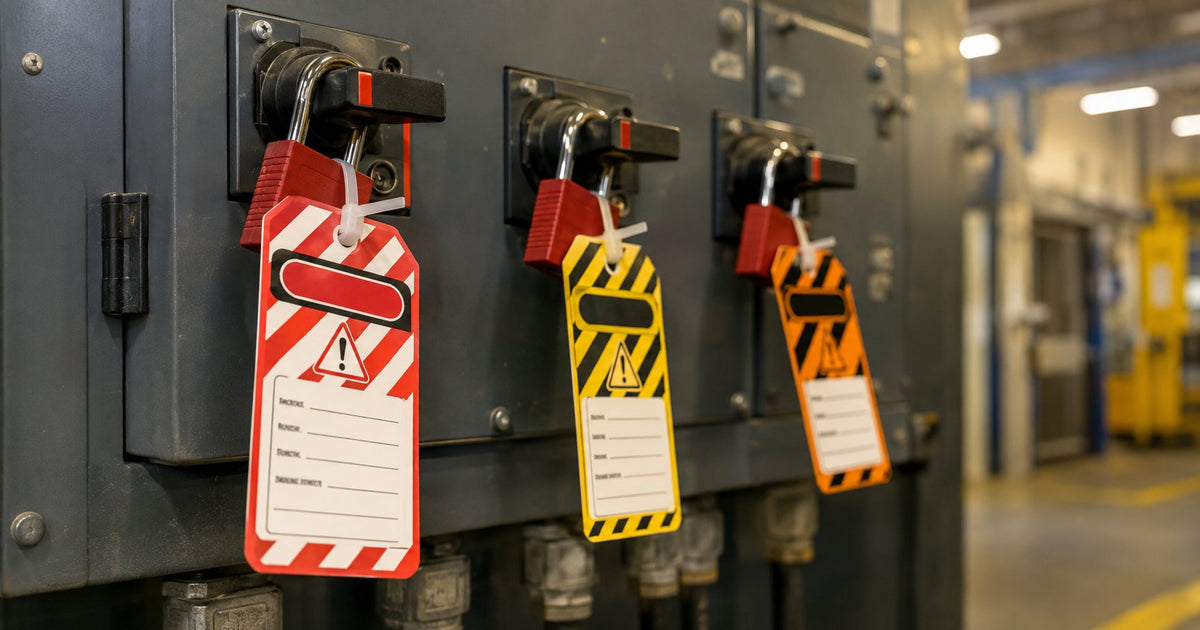
Every Australian workplace runs on a layered system of identification and warning communication. Safety signs communicate hazards at the area level. Safety tags communicate condition and status at the equipment level — this padlock is mine, this scaffold was inspected today, this electrical appliance was tested in the green quarter, this machine is out of service. Together they form the visual safety system that keeps workers safe and workplaces compliant.
Tags are governed by their own family of Australian Standards distinct from AS 1319 signs. AS/NZS 3760:2022 sets the rules for electrical test-and-tag including the RGBY quarterly colour rotation. AS/NZS 1576.1 covers scaffold inspection tags. AS/NZS 4836 covers electrical safe-working. AS 2865 covers confined space tags. The WHS Act 2011 backs all of them with Category 2 offence penalties up to $50,000 individual / $500,000 corporate for non-compliance.
This guide decodes the safety tag system from first principles. Lockout/Tagout (LOTO) tags — DANGER red/black, WARNING orange/black, OUT OF SERVICE distinction, personal worker tags. Electrical Test & Tag — the RGBY quarterly colour rotation, test intervals by industry, Class I vs Class II equipment categorisation. Scaffold tags — green/yellow/red system, 30-day validity, daily pre-use checks. Asset identification and equipment ID. Tag construction and durability. Common compliance failures. And the artwork file format trap that catches first-time custom-tag buyers.
AIMS Industrial stocks the Brady tag range across LOTO and DO NOT OPERATE categories alongside our safety signs collection. For Test & Tag electrical tags, scaffold tags or asset ID tags, we don't currently stock these specifically but can help source through our supplier network — contact us via the Quote Request form if you can't find the tag you need.
Workplace Safety Tag Selection — Quick Reference (AS/NZS 4836 + AS 1319)
Safety tags identify hazardous equipment, communicate isolation status + record inspection history. AU workplaces use a defined tag colour code aligned with AS/NZS 4836 (lockout/tagout) + AS 1319 (signage). The common workplace tags below.
| Tag Type | Colour | Meaning + Use |
|---|---|---|
| Danger Tag (Personal) | Red + Black + White | "DO NOT OPERATE" — personal LOTO isolation; only the person who applied may remove |
| Out of Service | Yellow + Black | Faulty equipment — do not use until repaired |
| Caution Tag | Yellow + Black | Hazard present, proceed with care |
| Scaffold Tag (Green) | Green | Scaffold inspected + safe to use — AS/NZS 1576 |
| Scaffold Tag (Yellow) | Yellow | Scaffold incomplete — restricted use only |
| Scaffold Tag (Red) | Red | Scaffold unsafe — do not use |
| Ladder Tag | Per state requirement | Inspection date + inspector ID — AS/NZS 1892 |
| Electrical Test Tag | Coloured by quarter | Test + tag per AS/NZS 3760 (electrical equipment) |
Critical: Personal danger tags + lockout locks are NEVER removed by anyone except the person who applied them — AS/NZS 4836 mandate. Tag durability matters for outdoor + harsh environments — match tag material to environment. AIMS stocks safety signs + labels, lockout kits, group lockout boxes, padlocks + identification products.
Tags versus signs — two parts of one workplace identification system
Tags and signs do related but distinct jobs in workplace safety communication. A safety sign communicates a permanent area-level message — "Hard Hat Must Be Worn", "Forklifts Operating", "Emergency Exit". Signs are mounted on walls, doors and structures, and they apply to whoever is in the area. A safety tag communicates equipment-level status that changes over time — "This Padlock Belongs to John, Do Not Remove", "This Scaffold Was Inspected Today and Is Safe to Use", "This Drill Was Tested in October 2025". Tags are attached to specific items of equipment, scaffolding or isolation points, and they apply to that specific item only.
The two systems share the AS 1319 colour and shape language for instant recognition. A red/black DANGER tag uses the same colour psychology as a red/black DANGER sign. A yellow scaffold caution tag uses the same colour as a yellow AS 1319 Warning sign. This consistency means workers don't have to learn a separate visual language for tags — they recognise the message the same way.
The legal framework is parallel but separate. AS 1319 governs signs; AS/NZS 3760 governs Test & Tag electrical tags; AS/NZS 1576.1 governs scaffold tags; AS 2865 governs confined space entry tags. The WHS Act 2011 backs them all with the same Category 2 offence penalty framework — up to $50,000 for an individual PCBU and up to $500,000 for a body corporate.
The five safety tag categories
| Tag category | Standard | Purpose | Typical colours |
|---|---|---|---|
| Lockout / Tagout (LOTO) | WHS Regs + AS/NZS 4836 | Active isolation during maintenance or work on energised equipment | DANGER red/black, WARNING orange/black, OUT OF SERVICE yellow/black |
| Test & Tag (electrical) | AS/NZS 3760:2022 | Records electrical equipment safety inspection and test results | RGBY quarterly rotation — Red, Green, Blue, Yellow |
| Scaffold inspection | AS/NZS 1576.1:2019 | Status of scaffold structure after inspection by competent person | Green (safe), Yellow (caution/restricted), Red (do not use) |
| Confined space entry | AS 2865 | Permit-required confined space entry authorisation and conditions | Custom format per site permit system |
| Asset / Equipment ID | Site-specific | Asset register identification, maintenance tracking, ownership | Site colour code (varies) |
The tag categories address different parts of the workplace safety workflow. LOTO and DO NOT OPERATE tags travel with the worker doing maintenance work. Test & Tag electrical tags travel with the equipment. Scaffold tags stay with the structure. Asset tags identify ownership and inspection schedule. A complex workplace might have all five categories visible at once — a forklift battery isolated under LOTO, a portable grinder with a Test & Tag colour-coded label, a scaffolding access tower with a green inspection tag, a confined space entry permit posted at the manhole, and an asset ID barcode on every piece of equipment.
Lockout Tagout (LOTO) tags — the active isolation tag system
LOTO tags are the workhorse safety tag category in any maintenance-heavy workplace. They communicate at the equipment level that an energy isolation point is locked out, who locked it out, when, and why. The principle is critical: a LOTO tag is a warning device, not a physical restraint. The actual safety control is the padlock. The tag tells everyone what the padlock is for and who applied it. For full lockout/tagout procedure see our Lockout Tagout Guide.
The three standard LOTO tag classifications under AU industry practice:
| Tag type | Colour | Use case | Implies |
|---|---|---|---|
| DANGER tag | Red/black, white background | Active isolation. The equipment is being worked on. Energising will cause injury or death. | Do not operate under any circumstances. Removal only by the worker who applied it (or authorised supervisor under documented procedure). |
| WARNING tag | Orange/black, white background | Caution required. Equipment status changed but not necessarily isolated. | Approval required before operation. Check with site supervisor. |
| OUT OF SERVICE tag | Yellow/black or similar | Equipment is defective and awaiting repair — NOT active LOTO isolation. | Do not use. Awaiting maintenance. Different procedure from LOTO. |
The DANGER vs WARNING distinction is critical and frequently misunderstood. DANGER means equipment is locked out and operating it will hurt or kill someone. WARNING means caution — typically used for partial isolation or scenarios where a worker can theoretically operate the equipment but shouldn't without supervisor sign-off. Using a WARNING tag where a DANGER tag is required is a common SafeWork audit finding and a leading contributor to LOTO-related incidents.
The OUT OF SERVICE tag is NOT a LOTO tag — this is one of the most common terminology errors in Australian workplaces. OUT OF SERVICE is used for defective equipment awaiting repair, not active isolation during work. The risk is workers seeing OUT OF SERVICE and treating it as authoritative when there's actually no lockout in place — a piece of equipment could be re-energised by someone who doesn't realise the lockout procedure was never completed. Keep OUT OF SERVICE tags strictly for equipment-not-in-use scenarios and use proper DANGER tags + padlocks for any active isolation.
Personal LOTO tags — one worker, one lock, one key
The universal LOTO safety principle is personal lockout — every authorised worker applies their own padlock and tag. No sharing. No shortcuts. No exceptions. A LOTO tag must identify the specific worker who applied it, when it was applied, and provide a contact number. The reason: if a piece of equipment has multiple workers performing maintenance, each worker controls their own safety by their own padlock — they cannot be re-energised against until every worker has removed their personal lock. A shared workgroup lock fails this principle because one worker can be re-energised against by another worker's decision.
Personal LOTO tags must include at minimum:
- Worker name (printed clearly, not handwritten if possible)
- Employer / contractor identification
- Date and time of isolation
- Contact phone number for queries
- Clear "DANGER — Do Not Operate" or equivalent warning text
- Reason for isolation (optional but recommended)
AIMS Industrial stocks the Brady personal LOTO tag range through the Lockout Tagout collection alongside safety padlocks and lockout devices. For the full LOTO procedure see our Lockout Tagout Guide.
Test & Tag Standards in Australia — AS/NZS 3760 Quarterly RGBY Rotation
Test & Tag is the Australian electrical equipment safety inspection regime, governed by the AS/NZS 3760:2022 Test & Tag standards. Every portable electrical appliance used in a workplace — power tools, extension leads, plug-in appliances, lighting, computers — must be periodically tested for electrical safety (earth continuity, insulation resistance, polarity) by a competent person, and then tagged with a record of the test. The tag tells anyone using the equipment that it has been tested, when it was tested, and when the next test is due.
Note: AIMS Industrial does not currently stock Test & Tag electrical tags as a standard line. The tag itself is a specialty consumable typically purchased through electrical wholesalers, training providers (who also supply tags to their certified testers) and specialty Test & Tag suppliers. We include comprehensive information here as a reference for electrical safety compliance. If you can't find the Test & Tag products you need elsewhere, contact us via the Quote Request form and we'll check our supplier network.
The RGBY quarterly colour rotation
The defining feature of the AS/NZS 3760 Test & Tag system is the RGBY (Red, Green, Blue, Yellow) quarterly colour rotation. Every quarter of the year uses a different tag colour, so any worker can see at a glance whether equipment was tested in the current quarter, the previous quarter, or longer ago. The rotation:
| Quarter | Months | Tag colour |
|---|---|---|
| Q1 | December, January, February | Red |
| Q2 | March, April, May | Green |
| Q3 | June, July, August | Blue |
| Q4 | September, October, November | Yellow |
The RGBY rotation is mandatory in construction, demolition and mining industries under AS/NZS 3012 (Electrical installations — Construction and demolition sites). On a construction site, all portable electrical equipment must be tested every three months and tagged with the appropriate quarterly colour — Red tags during summer, Green during autumn, Blue during winter, Yellow during spring. A worker arriving at a construction site can instantly see if an electrical lead has the correct current-quarter colour or whether it has fallen out of date.
For general industry outside construction/demolition/mining, the RGBY system is optional but strongly recommended. Many factories, workshops, hospitality venues and offices use either RGBY or their own consistent colour code for quarterly visual identification. AS/NZS 3760 only mandates that tags be applied and dated — the colour rotation is a practical industry consensus that makes visual identification fast.
Test & Tag intervals by industry
| Industry | Test interval | Why |
|---|---|---|
| Construction, demolition, mining | Every 3 months | High damage probability — cables get cut, drills get dropped, leads get abused |
| Factories, warehouses, manufacturing | Every 6 months | Moderate damage probability — equipment used daily but in controlled environment |
| Offices, commercial | Every 12 months | Low damage probability — equipment moved rarely, used in benign environment |
| Hire equipment | Before each hire | Equipment returned in unknown condition between hires |
| After repair | Before return to service | Repair may have affected electrical safety properties |
The 3-monthly construction interval is the most-mandated frequency in AU electrical safety practice. It reflects the practical reality that construction site equipment takes significant abuse — power leads dragged across rubble, drills dropped from height, extension cords driven over by loaders. The high abuse rate means earth continuity or insulation can degrade fast.
Class I versus Class II equipment
AS/NZS 3760 testing varies by equipment class:
- Class I (earthed, 3-pin plug): Tests required — earth continuity (≤1Ω resistance between earth pin and exposed metal), insulation resistance (≥1MΩ at 500V DC between active+neutral and earth), polarity (correct active/neutral on extension leads), visual inspection
- Class II (double-insulated, 2-pin plug, square-in-square symbol): Tests required — insulation resistance (≥1MΩ at 500V DC between active+neutral and accessible parts), visual inspection. No earth continuity test (no earth conductor).
The Class II "double-insulated" symbol (square inside a square) is critical — Class II equipment cannot be earthed because it has no earth conductor, so attempting to test earth continuity is meaningless. A Test & Tag operator needs to identify equipment class before testing.
What goes on each Test & Tag tag (per AS/NZS 3760 minimum):
- Tester identification (operator name or licence number)
- Test date (day/month/year)
- Next test due date
- Current period colour (RGBY rotation)
- Pass/Fail status (or just attached if pass — failed equipment is tagged out and removed)
Scaffold tags — AS/NZS 1576.1 green/yellow/red system
Scaffolding is one of the highest-risk construction activities in Australia. Falls from height are consistently in the top three workplace fatality categories. The scaffold tag system is the visual safety control that tells every worker arriving at a scaffold whether it's safe to use.
Note: AIMS Industrial does not currently stock scaffold inspection tags or Scafftag holders as a standard line. These are typically purchased through scaffolding suppliers, Brady authorised resellers (Scafftag® is a Brady trademark), or specialty access equipment suppliers. The system is included here as reference. If you can't find scaffold tags or holders elsewhere, contact us via the Quote Request form and we'll check our supplier network.
The three scaffold tag colours
| Tag colour | Meaning | Use scenario | Worker action |
|---|---|---|---|
| Green | Safe to use | Scaffold inspected by competent person and found compliant with AS/NZS 1576.1 | Use normally — standard PPE only |
| Yellow | Caution / restricted use | Scaffold modified for specific task and presents new hazards; or partial scaffold not meeting all standard requirements; or requires special PPE (fall arrest, harness) | Use only with required additional PPE; obtain supervisor approval before access |
| Red | Stop / do not use | Scaffold being assembled, dismantled, modified; or serious defect found; or recent adverse weather; or incident occurred | Do not access. No exceptions. Wait for re-inspection and green tag. |
Scaffold tag validity rules
The Safe Work Australia Code of Practice for Scaffolding sets the inspection cycle rules that all scaffold tags must respect:
- 30-day maximum validity while the scaffold remains erected
- Re-inspection required after first use, after any modification, after an incident, after adverse weather (wind, storm, heavy rain)
- Daily pre-use check required before each shift on many principal-contractor-led sites — visual inspection of platforms, ties, bracing, ladders, edge protection
- Competent person inspection — scaffolding inspection must be conducted by someone with documented training and the appropriate scaffolding ticket (Basic / Intermediate / Advanced)
The 30-day maximum is a hard limit — a scaffold that hasn't been re-inspected for 31 days is non-compliant regardless of whether it looks fine. Modifications mid-cycle require re-inspection — adding a hop-up, changing platform height, removing a guardrail all reset the validity clock. Adverse weather is the other common reset trigger — a windy weekend means scaffolds need re-inspection Monday morning.
The industry-standard product is Scafftag® (a Brady trademark) — a plastic tag holder mounted at the scaffold access point that holds the inspection record card. Workers can read the inspection status from the access ladder before climbing. Scafftag holders are available through Brady authorised distributors including Blackwoods and major safety suppliers — AIMS doesn't currently stock these.
Confined space entry tags — AS 2865 permit system
Confined spaces — tanks, vessels, pits, silos, ducts — are governed by AS 2865:2009 Confined spaces, which requires a permit-to-enter system. Every confined space entry needs a written entry permit listing atmospheric test results, ventilation in place, rescue arrangements, time limits, authorised entrants and standby personnel. The entry permit is typically supported by a confined space tag at the entry point showing the permit is active.
Confined space entry tags are site-specific — the format varies by employer permit system. Tags typically include:
- Permit number cross-referencing the full written permit
- Authorised entrants for this entry
- Standby person identification
- Atmospheric test results and expiry
- Maximum time inside
- Communication arrangements
- Emergency contact
AIMS Industrial doesn't currently stock confined space entry tags or permit systems as a standard line — these are typically site-customised through WHS consultants or confined space training providers. Contact us via the Quote Request form if you need help sourcing a confined space permit and tag system.
Asset and equipment identification tags
Asset tags are the identification layer of the workplace tag system. They identify specific items of equipment by serial number, asset register number, barcode, QR code, or RFID — allowing maintenance schedules, inspection records, ownership and accountability to be tracked across the equipment lifecycle.
Common asset tag formats:
- Sequential numbered tags — simple printed number 001, 002, 003... matched to a spreadsheet or asset register database
- Barcode asset tags — Code 39 or Code 128 1D barcodes scannable with handheld readers, links to asset management software
- QR code asset tags — 2D QR codes scannable with smartphones, can encode larger data including URLs to maintenance records
- RFID asset tags — passive RFID chips read at distance with a reader, used for fast inventory counts and access tracking
- Metal stamped tags — for harsh environments where printed labels won't survive
- Inspection-cycle tags — date-marked tags showing last inspection and next due date, common for lifting equipment, fire equipment, electrical tools
Asset tags are particularly important for lifting equipment inspection (AS 2550 series for cranes, AS 4991 for lifting devices), where every chain sling, lifting hook, beam clamp and lifting magnet must be inspected at documented intervals (typically 6-monthly or 12-monthly) and tagged with the inspection result. Failure to tag inspection-required lifting equipment is a common SafeWork audit finding.
AIMS Industrial doesn't currently stock asset identification tag systems as a standard line — major AU suppliers include Metal Sign & Label, BKLD, Certags and Thermal Labels. For asset tags integrated with lifting equipment inspection workflows, contact us via the Quote Request form — we can help match a tag system to your inspection schedule for the lifting equipment categories we supply.
DO NOT OPERATE tags — the workshop-generic warning
The DO NOT OPERATE tag is the most-used safety tag in any Australian workshop or factory. It's the workshop-generic version of the LOTO DANGER tag — used for any situation where equipment should not be operated, whether that's:
- Mid-repair maintenance (without full LOTO procedure)
- Awaiting parts
- Failed safety inspection
- Operator training requirement not met
- Recent incident — investigation pending
- End-of-day shutdown for overnight
- Tag-and-test in progress (typically used with Test & Tag PASS or FAIL outcomes)
The standard DO NOT OPERATE tag is a Brady Rigid Polyester 2-sided tag in red/black DANGER format, with reinforced grommet for cable tie attachment, and clear printed text reading "DANGER: DO NOT OPERATE — Equipment under repair / Do not remove this tag". Some variants add custom fields for date, worker name and reason.
DO NOT OPERATE tags are a high-volume consumable in any maintenance-heavy workplace. AIMS stocks the Brady DO NOT OPERATE tag range through the Lockout Tagout collection.
Tag construction and materials — what makes a safety tag durable
A safety tag that falls apart, fades, tears, or becomes illegible has failed its safety function. The construction and materials matter — paper tags and handwritten labels are explicitly not acceptable under AS/NZS 4836 (electrical safe working) and broader WHS practice.
| Material | Typical use | Durability |
|---|---|---|
| Rigid polyester | Brady standard LOTO DANGER + DO NOT OPERATE tags | UV-stable, tear-resistant, weatherproof, 5+ year outdoor life |
| Polyester laminate over cardstock | Mid-tier tags, lower-volume applications | 2-3 year indoor life, less durable outdoors |
| UV-stable polypropylene | Test & Tag electrical tags, asset ID tags | 3-5 year outdoor life, good chemical resistance |
| Vinyl self-adhesive | Asset ID labels (typically not tags — adhesive to equipment) | 3-5 year indoor, 1-3 year outdoor |
| Stainless steel (e.g. Brady B-7316) | Harsh environments — mining, marine, chemical, hot work | 10-15+ year life, severe environment rated |
| Metal stamped (aluminium, brass) | Asset ID in foundries, heat-treatment, abrasive environments | Permanent — survives anything short of physical destruction |
Tag attachment — OSHA cable tie equivalent
Tag attachment matters as much as tag construction. OSHA 1910.147 sets the global benchmark adopted by AU industry practice: tag attachment means must be at least equivalent to a one-piece, all-environment-tolerant nylon cable tie, with the following characteristics:
- Non-reusable — must break if removed, cannot be reapplied
- Hand-attachable — no tools required to apply
- Self-locking — locks in position once applied
- Nonreleasable — must be cut or broken to remove (not opened)
- Minimum unlocking strength 50 lbs (22.7 kg) — resists casual removal
The reinforced metal grommet on the Brady DANGER and DO NOT OPERATE tags is designed to accept the standard heavy-duty cable tie that meets these requirements. Brady supplies SSTIE-520 series cable ties designed specifically for tag attachment.
What is NOT acceptable for tag attachment: paper string, twine, masking tape, light-duty cable ties (the small ones used for cabling), wire ties without proper tag holes. Tags attached by inadequate means can fall off, be removed without intent, or fail in adverse weather. Use proper tag attachment.
Tag placement rules
| Tag type | Placement rule |
|---|---|
| LOTO DANGER tag | At every isolation point being locked out, paired with personal padlock. Visible to anyone approaching the isolation point. |
| Test & Tag electrical tag | On the appliance cord near the plug, or on the appliance body if no cord. Must remain attached during normal use. |
| Scaffold tag | At every access point to the scaffold (typically at the bottom of the access ladder). Must be visible before climbing. |
| Confined space entry tag | At the entry point to the confined space (typically the manhole or access opening). Must be visible to anyone considering entry. |
| Asset / Equipment ID tag | On a flat surface that won't be obscured by use. Barcode/QR tags must be scannable in position. |
| DO NOT OPERATE tag | On the control panel, operating switch, or most-visible part of the equipment. Must be impossible to miss before attempting operation. |
Tag lifespan and replacement triggers
Tags are a consumable. They wear out, fade, tear, and become outdated. The maintenance practice for tags is parallel to the AS 1319 sign audit cycle — quarterly visual inspection, annual formal audit.
Tag replacement triggers:
- Fading — UV degradation, especially on outdoor tags. Faded text or pictograms are functionally no tag.
- Physical damage — tears, cracks, missing corners, illegible writing
- Wrong period colour — Test & Tag tags from previous quarters must be replaced at next test
- Expired validity — scaffold tags past 30 days, confined space permits past their expiry
- Equipment changes — asset moved, sold, scrapped, transferred — tag updated or removed
- Personnel changes — worker leaves, contractor finishes — personal LOTO tags removed when work complete
- Standard updates — AS/NZS 3760 last updated 2022; periodic standards updates may trigger tag content changes
Custom tags and the "can't find what I need" pathway
Standard Brady tag formats cover the vast majority of Australian workplace tag requirements. Custom tags become necessary for:
- Site-specific identification (company name, site name, area code)
- Custom emergency contact details
- Site-specific permit format (confined space, hot work, working at heights)
- Asset ID format integrated with internal asset register
- Bilingual or multilingual tags for diverse workforces
- Specific test record format for Test & Tag electrical compliance
- Lifting equipment inspection tags with site-specific inspection schedule
The custom tag artwork file format is the same as custom signs — vector AI/EPS/PDF preferred, raster minimum 150 dpi at final print size. See our Safety Signs Guide custom artwork section for the file format trap that catches first-time buyers.
If you can't find the specific safety tag you need — Test & Tag electrical tags, scaffold inspection tags, asset ID systems, confined space permit tags, or anything else not in the standard Brady LOTO range — contact AIMS via the Quote Request form and we'll check our supplier network. We don't stock everything, but we can usually point you to a supplier who does, or check whether we can bring it in for you.
Common safety tag compliance failures
- Handwritten paper labels instead of proper tags — explicit AS/NZS 4836 violation for electrical work, broader WHS practice failure
- Shared workgroup lock instead of personal LOTO — fails the one-worker-one-lock-one-key rule
- OUT OF SERVICE tag used for active LOTO — wrong category, no actual lockout in place
- WARNING tag used where DANGER tag required — understates the hazard
- Test & Tag colour rotation incorrect — wrong period colour for the test date, common error
- Construction site equipment not tested every 3 months — AS/NZS 3012 / 3760 violation
- Scaffold tag past 30-day validity — Safe Work Australia Code of Practice violation
- Scaffold tag not updated after modification — validity reset triggered but ignored
- Tags attached with paper string or masking tape — fails OSHA 1910.147 cable tie equivalent rule
- Tag faded, torn, or illegible — functionally no tag
- Tag removed by someone other than the worker who applied it — universal LOTO violation
- Lifting equipment without inspection tag — AS 2550 / AS 4991 violation
- Asset ID register not maintained — tags exist but database is out of date or missing
AU standards summary — safety tag regulatory framework
| Standard | Scope | Applies to |
|---|---|---|
| AS/NZS 3760:2022 | In-service safety inspection and testing of electrical equipment | Test & Tag electrical tags — frequency, RGBY rotation, tag content |
| AS/NZS 3012 | Electrical installations — Construction and demolition sites | Mandatory RGBY in construction/demolition/mining |
| AS/NZS 1576.1:2019 | Scaffolding — general requirements | Scaffold inspection tag green/yellow/red system |
| AS/NZS 4836 | Safe working on low-voltage electrical installations | LOTO tag requirements for electrical work |
| AS 2865 | Confined spaces | Confined space entry permit and tag system |
| AS 2550 series | Cranes, hoists and winches — Safe use | Lifting equipment inspection tags |
| AS 4991 | Lifting devices | Lifting device inspection tags |
| AS 1319:1994 | Safety signs for the occupational environment | Parallel colour/shape system referenced by tag conventions |
| WHS Act 2011 + Regulations | Workplace health and safety | Cat 2 offence penalty $50k / $500k for non-compliance |
| OSHA 1910.147 (reference) | Lockout/tagout — control of hazardous energy | Cable tie attachment specifications adopted by AU industry practice |
Safety tags at AIMS Industrial
What we stock — Brady LOTO and DO NOT OPERATE tag range:
- Brady DANGER tags (red/black) — personal LOTO and equipment isolation
- Brady WARNING tags (orange/black) — caution and partial isolation
- Brady OUT OF SERVICE tags — defective equipment awaiting repair
- Brady DO NOT OPERATE tags — workshop-generic warning
- Brady personal tags with custom name slots
- Reinforced grommet cable tie attachment options
Browse the Lockout Tagout collection for the standard tag range plus the full LOTO ecosystem (padlocks, hasps, lockout devices, stations). For LOTO procedure see our Lockout Tagout Guide.
What we don't currently stock — but can help source:
- Test & Tag electrical tags (RGBY rotation AS/NZS 3760) — typically purchased through electrical wholesalers or Test & Tag training providers
- Scaffold inspection tags (green/yellow/red AS/NZS 1576.1) — typically through scaffolding suppliers or Brady-authorised Scafftag distributors
- Asset identification tag systems (barcode/QR/RFID) — AU suppliers include Metal Sign & Label, BKLD, Certags
- Confined space entry permit and tag systems — typically site-customised through WHS consultants
- Lifting equipment inspection tags — site-customised to inspection schedule
If you can't find what you need from the dedicated suppliers above, contact us via the Quote Request form or phone (02) 9773 0122 — we'll check our supplier network and see if we can help.
Annual safety tag audit checklist
| Audit check | What to verify |
|---|---|
| LOTO procedure compliance | Every isolation point has the right tag category. Personal padlocks + tags for each authorised worker. No shared workgroup locks. |
| Tag attachment quality | OSHA 1910.147 cable tie equivalent on every tag. No paper string, masking tape, or light-duty ties. |
| Test & Tag rotation | All portable electrical equipment shows current-quarter colour. Construction sites verified every 3 months. Class I and Class II properly distinguished. |
| Scaffold tag validity | Every scaffold has a tag less than 30 days old. Tags updated after modifications and adverse weather. |
| Asset register match | Every asset tag has a corresponding asset register entry. No tagged equipment missing from register; no register entries missing physical tags. |
| Lifting equipment inspection | Every chain sling, hook, beam clamp, lifting magnet has current inspection tag (typically 6- or 12-monthly). |
| Confined space permits | Active confined space entry tags match current permits. Expired permits removed. |
| Faded / damaged tags | Walk each work area. Replace any faded, torn, or illegible tags. |
| Obsolete tags | Tags for retired equipment, moved assets, completed work — all removed. |
| Personnel changes | Personal LOTO tags from departed workers — removed. Contractor-specific tags from completed jobs — removed. |
Frequently Asked Questions
What is a safety tag?
A safety tag is an attached label that communicates the status, ownership, inspection record or hazard isolation of a specific piece of equipment, scaffolding, electrical appliance or workplace asset. Tags work at the equipment level, distinct from safety signs which work at the area level. The main tag categories under Australian standards are Lockout/Tagout (LOTO), Test & Tag electrical, Scaffold inspection, Confined space entry, and Asset/Equipment identification.
What's the difference between a safety tag and a safety sign?
Safety signs communicate area-level messages permanently attached to walls, doors and structures — they apply to whoever is in the area. Safety tags communicate equipment-level status that changes over time — they're attached to specific items of equipment and apply to that item only. Both use the same colour and shape conventions (red DANGER, yellow WARNING, etc.) for instant recognition. See our Safety Signs Guide for the area-level system.
What is AS/NZS 3760?
AS/NZS 3760:2022 is the Australian and New Zealand Standard for in-service safety inspection and testing of electrical equipment, commonly known as "Test & Tag". It specifies how portable electrical appliances must be tested for electrical safety (earth continuity, insulation resistance, polarity), how often testing must be done (3-month, 6-month, 12-month intervals depending on industry), and what information must be on each tag.
What do the Test & Tag colours mean?
Under AS/NZS 3760, the RGBY (Red, Green, Blue, Yellow) quarterly colour rotation lets anyone see at a glance whether equipment was tested in the current quarter. Red = December/January/February (Q1), Green = March/April/May (Q2), Blue = June/July/August (Q3), Yellow = September/October/November (Q4). The rotation is mandatory in construction, demolition and mining under AS/NZS 3012 and optional but recommended for general industry.
How often does electrical equipment need to be test and tagged?
Construction, demolition and mining sites: every 3 months (mandatory under AS/NZS 3012). Factories, warehouses and manufacturing: every 6 months. Offices and commercial: every 12 months. Hire equipment: before each hire. Repaired equipment: before return to service. Construction has the shortest interval because equipment takes the most abuse.
What's the difference between Class I and Class II electrical equipment?
Class I equipment is earthed — it has a 3-pin plug and an earth conductor inside. Test & Tag for Class I includes earth continuity (≤1Ω), insulation resistance (≥1MΩ at 500V DC), polarity check, and visual inspection. Class II equipment is double-insulated — it has a 2-pin plug and the "square inside a square" symbol. Test & Tag for Class II includes insulation resistance and visual inspection only (no earth conductor to test).
What is a LOTO tag?
A Lockout/Tagout (LOTO) tag is a warning label attached to an energy isolation point during maintenance or work on equipment. It identifies the worker who locked out the equipment, the date and time of isolation, and a contact number. LOTO tags are warning devices only — the actual safety control is the padlock. Tags communicate why the lock is there and who applied it. See our Lockout Tagout Guide for full LOTO procedure.
What's the difference between a DANGER tag and an OUT OF SERVICE tag?
A DANGER tag (red/black) is used during active lockout/tagout — the equipment is isolated and being worked on. Operating it will cause injury or death. An OUT OF SERVICE tag (typically yellow/black) is used for defective equipment awaiting repair — there's no active LOTO procedure in place, the equipment just shouldn't be used until fixed. Using an OUT OF SERVICE tag where a DANGER tag is required is a common safety failure.
What do scaffold tag colours mean?
Green = scaffold inspected by a competent person and safe to use with standard PPE. Yellow = caution / restricted use — scaffold modified or partial, requires special PPE (fall arrest, harness) and supervisor approval before access. Red = stop / do not use — scaffold being assembled, dismantled, modified, recently damaged, or following adverse weather. The system follows AS/NZS 1576.1 and the Safe Work Australia Code of Practice for Scaffolding.
How often do scaffolds need to be inspected and tagged?
The Safe Work Australia Code of Practice for Scaffolding requires scaffold inspection: before first use, after modification, after an incident, after adverse weather, and at least every 30 days while erected. Many principal contractors also require daily pre-use checks before each shift. Inspection must be conducted by a competent person with appropriate scaffolding training (Basic / Intermediate / Advanced ticket). The 30-day maximum validity is a hard limit.
Can I use handwritten paper as a safety tag?
No. Handwritten paper tags fail AS/NZS 4836 (electrical safe working) requirements and broader WHS practice. Tags must be tear-resistant, weatherproof, UV-stable, and remain legible in the working environment. Handwritten content becomes illegible quickly and the durability fails under normal workplace conditions. Use proper printed tags on UV-stable polypropylene or rigid polyester (Brady standard) with reinforced grommets for cable tie attachment.
What kind of attachment should I use for safety tags?
OSHA 1910.147 sets the global benchmark adopted by Australian industry practice: tag attachment must be at least equivalent to a one-piece all-environment-tolerant nylon cable tie — non-reusable, hand-attachable, self-locking, nonreleasable, with minimum unlocking strength of 50 lbs (22.7 kg). Brady SSTIE-520 cable ties and equivalent heavy-duty ties meet this requirement. Do NOT use paper string, masking tape, light-duty cable ties, or wire without proper tag grommet support.
Can someone else remove my LOTO tag?
No. The universal LOTO principle is that only the worker who applied a personal padlock and tag can remove them. The only exception is a documented site procedure for supervisor removal of an absent worker's lock — this typically requires verification that the worker has left the site and the equipment is safe to re-energise, with documented sign-off. Casual removal of someone else's LOTO tag is a serious safety violation and a workplace dismissal offence at many sites.
Does AIMS Industrial sell Test & Tag tags or scaffold tags?
AIMS Industrial stocks Brady LOTO tags (DANGER, WARNING, OUT OF SERVICE, DO NOT OPERATE) through our Lockout Tagout collection. We don't currently stock Test & Tag electrical tags or scaffold inspection tags as standard lines — these are typically purchased through electrical wholesalers, Test & Tag training providers, or scaffolding suppliers and Brady-authorised Scafftag distributors. If you can't find the tag you need elsewhere, contact us via the Quote Request form and we'll check our supplier network.
How do I order custom safety tags?
Custom safety tags follow the same artwork pathway as custom signs. Submit your specification via the AIMS Industrial Quote Request form at aimsindustrial.com.au/pages/request-a-quote — include the tag content (text, pictograms, site-specific fields), required dimensions, material (polyester for indoor, UV polypropylene for outdoor), quantity, and attachment requirements. Supply your artwork as vector AI/EPS/PDF (preferred) or high-resolution raster (minimum 150 dpi at final print size). See our Safety Signs Guide custom artwork section for file format details.
What's the penalty for safety tag non-compliance under WHS law?
Non-compliance with safety tag requirements can fall under a Category 2 WHS offence, carrying penalties up to $50,000 for individuals and $500,000 for corporations.
What standard governs Test & Tag on construction and demolition sites?
AS/NZS 3012 makes RGBY colour-coded Test & Tag mandatory on construction, demolition and mining sites, in addition to the general AS/NZS 3760 testing requirements.
What's a common scaffold tag compliance failure?
A scaffold tag that's past its 30-day validity, or one that hasn't been updated after the scaffold was modified (which resets the validity), are both common Safe Work Australia Code of Practice violations.
What standards apply to lifting equipment inspection tags?
Lifting equipment inspection tags fall under AS 2550 (cranes, hoists and winches) and AS 4991 (lifting devices) — equipment without a current inspection tag is a compliance violation under both.