

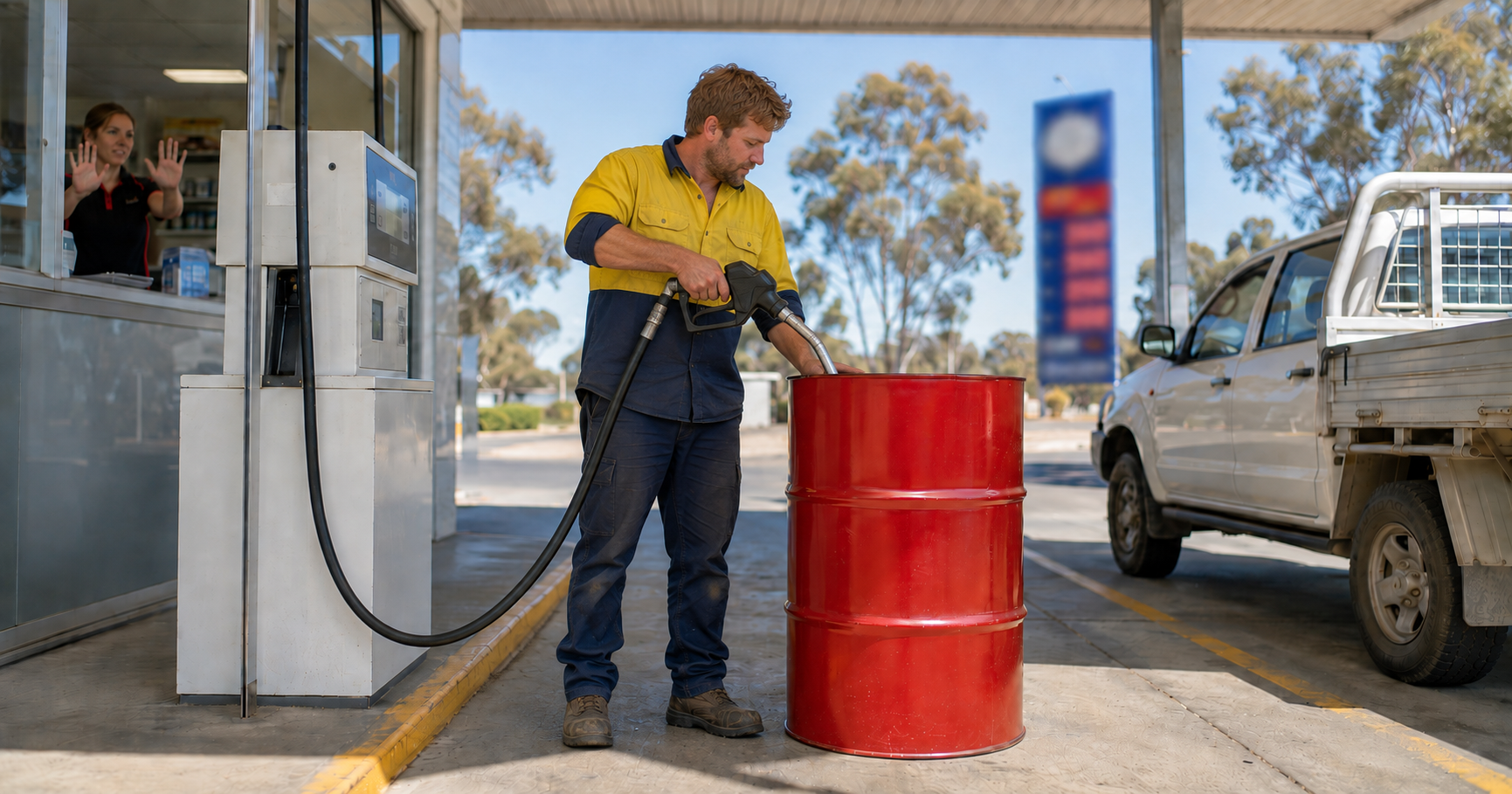
Short answer: no, and it was never allowed. Here is what the rules actually say, state by state, and what to do instead.
There is a story going around that Australia has brought in new rules banning 205 litre drums at the bowser. It is worth clearing up, because the truth is both simpler and more useful.
The rules have not changed. A 205 litre drum was never something you could legally fill at a public service station.
What has changed is enforcement. Below is the full picture, including how each state and territory handles it, and the legal options for getting bulk fuel onto your site.
Where the “new ban” story came from
During the fuel supply crunch in March 2026, plenty of service stations started knocking back bulk container fills they had previously waved through. Some sites imposed their own 25 litre purchase caps as stock tightened. Footage went around of people filling 1,000 litre tanks on trailers at the bowser, and the reaction was immediate.
If you had been quietly filling a drum for years without being challenged, that felt like a new rule landing overnight. It was not. It was an existing rule finally being applied.
The governing document is still AS 1940:2017 — The storage and handling of flammable and combustible liquids, incorporating Amendment 2 (2021). There is no 2025 or 2026 edition.
What the rule actually says

AS 1940 is explicit. Flammable liquids must not be filled from a service station dispenser into a container unless:
- the capacity of the container is not greater than 25 litres; and
- the container complies with AS/NZS 2906, or is substantially leakproof metal with a tight-fitting closure; or
- the container is an approved portable fuel tank for a boat.

The standard also requires that any container be on the ground while being filled — not in a car boot, not in the back of a ute. Approved portable boat tanks are the one exception and may be filled in situ.
A 205 litre drum is more than eight times the limit. It is not a borderline case.
The container has to be the right type, not just the right size
- Built to AS/NZS 2906 — Fuel containers, portable: plastics and metal
- Carrying UN package approval markings, confirming it meets the Australian Dangerous Goods Code
- Sealing effectively and in sound condition — no cracks, dents, corrosion or perished seals
Drink bottles, old five litre oil containers and water jerry cans do not qualify, no matter how handy they look sitting in the ute.
Why 25 litres and not more
It comes down to static electricity and vapour.
Petrol vapour collects in the neck of a container while you are filling, and a static discharge is enough to ignite it. The larger the container, the more vapour, the longer the fill, and the more opportunity for something to go wrong.
WorkSafe Victoria documents a case where a woman filled 20 litre containers while they sat in the back of her 4WD. Static ignited the vapour at the container neck. She was seriously injured, three vehicles were destroyed, and the service station needed a major refit before reopening.
That is why the guidance is consistent everywhere: place containers on the ground before filling, keep one hand on the container throughout, use an earthing strap if the site provides one, replace the cap firmly before lifting, and never decant inside a vehicle, boot, trailer, boat or caravan.
One litre of flammable liquid, fully evaporated, can produce around 5,000 litres of explosive vapour and air mix — enough to fill a small garage. That is the reason the rules look conservative.
Petrol vs diesel — the distinction most people miss
The 25 litre cap is written around flammable liquids. Petrol is a Class 3 flammable liquid with a flash point below 23 °C.
Diesel sits in a different category. With a flash point of roughly 61.5 °C it falls on the combustible side of the 60.5 °C dividing line under AS 1940, and it does not generate an ignitable vapour cloud at ambient temperature the way petrol does.
Three separate classification systems apply to diesel, which is where a lot of the confusion starts:
| System | How diesel is treated |
|---|---|
| AS 1940 | Combustible liquid (flash point above 60.5 °C) |
| WHS Regulations / GHS | Flammable liquid Category 4 — still a hazardous chemical |
| ADG Code (transport) | Not regulated as dangerous goods for transport purposes |
In practice this means some sites will let you fill larger containers with diesel and will not with petrol. That is the operator’s decision, not your entitlement. A service station is a manifest quantity workplace with its own risk controls, and the console operator can say no. If you turn up with a drum expecting a fill, expect to be knocked back — and do not give the operator a hard time about it. They are doing their job.
State by state: who regulates what
The 25 litre limit at the bowser is nationally consistent because it flows from AS 1940 and AS/NZS 2906. What differs between jurisdictions is the legislation it sits under, the licensing requirements above certain volumes, and the transport rules.
New South Wales
Regulator: SafeWork NSW (storage and handling) and NSW EPA (transport).
Legislation: Work Health and Safety Regulation 2025 (commenced 01/09/25) and the Dangerous Goods (Road and Rail Transport) Regulation 2022.
NSW has the clearest published transport allowances of any state. Under the tools of trade and personal use provisions in clause 7 of the DG Regulation, you can carry an aggregate of up to 500 kg or litres of dangerous goods. That drops to 250 kg or litres if the load includes flammable gases, toxic gases or any Packing Group I goods.
Above that you are into placard load territory: 1,000 litres aggregate, or any amount carried in a single receptacle over 500 litres capacity. That second trigger catches people out — a 1,000 litre tank on a trailer is automatically a placard load regardless of how much is in it.
The WHS Regulation 2025 updated Schedule 11 threshold quantities and Schedule 13 placarding requirements, so if you last checked your storage obligations before September 2025, they are worth revisiting.
Victoria
Regulator: WorkSafe Victoria.
Legislation: Dangerous Goods Act 1985 and the Dangerous Goods (Storage and Handling) Regulations 2022.
Victoria publishes the most detailed forecourt guidance in the country and states the 25 litre limit directly. WorkSafe Victoria also sets out the container-on-the-ground rule, the earthing strap advice, and an explicit prohibition on decanting into containers sitting in vehicles, on trailers, boats, caravans or motorcycles.
Queensland
Regulator: Workplace Health and Safety Queensland.
Legislation: Work Health and Safety Act 2011 and Regulation.
Queensland treats diesel as a flammable liquid Category 4, meaning its use, storage and handling fall under Part 7.1 of the WHS Regulation as a hazardous chemical. WHSQ guidance confirms a typical service station exceeds the manifest quantity of 2,500 litres for commercial petrol and is therefore a manifest quantity workplace. Queensland guidance also specifies no latching device on petrol dispensing nozzles, which is why you have to hold the trigger.
Western Australia
Regulator: WorkSafe WA / DEMIRS.
Legislation: Dangerous Goods Safety Act 2004.
WA states the 25 litre limit plainly and puts extra emphasis on transport. Petrol should be carried in UN-approved jerry cans complying with AS 2906, properly restrained, in a trailer or ute tray rather than an enclosed vehicle. WA guidance highlights that vented petrol fumes inside a vehicle can form an explosive mixture, with ignition sources as ordinary as a remote locking fob.
South Australia
Regulator: SafeWork SA.
Legislation: A separate Dangerous Substances licensing scheme, plus the Dangerous Substances (Dangerous Goods Transport) Regulations 2023.
SA is the outlier. It runs a dangerous substances licensing regime in addition to the WHS framework, and a licence is required to keep Class 3 flammable liquids above set limits. Selling Class 3 motor spirit to the public requires its own licence.
SA also imposes container specifications the other states do not: Class 3 liquids in containers under 20 litres must be in strong, completely closed containers, and containers of 20 litres or more must be approved steel drums. If you operate in SA, confirm your current licence position with SafeWork SA rather than assuming the national picture applies.
Tasmania
Regulator: WorkSafe Tasmania.
Legislation: WHS Act 2012 and the Dangerous Goods (Road and Rail Transport) Regulations 2021.
Tasmania states the 25 litre service station limit and references AS/NZS 2906 directly. Its bushfire guidance is the most useful domestic storage advice published anywhere in Australia: do not stockpile fuel, keep only what you need, do not store flammable liquids or their containers inside a residence even when empty, and if storing in an attached garage keep it to minor quantities — a maximum of 25 litres of petrol or 100 litres of diesel or oils, with adequate ventilation.
Northern Territory
Regulator: NT WorkSafe.
Legislation: Work Health and Safety (National Uniform Legislation) Act 2011 and Regulations.
Worth understanding the structure here: the NT Dangerous Goods Act 1998 and Regulations 1985 mostly cover explosives and fuel gas, so liquid fuel storage sits under the harmonised WHS hazardous chemicals framework instead. If you store Schedule 11 hazardous chemicals above manifest quantities, you must notify NT WorkSafe in writing.
Australian Capital Territory
Regulator: WorkSafe ACT.
Legislation: Dangerous Substances Act 2004 and the WHS Regulation.
The ACT follows the harmonised approach with one local requirement worth noting: WorkSafe ACT expects the manifest to be kept as close as practicable to the main entry of the workplace, and where a manifest is required the PCBU must give ACT Fire & Rescue a copy of the workplace emergency plan.
So how do you legally move bulk fuel to site?
Four options, depending on volume.
1. Approved jerry cans — up to 25 litres each
Straightforward, legal, available everywhere. Fine for mowers, generators, pumps and topping up plant. Fill one at a time with the caps closed on the others. In practice a 20 litre can is more manageable as a lift than a 25.
2. Bulk delivery to an on-site tank
Once you are past the jerry can stage, this is the real answer. A properly specified tank on site, filled by a fuel supplier’s tanker, means you are never decanting at a public forecourt at all. Most suppliers will deliver from around 1,000 litres.
3. Drums filled by your supplier
205 litre drums are perfectly legal to own, transport, store and dispense from. The only thing you cannot do is fill one at a retail bowser. Buy them filled from your fuel supplier and the problem disappears. Pair the drum with a proper drum pump and the setup is safer than repeated jerry can decanting anyway.
4. A compliant transportable or self-bunded tank
For contractors moving between sites, a purpose-built transportable fuel cell with integrated bunding and a pump is the compliant version of the trailer-and-drum arrangement. Check it is rated for fuel and carries the right approvals — and remember the NSW placard load trigger at receptacles over 500 litres capacity.
One thing to avoid entirely
Standard IBCs and general-purpose poly tanks are not suitable for fuel storage under AS 1940. They are designed for water and food-grade liquids. Using one for fuel is a compliance problem and a contamination problem at the same time.
Storing fuel safely on site
Once the fuel is yours and on your property, AS 1940 sets the expectations:
- Bunding — spill containment sized to the standard. For package stores, 100% of the largest package plus 25% of total storage capacity, with freeboard for rainfall. For tanks, 110% of the largest tank.
- Spill response kit — mandatory where Class 3 flammable liquids are handled, and sensible practice everywhere else.
- Shade — the single biggest factor in how long stored fuel stays serviceable.
- Signage and placarding — appropriate to the class and quantity held.
- Flammable liquids cabinet — for jerry cans and small quantities of petrol, built to AS 1940.
- Separation — keep oxidising agents, combustible waste and LPG cylinders well clear.
- Minimum quantity — every jurisdiction expects you to hold the lowest practicable quantity for your needs.
Quick reference
| Question | Answer |
|---|---|
| Can I fill a 205 L drum with petrol at a servo? | No. The 25 litre cap applies nationally. |
| Can I fill one with diesel? | Only if the operator permits it. Do not assume. |
| Can I own and use a 205 L fuel drum? | Yes. Just have it filled by your supplier. |
| What container can I use at the bowser? | AS/NZS 2906 approved, UN marked, 25 litres or under. |
| Can I fill it in the back of the ute? | No. On the ground, every time. |
| Can I use a standard IBC for fuel? | No. Use a purpose-built fuel tank. |
| How much can I carry? | NSW: up to 500 L aggregate for tools of trade. Check your state. |
Get set up properly
If the servo has started saying no, that is usually a sign you have outgrown the jerry can approach. AIMS Industrial stocks the gear that makes the compliant option the easy one — approved fuel containers, drum and transfer pumps, fuel hose and nozzles, flow meters, funnels, bunding, spill kits and absorbents, and flammable liquids storage.
Not sure what suits your site or your volumes? Give us a call. We would rather spend ten minutes getting it right with you than have you buy the wrong thing.
AIMS Industrial — Industrial Supplies made Simple!
Make the compliant option the easy one.
Shop fuel containers, drum pumps, bunding & spill kits at AIMS
AIMS Industrial stocks the full setup — AS/NZS 2906-approved fuel containers, drum and transfer pumps, fuel hose and nozzles, flow meters, bunding, spill kits and flammable liquids storage cabinets. Not sure what suits your site or volumes? Give us a call.


