

Quick answer: Work out your watts (what you're running at once) and your watt-hours (how long you need to run it), then match those two numbers to a unit — not the other way around. For light use (phones, lights, a small fridge overnight) you're looking at 500–1,200Wh. For a fridge plus laptop over a weekend off-grid, 1,000–2,000Wh. For job-site tools or blackout backup for the essentials, 2,000Wh and up, with enough continuous watts to cover everything running at once. LiFePO4 battery chemistry is worth paying for if the unit's going to live in a vehicle, shed or on-site rather than a backpack.
In 30 seconds
- Two numbers matter: watts (what it can run at once) and watt-hours (how long it can run it for).
- Sizing rule of thumb: under 500Wh for phones/lights, 500–1,200Wh for camping and tool charging, 1,000–2,000Wh for a weekend off-grid with a fridge, 2,000Wh+ for job-site tools or blackout backup.
- Battery chemistry: LiFePO4 outlasts standard lithium-ion (NMC) 2–3× in cycle life and runs safer under fault conditions — worth the extra weight for anything that isn't going in a backpack.
- A portable power station is not a whole-home battery system — it runs specific appliances for a defined period, not your whole house indefinitely.
- Use the calculator below to work out your own numbers in under a minute.
Try It: Quick Power Station Sizing Calculator
List what you want to run, and this works out the watt-hours and continuous watts you need — then matches it to the smallest suitable Welling & Crossley model AIMS stocks.
What do you need to run?
| Appliance | Watts | Hours/day |
|---|
Estimate only — actual runtime varies with inverter losses (typically 10–15%), ambient temperature and appliance start-up (surge) draw. Use this as a starting point, then confirm against the exact spec of the unit you're considering.
"Portable Power Station" or "Solar Generator" — Same Thing?
Mostly, yes. In Australia, "portable power station" and "solar generator" are used almost interchangeably for the same category of product: a battery, an inverter and a charge controller in one box, designed to be recharged from mains power, a car, or solar panels, and to run your gear off battery power rather than fuel. "Solar generator" tends to get used when the marketing wants to emphasise the solar-charging angle; "portable power station" is the more common and more searched term overall in Australia.
One genuine point of confusion worth clearing up early: a portable power station is not the same thing as a whole-home solar-plus-battery system. If you're picturing something that runs your whole house through a blackout, that's a fixed home battery system, professionally installed by a licensed electrician — a different product, a different price bracket, and a different buying process entirely. Everything in this guide covers the portable, plug-and-play category: units you can pick up, throw in a ute or camper, and use anywhere.
Step 1: Work Out What You Actually Need to Run
The single biggest mistake buyers make is picking a unit based on price or brand first, and only checking afterwards whether it can actually run what they need. Do it the other way around. List every device you want to run, add up the numbers, and let that drive the decision — the calculator above does this for you.
The formula
Two numbers matter, and they're not the same thing:
- Watts (W) — how much power something draws while it's running. This determines whether the power station can run it at all, right now, at the same time as everything else you've got plugged in.
- Watt-hours (Wh) — the size of the battery. This determines how long the power station can keep everything running before it needs a recharge.
The runtime formula is simple: battery capacity (Wh) ÷ appliance draw (W) ≈ hours of runtime. Treat the result as an estimate, not a guarantee — inverter losses (typically 10–15%), ambient temperature and how often a compressor fridge cycles on and off all move the real number around.
Worked examples
| Device | Typical draw | What that means in practice |
|---|---|---|
| Smartphone | ~15–20Wh per full charge | A 200Wh unit gives roughly 8–10 phone charges |
| CPAP machine | ~30–60W | A full night of quiet running from most mid-size units |
| Compact 12V/camping fridge | ~30–65W running (compressor start-up briefly spikes higher) | Roughly 300–500Wh of battery per full day of running, depending on ambient temperature — a 1,000Wh unit comfortably covers a weekend |
| Laptop | ~50–100W | A few hours of work per 500Wh of capacity |
| Corded power tool (drill, saw) | ~500–1,500W while cutting/drilling | You need enough continuous watts, not just battery size, to run it at all — check the tool's rated wattage against the unit's rated (not surge) output |
| Small fridge/freezer (mains, 240V) | ~100–200W running | Similar to a camping fridge, but check the compressor start-up (surge) draw, which can briefly spike 3–5× the running wattage |
Match your use case to a capacity tier
| Use case | What you need | Rough capacity |
|---|---|---|
| Phones, lights, day trips | Light, grab-and-go charging only | Under 500Wh |
| Camping, market stalls, tool charging | Run a camp fridge or charge tools overnight | 500–1,200Wh |
| Caravan/RV weekend trips | Fridge, lighting, laptop and phone charging over several days off-grid | 1,000–2,000Wh |
| Tradie site power | Corded power tools, a site radio, chargers, first tier with UPS backup | 2,000Wh+, with 2,000W+ continuous output |
| Small home blackout backup | Fridge, router, lighting and a laptop running through an outage | 2,000–3,600Wh |
| Farm, workshop or larger home essentials | Multiple higher-draw devices at once, longest runtime | 3,600Wh+ |
Step 2: Battery Chemistry — LiFePO4 vs Standard Lithium-ion
Most budget power banks and cheaper power stations use standard lithium-ion (NMC) cells. The better units on the market — and the whole reason "LiFePO4" gets printed on the box in big letters — use Lithium Iron Phosphate instead. The difference isn't marketing spin; it shows up in three places:
Cycle life and real-world lifespan
LiFePO4 chemistry typically delivers 2,000–6,000+ charge cycles to 80% capacity, versus roughly 800–2,000 cycles for standard NMC lithium-ion. Charged once a day, that's the difference between a battery that's tired out in 3–5 years and one still going strong after a decade or more.
Thermal safety margin
LiFePO4 has a materially higher thermal runaway threshold than NMC lithium-ion — commonly cited around 270°C versus roughly 210°C for NMC. That extra margin is a big part of why LiFePO4 has become the preferred chemistry for stationary and heavy-duty portable power, where the battery might sit charged in a shed, ute tray or site container for long stretches.
The trade-off
LiFePO4 is less energy-dense than NMC lithium-ion (roughly 90–120 Wh/kg versus 150–220 Wh/kg), which is why LiFePO4 units are heavier per watt-hour than a lightweight hiking power bank. For something that lives in a vehicle, on-site or in the shed rather than a backpack, that trade favours LiFePO4 almost every time.
Step 3: How You'll Recharge It
Every unit recharges from mains AC power, but the better ones give you more than one path back to full — and which paths you need depends entirely on how you'll use it:
- Mains AC — fastest option when you have access to a wall socket. Look at the charge time to 80%, not just "full," since most units taper off the last 20%.
- Solar (MPPT input) — genuinely useful if you're off-grid for more than a day or two: pairing a power station with a folding solar panel means you're not relying entirely on the vehicle or a generator to keep topping up. Check the max solar input wattage against your panel's output — an undersized MPPT controller will bottleneck a bigger panel.
- Car/12V or alternator charging — useful for topping up while driving between camps, though generally the slowest of the three methods.
Step 4: Portability and Form Factor
Weight and size matter more than most buyers expect until they're the one lifting it. A compact 4–5kg unit is genuinely grab-and-go — into a daypack, onto a market stall, in and out of a ute cab without a second thought. A 30–70kg unit at the top of the range needs to live somewhere permanent (a vehicle, a shed, a site container) and generally needs wheels or two people to move. Match the weight to where the unit will actually live day to day, not just to the capacity you want.
Step 5: UPS/Automatic Backup — Only If You Need It
If the job is blackout protection for something that can't just stop and restart — a fridge full of food, a router, an alarm system, a fish tank — look specifically for UPS (uninterruptible power supply) functionality. This means the unit sits on mains power permanently and automatically switches to battery the instant mains drops out, so connected devices don't lose power at all. Not every unit has this — some only "recharge from mains," which is a different feature. If UPS matters to your use case, confirm it explicitly before buying, and if anything plugged in genuinely cannot tolerate a break in power (medical equipment especially), check the manufacturer's published switchover time rather than assuming instant is instant.
Portable Power Station vs Petrol Generator
| Portable Power Station | Petrol Generator | |
|---|---|---|
| Noise | Silent — no combustion engine | Audible, often restricted on residential sites after hours |
| Fumes | None — safe near living/sleeping areas | Carbon monoxide risk — must run outdoors, away from openings |
| Refuelling | Recharge from mains, solar or vehicle DC | Carry and store petrol; refuelling while hot is a fire risk |
| Maintenance | No engine — nothing to service | Oil changes, spark plugs, carburettor issues from stale fuel |
| Startup | Instant and silent; UPS models switch over automatically | Pull-start or electric start, manual changeover |
| Runtime | Fixed by battery capacity — rechargeable, not refillable on the fly | Runs as long as you keep feeding it fuel |
The trade-off is honest: a petrol generator can run indefinitely as long as there's fuel, where a power station is capped by its battery. For site work, home backup and anywhere noise, fumes or indoor use matter, the power station wins outright. For multi-day off-grid power with no recharge option at all, a generator — or a power station paired with solar input — still has a role.
What Should You Budget in Australia?
Price scales with capacity and, to a lesser extent, brand and battery chemistry — a genuine LiFePO4 unit will cost more up front than an equivalent-capacity NMC lithium-ion unit, but should outlast it several times over. As a rough sense of the Australian market: small (under 500Wh) units start under $500; mid-size (1,000–2,000Wh) units with LiFePO4 batteries typically run $1,200–$2,500; and larger (3,000Wh+) units with UPS backup and high continuous output move into the $4,000–$6,000+ bracket. Chasing the cheapest unit at your target capacity almost always means accepting NMC lithium-ion chemistry and a shorter real-world lifespan — worth knowing going in, not discovering in year three.
AIMS Recommendation: The Best Portable Power Station Range in Australia
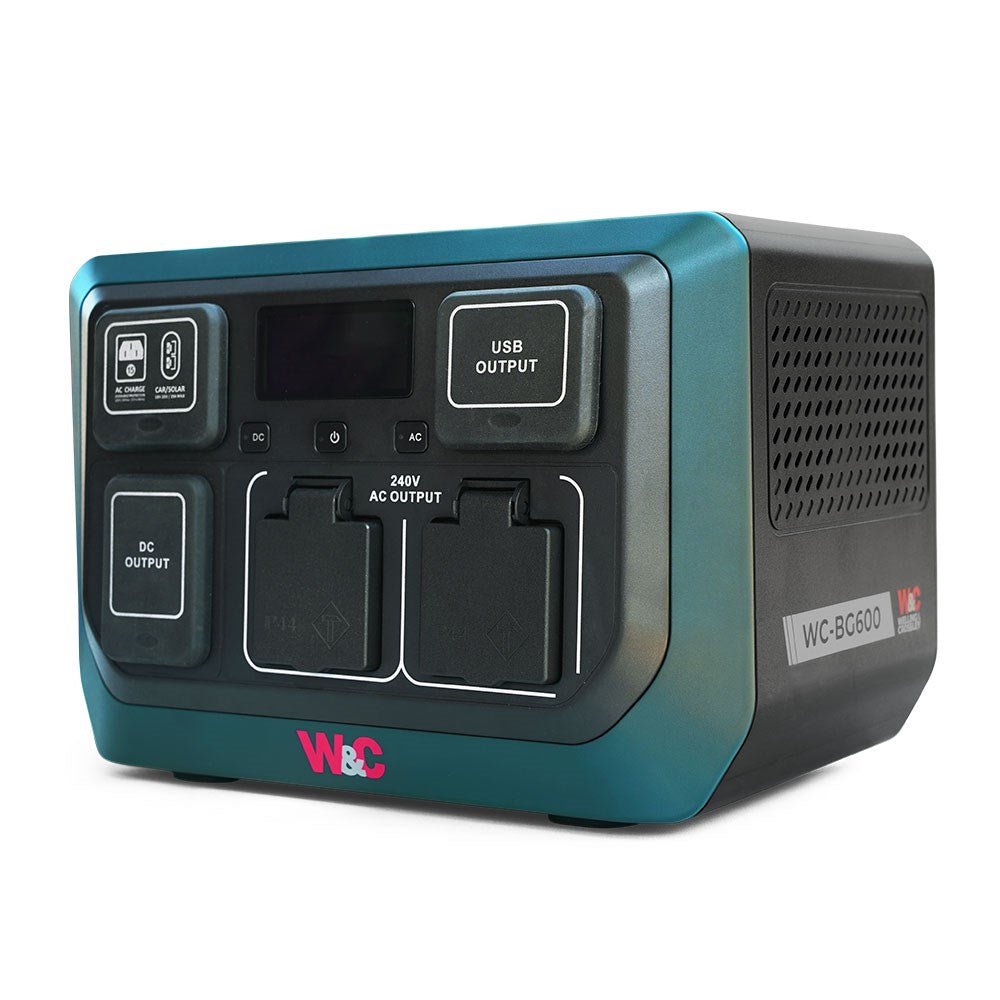
If you've worked through the above and want a straightforward, Australian-stocked option, AIMS carries the Welling & Crossley portable power station range — five capacities on one LiFePO4 platform, from a 4.5kg grab-and-go unit through to a 70kg station with built-in UPS backup for site and home use.
| Model | WC-BG600 | WC-BG1200 | WC-BG2000 | WC-BG3600 | WC-BG5500 |
|---|---|---|---|---|---|
| Rated AC output | 600W | 1,200W | 2,000W | 3,600W | 5,500W |
| Battery capacity | 512Wh | 1,152Wh | 1,843Wh | 3,840Wh | 5,376Wh |
| Weight | 4.5 kg | 14 kg | 30 kg | 51 kg | 70 kg |
| Solar input (MPPT) | 200W max | 400W max | 1,200W max | 2,400W max | 2,400W max |
| Charge to 80% (AC) | ~60 min | ~70 min | ~70 min | ~100 min | ~130 min |
| UPS auto-backup | No | Not specified | Yes | Yes | Yes |
| Cycle life | 3,000+ cycles to 80% capacity (all models) | ||||
| AIMS price (inc. GST) | $971.25 | $1,262.92 | $2,235.14 | $4,860.15 | $5,832.37 |
Pricing current as at August 2026 and subject to change — confirm the live price on the product page. UPS status on the WC-BG1200 is unconfirmed in manufacturer documentation sighted; treated as backup-only from the WC-BG2000 up until confirmed otherwise.
Frequently Asked Questions
For most people who camp, tow a caravan, work on tools, or want blackout backup for essentials, yes — the running cost is near zero (recharging from mains or solar) and there's no fuel to store, no fumes, and nothing to service. The exception is if you need indefinite runtime with no recharge opportunity at all (remote work for weeks with no sun and no mains access); in that specific case a petrol generator, or a much larger unit paired with solar, is the better fit.
Yes, for compact 12V camping fridges (typically 30–65W running) and small mains fridges (typically 100–200W running), most mid-size units handle this comfortably. Check two things: that the unit's continuous watt rating comfortably covers the fridge's running wattage plus its brief compressor start-up spike, and that the battery capacity (Wh) gives you the runtime you need — a 1,000Wh unit typically covers a full day to a weekend of fridge use, depending on ambient temperature and how often the compressor cycles.
It depends on the fridge. A compact 12V camping/portable fridge typically draws 30–65W while running. A small mains (240V) bar fridge or bar-sized unit is typically 100–150W running, and a full-size household fridge is commonly 150–400W running, though all fridges briefly draw several times their running wattage for a second or two when the compressor starts. When sizing a power station, use the running wattage for the continuous-watts check, but budget extra headroom for that compressor start-up spike so the power station doesn't trip out.
A power station rated at 1,000 continuous watts can run most single household or trade appliances at a time that draw under that figure — a compact fridge, laptop, LED lighting, phone chargers, a small TV, or a corded power tool with a modest draw. It won't run a mains fridge, a kettle and a heater all at once, since those running wattages add up quickly. Add up the running watts (not just the "1,000W" headline number) of everything you plan to run simultaneously, and stay under the unit's rated — not surge — output. Separately, watt-hours (battery size) determines how long it runs, not how much it can power at once; a "1,000W" unit could have anywhere from 500Wh to 2,000Wh of battery depending on the model.
Not in the way most people picture it. A portable power station or "solar generator" in this category — even a large one — is built to run a handful of specific appliances for a defined period, not to power an entire home's circuits indefinitely. Running "a house" through a blackout at scale is the job of a fixed home battery/solar system professionally installed by a licensed electrician, which is a different product category, price point and installation process. What a portable unit can genuinely do is keep the essentials going — fridge, router, some lighting, phone and laptop charging — for hours to a couple of days, depending on capacity.
Match rated watts to what you're running continuously, and watt-hours to how long you need to run it. Light jobs — camp fridges, tool charging, laptops — suit 500–1,200Wh units. Running corded power tools or backing up a fridge and essentials through a blackout calls for 2,000Wh and up, with 2,000W+ continuous output. Farm, workshop or larger home backup with multiple devices running at once points to 3,600Wh or larger units. The calculator near the top of this guide will do the maths for your own appliance list.
"Best" depends entirely on the use case, which is exactly why sizing to your own needs (Step 1 above) matters more than any single brand ranking. That said, LiFePO4 battery chemistry, genuine UPS backup (if you need it), a continuous watt rating with real headroom over what you'll run, and multiple recharge paths (mains, solar, car) are the features that separate a unit that'll still be doing the job in five years from one that won't. AIMS stocks the Welling & Crossley range on exactly that spec profile — see the table above for the AU-available option across five capacities.
Specifications for the Welling & Crossley range sourced from manufacturer documentation and AIMS Industrial's live Shopify catalogue, current as at August 2026. General buying-guide figures (typical appliance draw, cycle life ranges, price bands) are industry-typical figures for context and should be checked against the specific product you're considering. Always confirm current pricing, stock and exact specifications on the AIMS Industrial product page before purchase.