

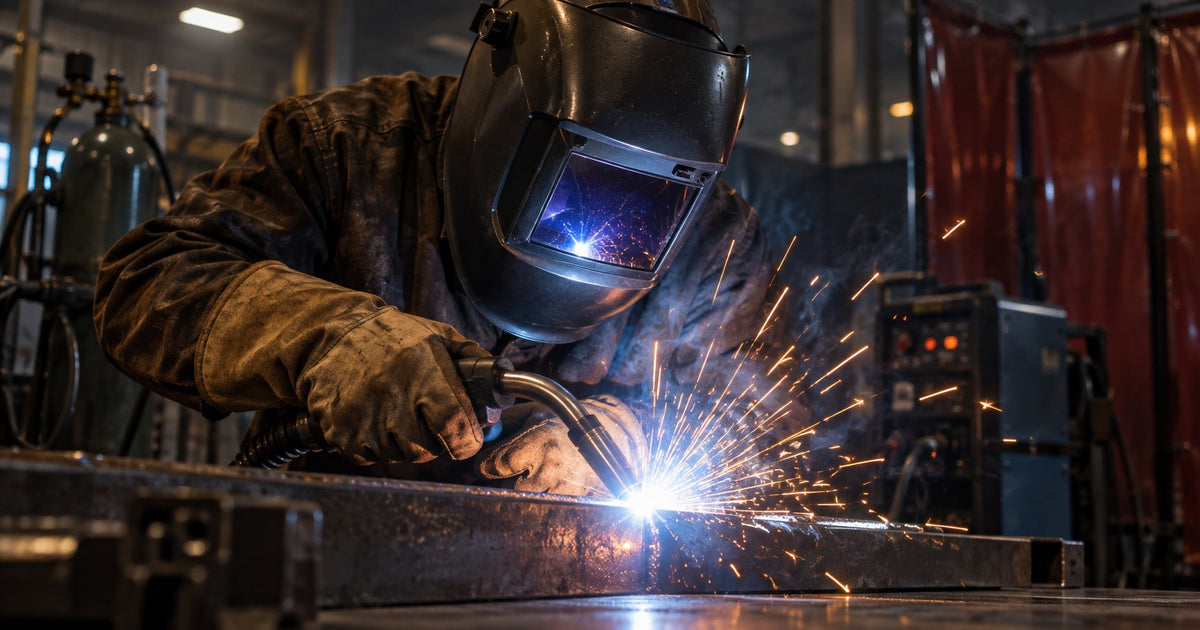
A welding helmet is the most safety-critical piece of equipment a welder owns. Get it wrong and you are either flashing your corneas with UV radiation or working half-blind behind a lens so dark you cannot see the joint. Get it right and the helmet disappears into the background — you weld, and the protection takes care of itself.
This guide covers everything that actually matters when choosing, setting up, and maintaining a welding helmet in an Australian workplace: shade numbers by process, what auto-darkening technology is actually doing, why sensor count matters more than price, when a powered air-purifying respirator (PAPR) is legally required rather than optional, and what AS/NZS 1337.1 and 1338.1 mean in plain language.
AIMS Industrial stocks welding helmets from Bosssafe, Bossweld and Tecmen across the full range from entry auto-darkening through PAPR-integrated units for stainless and confined space welding. Browse the range at AIMS Welding Helmets.
Need another reference chart? Browse the full AIMS Engineering Reference Charts library — drill bit sizes, tap drill, torque, viscosity, GD&T, AS/NZS standards and more.
Fixed Shade vs Auto-Darkening: The Core Decision
Every welding helmet starts with one fundamental choice: fixed shade or auto-darkening. Understanding what each type actually does is the foundation of everything else.
A fixed shade helmet contains a passive lens permanently set to a single shade — typically DIN 10 or DIN 11. The lens is always dark. To position yourself over the workpiece, you either flip the helmet up on its hinge (lift-front design) or nod your head down sharply to drop the helmet into position. You cannot see the joint clearly until the arc strikes. This requires experience — novices struggle to reliably position the torch or electrode on the correct spot before striking, which leads to poor starts, arc wander, and frustration. Fixed shade helmets remain popular for budget applications and are entirely adequate when a welder does the same joint type repeatedly and does not need to see positioning detail.
An auto-darkening helmet contains a liquid crystal display (LCD) lens that sits at shade 3–4 (light, clear) in its passive state. The moment arc sensors detect the UV and infrared spike from an arc strike, the lens darkens to the selected shade within milliseconds. You can see the joint, position the torch exactly, and strike — the lens has already darkened before any meaningful UV reaches your eye. Between passes you can inspect the weld pool without lifting the helmet. This changes how you weld: cleaner starts, better positioning, significantly less fatigue from the constant lift-nod-weld-lift cycle.
Auto-darkening dominates professional welding in Australia. The overwhelming majority of tradespeople, fabricators, and maintenance welders use auto-darkening helmets for a straightforward reason: they are faster, more comfortable, and produce better welds. The argument that auto-darkening is somehow less protective than fixed shade is not supported — a quality auto-darkening lens reacts in 1/25,000 of a second, which is orders of magnitude faster than any reflex action. The UV exposure during the reaction window is clinically negligible in a helmet meeting AS/NZS 1338.1.
Fixed shade has a place for: very occasional use where cost is the primary constraint, teaching beginners the basics of arc positioning without relying on technology, and specific industrial processes where the welder's position and workpiece geometry are completely consistent.
Shade Numbers Explained: DIN Grades by Welding Process
Every welding helmet lens is assigned a shade number — a DIN grade in Australian/European convention — that represents how much visible light the lens transmits. Higher number equals darker lens equals more light blocked. The shade must match the process: too light and UV reaches the eye; too dark and you cannot see the weld pool, which causes technique errors that create worse welds.
The table below gives recommended shade ranges for each common welding process. The correct shade within each range depends on amperage: higher amperage equals brighter arc equals darker shade required.
| Process | Recommended Shade (DIN) | Notes |
|---|---|---|
| MIG/MAG welding | DIN 10–12 | Most AU MIG at 90–200A → DIN 10–11. High-amperage MIG (200A+) → DIN 12 |
| TIG welding | DIN 9–13 | Low-amperage TIG (<50A) → DIN 9. High-amperage TIG (200A+) → DIN 12–13 |
| MMA / Stick welding | DIN 9–11 | Electrode diameter and amperage determine shade. 2.5mm → DIN 9; 4.0mm → DIN 10–11 |
| Flux-core arc welding | DIN 10–12 | Similar to MIG; higher spatter requires outer lens protection |
| Plasma cutting | DIN 9–14 | Higher current plasma → darker shade; cutting generates intense UV |
| Oxy-acetylene cutting | DIN 3–5 | Lower UV output than electric arc; shade 3–4 cutting, 5 for heavy cutting |
| Oxy-acetylene welding | DIN 5–7 | Brighter flame → slightly darker shade than cutting |
| Grinding | DIN 3 | Grind mode on auto-darkening helmets; no arc means no darkening |
| Laser welding | Process-specific | Standard helmets are NOT suitable for laser; use laser-specific helmets (e.g. Tecmen 100LW) |
Australian auto-darkening helmets typically offer a variable shade range of DIN 9–13, which covers MIG, TIG, MMA, and plasma cutting without needing a different helmet. If you weld both stainless TIG at 30A and structural MIG at 180A in the same session, an adjustable-shade helmet dialled to DIN 10–11 covers both adequately — fine-tune as needed.
One important point: shading requirements in Australia follow AS/NZS 1338.1, which aligns closely with the international DIN EN 169 standard. US-market references to "shade number 10" or "shade 11" are equivalent to DIN 10 and DIN 11 respectively — the scale is the same.
Auto-Darkening Helmet Technology: How It Actually Works
Most welders use auto-darkening helmets for years without understanding the mechanism. Knowing what is actually happening helps you use and maintain the helmet correctly.
The lens in an auto-darkening helmet is a liquid crystal display (LCD). In its normal unpowered state, the liquid crystals are randomly oriented — light passes through freely. When voltage is applied, the crystals align in a way that blocks light transmission. The degree of alignment — and therefore the shade achieved — is controlled by the voltage level applied.
This is why auto-darkening helmets must be powered: they are active devices, not passive filters. The lens takes no action until sensors detect an arc. Four components work together:
- Arc sensors: Photoelectric detectors on the front of the helmet that detect the UV and infrared spike characteristic of a welding arc
- Control circuit: Processes sensor input and determines whether to trigger darkening, what shade to apply, and how long to hold the dark state
- LCD lens: The switchable filter — transitions from shade 3–4 (passive) to selected shade (DIN 9–13) under voltage
- Power system: Solar cells (panels on the helmet exterior) charging an internal battery; most quality helmets use a lithium backup battery
Reaction time is the most safety-critical specification. It is measured as the time from arc detection to full shade achievement. Quality helmets react in 1/25,000 of a second — this is fast enough that the transition is imperceptible and the UV exposure window is clinically negligible. Budget helmets may have reaction times of 1/2,500 or even 1/1,000 of a second. This sounds fast, but at those speeds a brief flash of UV reaches the cornea on every single arc strike. Over months and years, cumulative exposure adds up. The 1/25,000 second threshold is the dividing line between quality and corner-cutting.
Power: Pure solar helmets fail in low-light environments — overhead fluorescent lighting in a workshop is insufficient for some models. Hybrid solar-plus-battery is the standard for professional use. Check whether the battery is replaceable: non-replaceable sealed lithium cells typically last 3–5 years, after which the helmet becomes unusable even if the lens is undamaged. Replaceable batteries (typically CR2032 or AAA) mean the helmet has a longer service life.
Arc Sensors: 2 vs 4 and Why It Matters
Arc sensors are positioned on the front face of the helmet to detect the arc. Entry-level helmets use two sensors. Professional and wide-view helmets typically use four. The difference matters more than many welders realise.
Two sensors provide adequate coverage for straightforward flat or horizontal welding in open positions — the sensors have a clear line of sight to the arc, detection is reliable, and the helmet functions as intended. For a hobbyist or tradesperson doing general MIG work on flat plate, two sensors is usually fine.
Four sensors become important in three specific situations:
- Out-of-position welding: Overhead, vertical, and in-position welding means the helmet is not facing the arc squarely. One or both sensors on a two-sensor helmet may be shaded by the helmet housing, the welder's arm, or the workpiece itself. With only two sensors, partial shading can reduce detection reliability or cause the lens to go clear mid-weld. Four sensors at different positions around the lens provide redundancy.
- Welding in corners, jigs, and fixtures: Any time the arc is partially obscured by surrounding metalwork, sensor line-of-sight can be compromised. Fabricators doing structural work regularly report two-sensor failure modes that simply do not occur with four-sensor helmets.
- TIG welding at low amperage: TIG arcs below 30–40A produce significantly less UV and infrared output than MIG or MMA arcs. Two-sensor helmets calibrated for typical arc brightness can fail to trigger on faint TIG arcs. Four sensors with properly calibrated sensitivity settings provide reliable triggering across the amperage range. This is a documented and frequently discussed failure mode on welding forums — TIG welders who have switched from two-sensor to four-sensor helmets report it as an immediate, noticeable improvement.
Most Bosssafe wide-view and mega-view models at AIMS use four sensors. Check the specification before purchasing if out-of-position or TIG work is on the agenda.
Sensitivity and Delay Settings: Getting Them Right
Two user-adjustable controls on any quality auto-darkening helmet are consistently misunderstood and rarely set correctly. Getting them right takes two minutes and meaningfully improves the helmet's performance.
Sensitivity
Sensitivity controls the brightness threshold at which the sensor triggers darkening. At high sensitivity, the helmet darkens in response to a faint arc — important for low-amperage TIG. At low sensitivity, it only triggers on bright arcs — useful to prevent false triggers from sunlight or fluorescent lighting in bright environments.
The correct calibration method: face a bright light source (workshop fluorescent or an open window). Slowly turn the sensitivity dial toward maximum until the lens darkens. Then back it off by one position. This is the optimal sensitivity for your specific lighting environment — sensitive enough to catch any arc, not so sensitive that ambient light triggers it.
False triggering (lens darkening without an arc) is a sign of sensitivity set too high. Failure to trigger on arc strike is sensitivity set too low — or, in the case of low-amperage TIG, a sensor count issue.
Delay
Delay controls how long the lens stays at welding shade after the arc extinguishes. The range on most helmets is approximately 0.15 to 0.80 seconds.
- Short delay (0.15–0.25s): Lens clears quickly after each arc. Good for tack welding and repetitive short welds where fast repositioning matters. Risk: lens may clear before the weld pool stops glowing, causing brief UV exposure from the crater.
- Medium delay (0.3–0.5s): The correct setting for most MIG and MMA welding. Lens stays dark until the puddle has significantly cooled.
- Long delay (0.6–0.8s): Useful for high-amperage welding where post-arc glow is sustained. Frustrating for tack work.
The most common mistake is setting delay too short. Welders rushing between tacks turn delay to minimum and then wonder why their eyes are tired after a long session. The brief UV flash from a hot crater at short delay is not enough to cause arc eye in a single session, but it accumulates as eye strain over hours.
Optical Class: Lens Clarity and Its Effect on Fatigue
Shade number gets most of the attention, but optical class — the lens quality specification — arguably matters more for day-to-day comfort on extended welding shifts.
AS/NZS 1338.1 incorporates optical class requirements aligned with the European EN379 standard. Optical class is expressed as four numbers in the format optical class / light scattering / angular dependence / uniformity of transmittance. Each number ranges from 1 (best) to 3 (acceptable minimum). A professional-grade lens is rated 1/1/1/1. Entry-level helmet lenses may be rated 3/3/3/3.
| Rating | What It Means | Practical Effect |
|---|---|---|
| Optical class (first number) | Power (focusing accuracy) of the lens | Class 3 introduces slight magnification distortion — objects appear slightly larger or smaller through the lens |
| Light scattering (second) | How much the lens diffuses light | Class 3 causes hazing at the weld pool — reduced crispness, harder to read bead |
| Angular dependence (third) | How consistent transmission is across viewing angles | Class 3 causes darkening at edges of the viewing window — welders tilt their head to compensate |
| Uniformity (fourth) | Consistency of shade across the lens area | Class 3 has visible hot spots — brighter or darker zones within the same lens |
A welder using a class 3/3/3/3 helmet for an eight-hour shift will typically experience more eye fatigue, more headaches, and reduced weld quality compared to the same welder using a 1/1/1/1 helmet. The brain is constantly compensating for lens distortion at a subconscious level — it is tiring in the same way that slightly wrong glasses prescriptions cause persistent headaches.
Lens tint colour — green vs gold — is an aesthetic difference, not a performance one. Both achieve the same shade at equivalent optical class. Green tint is traditional; gold reflects more IR and is preferred by some welders in very hot environments.
PAPR and Air-Fed Welding Helmets: When You Need More Than Eye Protection
A standard welding helmet — even the most expensive auto-darkening unit on the market — provides zero respiratory protection. The helmet protects your eyes and face. It does nothing for what you breathe. For most mild steel MIG or MMA welding in a ventilated workshop, adequate general ventilation combined with welding fume extraction is the appropriate control. But certain materials and environments require a different approach entirely.
A Powered Air-Purifying Respirator (PAPR) integrated with a welding helmet combines a welding-grade face shield with a battery-powered blower unit that draws ambient air through filter cartridges and delivers filtered, positive-pressure air to the welder's breathing zone inside the helmet. The welder breathes filtered air regardless of ambient fume concentration. The positive pressure also prevents unfiltered air from leaking in around the face seal.
PAPR helmets are required — not merely recommended — in the following situations:
- Stainless steel welding: The welding arc oxidises chromium in stainless steel to produce hexavalent chromium (Cr(VI)), an IARC Group 1 confirmed carcinogen. The Safe Work Australia workplace exposure standard (WES) for Cr(VI) is 0.02 mg/m³ TWA. Uncontrolled stainless welding can exceed this by a factor of 10 or more even with fume extraction. WHS Regulations require the hierarchy of controls to be applied; where engineering controls cannot achieve the WES, appropriate RPE — meaning PAPR-level protection — is mandatory.
- Galvanised steel welding: Zinc oxide fumes from the galvanised coating cause metal fume fever — flu-like symptoms including fever, chills, nausea, and muscle aches appearing 4–8 hours after exposure. Zinc oxide WES is 2 mg/m³ TWA. Short-duration galvanised welding with excellent LEV may be manageable with P2 masks; regular or heavy galvanised welding requires PAPR.
- Manganese-containing alloys: Manganese in filler metals and base metals is a neurotoxin causing Parkinson's-like symptoms with chronic exposure. WES is 0.2 mg/m³ (respirable fraction). PAPR provides substantially better protection than filtering facepiece respirators.
- Chrome-containing alloys and nickel alloys: Similar Cr(VI) concerns to stainless steel. Nickel compounds are also IARC Group 1 carcinogens.
- Confined spaces: Where ventilation cannot adequately dilute fume concentrations, PAPR or supplied-air respirator is the appropriate control. General fume extraction cannot be relied upon in confined spaces with restricted airflow.
A P2 disposable mask worn under a standard welding helmet does not provide equivalent protection to a PAPR. The assigned protection factor (APF) for a P2 mask in Australia is approximately 10 — meaning it reduces inhaled concentration to 1/10th of ambient. A PAPR with P2 filters has an APF of 25 or higher, and eliminates the face-seal fit issues that plague disposable masks in welding environments (sweat, facial hair, helmet pressure).
AIMS stocks the Tecmen PAPR Freflow range, including the Tecmen PAPR Freflow iMUX TM16 (the most popular unit for professional welding use) and the Tecmen PAPR iEXP TM1000 for heavy-duty applications. Face shield variants are available for grinding and low-arc applications where a full welding helmet is not required.
Flip-Front Helmets: The Multi-Process Advantage
A flip-front welding helmet is an auto-darkening helmet where the entire electronic lens assembly hinges upward, away from the face. The welder can inspect the weld, change electrodes, tack a new component, or grind a pass — and then flip the lens back down in one motion, without removing the helmet from their head.
This sounds like a minor convenience. In practice, for welders doing multi-process work — welding a pass, grinding it back, welding again; or welding, tacking components, welding — it eliminates dozens of put-on and take-off cycles per shift. The helmet stays on the face, which is also more hygienic (less contact with contaminated benches), and reduces the chance of the helmet being knocked off or bumped.
Flip-front helmets are particularly suited to:
- Fabrication shops doing repetitive tack-weld-grind sequences
- Maintenance welding where the welder moves between welding and visual inspection frequently
- Pipeline and structural work where frequent repositioning between welds is required
- TIG welding with frequent electrode changes
AIMS stocks the Tecmen iEXP 950S Flip Front Helmet — a professional-grade flip-front with four arc sensors, variable shade DIN 9–13, and lightweight construction for all-day use. At $466.42, it sits between trade auto-darkening and PAPR pricing and represents strong value for any welder doing regular multi-process work.
Welding Helmet Fit, Headgear and Comfort
A helmet that does not fit correctly is a helmet that gets taken off — and a helmet on the bench protects nothing. Fit and comfort are functional requirements, not preferences.
Headgear adjustment: Quality helmets offer fore-aft adjustment (how far the helmet sits from the face), tilt adjustment (the angle of the lens relative to the skull), and a sweatband. Entry helmets frequently offer only basic adjustment. Spend time setting the headgear before the first use — the helmet should sit firmly without requiring the welder to hold it in place, with the lens directly in front of the eyes.
Weight and balance: Auto-darkening helmets typically weigh 500–700g. PAPR helmets with blower units are heavier. Front-heavy helmets — where the lens and housing extend far forward — concentrate weight at the front of the head, causing neck fatigue on extended shifts. Wide-view and mega-view helmets at AIMS from Bosssafe are designed with a lower centre of gravity than standard helmets.
Sweatband: This is a frequently overlooked consumable. Sweatbands saturate with perspiration and, if not replaced, become a hygiene and comfort issue. Quality helmets use replaceable sweatbands (towelling or foam). Budget helmets often use non-replaceable moulded foam that degrades within months of regular use.
Hardhat integration: Some worksites require both welding eye protection and head protection simultaneously. The Tecmen PAPR Freflow V1 with G20-V Hardhat and the V1 with G10 Bumpcap configurations at AIMS provide compliant head and face protection in a single integrated unit — avoiding the helmet-over-hardhat stacking problem that compromises fit in both pieces of PPE.
Viewing window size: Standard viewing windows are approximately 100×50mm. Wide-view (mega-view) helmets from Bosssafe offer windows of 130×100mm or larger. The larger window reduces the parallax problem — the tendency to tilt the head to track the weld pool at the edges of a small window — and improves situational awareness for out-of-position and structural welding.
Welding Process Compatibility: Which Helmet for Which Job
The table below matches process requirements to helmet specifications, with the AIMS range positioned against each application.
| Process | Shade Range | Sensors | PAPR? | Recommended at AIMS |
|---|---|---|---|---|
| MIG/MAG — mild steel | DIN 10–12 | 2+ OK | No (with LEV) | Bosssafe Trade / Wide View |
| MIG — stainless steel | DIN 10–12 | 2+ | Yes — Cr(VI) | Tecmen PAPR TM16 or TM1000 |
| MIG — galvanised steel | DIN 10–12 | 2+ | Yes — ZnO | Tecmen PAPR TM16 or TM1000 |
| TIG — general | DIN 9–13 | 4 recommended | Mild steel: No. SS: Yes | Bosssafe Mega View (4-sensor) or Tecmen PAPR |
| MMA / Stick | DIN 9–11 | 2+ OK | Generally No | Bosssafe Trade or Wide View |
| Plasma cutting | DIN 9–14 | 4 recommended | Application-dependent | Bosssafe Mega View |
| Multi-process (weld + grind) | DIN 9–13 | 4 | Material-dependent | Tecmen iEXP 950S Flip Front |
| Confined space welding | Any | 4 | Yes — always | Tecmen PAPR TM16 or TM1000 |
| Laser welding | Laser-specific | N/A | Application-dependent | Tecmen 100LW Laser Helmet |
Note on laser welding: standard welding helmets — including quality auto-darkening units — are not suitable for laser welding or laser cutting applications. Laser wavelengths require specific filter materials calibrated to the laser's output wavelength. The Tecmen 100LW Laser Welding Helmet at AIMS is designed for this application. Using a standard welding helmet for laser work is a serious safety risk regardless of the shade setting.
AS/NZS Standards for Welding Helmets: What Compliant Actually Means
Two Australian and New Zealand standards apply to welding helmets, and both must be met for a helmet to be fully compliant. This is a point of genuine confusion — a helmet marketed as "Australian standard compliant" may reference only one standard.
AS/NZS 1337.1:2010 — Eye and face protectors for occupational applications covers the physical construction of the helmet:
- Field of view minimum dimensions
- Headgear strength and adjustment requirements
- Face and head coverage area
- Resistance to ignition (the shell must not sustain combustion)
- Penetration resistance (resistance to high-velocity particle impact)
- Marking requirements: manufacturer, standard reference, shade number, lot number
AS/NZS 1338.1:2012 — Filters for eye protectors: Filters for welding and related techniques covers the optical performance of the lens itself:
- Shade number verification (measured transmittance must match marked shade)
- UV transmittance limits at each shade level
- IR transmittance limits
- Visible light transmittance requirements
- Optical class performance requirements (clarity, distortion)
A helmet that meets 1337.1 but uses a non-compliant filter does not provide adequate UV and IR protection. A filter that meets 1338.1 in an inadequate housing doesn't meet the face coverage or impact requirements. Both are required simultaneously.
Compliant helmets carry markings on the shell and on the lens: "AS/NZS 1337.1" on the housing and "AS/NZS 1338.1 (DIN X–Y)" on the lens or lens cartridge. Check these markings when purchasing any helmet — import helmets from unverified sources frequently claim compliance without carrying it.
Employer obligations under WHS Regulation 2017: The WHS Regulation requires employers to provide suitable PPE, free of charge, to workers where hazardous work is performed and engineering and administrative controls do not eliminate or adequately minimise risk. For welding, this includes providing welding eye protection meeting the relevant AS/NZS standards. Workers must wear provided PPE.
Welder's Flash (Arc Eye): What It Is and How to Avoid It
Welder's flash — medically known as photokeratitis or photokeratoconjunctivitis — is a UV burn of the corneal epithelium. It is one of the most unpleasant occupational injuries in welding, and one of the most easily prevented.
How it happens: The welding arc emits intense UV-B and UV-C radiation. The corneal epithelium — the transparent outer layer of the cornea — absorbs UV radiation and the cells are damaged or destroyed. The lens and retina are also affected in severe exposure. UV does not cause immediate pain: there are no UV-sensitive pain receptors in the cornea. The welder feels nothing at the moment of exposure.
Delayed onset: Symptoms appear 6 to 12 hours after exposure — typically in the middle of the night. The welder who received a brief flash at work goes home feeling fine. At 2am, they wake with intense eye pain, extreme sensitivity to light, excessive tearing, a foreign body sensation ("as if sand has been rubbed into the eyes"), and blurred vision. First-time sufferers frequently believe they have serious eye disease. The delay between cause and effect is why many welders do not connect the flash with the outcome.
Treatment: Arc eye heals spontaneously in 24–48 hours as the corneal epithelium regenerates. Treatment is supportive: dark room, cold packs over closed eyes, analgesic medications for pain. Eye drops prescribed by a GP or emergency doctor may help. Never use topical anaesthetic eye drops unless prescribed and supervised by a doctor — numbing drops relieve pain but mask further damage, and their repeated use causes serious corneal complications.
Prevention — the simple version:
- Always verify your shade is set correctly before welding
- Always confirm grind mode is off before striking an arc
- Never look at an adjacent welder's arc without a helmet
- Replace outer protective lenses when scratched — scratches scatter UV in unpredictable directions
- Do not rely on sunglasses, tinted safety glasses, or any lens not rated for welding to protect from arc UV
One flash is sufficient to cause a full arc eye episode. Chronic repeated flash exposure — even sub-symptomatic levels — accumulates as UV damage to the cornea and increases long-term cataract risk.
Welding Helmet Price Guide: Budget to PAPR
The AIMS welding helmet range spans from basic passive lift-front helmets to full PAPR-integrated professional units. Here is what each price tier actually delivers, and who it is right for.
| Tier | Price Range | What You Get | Who It Suits |
|---|---|---|---|
| Passive / lift-front | $28–$55 | Fixed shade, no electronics, manual flip. Bossweld Black Lift Front, Bossweld Forge | Very occasional use, budget, hobby, backup helmet |
| Entry auto-darkening | $56–$115 | Auto-darkening, variable shade DIN 9–13, 2 sensors typical. Bosssafe Stealth V, Bullseye fixed; Bossweld X-Sight XR4 | Hobbyists, DIY welders, light trade use |
| Trade auto-darkening | $115–$175 | 4 sensors, better optical class, wider viewing area. Bosssafe Patriot, Siren, Scorpion ($124.50); Bosssafe Graphite, Blaze, Urban Wide View ($114.75) | Tradespeople doing daily MIG/MMA, general fabrication |
| Professional / mega view | $175–$220 | Enlarged viewing window (mega view), 4 sensors, optical class 1/1/1/1, premium headgear. Bosssafe Orion, Delta, Inferno, Vixen Mega View ($185.67) | Structural welding, pipeline, positional, out-of-position — anywhere peripheral vision and lens clarity matter |
| Flip-front | $400–$500 | Hinged auto-darkening lens, 4 sensors, multi-process. Tecmen iEXP 950S ($466.42) | Fabricators, maintenance welders doing frequent weld-grind-weld sequences |
| PAPR integrated | $1,300–$1,720 | Eye + face + respiratory protection combined. Tecmen PAPR TM16 ($1,341.58); TM1000 ($1,716.03); various face shield configs | Stainless, galvanised, chrome alloys, confined spaces — any application where Cr(VI) or ZnO WES is a risk |
The most common purchasing mistake is buying a trade helmet for PAPR applications (the price difference makes the trade helmet look attractive) or buying a mega-view helmet when a PAPR is actually required by the material being welded. Price tier and protection capability are not interchangeable — they solve different problems.
Maintaining and Inspecting Your Welding Helmet
A welding helmet is a safety device. Like any safety device, it requires regular inspection and maintenance to remain effective.
Before each use:
- Check the outer protective lens. Scratches and spatter pitting scatter light and UV in unpredictable directions — replace outer lenses when they are no longer optically clear. Outer lenses are consumables: $5–$15 each and should be stocked in quantity
- Confirm the shade setting is correct for today's process
- Confirm grind mode is off (critical)
- Check headgear is secure and adjusted
- Verify the lens activates by briefly flashing a lighter or using a welding arc test in a safe area
Periodic maintenance:
- Arc sensors: Clean with a soft brush or gentle compressed air. Contaminated sensors (spatter, grease, dirt) reduce sensitivity and detection reliability. Do not use solvents near sensors or LCD lens assemblies
- Solar cells: Keep clean. Do not cover with tape or stickers — solar cells must receive light to function
- Battery: Check battery life indicator if present. Keep a spare battery of the correct type for your helmet. Non-replaceable battery helmets should be evaluated for replacement when the battery is nearing end of life (typically 3–5 years from manufacture)
- Sweatband: Replace when saturated, damaged, or at least annually for regular use helmets
- Inner lens: Clean with a soft, lint-free cloth. Do not use abrasive cleaners on the LCD inner lens — surface scratches permanently degrade optical performance
- Shell inspection: Check for cracks, especially around the hinge points and headgear attachment. A cracked shell does not meet AS/NZS 1337.1 penetration resistance requirements — retire and replace
Storage: Store helmets face-up or hung from the headgear — not lens-down on a bench where the outer lens receives impact scratches. Avoid direct UV exposure (workshop window sunlight) during storage; prolonged UV affects lens materials over time. Keep in a clean, dry environment away from chemicals and solvents.
Welding Helmet Selection Checklist
Work through these eight questions before purchasing to match the helmet to the actual application:
- What process will you primarily weld? MIG → DIN 10–12; TIG → DIN 9–13; MMA → DIN 9–11; multi-process → variable shade DIN 9–13 required
- What materials are you welding? Mild steel → standard helmet adequate with LEV. Stainless, galvanised, chrome alloys → PAPR required
- Is welding in a confined space likely? Yes → PAPR is the minimum compliant solution regardless of material
- Do you weld out-of-position, in corners, or at low amperage TIG? Yes → 4 arc sensors required
- Do you regularly alternate between welding and grinding? Yes → flip-front helmet is a strong option; check grind mode feature on any helmet considered
- How many hours per day are you welding? Occasional (hobby, light trade) → trade-tier auto-darkening adequate. All-day professional use → optical class 1/1/1/1 and wide-view lens are worthwhile investments in fatigue reduction
- Is head protection also required? Yes → Tecmen PAPR V1 with G20-V hardhat or G10 bumpcap provides integrated solution
- What is the budget? Passive ($28–$55) → Entry auto-dark ($56–$115) → Trade ($115–$175) → Professional ($175–$220) → Flip-front ($400–$500) → PAPR ($1,300+)
Browse the complete AIMS range at /collections/welding-helmets. If your application involves stainless, galvanised, or confined space welding, contact AIMS directly — our team can help confirm the right PAPR configuration for your workplace and WHS obligations.
For broader welding eye protection context — including welding goggles, face shields, and shade selection for oxy-acetylene — see our Welding Eye Protection Guide. For welding process selection (MIG vs TIG vs Stick), see the MIG vs TIG vs Stick Welding Guide.
For foot protection in welding and fabrication environments, see our Steel Cap Boots Guide — AS/NZS 2210.3 ratings, steel vs composite toe, and WHS employer duties explained.
For respiratory protection guidance specific to welding — P2/P3 respirator selection, half-face vs PAPR under AS/NZS 1716, and fit testing requirements — see our Respirator & Dust Mask Guide.
For plasma cutting shade requirements (DIN 9–14 by amperage), pilot arc vs HF start, and air compressor sizing for plasma cutters, see the AIMS plasma cutter guide.
For welding hand protection — leather gauntlets for MMAW/MIG, goatskin or kidskin for TIG, plus full AS/NZS 2161 and EN 388 selection guidance — see our Work Gloves Guide.
People Also Ask — Welding Helmets
Q: What is the difference between a fixed shade and an auto-darkening welding helmet?
A fixed shade welding helmet has a passive lens permanently set to a single shade number — the welder must lift the helmet to see the joint clearly before striking the arc, then lower it before welding. An auto-darkening helmet has an electronic lens that switches from a light viewing state (typically shade 3–4) to the welding shade (typically shade 9–13) in milliseconds when the arc is detected. Auto-darkening helmets increase productivity by allowing the welder to position the torch accurately before striking the arc without flipping the helmet up and down.
Q: What shade number should I use for MIG, TIG and stick welding?
The appropriate shade number depends on the welding process and amperage. As a general guide: TIG welding at low amperage typically uses shades 9–11; MIG welding uses shades 10–12 depending on wire size and amperage; stick welding (MMAW) typically uses shades 10–12 for common electrode sizes, moving toward shade 13 at higher amperages. These ranges are consistent with the DIN shade grading system referenced in AS/NZS 1338.1. Always check the helmet manufacturer's shade guide for the specific process and amperage combination.
Q: What is optical class in a welding helmet lens and why does it matter?
Optical class describes the clarity of the auto-darkening lens across four optical quality criteria: optical clarity, diffusion of light, variation in luminous transmittance, and angular dependence of luminous transmittance. A lens rated 1/1/1/1 is the highest class — the clearest, most uniform view with least distortion at all angles. Lower optical class lenses produce eye fatigue during extended welding and make it harder to see the weld pool accurately. For professional or high-production welding, an optical class of 1/1/1/1 is strongly recommended.
Q: When is a PAPR welding helmet required rather than a standard helmet?
A PAPR (powered air-purifying respirator) welding helmet combines eye and face protection with supplied filtered air, and is required when welding operations produce fume concentrations that cannot be adequately controlled by local exhaust ventilation alone. This is particularly important when welding stainless steel (which produces hexavalent chromium), galvanised steel (zinc oxide fume), or in confined spaces where fume builds up. Standard helmet-only protection provides no respiratory protection against welding fume, which Safe Work Australia classifies as a carcinogen.
How many arc sensors should an auto-darkening welding helmet have?
Arc sensors detect the flash and trigger the lens to darken. Two sensors suit general MIG and stick work; three or four give more reliable triggering for TIG at low amperage, out-of-position welding, and where an obstruction might block a sensor. More sensors reduce the chance of the lens failing to darken at strike. See the welding helmets range.
What is grind mode on a welding helmet?
Grind mode switches the auto-darkening function off so the lens stays at a light shade (around shade 3-4) for grinding and prep, without darkening at every spark. It lets you grind and weld without swapping headgear. Engage it for grinding, and remember to switch it back before striking an arc, or the lens won't darken.
What is the switching (response) time of an auto-darkening lens and why does it matter?
The switching time is how fast the lens goes from light to dark when the arc strikes, quoted in fractions of a millisecond. A faster switch means less arc flash reaches the eyes over a working day. Quality helmets switch quickly and darken reliably even at low TIG amps; very cheap helmets can be slow or inconsistent, which tires and strains the eyes.
What standard must welding helmets meet in Australia?
Welding filters and eye protection against welding radiation in Australia are covered by AS/NZS 1338.1. Choosing a helmet that meets AS/NZS 1338.1, with the correct shade for the process and amperage, is what protects the eyes from arc radiation. For the wider PPE picture see our welding safety guide and the welding range.
Browse the AIMS welding helmet accessories range.

