

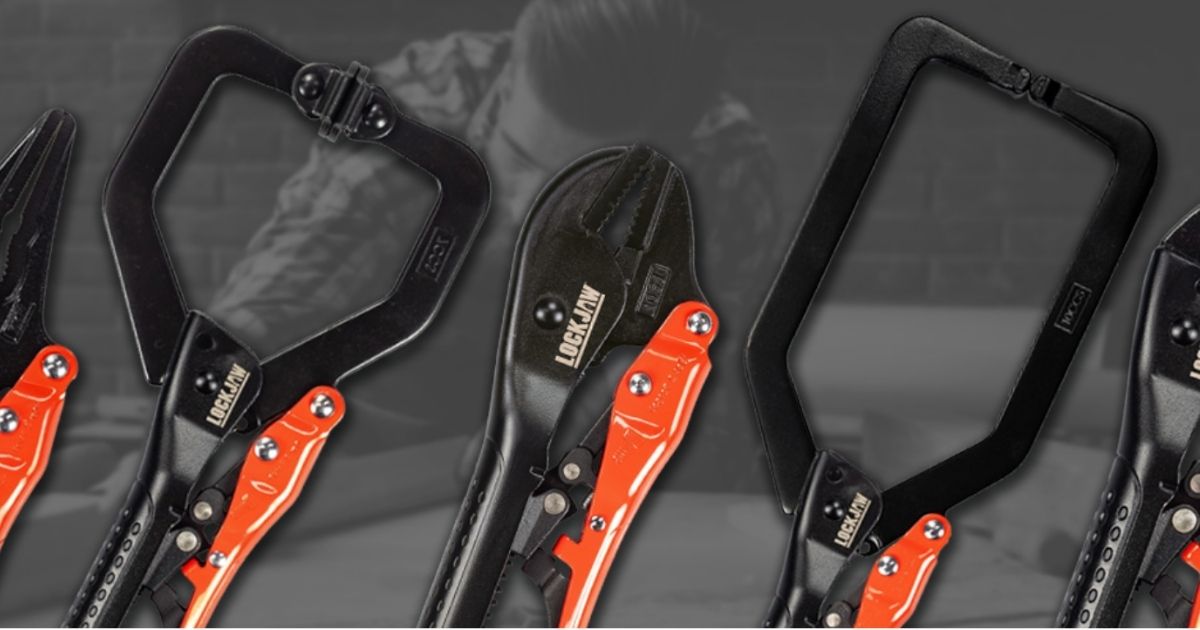

(Taken from this post by Sutton Tools. Republished with permission. Edited for point of view, recency and relevance.)
Over many years, Lockjaw pliers and clamps have gained a devoted following of tradespeople, weekend warriors and hobbyists. Quite simply, they are known to be much easier and more reliable to use than other brands.
The key is the ability for users to set a pressure – from slight to extreme – via the unique Set and Forget™ adjustor. The plier or clamp will then hold this same pressure automatically, self-adjusting to grip the correct distance according to the thickness of the material.
This feature is extremely useful when clamping different materials. For example, pine wood could be damaged at the pressure you’d use to hold a slab of Masonite, and Masonite could drop from the clamp at the pressure you’d use for a softwood. So, you want to set the pressure to suit the material, regardless of its thickness.
Most importantly, the process of setting the pressure is by turning a screw mechanism embedded in the tool’s handle; so it’s a single-handed operation.
This capability is critical for clamping, because you typically need the other hand to manipulate the material you are holding. Hence, the Lockjaw promise: 7x faster, 100% easier.
In manufacturing, construction and similar industries involving regular clamping of materials, this time-saving ability can translate to thousands of dollars a year in process time savings.
More stocks now available
As a tool manufacturer and supplier, Sutton Tools is proud to be the official Australian distributor of Lockjaw products and has a reputation for maintaining ready-to-ship stocks of over 16,000 SKUs at adequate levels for their customers’ needs. However, due to the popularity of Lockjaw pliers and clamps, they have not always been able to prevent shortages and backorders.
To address this, they have recently reorganised and streamlined their Lockjaw supply chain processes, which means stock availability should no longer be an issue.
They’ve also improved the packaging, so it’s less likely to suffer damage in transit.
Shop for Lockjaw pliers and clamps now.
AIMS' Note on Safe Use of Hand Tools
- Inspection: Before using any tool, carefully inspect it for cracks, chips, loose handles, worn / mushroomed heads or any other signs of damage. Damaged or defective tools may cause harm! Ensure all guards are in place.
- Right tool for the job: Make sure you understand the intended purpose of each tool and choose the correct one for your specific job. Don't try to make a screwdriver work as a pry bar or a wrench as a hammer.
- Safe handling: Carry sharp tools pointed down and away from your body. Never carry tools in your pockets where they can cause injury. When passing a tool to someone, extend the handle first.
- PPE: Wear safety glasses or goggles to protect your eyes from flying debris. Consider gloves depending on the tool and task to prevent cuts or blisters but without compromising comfort, dexterity and protection. If working with noisy tools, wear ear protection.
- Maintenance: Keep your tools clean, sharp and properly maintained. Store them in a safe and organised place when not in use.


People Also Ask — Locking Pliers & Clamps
Q: What are locking pliers used for?
Locking pliers — sometimes called by the trade as a self-grip or mole-type tool — clamp onto a workpiece and stay locked with strong, hands-free pressure until released. That makes them a cross between pliers and a clamp. Tradespeople use them to grip and turn rounded or damaged fasteners, hold parts together for welding or drilling, act as a temporary handle or clamp, and free seized nuts and bolts. Because the jaws lock under adjustable pressure, you can set them onto an item and let go, freeing both hands for other work. Their versatility is why they are a staple in automotive, fabrication and general maintenance kits.
Q: How do you adjust and lock the pliers onto a workpiece?
Locking pliers have an adjusting screw in the end of one handle that sets the jaw opening and clamping force. You turn the screw so the jaws are slightly smaller than the item, then squeeze the handles until they snap shut and lock with firm pressure. If they are too loose or too tight, you release and fine-tune the screw and try again. A release lever in the handle pops them open when you are done. The knack is setting the screw so the lock engages with a positive snap and real clamping force — too loose and they slip, too tight and they will not close.
Q: What is the difference between locking pliers and a clamp?
A standard clamp is purpose-built to hold work together with a fixed frame and a screw or lever, giving steady, distributed pressure for tasks like glue-ups and welding fit-up. Locking pliers are a portable, hand-sized tool that locks onto a point with concentrated jaw pressure, doubling as a gripping and turning tool as well as a temporary clamp. Locking clamps blend the two — locking-plier mechanisms fitted with clamp-style jaws (such as C-clamp or sheet-metal jaws) for holding fabrication work. Choose a clamp for steady holding over a wider area, and locking pliers where you need a quick, strong, portable grip or a turning tool.
Q: What jaw shapes are available on locking pliers?
Locking pliers come with several jaw styles for different jobs. Curved jaws are the general-purpose shape and grip round and hex items well. Straight or long-nose jaws reach into tight spots and grip small parts. Wide or sheet-metal jaws spread the clamping force to hold panels flat without marking, which suits fabrication. C-clamp jaws turn the tool into a deep-reach welding clamp. Chain and specialty versions grip large or awkward shapes. Matching the jaw shape to the task — gripping, turning, or clamping flat work — gets the best hold, so many workshops keep a few jaw styles on hand.
Q: Can locking pliers damage the workpiece?
They can, because they grip with concentrated, serrated jaw pressure that can mar soft surfaces, crush thin material or chew up the corners of a fastener if over-tightened. That is a fair trade-off when freeing a seized or already-damaged bolt, but on finished or soft parts it is worth protecting the surface — backing the jaws with cloth or soft pads, using smooth or wide jaws, or choosing a proper clamp instead. Set the clamping screw only as tight as the job needs rather than maximum. Used with that bit of judgement, locking pliers grip securely without leaving unnecessary damage.
Need adjustable hand reamers? Browse the AIMS range at adjustable hand reamers.