

Before you read on — what this guide is, and isn't
Fire pump controllers are life-safety equipment. This guide explains the concepts in plain English so you know what you're looking at and what questions to ask — it is not a substitute for AS 2941 itself, a fire safety engineer, or an AS 1851-accredited servicer, and it must never be used as the basis for installing, commissioning or certifying a fire pump system. Where we're confident a fact is well-established, we say so plainly. Where the detail depends on your specific building, standard revision or state regulator, we say that too, and point you to who can actually confirm it. Any AS 2941 compliance work must be specified, installed and certified by suitably qualified, licensed professionals.
Quick answer: A fire pump controller's job is simple to state and strict to execute: detect a pressure drop in the fire system and start the pump automatically, every time, with no human input required — and never stop it automatically once it's running. Diesel and electric controllers do this differently under the hood, and AS 2941 sets out what a compliant controller must do. Getting the controller wrong, or letting an old one drift out of compliance, doesn't just risk a certification failure — it risks the fire system not working when a building's whole fire safety design assumes it will.
In 30 seconds
- Auto-start, manual-stop — the core logic: a compliant controller starts the pump automatically on pressure drop and can only be stopped by a person, never itself.
- Diesel and electric controllers are genuinely different: different starting logic, different redundancy requirements, different failure modes to understand.
- This isn't just a certification checkbox: buildings are often designed with reduced fire ratings or longer travel distances specifically because a working sprinkler/pump system exists — an out-of-compliance controller undermines that whole design basis.
- Old panels don't need a full engine swap to get compliant — like-for-like replacement controllers exist for exactly this reason.
- This is licensed, certified work, always — this guide is background, not a specification document.
What a fire pump controller actually does
Strip away the enclosure, the LEDs and the wiring, and a fire pump controller's job comes down to one piece of logic, and it's worth understanding because almost everything else about AS 2941 compliance follows from it: the controller must detect a pressure drop in the fire protection system and start the pump automatically, with no human action required — and once running, it must not be able to stop itself. A person has to manually stop it. This sounds like a small detail, but it's the entire safety philosophy of a fire pump system in one sentence: the system assumes the building is on fire, people may be incapacitated or unable to reach the plant room, and the pump has to keep running until a person deliberately decides it's safe to stop it. Everything else — battery redundancy, fuel reserves, alarm and monitoring requirements — exists to make that one piece of logic reliable under the worst possible conditions.
Diesel vs electric fire pump controllers — the real differences
Both controller types share the same core auto-start/manual-stop logic, but the way they achieve reliable starting is genuinely different, and it's worth understanding which one you're dealing with.
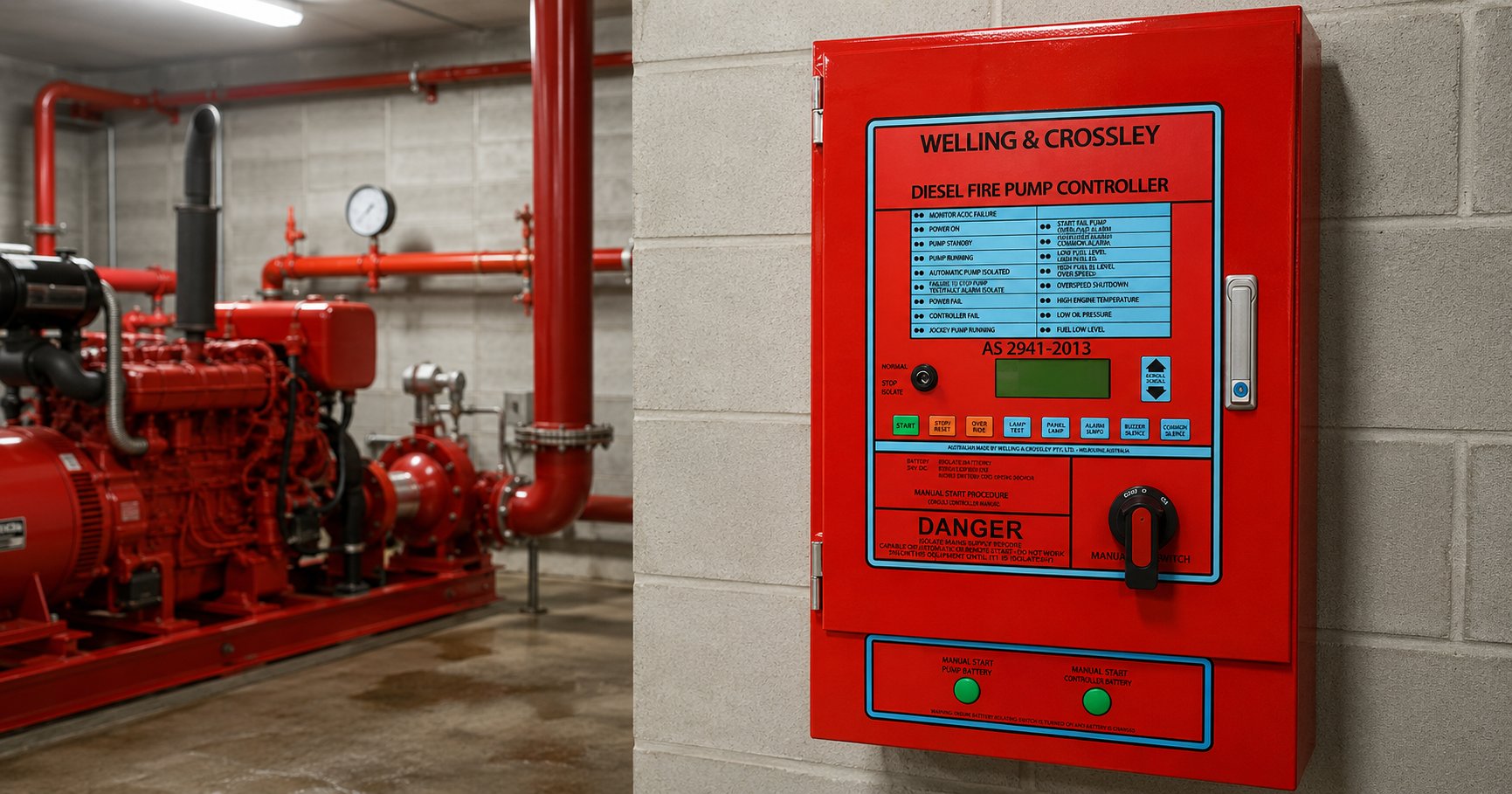
Diesel fire pump controllers exist because diesel engines don't depend on mains power to run — which is the whole point in a fire scenario, where mains power may have failed. A diesel controller manages engine cranking (typically via battery-start), monitors engine health (oil pressure, coolant temperature, fuel level, RPM), and is built around the assumption that the diesel engine is the more resilient option precisely because it doesn't need the grid. This is why diesel fuel storage matters so much: the controller and engine are only as reliable as the fuel supply behind them.
Electric fire pump controllers run the pump from a dedicated, fire-rated electrical supply rather than an engine. They're simpler in some respects (no fuel, no engine to maintain) but entirely dependent on that dedicated supply actually being available and correctly isolated from other building loads — which is why electric controller installations focus heavily on supply integrity, phase failure detection and isolator arrangements, rather than fuel and battery management.
Many larger or more critical buildings run one of each — an electric pump as the primary and a diesel pump as backup, or vice versa — specifically so that a single point of failure (a mains outage, a flat battery, an empty fuel tank) can't take out fire protection entirely. Which configuration is right for a given building is a fire engineering decision, not something to infer from a product guide.
What AS 2941 actually requires — the parts we can confirm, and the parts we can't
We cross-checked the technical claims below across multiple independent Australian fire protection industry sources before including them, the same discipline we've applied to every compliance topic in this series. A short list of facts came up consistently enough across sources that we're comfortable stating them plainly. Several other commonly-repeated figures did not — we've flagged those separately rather than presenting a single source's claim as settled fact.
Confirmed by multiple independent sources:
- Diesel fire pump fuel storage must provide at minimum 6 hours of continuous operation at full load.
- The controller must start the pump automatically on detecting a pressure drop, with no manual step required, and must be manual-stop only — it cannot shut itself down automatically.
- Stored diesel fuel degrades over time — commonly cited at around the 12-month mark — which is why annual fuel testing and periodic replacement is standard recommended practice, not an optional extra.
Commonly mentioned, but only from a single source we could find — treat as indicative, not settled, and confirm against the current standard or your fire engineer: specific shop-test durations and flow percentages, a fixed building-height threshold that triggers a two-pump redundancy requirement, exact battery/charging redundancy configurations, and detailed suction-line and NPSH design specifics. These are all real engineering considerations — we simply can't independently verify the precise figures well enough to state them as fact here.
Why this matters more than a certification checkbox
It's easy to treat fire pump controller compliance as paperwork — something a servicer ticks off once a year. The reality is more structural than that. Many buildings are granted design concessions specifically because they have a working sprinkler and pump system: reduced fire-resistance ratings on some elements, longer permitted travel distances to an exit, and similar trade-offs that fire engineers make on the assumption the suppression system will actually perform when called on. If the fire pump controller isn't doing its job — whether that's outright failure or just drifting out of AS 2941 compliance — the building's entire fire engineering basis is compromised, not just one component in isolation.
Enforcement is also tightening, not loosening. As one live example: NSW introduced stricter alignment with AS 1851-2012 servicing requirements and tougher enforcement from 13 February 2026, with penalties for non-compliant strata buildings reported as high as $66,000 per incident. We're citing this as a real, current example of the direction of travel in fire safety compliance generally — not as a claim that identical rules apply in every state, since other jurisdictions run their own essential safety measures schemes under different names and timelines. The broader point holds everywhere: property owners carry primary responsibility for this equipment working, and "it's hidden in the plant room so nobody thinks about it" is a genuinely common failure mode, not a rare one.
Common real-world issues worth knowing about
Some recurring themes come up wherever fire pump controllers get discussed by the people who actually install and maintain them — grounding and earthing arrangements at the controller, the wiring method used between the controller and the fire pump's power supply, where the service disconnect sits relative to the controller, and fault current considerations on the supply feeding it. We're deliberately not stating specific rules here: the detailed discussion we found on these topics comes from US-context forums working to NFPA 20 and the National Electrical Code, not AS 2941 or AS/NZS 3000. The themes are a useful heads-up that these are real, recurring points of attention in fire pump controller installations generally — but the actual rule in your case comes from AS 2941, AS/NZS 3000, and your licensed electrician, not from an overseas forum thread.
New installation or like-for-like replacement?
Not every fire pump controller job is a new building. A genuinely common scenario: an existing diesel or electric fire pump set has an ageing or non-compliant controller, but the engine and pump themselves are still sound — replacing the whole set would be a large, unnecessary cost. This is exactly why compliant controllers are still built to older specifications (AS 2941-2008 as well as the current 2013 version) rather than only the newest revision: a like-for-like controller replacement can bring the control system back into compliance without forcing a full engine or pump swap. If you're specifying a replacement, knowing your existing engine's voltage (typically 12V or 24V) and make is the first thing whoever quotes it will ask for.
Where AIMS fits
Through our relationship with Welling & Crossley, we have access to AS 2941-compliant fire pump controllers for both diesel and electric fire pump sets — current 2013-spec panels and legacy 2008-spec panels for like-for-like replacements, in 12V and 24V configurations, with pre-wired engine looms and full technical documentation. If you're specifying a new fire pump set, replacing a non-compliant or obsolete controller, or sourcing a part for a client as a servicing contractor, get in touch with your requirements — engine voltage and make, diesel or electric, new build or replacement — and we'll quote it properly.
Frequently asked questions
What does a fire pump controller actually do?
It detects a pressure drop in the fire protection system and starts the fire pump automatically, with no human action required, and it can only be stopped manually — never automatically. That single rule is the basis for most of what AS 2941 requires of a compliant controller.
What's the difference between a diesel and an electric fire pump controller?
A diesel controller manages engine starting and health monitoring for a pump that doesn't depend on mains power — the point of a diesel pump in the first place. An electric controller runs the pump from a dedicated, fire-rated electrical supply and focuses on supply integrity and isolation rather than fuel and engine management.
What is the most common type of fire pump set up in Australian buildings?
Many larger or more critical buildings run a combination — commonly an electric pump as the primary supply and a diesel pump as backup, or the reverse — specifically so a single failure point (a mains outage, a flat battery, an empty tank) can't take out fire protection entirely. Which arrangement suits a given building is a fire engineering decision.
How much fuel does a diesel fire pump need to store?
At minimum, enough for 6 hours of continuous operation at full load — this figure is consistently confirmed across independent Australian fire protection industry sources.
How often does a fire pump controller need to be tested?
Regular testing is required under AS 1851 servicing schedules, but we couldn't independently verify a single, universally-quoted test frequency and duration figure well enough to state it as fact here — confirm your specific servicing schedule with an AS 1851-accredited fire protection servicer.
My building has an old AS 2941-2008 controller — does it need replacing entirely?
Not necessarily. Compliant replacement controllers are still built to match older installations, so a like-for-like controller swap can restore compliance without replacing the engine or pump. Whether your specific installation can be handled this way is a question for a fire protection engineer or servicer who's seen the actual equipment.
Is fire pump controller compliance just a paperwork exercise?
No — many buildings are granted design concessions (reduced fire ratings, longer travel distances) specifically because a working pump system exists. A non-compliant or failing controller undermines the building's actual fire engineering basis, not just a certification line item.
Can I install or wire a fire pump controller myself?
No. This is licensed electrical and fire protection work, and in most cases requires certification by an accredited fire safety practitioner. This guide is background information only, not installation guidance.
This guide is general information current as at August 2026 and is not a substitute for AS 2941, AS 1851, or advice from a qualified fire protection engineer or accredited servicer. Facts presented as confirmed were cross-checked across multiple independent Australian fire protection industry sources; facts we could only find from a single source are explicitly flagged as such rather than stated as settled. Forum-sourced discussion of installation practices reflects US NFPA 20/NEC context and is presented only as a general heads-up on recurring themes, not as an AU-specific rule. Regulatory examples (including NSW's February 2026 reforms) are illustrative of the compliance environment generally and may not reflect requirements in your specific state or building. Always verify current requirements directly with a licensed, qualified professional before specifying, installing or certifying any fire pump system component.
Browse the full AIMS diesel pumps range.