

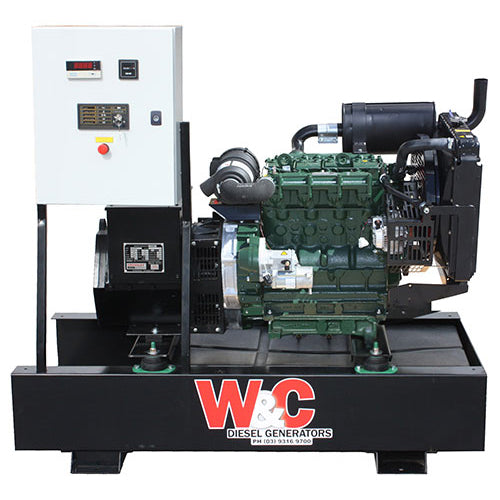
Quick answer: Work out your total running load first, then add extra headroom for whatever has a motor or compressor in it — that headroom is usually bigger than people expect, and it's the single most common reason a "big enough" generator trips or stalls. A fridge that runs quietly at 150W can demand 600–900W for a second or two when its compressor kicks in. Size for that surge, match the phase to your supply, and you'll avoid the single most common generator complaint we see.
In 30 seconds
- Size for peak load, not running load: your total running watts plus the single biggest motor's starting surge — not every motor's surge added together at once.
- kVA ≠ kW: a "5kVA" generator only delivers roughly 4kW of real, usable power.
- Match phase to your supply — most homes are single-phase, workshops with heavier machinery are often three-phase.
- Diesel and petrol suit different jobs — petrol for lighter, intermittent use; diesel for longer, heavier duty.
- Use the calculator below to size your own setup in under a minute.
How big a generator do you actually need?
If your generator is sized to the running total with no allowance for motor or compressor start-up surge, it can shut down or brown out the moment the compressor starts — which is the single most common generator complaint we see, and almost always a sizing problem, not a faulty unit. Getting this right the first time is the difference between a generator that quietly does its job for a decade and one you're constantly troubleshooting.
Running watts vs starting watts — the mistake that trips up almost everyone
Every appliance has a running wattage — what it draws once it's going. Anything with a motor or compressor (fridges, freezers, air conditioners, pumps, some power tools) also has a starting or surge wattage, which is what it draws for a second or two while the motor gets up to speed. That starting draw is typically 3 to 7 times the running wattage — the exact multiplier depends on the specific motor, so treat it as a planning range, not an exact figure, and check the appliance's nameplate or manual if it's listed.
This is the actual failure pattern behind almost every "my generator died as soon as the aircon/fridge started" story: the running-watts total looked fine, but nobody accounted for the surge. Size for the surge, not just the running total, and this stops being a problem. If you're powering three-phase motors or workshop equipment rather than household appliances, the starting method itself also matters — see our motor starting methods guide for how DOL, star-delta, soft starters and VFDs compare on starting current.
Worked example: sizing for a weekend blackout
Say you want to run a fridge (150W running, has a compressor), a freezer (130W running, has a compressor), some LED lighting (40W) and charge a laptop (60W). Here's the actual maths, step by step:
- Running total: 150 + 130 + 40 + 60 = 380W. That's what everything draws once it's all up and running together.
- Biggest single surge: the fridge and freezer both have compressors, but you size for the largest one starting, not both at once — in practice, only one compressor is likely to kick in at the exact same instant as the other appliances are already running. Using a 5× planning multiplier on the larger of the two (150W fridge), that's an extra 600W on top of its own running watts during the moment it starts.
- Peak load: 380W (everything else already running, including the fridge's own running watts) + 600W (the extra surge on top) = 980W, or roughly 0.98kW.
- Convert to kVA with headroom: 0.98kW ÷ 0.8 (power factor) × 1.25 (25% headroom) ≈ 1.53kVA.
- Round to a real standard size: single-phase generators aren't sold at 1.53kVA — the next standard size up is 2kVA, so that's your realistic starting point for this exact appliance list.
This is exactly what the calculator below does automatically for your own appliance list — the worked example just shows the actual arithmetic so you know what it's doing, not treating it as a black box.
kVA vs kW — what your spec sheet is actually telling you
Generators are rated in kVA, not kW, and the difference matters when you're comparing units. kVA is the alternator's total output capacity; kW is the real, usable power after accounting for power factor (typically 0.8 for a standard generator). In practice: kW = kVA × 0.8. So a "5kVA" generator delivers roughly 4kW of real, usable power — not 5kW. If you're sizing against a load that's specified in kW, convert first, or you'll end up under-buying.
Single-phase or three-phase?
This comes down to your supply, not personal preference. Most homes run single-phase (230/240V) and a single-phase generator is the right match. Workshops or commercial sites with three-phase machinery — larger compressors, some welders, industrial equipment — need a three-phase generator (400/415V) to match. If you're not certain which your site has, that's worth confirming before you buy, not after.
Size your own setup
Add what you need to run. We'll calculate your running total plus the surge from your biggest motor or compressor — the realistic worst case, since it's rare for every motor to start at exactly the same instant — then round up to the nearest size generators are actually sold in (single- and three-phase come in different standard steps, so switching phase can genuinely change the recommended size, not just the label).
| Appliance | Running watts | Has a motor or compressor? |
|---|
Supply:
This is a planning estimate, not a substitute for checking nameplate starting ratings on critical or life-safety equipment (e.g. medical devices) — always confirm those directly against the manufacturer's specs.
Get a quote for this size →Typical sizing for common Australian scenarios
These are realistic starting points, not exact figures for your specific setup — appliance efficiency and age vary a lot. Use the calculator above for your actual gear.
| Scenario | Typical sizing |
|---|---|
| Essentials only (fridge, freezer, lighting) | ~2–3kVA |
| Essentials plus a split-system air conditioner | ~5–6kVA |
| Job site — power tools, small compressor | ~4–7kVA depending on tools |
| Duty-cycle welding | ~5.5–6kVA (5kVA is often marginal) |
| Workshop with three-phase machinery | Sized to the largest single motor's starting draw plus everything else running — get this one properly calculated, not estimated |
On medical equipment specifically (CPAP machines and similar): most CPAPs draw relatively little power on their own (often under 100W, more with a heated humidifier), but this is exactly the category where you should confirm against the device's own specifications and, for anything life-support related, talk to your equipment provider directly rather than sizing from a general guide.
Diesel or petrol? What it means for sizing and running
The fuel type doesn't change the sizing maths above, but it does change what the generator will actually be like to own, and it's worth deciding alongside sizing rather than as an afterthought. Petrol generators suit lighter, more intermittent use — camping, occasional home backup, a few hours here and there — and are generally cheaper upfront and lighter to move. Diesel suits longer, heavier duty: tradie sites running most of a day, extended blackouts, or anything approaching continuous use. Diesel engines are generally more fuel-efficient per hour of real work and tend to handle sustained running better over the long term, which is why most of the larger and continuous-duty end of the market — including the fire pump and industrial engine range — is diesel, not petrol.
One safety point that applies to both, but especially petrol given how volatile the fuel is: never refuel a generator while it's running or still hot. Let it cool first. And regardless of fuel type, check your own state's rules on how much fuel you can legally store at a residential property before assuming you can just keep a large reserve on hand.
What will it actually cost to run?
As a rough planning figure, diesel generators typically burn somewhere around 0.2–0.3 litres per hour for every kVA of rated capacity when running at or near full load — so a 6kVA unit working hard might use somewhere in the order of 1.2–1.8 litres an hour. That efficiency drops off at partial load, which is one reason to size accurately rather than buying much bigger than you need "just in case" — a diesel generator running well below its rated capacity for extended periods burns more fuel per kWh produced, and can develop long-term engine problems from consistently light loading. At an illustrative $2/litre, that 6kVA example above works out to roughly $2.40–$3.60 an hour at full load — treat this as a ballpark for comparison, not a running-cost guarantee, since fuel prices and your actual load will move the real number around.
Where can you put it? Noise and safety
Carbon monoxide is the real, deadly risk with any petrol or diesel generator — it's invisible and odourless, and running one in a garage or other enclosed space is dangerous even with the door open. Always run a generator outdoors, well clear of doors, windows and eaves where exhaust could drift back inside.
On noise: open-frame petrol or diesel generators typically run somewhere around 70–85 dB(A) at 7 metres — in the range of passing heavy traffic. Acoustic canopy-enclosed diesel units are considerably quieter, typically around 50–58 dB(A) at 7 metres, closer to normal conversation. Inverter generators sit in a similar range to enclosed diesel units, commonly around 49–60 dB(A) at 7 metres. There's no single national noise curfew specific to generators — check with your local council if noise restrictions matter for where and when you'll be running it, rather than assuming a blanket rule applies everywhere.
Keeping it ready for when you actually need it
A generator that's only touched once a year, in the middle of an outage, is the least reliable version of that generator. If it's for blackout backup rather than regular use, run it under some load for 15–20 minutes every month or two — this keeps the engine lubricated, exercises the battery (if it has an electric start) and means you find out about a problem on a Tuesday afternoon, not in the middle of a storm. Stored petrol degrades within a few months and can gum up a carburettor; if a generator will sit unused for a while, either run the tank down before storing it or use a fuel stabiliser, and check your state's rules on how much fuel you're allowed to store at a residential property before assuming you can keep a large reserve on hand. Diesel stores considerably longer than petrol but isn't indefinite either — treat both as something to rotate through, not something to set and forget.
Connecting it to your home or business
Sizing is only half the job — a generator still needs to be connected safely, and that's not a DIY step. See our guide to manual vs automatic changeover switches for what's required and why it matters.
Frequently asked questions
Can a 5kVA generator run a fridge and aircon?
Often it's marginal once you account for real usable power (a 5kVA unit delivers roughly 4kW) and the aircon's starting surge. Run the numbers through the calculator above with your actual appliances before assuming it'll cope.
What's the difference between kVA and kW?
kVA is a generator's total rated output; kW is the real usable power after power factor (typically kW = kVA × 0.8). A "5kVA" generator gives you roughly 4kW to actually use.
Do I need three-phase for my workshop?
Only if your equipment itself is three-phase. Match the generator to your existing supply — most homes are single-phase, workshops with heavier machinery are often three-phase.
How much bigger should my generator be than my actual running load?
Big enough to cover your running total plus the starting surge of your largest motor or compressor — typically 3–7 times that appliance's running watts, not just its running figure.
Why did my generator trip or stall when my fridge/aircon started?
Almost always a sizing issue — the unit was matched to running watts only, without allowance for the compressor's starting surge. This is the most common generator complaint and it's a sizing fix, not usually a faulty unit.
Should I buy diesel or petrol?
Petrol suits lighter, intermittent use like camping or occasional backup; diesel suits longer, heavier duty like tradie sites or extended blackouts, and is generally more fuel-efficient over sustained running.
How much does it cost to run a generator?
As a rough guide, diesel units burn roughly 0.2–0.3 litres per hour per kVA of rated capacity at full load — a 6kVA unit working hard might use around 1.2–1.8 litres an hour. Check current fuel prices for your own running-cost estimate.
Can I run a generator in my garage?
No — carbon monoxide is invisible, odourless and deadly, and this applies even with the garage door open. Always run a generator outdoors, well away from doors, windows and eaves.
Fuel consumption and noise figures in this guide are industry-typical planning ranges as at August 2026, cross-checked across multiple manufacturer and independent engineering sources — always confirm against the specific unit you're considering. The illustrative running-cost example uses a rounded fuel price for comparison purposes only and will not reflect current pricing.