

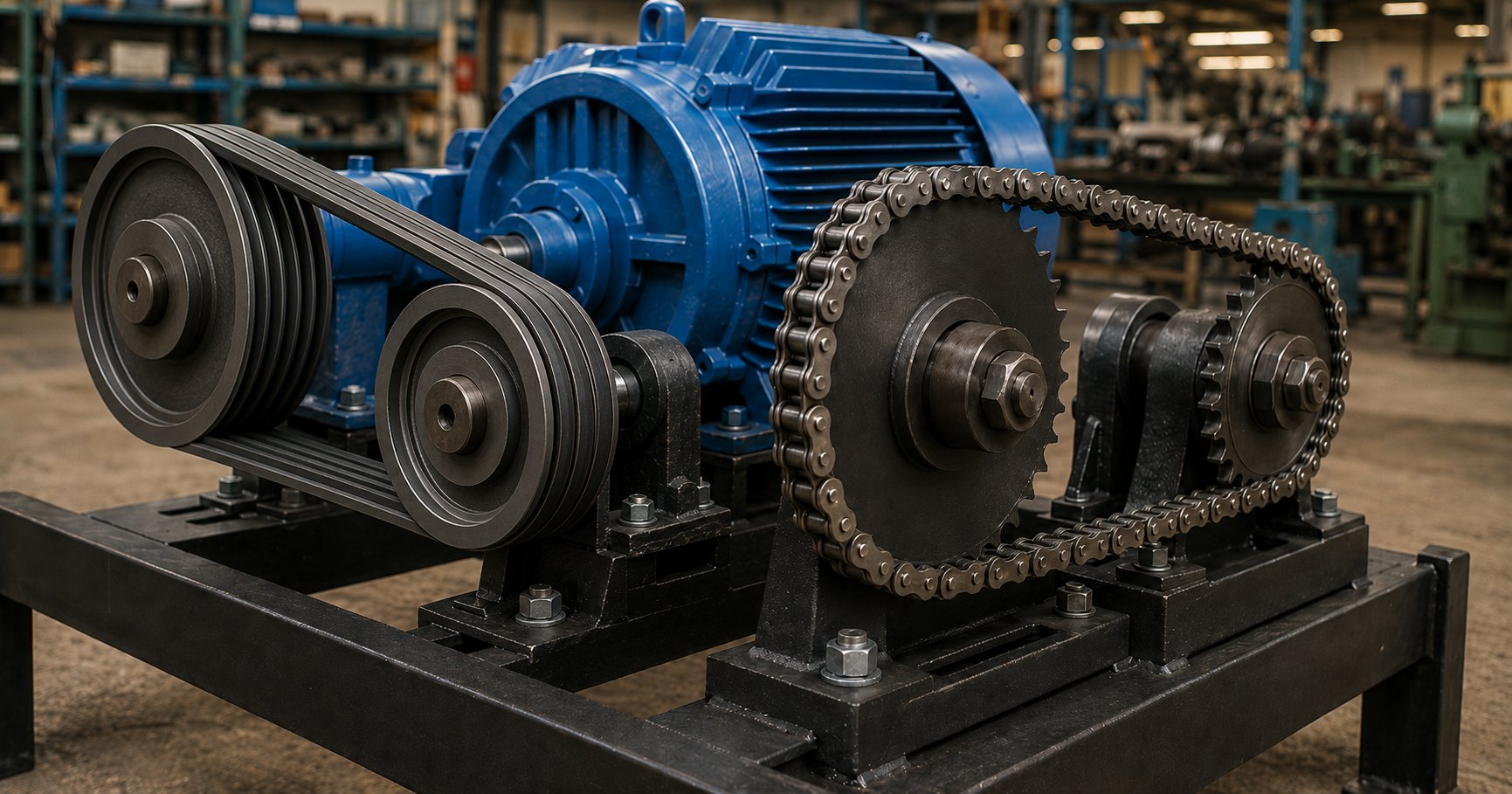
Choosing between a belt drive and a chain drive is one of the foundational decisions in industrial power transmission. The wrong call early in the design phase locks you into the wrong maintenance regime, the wrong downtime profile, and often the wrong lifecycle cost for the life of the equipment. The right call, made with a clear view of the trade-offs, pays back every year the drive runs.
This guide walks the practical trade-offs between V-belt drives, synchronous (timing) belt drives, and roller chain drives — covering efficiency, speed, torque capacity, centre distance, shock load tolerance, environmental tolerance, noise, lubrication, and lifecycle cost. It finishes with selection guidance by application and a 15-question FAQ.
Belt vs Chain Drive — Quick Reference
Side-by-side comparison of the three main industrial power transmission options. Use this as your first-cut filter, then read the detail sections that follow.
| Parameter | V-Belt Drive | Synchronous Belt Drive | Roller Chain Drive |
|---|---|---|---|
| Engagement | Friction (can slip) | Positive (no slip) | Positive (no slip) |
| Efficiency, typical | 92–96% | 97–99% | 96–98% lubed; drops to ~90% poorly maintained |
| Max speed (belt/chain surface) | Up to ~30 m/s | Up to ~60 m/s | Up to ~15 m/s |
| Torque capacity | Low to moderate | Moderate to high (Poly Chain GT covers heavy-duty) | High to very high |
| Centre distance | Wide range; comfortable to ~3 m | Wide range; comfortable to ~3 m | Best to ~4 m+ with idler support |
| Shock load tolerance | Good (slip is protective) | Moderate (tooth shear limit) | Excellent |
| Environment tolerance | Sensitive to oil, heat, dirt | Better than V-belt; check temperature limit | Best — handles dust, heat, contamination |
| Noise | Quiet | Quiet (slight tooth hum at high speed) | Loud, especially at speed |
| Lubrication required | No | No | Yes — ongoing |
| Capital cost | Lowest | Mid | Highest installed |
| Lifecycle cost (5 yr typical) | Low | Low to mid | Mid to high (lubrication + downtime) |
| Replacement labour | Quick | Quick | Slower (lubrication, tensioning, alignment) |
| Typical service life | 12,000–18,000 hrs | 18,000–25,000 hrs | 15,000–25,000 hrs (lube-dependent) |
V-Belt Drives
How V-belt drives work
A V-belt sits in a V-shaped groove on the pulley (sheave). The belt's wedge-shaped cross-section forces it into the groove under load, multiplying the friction grip without needing high installation tension. Power transmits through that friction grip between belt sidewalls and pulley grooves — there is no tooth engagement.
V-belts come in classical sections (A, B, C, D, E — designated by top width and depth), narrow wedge sections (SPZ, SPA, SPB, SPC — higher power capacity in a smaller package), cogged or notched variants (slotted underside for tighter bend radius and better cooling), and banded multi-rib V-belts like the Gates Predator and Banded Predator series for shock-loaded heavy-duty drives.
V-belt strengths
- Lowest capital cost of any industrial drive — both belt and pulleys are inexpensive.
- No lubrication required — eliminates oil mist, grease contamination, and lube-related maintenance hours.
- Slip is protective — when a sudden overload hits, V-belts slip rather than transmitting the spike through to the driven equipment. This protects gearboxes, bearings and motor windings from shock damage.
- Quiet — no metal-on-metal engagement.
- Tolerant of small misalignment — the wedge profile self-centres in the groove.
- Quick replacement — slacken the tensioner, slip the old belt off, fit the new one, retension. Often achievable in 15–30 minutes per drive.
V-belt limitations
- Slip under sustained overload — efficiency drops, belt heats up, life shortens. The protective slip becomes a problem if the drive is operating beyond rated capacity.
- Sensitive to oil and chemicals — petroleum oils swell rubber compounds and ruin grip. Identify a contamination source and stop it before fitting a new belt.
- Temperature limited — standard EPDM and chloroprene compounds run to around 80–100 °C. Above that, specify heat-resistant compounds or move to chain.
- Less efficient than synchronous belts — typical 92–96% vs 97–99% for synchronous.
- Requires periodic retensioning — belts seat and stretch in the first 500–1,000 operating hours, then run stable. Quarterly tension checks thereafter.
Common V-belt applications
- HVAC fan and pump drives (the dominant application by volume in Australia)
- Compressor drives (rotary screw, reciprocating)
- Light-to-moderate machinery (drill presses, bandsaws, woodworking equipment)
- Agricultural equipment (auger drives, fan drives, light pump drives)
- Vehicle accessory drives (though serpentine ribbed belts now dominate this segment)
See our V-Belt Sizing & Identification Guide for section profile dimensions, and How to Measure a V-Belt for the practical identification steps when you've got an unmarked belt in hand.
Synchronous (Timing) Belt Drives
How synchronous belt drives work
Synchronous belts have moulded teeth on the inside face that engage matching teeth on the pulley (the pulley is called a sprocket in synchronous belt terminology, even though it's a belt pulley). Power transmits through positive tooth engagement — there is no friction grip and no slip. The belt arrives at the driven shaft in exact phase with the driver, hence "synchronous" and "timing".
Profile types include trapezoidal (older MXL, XL, L, H, XH series), curvilinear HTD, modified curvilinear GT2/GT3, and high-performance Poly Chain GT Carbon for heavy-duty chain-replacement applications. Profile choice affects tooth-shear strength, noise and load capacity.
Synchronous belt strengths
- No slip — positive engagement means the driven shaft always knows where the driver is. Essential for timing-critical drives (printing presses, CNC machinery, robotics).
- Highest efficiency — typically 97–99% transmission efficiency, beating both V-belts and roller chain.
- No lubrication — like V-belts, runs clean and dry.
- Higher speed capability than chain — the polymer-and-fibre construction tolerates higher surface speeds than metal chain.
- Quiet — modern curvilinear profiles produce a slight hum at high speed but are dramatically quieter than chain.
- Can replace chain in many applications — Gates Poly Chain GT Carbon was engineered specifically for this. Cleaner, lighter, lower-maintenance, often longer-lived.
Synchronous belt limitations
- Tooth shear limit — exceed rated torque and the teeth shear off. There's no slip warning before failure.
- Less shock-load tolerant than V-belt or chain — the positive engagement that gives precision also transmits shock straight through.
- Pulleys are not interchangeable across profiles — an HTD belt won't run on a GT2 pulley; Poly Chain GT belts need dedicated Poly Chain GT sprockets. Get the profile match right or the drive fails fast.
- Tensioning is critical — undertensioned synchronous belts ratchet (tooth jumping) and destroy themselves quickly. Overtensioned belts overload bearings.
- Higher capital cost than V-belt — both belt and sprocket are more expensive than V-belt equivalents.
Common synchronous belt applications
- Positioning and timing drives (CNC, printing, packaging, robotics)
- Pump drives where energy efficiency matters (water utilities, irrigation)
- Conveyors requiring positive indexing
- HVAC fan upgrades from V-belt (efficiency play — payback typically 12–24 months on continuous-run drives)
- Chain replacement in food processing, pharmaceutical and washdown environments
- Heavy industrial drives where Poly Chain GT Carbon replaces roller chain
See our Industrial Synchronous Timing Belt Guide for profile selection, pitch identification and selection by load.
Roller Chain Drives
How roller chain drives work
Roller chain consists of alternating inner and outer link plates, pins, bushings and rollers, engaging teeth on sprockets at the driver and driven shafts. Power transmits through positive tooth engagement, like a synchronous belt — but with steel-on-steel contact at the roller-tooth interface and pin-bushing interface. Those interfaces need lubrication or they wear, gall and fail prematurely.
Standard sizes follow ANSI (US) or ISO (metric) standards: ANSI 40, 50, 60, 80, 100 etc. (designation × pitch ⁄ 8 inch); ISO 08B, 10B, 12B, 16B, 20B etc. (pitch in mm). Heavy-duty chain comes in single, double (duplex) and triple (triplex) strand configurations for higher torque without going up a chain size.
Roller chain strengths
- Highest torque capacity per drive size of any common industrial transmission option.
- Excellent shock load tolerance — steel chain handles sudden overload spikes without permanent damage.
- Tolerant of harsh environments — dust, dirt, heat, abrasive contamination. Chain runs in conditions where belts fail in months.
- Long centre distances — chain handles 4 m+ centre distances comfortably with idler support.
- Positive engagement — no slip, accurate speed transmission.
- High temperature tolerance — standard chain runs to 150 °C, special grades higher.
- Forgiving on tension — chain doesn't need the precise tensioning of synchronous belts. A bit slack is normal.
Roller chain limitations
- Requires ongoing lubrication — manual oiling, oil bath, or automatic lubrication. Lubrication failure is the leading cause of premature chain failure.
- Heaviest of the three options — high inertia, higher load on shafts and bearings.
- Loud — metal-on-metal engagement noise grows with speed. In acoustic-sensitive environments, chain is the wrong choice.
- Speed limited — chain typically caps out around 15 m/s; belts run faster.
- Chain stretch — pin-bushing wear lengthens the chain over time, throwing off sprocket engagement. Replace at 1.5–3% elongation depending on the manufacturer's specification.
- Sprocket wear hooks the teeth — worn sprockets shorten new chain life dramatically. Replace chain and sprockets together when wear is advanced.
- Lubricant contamination — oil mist and dripping grease rule chain out for food processing, pharmaceutical and cleanroom applications.
Common roller chain applications
- Heavy-duty conveyors (mining, quarrying, bulk materials handling)
- High-torque drives where belt slip is unacceptable
- Long centre-distance drives
- Vehicle drivetrains (motorcycles, agricultural equipment, forklifts)
- Rolling stock, locomotive auxiliaries
- Drives operating in dirty, abrasive or high-temperature environments where belts fail
Browse our Roller Chain range (76 products covering ANSI and ISO sizes, single and multi-strand) and Sprockets (53 products) to match.
Direct Comparison — The Critical Trade-Offs
Efficiency
Synchronous belt drives are the most efficient at 97–99% transmission efficiency when properly specified and tensioned. V-belts run 92–96%. Well-maintained roller chain hits 96–98%, but drops sharply (down to ~90% or lower) when lubrication is neglected. On continuous-run drives, the efficiency gap between synchronous belt and V-belt or poorly-maintained chain translates directly to energy bills — typical payback on a V-belt-to-synchronous upgrade is 12–24 months on a 24/7 drive over 7.5 kW.
Speed range
V-belts comfortably run up to about 30 m/s belt surface speed. Synchronous belts run faster, up to about 60 m/s for premium curvilinear profiles. Roller chain caps around 15 m/s — above that, lubrication breakdown and centrifugal load on the chain become limiting. For very high-speed drives, belts are the only option.
Torque capacity
Roller chain takes more torque per drive size than any belt. Multi-strand chain (duplex, triplex) extends this further without going up a chain size. For very heavy-duty drives, chain has historically been the only option — though Gates Poly Chain GT Carbon has now closed much of this gap and replaces roller chain in many heavy-industrial applications.
Centre distance
Belts and chains both handle short-to-medium centre distances well. Chain has the advantage at very long centre distances (4 m+) where belt sag becomes problematic without intermediate idlers. For centre distances under 3 m, all three options are practical.
Shock load tolerance
Roller chain absorbs shock loads best. V-belts are next — the friction grip slips under spikes, protecting downstream equipment. Synchronous belts are the least tolerant of shock; positive tooth engagement transmits the spike straight through, and tooth shear is the failure mode if rated torque is exceeded.
Environmental tolerance
Roller chain wins on environmental tolerance — heat, dust, dirt, abrasive contamination. Belts are more environment-sensitive: oil and chemicals attack rubber compounds, heat shortens belt life, dust accelerates pulley groove wear. In severe environments (mining haul roads, foundries, cement works), chain is the default.
Noise
Belts win comprehensively. V-belts are very quiet; synchronous belts produce a slight tooth-engagement hum but stay well below chain noise levels. Chain noise grows with speed and becomes a significant occupational health consideration in enclosed industrial spaces.
Lubrication
Belts don't need lubrication and must never be lubricated — oil contamination destroys belt grip and shortens life. Chain requires ongoing lubrication; lubrication management is a major maintenance line item. Drip-feed oilers, oil baths and automatic chain lubricators all aim to make this manageable, but lubrication never goes away on a chain drive.
Lifecycle cost
Capital cost ranks V-belt < synchronous belt < roller chain. Over a 5-year operating life, factoring in lubrication, energy efficiency, downtime and replacement labour:
- V-belt — lowest installed cost, low ongoing cost. Best lifecycle on light-to-moderate clean drives.
- Synchronous belt — higher installed cost, lowest ongoing cost. Best lifecycle on continuous-run drives where energy efficiency compounds.
- Roller chain — highest installed and ongoing cost. Best lifecycle (and often the only valid option) on heavy-duty, shock-loaded, harsh-environment drives.
Selection by Application
Industrial machinery (machine tools, presses, mixers)
V-belt drives dominate where loads are moderate and the environment is reasonably clean. Synchronous belts where precision timing matters. Roller chain where shock loads or very high torque rule belts out (e.g. punch presses, heavy mixers, rolling mills).
Conveyors
Long-conveyor drives typically use roller chain — shock load tolerance, long centre distance and torque capacity all favour chain. Light material handling conveyors can run on V-belt or synchronous belt. Food and pharmaceutical conveyors increasingly run on synchronous belts (Poly Chain GT or equivalent) to avoid lubricant contamination.
HVAC
V-belt drives are the legacy default for HVAC fan and pump drives across Australia. Synchronous belt retrofits are an efficiency play on large continuous-run installations — payback comes from energy savings, with no lubrication and lower maintenance as bonuses. Chain is essentially never used in HVAC because of noise.
Food processing
Synchronous belts are the right call — no lubricant contamination, washdown-tolerant when specified, hygienic operation. Stainless-steel sprockets pair with food-grade belt compounds. Roller chain is used only in non-food-contact auxiliary drives and is increasingly being displaced.
Pharmaceutical and cleanroom
Synchronous belts only. Chain lubricant contamination rules out roller chain in any process-contact role. V-belts are usable in non-process-contact drives but synchronous is generally preferred for the cleaner running.
Mining (Pilbara, Bowen Basin, Goldfields)
Roller chain dominates harsh-environment drives — crushers, conveyors handling abrasive ore, screen drives. Belt drives serve cleaner auxiliary roles (pump drives, fan drives). The Gates Predator (Banded and Single) and Poly Chain GT Carbon ranges have made inroads into shock-loaded mining drives where roller chain was previously the only option — talk to Sam if you're sizing a heavy-duty mining belt drive.
Agriculture
Mixed. V-belt for auger drives, fan drives, light pump drives. Roller chain for header drives, baler drives, heavy implement drives. Synchronous belts in newer precision-ag equipment where positioning matters.
Automotive workshop equipment
V-belt for compressors, fans, light machinery. Synchronous belts in the vehicles themselves (timing belt — though many engines now use chain or interference-fit gear drives). Workshop chain drives are rare except on hoists and lifting equipment.
Replacing Chain with Belt — When and How
Gates Poly Chain GT Carbon was designed specifically to replace roller chain drives. The business case is strong on the right application: no lubrication, no chain stretch, no oil mist, no environmental contamination from chain lube, lower noise, longer life, lower maintenance hours.
When chain-to-belt replacement makes sense
- Lubrication is a hassle — automatic lubrication systems failing, manual lubrication being missed, lubricant cost escalating, lubrication contamination causing other issues.
- Downtime is expensive — chain replacement and tensioning takes longer than belt replacement on equivalent drives.
- Environment must be cleaner — food, pharma, washdown, near-product contact.
- Noise is a problem — belt drive cuts noise by 5–15 dB(A) on equivalent drives.
- Centre distance is reasonable — under 3 m centre distance is comfortable; longer needs careful belt selection.
What needs to change
- Dedicated sprockets — Poly Chain GT belts run only on Poly Chain GT sprockets. You can't use existing chain sprockets, even if the diameter looks close.
- Recalculated drive geometry — pitch lengths, centre distance, idler placement may all need updating.
- Tensioner type — belt tensioners differ from chain tensioners; static idlers may be fine for chain but inappropriate for belt.
- Shaft alignment to belt tolerances — chain forgives misalignment; synchronous belt does not. Check alignment to manufacturer tolerance (typically <0.25° angular, <1 mm/m parallel).
- Vibration analysis — chain absorbs vibration; synchronous belt transmits it. Check that the driven equipment isn't generating vibration outside belt operating envelope.
When chain-to-belt replacement does NOT work
- Sustained shock loading beyond belt rated torque — keep the chain.
- Very high torque exceeding even Poly Chain GT capacity — chain only.
- Very long centre distance (5 m+) with no idler option — chain handles this better.
- Operating temperature above belt limit — most belt compounds top out around 80–100 °C. Gates Poly Chain GT Carbon (standard) is rated to +85 °C; the high-temperature variant runs to +120 °C continuous (+140 °C peak). Above those windows, chain is the option.
- Extremely abrasive environment with belt-cutting debris — chain tolerates more abrasion than belt.
Replacing Belt with Chain — When It's Necessary
Replacing a belt drive with chain is less common, but legitimate when:
- Belt slip is unacceptable and synchronous belt won't fit — chain gives positive engagement in any geometry.
- Repeated belt failures from environmental contamination — chain tolerates conditions that destroy belts (foundries, cement works, abrasive dust).
- Torque demand has grown past belt capacity — uprated motors or higher production loads can push past belt rating.
- Operating temperature has risen — heat damage to belts, fine for chain.
- Centre distance has been extended significantly — chain handles longer centres without sag.
The conversion involves new sprockets, drive frame revisions for chain tensioning, and lubrication provision — typically a more substantial change than belt-to-chain.
Maintenance Regime Comparison
V-belt drive maintenance
- Visual inspection: monthly — cracking, glazing, fraying, side wear
- Tension check: every 500–1,000 hrs for new belts, then quarterly
- Pulley alignment check: annually, or after any driven equipment shift
- Pulley groove wear inspection: at every belt change
- Drive area cleanliness: keep clear of debris and contamination
- Typical replacement: every 12,000–18,000 operating hours
Synchronous belt drive maintenance
- Visual inspection: monthly — tooth wear, cracking, fraying, ratcheting marks
- Tension check: at installation, then quarterly (belt seats in less than V-belt but still moves)
- Alignment check: every six months — synchronous is far less tolerant of misalignment than V-belt
- Sprocket wear inspection: at every belt change
- Typical replacement: 18,000–25,000 hrs for premium GT and Poly Chain GT belts
Roller chain drive maintenance
- Lubrication: per manufacturer specification — daily for splash and drip systems, continuous for oil-bath, periodic for grease-pack designs. Lubrication failure is the leading cause of premature chain wear.
- Chain elongation check: every six months — replace at 1.5–3% elongation per manufacturer spec
- Sprocket wear inspection: replace chain and sprockets together once tooth hooking is visible
- Visual inspection: weekly — link plate cracks, pin wear, plate fatigue
- Alignment: chain is forgiving but check annually
- Typical replacement: 15,000–25,000 hrs with consistent lubrication; far shorter with neglect
Australian Industry Context
Mining and resources
Roller chain remains the dominant choice for heavy-duty mining drives — crushers, screening plant, conveyor head and tail drives in Pilbara iron ore, Bowen Basin coal, Goldfields gold and Olympic Dam copper-uranium. The Gates Predator banded belt and Poly Chain GT Carbon ranges have replaced chain in some shock-loaded auxiliary drives where lubrication contamination or noise mattered, but chain still wins on heavy-duty primary drives. Talk to Sam Cassar about heavy-duty drive sizing — he'll have stocked the equivalent specification before.
Food and beverage processing
Synchronous belts are now the dominant choice — Australian food processors have been pushing chain out of any process-contact role for two decades. NSF/EHEDG-compliant belt compounds and stainless sprockets pair with washdown-rated motors. AIMS supplies Gates Poly Chain GT and standard synchronous belts in this segment.
HVAC (commercial buildings, hospitals, data centres)
V-belt drives still dominate the installed base, but synchronous belt retrofits are the growth segment — energy efficiency payback is genuine on continuous-run fan and pump drives. Data centre cooling drives in particular increasingly run on synchronous belt for the efficiency, noise and maintenance combination.
Pharmaceutical (manufacturing, dispensing)
Synchronous belt only. Roller chain is excluded from any product-contact zone.
Defence and shipbuilding (Osborne, Henderson, Williamstown)
Mixed — depends on the system. Chain for heavy-duty winches and lifting; belt for auxiliary machinery. Specification typically follows the platform's existing maintenance manual rather than first-principles selection.
AIMS' Note on Drive Selection — When to Call
Drive selection is forgiving when the application is straightforward and unforgiving when it isn't. Ring us on (02) 9773 0122 or email sales@aimsindustrial.com.au when:
- You're sizing a new drive and want a sanity check on belt/chain choice before committing to capital equipment.
- You're considering replacing chain with belt and want to confirm the application is suitable (Sam has done this conversation hundreds of times — five minutes on the phone saves a week of trial and error).
- You've had repeated belt or chain failures and the cause isn't obvious — bring the failed belt or chain to us with the operating conditions and we'll diagnose the root cause.
- You need a non-standard length (Gates Poly Chain GT custom lengths up to 20,000 mm), a special compound (heat-resistant, oil-resistant, FRAS for hazardous areas), or a specific brand the OEM specified.
- You're balancing capital cost against lifecycle cost on a fleet-scale decision (e.g. retrofit synchronous across 50 HVAC drives).
Have ready when you call: drive HP/kW, driver RPM, driven RPM, centre distance, current belt or chain specification, application environment, and a photo if you can.
Browse the ranges referenced through this guide:
- Belts — full power transmission belt range, 213 products
- Industrial V-Belts — classical and narrow wedge sections, 79 products
- Poly Chain Belts — Gates Poly Chain GT Carbon, 6 products + custom lengths
- Single Predator Belts and Banded Predator Belts — heavy-duty shock-load V-belts
- Roller Chain — ANSI and ISO, 76 products
- Sprockets — 53 products
- Pulleys — V-pulleys and timing pulleys, 59 products
- Gates — full Gates range across belts, sprockets and pulleys, 431 products
Related reading on the AIMS reference library:
- V-Belt Sizing & Identification Guide
- How to Measure a V-Belt
- V-Belt Problems & Solutions
- V-Belt Storage Guide
- Industrial Synchronous Timing Belt Guide
- Pulley Speed Ratio Calculator
- FRAS Belts FAQ
- Electric Motors for Hazardous Areas FAQ
Safety Notes for Belt and Chain Drive Work
- Lockout/tagout — isolate, lock and tag the drive before any inspection, tensioning or replacement. Apply a LOTO device. AS/NZS 4836 covers safe work on electrical equipment; AS 4024 covers safety of machinery.
- Guards — never operate a belt or chain drive with guards removed or bypassed. Re-fit guards before restoring power.
- Clothing — secure long hair, remove jewellery, fit-for-purpose workwear without loose sleeves or hoods near moving drives.
- Tensioning safety — releasing belt tension stores energy in the tensioner; control the release.
- Hot drives — let chain drives cool before lubrication or inspection — chain temperature rises significantly under load and lubricant burns lift off contaminants.
- Chain lubrication safety — manage lubricant contamination and slip hazards; clean spills immediately.
Frequently Asked Questions
Which is better — belt drive or chain drive?
Neither is universally better — it depends on the application. Belts win on maintenance (no lubrication required), noise, cleanliness, non-parallel shaft setups, operational speed, space efficiency and total cost of ownership on clean light-to-moderate drives. Chains win on torque capacity, shock load tolerance, environmental tolerance (dust, heat, contamination), and forgiveness on tension and alignment. Most workshop and light-to-moderate industrial drives are better suited to belts; heavy-load, harsh-environment and shock-loaded drives stay with chain.
Do belt drives need to be lubricated?
No. Standard industrial belts (V-belts and synchronous timing belts) do not require lubrication and must not be oiled or greased — contamination causes slippage and premature failure. This is one of the major maintenance advantages of belt drives over chain drives, which need ongoing lubrication.
Can a belt drive replace a chain drive in an existing system?
Yes, in many cases — but the conversion is not as simple as swapping the belt for a chain. You need belts specifically designed to replace chains (such as the Gates Poly Chain GT Carbon series), matching dedicated sprockets (Poly Chain GT sprockets, not generic synchronous sprockets), and the existing drive must have suitable shaft alignment, centre distance and vibration tolerance for belt operation. Always confirm via technical data or contact a drive specialist before converting.
Are belts noisier than chains?
No — the opposite. Belt drives are typically much quieter than chain drives. The polymer-and-fibre belt construction absorbs vibration, and there is no metal-on-metal engagement noise. Chain noise grows with speed and is a significant occupational health consideration in enclosed industrial spaces. Belt drives typically cut noise 5–15 dB(A) on equivalent drives.
Do belts slip more than chains?
Standard V-belts can slip in oily, wet or contaminated conditions or under overload, whereas chains are inherently more resistant to slippage thanks to positive sprocket engagement. However, synchronous (timing) belts have moulded teeth that engage matching sprockets — they do not slip and run with the same positive drive as chains. If slippage is a concern, specify synchronous belts rather than V-belts.
What is the efficiency difference between belt and chain drives?
Synchronous belts are the most efficient (97–99%). V-belts run 92–96%. Well-maintained roller chain runs 96–98%, but drops to ~90% or lower when lubrication is neglected. On continuous-run drives, the efficiency gap can justify a synchronous belt upgrade through energy savings alone — typical payback 12–24 months on drives above 7.5 kW running 24/7.
Which has a longer service life — belts or chains?
Both are wear items. V-belts typically reach 12,000–18,000 operating hours. Premium synchronous belts (Gates GT3, Poly Chain GT Carbon) reach 18,000–25,000 hrs. Roller chain reaches 15,000–25,000 hrs when lubricated consistently; lubrication failure cuts chain life by 50–80%. In equivalent conditions and with proper maintenance, all three approach similar service life.
Can a belt drive handle heavy loads?
Standard V-belts are suitable for light to moderate loads. For heavy-duty applications, chains were the traditional choice — until the introduction of high-strength synchronous belts like the Gates Poly Chain GT Carbon series, which carries loads previously requiring roller chain. Specify Poly Chain or a banded V-belt range like the Gates Predator for heavy-duty drives; standard V-belts will fail under sustained heavy load.
What is the Gates Poly Chain series?
Poly Chain GT Carbon is a high-performance synchronous belt designed by Gates specifically to replace roller chain drives. It uses a carbon-fibre tensile cord for high power-transmission capacity, has long flex fatigue life, withstands shock and surge loads, and is available in lengths up to 20,000 mm with custom lengths to order. Poly Chain belts run on dedicated Poly Chain GT sprockets — generic synchronous sprockets won't fit.
Are belts cleaner than chains in food processing or pharmaceutical applications?
Yes. Belt drives produce no oil or grease mist (because they are not lubricated), making them the appropriate choice for food processing, pharmaceutical manufacturing, cleanroom and washdown environments where contamination control is critical. Chain drives shed lubricant mist and accumulate dirt in the grease — generally unsuitable for clean process environments.
Can belts and chains be used in environments with flammable substances?
Standard belts and chains are not suitable for areas with flammable atmospheres or significant static discharge risk. For these environments, specify fire-resistant anti-static (FRAS) belts, manufactured to dissipate static charge and resist ignition. Alternatively, heat-resistant or oil-resistant belts cover other specific environmental hazards. Site safety compliance determines which specification is required — see our FRAS Belts FAQ.
What maintenance do belt drives need?
Belt drive maintenance is significantly less than chain maintenance, but not zero. Monthly visual inspection (cracking, glazing, fraying); tension checks every 500–1,000 operating hours for the first year then quarterly; pulley alignment checks at least annually; and keeping the drive area clean. Replace belts before they fail in service — once visibly worn, schedule replacement at the next planned downtime. Always lock out the drive before inspection or maintenance.
What's the maximum centre distance for a belt drive?
V-belts and synchronous belts both handle centre distances comfortably up to about 3 m without intermediate idlers. Beyond that, belt sag becomes an issue and chain (with intermediate idlers as needed) handles longer centre distances better. Specific belt sections and pitch profiles have different sag tolerances — check the manufacturer's drive design tables for your selection.
Can I run a V-belt and a synchronous belt on the same shaft?
Not at the same time on the same pulley — V-belts and synchronous belts use completely different pulley profiles. You can run separate V-belt and synchronous belt drives off the same input shaft using stacked pulleys, but each belt needs its own dedicated profile pulleys.
How do I know when to replace a belt or chain?
Belts: replace at first signs of glazing, cracking, fraying, fluttering, or any visible tooth wear (on synchronous belts). Don't run belts to failure in service — schedule replacement at planned downtime once visible wear shows. Chains: replace at 1.5–3% elongation (manufacturer-specified) or when sprocket teeth start hooking. Always replace chain and worn sprockets together — new chain on worn sprockets fails in months.
People Also Ask — Belt vs Chain Drives: Selection by Application & Trade-Offs
Q: When should I use a chain drive instead of a belt drive?
Choose a chain drive when high torque at low speed is required, exact speed ratio is critical (chains don't slip), the environment is oily or contaminated (oil-bath chain drives are self-lubricating), or when centre distances are short and large speed reductions are needed. Chains suit conveyors, agricultural equipment, and motorcycle final drives where reliability under shock loading is paramount.
Q: Why do V-belts slip and how can I prevent it?
V-belt slip occurs when belt tension is insufficient to transmit the required torque — the belt slides in the pulley groove rather than gripping. Causes include worn pulley grooves, incorrect tensioning, belt glazing, oil contamination, or overloading. Prevent slip by tensioning to manufacturer specifications, replacing worn pulleys when groove wear exceeds 2–3 mm, and keeping belts free from oil and chemical contact.
Q: When should I replace a roller chain?
Replace a roller chain when elongation (stretch) reaches 1.5–2% of its nominal pitch length — at this point, the chain is riding up on sprocket tooth tips, accelerating wear. Measure a 12-link section: a new 1/2" pitch chain measures 6" across 12 links; at 2% elongation it measures 6.12". Also replace if links are cracked, stiff, or side plates are visibly deformed.
Q: Can I use V-belts in food processing applications?
Standard rubber V-belts are not suitable for direct food contact or washdown-intensive food processing environments — they can contaminate product and degrade rapidly under caustic cleaning chemicals. Use food-grade polyurethane belts or enclosed gear/chain drives with food-grade lubricant for these applications. V-belts remain suitable for driving equipment such as fans, pumps, and compressors away from food contact zones.
Pair this with the right chain hardware — see the AIMS roller chain links collection.

