

For welders, consumables and welding safety equipment, see AIMS Welding.
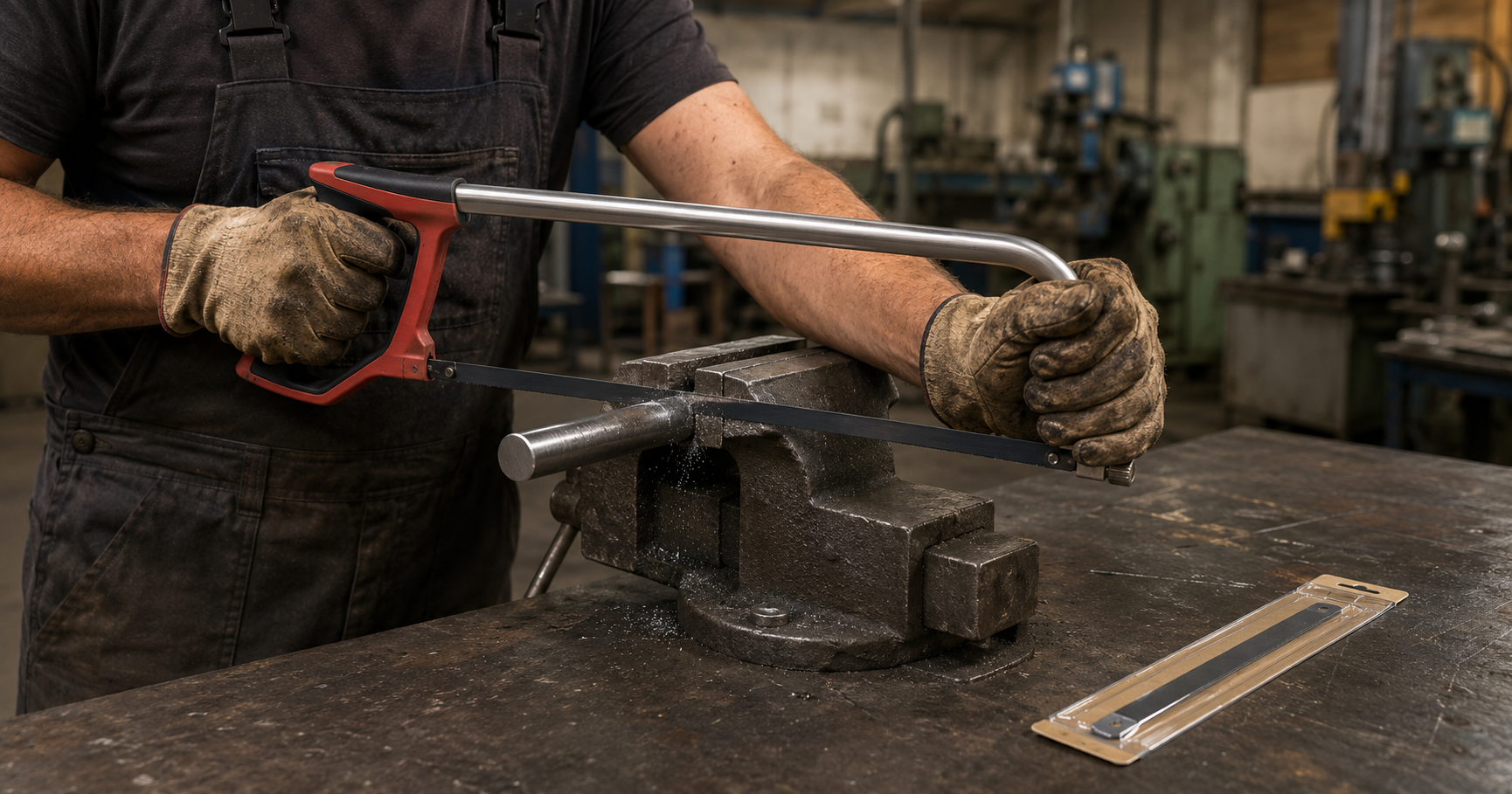
Pick up any hacksaw and the blade is doing all the work — but hand the wrong blade to the wrong job and the teeth strip in seconds, the cut wanders, or the blade snaps clean across. The difference between a blade that lasts a day and one that lasts a year usually comes down to three choices: TPI, material grade, and technique. This guide covers all three, along with blade direction, fitting, tensioning, and how to cut specific materials including stainless steel, aluminium, and copper pipe.
For powered bandsaw blade selection (covered separately from hand-cut hacksaw work), see our Band Saw Blade Guide — same TPI principles, applied to bi-metal and carbide bandsaw blades for production cutting.
Hacksaw Blade Selector — Match Blade to Material
This guide is a working blade-selection tool — not a passive reference. Use the scenarios below to land on the right TPI and blade material fast, or scroll down for the full materials × TPI × technique walkthrough.
Rule of thumb: keep 3 teeth in the cut. Thin wall + sheet = fine TPI (24–32). General workshop steel = 18 TPI. Soft / thick materials = coarse (14 TPI). Bi-metal blades outlast carbon steel by 5–10× on most workshop work — the small extra cost pays back fast. Need help? Call (02) 9773 0122.
Jump to: 5 Things That Matter TPI Explained Blade Materials Blade Sizes Fitting & Tension Cutting Technique By Material Why Blades Break Power Hacksaws Brands Related Selectors
AIMS Top Picks — Pick the Right Hacksaw Blade
Sutton's H-series hacksaw blade range is comprehensive — bi-metal, all-hard, flexible, cobalt. Add Bordo + Bahco + Stahlwille frames + premium options. Recommendations below by material + TPI. Call (02) 9773 0122 for the right blade + frame combo.
By Material — Workshop Default Picks
| Material | Recommended TPI + Type | AIMS recommendation | Why this one |
|---|---|---|---|
| General mild steel (workshop default) | 18 TPI Bi-Metal | Sutton H340 Bi-Metal | The AU workshop standard. Bi-metal teeth on flexible backing — best balance of life and flex |
| General mild steel (alt brand value) | Bi-Metal | Bordo Bi-Metal Hacksaw Blade | Bordo bi-metal — value tier vs Sutton. Workshop-grade at lower cost |
| Stainless steel (work-hardening) | 24 TPI Bi-Metal or Cobalt | Sutton H356 Cobalt Blade | Cobalt blade — 2-3× longer on stainless than bi-metal. Resists work-hardening on 304/316 |
| Cobalt for production work | Cobalt | Sutton H355 Cobalt Blade | Sutton's H355 cobalt — production volume on stainless + tough metals |
| Hardened steel / spring steel | All-Hard | Sutton H345 All-Hard | All-hard construction — no flex, less likely to wander on hard material. Brittle but cuts hardened steel |
| Hardened steel (heavier section) | All-Hard | Sutton H346 All-Hard | H346 — heavier section all-hard for hardened bar stock |
| Hardened steel (premium all-hard) | All-Hard | Sutton H347 All-Hard | H347 — premium all-hard for production cutting on hard material |
By TPI — Match to Section Thickness
| Section thickness | TPI | AIMS recommendation | Why this one |
|---|---|---|---|
| Thin wall tube / conduit (<3mm) | 32 TPI bi-metal flexible | Sutton H351 Flexible | Flexible blade — won't snap on thin wall. 32 TPI keeps 3+ teeth in workpiece (the no-strip rule) |
| General steel rod / bar (workshop default) | 18 TPI bi-metal | Sutton H341 Bi-Metal | 18 TPI is the workshop default — covers most common rod/bar sizes |
| Aluminium / soft material (chip clearance) | 14 TPI bi-metal | Sutton H342 Bi-Metal | Coarse 14 TPI — chip clearance prevents loading on aluminium + soft materials |
| Mixed grit variety pack (3-pack) | 18/24/32 TPI Bi-Metal HSS | Sutton H3400003 18/24/32 TPI 3-Pack | One of each common TPI in 300mm bi-metal HSS — for shops that don't know what's coming next |
| Flexible bi-metal alt sizes | Flexible | Sutton H352 Flexible | H352 alternate flexible — different length/TPI combos |
| Flexible bi-metal mid | Flexible | Sutton H350 Flexible | H350 — mid-range flexible bi-metal |
Junior + Tight-Space Hacksaws (150mm Blade)
| Job | Type | AIMS recommendation | Why this one |
|---|---|---|---|
| Junior hacksaw (150mm blade) | Junior | Sutton H3050150 Junior 150mm | Junior hacksaw — for tight spaces, plumbing in walls, electrical cabinet work |
| Stahlwille small hacksaw blades (158mm) | 32 TPI 6-pack | Stahlwille 158mm 32 TPI 6-Pack | Stahlwille premium replacement blades for the SW12053 frame. 32 TPI fine teeth |
| Stahlwille tubular hacksaw 300mm | Tubular + blade | Stahlwille SW12050 Tubular 300mm + Blade | Premium German hacksaw with adjustable blade tension. Workshop tool standard |
Hacksaw Frames
| Job | Type | AIMS recommendation | Why this one |
|---|---|---|---|
| Workshop default frame | Soft grip 300mm | Sutton H3150300 Soft Grip 300mm | Sutton soft-grip frame — workshop standard. Tension lever, ergonomic handle |
| Hi-tension frame (workshop) | Hi-tension general | Bordo Hi-Tension General Purpose 300mm | Bordo hi-tension — straighter cuts on hard material, less wandering |
| Heavy duty hi-tension | Hi-tension HD | Bordo Hi-Tension Heavy Duty 300mm | HD version — for production use, stiffer frame for sustained heavy cutting |
Buying tip from AIMS: Keep 3-6 teeth in the workpiece (the “3-tooth rule”). Thin tube needs fine TPI (32), thick bar needs coarse TPI (14). Bi-metal lasts 5-10× longer than carbon steel on workshop steel — pay the small premium. For stainless, step up to cobalt. For hardened/heat-treated, all-hard. Always tension the blade tight in the frame — loose tension is the #1 cause of broken hacksaw blades. Don't cut at angles or twist the saw mid-cut.
What makes a hacksaw blade — the five things that matter
Every hacksaw blade is defined by five variables. Get these right for the job and the blade does what it is supposed to. Get them wrong and you will be replacing blades far too often.
TPI (teeth per inch) is the most important choice. TPI determines whether the teeth bite properly into the material or skim over it. Too coarse for thin sections and individual teeth catch and strip; too fine for thick sections and the gullets clog with chips. The rule of thumb — keep at least three teeth in contact with the workpiece at all times — drives the whole TPI selection process.
Blade material determines hardness, toughness and heat resistance. The main options for hand hacksaws are bi-metal (HSS teeth, spring-steel back), all-hard (HSS throughout), flexible (HSS teeth, carbon-steel back) and cobalt bi-metal (high-cobalt HSS teeth). Each suits different workloads and materials.
Back flexibility is related to blade material but worth noting separately. A flexible back resists blade twist and snapping during awkward cuts. An all-hard blade cuts slightly more aggressively in a rigid frame but is unforgiving if the workpiece shifts or the cut binds.
Blade length determines frame compatibility. Most hacksaw frames take 300 mm (12″) blades. Junior frames take 150 mm (6″) blades. The two are not interchangeable.
Set refers to the alternating outward bend of adjacent teeth, which creates a kerf (cut width) slightly wider than the blade body. Set prevents the blade binding in the cut. Fine-TPI blades tend to have narrower set; coarse-TPI blades have wider set to clear chips from deeper cuts.
TPI explained — how to choose the right teeth-per-inch
TPI selection is driven by the three-tooth rule: there must always be a minimum of three teeth in contact with the workpiece at any point in the cut. If fewer than three teeth engage, individual teeth take the full cutting load rather than sharing it across the blade. That causes stripping — the teeth bend or snap off — and the blade fails prematurely.
The practical result of the three-tooth rule is that thinner material needs finer TPI, and thicker material can use coarser TPI.
| TPI | Material thickness | Typical applications |
|---|---|---|
| 14 TPI | Over 35 mm | Heavy solid bar, thick-wall pipe, large structural sections — mainly power hacksaw blades |
| 18 TPI | 6 mm – 35 mm | General-purpose: mild steel bar, pipe, flat bar, angle iron — the default for most workshop use |
| 24 TPI | 2 mm – 6 mm | Sheet metal, thin-wall pipe, box section, conduit walls |
| 32 TPI | Under 2 mm | Thin-wall tubing, copper pipe, electrical conduit, small-diameter pipe |
Note that 14 TPI is primarily a power hacksaw blade pitch. Standard hand hacksaw frames and blades in Australia are most commonly available in 18, 24 and 32 TPI. If you are cutting material thick enough to call for 14 TPI with a hand hacksaw, a reciprocating saw or power hacksaw is likely a better tool choice.
When cutting pipe, tube or hollow sections, the wall thickness — not the outer diameter — determines TPI choice. A 50 mm-diameter pipe with a 3 mm wall is a thin-material cut and needs 24 or 32 TPI, not the 18 TPI that the outer diameter might suggest.
When you are unsure, err on the finer side. A 24 TPI blade on 10 mm flat bar cuts a little slower than 18 TPI but will not strip. An 18 TPI blade on 2 mm sheet will strip almost immediately.
Blade materials — bi-metal, all-hard, flexible and cobalt
The blade material determines how the blade behaves under load, how long the teeth stay sharp, and how well the blade handles heat. There are four main types available for hand hacksaw use.
Bi-metal (HSS teeth, spring-steel back)
Bi-metal is the standard choice for most hand hacksaw work. The teeth are high-speed steel (M2 grade is common) electron-beam-welded to a spring-steel back. The spring-steel back flexes without breaking; the HSS teeth hold a sharp edge far longer than carbon steel. This combination of toughness and tooth hardness makes bi-metal blades the most practical all-round option.
Bi-metal blades handle mild steel, stainless steel, aluminium, copper, brass, and most plastics. They are forgiving of slight blade twist, which makes them practical for use by operators who are not cutting under ideal clamping conditions. The Sutton H340 Bi-Metal is available in 18, 24 and 32 TPI.
All-hard (HSS throughout)
All-hard blades are manufactured from a single piece of HSS with no flexible backing. They are stiffer than bi-metal and cut with slightly more precision in a rigid frame, because the blade does not flex under load. In production environments where the same cut is being repeated in a fixed setup, all-hard blades can be appropriate.
The limitation is brittleness. If the blade twists, if the workpiece clamps shift, or if the cut binds, all-hard blades snap. They are not suitable for awkward-angle work or for operators who may put lateral stress on the blade during cutting. The Sutton H345 All Hard suits controlled workshop use in 18, 24 and 32 TPI.
Flexible (HSS teeth, carbon-steel back)
Flexible blades sit between bi-metal and all-hard in terms of back material. The teeth are HSS, but the back is carbon steel rather than spring steel, making the blade more flexible than all-hard but without quite the same back resilience as a true bi-metal. Flexible blades are appropriate for light-duty cutting where cost is a consideration and the demands on the teeth are not severe.
For most industrial maintenance and trade use, bi-metal is the more practical choice, as it offers better tooth longevity for a modest price difference. The Sutton H350 Flexible is available in 18, 24 and 32 TPI.
Cobalt bi-metal (high-cobalt HSS teeth)
Cobalt bi-metal blades are a step up from standard bi-metal. The HSS teeth contain 8–10% cobalt (M35 or M42 grade), which increases heat resistance and hardness retention at elevated temperatures. Standard HSS teeth begin to soften above roughly 550°C; cobalt HSS maintains hardness to around 650°C.
In practical terms, cobalt blades last longer when cutting stainless steel, Inconel, titanium, hardened alloy steels, and other materials that generate significant heat or resist conventional HSS cutting. For everyday mild steel, the additional cost of cobalt is not justified — standard bi-metal handles it fine. The Sutton H355 Cobalt is available in 18, 24 and 32 TPI.
Not sure which grade to start with? The Sutton H3400003 Bi-Metal 3-Pack includes one each of 18, 24 and 32 TPI bi-metal blades — a practical starter set that covers the full range of common materials without committing to a single pitch.
Blade sizes — 300 mm, 250 mm and junior (150 mm)
Hacksaw blades are standardised in length. The vast majority of hacksaw frames sold in Australia accept 300 mm (12″) blades, and this is by far the most commonly stocked blade length. The 300 mm length gives a practical stroke length for most cuts and fits the full range of standard adjustable and fixed hacksaw frames.
250 mm (10″) blades are less common in Australia and suit specific compact frames. Most modern hacksaw frames are adjustable and will accommodate both 300 mm and 250 mm blades. Check your frame before buying — the pin-hole spacing determines blade compatibility.
Junior hacksaw frames use 150 mm (6″) blades. These are a different product entirely from standard blades — compact, lightweight, and typically available in 32 TPI. The Stahlwille SW12053 junior hacksaw takes 158 mm blades. The matching Stahlwille 158 mm 32 TPI Junior Blade is available in a 6-pack.
Blade width and pin-hole pitch are also standardised (ISO 2336-1:1996), which means blades from different manufacturers are generally interchangeable between frames of the same size.
Which way should the teeth face?
The teeth point forward, away from the handle. The hacksaw cuts on the push stroke.
This seems simple but is one of the most common mistakes made when fitting a new blade. The tooth geometry — the rake angle and the direction of the cutting edge — is designed to remove material on the forward stroke. The blade is also tensioned within the frame to resist the pull forces of the return stroke, not to push. Fitting a blade backward results in a blade that drags on the return stroke, strips teeth immediately, and produces no useful cut.
To check orientation before fitting: hold the blade flat and look at the teeth from the side. They should look like the teeth of a hand saw, angling away from you in the direction of cutting. When fitted in the frame, with the frame pointing ahead, the teeth angle forward.
The exception is reverse fitting for pull-stroke work. Some plumbers fit blades backward in junior hacksaws when cutting in extremely confined ceiling or wall spaces where a push stroke is impractical. This works — the teeth do cut on the pull — but it is a workaround technique, not a standard setup. Blade life will be shorter in reverse orientation.
How to fit and tension a hacksaw blade
Fitting a blade correctly takes less than a minute. Fitting it incorrectly — whether the wrong orientation, wrong tension, or unsecured pins — is the source of most blade failures and inaccurate cuts.
Step 1: Loosen the tensioning mechanism. On most standard hacksaw frames this is a wing nut at the rear, or a T-bar tensioner. Wind it off until there is enough slack to drop the blade into position without forcing the pins.
Step 2: Check blade orientation. Teeth should point forward, away from the handle. Do not fit the blade without checking this first.
Step 3: Seat both pin holes. Lower the blade's pin holes over the locating pins at each end of the frame. Make sure both pins are fully seated — a half-seated pin will rotate under load and either release the blade mid-cut or crack the pin hole in the blade.
Step 4: Apply tension. Wind the tensioning mechanism until the blade is firm. On a wing-nut frame, hand-tighten, then approximately a quarter turn further. The blade should feel firm but not rigid. Flick the blade with a fingernail — it should produce a clear ringing tone. If it thuds or does not ring, it is too slack. If it feels like it could snap the frame, it is too tight.
Step 5: Confirm the blade is straight. Sight down the frame from the front. The blade should run straight in line with the frame, not canted to one side. A canted blade will produce a cut that drifts off line.
Cutting technique — stroke speed, pressure and lubrication
Correct technique extends blade life significantly and produces better cuts. The two things most beginners get wrong are stroking too fast and applying pressure on the return stroke.
Stroke speed
The target for cutting metal is 40–50 strokes per minute. This is considerably slower than the instinctive “saw as fast as possible” approach. Fast stroking generates friction heat that dulls HSS teeth rapidly and reduces cutting efficiency because the teeth skim across the surface rather than biting cleanly through it. Slowing down sounds counterintuitive but produces more material removed per stroke.
For stainless steel and hard alloys, reduce further to 30–40 strokes per minute. For aluminium, which is soft and where chip loading rather than heat is the primary concern, 50–60 strokes per minute is acceptable.
Pressure
Apply firm, consistent forward pressure on the push stroke. On the return stroke, reduce pressure to almost nothing — just enough to maintain contact. Dragging the full weight of the frame back across the material on the return stroke wears teeth without cutting anything useful.
On bi-metal and flexible blades, this is important but the blades are forgiving. On all-hard blades, maintaining consistent forward pressure without twisting is critical.
Starting the cut
The first few strokes are where most cuts go wrong. On smooth round bar or pipe, the blade has a tendency to skate sideways before biting. Use your thumb knuckle as a guide for the first two or three strokes, keeping it clear of the teeth. Alternatively, nick the surface with a file first to create a starting groove. On flat material, a piece of masking tape across the cut line gives the blade a small surface to bite into before the groove is established.
Lubrication
For general mild steel cutting, no lubrication is required. The cut is short enough and the heat generated low enough that dry cutting works well.
Lubrication becomes important in three situations: cutting stainless (where sulphurised cutting oil or general metalworking fluid reduces heat and prevents work hardening), cutting aluminium (where WD-40 or light machine oil prevents chip loading and chip welding), and cutting any hard alloy where the blade starts to struggle rather than cut cleanly.
Cutting specific materials
Mild steel
Mild steel is the default application for most hacksaw blades. Bi-metal 18 TPI handles most solid bar and pipe. For flat bar and angle iron under 6 mm thick, move to 24 TPI. No lubrication required, though a drop of oil does not hurt on longer cuts. Standard stroke speed and pressure apply. Threaded rod (allthread) is one of the most common hacksaw applications — for the nut trick that protects threads when cutting to length, see the Threaded Rod Guide.
Stainless steel
Stainless steel is the most technically demanding common hacksaw application. The key issue is work hardening — when the blade skates across stainless without cutting, the surface hardens rapidly and becomes even more difficult to cut. Once a stainless section has hardened, no standard HSS blade will penetrate it.
The discipline is to always be cutting, never skating. Use bi-metal or cobalt bi-metal. Apply cutting fluid. Keep the stroke slow and the pressure consistent — do not pause mid-cut and do not let the blade dwell on the surface without cutting. 18 TPI suits most stainless sections. If you are cutting thin-wall stainless tube, move to 24 TPI.
Aluminium
Aluminium is soft and cuts quickly, but the material loads into blade gullets if the blade is dry. Use bi-metal 18 TPI with WD-40 or light oil as a lubricant. Keep strokes fluid and consistent to prevent the chips from packing. Do not use 24 or 32 TPI on solid aluminium bar — the gullets are too small to clear the soft chips.
Copper and copper pipe
Copper is soft but gummy and can load the blade. For standard domestic copper pipe (15 mm and 22 mm), use bi-metal 24 TPI. For thin-wall copper or microbore, use 32 TPI. Hold the pipe in a vice or pipe clamp — cutting copper freehand produces a ragged, out-of-square cut. Light lubrication helps on longer cuts.
Brass and bronze
Brass and bronze cut cleanly with bi-metal blades. Use 18 TPI for solid sections and 24 TPI for thin-wall material. No special technique required. Be aware that some brass alloys are leaded (free-machining grades) and produce fine chips — these can load fine-TPI blades more quickly than with ferrous materials.
Hardened steel
Standard HSS blades — bi-metal, all-hard or cobalt — cannot cut fully hardened steel. The material is harder than the blade teeth and the blade will skate and dull without removing material. The correct tool is a tungsten carbide grit blade, which abrades through hardened material rather than cutting with defined teeth. For cutting hardened material in the workshop, an angle grinder with a suitable disc is often a faster solution. See the Angle Grinder Guide for disc selection and technique.
Plastics
Most engineering plastics (nylon, acetal, polycarbonate, PVC) cut reasonably well with a hacksaw. Use bi-metal 18 TPI. Reduce pressure — plastics are soft and a heavy stroke causes the blade to tear rather than cut cleanly. For acrylic (Perspex), which shatters under sharp impacts, use slow, light strokes and keep the cut cool. Masking tape along the cut line reduces chipping on acrylic.
Why blades break or wear fast — causes and fixes
Most premature blade failure has an identifiable cause. The following are the most common issues and the fixes.
Blade snapping across the width: The blade has twisted — either because the cut closed on the blade (workpiece grip failing), because the operator angled the frame sideways, or because the blade was overtensioned and had no give when the cut bound. Fix: ensure the workpiece is firmly clamped, cut without lateral wrist movement, and check tension. All-hard blades are significantly more prone to snapping from twist than bi-metal.
Teeth stripping: The TPI is too coarse for the material section. Individual teeth are taking the full cutting load rather than spreading it across three or more teeth. Fix: move to a finer TPI. Check the three-tooth rule for the actual wall or section thickness, not the outer diameter.
Blade dulling quickly: Three possible causes — stroking too fast (heat dullling), skating on stainless without cutting (work hardening damages teeth), or cutting without lubrication on a heat-sensitive material. Fix: reduce stroke speed, apply cutting fluid, and ensure the blade is actually removing material on every stroke rather than dragging over a hardened surface.
Cut wandering off line: Blade undertension (blade bowing under load), blade fitted slightly canted in the frame, or excessive lateral wrist movement. Fix: re-tension the blade, check it is running straight in the frame, and use a guide line or light scoring nick at the cut start.
Blade rattling in the frame: Pin holes in the blade have enlarged or a pin has rounded. This happens from repeated overtensioning or from use with a poorly fitted frame. The blade should be replaced — a loose blade produces inaccurate cuts and the rattling accelerates pin hole wear further.
Junior hacksaws and mini hacksaws
Junior hacksaws are one-handed, compact tools designed for tight-access work. The frame is lightweight and typically fixed (not adjustable), accepting 150 mm (6″) or 158 mm blades only. Junior hacksaws are standard kit for plumbers and electricians working in confined ceiling and wall spaces, and for anyone who needs to trim a fastener or make a small cut where a full-size hacksaw will not fit.
Junior blades are typically 32 TPI — correct for thin-wall pipe, conduit and small fasteners which are the primary applications. The compact frame limits stroke length and sustained pressure, so junior hacksaws are not suitable for heavy cutting.
The Stahlwille 158 mm 32 TPI Junior Blade (6-pack, suits SW12053 frame) is available from AIMS for workshop and trade use.
Mini or pistol-grip hacksaws are another variant — a handle-only design that grips a standard 300 mm blade with only the handle end attached. These sacrifice frame tension entirely, so they are appropriate only for very light cuts where access is the primary constraint. Tension is minimal; use with care and expect shorter blade life.
Power hacksaw blades — a separate category
Power hacksaw blades are a completely different product category from hand hacksaw blades and are not interchangeable. Power hacksaw machines are fixed machine tools that apply a reciprocating blade under constant hydraulic or mechanical pressure. For the cordless handheld reciprocating saw alternative — used for demolition, pipe cutting, pruning, and field cutting work — see the Reciprocating Saw Blade Guide covering TPI selection by material, bi-metal vs TCT carbide, and the Sutton + Bordo AU range. The blades are much larger (300 mm to 500 mm, 25 mm to 38 mm wide), significantly thicker, and designed to withstand sustained cutting loads at machine speeds.
Sutton's H201–H204 range covers power hacksaw blades in 300 mm, 350 mm, 400 mm and 450 mm lengths, all-hard HSS, in 6, 10 and 14 TPI. These are workshop machine blades — do not attempt to fit power hacksaw blades in a hand hacksaw frame.
If you are sourcing power hacksaw blades, confirm the blade length, width and pin-hole pitch against your machine's specifications before ordering. AIMS stocks the full Sutton power hacksaw blade range — contact us at (02) 9773 0122 or via the website if you need help matching a blade to a specific machine.
Hacksaw blade brands — what to look for
Not all hacksaw blades are equal. The key quality indicators are tooth grade (HSS specification — M2 or M42 cobalt vs lower-grade alloys), set consistency, and back weld quality on bi-metal blades. Blades where the HSS teeth are poorly bonded to the back separate at the weld under load, causing tooth loss rather than gradual dulling.
Sutton Tools is an Australian-distributed range with broad presence in industrial supply. Sutton's H-series hacksaw blades are manufactured to ISO 2336-1:1996 and cover bi-metal, all-hard, flexible and cobalt grades in 18, 24 and 32 TPI for 300 mm hand hacksaw use. AIMS Industrial stocks the full Sutton hand hacksaw blade range — individual blades, 10-packs and industrial box quantities — as well as the Sutton power hacksaw blade range. See the full range at Saws & Hacksaws.
Bahco (Swedish, part of Snap-on Group) is one of the most recognised names in the hacksaw category globally, particularly the Bahco 3906 bi-metal blade series. Bahco blades are widely distributed through industrial and trade suppliers in Australia. AIMS does not stock Bahco at time of writing.
Lenox (US, part of Stanley Black & Decker) produces bi-metal and carbide-grit hacksaw blades across the full TPI range. Lenox T2 bi-metal blades are widely referenced in industrial forums as a reliable choice for mixed materials. Not available through AIMS.
Starrett (US) is the precision-focused option — their hacksaw blades are a standard reference in toolroom and maintenance environments where quality is non-negotiable. Typically available through specialist industrial suppliers.
For most maintenance and trade applications, brand is less important than choosing the right grade and TPI. A correct-grade Sutton bi-metal blade at the right TPI will outperform a premium brand blade at the wrong TPI every time.
Hacksaw vs angle grinder — which tool for the job
Both tools cut metal, but they suit different situations. Knowing when to reach for the hacksaw instead of the angle grinder — or vice versa — saves time and produces better results.
Use a hacksaw when:
- You are working near fuel, gas, paint, or any flammable material — a hacksaw produces no sparks
- The cut needs to be clean and controlled, or the finish matters (threads, mating surfaces, precision fitting)
- You are cutting in a confined space where an angle grinder will not fit or cannot be safely positioned
- You do not have power available
- The section is small — thin pipe, conduit, small fasteners — where an angle grinder is disproportionate
- The work is light and intermittent — a hacksaw requires no PPE beyond eye protection and gloves
Use an angle grinder when:
- You are cutting solid bar, thick plate or structural section where a hacksaw would take many minutes
- Speed matters more than precision
- You need to cut in a position or at an angle that a hacksaw frame cannot reach
- You are cutting multiple sections of the same material at the same length
See the Angle Grinder Guide for disc selection, sizing and safe use, and the Cutting Disc Guide for disc specification by material. Both tools have a place in a well-equipped workshop — neither replaces the other.
When you do need safety eyewear for either tool, the Safety Glasses Guide covers AS/NZS 1337 ratings and lens selection for metalworking.
For hacksaw blades, frames and cutting equipment, see the AIMS Industrial Saws & Hacksaws range or call us on (02) 9773 0122 — our team can help you match the right blade grade and TPI to your specific material and application.
Related AIMS Selectors
This selector pairs with AIMS's other cutting-tool guides:
- Band Saw Blade Guide — bandsaw equivalent: TPI selection, bi-metal vs carbide, raker/wavy/regular set patterns.
- End Mill Guide — when milling beats hacksawing for production cuts.
- Carbide vs HSS End Mill — same material trade-off applied to milling.
- Cutting Tool Materials Guide — HSS, bi-metal, cobalt, carbide compared in depth.
- Cutting Speeds & Feeds Reference — workpiece × tool material reference.
- Cutting Tool Troubleshooting — chipped teeth, fast wear, stripped set, blade breakage causes.
- Material Cross-Reference Chart — workpiece material identification + ISO grouping.
- Tap Drill Size Selector — for threading work after cutting to length.
Or browse the full hacksaws & blades range and power hacksaw blades — Bahco, Bordo, Sutton + workshop frames in stock for next-day Australia-wide dispatch from our Milperra warehouse.
Hacksaw blade FAQ
What TPI should I use for cutting mild steel?
For mild steel, TPI depends on thickness. Solid bar or tube over 25 mm (1″): use 18 TPI. Sections between 6 mm and 25 mm: 18 TPI covers most situations. Thin-wall sections under 6 mm: 24 TPI. Very thin material under 3 mm: 32 TPI. The rule of thumb is to keep at least 3 teeth in contact with the workpiece at all times. Fewer than 3 teeth in contact causes tooth stripping, especially with coarse blades on thin material.
What is the difference between bi-metal and all-hard hacksaw blades?
Bi-metal blades have HSS teeth welded to a flexible spring-steel back. The flexible back resists breaking when the blade twists slightly in the cut, making bi-metal the most forgiving option for general use. All-hard blades are HSS throughout — teeth and back — which makes them stiffer and better for straight cuts in a rigid frame, but they snap if the blade is twisted or the frame flexes. Bi-metal is the default recommendation for most users; all-hard suits high-production environments with rigid framing where a straighter, slightly faster cut is the priority.
Which way should the teeth face on a hacksaw?
Teeth should point forward, away from the handle. The blade cuts on the push stroke. This is the standard configuration — the blade is tensioned to resist pull forces and the tooth geometry is designed to cut efficiently on the push. If you hold a blade up and look at the teeth from the side, they should lean away from you when the blade is fitted in the frame with the frame in front. Reverse fitting (teeth toward the handle) is occasionally used by plumbers cutting in very confined spaces where the push stroke is impractical, but this is a workaround, not standard practice.
What hacksaw blade should I use for stainless steel?
Use a bi-metal or cobalt bi-metal blade for stainless steel. 18 TPI suits most stainless sections. Three things matter with stainless: keep the stroke slow (around 30–40 strokes per minute), apply consistent forward pressure, and use cutting fluid. Stainless work-hardens quickly when the blade rubs without cutting — if you let the blade skate over the surface rather than bite, the material hardens and the blade dulls. Cobalt bi-metal blades hold up better under the heat generated by stainless cutting and are worth the extra cost if you cut stainless regularly.
Why does my hacksaw blade keep breaking?
The three most common causes are: (1) Overtension — a blade that is drum-tight has no give and snaps the moment the frame flexes or the blade binds. Tension should be firm but not rigid; the blade should ring clearly when flicked but still have a tiny amount of side flex. (2) Blade twist — if the workpiece grip loosens and the cut closes on the blade, or if you angle the frame while cutting, the blade twists and snaps. All-hard blades are especially vulnerable. (3) Wrong TPI for thin material — if the blade TPI is too coarse for the section being cut, individual teeth catch and strip, which can cause the whole blade to fail suddenly.
Can I use a hacksaw to cut aluminium?
Yes. Aluminium cuts well with a hacksaw, but the soft metal tends to load into the gullets (the spaces between teeth) and clog the blade. Use bi-metal 18 TPI and apply a small amount of cutting fluid or WD-40 as a lubricant — this prevents chip welding and keeps the teeth clear. Use moderate pressure and a smooth, even stroke. Do not use very fine TPI blades (24 or 32) on solid aluminium bar — the gullets fill too quickly. 18 TPI gives enough clearance for aluminium chips to escape.
What hacksaw blade should I use for copper pipe?
For standard copper pipe (15 mm and 22 mm domestic sizes), 24 TPI is the right choice. The wall thickness is thin enough that 18 TPI can catch and strip on entry. For very thin-wall copper or microbore pipe, 32 TPI gives a cleaner cut. Bi-metal blades work well on copper — the flexible back handles the pipe rolling in the vice without snapping. Use a pipe clamp or vice to hold the pipe firmly; cutting freehand causes the blade to wander and burr the cut end.
How tight should a hacksaw blade be?
Tight enough that it does not deflect sideways under moderate finger pressure, but not drum-tight. A correctly tensioned blade should produce a clear ringing note when flicked with a fingernail — like a guitar string. Undertension causes the blade to wander and bow in the cut, producing angled or wavy cuts. Overtension puts excessive stress on the blade and frame, particularly at the pin holes, and increases the risk of snapping. On hacksaw frames with a wing nut tensioner, tighten hand-tight, then give it approximately a quarter turn further. On frames with a T-bar, use firm hand pressure only.
How fast should I stroke when using a hacksaw?
For cutting metal, aim for around 40–50 strokes per minute. This is slower than most beginners expect. Fast frantic stroking generates heat, dulls teeth quickly and reduces cutting efficiency because the teeth skip over the surface rather than biting cleanly. For stainless steel or hard alloys, reduce to 30–40 strokes per minute. For aluminium, a slightly faster stroke (50–60) works well because the metal is soft and the main issue is chip loading rather than heat. Apply firm, consistent pressure on the push stroke and reduce pressure on the return — dragging the blade back with full pressure wears the teeth unnecessarily.
What is a flexible hacksaw blade used for?
Flexible hacksaw blades have HSS teeth on a carbon-steel back (as opposed to bi-metal, which uses spring-steel back). This makes them more flexible than an all-hard blade but they are generally considered a step below bi-metal in terms of tooth durability. They suit light work where blade twist is a risk and where the cutting demands are not severe. In AIMS's Sutton range, the H350 Flexible is available in 18, 24 and 32 TPI. Many users find bi-metal a better all-round choice; flexible blades are worth considering where cost is a priority for high-volume lighter-duty cutting.
What is a cobalt hacksaw blade and when should I use it?
Cobalt blades are bi-metal blades where the HSS teeth contain 8–10% cobalt instead of the standard 5–8% tungsten-based HSS. Cobalt HSS (commonly M35 or M42 grade) has higher heat resistance and hardness retention at elevated temperatures than standard HSS. Use cobalt blades for stainless steel, Inconel, titanium, hardened alloy steels, and other tough or heat-generating materials. For everyday mild steel, cobalt is unnecessary — standard bi-metal or all-hard will do. The Sutton H355 Cobalt is available in 18, 24 and 32 TPI.
Can you cut hardened steel with a hacksaw?
Standard HSS hacksaw blades — bi-metal, all-hard or cobalt — cannot cut through fully hardened steel. The material is harder than the blade teeth and the blade will skate across the surface without biting. The correct tool for hardened steel is a tungsten carbide grit blade. These blades have no conventional teeth — instead, tungsten carbide particles are bonded to the blade edge and abrade through hardened material rather than cutting it. Alternatively, an angle grinder with a grinding disc or cut-off wheel can handle hardened steel. If you are attempting to cut tool steel, gauge plate, or case-hardened shafts, confirm the hardness and match the cutting method accordingly.
What is the difference between a junior hacksaw and a standard hacksaw?
A standard (or senior) hacksaw uses 300 mm (12″) blades and has a full-size frame with a pistol-grip handle. It can apply sustained pressure over long cuts. A junior hacksaw uses 150 mm (6″) blades in a small, lightweight frame. Junior hacksaws are one-handed, compact tools suited to tight-access work — cutting pipes in wall cavities, trimming fasteners in confined spaces, or light-duty jobs where a full-size frame will not fit. Junior blades are typically 32 TPI. They are not interchangeable with standard blades. Stahlwille's SW12053 junior hacksaw takes 158 mm blades available in 32 TPI.
Do I need cutting fluid when using a hacksaw?
For most mild steel cutting, cutting fluid is optional — hand hacksawing does not generate enough heat to make fluid critical. Cutting fluid becomes important when cutting stainless steel (prevents work hardening), aluminium (prevents chip loading and welding), and hard alloys (reduces heat and extends blade life). For stainless, a sulphurised cutting oil or a general-purpose metalworking fluid makes a measurable difference to both cut quality and blade life. For aluminium, WD-40 or light machine oil is sufficient. Do not use cutting fluid on wood, plastics, or materials where contamination is a concern.
How long should a hacksaw blade last?
Blade life varies widely depending on material, technique and blade grade. A bi-metal blade cutting mild steel with correct technique and tension should make hundreds of cuts before dulling noticeably. Cutting stainless or hard alloys will shorten blade life significantly — expect perhaps 20–50 cuts from a standard bi-metal, and somewhat more from cobalt. Blade life is shortened by: cutting too fast, skipping or rubbing without cutting (dulls teeth without removing material), wrong TPI causing tooth stripping, or working without lubrication on heat-sensitive materials. When a blade is dull, replace it — trying to extend blade life by cutting harder causes inconsistent cuts and can snap the blade.
Related AIMS Industrial Engineering References
For the engineering data behind hacksaw blade selection — material identification, TPI cutting parameters by material, and tooth wear troubleshooting — see the AIMS Phase 4 master references.
Phase 4 master references (universal engineering data):
- Workpiece Material Cross-Reference Chart — SAE / AISI / DIN / JIS / AS/NZS equivalents across 20 material groups
- Cutting Speeds & Feeds Reference — RPM and feed rate by material and tool type — drilling, milling, tapping, reaming
- Cutting Tool Materials Guide — HSS, HSS-Co, PM-HSS, solid carbide, PCBN and PCD explained
- Cutting Tool Coatings Guide — TiN, TiCN, TiAlN, AlCrN and premium coatings with application matrix
- Cutting Tool Troubleshooting Guide — 33 symptoms diagnosed across drills, taps, endmills, reamers and bandsaw blades
- Metric to Imperial Conversion Chart — mm, inches, drill # and gauge cross-reference
Sister selection guides in the AIMS application cluster:
- AIMS Drill Bit Selection Guide — HSS / cobalt / carbide / masonry / tile selection by material and application
- AIMS Tap & Die Selection Guide — Hand, spiral point, spiral flute and forming taps — metric and imperial
For purchase advice, technical questions or items not currently listed, ring AIMS Industrial on (02) 9773 0122 or use the contact page. Trade accounts and bulk pricing available.

