

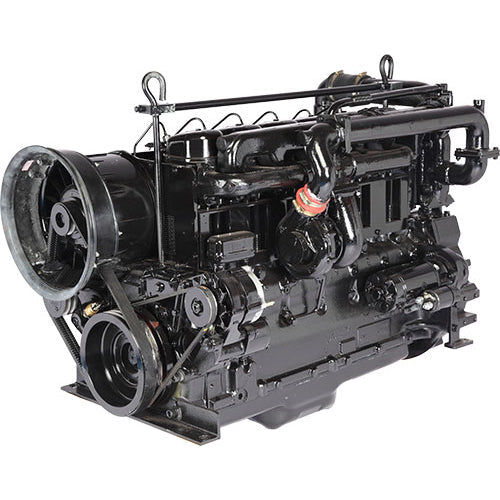
Quick answer: Before you compare engine brands, get the duty rating right: Standby (backup only, capped hours, no overload), Prime (unlimited hours, handles varying loads, small overload allowance) or Continuous (constant, steady load, no overload). Getting this wrong — in either direction — costs you more than any brand choice will. Once the rating's settled, brand comes down to service network, parts availability and application fit, not a single "best" answer.
In 30 seconds
- Duty rating first, brand second: a correctly-rated "second-tier" engine will outlast a premium engine that's rated wrong for the job.
- Three ratings, one standard: Standby, Prime and Continuous are internationally defined under ISO 8528-1 — they're not marketing terms.
- Under-rating voids warranties and shortens engine life — running a standby-rated engine like a prime unit is the single most common costly mistake.
- No engine brand is universally "best" — the right choice depends on application, service network access, and total cost of ownership, not badge prestige.
- The prime/continuous line isn't as crisp as it looks: some manufacturers publish a continuous rating lower in kW than the same unit's prime rating — always check the actual data sheet, not just the standard.
Standby vs Prime vs Continuous — the decision that actually matters
These three ratings are defined under ISO 8528-1, the international standard for reciprocating engine-driven generating sets — they're not just marketing language, and getting them right matters more to your outcome than which brand badge is on the engine.
Standby (Emergency Standby Power): for backup only. Capped at a maximum of 500 hours of operation per year, at an average load of no more than around 70% of nameplate rating, with no overload allowance built in. This is the rating for a generator that sits ready and only runs during an outage — hospitals, telecom towers, commercial buildings with intermittent grid loss.
Prime Power: for unlimited running hours at a varying load, averaging around 70% of the prime rating, with a 10% overload allowance permitted for emergencies (typically capped at one hour in any 12-hour period, and a maximum number of hours per year). This is the rating for a generator that's the primary power source some or all of the time — construction sites, rental fleets, off-grid or islanded systems.
Continuous (Baseload): for constant, unchanging load, 100% of the time, with no overload capability at all. This suits industrial processes and baseload applications — data centres, mining operations, and sites running generation continuously rather than as backup or a varying primary source.
Why the prime-vs-continuous line is blurrier than it looks
Ask around in generator engineering circles and you'll find a genuinely common point of confusion: where exactly does "prime" stop and "continuous" start? It isn't just about the load percentage — it also depends on running hours per year, whether those hours are continuous or intermittent, and how a given manufacturer chooses to define its own model range. Adding to the confusion, some manufacturers publish a continuous rating that's actually lower in kW than their prime rating for the same physical genset, which looks backwards until you understand why: continuous duty demands 100% load with zero overload margin, indefinitely, so the manufacturer derates the same hardware to a figure it can guarantee forever, rather than the figure it can guarantee for a defined prime duty cycle. ISO 8528-1 sets the framework, but it doesn't hand every manufacturer an identical number — always read the specific genset's data sheet rather than assuming the standard alone tells you the exact kW figure.
Converting between prime and continuous — there's no fixed formula
A question that comes up often: if you need, say, a 40kVA continuous-rated generator, what's the equivalent prime rating? There isn't a universal conversion that applies across brands. A commonly cited rule of thumb among generator engineers is that a prime rating typically runs somewhat lower than the same unit's standby rating — sometimes quoted at roughly 10–15% less — but this is a rough industry convention, not a fixed standard, and it varies by manufacturer and model. The only reliable approach is checking the specific engine and alternator combination's published data sheet for all three ratings side by side, rather than converting one rating into another using a rule of thumb built for a different unit.
What actually goes wrong when the rating's wrong
Buy a standby-rated set and run it like a prime unit — regular hours, high average load — and you're heading for premature wear, more frequent servicing, a voided warranty, and eventually an expensive early replacement. Go the other way and over-spec a continuous-rated unit for occasional backup duty, and you've spent considerably more capital than the job needed, on a unit that will spend most of its life sitting idle anyway. Neither mistake is about the engine brand — both come from matching the rating to how the generator will actually be used, which is a conversation worth having before brand ever comes up.
Worked example: a site running 10 hours a day, 6 days a week
Say a manufacturing site wants a generator to cover a known daily grid outage window — 10 hours a day, 6 days a week, at a fairly consistent load. That's roughly 3,100 hours a year. A standby-rated unit is capped at 500 hours a year by definition — running it this way isn't a grey area, it's outside the rating entirely, and the manufacturer's warranty almost certainly won't cover the resulting wear. This site needs a prime-rated generator, not a standby one, even though the load itself might look modest on paper. Conversely, if that same site only loses grid power for a few hours during the occasional storm, a prime-rated unit would be genuine overkill — correctly-specified standby power would do the job for meaningfully less capital. The lesson either way: the rating decision is about how the generator will actually be used, not how big the load is.
What actually differentiates engine brands
Once the rating's settled, brand comparison is genuinely useful — but the honest answer isn't a ranked "best to worst" list. It comes down to matching the brand's real strengths to your application and location:
- Service network and parts access: the best engine in the world is a liability if a breakdown means waiting weeks for a part. This matters more in regional and remote Australian sites than almost any other factor.
- Application fit: compact, fuel-efficient engines suit farms, rural properties and off-grid backup. Industrial and commercial standby applications generally favour engines built around strong load acceptance and stable output under changing loads. Heavy-duty continuous or mission-critical applications (mining, major infrastructure) tend to favour manufacturers with the deepest lifecycle service and support commitments.
- Total cost of ownership, not sticker price: fuel efficiency, service intervals, and parts pricing over five-plus years of operation usually matter more than the upfront purchase price difference between brands.
Broadly, and without pretending this is a precise ranking: Kubota-powered sets are commonly chosen for compact, fuel-efficient backup on farms and rural properties. Cummins-powered sets are a common choice for industrial and commercial standby applications where load acceptance and a strong national support network matter. Perkins-powered sets span a wide range from small to large and are valued for dependable performance with solid Australian parts supply. All three have a genuine track record across Australian industry — the right one depends on your specific application and who can service it locally, not which name is best known.
It's also worth being honest about what field experience actually shows: in trade and owner-operator discussions comparing these brands across generators, tractors and heavy equipment, the recurring theme isn't which badge wins — it's that properly maintained engines from any of the major manufacturers rack up tens of thousands of trouble-free hours, while poorly maintained or incorrectly sized examples of any brand fail early. Badge loyalty gets debated constantly online; almost nobody with genuine field experience claims one of these mainstream brands is simply unreliable. Correct sizing (see above) and a proper maintenance schedule consistently matter more to real-world outcomes than which of these names is on the block.
Where our range fits
Through our relationship with Welling & Crossley — Australia's longest-established diesel generator and engine specialist, tailoring gensets since 1926 — we have commercial access to a broader engine range than what's currently listed on our site, including Lister Petter, Cummins, Kubota, Perkins, HD Hyundai and Kirloskar options. Lister Petter has a long-standing reputation built specifically around engine longevity and parts availability. Kirloskar is a high-volume manufacturer with a strong track record in its core markets, and increasingly used in cost-conscious generator builds internationally. If you're still working out what capacity you need before the engine and duty rating conversation, start with our generator sizing guide. Once you've settled on the generator itself, it still needs to be connected safely — our changeover switch guide covers what that involves and why it's not a DIY step. If you're specifying a generator and want to talk through which engine and duty rating actually fits your application — not just which one we'd rather sell you — get in touch and we'll talk it through properly.
Frequently asked questions
What's the difference between a standby and a prime generator?
Standby is for backup only — capped at 500 hours a year with no overload allowance. Prime is for unlimited running hours at a varying load, with a small overload allowance for emergencies. Running a standby-rated unit like a prime one is the most common costly mistake we see.
Where exactly is the line between prime and continuous rated?
It's not a single clean cut-off — it depends on running hours, load consistency, and how the specific manufacturer defines its range, and some manufacturers publish a continuous rating lower in kW than their prime rating for the same unit. Always check the specific genset's data sheet rather than assuming the general standard alone gives you an exact number.
Can I convert a continuous kVA rating into an equivalent prime rating?
Not with a fixed formula. Prime ratings commonly run somewhat lower than a unit's standby rating — sometimes quoted around 10–15% — but this is a rough industry rule of thumb, not a standard, and it varies by manufacturer. Check the actual data sheet for your specific engine and alternator combination.
Can I run a standby generator all the time?
No. Standby units are only rated for a maximum of around 500 hours a year and aren't built for sustained duty — doing so risks premature wear and will typically void the manufacturer's warranty.
What's the best generator engine brand?
There isn't a single "best" — the right choice depends on your application, site location and which brand's local service and parts network you can actually rely on. Field experience across the trade consistently shows correct sizing and maintenance matter more to reliability than which of the major brands you choose.
Is Cummins better than Perkins?
Not universally — both have a strong Australian track record. Perkins is often chosen for dependable performance across small to large ranges with solid local parts supply; Cummins is a common choice for industrial and commercial standby applications with strong load acceptance and national support.
What does "prime power" actually mean?
It means the generator is rated to run for unlimited hours as the primary power source at a varying load, with a small overload allowance for occasional emergencies — as distinct from a standby set, which is for backup only.
Do continuous-rated generators cost more?
Generally yes for the same electrical output, since they're built to run at full, steady load indefinitely with no overload margin. Don't buy a continuous-rated unit for occasional backup duty — you'll be paying for capability you don't need.
Duty rating definitions in this guide follow ISO 8528-1 as summarised in published manufacturer technical literature as at August 2026 — individual OEMs may apply these more conservatively, so always check the specific unit's data sheet. The prime/continuous distinction and conversion questions above reflect genuine, recurring points of confusion raised in generator engineering and owner-operator forum discussions (including Mike Holt's Electrical Forum and trade equipment forums), not questions we invented ourselves. Brand positioning reflects general industry reputation, application fit and field-reported maintenance experience, not a ranked endorsement.