


(Taken from this post by Beaver Brands. Republished with permission. Edited for point of view and relevance.)
As a guide only, the process of choosing the right coveralls starts with answering various questions about contaminants (hazardous or not) and work environments. Many factors can lead to different coveralls for the same application or job.
Beaver Brands recommends considering these factors and steps to wisely choose your protective coveralls.
Step 1: Conduct a detailed assessment of the work environment and the nature of the hazards, including consideration of the following:
- Physical state of contaminant
- Form of contaminant (chemical concentration/particle size)
- Type of exposure
- Working environment (temperature, humidity)
- What kind of job is going to be performed
- What other personal protective equipment (PPE) will be used with the coverall
- Additional risks (eg. electrostatic charge, infective agents, nuclear particles)
Step 2: Determine the degree of exposure and minimum levels of protection needed.
Based on the level of protection they provide, disposable coveralls are classified into six categories:

Step 3: Assess hazard toxicity and short-term and long-term exposure.
Consider if the protective coveralls have been tested against a given hazard and how they performed.
Also refer to permeation data of the coveralls, which means that the coveralls were tested against a specific hazard/toxic substance. Not all coveralls are the same, even if they are the same “type”.
It is all about how they perform against a given hazard or chemical substance.
Step 4: Consider the comfort of the wearer.
Most Type 5/6 protective coveralls are made from either Spunbond Meltblown Spunbond (SMS) fabric or microporous material, and although they both offer the same protection level, selection may differ in terms of comfort, breathability and even application.
For example, SMS fabric is generally more breathable than other coverall fabrics and may be more suitable in hotter environments. MP, or microporous laminated coveralls, on the other hand, may provide a more suitable barrier against liquid splashes as it offers higher tensile strength and a more effective liquid barrier as a result.
Step 5: Ensure wearers are provide with proper training on how to don, adjust and remove protective coveralls.
Step 6: Fit-test. All PPE should be fit tested for size and effectiveness in protecting the wearer.
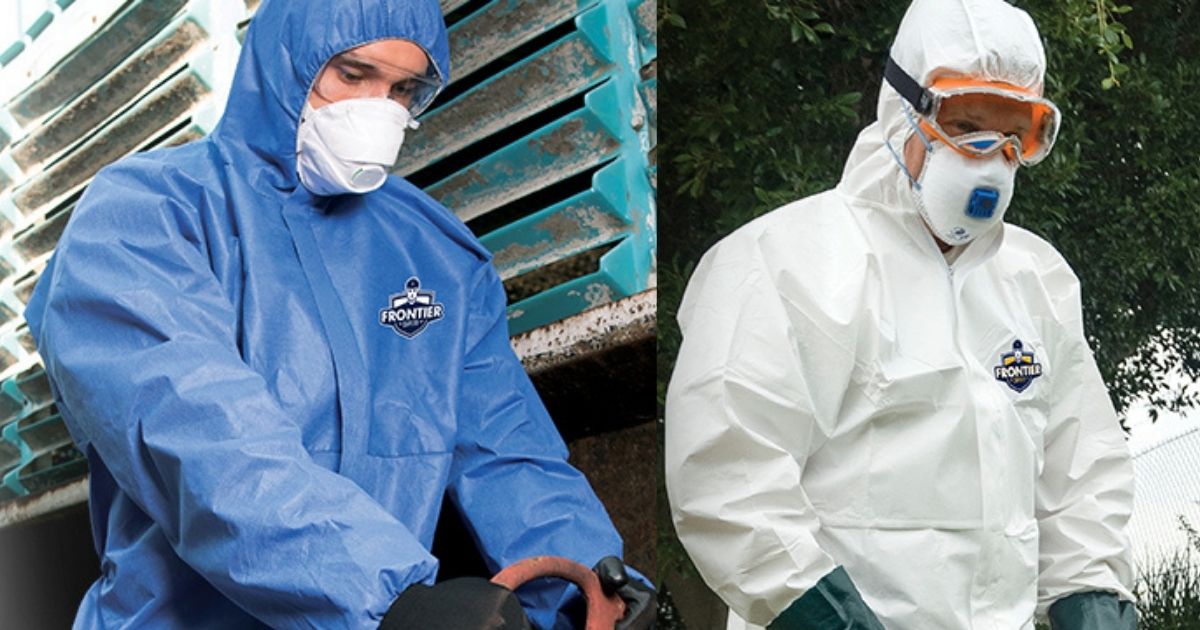
Frontier Protective Disposable Coveralls Range
Frontier coveralls have recently been re-designed with improved comfort and durability in mind. The range consists of SPP (polypropylene) for non-hazardous applications, SMS, and Microporous coveralls in varying degrees of protection up to Type 4/5/6, and with coloured options available in the Frontier SMS Type 5/6 Coveralls.
Other features of the Frontier Type 4/5/6 and Type 5/6 Coveralls include two-way zippers and protective flaps for added protection; low linting fabric (for microporous only); as well as comfortable elasticised wrists, ankles, and waists.
Important: If in doubt, consider discussing your protection requirements with a safety expert prior to purchasing disposable coveralls, as statutory and/or regulatory requirements may apply in your workplace or line of work.
AIMS' Note on Buying PPE and Workwear
- Hazard assessment: Identify the specific hazards you will likely be facing in your work environment. Consider potential risks such as chemical exposure, falling objects, loud noises, electrical hazards or biohazards. This assessment will guide you in selecting the appropriate PPE for the job.
- Appropriate materials: Different materials offer various protective qualities. Consider flame-resistant (FR) materials for fire hazards, chemical-resistant fabrics for handling hazardous liquids and high-visibility options for work in low-light environments.
- Compliance to occupational safety standards: Opt for PPE that meets the pertinent Australia Standard (AS), although some brands -- especially imports -- will have other compliance markings such as ANSI, OSHA, ANSI, NIOSH, oSA etc. Look for certifications on the product label to ensure the equipment has undergone rigorous testing.
- Proper fit and comfort: Proper fit is crucial for both comfort, dexterity and protection. Ill-fitting clothing can snag on machinery or restrict movement, potentially creating additional hazards. Choose sizes that allow for layering in cold weather without being overly bulky and consider adjustable options for items like hard hats or respirators.
- Maintenance and replacement: Inspect PPE before each use for signs of wear, tear or damage. Follow (and factor in) the manufacturer's instructions for cleaning and storage. Some materials may require specialised laundering, while others can be machine-washed. Check for durability to ensure the clothing can withstand frequent use and cleaning. Replace damaged or expired PPE immediately to guarantee your safety.
- Training: Ensure you and any employees understand how to properly use, wear, adjust, maintain and store PPE and workwear. Improper use can negate its protective benefits.


Need to pick the right hard hat for an Australian work site? Our Hard Hat Guide covers colours, classes and standards.
People Also Ask — Choosing Coveralls and Protective Clothing
Q: What is the Australian standard for coveralls and protective clothing?
Protective clothing in Australia is primarily governed by AS/NZS 4501 (Occupational protective clothing), which covers general performance requirements and test methods for protective garments. Specific hazard categories have their own standards: AS/NZS 1269 (hearing protection — for noise), AS/NZS 1891 (fall arrest), AS/NZS 2211 for welding protective clothing, and the IEC 61482-1-2 arc flash standard for high-voltage electrical work. For chemical-resistant coveralls, AS 3765 and the relevant European EN standards (often cited on product datasheets) define performance levels. Always check that the coverall selected is rated for the specific hazard present.
Q: What is the difference between Type 4, Type 5, and Type 6 chemical coveralls?
Chemical protective coveralls are classified by their liquid and spray barrier performance under European EN 13982 and equivalent standards used in Australia: Type 4 provides protection against liquid chemical jets (spray-tight); Type 5 provides protection against airborne solid particles (particle-tight); Type 6 provides limited protection against light liquid spray and mist (spray-resistant, lower level than Type 4). For handling fine powders, dusts, or dry chemicals, Type 5 is the appropriate choice. For work near chemical spray, jets, or splashes, Type 4 or Type 4/5 dual-rated coveralls are standard. Type 6 is suitable for incidental or light splash exposure only.
Q: When are FR (flame-resistant) or anti-static coveralls required in industry?
Flame-resistant (FR) coveralls are required wherever there is a risk of fire, flash fire, or electric arc ignition — including chemical plant operations, oil and gas facilities, welding and hot work environments, and areas with flammable atmospheres. Australian and New Zealand compliance follows AS/NZS 4602.1 (FR protective clothing) and AS/NZS 1716 for respiratory protection in fire environments. Anti-static garments (meeting EN 1149-5 or AS/NZS requirements) are required in ATEX/explosive atmosphere zones classified under AS/NZS 60079 to prevent static discharge igniting flammable vapours or dust. Check your site HAZOP and area classification documentation.
Q: How do I choose the correct coverall size for fit and mobility?
Coveralls must fit to allow full range of movement without excess material that can catch on machinery or equipment. The key measurements are: chest circumference, waist, hip, inside leg, and height. Most coverall manufacturers provide a size chart correlating these measurements to their sizing (S, M, L, XL, XXL, XXXL, and tall variants). A properly fitted coverall allows arms to be raised above the head without the body of the suit lifting; shoulders should sit correctly without restricting arm movement; and knees should bend without the fabric pulling tight. Trial fit in the coverall before committing to bulk purchase if possible.
Q: Can disposable coveralls be reused, and how should they be disposed of?
Disposable coveralls (e.g., Tyvek-style polypropylene) are designed for single use where contamination prevents safe reuse. If the coverall has been exposed to chemical contamination, asbestos, or biological hazards, it must be removed in the correct doffing sequence, bagged, and disposed of as contaminated waste per the applicable environmental and WHS regulations — do not simply bin it in general waste. Some lightweight disposable coveralls can be reused for non-hazardous applications such as clean-room painting, but the manufacturer's guidance should confirm the garment's protective performance is not compromised by a single wearing. Document disposal of contaminated PPE.
