

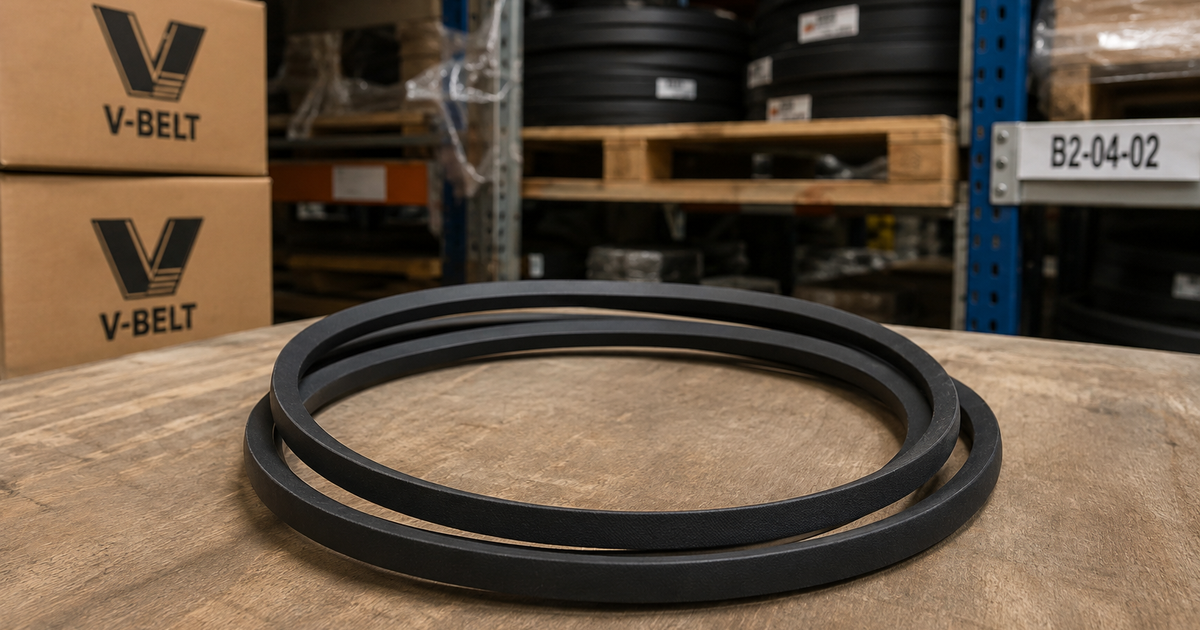
Belts don't fail only on the drive. They fail in the storeroom too — slowly, invisibly, until you fit one and it cracks in a week. Heat, ozone, humidity, sunlight, and bad hanging habits all chip away at rubber and tensile cords long before installation. Get storage right and a quality belt will sit on the shelf for years and run for years more.
Quick Reference — Belt Storage Conditions
The fast version. Hold to these and you'll get the manufacturer's full shelf life out of every belt on your rack.
| Parameter | Ideal range | Why it matters |
|---|---|---|
| Temperature | 10–25°C (max 29°C) | Heat accelerates rubber aging. Above 29°C, shelf life roughly halves for every 15°F (~8°C) rise. |
| Relative humidity | 50–70% RH | Above 70% promotes mould/mildew; below ~40% accelerates rubber drying and cracking. |
| Light | No direct sunlight or UV | UV degrades rubber and polyurethane. Sun through a workshop window is enough to damage exposed belts. |
| Ozone | Away from motors, welders, ozone generators | Ozone is the single fastest rubber aging accelerator. Causes surface cracking on flex points. |
| Position | Hung straight on wide pegs OR laid flat | No kinks, no folds, no compression. Bent storage deforms the tensile cord and prints a memory the belt won't shake off. |
| Stock rotation | FIFO (first in, first out) | Belts have a real shelf life. Rotate by date code so the oldest stock fits first. |
Why Storage Matters
A new V-belt or synchronous belt is a precision-engineered composite — rubber compound, tensile cords (polyester, aramid, or steel), fabric jacket, and on synchronous belts, polyurethane teeth. Every one of those materials degrades when stored wrong.
The failure modes you'll see in a poorly stored stock:
- Surface cracking — ozone and UV attack on the belt back. Hairline cracks turn into chunks under flex.
- Rubber hardening — heat exposure cures the rubber further until it loses flexibility. The belt rides high in the groove and slips.
- Mildew and mould — high humidity. Cosmetic on rubber, but on fabric-jacketed belts it weakens the jacket.
- Tensile cord damage — folding, kinking, or coiling tighter than the minimum bend radius. Cords break in invisible spots; the belt fails under load.
- Deformation memory — long-term storage under tension or compressed under stacked stock. The belt runs untrue, vibrates, and wears the pulleys.
- Tooth shear (synchronous belts) — UV degradation of polyurethane plus deformation. Teeth shear off during start-up.
None of this shows up in a casual visual check. A belt that's been stored badly for two years will look fine until you fit it.
Temperature
The Gates Industrial Power Transmission Preventive Maintenance + Safety guide gives the cleanest published figures, and they're consistent with what Optibelt, Continental, and Carlisle publish. Cited in many manufacturer manuals:.
- Ideal: 10–25°C. A normal climate-controlled warehouse or store room.
- Acceptable: up to 29°C (85°F). Beyond this, the manufacturer-rated shelf life starts to drop.
- Marginal: 29–46°C. Shelf life roughly halves for every 8°C above 29°C. A belt rated for 5 years at 25°C will be down to ~2.5 years at 33°C, ~1.25 years at 41°C.
- Do not store: above 46°C (115°F). Cured rubber starts permanent degradation.
Australian context: a colorbond shed in Mt Isa, Karratha or the Pilbara summer easily sits above 40°C internal temperature. Spare belts kept on a top shelf in that environment will not last their rated life. Ground-floor, internal-wall, climate-buffered storage is the difference between a 5-year belt and an 18-month belt.
Humidity
Belts tolerate a wider humidity band than temperature, but both extremes cause problems.
- Ideal: 50–70% RH.
- Too dry (below ~40% RH): rubber loses plasticisers over time, becomes brittle. Risk in Mt Isa, Kalgoorlie, dry inland depots.
- Too humid (above 70% RH): fungus and mildew form on the belt surface. Mostly cosmetic on rubber, but fabric jackets weaken and adhesives can be affected. Risk in Cairns, Darwin, coastal NQ.
If you store belts in a humid coastal warehouse, a sealed plastic tote with silica gel desiccant is cheap insurance for long-shelf-life items.
UV & Light
Ultraviolet light breaks down rubber polymer chains. The damage is cumulative and invisible until cracking starts.
- Worst: direct sunlight. A belt sitting in afternoon sun through a window can degrade visibly in 6–12 months.
- Bad: fluorescent and some LED tubes emit low-level UV. Long-term ambient lighting on a brightly lit rack still accumulates damage.
- Acceptable: dim or shaded storage. Original cardboard packaging is genuinely protective — keep belts in their boxes or bags until they're needed.
Polyurethane synchronous belts (Gates Poly Chain GT Carbon and similar) are more UV-sensitive than rubber V-belts. Treat them as light-sensitive stock.
Ozone
Red flag. Ozone is the fastest rubber aging accelerator there is. A few ppm of ozone in a closed room will visibly crack belt rubber within months, even with everything else right.
Sources of ozone in industrial workshops:
- Electric motors and generators — brush arcing produces ozone. A motor room with poor ventilation is one of the worst places to store belts.
- Arc welders — both stick and MIG welding generate ozone.
- Photocopiers and laser printers — small but constant ozone source.
- Ozone generators — used in some cleaning, food, and water treatment processes.
- High-voltage switchgear, transformers — corona discharge.
Practical fix: separate belt storage from electrical and welding areas. A dedicated cool, dark cupboard on an external office wall is dramatically better than a top shelf in the workshop. If you have to share space, ventilation that exchanges air rather than recirculating it helps.
Operating belt-driven equipment in hazardous-area environments raises related concerns — see our FAQ on electric motors in hazardous areas.
Storage Position
How you hang or stack the belt matters as much as the room it's in. Tensile cords have a permanent memory — bend a belt sharply on a small peg for six months and it'll never run true again.
| Method | Use it? | Notes |
|---|---|---|
| Hung on a wide peg or "saddle" | Yes — preferred for V-belts | Peg diameter must be at least the minimum recommended pulley diameter for that belt. Wider is better. A narrow nail is worse than laying the belt flat. |
| Laid flat on a shelf | Yes — preferred for synchronous and variable-speed belts | One belt deep ideally. Don't stack heavy items on top. |
| Nested (synchronous belts up to ~3000 mm) | Yes — manufacturer-recommended for shipping and shelf storage | Lay one belt on its side on a flat surface, nest smaller belts inside. Stack nests up to 8 high if needed. |
| Coiled (V-belts only, large sizes) | Sparingly | Coil to the natural bend direction. Coil diameter must be no smaller than minimum recommended pulley diameter for that belt. See the coiling table below. |
| Folded or kinked | Never | Permanently damages the tensile cord. Bin the belt. |
 Tied with rope or wire |
Never | Bites into the cord at the tie point. Common storeroom shortcut, always wrong. |
| Stacked on the floor | Never | Water leaks, foot traffic, forklift damage, dust ingress, compressed bottom belts. |
| Under tension on a machine in storage | Never (long term) | If equipment is stored more than 6 months, relax belt tension or remove the belts. |
Bend Radius & Coiling
Every belt has a minimum bend radius — the tightest circle it can be bent around without damaging the tensile cord. As a rule of thumb, the minimum bend radius equals the minimum recommended pulley diameter for that belt section.
For V-belts being stored on pegs or coiled:
- Z/SPZ section: minimum bend ~63 mm diameter
- A/SPA section: minimum bend ~80 mm diameter
- B/SPB section: minimum bend ~125 mm diameter
- C/SPC section: minimum bend ~200 mm diameter
- D section: minimum bend ~315 mm diameter
If you coil a V-belt for storage, coil it in the natural bend direction (the way it ran on the drive). One coil produces three loops; two coils produces five loops; and so on. Coiled belt diameter must stay above the minimum bend.
For synchronous belts: coiling is generally not recommended for belts under 3000 mm. Longer belts can be rolled for shipping, but the bend radius must stay above the minimum recommended pulley size. Use a cardboard tube of the right diameter at the bend point if the roll has to be tight.
Shelf Life
Properly stored, belts have a real shelf life — but it's longer than most people assume.
| Belt type | Typical shelf life (at 25°C, 50–70% RH, dark) |
|---|---|
| Classical V-belt (A, B, C, D) | ~6 years |
| Narrow wedge V-belt (SPZ, SPA, SPB, SPC) | ~5–6 years |
| Cogged / raw-edge V-belt | ~5 years |
| Banded (joined) V-belt | ~5 years |
| Variable-speed belt | ~3–4 years (more storage-sensitive) |
| Synchronous timing belt (rubber) | ~5–7 years |
| Polyurethane synchronous belt (Poly Chain, etc.) | ~7–10 years |
| FRAS belts | ~5 years (don't compromise the FRAS rating with bad storage) — see our FRAS belt FAQ |
Above 29°C, halve those figures for every ~8°C of additional temperature.
Rotate stock FIFO (first in, first out). The simplest system is a date label on each box at receipt — when you pull a belt to fit, take the oldest dated one first.
Date Code Decoding
Most premium belts carry a date code printed on the back or the inside of the belt. Decoding it tells you what's been sitting in stock the longest.
| Brand | Date code pattern | Example & reading |
|---|---|---|
| Gates | 4 digits: day of year (1–365) + last digit of year. May appear with a preceding letter for plant code. |
1547 = day 154 of a year ending in 7 (i.e. 3 June 2017 or 2027 — confirm from context) |
| Optibelt | 2-digit week + 2-digit year (week/year). |
2624 = week 26 of 2024 |
| Continental ContiTech | Variable — often week/year or Julian + year. | — |
| Carlisle / Timken Belts | Variable batch code. | — |
If the code is illegible, treat the belt as undated and rotate it out next. If a belt has no code at all and came from an unknown supplier, treat with caution — date codes are a quality signal.
Pre-Installation Inspection
Before you fit a belt from stock, run a one-minute visual and tactile check. The Gold Standard checklist:
- Date code — within shelf life? If borderline, use it on a low-load drive first rather than a critical one.
- Belt back — any surface cracks, crazing, or hairline cracking? That's ozone or UV damage. Bin the belt.
- Sidewalls (V-belts) — clean, intact, no fraying or fabric exposure? Wedge section should be square.
- Teeth (synchronous belts) — full, undamaged, no shear lines at the base of teeth.
- Tensile cord — no visible cord at the surface, no kinks, no folded creases.
- Smell — fresh rubber smell good; sour, chemical, or musty smells = contamination or mould.
- Flexibility — bend the belt to its normal running curve. Should flex smoothly without crackling or stiffness.
- Length and section match — verify against the part number on the box and the belt's printed code. Numbers must match exactly.
If anything's off, set the belt aside and pick another. The cost of a replacement belt is less than the cost of an unplanned shutdown a week after install. For diagnosing belts that have failed in service, see our V-belt problems and solutions guide.
Handling Don'ts
Storeroom habits that quietly ruin belts:
- Don't drag belts across the floor. Picks up grit, oils, and scuff damage on the back.
- Don't drop boxes from height. Sudden impact can fracture aramid or steel cords in heavy belts.
- Don't use belts as straps — to tie loads, hold doors, lift gear. Common in shed culture; always wrong.
- Don't expose to oils, solvents, fuels, adhesives, acids, alkalis. Any of these soften or chemically attack the rubber. Even brief contact during handling can leave a soft spot.
- Don't store with sharp tools or fasteners loose in the same bin. Cuts and punctures are killers.
- Don't pack tight in cartons. Belts compress and deform under load. Original packaging is sized to avoid this.
- Don't write on belts with permanent marker or paint pen. Solvents in the ink may locally degrade the rubber. Mark the box, not the belt.
Returning Belts to Stock
A belt that's been pulled out of stock, taken to the job, then not used — can it go back on the shelf?
- Yes, if: still in original packaging, undamaged, no signs of stress, contamination, or sunlight exposure during the trip.
- No, if: it's been fitted to a pulley (even briefly), tensioned, contaminated with oil/grease/solvent, dropped, kinked, or left in direct sun in a vehicle.
- Never: a used belt. Even if a belt was on a machine for an hour, the tensile cord has been load-cycled. It's no longer new stock.
When in doubt, label it "field-returned, second pick" and use it on a non-critical drive before reaching for a fresh belt.
Setting Up a Belt Store
A workshop belt store doesn't need to be elaborate, but the geometry pays off. The minimum useful setup:
- Location: internal wall, away from workshop heat and welding. Office side of a partition is ideal. Climate-buffered, dim, draft-free.
- Storage racks: wide pegs (50 mm+ diameter for medium belts, 100 mm+ for large) or shelving with belt-sized compartments. No nails, no thin rods.
- Original packaging on shelves: store synchronous and variable-speed belts flat in their original boxes.
- FIFO bins for fasteners on the same rack: oldest stock at the front, newest behind. Same principle applies to belts.
- Ventilation: air exchange with the outside (or a non-motor part of the building) keeps ozone levels low.
- Temperature monitoring: a min/max thermometer in the belt store is a $20 item that tells you whether your storage is doing its job.
- Lighting: dim and shielded. LED downlights are fine if not directly on the belts.
- Inventory list with date codes: simple spreadsheet or even a clipboard on the door. Track what's there, what's oldest, what needs ordering.
For matching belts to the right drive, check our V-belt size chart and the how to measure a V-belt guide before ordering.
AIMS' Note on Belt Procurement
The other side of storage strategy is procurement strategy. Some thoughts from our side of the counter:
- Stock what fails fast, JIT what fails slow. If a belt drives critical production and a 24-hour delay costs you thousands, keep two spares. If it's a low-load drive on a non-critical machine, order on demand.
- Standardise where you can. Fewer belt section types across your fleet = simpler storage = lower obsolescence risk. Talk to maintenance about consolidating to common sections at the next drive redesign.
- Buy from a stocking distributor. AIMS holds Gates, Optibelt, and other premium belt brands in Sydney. Same-week delivery across most of Australia means you can hold less and rotate faster.
- Don't cheap out. A no-name belt at 40% of the price of a Gates Predator will rarely give 40% of the service life. The total cost of a premature belt failure — downtime, labour to refit, potential damage — dwarfs the saving.
- Review stockholding annually. Date-coded belts older than half their rated shelf life should either be used or written off. Ageing stock is wasted shelf space.
Browse our full range: all power transmission belts, industrial V-belts, synchronous/timing belts, banded V-belts, pulleys, and drive accessories. Gates is our flagship brand — see the full Gates power transmission range.
Choosing between belt and chain drives for a new install? Our Belt vs Chain Drives comparison walks the trade-offs across efficiency, torque, environment and lifecycle cost.
Storing ride-on mower belts off-season? The same temperature, humidity and bend-radius rules apply — see our Ride-On Mower Belt Guide for the mower-specific notes.
Frequently Asked Questions
How long can I store a V-belt before it goes off?
Stored properly (cool, dry, dark, no ozone, no kinks), a classical V-belt has a shelf life of around 6 years and a narrow wedge V-belt around 5–6 years. Above 29°C the shelf life roughly halves for every 8°C of additional temperature, so a belt sitting in a 40°C shed might only last 2 years on the rack.
What's the ideal temperature for belt storage?
10–25°C is ideal. Up to 29°C is acceptable. Storage above 46°C is not recommended at all — the rubber starts to undergo permanent degradation.
Can I store belts in a shipping container or shed?
Only if internal temperatures stay below 29°C. In most of Australia, an uninsulated shed or container hits 40°C+ in summer. Either insulate and ventilate the space, or move the belt store inside an office or climate-buffered area.
How does humidity affect belts?
Above 70% RH, mould and mildew form on belt surfaces — mostly cosmetic on rubber, but it weakens fabric jackets. Below 40% RH, rubber slowly dries out and loses flexibility. Aim for 50–70% RH.
Why is ozone such a big deal?
Ozone attacks rubber polymer chains at a molecular level, causing visible cracking on flex points. Electric motors, arc welders, photocopiers, and high-voltage gear all generate ozone in small quantities. In a confined motor room with poor ventilation, the concentration is enough to age belts noticeably within months. Keep belt storage separate from electrical and welding areas.
Can I hang belts on a nail?
No. The nail bends the belt around too small a radius, deforming the tensile cord. Use a wide peg or "saddle" — diameter equal to or larger than the minimum recommended pulley diameter for that belt section.
Can I coil a V-belt for storage?
Yes, sparingly, and only V-belts. Coil in the natural bend direction (the way it ran). Coil diameter must stay above the minimum recommended pulley diameter for that belt section. Synchronous belts under 3000 mm should not be coiled — store them nested flat or laid on a shelf.

How do I read a Gates belt date code?
Gates date codes are typically a 4-digit number on the back of the belt: the first three digits are the day of the year (1–365) and the fourth digit is the last digit of the year. So 1547 could mean day 154 of a year ending in 7 — confirm the decade from invoice or supplier context.
What's FIFO and why does it matter for belts?
FIFO is "first in, first out" — use the oldest stock first. Belts have a real shelf life, so a belt sitting at the back of the rack for 4 years is closer to end-of-life than the new arrival behind it. Date-label every box at receipt and pull from the oldest end.
Can I store belts under tension on a machine that's not running?
Not long term. If equipment is shelved for more than 6 months, either relax belt tension or remove the belts entirely and store them on the shelf. Belts under load develop deformation memory and run untrue when the machine restarts.
What's the difference between storage life of a rubber V-belt and a polyurethane synchronous belt?
Polyurethane synchronous belts (Gates Poly Chain GT Carbon, etc.) typically have a longer shelf life — 7–10 years — than rubber V-belts (5–6 years). But polyurethane is more UV-sensitive, so they need genuinely dark storage to hit that figure.
Are FRAS belts more storage-sensitive than standard belts?
Not significantly more sensitive in storage, but poor storage that damages the rubber can compromise the FRAS (fire-resistant anti-static) rating. If a FRAS belt has been heat-aged or UV-degraded, don't trust the FRAS performance for a hazardous-area drive. More on FRAS belts here.
Can I return a belt to stock if it was taken out but not fitted?
Yes, if it's still in the original packaging, undamaged, and hasn't been exposed to sun, oil, or heat during the trip. No, if it's been on a pulley even briefly, tensioned, contaminated, or kinked. Mark field-returned belts with a sticker and use them on non-critical drives first.
What's the worst place I could store belts?
An uninsulated tin shed in summer, on a top shelf under a skylight, next to the workshop's main electric motor, on a thin nail. That combination ticks every accelerator: heat, UV, ozone, deformation. Avoid all four.
How much stock should I hold of each belt?
Depends on criticality and lead time. For a critical drive with 24-hour lead time and high downtime cost, hold 1–2 spares. For non-critical drives with same-week supply from a stocking distributor, hold zero or order on demand. Review annually — ageing stock is wasted shelf space, and a date-coded belt past half its shelf life should be used or written off.
Can I store belts outdoors under cover?
No. Even under cover, outdoor storage exposes belts to wide temperature swings, humidity extremes, UV-reflected light, and potential moisture. Belt storage belongs indoors, climate-buffered, and away from sun.
People Also Ask — V-Belt Storage and Handling
Q: How should V-belts be stored to prevent premature deterioration?
V-belts should be stored in a cool, dry location away from direct sunlight, ozone sources such as electric motors and welding equipment, heat, and solvents. Belts should be kept in their original packaging or hung on proper belt racks without sharp bends, kinks or being coiled too tightly, as deforming the belt cross-section can cause cracking and reduce service life.
Q: What is the maximum recommended storage period for V-belts?
Under correct storage conditions, most manufacturers recommend using V-belts within three to five years of manufacture. The manufacture date is typically encoded in the belt markings. Belts stored beyond this period should be inspected carefully for surface cracking, hardening or tackiness before installation.
Q: Why should V-belts never be rolled or folded for storage?
Folding or tightly coiling a V-belt causes permanent set in the rubber compound and can crack the tension cords running through the belt. Once the internal cords are damaged the belt will exhibit premature fatigue, reduced power transmission capacity, and shortened service life even if the damage is not visible externally.
Q: What is the correct way to install a V-belt without damaging it?
V-belts should always be installed by reducing the centre distance between pulleys until the belt can be seated by hand, never by using a lever or screwdriver to force the belt over the pulley rim. Forcing a belt over a pulley can fracture the tension cords and cause immediate or early failure.
What is the minimum bend radius for coiling a V-belt for storage?
The minimum bend radius equals the minimum recommended pulley diameter for that belt section: roughly 63mm for Z/SPZ, 80mm for A/SPA, 125mm for B/SPB, 200mm for C/SPC, and 315mm for D section. Coil V-belts in the natural bend direction the belt ran on the drive, and never let the coil diameter fall below that minimum -- tighter coiling deforms the tensile cord permanently.
What should I check on a belt before installing it from stock?
Run a one-minute check: confirm the date code is within shelf life, inspect the belt back for surface cracks or crazing, check sidewalls (V-belts) or teeth (synchronous belts) for damage, look for any visible tensile cord or kinks, smell for sour or musty contamination, flex the belt through its normal running curve to check it moves smoothly, and verify the length and section match the part number on the box. If anything's off, set it aside and pick another belt.
What does a properly set-up workshop belt store look like?
An internal wall location away from workshop heat and welding, wide storage pegs (50mm+ for medium belts, 100mm+ for large) or belt-sized shelving rather than nails or thin rods, synchronous and variable-speed belts kept flat in their original boxes, ventilation that exchanges air with the outside to keep ozone levels down, a min/max thermometer to monitor temperature, dim shielded lighting, and an inventory list with date codes so the oldest stock is used first.
What handling mistakes commonly damage belts in the storeroom?
Dragging belts across the floor (picks up grit and scuffs the back), dropping boxes from height (can fracture aramid or steel cords), using belts as makeshift straps, exposing them to oils, solvents, fuels or adhesives, storing them loose with sharp tools or fasteners, packing them tightly in cartons so they compress and deform, and writing on belts with permanent marker or paint pen -- the solvents in the ink can locally degrade the rubber. Mark the box, never the belt.