

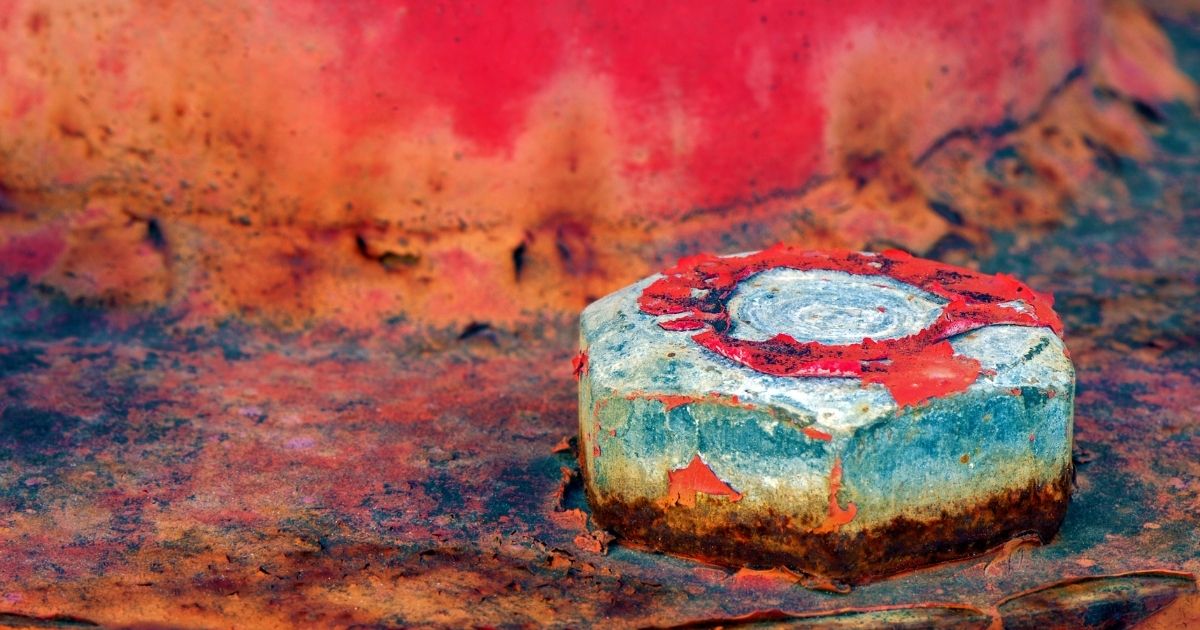
A stuck bolt or seized nut is one of the most frustrating problems on a workbench, vehicle, or piece of plant. Brute force usually makes it worse — snapped bolts, stripped heads, and damaged threads cost more time than the original job. The right approach is a calm escalation ladder: start with the gentlest method that has any chance of working, and only step up when the previous step fails. This guide walks through 11 steps from penetrating oil to weld-nut-on cut-out, with material-specific notes, stripped-head recovery, and how to stop it happening again.
Quick Reference: The Stuck-Bolt Escalation Ladder
| Step | Method | Tool / Product | When to use |
|---|---|---|---|
| 1 | Penetrating oil | CRC 5-56, CRC Brakleen, PB B'laster, Plus Gas | First move on any rusted or seized fastener. |
| 2 | Vibration / shock | Hammer + punch (centre or pin) | Tap the head to break the rust bond before applying torque. |
| 3 | Heat | LPG/MAP/oxy torch, heat gun | Expand the nut to break the seize. Avoid near fuel, brake lines, polymer. |
| 4 | Cold contraction | Freeze release spray (Loctite LB 8040, CRC Freeze) | Shrinks the bolt relative to the nut. Good where heat is unsafe. |
| 5 | Impact | Manual impact driver, air or electric impact wrench | Loosens by shock, not pure torque. Use impact-rated sockets only. |
| 6 | Leverage | Breaker bar, long-handle ratchet, cheater pipe | When torque is the only thing missing — within bolt grade limits. |
| 7 | Bolt extractor | Spiral extractor, screw extractor, locking pliers | Head is rounded, stripped, or partly sheared. |
| 8 | Drill out | Cobalt or carbide drill bits, progressive sizing | Extractor failed, or bolt has snapped flush. |
| 9 | Re-thread | Hand tap matching original thread | Clean and recut the threads once the broken stud is out. |
| 10 | Thread insert | Helicoil or solid thread insert kit | Original threads beyond saving — restore to nominal size. |
| 11 | Cut & weld | Cut-off wheel, MIG welder, replacement nut | Last resort — weld a new nut onto the stub and unwind. |
Work top to bottom. Most stuck bolts are released somewhere between Step 1 and Step 5. Drilling and inserts are not failure — they are repair operations once the fastener can't be saved.
Why Bolts Seize
Understanding the cause narrows the right move.
- Rust and corrosion — moisture between threads forms iron oxide, which has greater volume than steel. The threads physically lock. Penetrating oil and time are the answer.
- Galvanic corrosion — dissimilar metals (steel bolt in aluminium housing, stainless in mild steel) plus moisture form an electrochemical cell. Aluminium engine fittings, marine hardware, and rooftop installations are common sites.
- Galling — stainless on stainless, especially A2/304 and A4/316. Surface oxide layers cold-weld together under load. Once galled, heat won't release it; the fastener has to be cut or drilled.
- Thread locker — anaerobic adhesive (Loctite blue 243, red 271, green 290) hardens between threads. Blue 243 releases at roughly 250°C; red 271 needs around 300°C. [VERIFY: confirm Loctite datasheet temperatures before quoting to customer]
- Cross-threading — the bolt was started off-axis on assembly. Spins free initially, then locks. Backs out the way it went in if caught early.
- Mechanical lock — bent shaft, damaged head, distorted nut. Extraction or cutting is the only path.
- Over-torque on assembly — bolt yielded, threads partially stripped from new. Same removal problem as rust without the time component.
Step 1: Penetrating Oil
The first move on any stuck fastener. A good penetrant uses capillary action to wick between thread surfaces, displace moisture, and loosen the rust bond. Don't confuse general-purpose lubricants like WD-40 with proper penetrants — WD-40 is mainly a water displacer with light oil, not optimised for capillary penetration. Modern dedicated penetrants are dramatically more effective on rusted fasteners.
What AIMS stocks (CRC range, 218 products):
- CRC 5-56 — flagship penetrant, works on rust, displaces moisture, lubricates threads as it frees them.
- CRC Brakleen — solvent cleaner that washes rust scale before penetrant goes on.
- CRC Inox — corrosion inhibitor; good for prevention and as a finishing wipe after the bolt is out.
- Loctite LB 8040 Freeze & Release — penetrating oil with built-in cold-shock chemistry. Useful when heat is unsafe.
- PB B'laster, Plus Gas, Kroil — specialist penetrants well-regarded in trades. AIMS can source on request.
Technique:
- Wire-brush off loose rust and debris around the fastener. Penetrant can't reach what's blocked by scale.
- Apply a generous shot. You want it sitting on the joint where capillary action can pull it in.
- Tap the head firmly with a brass or steel hammer (steady taps, not crushing blows). Vibration helps the oil migrate into the threads.
- Wait. Light surface rust: 5–15 minutes. Moderate rust: 1–2 hours. Severe rust: 24 hours, with several re-applications and tapping cycles.
- Try to undo gently. If it doesn't move, repeat — don't escalate prematurely.
Most fasteners that come free with penetrant alone need TIME more than chemistry. The trades habit of "spray, walk away, come back tomorrow" exists for a reason.
Step 2: Vibration and Shock
A few firm hammer taps directly on the head of the bolt (or on a punch placed in the centre of the head) "convinces" the corroded threads to relax. The shock breaks micro-bonds in the rust layer. Combined with penetrating oil, this is one of the highest-yield steps before any tool change.
- Use a heavy hammer and a hardened punch — short, controlled strikes.
- For seized exhaust manifold bolts (a common Australian ute job), a few taps with a bolster hammer often beats reaching for the impact gun.
- Tap, then re-apply penetrant, then wait. The micro-cracks open new capillary paths.
- Don't pound a thin-walled casting. Use a softer hammer or back the work with a bolster.
- For a more aggressive variant: place a hardened punch (centre or pin) into the head of the bolt at a counter-clockwise angle and strike firmly with a hammer. The combined impact plus rotational bias often jars the bolt loose where pure torque has failed. Effective on Phillips-head and slotted bolts that have cammed out.
- Find punches in the AIMS marking tools and punches range.
Step 3: Heat
Heat expands the nut faster than it heats the bolt (the nut is exposed; the bolt is shielded inside it). The expansion breaks the rust bond. Used correctly, heat is dramatic — used carelessly, it sets the workshop on fire.
Target the nut, not the bolt — you want the nut to grow while the bolt stays close to its starting size.
Temperature guidance:
- Bright red on mild steel ≈ 700–800°C. Effective for breaking rust bonds but the bolt is now annealed and weak.
- Cherry red ≈ 600°C. Enough for most stuck fasteners; bolt usually needs replacing afterwards.
- Dull red ≈ 500°C. Marginal for very seized fasteners; lower risk of damaging surrounding parts.
- Heat gun (~300–550°C): useful for thread-locker breakdown without going incandescent.
Loctite breakdown temperatures (manufacturer guidance — [VERIFY: confirm from current Henkel TDS]):
- Loctite 243 (blue, medium strength) — softens around 250°C.
- Loctite 271 (red, high strength) — needs roughly 250–300°C to release.
- Loctite 290 (green, wicking) — similar to 271.
- Aluminium hesitates around 200°C; nylon-insert nuts melt at 100–120°C.
SAFETY: Never heat a fastener near: brake or hydraulic fluid (vapour ignition), fuel lines or tanks, plastic or rubber hoses, painted panels you want to keep, sealed grease bearings, or pneumatic tyres. On vehicles, identify what's behind the bolt before lighting the torch. Have a fire extinguisher within arm's reach.
AIMS related ranges: gas welding equipment covers oxy/LPG torch kits suitable for stuck-bolt work.
Step 4: Cold Contraction
The opposite play to heat. A blast of freeze release spray cools the bolt below the surrounding material's temperature — the bolt shrinks slightly while the nut and casing stay at ambient. Combined with a built-in penetrant, the brief moment of shrinkage is often enough to release the seize when you turn the spanner straight away.
- Loctite LB 8040 Freeze & Release — dual-chemistry: cools to around −40°C while delivering penetrating oil. Stocked in the AIMS Loctite range.
- Apply directly to the bolt head/shaft for several seconds. Turn the fastener while the cold is still on it — the window is short (seconds, not minutes).
- Excellent option near fuel systems, brake lines, polymer bushings, painted panels — anywhere heat would cause damage.
- Wear cold-resistant gloves: the can and the bolt will frostbite skin.
Step 5: Impact
An impact tool delivers many short rotational hammer blows rather than a single steady torque. The shock dislodges the rust bond and lets the bolt move in tiny increments. This is often the breakthrough step on rusted automotive and machinery bolts.
Manual impact driver — a hand tool you strike with a hammer; the internal cam converts axial blow into rotational impulse. Cheap, simple, and surprisingly effective on stripped Phillips and stuck cross-head fasteners.
Pneumatic and electric impact wrench — what most workshops reach for. Stocked at AIMS under impact drivers and within the broader power tools range.
CRITICAL — impact sockets only: Chrome vanadium sockets are designed for steady hand-tool torque. Under impact loading they can shatter explosively, sending steel fragments at face level. Always use impact-rated sockets (typically matte black finish, marked "Impact" or "IMP") on impact wrenches. Standard chrome sockets on an impact wrench is the single most common shop injury cause with these tools. Ko-Ken impact sockets (468 products) are a workshop standard. Eye protection is non-negotiable.
Bolt grade limit: If you bury an impact wrench at full torque on a Grade 4.6 or 8.8 bolt with a high-power gun (1,000+ Nm), you can twist the bolt off. Modulate the trigger — short bursts, not held wide open.
Even after penetrant and time, a heavily corroded bolt may still snap under impact. Have a replacement bolt ready and accept the risk before squeezing the trigger.
Step 6: Increased Leverage
Sometimes you just need more torque. A breaker bar is the right answer; a "cheater pipe" extension over a ratchet handle is the wrong one — ratchets are designed for a defined torque ceiling, and over-leveraging them blows the internal pawls.
- Breaker bar (1/2" or 3/4" drive) — solid steel handle, no ratchet mechanism. Designed exactly for this. Stocked at AIMS under ratchets & sockets.
- Long-handle spanner — for stuck fasteners with limited access. AIMS' Stahlwille, Bahco, Wiha, Trax and Maxigear ranges include long-pattern spanners for tight torque.
- Bolt grade limits torque ceiling. A Grade 8.8 M16 bolt yields at ~210 Nm. Push past that and the bolt yields elastically, then plastically, then snaps. Use a metric bolt torque chart for the bolt grade rating.
- Apply steady increasing force, not jerks. Sudden shock here moves you back to Step 5 territory without the impact-tool design margin.
Step 7: Bolt Extractor
When the head is rounded, broken, or sheared and conventional tools no longer engage, bolt extractors take over. There are two main families:
External extractors (grip socket / twist-grip): spiralled inner geometry, hammered down over a damaged head — the spirals bite as you turn counter-clockwise. Faster and less invasive than internal extractors.
Internal extractors (screw extractors / spiral extractors / "Easy-Outs"): reverse-spiral tools driven into a drilled pilot hole. As you turn counter-clockwise, the spiral bites the bolt walls and torques the broken stud out. Stocked at AIMS in the extraction & removal tools range (41 products) — Bordo extractor sets are common in our customer base.
Technique for internal extractors:
- Centre-punch the broken bolt to start the drill bit cleanly on-axis.
- Drill a pilot hole sized to the extractor's specification — typically 1/3 to 1/2 the bolt diameter. Sizing matters; too small and the extractor breaks, too large and there's no metal left to bite.
- Apply penetrant; let it sit.
- Insert the extractor, hammer lightly to seat the spirals, then turn counter-clockwise with steady torque using a tap handle (not a ratchet — extractors are brittle and break under sudden torque).
- If you feel the extractor flexing or hear cracking, stop. A broken extractor inside a broken bolt is the worst-case scenario and may need EDM (spark erosion) to remove.
For a deeper walkthrough including bit-size charts and which extractor to use when, see the AIMS bolt extractor guide.
Step 8: Drill Out
When extractors fail or aren't suitable, drilling out is the structural fallback. The aim is to remove the bolt body, ideally leaving the threads in the parent material intact for re-tapping at Step 9.
Drill bit selection:
- HSS works on Grade 4.6/8.8 mild and medium-strength bolts.
- Cobalt (M35/M42) for Grade 10.9/12.9 hardened bolts and stainless. Heat-resistant, holds an edge in tough material. Stocked at AIMS as cobalt drill bits; the cobalt drill bit guide covers grade selection.
- Carbide-tipped for hardened or work-hardened stainless that even cobalt struggles with. Brittle — needs rigid setup.
Technique:
- Centre-punch dead-centre on the broken bolt. Off-centre = damaged parent threads.
- Start with a small pilot (3 or 4 mm) drilled perpendicular. A drill press or magnetic base is far better than freehand.
- Use cutting fluid generously — heat kills drill bits. AIMS stocks Tap Magic and other cutting fluids in the cutting fluid range.
- Progress through sizes (3 → 5 → 7 → 9 mm for an M10 bolt, for example).
- Stop one size under the bolt's minor thread diameter — the last shell of bolt material will chase out with a tap, leaving the parent threads usable.
- If you go too large or wander off-axis, the parent threads are damaged and you move to Step 10.
Step 9: Tap and Re-thread
Once the bolt material is drilled clear, run a hand tap of the same thread spec (e.g. M10 x 1.5) through the hole to clean and recut any partially damaged threads. Use a tap wrench, not a powered driver — feel matters.
- Apply cutting fluid; back the tap off every half turn to clear chips.
- Use the AIMS tap drill size chart to confirm pilot drill vs final thread size.
- AIMS stocks 599 tap products under taps, including Sutton (Australian-made), Bordo and OSG.
If the recut tap pulls clean threads through, you're back in service with a fresh bolt at original spec. If the tap snags or strips, threads are beyond saving — proceed to Step 10.
Step 10: Thread Insert (Helicoil)
When parent threads are damaged beyond repair, a thread insert restores nominal size. Two main systems:
- Wire coil inserts (Helicoil / Recoil) — a stainless wire coil installed into an oversized tapped hole. Re-establishes the original thread size with a stronger thread engagement than the parent material.
- Solid bushed inserts (Time-Sert, Keensert) — solid sleeves threaded externally and internally. Stronger and reusable; standard fix for spark plug holes, head bolt holes, and high-load applications.
AIMS stocks thread inserts (36 products). Installation kits include the step drill, oversize tap, and insertion tool sized for the specific insert system.
Worked properly, a thread insert restores the joint to original or better than original strength. This is a routine repair in alloy engine work and high-cycle assembly.
For a full decision tree on choosing between re-tap, oversize, Helicoil, TimeSert or Keensert repairs — and the prevention habits that stop stripped threads happening again — see our Stripped Threads: Repair Options & Prevention Guide.
Step 11: Cut and Weld (Last Resort)
For broken studs that are too short to grip, too damaged to extract, and in positions where drilling-out isn't safe:
- Cut the bolt flush or just proud using an angle grinder with a thin cut-off wheel.
- Place a fresh nut (sized to fit OVER the broken stud, larger than the original) on top of the cut-off stub.
- MIG-weld through the centre of the nut, filling it onto the broken stud. Weld penetration through the nut gives a solid bond plus heat that breaks the rust bond simultaneously.
- Let it cool briefly (a minute or two — not fully cold), then turn the welded-on nut counter-clockwise with a spanner. The heat-soaked threads usually break free.
This is a workshop fallback, not a first-line method. Adjacent paint, fuel and brake-line clearances must be checked. AIMS stocks MIG and stick welders, consumables, and PPE in the welding range.
Material-Specific Notes
Brass and Copper Fittings
Heat very carefully — brass anneals soft above ~400°C and threads strip easily. Penetrant + gentle leverage + manual impact driver is the safer escalation path. Plumbing brass commonly seizes via dezincification corrosion; the threads can be lace-thin under the surface.
Aluminium
Steel bolts in aluminium housings (engine blocks, gearbox covers, marine fittings) are the classic galvanic-corrosion case. Hot-cold cycling alone — gentle heat to ~150–200°C then cool — often releases without escalation. Don't go above ~200°C — aluminium loses temper around 250°C and the parent threads can fail. Anti-seize compound (Loctite Nickel or C5-A) on reassembly is mandatory for this combination.
Stainless on Stainless (Galled)
Once stainless has galled, heat does not release it — the surfaces are cold-welded. Penetrant rarely helps. Direct path is to cut the fastener with a thin cut-off wheel, drill out the remainder, and rethread. Prevention is the better answer: anti-seize on every stainless-on-stainless thread, hand-tightening only, no power tools.
Cast Iron
Brittle — watch for cracking under impact loads. Heat works well (cast iron handles 700°C+ comfortably) but localised heat plus cold can crack the casting. Heat the whole boss evenly with a soft flame, not a focused jet.
Stripped Head Recovery
Rounded Hex / Stripped Allen Key Socket
- Try one size SMALLER imperial socket (e.g. 9/16" on a rounded 15 mm hex) — the slight undersize bites into the rounded corners.
- Hammer a Torx bit one size larger than the original socket size into the stripped recess; the points cut a fresh purchase.
- If neither works, switch to an external bolt extractor socket — grip-style with internal spirals that bite as torque is applied.
- Failing that, drill and extract.
Blown Torx or Cammed Phillips
- Pack the recess with valve-grinding paste or a thin smear of cyanoacrylate (super glue) on the driver tip; sometimes that's enough to torque it free.
- Try a left-hand drill bit — half the time, the act of drilling counter-clockwise alone unwinds the bolt.
- Internal extractor as above.
Snapped Flush with Surface
- Centre-punch dead-centre on the broken stub.
- Pilot drill, then extractor. If geometry allows, weld-nut-on (Step 11) usually beats drilling for fully seized snapped bolts.
Snapped Below Surface
- Drilling and extractor only. Welding access is gone.
- For deep seized fragments, professional EDM (spark erosion) removal is sometimes faster and cheaper than risking damage to the parent threads.
Preventing Recurrence
Most stuck-bolt jobs come back. Prevention takes 30 seconds at reassembly and saves an hour next time.
- Anti-seize compound on every fastener exposed to weather, dissimilar metals, heat cycling, or stainless-on-stainless contact. Loctite C5-A (copper-based) for general work; Loctite Nickel anti-seize for stainless and high-temperature joints up to ~1,100°C. Stocked at AIMS within the Loctite range.
- Correct torque — over-torque deforms threads and accelerates corrosion. Use a torque wrench against a metric bolt torque chart for the grade.
- Clean threads before assembly — wire-brush old paint, scale and corrosion off both bolt and parent threads. A chase tap through a tapped hole takes seconds.
- Don't lubricate under the head unless the torque value calls for it — head-friction lubrication changes the torque-to-tension relationship, causing over-tension and silent yielding.
- Thread locker correctly — Loctite 243 (blue) for fasteners that need to come out occasionally with hand tools. Reserve Loctite 271 (red) for permanent assemblies — see the Loctite 243 application guide for selection.
- Galvanised or stainless hardware on outdoor work — initial cost is higher; rust-jobs in three years are far more expensive.
Common Stuck-Fastener Jobs — Worked Examples
Exhaust Manifold Bolts (Automotive)
Symptoms: rusted Grade 8.8 bolts, often with snapped heads on previous removal attempts. Heat cycling from engine operation accelerates corrosion. The bolt closest to the head is usually the worst.
- Penetrant 24 hours before the job — Loctite LB 8040 Freeze & Release or CRC 5-56. Two applications, 12 hours apart, with light tapping between each.
- Heat with oxy or LPG torch directly on the nut to dull red. The bolt is shielded inside the manifold flange; the nut takes the expansion.
- Manual impact driver or low-torque air impact with short bursts. Don't bury the trigger.
- Replace with new bolts on reassembly — heated bolts are softened and shouldn't be reused.
- Apply Loctite Nickel anti-seize on the new bolts for next time.
Wheel Lug Nuts (Stuck on Studs)
Symptoms: wheel won't come off after years of road service. Galvanic corrosion between alloy wheel hub and steel stud is the usual culprit.
- Penetrant on the stud-to-wheel interface; let sit while you do other work.
- Loosen all nuts with the car on the ground, then jack up.
- If the wheel won't come off, refit the nuts finger-tight, drive 10–20 metres in a straight line, then forwards-and-back. The forces usually break the corrosion bond.
- Never beat the wheel face with a hammer — alloy wheels crack. Kicking the inside of the tyre tread is safer.
- Anti-seize on the hub face (not the threads) on reassembly.
Sump Plug Frozen in Aluminium Pan
Symptoms: oversized hex from previous over-torque, surrounded by aluminium sump that you cannot afford to damage. Anti-seize was missing.
- Place a hardened external socket extractor (grip-style) over the rounded plug.
- Light tap with a hammer to seat the spirals, then steady torque on a breaker bar — no impact.
- Don't heat — the aluminium loses temper around 250°C and the parent threads will fail.
- Anti-seize on the new plug to spec torque (typically 25–30 Nm for M14 plugs; [VERIFY: check manufacturer spec]).
Rusted Outdoor Bolts (Trailer, Fence, Roof)
Symptoms: galvanised or zinc-plated bolts that have rusted through the coating, often with seized nuts and visible scale.
- Wire-brush off scale to expose threads.
- Penetrant — generous, with vigorous tapping. Leave overnight.
- If access allows, heat the nut with an LPG torch (away from any flammable cladding).
- Spanner with a sleeve extension for leverage if the bolt grade is sufficient. Otherwise, grinder.
- Replace with stainless or hot-dip galvanised hardware. Anti-seize the threads on assembly.
Snapped Stud in Engine Block
Symptoms: head bolt or accessory mounting bolt snapped flush with the deck. Drilling on-axis is critical or the parent threads die.
- If a stub protrudes: weld a nut on (Step 11). Often beats drilling.
- If snapped flush: centre-punch dead-centre, pilot drill, then internal extractor on a tap handle.
- If extractor breaks: stop. A broken hardened extractor inside a stud is the worst-case scenario — needs EDM (spark erosion) at a specialist shop. Drilling further with a HSS or cobalt bit just damages the bit on hardened extractor remnants.
- Have a Helicoil kit on hand before you start. If the threads need restoration, you'll need it then and there.
Stainless Bolt Galled in Stainless Nut (Marine)
Symptoms: deck hardware, mast fittings, anchor brackets. The fastener spun in, then locked partway out. Heat and penetrant both ineffective.
- Accept the bolt is sacrificial.
- Cut with a thin cut-off wheel — most stainless deck bolts can be sliced flush in seconds.
- Drill out the remaining stub, rethread.
- Future-proof: always anti-seize stainless threads (Loctite Nickel), hand-tighten only, no power drivers on stainless.
Tool Kit for Stuck-Fastener Work
If you're regularly fighting seized bolts, build a dedicated kit. Adding pieces as you hit each problem is slower than just starting with the lot.
- Three penetrants: CRC 5-56 (general), Loctite LB 8040 Freeze & Release (where heat is unsafe), and one specialist (PB B'laster or Plus Gas) for the worst jobs.
- Centre punches, pin punches, brass and steel hammers in 16 oz and 32 oz.
- LPG hand torch for moderate jobs; oxy/MAP for the worst.
- Manual impact driver plus 1/2" air or electric impact wrench.
- Full impact-rated socket set (metric + imperial) — Ko-Ken is the workshop standard.
- Breaker bar in 1/2" drive, 18" minimum length.
- Bolt extractor set (external grip + internal spiral) — Bordo and similar from the extraction & removal tools range.
- Cobalt drill bit set in incremental sizes from 2–13 mm for drill-out work — cobalt drill bits.
- Hand tap set (metric coarse and fine, imperial UNC/UNF) — taps range.
- Helicoil kit in common thread sizes (M6, M8, M10, M12) — thread inserts.
- Anti-seize: Loctite C5-A (copper) for general; Loctite Nickel for stainless and high-temp.
- Cutting fluid (Tap Magic or similar) for drilling and tapping.
- PPE: safety glasses to AS/NZS 1337.1, face shield, nitrile gloves, cold-resistant gloves for freeze spray.
AIMS' Note on Stuck Fastener Safety
- Eye protection always. Snapped bolts and shattering chrome sockets fly at face height. Safety glasses to AS/NZS 1337.1 minimum; a full face shield for impact work near the face.
- Brace the work-piece — bolts under high torque release suddenly. A knuckle into a sharp edge is a typical injury.
- Controlled escalation — don't jump straight to the drill press. The ladder above is in order for a reason. Each step costs more time to recover from if it goes wrong.
- Fire safety with heat — extinguisher within arm's reach, rags away from the torch, fuel and brake fluid identified before lighting up.
- Anti-seize gloves — copper-based compounds stain and irritate skin. Nitrile or neoprene disposable gloves keep hands clean.
- Impact sockets only on impact tools. Worth repeating. Chrome shrapnel under impact loading is a hospital trip.
FAQ
What is the best penetrating oil for stuck bolts?
CRC 5-56 is AIMS' best-selling general-purpose penetrant and works on the vast majority of seized fasteners. For heavy industrial corrosion, PB B'laster and Plus Gas are respected specialist options. For cold-shock release where heat isn't safe, Loctite LB 8040 Freeze & Release combines a penetrant with chilling chemistry.
How long should I leave penetrating oil to soak?
Light surface rust: 5–15 minutes. Moderate corrosion: 1–2 hours. Severe seized bolts: 24 hours with multiple applications and tapping cycles. Most "the penetrant didn't work" cases are actually "the penetrant wasn't given long enough".
Should I heat the bolt or the nut?
The nut. Heating the nut expands it faster than it heats the bolt, breaking the rust bond. Heating the bolt while the nut stays cool tightens the seize. If only the bolt is accessible (e.g. a stud in a casting), heat-then-cool cycles still help by expanding and contracting the bolt against the parent threads.
Can I use WD-40 to free a stuck bolt?
WD-40 is a water displacer with light lubricating oil — it isn't optimised for capillary penetration into rusted threads. A dedicated penetrant such as CRC 5-56, PB B'laster, or Plus Gas will outperform it on seized fasteners. WD-40 is fine for general lubrication and corrosion protection, but it's not the right tool here.
Why do my bolts always seize on stainless steel work?
Galling. Stainless oxide layers cold-weld together under load, especially at high torque or under vibration. Always use a stainless-rated anti-seize (Loctite Nickel is the workshop standard) and never run stainless fasteners with a powered driver — hand-tightening at moderate speed prevents galling.
What's the difference between impact sockets and regular sockets?
Regular (chrome vanadium) sockets are heat-treated for steady torque from a hand spanner or ratchet. Impact sockets (typically matte black or oxide finish, marked "Impact" or "IMP") are heat-treated tougher to absorb the cyclic shock from impact wrenches. Using a chrome socket on an impact wrench can shatter the socket, sending steel fragments at face level. The colour rule isn't universal — check the marking.
The bolt head has rounded off — what now?
Try a slightly undersize imperial socket first; the corners often re-engage. If that fails, hammer a Torx bit one size larger than the original socket into the recess. If both fail, switch to an external bolt extractor socket (grip-style with internal spirals). Last resort: drill the head off, deal with the remaining stud separately.
How do I remove a bolt that's snapped flush with the surface?
Centre-punch dead-centre, pilot drill, then either internal extractor or weld-nut-on. For high-value assemblies, professional EDM removal is sometimes faster than risking the parent threads. Don't try to chisel or grind — both will damage the parent material around the bolt.
What does Loctite breakdown look like with heat?
Blue Loctite 243 softens at approximately 250°C and the bolt will come free with a hand spanner. Red Loctite 271 needs 250–300°C — usually a heat gun won't get there; you'll need a small torch. The fastener gives off a slight smell as the adhesive degrades; that's the cue to try the spanner.
Can a thread insert make a hole stronger than the original?
Yes. Helicoil wire inserts in aluminium often produce a stronger thread than the original parent threads because the stainless coil distributes load across more parent material than the original cut threads. Used routinely in alloy engine work and high-cycle aerospace assembly.
I drilled the bolt off-centre and damaged the threads — is the part ruined?
Not necessarily. If the damage is one or two thread peaks, a thread chase or recutting tap may clean it up. If half the thread profile is gone, an oversize insert (Helicoil or Time-Sert) restores nominal size. If the parent material is cracked or completely opened up, then yes — that's a replacement part.
How do I prevent bolts seizing on outdoor equipment?
Anti-seize on every threaded joint exposed to weather. Galvanised or stainless hardware where the budget allows. Wash salt-water and road salt off promptly. Cover threaded joints (e.g. with grease-impregnated tape) where serviceability matters.
Is it ever safe to use a cheater pipe over a ratchet handle?
No — ratchets have a defined torque ceiling and over-leveraging blows the internal pawls (sudden release = injury). Use a breaker bar instead; they're solid steel with no internal mechanism and designed exactly for this. AIMS stocks breaker bars in 1/2" and 3/4" drive within the ratchets and sockets range.
When should I just cut and replace versus persisting with extraction?
If 30+ minutes of penetrant, heat, impact and leverage hasn't moved a fastener that you can replace cheaply, switch strategy. Persistence costs labour hours; a new bolt is minutes of work. Save extractor and drill-out time for fasteners where the parent material is high-value and the bolt simply has to come out cleanly.
Does freeze release spray work better than heat?
Each works on a different principle. Heat expands the nut to break the rust bond; freeze release shrinks the bolt while penetrant migrates into the freshly-opened gap. Freeze is the better option near fuel systems, brake lines, polymer parts, painted panels, or sealed grease bearings — anywhere heat creates a hazard. Heat usually has the edge on long-term, heavily-corroded fasteners where you need to convince a thick rust scale to release.
Need a specific product or unsure which step to start with for an awkward job? Call AIMS on (02) 9773 0122 or email marketing@aimsindustrial.com.au. Our team has the experience to point you at the right penetrant, extractor set, or impact tool for the job at hand.


