

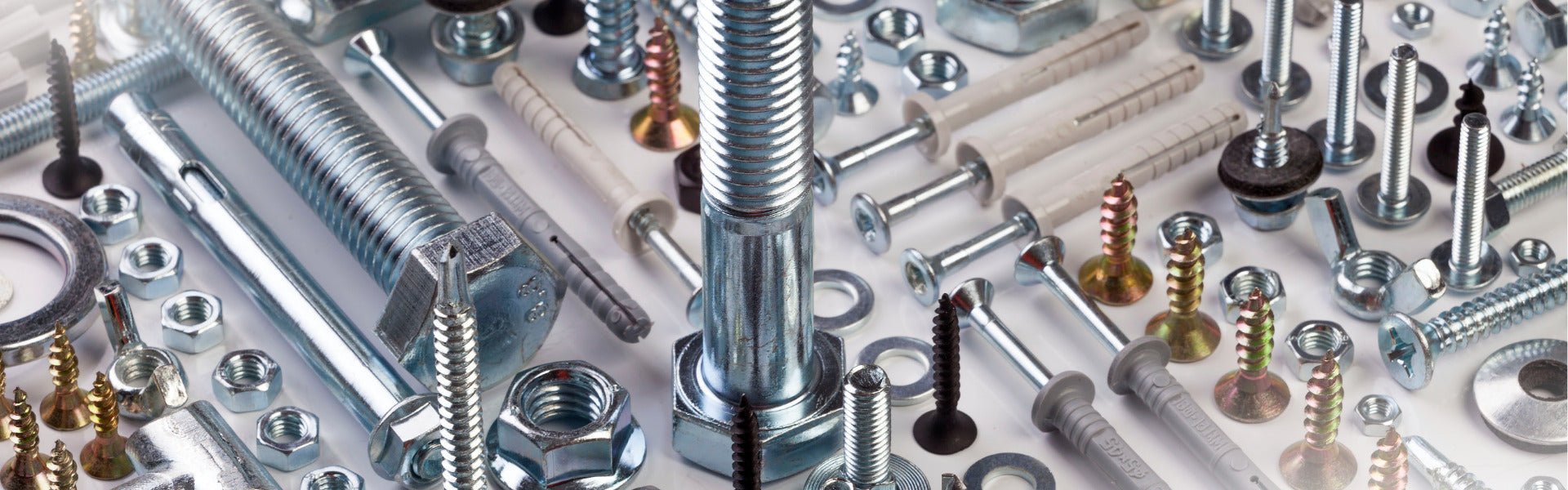
If you spend any time in a workshop, on site, or specifying parts at a desk, fasteners are one of those things you stop noticing — until the wrong one fails. This guide walks through every major fastener category in plain language, lines up the Australian Standards that apply, and points you to deep guides where you need them. Use it to orient yourself, decode a part number, or confirm you're holding the right thing before you torque it down.
Fastener Categories at a Glance
Every fastener falls into one of a handful of families. Here's the rapid-look table — what it does, where you see it, and the headline Australian Standard.
| Category | Common AU Use | Headline Standard |
|---|---|---|
| Hex bolts & set screws | Steel structures, plant, machine assembly | AS 1110 / AS 1111 (metric ISO precision & product grade hex) |
| Socket head cap screws | Tooling, jigs, hydraulic blocks, machine guards | ISO 4762 / DIN 912 |
| Nuts (hex, nyloc, castle, flange) | Mating threads on bolts and studs | AS 1112 series |
| Washers (flat, spring, Belleville) | Load spreading and anti-loosening | AS 1237 (flat), AS 1252 (HSFG assemblies) |
| Screws (self-tapping, wood, machine) | Sheet metal, timber, fixtures | AS 3566 (self-drilling Class 3/4 coatings) |
| Anchors (chemical, mechanical, dynabolt) | Concrete, masonry, brick | ETA / ICC-ES + AS 5216 (post-installed in concrete) |
| Rivets, pins, threaded rod | Sheet joining, alignment, structural ties | AS 1444 (steel), AS 2465 (precision) |
| Stainless steel fasteners | Marine, food & pharma, outdoor exposure | AS 4291 (mech properties) — A2 / A4 grades |
If you already know which family you're in, jump down. If you're staring at a fastener and not sure, the next section covers thread systems — almost every mis-buy starts there.
Thread Systems — Metric, Imperial & British
Thread system is the single most common source of fastener mistakes in Australia. We use metric on most modern equipment, but legacy plant, US machinery, and the plumbing/gas trades keep imperial and British threads alive. The four families you'll meet:
Metric (ISO 261 / ISO 262)
Standard on every new piece of locally specified equipment. Designated as M(diameter) × (pitch) — for example M10 × 1.5. If the pitch is omitted, assume the coarse default for that diameter. Fine pitches (M10 × 1.25, M12 × 1.25) exist for vibration-prone joints or thin-wall applications. Use a thread pitch gauge or a known-good companion fastener to confirm before ordering.
Unified Thread Standard (UTS) — UNC, UNF, UNEF
The US imperial system. Diameter is in inches or as a number gauge (#6, #8, #10), and pitch is expressed as threads per inch (TPI). UNC (coarse) is the default for general work; UNF (fine) shows up in automotive and aerospace; UNEF (extra fine) is niche. A 1/4-20 UNC bolt is 1/4" diameter, 20 TPI. UTS turns up on US-built machinery, older Holden/Ford gear, and a lot of imported tooling.
British threads — BSW, BSF, BSP / BSPP / BSPT, NPT
BSW (Whitworth) and BSF (Fine) are largely retired from new builds but still found on older Australian equipment, classic cars, and heritage steel. BSP is the dominant pipe thread for fluid & gas work in Australia (parallel BSPP for sealing-by-O-ring, tapered BSPT for thread-seal). NPT is the US tapered pipe thread — common on imported pneumatics and US fluid power gear. BSP and NPT look similar but are NOT interchangeable; mixing them strips threads and leaks. Full BSP vs NPT vs UNC guide.
Quick metric-to-imperial size cross-reference
For body diameter only — never a thread-matching reference. Use this when you're trying to pick a spanner or visualise sizes, not when you're sizing a replacement bolt.
| Metric (mm) | Closest imperial body | Closest UTS thread |
|---|---|---|
| M3 | 1/8" | #5-40 / #6-32 |
| M4 | 5/32" | #8-32 |
| M5 | 3/16" | #10-24 |
| M6 | 1/4" | 1/4-20 UNC |
| M8 | 5/16" | 5/16-18 UNC |
| M10 | 3/8" | 3/8-16 UNC |
| M12 | 1/2" | 1/2-13 UNC |
| M14 | 9/16" | 9/16-12 UNC |
| M16 | 5/8" | 5/8-11 UNC |
| M20 | 3/4" | 3/4-10 UNC |
| M24 | 1" | 1"-8 UNC |
For the deep cross-reference with full pitch data, tap drill sizes, and tightening info, see our Metric & Imperial Fastener Reference Guide and the Tap Drill Size Chart.
Property Classes & Grades
Property class tells you how strong the steel is — the most important factor after thread match. Mismatch a grade and you either over-engineer (waste money) or under-engineer (risk failure). Three systems are in active use in Australia.
Metric property class (ISO 898-1)
Marked on the head as a two-number code — for example 8.8, 10.9, 12.9. The first digit, multiplied by 100, gives the nominal tensile strength in MPa. The second digit, divided by 10, gives the yield-to-tensile ratio.
- 4.6 / 5.6 / 6.8 — low/medium strength. General-purpose mild steel bolts. OK for non-critical work.
- 8.8 — the workhorse of structural and mechanical work. ~800 MPa tensile, ~640 MPa yield. Galv or zinc plated. Specify for any load-bearing joint unless engineer says otherwise.
- 10.9 — high tensile. Used in structural HSFG assemblies (AS/NZS 1252), heavy machinery, automotive. Almost always plain or black, occasionally zinc.
- 12.9 — very high tensile. Socket head cap screws, hydraulic blocks, precision tooling. Brittle if mis-applied — not a "stronger 10.9", use only where specified.
If you're identifying high-tensile in the field, see How to Identify High Tensile Bolts. For torque values per grade and size, the Metric Bolt Torque Chart is the reference. Full background → Bolt Grade Chart.
Imperial — SAE J429
The US grade system uses radial slashes on the head:
- Grade 2 — no head markings. Low-carbon steel. Common in hardware-store bolts.
- Grade 5 — three radial slashes. Medium-carbon, heat-treated. Loosely equivalent to metric 8.8.
- Grade 8 — six radial slashes. Alloy steel, quenched & tempered. Loosely equivalent to metric 10.9.
SAE grades are common on imported US automotive, mining gear, and pre-2000 plant. Don't substitute SAE for metric on a thread basis — even at near-equivalent strength, the pitches don't match.
Stainless steel — ISO 3506 / AS 4291
Stainless grades are marked as a material code + property class, separated by a hyphen — for example A2-70 or A4-80.
- A2 — austenitic stainless, broadly equivalent to 304/18-8. General outdoor, marine-adjacent, food service.
- A4 — austenitic stainless with molybdenum (316). Required for marine, coastal, chloride, food & pharma.
- -70 — 700 MPa tensile, standard cold-worked. The volume product.
- -80 — 800 MPa tensile, higher cold-work. Stronger but harder to install, more galling risk.
Full guide → Stainless Steel Fastener Grades Explained. For coastal builds, marine, food & pharma, default to A4-70 (316) and use anti-galling lubricant on assembly.
Head Types
Head choice affects clamp force, tool access, appearance, and removal risk. The big ones in Australian workshops:
Hex head
The default for structural and mechanical bolts. Standard hex (AS 1110/AS 1111) accepts a spanner or socket. Easy to torque to spec, easy to remove. Specify hex unless you have a reason not to.
Socket head cap screw (SHCS)
Cylindrical head with internal hex drive. Sits flush in a counterbore, tolerates higher torque than equivalent hex (denser head material), and is the go-to for machined assemblies, hydraulic manifolds, jigs and fixtures. Almost always Grade 12.9. Full background → Socket Head Cap Screw Guide.
Button head
Low-profile dome with internal hex. Decorative, fingertip-safe, but lower clamp force than SHCS (thinner head, less material under the recess). Use where appearance matters or knuckle clearance is tight. Not for high-torque structural work.
Countersunk (CSK) — flat & raised
Tapered head designed to sit flush in a chamfered hole. Standard angles in Australia are 90° (metric ISO) and 82° (UTS imperial — common on US sheet-metal hardware). Mixing the two leaves the head proud or distorts the chamfer. Available with Phillips, slotted, Torx, or socket drives.
Pan, dome & truss
Pan head: low cylindrical sides with rounded top — the default machine-screw head. Dome (round head): higher-profile, more decorative. Truss: wide flange-style head spreading load on soft materials (sheet metal, plastics). Used widely across covers, panels, signage.
Flange head
Integrated serrated or smooth washer under the head — spreads load and resists loosening without needing a separate washer. Common on automotive, mining haul-truck, and white-goods chassis work. Once torqued, the serrations bite the substrate.
Carriage / coach bolt head
Smooth dome with a square shoulder under the head. Square shoulder bites into timber and prevents rotation while the nut is tightened from below. Old-school but unbeatable for timber framing, deck framing, gates and fencing. Full background → Coach Bolt & Coach Screw Guide.
Cup & tee head
Cup head (round head with square shank, similar to carriage) used on agricultural and trailer gear. Tee head — wide T-shape — for slot mounts and machine T-slots.
Full deep-dive across all head families → Screw Head Types Guide.
Drive Types
Drive type is how you turn the fastener. Wrong drive = stripped head and a stuck bolt. The major drives:
Hex / Allen (internal hex)
Hexagonal recess in the head, turned with an Allen key or hex bit. The default drive for socket head cap screws, button head, low-head SHCS and many grub screws. Sizing is the across-flats measurement (e.g. 5 mm hex on an M8 SHCS). Imperial Allen drives still appear on US tooling.
Torx (star, 6-lobe)
Six-lobed star recess. Higher torque transfer than hex, less cam-out than Phillips, and the security versions (Torx Plus, Torx Security with pin) are vandalism-resistant. Used widely on cars, white goods, electrical assembly. Sizes are T(number) — e.g. T25, T30. Full guide → Torx Bit Sizes Guide.
Phillips
Cross-shaped recess (PH0-PH4). Designed in the 1930s to cam out under high torque (preventing over-tightening on assembly lines). That cam-out is the trade-off — Phillips strips easier than any other modern drive. Use where the spec requires Phillips; otherwise prefer Pozidriv, Torx, or hex.
Pozidriv (PZ)
Looks like Phillips with extra fine ribs at 45° in the recess. Engages deeper, cam-outs less, transmits more torque. Common on European screws and modern self-tapping fasteners. Use a Pozidriv bit (not Phillips) — the wrong bit destroys the head.
Slotted (flat)
The original screw drive. Centring is poor, cam-out is high, and it's only specified where heritage appearance matters or where field-improvised drivers (coin, knife edge) are useful. Avoid for production work.
Square (Robertson)
Square recess. Excellent torque transfer, self-centring, common in cabinet-making and construction screws. Underused in industrial work but loved by joiners and timber-frame installers.
Combination drives
Phillips/slot, Phillips/square, Torx/hex — pick the bit that fits best. Avoid double-driving (don't alternate Phillips and slot on the same screw; you'll round both).
Nut Types
Nuts are not a commodity. The choice between hex, nyloc, castle, flange and dome decides whether the joint loosens, comes apart, or seizes. The main families:
Standard hex nuts
The default. AS 1112.1 series for ISO metric hex nuts. Match the grade to the bolt — Grade 8 nut on Grade 8.8 bolt; Grade 10 nut on 10.9; Grade 12 nut on 12.9. A weak nut on a strong bolt strips the nut threads before reaching torque spec.
Nylon insert lock nuts (Nyloc)
Hex nut with a nylon collar pressed into the top. The collar grips the bolt thread and resists vibration loosening. Use once where possible — the nylon loses grip on each reuse, and is rated to about 100-120 °C continuous (the nylon softens above that). Detailed background → Nyloc Nut Guide. AIMS carries a strong Nylon Lock Nuts range.
All-metal lock nuts (prevailing torque)
The nut thread itself is deformed or has a metal ring that grips the bolt. Higher temperature rating than Nyloc, can be reused more times, and trusted in vibration-heavy automotive and rail work.
Castle nuts
Crown-shaped slots cut into the top of a hex nut. A cotter pin (split pin) drops through a transverse hole in the bolt and through one slot, mechanically locking the nut against rotation. The default for tapered-joint applications — tie-rod ends, ball joints, axle nuts. Critical safety rule: always tighten to the next slot, never loosen back. Loosening releases the taper-seat clamping force. See stuck bolts removal guide for related rigging.
Flange nuts
Integrated wide flange under the hex. Spreads load, reduces marking on soft substrates, and the serrated variants resist loosening. Auto chassis and mining equipment.
Dome / cap / acorn nuts
Hex nut with a sealed dome over the bolt end. Finger-safe, weatherproof, decorative. Common on guardrail and trailer assemblies. The bolt has to be short enough to fit inside the dome.
Wing nuts
Two wings for hand tightening. Light-duty assemblies, clamps, fixtures requiring frequent removal.
K-lock / Kep nuts
Hex nut with a captive serrated free-spinning washer. Saves a step on assembly lines. Common on electrical and sheet-metal panel work.
Purlin / cup nuts
Roofing and cladding nuts designed for purlin connections — wide load distribution under the nut, often supplied as bolt+nut+washer assemblies. See Purlin Bolts & Nuts.
For lock nuts other than nylon, AIMS carries Hex Lock Nuts and the full Nuts range.
Washer Types
Washers are not optional decoration. They spread load, prevent thread damage to the substrate, and (in their lock variants) help resist loosening. The families:
Flat washers
Round, flat steel discs. Three common Australian patterns:
- Standard flat (AS 1237.1) — the everyday workhorse. Inside diameter sits with light clearance over the bolt thread.
- Heavy / structural (AS 1252) — thicker, larger OD. For HSFG (high-strength friction grip) structural assemblies.
- Fender / mudguard — wide OD relative to ID. Spreads load on soft or thin substrates (sheet metal, timber, plastic).
See Flat & Round Washers.
Spring washers (single-coil / DIN 127)
Split, slightly conical. Compressed under the bolt head and the edges bite into the nut and substrate. Their effectiveness against modern vibration is debated — many engineering specifications now favour Nyloc or wedge-locking systems instead. Still standard on general workshop work. Spring Washers range.
Belleville (disc / conical) washers
Dished steel discs that act as springs. Maintain clamp force as the joint relaxes, expands or compresses (thermal cycles, gaskets bedding in). Stacked in series or parallel to tune spring rate. Used widely in flanged joints, gasket-sealed assemblies, and machinery with thermal cycling.
Internal & external tooth lock washers
Teeth around the ID (internal) or OD (external) bite into the bolt head/nut and the substrate. Cheap, effective on softer substrates. Less reliable on hard surfaces (no bite). Common on electrical earthing — the teeth cut through paint and oxide to reach base metal.
Wedge-lock washers (NordLock-style)
Pairs of cam washers — radial cams between the washers, serrations on the outer faces. As the joint vibrates, the cams resist back-rotation. Trusted in mining, rail, defence. Specify when vibration is critical.
Sealing & bonded washers
Steel washer with a vulcanised rubber (EPDM, NBR, FKM) ring on one face. Seals the bolt hole against weather, fluid, gas. Standard on roofing screws, automotive sumps, and any fluid-tight bolt hole. Don't confuse with Dowty / bonded seal washers (those have the rubber bonded inside the steel washer for hydraulic port sealing).
Specialty Fasteners
Beyond the main families, a handful of specialty fasteners come up often enough to be worth knowing.
Set screws & grub screws
Headless screws with internal hex (or slotted) drive, threaded full-length. Used in shaft collars, pulleys, knobs and adjusters where the screw must sit flush or below the surface. Point styles — cup, flat, dog, cone, knurled — each suit different gripping jobs. AIMS carries a strong Grub Screws range.
Shoulder bolts (stripper bolts)
Precision-ground unthreaded shoulder section sized for a slip fit, with a smaller-diameter threaded end. Used as pivots, dowels, bearing supports, and in stamping dies. ISO 7379. Don't substitute a hex bolt and washer — the shoulder geometry is the load-bearing feature.
Anchor bolts & chemical anchors
For concrete and masonry. Mechanical anchors (dynabolts, sleeve anchors, wedge anchors) expand inside the hole as you tighten. Chemical anchors (epoxy or vinyl ester resin into a drilled hole) suit cracked concrete, edge-of-slab work, and the highest pullout loads. AS 5216 covers post-installed anchors in concrete. See the full Anchors range.
Eye bolts & U-bolts
Eye bolts: forged loop on a threaded shank — lifting points and rigging attachment. Critical safety: only use rated lifting eye bolts (forged, stamped with WLL) for overhead lifting. Hardware-grade eye bolts are NOT lifting hardware. U-bolts (U-Bolts range): two-thread U shape with mating plate. For pipe brackets, suspension fittings, and trailer leaf-spring assemblies.
Threaded rod (all-thread / studding)
Continuously threaded steel rod sold by the metre or length. Cut to size on site for hanging supports, threaded inserts, anchor stud assemblies. Plain mild steel, galvanised, 8.8, 10.9, and stainless A2/A4 grades. Range: All Thread Rod.
Rivets & rivet nuts
Permanent fastening for sheet metal where you can only access one side (blind rivets), or where lower-cost mass assembly matters (solid rivets). Rivet nuts (rivnuts) install a permanent threaded insert into thin sheet. Full Rivets range.
Pins — clevis, dowel, roll, cotter
Clevis pins (with head and cross-hole, secured by a split pin) form pinned joints — rigging, linkages, agricultural gear. Dowel pins (precision-ground cylinders) align mated parts in tooling and machine assembly. Roll pins (spring pins) — cylindrical pins formed from spring steel, installed into a tight bore. Cotter / split pins secure castle nuts and clevis pins.
Australian Standards Quick Reference
The fastener standards you're most likely to meet on a drawing, in a spec, or on a certificate of conformance. currency of edition years before quoting in a formal compliance document.
| Standard | Covers |
|---|---|
| AS 1110 / AS 1110.1 / AS 1110.2 | ISO metric hexagon precision bolts & screws (Grades A & B) |
| AS 1111 / AS 1111.1 / AS 1111.2 | ISO metric hexagon product grade C bolts & screws |
| AS 1112.1–1112.4 | ISO metric hexagon nuts (style 1, style 2, thin, chamfered) |
| AS 1252 | HSFG bolts, nuts & washers for structural steel — Grade 8.8/S |
| AS 1237 series | Plain washers for metric bolts, screws & nuts |
| AS 2465 | Unified hexagon bolts, screws & nuts (UNC/UNF — imperial) |
| AS 3566 | Self-drilling screws for the building & construction industries (Class 3 / Class 4 corrosion) |
| AS 4291.1 | Mechanical properties of corrosion-resistant stainless steel fasteners (A1/A2/A3/A4) |
| AS 5216 | Design of post-installed and cast-in fastenings for use in concrete |
| ISO 898-1 | Mechanical properties of fasteners — Grade 4.6 through 12.9 |
| ISO 3506 | Mechanical properties of stainless steel fasteners — A2, A4, etc. |
| ISO 4762 / DIN 912 | Socket head cap screws (SHCS) |
| DIN 985 | Prevailing torque type hex nuts with non-metallic insert (Nyloc) |
Selection Quick Rules
Thread match comes first
Never mix metric and imperial threads. The pitches don't match, and you'll either cross-thread (visible damage) or get a few turns of false engagement before the joint fails under load. If you can't read the markings, use a thread pitch gauge — every workshop should have one. Match coarse to coarse and fine to fine within the same system.
Match grade across the joint
The nut grade must match or exceed the bolt grade. Mismatched grades are one of the most common preventable failures — a Grade 6 nut on a Grade 10.9 bolt will strip its threads well below the bolt's rated torque.
Torque to spec, not by feel
Tightening "until it feels right" overloads small fasteners and under-loads large ones. Use the Metric Bolt Torque Chart as your reference. Wet/dry/lubricated torque values are not the same — read the spec carefully.
Match the corrosion environment
Indoor, dry, climate-controlled: zinc or plain finish is fine. Outdoor, exposed to weather, coastal: galvanised or stainless A2 minimum. Marine, splash zone, food & pharma: stainless A4 (316) and anti-galling lube on assembly. Mixing dissimilar metals (steel bolt in aluminium plate, untreated) causes galvanic corrosion — use a barrier or matched-material fastener.
Plan for re-use (or don't)
Nyloc nuts: ideally single-use. Critical structural fasteners (HSFG, head studs, suspension): always replace per OEM spec. Adhesive thread locker (Loctite): clean off old residue with primer before re-applying. If a joint comes apart and the threads look polished or burred, replace the fastener.
Tooling matters
A good caliper measures bolt diameter and head. A thread pitch gauge confirms pitch. A torque wrench (calibrated, in date) delivers spec torque. Spending five extra minutes with the right tool prevents an hour fixing a stripped joint.
AIMS' Note on Fastener Sourcing
AIMS stocks the volume range across Hobson, Bremick, Bumax, Sutton, Inox World and other Australian-trusted brands — see the full Fasteners range, or jump into a specific family: Bolts, Nuts, Washers, Screws, Anchors, Rivets, All Thread Rod.
For volume runs, custom sizes, certified material (mill certs, hot-dip galv to AS/NZS 4680), or anything you can't find on-site, give us a call. When you ring, having the following handy speeds the quote: thread system + diameter + pitch + length, grade or material, head type, finish/coating, quantity required, and the application. If it's a replacement, the part number off the old fastener (or a clear photo of the head markings) is often enough.
For broader Australian-made and stocked-in-AU brands: Hobson (full range), Bremick, Bumax (high-tensile stainless), Inox World, Sutton Tools (cutting/threading consumables).
Frequently Asked Questions
What's the difference between a bolt and a screw?
In Australian practice, a bolt is designed to pass through a clearance hole and be secured by a nut on the far side. A screw threads directly into a mating threaded hole (tapped material or female thread). Many fasteners blur the line — socket head cap screws are technically screws by this rule even when used like bolts. Use the manufacturer's terminology if certifying to a spec.
How do I tell metric from imperial without a thread gauge?
Look at the head markings. Metric uses property class digits like 8.8 or 10.9. Imperial SAE uses radial slashes (Grade 5 = three slashes, Grade 8 = six). If the diameter is a clean millimetre value (M6, M8, M10) it's metric; if it's a fractional inch (1/4", 3/8", 1/2") or a # number (#8, #10), it's imperial. A thread pitch gauge resolves any doubt in 10 seconds and costs less than one mis-bought box of bolts.
Can I use a Grade 12.9 bolt anywhere I'd use a Grade 8.8?
Not safely as a blanket rule. 12.9 is harder and more brittle than 8.8 — it can fail suddenly under shock loads or in corrosive environments (hydrogen embrittlement risk is higher). 12.9 is specified by design where its strength is needed in compression-clamped joints with controlled torque. For general structural and mechanical work, 8.8 is the engineered choice — substitute up only with engineering sign-off.
What's the maximum service temperature for a Nyloc nut?
The nylon insert is rated for about 100-120 °C continuous service. Above that the nylon softens and loses grip, and the locking function fails. For higher-temp service use all-metal prevailing torque lock nuts, castle nuts with split pins, or wedge-lock washers. Full background → Nyloc Nut Guide. manufacturer-specific upper limits before high-temp service.
When do I need stainless A4 vs A2?
A4 (316 grade, with molybdenum) for marine exposure, coastal builds within ~1 km of breaking surf, chloride-rich industrial environments, food & pharma. A2 (304-equivalent) for general outdoor in low-chloride environments and indoor wet areas. If in doubt and you're within sight of the ocean, specify A4 — the upcharge is small against the cost of replacing rusted fasteners later.
Why does my Phillips bit keep stripping screws?
Phillips was designed to cam out — that's the original feature, not a defect. The trade-off is poor tolerance for misalignment, worn bits, and over-torque. Three fixes: (1) use a fresh bit, (2) press firmly into the screw and torque slowly, (3) where the spec allows, switch to Pozidriv, Torx, or hex drive. See the Torx Bit Sizes Guide.
What thread is BSP, and is it the same as NPT?
BSP (British Standard Pipe) is the dominant Australian pipe and fluid thread. It comes in BSPP (parallel — sealed by an O-ring or bonded seal washer at a port face) and BSPT (tapered — sealed by the thread itself, usually with PTFE tape or thread compound). NPT is the US tapered pipe thread. BSP and NPT have different thread angles (55° vs 60°) and different taper rates — they do not interchange. Mixing them strips threads and leaks fluid or gas. Full background → BSP vs NPT vs UNC Guide.
How tight is "tight enough" for a bolt?
Use a torque wrench and the Metric Bolt Torque Chart for the grade, diameter, and condition (dry, lubricated). Critical joints — structural, suspension, head studs, pressure-containing — should always be torqued to spec, not by feel. For non-critical assembly work, a calibrated torque wrench used at 70-80% of recommended dry torque is a safe default.
Why does my flat washer keep loosening even with a spring washer underneath?
Modern engineering research has shown that DIN 127 single-coil spring washers are not very effective against high-frequency vibration. They flatten under torque and provide minimal anti-rotation force. For real vibration resistance, use Nyloc nuts, wedge-lock washers (NordLock-style), or thread-locking adhesive (Loctite 243 medium-strength, 263 high-strength). A flat washer alone, correctly torqued, often outperforms a flat-plus-spring combination on a properly tensioned joint.
What's the difference between coach screws and coach bolts?
Coach bolts (also called carriage bolts) have a smooth domed head with a square shoulder under the head; the shaft is threaded only on the lower portion and is used with a nut on the far side. Coach screws (also called lag screws or lag bolts) have a hex head and a tapered wood-screw thread for direct driving into timber — no nut. Both are timber-framing fasteners. Full background → Coach Bolt & Coach Screw Guide.
Are Australian fastener standards different from the rest of the world?
AS standards are largely aligned with ISO and DIN equivalents — for example AS 1110 maps to ISO 4014. The Australian-specific standards mainly cover hot-dip galvanised coatings (AS/NZS 4680), structural HSFG assemblies (AS 1252), and self-drilling screws for the Australian climate (AS 3566 Class 3/Class 4). Imported fasteners marked to ISO or DIN are generally compatible with AS-specified work, but a certificate of conformance or mill certificate is the safe document when audit risk applies.
How do I get a stuck or seized bolt out?
The escalation ladder runs from heat + penetrant (CRC 5.56, WD-40, Loctite Freeze & Release) through impact (impact driver, breaker bar) to thread-rescue (extractor bits, left-hand drill bits) to last-resort (cut and replace). The full procedure is in the stuck bolts & nuts guide.
What's the right anchor for fixing into concrete?
Light load, non-cracked concrete: dynabolt or sleeve anchor. Medium load, cracked concrete possible: through-bolt or wedge anchor rated for cracked concrete. High load, edge-of-slab, or vibration: chemical anchor (epoxy or vinyl ester) with threaded rod. AS 5216 is the design standard. AIMS carries the full Anchors range — call us if you need help matching anchor to substrate.
What head and drive should I use for outdoor timber decking?
Stainless A2-70 (or A4-70 if coastal) self-drilling Type 17 screws to AS 3566 Class 3 (or Class 4 for severe marine) — Pozidriv or square drive, countersunk head with ribbed underhead to flush-finish into hardwood. For structural timber connections (joists, bearers, ledgers), coach screws or coach bolts (galvanised or stainless) sized per AS 1684 timber framing.
What's an A2-70 marking telling me?
A2 = austenitic stainless steel (broadly 304-grade equivalent, 18% chromium / 8% nickel). 70 = property class 700 MPa nominal tensile strength, cold-worked to standard hardness. For tougher applications use A2-80 (cold-worked harder, 800 MPa) — same material, higher work-hardening. For chloride / marine exposure, step up to A4-70 (316 with molybdenum). Full guide → Stainless Steel Fasteners.

